Cracking a skill-specific interview, like one for Torching, requires understanding the nuances of the role. In this blog, we present the questions you’re most likely to encounter, along with insights into how to answer them effectively. Let’s ensure you’re ready to make a strong impression.
Questions Asked in Torching Interview
Q 1. Describe the different types of torches and their applications.
Torches come in various types, each suited for specific applications. The choice depends on the fuel source, flame temperature needed, and the material being worked on.
- Acetylene Torches: These use acetylene and oxygen, producing a very hot flame (up to 3000°C), ideal for welding and cutting steel and other ferrous metals. Think of constructing a metal framework for a building – acetylene torches are crucial for joining those steel beams.
- Propane Torches: Using propane and oxygen or just propane, these produce a less intense flame (around 1900°C), suitable for brazing, soldering, and heating smaller components. They’re commonly used by plumbers or jewelry makers.
- MAPP Gas Torches: MAPP gas (methylacetylene-propadiene-propane) provides a flame hotter than propane but cooler than acetylene, making it versatile for various applications. A good middle ground between propane and acetylene in terms of heat and usability.
- Hydrogen Torches: Employing hydrogen and oxygen, these offer a very high-temperature flame, used in specialized welding and glassblowing. Think of delicate glass sculptures or scientific apparatus requiring precise control of extremely high temperatures.
- Butane Torches: These small, portable torches use butane fuel and produce a relatively cool flame, perfect for lighter jobs like softening plastics or igniting pilot lights. The type you’ll find in most hardware stores.
Q 2. Explain the safety precautions necessary when operating a torch.
Safety is paramount when using torches. A single lapse in judgment can lead to severe burns or fires.
- Proper Ventilation: Always work in a well-ventilated area to avoid inhaling combustion byproducts. Carbon monoxide poisoning is a real risk.
- Protective Gear: Wear appropriate safety glasses or a face shield to protect your eyes from sparks and UV radiation. Gloves and flame-resistant clothing are also essential to prevent burns.
- Fire Safety: Keep a fire extinguisher nearby and be aware of flammable materials in the vicinity. Never leave a lit torch unattended.
- Gas Cylinder Handling: Handle gas cylinders with care, keeping them upright and away from heat sources. Use proper regulators to control gas flow.
- Proper Training: Ensure you have received adequate training before operating any type of torch. Understand the equipment and the potential hazards.
For example, I once saw a colleague suffer a minor burn because they weren’t wearing gloves. It was a reminder that even experienced professionals need to stay vigilant.
Q 3. What are the various gases used in torch operations and their properties?
Different gases have distinct properties that impact flame characteristics and applications.
- Acetylene (C2H2): Highly flammable and produces the hottest flame of commonly used gases. It’s reactive and needs special care in handling and storage.
- Oxygen (O2): A supporter of combustion; essential for generating the high temperatures needed in welding and cutting.
- Propane (C3H8): A relatively safe and readily available fuel gas, producing a moderate flame temperature.
- MAPP Gas: A blend of hydrocarbons, offering a higher flame temperature than propane but lower than acetylene.
- Hydrogen (H2): Extremely flammable and light, produces a very hot flame with a relatively narrow cone. Requires specialized equipment and safety precautions.
- Butane (C4H10): Similar to propane, but with a slightly lower flame temperature, used in smaller, portable torches.
Q 4. How do you adjust the flame for different applications?
Flame adjustment is crucial for optimal results. It typically involves controlling the fuel and oxygen mixture.
A neutral flame, preferred for most applications, has a clearly defined inner cone surrounded by a lighter outer flame. Too much fuel creates a reducing flame that is yellow and smoky, depositing carbon on the workpiece. Too much oxygen results in an oxidizing flame, which is very hot but can burn or damage the material. Adjusting the fuel and oxygen valves on the torch allows you to control the flame’s character and temperature. The specific process varies slightly depending on the type of torch, but the basic principles remain the same.
For instance, when brazing, a slightly oxidizing flame might be preferred to prevent excessive soot, while a neutral flame might be best for soldering to prevent material damage.
Q 5. Describe the process of brazing using a torch.
Brazing involves joining metal pieces using a filler metal that melts at a temperature lower than the base metals. A torch is used to heat the base metals to a temperature sufficient to melt the brazing alloy, allowing it to flow and create a strong joint.
- Clean the surfaces of the metals to be joined, ensuring they are free from oxides or contaminants.
- Apply the brazing alloy (typically a rod or wire) to the joint.
- Use the torch to heat the base metals near the joint, not directly on the brazing alloy.
- The heat will cause the brazing alloy to melt and flow into the joint by capillary action, filling the gap between the two pieces.
- Allow the joint to cool slowly, ensuring a strong and durable bond.
For example, brazing is commonly used in bicycle frame construction and in the creation of intricate metal jewelry.
Q 6. Explain the process of soldering using a torch.
Soldering is similar to brazing, but uses a filler metal with a lower melting point. It is suitable for joining thinner materials and produces a weaker joint compared to brazing. A torch, often propane or butane, is used to melt the solder.
- Clean the surfaces of the metals to be joined.
- Apply flux to the joint to prevent oxidation and improve solder flow.
- Apply the solder to the joint.
- Use the torch to carefully heat the metals, causing the solder to melt and flow into the joint.
- Allow the joint to cool.
Soldering is widely used in electronics and plumbing applications. For instance, soldering electronic components onto circuit boards is a crucial step in manufacturing electronic devices.
Q 7. How do you prevent overheating of the workpiece during torching?
Overheating can damage or warp the workpiece, leading to unsatisfactory results. Here’s how to prevent it:
- Use the correct flame size and temperature: Adjust the flame to be appropriate for the material and the task at hand. A smaller flame focused on the joint prevents excess heat spreading to other areas.
- Avoid prolonged heating in one area: Constantly move the flame to distribute the heat evenly. Concentrating heat on a single point for too long will cause local overheating.
- Use a heat sink: For delicate components or those prone to warping, apply a heat sink (e.g., a copper block or wet cloth) to the areas you wish to keep cool.
- Pre-heating the workpiece: Sometimes, pre-heating the entire component to a relatively low temperature reduces the risk of warping and cracking during localized heating with the torch.
- Intermittent heating and cooling: Heat and then let the piece cool momentarily before reheating, allowing heat to dissipate preventing overheating.
For example, when soldering delicate electronic components, applying a heat sink to the circuit board near the component helps to prevent overheating and damage to sensitive components.
Q 8. What are the signs of a poorly adjusted torch flame?
A poorly adjusted torch flame is like a poorly tuned engine – it won’t perform optimally and can even cause damage. Signs include a yellow, smoky flame instead of a sharp, blue cone; a flame that’s too long or too short; an uneven flame with flickering or sputtering; and excessive noise, such as hissing or roaring. A yellow flame indicates incomplete combustion, resulting in lower heat output and the production of soot which can contaminate your work. An improperly sized flame can lead to inconsistent heating or even melt-through in unintended areas. For example, a flame that’s too short might not provide enough heat for brazing, while a flame that’s too long can lead to overheating and warping of the metal.
Q 9. How do you maintain and clean a torch?
Maintaining and cleaning your torch is crucial for its longevity and your safety. After each use, allow the torch to cool completely. Then, carefully remove the tip and clean it using a wire brush to remove any debris or carbon buildup. Inspect the tip for any damage, such as cracks or warping. If it’s damaged, it needs to be replaced to maintain consistent flame characteristics. Regularly check the gas hoses for cracks, kinks, or leaks. A soapy water solution applied to the connections will show bubbles if a leak is present. Finally, store the torch in a dry, safe place to protect it from damage and moisture.
Q 10. Describe the different types of metals that can be torched.
Various metals can be worked with a torch, each requiring specific techniques and flame adjustments. Common metals include:
- Steel: A versatile metal frequently used in construction and fabrication. Requires careful control to avoid overheating and warping.
- Aluminum: A lightweight metal known for its corrosion resistance. Requires a high-temperature flame and rapid heating to prevent cracking.
- Copper: Highly conductive and used in plumbing and electrical work. Melts relatively easily, so precise flame control is necessary.
- Brass: A copper-zinc alloy with good machinability and corrosion resistance. Similar to copper in its torching requirements.
- Bronze: Another copper alloy, often stronger and more durable than brass. Requires a slightly hotter flame than brass.
Q 11. Explain the importance of preheating in some torching applications.
Preheating is essential in many torching applications to ensure a uniform and controlled heating process. It prevents thermal shock, which can cause cracking or warping in the metal. For instance, when brazing, preheating the base metal reduces the temperature differential between the filler metal and the base metal, leading to a stronger, more reliable joint. Think of it like slowly heating a pot on the stove versus placing it directly over a very hot flame—the gradual heating prevents cracking. The specific preheating temperature depends on the type and thickness of the metal being worked; thicker metals require longer preheating times. The goal is to bring the metal to a uniform temperature before applying the torch for brazing or soldering.
Q 12. How do you identify and address common torch problems?
Troubleshooting torch problems requires a systematic approach.
- No flame: Check gas supply, ensure the gas is turned on at the tank and regulator, check for leaks in the hoses, and ensure the tip is clean and correctly attached.
- Weak flame: Check the gas pressure, clean or replace the tip, ensure sufficient gas flow.
- Yellow flame: Adjust the gas mixture, ensure proper ventilation, the tip may be dirty or clogged.
- Uneven flame: Clean the tip, check for obstructions, adjust the gas mixture.
Q 13. What are the different types of tips used in torching and when would you use each?
Different torch tips are designed for specific applications, providing varied flame sizes and heat intensities.
- Small tips: Ideal for delicate work like soldering small components or jewelry making. They produce a smaller, more concentrated flame.
- Medium tips: Versatile and suitable for a range of applications, including brazing and light welding.
- Large tips: Used for heavy-duty work like welding thicker metals or cutting. They deliver a larger, more powerful flame.
- Cutting tips: Specifically designed for cutting metal; they produce a high-velocity, oxygen-enriched flame that melts and blows away the metal.
Q 14. Describe the process of cutting metal using a torch.
Cutting metal with a torch, also known as oxy-fuel cutting, involves using a high-velocity jet of oxygen to burn through the metal. The process starts by preheating the metal with a neutral flame to bring it to its ignition temperature. Once the metal is hot enough, the oxygen jet is introduced, creating an exothermic reaction that rapidly oxidizes and melts the metal. The molten metal is then blown away by the high-velocity oxygen stream, leaving a clean cut. This is a common method used in metal fabrication and demolition; the thickness of the metal dictates the size of the torch tip and the amount of preheating required. Safety is paramount in this process: always use appropriate protective gear, including eye protection and gloves, and follow proper safety procedures for handling oxygen and fuel gases.
Q 15. Explain the safety procedures for handling compressed gases.
Handling compressed gases requires meticulous adherence to safety protocols. Think of these gases as powerful, potentially dangerous tools; respect demands caution. The key is preventing leaks, explosions, and fires.
Secure Storage: Cylinders should be stored upright, chained or secured to prevent tipping, and away from heat sources, direct sunlight, and ignition sources. Imagine a domino effect – one cylinder falling could trigger a chain reaction.
Proper Handling: Always use a hand truck or cart to move cylinders, never roll them. Avoid dragging or dropping them. Remember, damage can weaken the cylinder and lead to failure.
Leak Detection: Regularly inspect cylinders and connections for leaks using a leak detection solution. The hissing sound is a clear indicator, and soap bubbles will visibly show leaks.
Ventilation: Ensure adequate ventilation in the work area. Many compressed gases are heavier than air and can accumulate in low-lying areas, displacing oxygen and creating a hazardous environment.
Protective Equipment: Wear appropriate personal protective equipment (PPE), including safety glasses, gloves, and a face shield, especially when dealing with potentially hazardous gases.
Emergency Procedures: Be familiar with the emergency procedures and know the location of safety equipment, including fire extinguishers.
Career Expert Tips:
- Ace those interviews! Prepare effectively by reviewing the Top 50 Most Common Interview Questions on ResumeGemini.
- Navigate your job search with confidence! Explore a wide range of Career Tips on ResumeGemini. Learn about common challenges and recommendations to overcome them.
- Craft the perfect resume! Master the Art of Resume Writing with ResumeGemini’s guide. Showcase your unique qualifications and achievements effectively.
- Don’t miss out on holiday savings! Build your dream resume with ResumeGemini’s ATS optimized templates.
Q 16. How do you handle emergency situations during torching operations?
Emergency situations during torching demand swift, decisive action. Preparation and training are paramount. Think of it like a fire drill – the more you practice, the better prepared you are for the real thing.
Fire: If a fire starts, immediately turn off the torch and use the appropriate fire extinguisher (usually a dry chemical or CO2 extinguisher). If the fire is too large or out of control, evacuate the area and call emergency services.
Burns: Immediately cool the burn with cool (not ice-cold) running water for at least 20 minutes. Remove any clothing or jewelry from the burn area. Seek medical attention.
Gas Leaks: Immediately shut off the gas supply. Ventilate the area. Do not attempt to ignite the leaked gas. If the leak is significant or cannot be easily contained, evacuate the area and call for professional assistance.
Eye Injuries: Immediately flush the affected eye(s) with plenty of clean water for at least 15 minutes. Seek medical attention.
Regular safety training and drills are crucial for effective emergency response. Remember, your safety and the safety of those around you is the top priority.
Q 17. What are the various types of thermal spraying processes?
Thermal spraying encompasses various processes used to deposit a coating onto a substrate. Imagine it like painting, but with molten materials instead of paint.
Flame Spraying: Uses a flame to melt the coating material, which is then propelled onto the substrate using compressed air. It’s like a high-temperature paint sprayer.
Plasma Spraying: Uses a high-velocity plasma jet to melt and propel the coating material. This allows for higher temperatures and more precise control.
High-Velocity Oxy-Fuel (HVOF) Spraying: This method uses a high-velocity jet of hot combustion gases to propel the coating material. It results in denser and more wear-resistant coatings.
Wire Arc Spraying: An electric arc melts the wire feedstock, which is then sprayed onto the substrate with compressed air. This is a cost-effective technique for larger applications.
Detonation Gun Spraying: This method uses a series of small explosions to propel the coating particles onto the substrate. It offers excellent coating quality.
The choice of process depends on factors like the material being coated, the desired coating properties, and budget constraints.
Q 18. Explain the difference between brazing and welding.
Brazing and welding are both joining processes that utilize heat, but they differ significantly in the melting points involved and the resulting joint strength. Imagine welding as fusing two pieces of metal together, while brazing is more like soldering metal together.
Welding: The base metals are melted and fused together, forming a homogeneous joint. The strength of the weld approaches or even surpasses the strength of the base metal itself.
Brazing: A filler metal with a lower melting point than the base metals is melted and drawn into the joint by capillary action. The base metals do not melt. The joint strength is typically lower than that of a weld.
In essence, welding creates a stronger, more permanent bond, while brazing provides a strong, yet more easily disassembled bond. The choice depends on the application’s strength and disassembly requirements.
Q 19. Describe your experience with different types of torch fuels.
My experience encompasses a wide range of torch fuels, each with unique properties and applications. Selecting the right fuel is critical for optimal performance and safety.
Acetylene: Provides a high-temperature flame, ideal for welding and cutting most metals. It’s versatile but requires specialized precautions due to its flammability.
Propane: A lower-cost option with a somewhat lower flame temperature. Suitable for lighter-duty applications like brazing or heating.
MAPP Gas (Methylacetylene-Propadiene-Propane): Offers a flame temperature between acetylene and propane, balancing cost and performance. A popular choice for various applications.
Natural Gas: Readily available and relatively inexpensive, but its flame temperature is lower than acetylene or MAPP gas. Best suited for specific heating tasks.
Each fuel has its safety considerations. For instance, acetylene requires specific regulators and hoses to prevent decomposition. Proper training and familiarity with each fuel are essential for safe and effective use.
Q 20. How do you ensure quality control in torching operations?
Quality control in torching operations is essential to ensure the integrity and reliability of the final product. It’s like baking a cake; following the recipe carefully results in a better outcome.
Material Selection: Verifying the correct base materials and filler metals are used is fundamental. Incorrect materials can lead to brittle or weak joints.
Surface Preparation: Cleanliness of the surfaces being joined is critical. Contamination can weaken the joint and prevent proper fusion or bonding.
Process Parameters: Maintaining consistent torch settings (flame size, preheat temperature, etc.) is crucial. Variations can lead to inconsistent joint quality.
Visual Inspection: Careful visual inspection of the completed joint is crucial to detect any imperfections or defects like porosity or cracks.
Non-Destructive Testing (NDT): For critical applications, NDT methods such as radiography or ultrasonic testing can reveal internal flaws.
Documentation: Meticulous record keeping of materials used, procedures followed, and inspection results is crucial for traceability and quality assurance.
A robust quality control system ensures consistently high-quality workmanship and prevents costly rework or failures.
Q 21. Explain the importance of proper ventilation during torching.
Proper ventilation during torching is paramount for both safety and productivity. The fumes and gases generated during torching can be toxic and pose serious health risks. Imagine working in a poorly ventilated space – you’d quickly become uncomfortable and potentially ill.
Toxicity: Many gases produced during torching, such as carbon monoxide, are highly toxic. Adequate ventilation ensures these gases are diluted and removed from the breathing zone.
Oxygen Depletion: Some processes consume large amounts of oxygen, potentially creating an oxygen-deficient environment. Proper ventilation ensures a safe oxygen level.
Health Risks: Exposure to combustion byproducts, including metal fumes, can lead to respiratory problems or other health issues.
Heat Stress: Torching generates significant heat. Proper ventilation helps dissipate this heat, preventing heat stress and discomfort among workers.
Ventilation systems should be designed to remove fumes and gases effectively, ensuring a safe and comfortable working environment. Local exhaust ventilation is particularly beneficial for focusing on the immediate vicinity of the torching operation.
Q 22. What are the environmental concerns associated with torching?
Torching, while efficient for many processes, carries significant environmental concerns primarily due to the emission of pollutants. The most significant is the release of combustion byproducts, including greenhouse gases like carbon dioxide (CO2) and methane (CH4), contributing to climate change. Incomplete combustion can also generate harmful particulate matter (PM), including soot and unburnt hydrocarbons, which negatively impact air quality and human health. Furthermore, depending on the materials being torched, toxic gases like carbon monoxide (CO), nitrogen oxides (NOx), and sulfur dioxide (SO2) can be released, leading to acid rain and other environmental damage. The intensity of these emissions varies greatly based on factors such as the type of fuel used (e.g., propane, acetylene), the efficiency of the torch, and the materials being processed. Minimizing environmental impact requires using efficient torches, employing proper ventilation, and potentially investing in emission control technologies.
For example, in a large-scale refinery, improper torch operation can lead to significant NOx emissions impacting surrounding communities. Implementing best practices, regular maintenance, and employing advanced combustion techniques are crucial to mitigating these environmental concerns.
Q 23. Describe your experience with different types of torch regulators.
My experience encompasses a wide range of torch regulators, from simple, single-stage regulators for smaller applications to sophisticated, multi-stage regulators for high-pressure, high-volume operations. I’ve worked extensively with regulators designed for different fuel types – acetylene, propane, natural gas – each requiring specific pressure control mechanisms. Single-stage regulators offer a simple, direct pressure reduction, often suitable for hobbyist or smaller-scale projects. However, multi-stage regulators provide finer control and greater stability of output pressure, making them essential for precise, high-precision applications where consistent flame characteristics are paramount. I’m also familiar with regulators equipped with safety features such as pressure relief valves and gauges that monitor both input and output pressures, minimizing risks of over-pressurization and ensuring operator safety. One project involved troubleshooting a malfunctioning regulator on a large industrial torch system; the problem traced back to a faulty pressure relief valve that needed replacement.
The selection of the appropriate regulator heavily depends on the specific application. High-precision welding requires a multi-stage regulator offering fine pressure adjustments while a basic cutting task might only need a simple, single-stage device. A good regulator is critical for safe and efficient torching; it’s the ‘governor’ of the system, making sure the fuel flow remains safe and consistent.
Q 24. How do you ensure the safety of yourself and others during torching operations?
Safety is paramount in all torching operations. My approach is based on a multi-layered strategy incorporating risk assessment, proper equipment, and rigorous adherence to safety protocols. Before commencing any work, a thorough risk assessment is performed to identify potential hazards such as fire risks, gas leaks, and burns. This is followed by the selection of appropriate personal protective equipment (PPE), including flame-resistant clothing, safety glasses with side shields, and heat-resistant gloves. The work area must be properly ventilated to prevent the buildup of harmful gases. Cylinders containing fuel gases are secured and handled according to safety regulations, always keeping them upright and away from ignition sources. The torch and regulator are carefully inspected before use to ensure they are in good working order. Regular maintenance is essential to avoid malfunctioning equipment. During the torching process, I maintain a safe distance from the flame and ensure there are no flammable materials nearby. Finally, after completing the work, all equipment is inspected, cleaned, and stored safely.
For instance, during a recent project involving cutting steel beams, I ensured a fire extinguisher and appropriate personnel were present. A designated fire watch was also in place to quickly respond to any unexpected incidents. Regular checks of the torch and cylinder pressure gauges further added a critical layer of safety to the procedure.
Q 25. How do you interpret and follow technical drawings related to torching?
Interpreting and following technical drawings is crucial for accurate and efficient torching. My approach involves a systematic review of the drawing, starting with understanding the overall project scope and objectives. I carefully examine the dimensions, material specifications, and joint designs. I pay close attention to symbols and annotations indicating specific torch settings, such as flame type (neutral, oxidizing, reducing), and torch angle. Often, drawings will also specify preheating requirements or specific joint preparation techniques. Once the drawing is fully understood, I create a step-by-step plan that details the procedures, ensuring that all necessary safety precautions are implemented. I verify my understanding with supervisors or engineers before commencing any work.
For example, a recent project involved using technical drawings to guide the torching of intricate pipe joints. The drawings specified precise angles and distances for torch application to ensure that the joints were perfectly aligned and sealed. Attention to detail from the drawing interpretation was essential for a successful, safe and efficient project.
Q 26. Explain your understanding of different joint designs for torch applications.
Joint design is critical for the success of any torching application. The choice of joint design depends on several factors, including the materials being joined, the strength required, and the desired aesthetics. Common joint designs include butt joints, lap joints, tee joints, and corner joints. Each design has its own set of strengths and weaknesses. For instance, butt joints are simple but require precise alignment, while lap joints offer higher strength but might not be suitable for all applications. Tee and corner joints offer solutions for specific configurations. Before torching, appropriate joint preparation is crucial. This can include cleaning, beveling, or fitting the parts according to the specific requirements of the design and material specifications. The choice of filler material (if any) also impacts the final strength and appearance of the joint.
For instance, in a project involving the construction of a stainless steel framework, butt joints were chosen for their clean aesthetic but meticulous preparation and torch manipulation were crucial to ensure a robust, leak-free connection.
Q 27. Describe your experience with automated or robotic torching systems.
My experience with automated and robotic torching systems is primarily in the context of large-scale industrial applications. These systems offer increased precision, repeatability, and productivity compared to manual torching. I have worked with systems employing CNC (Computer Numerical Control) programming to guide the torch along pre-defined paths. These systems typically incorporate sensors to monitor the process, ensuring consistent results and automatically adjusting parameters as needed. Robotic arms are often used for manipulating the torch, particularly in situations requiring intricate movements or access to confined spaces. The benefits are significant, including reduced labor costs, improved quality, and enhanced safety. However, programming, maintenance, and system integration require specialized skills. Troubleshooting system failures, including sensor malfunction or software glitches, requires a good understanding of both mechanical and software aspects.
One instance involved working with a robotic torching system in a shipbuilding facility. The system was used for automated cutting and welding of large steel plates, resulting in significant improvements in productivity and reduced weld defects compared to manual methods.
Q 28. How do you troubleshoot and repair common issues with torch equipment?
Troubleshooting and repairing torch equipment requires a systematic and methodical approach. I begin by identifying the specific problem, noting any unusual sounds, smells, or visual indicators. Common issues include gas leaks, faulty regulators, clogged nozzles, or ignition problems. A visual inspection of all components, including hoses, connections, and the torch head itself, is the first step. I use leak detection solutions like soapy water to identify gas leaks. For regulator problems, I check pressure gauges and look for signs of damage or malfunction. Clogged nozzles usually require cleaning or replacement. Ignition problems often stem from faulty igniters or low gas pressure. If the problem is not readily apparent, I consult the equipment’s maintenance manuals and schematics to guide the troubleshooting process. Safety is paramount – all gas supplies are turned off before any major repairs are attempted.
For example, I recently diagnosed a torch that wouldn’t ignite. A thorough inspection revealed a faulty igniter; replacement quickly solved the problem. Another time, a persistent gas leak was traced to a damaged hose; prompt replacement prevented a potentially dangerous situation.
Key Topics to Learn for Torching Interview
- Fundamentals of Torching Techniques: Understanding different torch types, fuel sources, and safety procedures is crucial. Mastering the basics ensures a solid foundation for more advanced applications.
- Material Science and its Relation to Torching: Explore how different materials react to heat and flame. This knowledge is essential for choosing the right techniques for various applications, ensuring quality and avoiding damage.
- Practical Applications in Various Industries: Research how torching is utilized in fields like manufacturing, construction, and repair. Understanding real-world applications will help you connect theoretical knowledge with practical scenarios.
- Troubleshooting and Problem-Solving: Familiarize yourself with common issues encountered during torching processes and develop effective troubleshooting strategies. Demonstrating problem-solving skills is key.
- Safety Regulations and Best Practices: Thorough understanding of safety protocols and adherence to best practices is paramount in this field. Highlighting your commitment to safety will impress potential employers.
- Advanced Torching Techniques: Explore specialized techniques like brazing, soldering, and welding, depending on the specific role requirements. Demonstrating proficiency in these areas can give you a competitive edge.
Next Steps
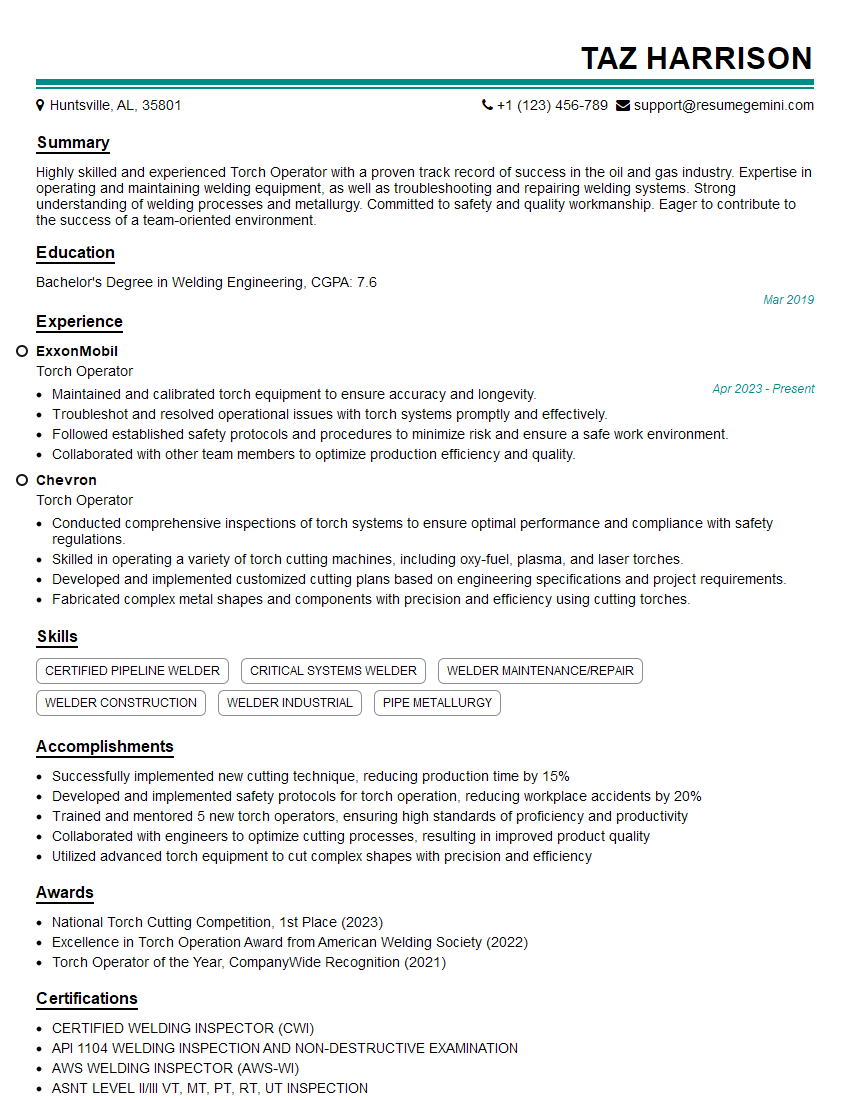
Mastering Torching opens doors to exciting career opportunities in diverse industries, offering excellent growth potential and rewarding challenges. To maximize your job prospects, it’s crucial to create a compelling and ATS-friendly resume that showcases your skills and experience effectively. ResumeGemini is a trusted resource that can help you build a professional resume that stands out. We provide examples of resumes tailored to Torching to guide you through the process, ensuring your application makes a lasting impression. Take the next step towards your dream job today!
Explore more articles
Users Rating of Our Blogs
Share Your Experience
We value your feedback! Please rate our content and share your thoughts (optional).
What Readers Say About Our Blog
Very informative content, great job.
good