Preparation is the key to success in any interview. In this post, we’ll explore crucial Wood interview questions and equip you with strategies to craft impactful answers. Whether you’re a beginner or a pro, these tips will elevate your preparation.
Questions Asked in Wood Interview
Q 1. Describe the different types of wood grain patterns and their impact on woodworking.
Wood grain patterns are essentially the visual representation of the wood’s cellular structure. These patterns significantly impact a woodworker’s choices and techniques, influencing both aesthetics and structural integrity. Different patterns offer varied strength and workability.
- Straight Grain: Fibers run parallel to the wood’s length, resulting in a uniform appearance and high strength. Think of a perfectly straight, even-toned piece of pine. This is ideal for furniture legs or structural elements needing maximum strength and minimal warping.
- Spiral Grain: Fibers spiral around the tree’s core. This creates a swirling visual effect but reduces strength and increases the chance of warping during drying or processing. Imagine the visual complexity in a burl wood – beautiful but more challenging to work with.
- Interlocked Grain: Fibers are aligned in alternating directions, creating a distinct zig-zag pattern. This provides moderate strength and can make planing and finishing more difficult. Certain hardwoods display this like some species of oak.
- Diagonal Grain: Fibers run at an angle to the wood’s length. This pattern offers a balance between strength and workability. It’s fairly common and adds an interesting visual texture to projects.
- Knots: While not strictly a grain pattern, knots (branches embedded within the trunk) are a significant structural feature that affect a piece’s strength. Large or poorly distributed knots are often considered defects.
Understanding grain patterns is crucial for selecting appropriate wood for a given project and choosing optimal cutting and joining methods. For example, you wouldn’t choose wood with spiral grain for a project requiring significant strength, like a chair leg.
Q 2. Explain the process of kiln drying lumber and its importance.
Kiln drying is a controlled process of removing moisture from lumber to prevent warping, cracking, and shrinking during and after construction. It’s essential for creating stable and durable wood products.
The process typically involves placing freshly cut lumber in a climate-controlled kiln. The kiln’s temperature and humidity are carefully monitored and adjusted over several days or weeks, gradually reducing the moisture content to a target level (usually 6-8% for interior applications). This controlled drying prevents rapid moisture loss that can cause internal stresses and defects.
The importance of kiln drying cannot be overstated. Unkiln-dried wood is prone to significant dimensional changes in response to variations in environmental humidity. This can lead to warping, splitting, and other problems, rendering the finished product unusable. A properly kiln-dried board, however, maintains its shape and dimensions, crucial for precision woodworking.
Q 3. What are the common defects found in wood and how do they affect its use?
Wood, being a natural material, is susceptible to various defects. These defects impact the wood’s strength, appearance, and overall suitability for different applications.
- Knots: Branches embedded in the trunk. Large knots weaken the wood.
- Checks: Cracks that extend across the grain, often caused by rapid drying.
- Splits: Cracks that run along the grain.
- Shakes: Separations between the annual growth rings, weakening the wood.
- Decay: Rot caused by fungi, seriously compromising structural integrity.
- Wane: Un-shaped or bark-covered edges of a board.
- Pitch Pockets: Resin-filled voids found mainly in softwoods.
- Warping: Bending or twisting of the wood, affecting flatness.
The impact of these defects varies depending on the type of defect, its size, location, and the intended use of the wood. For instance, a small knot in a decorative piece might be acceptable, but a large check in a structural beam could be catastrophic. Careful inspection and selection are paramount for any woodworking project.
Q 4. Discuss various wood preservation techniques and their effectiveness.
Wood preservation techniques aim to extend the lifespan of wood by protecting it from decay, insects, and weathering. Several methods are employed, each with its effectiveness depending on the specific threat and wood type.
- Pressure Treatment: Wood is placed in a pressure vessel and treated with preservatives under high pressure, forcing the chemicals deep into the wood. This is highly effective against decay and insects but may affect some finishes or limit certain applications.
- Surface Treatments: Applying preservatives to the wood’s surface offers protection but is less effective against deep penetration of decay organisms. Paints, stains, and sealants can provide protection from UV damage and moisture.
- Heat Treatment: Modifying the wood’s internal structure through heat alters its chemical properties, making it less susceptible to decay and insects. This is a more eco-friendly method, although may still require surface treatment for moisture resistance.
- Oil-based preservatives: Penetrate the wood and provide a level of protection against moisture. Linseed oil is a traditional example. However, the efficacy will vary and require reapplication.
Choosing the right preservation technique depends on factors like the wood species, intended use (exterior vs. interior), and budget. For example, pressure-treated lumber is commonly used for outdoor structures like decks, while surface treatments might suffice for interior trim.
Q 5. How do you select the appropriate type of wood for a specific project?
Selecting the right wood involves considering several factors, aligning the wood’s properties with the project’s requirements.
- Project Requirements: Strength, durability, aesthetic appeal, intended use (interior/exterior), budget.
- Wood Properties: Hardness, density, grain pattern, workability, resistance to decay and insects.
- Availability: Local sourcing may affect cost and selection.
- Finishing Considerations: Some woods accept stains and finishes better than others.
For example, if building a sturdy table, hardwood like oak or maple would be preferred for its strength and durability. For a delicate carving, a softer wood like basswood might be a better choice. Considering all these factors ensures the final project meets the intended purpose and looks great.
Q 6. Explain the difference between hardwood and softwood.
The terms ‘hardwood’ and ‘softwood’ are not related to the actual hardness of the wood, but rather to the type of tree they come from.
- Hardwoods: Come from deciduous (broad-leaf) trees that lose their leaves annually. They generally have a denser, more complex structure, leading to higher strength, durability, and a more attractive grain pattern. Examples include oak, maple, cherry, walnut, and mahogany.
- Softwoods: Come from coniferous (needle-leaf) trees such as pines, firs, and spruces. They generally have a simpler structure, are less dense, and are typically softer and easier to work with than hardwoods. Though some softwoods, such as Douglas Fir, possess considerable strength.
The distinction is important because hardwoods tend to be more expensive and harder to work with but offer superior strength and aesthetics for many applications. Softwoods are a more economical choice for various projects, particularly those where strength is less critical.
Q 7. Describe different methods of joining wood pieces (e.g., mortise and tenon, dowels).
Numerous methods exist for joining wood pieces, each offering varying strength and aesthetic appeal. The choice depends on the project’s requirements and the woodworker’s skill level.
- Mortise and Tenon: A strong, traditional joint where a projecting tenon (peg) from one piece fits into a mortise (hole) in another. It’s a durable and elegant joinery, frequently used in furniture making. It requires precision and specialized tools.
- Dowels: Simple, cylindrical dowels inserted into holes in both pieces provide a strong, fairly easy to create joint. Glue is typically used to enhance strength. Suitable for many projects but doesn’t have the visual appeal of more complex joints.
- Biscuits: Oval-shaped wood biscuits are inserted into slots cut into adjoining boards, creating a strong glue surface area. A quick and effective method, particularly for aligning wide boards together in cabinetry.
- Pocket Screws: Screws are driven into angled pockets pre-drilled into the edges of the boards. A concealed yet strong joint that’s quick to assemble but needs specialized tools.
- Lap Joints: Overlapping joints where one piece is cut away to receive the other. Variations exist like half-lap, finger joints, etc., each offering different strengths.
Understanding these methods allows woodworkers to choose the most appropriate joinery technique based on the project’s structural needs and the desired aesthetic.
Q 8. What safety precautions are crucial when working with woodworking machinery?
Working with woodworking machinery demands unwavering attention to safety. A single lapse in concentration can lead to serious injury. The most crucial precaution is always to ensure the machine is properly maintained and in good working order. This includes checking for loose parts, ensuring blades are sharp and correctly aligned, and verifying safety guards are in place and functioning correctly.
- Personal Protective Equipment (PPE) is non-negotiable. This includes safety glasses or a face shield to protect against flying debris, hearing protection to mitigate the loud noise of machinery, and dust masks to prevent inhalation of wood dust, a known carcinogen. Appropriate clothing, such as long sleeves and pants, are also essential to prevent clothing from getting caught in moving parts.
- Never operate machinery when fatigued or under the influence of drugs or alcohol. Your focus needs to be sharp and your reactions quick.
- Always use push sticks and featherboards when working with table saws, planers, and jointers to keep your hands a safe distance from the blades.
- Understand the operation of each machine thoroughly before using it. Read manuals, watch instructional videos, and if possible, receive hands-on training from an experienced woodworker.
- Keep your workspace clean and organized. Clutter can create tripping hazards and impede safe operation.
- Disconnect power to the machine before making adjustments or cleaning. This simple step prevents accidental starts.
For example, I once saw a colleague fail to use a push stick on a table saw, resulting in a severe hand injury. This reinforced the absolute necessity of following safety protocols at all times.
Q 9. How do you identify different species of wood?
Identifying different wood species requires a combination of techniques. There’s no single foolproof method, but a careful examination often yields conclusive results. We rely on a number of characteristics:
- Grain Pattern: The arrangement of wood fibers significantly varies between species. Some display straight grains (e.g., Pine), while others have intricate swirls or curls (e.g., Curly Maple).
- Color and Tone: Wood color is a strong indicator. For example, Cherry has a distinctive reddish-brown hue, while Oak exhibits a variety of colors depending on the species but tends to be light to medium brown.
- Texture and Density: Run your fingers across the wood. Some species feel smooth, while others are rougher. Density varies considerably; some are lightweight (e.g., Balsa), while others are dense and heavy (e.g., Ebony).
- Smell and Taste (Caution!): Some woods have distinct scents. Cedar, for instance, possesses a recognizable aromatic quality. (Note: exercise extreme caution and avoid ingesting wood samples).
- Growth Rings: The annual growth rings (visible in cross-sections) provide clues about the species’ growth rate and climate. The width and clarity of the rings can vary significantly.
- Knots and Figure: The presence, size, and arrangement of knots can aid in identification, as can unique wood figures such as fiddleback or birdseye.
A magnifying glass can be helpful in examining the intricate details of the wood’s structure. Experienced woodworkers often develop a keen eye for identifying various species over time. I’ve personally found that referencing a comprehensive wood identification guide, combined with practical experience, is the most effective approach.
Q 10. Explain the process of finishing wood, including sanding and applying finishes.
Finishing wood enhances its appearance, protects it from damage, and increases its durability. It’s a multi-step process involving careful sanding and the application of finishes.
- Sanding: This crucial step removes surface imperfections, creating a smooth foundation for the finish. Start with coarser grit sandpaper (e.g., 80-grit) and progressively move to finer grits (e.g., 120, 180, 220, and even higher). Each step removes scratches from the previous stage. Sanding with the grain is essential to prevent scratches and maintain the wood’s natural texture.
- Cleaning: After sanding, remove all dust particles using a tack cloth or compressed air. Any dust left behind will compromise the finish’s adhesion and appearance.
- Applying the Finish: Many finishes are available, each with its own properties and characteristics. Common types include:
- Oil-based finishes (e.g., linseed oil, tung oil): Penetrate the wood, enhancing its natural beauty and providing moderate protection.
- Water-based finishes (e.g., polyurethane, acrylic): Easy to clean up, durable, and provide good protection.
- Shellac: A natural resin-based finish that provides a warm, rich tone and good protection.
- Lacquer: Dries quickly and is very durable, often used for furniture and musical instruments.
- Application Techniques: The best application method depends on the chosen finish. Some finishes are applied by rubbing or wiping, while others require spraying or brushing. Multiple thin coats are generally preferable to one thick coat to avoid runs and drips.
- Drying and Curing: Allow each coat to dry completely before applying the next. The drying and curing times vary depending on the finish, temperature, and humidity.
For instance, a recent project required a high-gloss finish, for which I chose a high-quality polyurethane applied in multiple thin coats with a spray gun, ensuring a smooth, even, and durable protective layer.
Q 11. What are the advantages and disadvantages of using different wood adhesives?
Wood adhesives play a crucial role in woodworking, providing strong bonds for joints and assemblies. Several types exist, each with advantages and disadvantages:
- Polyurethane glue: Excellent gap-filling capabilities, strong bond, water-resistant. Disadvantages include longer drying time and cleanup can be challenging.
- Yellow wood glue (PVA): Versatile, commonly used, strong bond for most woods, easy to clean up with water. Not highly water-resistant.
- Epoxy glue: Extremely strong bond, chemical resistant, gap-filling. Can be expensive and requires precise mixing.
- Animal glue: Traditional glue, biodegradable, reversible with water when still wet. Not suitable for outdoor applications or highly stressed joints.
The choice of adhesive depends on the application. For instance, I’d choose polyurethane glue for exterior projects requiring gap-filling, while yellow wood glue is perfectly suitable for interior joinery where water resistance isn’t critical. Epoxy glue is reserved for demanding applications where high strength and chemical resistance are paramount. I have personal experience with each of these glues in various projects, understanding their strengths and limitations is critical for success.
Q 12. Describe your experience with different woodworking tools.
My experience with woodworking tools spans decades, encompassing both hand tools and power tools. I’m proficient in using a wide range of tools, including:
- Hand Tools: Chisels, hand planes, saws (hand saws, tenon saws, coping saws), mallets, clamps, measuring tools (squares, rulers, calipers), marking gauges.
- Power Tools: Table saw, miter saw, jointer, planer, router, drill press, band saw, spindle sander, belt sander, random orbital sander.
Hand tools require skill and precision, allowing for intricate work and fine control. Power tools offer speed and efficiency, particularly when working on larger pieces. The combination of both provides incredible versatility. For example, I might use a hand plane to refine a surface after initial shaping with a power planer, achieving a superior finish. Proficiency in using a diverse range of tools allows me to tackle any project with confidence, efficiently and effectively.
Q 13. How do you handle wood warping or cracking?
Wood warping and cracking are common issues caused by changes in moisture content. Addressing these issues requires understanding the underlying causes and implementing appropriate solutions.
- Prevention: Proper drying and acclimation of lumber before use is critical in preventing warping and cracking. Storing wood in a stable environment with consistent temperature and humidity is essential.
- Repairing Warping: Minor warping can sometimes be corrected through carefully applied moisture or heat. For significant warping, resawing and re-gluing may be necessary. Using specialized clamps can help to re-straighten the warped piece.
- Repairing Cracks: Small cracks can be filled with wood filler, matching the color of the wood as closely as possible. Larger cracks may require more complex repairs, including wood splints or dowels to stabilize the crack and strengthen the wood.
- Avoiding Stress Concentrations: Proper joint design and construction can minimize stress points within the wood, reducing the likelihood of cracking. Well-designed joints distribute forces more evenly.
For example, I once rescued a beautifully figured piece of cherry that had severely warped during drying. By carefully resawing the piece into thinner boards and re-gluing them together with precise clamping, I managed to straighten the wood and salvage the material for a stunning tabletop.
Q 14. Explain the concept of wood density and its significance.
Wood density refers to the mass of wood per unit volume, often expressed as kilograms per cubic meter (kg/m³) or pounds per cubic foot (lbs/ft³). It’s a crucial factor influencing many aspects of a wood’s properties and how it is used.
- Strength and Durability: Higher density woods generally exhibit greater strength, stiffness, and durability. They are better suited for structural applications and resist wear and tear more effectively.
- Workability: Dense woods can be more challenging to work with, requiring sharper tools and more effort to cut, shape, and sand. They may also be more prone to dulling tools.
- Appearance: Density can affect the wood’s appearance. Dense woods often have a more refined texture and luster.
- Stability: Density plays a role in the wood’s dimensional stability, influencing its tendency to warp, shrink, or swell in response to changes in moisture content. Generally denser woods are more dimensionally stable.
For example, Balsa wood, with its exceptionally low density, is ideal for lightweight models and crafts, whereas hardwoods like Oak or Mahogany, possessing higher density, are better suited for furniture or flooring where strength and durability are paramount. Understanding wood density is essential for choosing the appropriate species for a specific application.
Q 15. What is the difference between plain-sawn, quarter-sawn, and rift-sawn lumber?
The terms plain-sawn, quarter-sawn, and rift-sawn describe different ways lumber is cut from a log, significantly impacting the wood’s appearance and stability. Think of it like slicing a cake: each cut yields a different texture and pattern.
- Plain-sawn (or flat-sawn): This is the most common and economical method. The saw cuts are parallel to the growth rings, creating a wide, often dramatic grain pattern with pronounced variations in color and density. This method is prone to cupping and warping due to the uneven drying stress across the wider faces.
- Quarter-sawn: The log is first quartered, then each quarter is sawn parallel to the pith (the center of the tree). This results in a more uniform grain pattern with less pronounced variation and improved dimensional stability compared to plain-sawn. The characteristic “flake” or “rays” are visible, adding aesthetic appeal. Think of a starburst pattern.
- Rift-sawn: This is the most stable but least efficient method. The cuts are made at a near 90-degree angle to the growth rings. This results in a very straight, tight grain pattern with excellent dimensional stability but can generate more waste due to the precise cutting angles. The grain appears extremely linear and consistent.
In practice, quarter-sawn and rift-sawn lumber are favored for applications where stability is critical, such as flooring, furniture, and exterior siding, despite the increased cost.
Career Expert Tips:
- Ace those interviews! Prepare effectively by reviewing the Top 50 Most Common Interview Questions on ResumeGemini.
- Navigate your job search with confidence! Explore a wide range of Career Tips on ResumeGemini. Learn about common challenges and recommendations to overcome them.
- Craft the perfect resume! Master the Art of Resume Writing with ResumeGemini’s guide. Showcase your unique qualifications and achievements effectively.
- Don’t miss out on holiday savings! Build your dream resume with ResumeGemini’s ATS optimized templates.
Q 16. How do you calculate the amount of lumber needed for a project?
Calculating lumber needs requires careful planning and accurate measurements. The process involves several steps:
- Detailed Design: Create detailed shop drawings indicating the dimensions of each piece of lumber required. This includes considering allowances for cuts, joints, and waste.
- Board Foot Calculation: The standard unit for lumber is the board foot (BF). One board foot is a piece of wood 12 inches long, 12 inches wide, and 1 inch thick. The formula is:
BF = (Thickness in inches) x (Width in inches) x (Length in feet) / 12 - Waste Factor: Always add a waste factor to account for imperfect cuts, knots, and unusable sections of lumber. This factor varies depending on the project’s complexity and the wood’s quality, typically ranging from 10% to 20%, or even higher for intricate designs.
- Total Lumber Required: Add the board feet of all pieces, including the waste factor, to determine the total lumber required for your project.
Example: You need five boards, each 1 inch thick, 6 inches wide, and 8 feet long. One board’s BF is (1 x 6 x 8) / 12 = 4 BF. Five boards would be 20 BF. Adding a 15% waste factor (20 BF * 0.15 = 3 BF), the total is 23 BF.
Q 17. Describe your experience with CNC machining of wood.
My experience with CNC machining of wood is extensive. I’ve used CNC routers to create intricate designs, repetitive parts, and complex 3D shapes with incredible precision. This technology allows for rapid prototyping and high-volume production, something that’s impossible to achieve with purely manual woodworking techniques.
I’m proficient in CAM software, such as Vectric VCarve Pro and Autodesk Fusion 360, allowing me to translate designs into CNC-compatible code. I understand the importance of proper tool selection (bits), feed rates, and depth of cut to avoid burning, chipping, or breaking the wood. I’m also experienced in optimizing toolpaths for efficiency and minimizing material waste. One recent project involved creating 100 customized decorative moldings using a CNC router, significantly speeding up the process and ensuring consistency across all pieces.
Q 18. Explain your understanding of wood anatomy.
Wood anatomy is crucial for understanding wood properties and behavior. Wood is a complex, cellular structure primarily composed of cellulose, hemicellulose, and lignin. These components create the structural framework of the tree and influence the wood’s strength, density, and durability.
Understanding the basic elements such as:
- Growth rings: Annual growth layers reflecting seasonal variations. Their width indicates growth rate and wood density.
- Heartwood: The darker, central core of the tree, often more decay-resistant.
- Sapwood: The lighter, outer layer responsible for water transport.
- Earlywood and Latewood: Earlywood (spring wood) is less dense, while latewood (summer wood) is denser, creating the variations within growth rings.
- Vascular tissues (vessels, tracheids): Responsible for water and nutrient transport.
- Fibers: provide strength and structural support.
This knowledge allows me to select appropriate wood species for specific applications, predict wood behavior during processing (e.g., drying, machining), and optimize the use of wood resources.
Q 19. What are the environmental impacts of deforestation and sustainable forestry practices?
Deforestation has devastating environmental consequences, including:
- Habitat Loss: Destroying ecosystems and biodiversity.
- Soil Erosion: Leading to land degradation and water pollution.
- Climate Change: Trees absorb CO2; deforestation contributes to greenhouse gas emissions.
- Water Cycle Disruption: Affecting rainfall patterns and water availability.
Sustainable forestry practices aim to mitigate these impacts by:
- Reforestation and Afforestation: Planting new trees.
- Selective Logging: Harvesting only mature trees, leaving younger trees to grow.
- Reduced-Impact Logging: Minimizing damage to the forest during harvesting.
- Forest Certification: Ensuring responsible forest management through independent certification programs (e.g., FSC).
Adopting these practices is crucial for maintaining healthy forests, protecting biodiversity, and mitigating climate change.
Q 20. How do you create detailed shop drawings for woodworking projects?
Creating detailed shop drawings is fundamental to successful woodworking. My process involves:
- Detailed Measurements: Accurately measure all dimensions of the project.
- Sketching: Create initial sketches to visualize the design.
- Software: Use CAD software (e.g., SketchUp, AutoCAD) to create precise 2D and 3D drawings. These drawings include dimensions, material specifications, joinery details, and assembly instructions.
- Annotations: Add clear annotations to indicate cut lists, material types, hardware requirements, and assembly sequences.
- Revisions: Review and revise drawings to ensure accuracy and clarity before commencing the project.
My shop drawings are clear, concise, and easy to understand, even for others unfamiliar with the project. They are instrumental in ensuring accurate cutting, assembly, and the overall success of the project. I always include a cut list as a separate document to make material procurement efficient.
Q 21. Describe your experience working with different types of wood finishes (e.g., oil, varnish, lacquer).
I have extensive experience working with various wood finishes, each offering unique properties and aesthetics:
- Oil Finishes (e.g., linseed oil, tung oil): Penetrate deep into the wood, enhancing its natural beauty and providing a durable, water-resistant finish. They require multiple coats and regular maintenance but give a warm, natural look. I frequently use linseed oil on butcher blocks and kitchen countertops.
- Varnish: Forms a hard, protective layer on the wood’s surface, offering excellent resistance to scratches and water damage. It creates a glossy or satin sheen and is suitable for furniture and other items that need robust protection. The curing process can be quite lengthy.
- Lacquer: Dries quickly, offering a durable and smooth finish. It’s available in various sheens and is suitable for furniture, cabinetry, and other applications where fast drying time is beneficial. Lacquer is less forgiving of imperfections, requiring a very smooth surface before application.
Choosing the right finish depends on the wood type, application, desired aesthetic, and level of protection needed. I always test different finishes on scrap wood to determine the best option for a specific project and assess how different finishes might impact the final look.
Q 22. How do you troubleshoot common problems encountered during woodworking?
Troubleshooting woodworking problems involves a systematic approach. It starts with careful observation to identify the root cause. Is the problem with the wood itself (e.g., knots, warping, grain direction), the tools (dull blades, incorrect settings), or the technique (incorrect joinery, improper finishing)?
- Wood Defects: Knots can weaken a piece; warping indicates improper drying or storage. Solutions include selecting better lumber, using the wood strategically to minimize the impact of defects, or using wood fillers.
- Tool Issues: Dull blades lead to uneven cuts and tear-out. Solution: Sharpen or replace blades. Incorrect tool settings (e.g., improper depth of cut on a planer) can also cause issues. Solution: Refer to the manufacturer’s instructions and adjust accordingly.
- Technique Errors: Poor joinery results in weak structures. Practice and patience are key. Improper finishing leads to a poor surface. Solution: Review woodworking fundamentals, practice on scrap wood, and use appropriate finishing techniques.
- Glue Problems: Glue not setting properly, or excessive glue squeeze-out, often arises from incorrect application, incorrect clamping pressure, or improper glue selection. Solution: Use the correct glue for the materials and follow manufacturer’s instructions regarding application and clamping.
For example, if a chair leg is wobbly, I’d first check the joinery. If the mortise and tenon are loose, I might add wood glue and clamps, or consider using dowels for added strength. If the wood itself is splitting, I’d explore the cause (e.g., improper drying, excessive stress) and consider reinforcing it with additional wood or epoxy.
Q 23. Describe your experience with wood turning techniques.
Wood turning is a rewarding technique that allows for the creation of beautiful, symmetrical forms. My experience encompasses a range of techniques, from spindle turning (creating shapes that are primarily elongated and cylindrical, like chair legs) to bowl turning (creating hollow vessels) and faceplate turning (for irregular shapes).
I am proficient with various lathe tools, including gouges (for shaping), skew chisels (for smoothing and creating sharp curves), and parting tools (for separating pieces). I understand the importance of speed control, tool angle, and pressure to achieve a smooth, clean finish. Safety is paramount, and I always wear appropriate safety equipment, including eye protection and dust masks.
One particularly memorable project involved turning a large oak bowl. Getting the precise curve for the rim and maintaining a consistent wall thickness was a challenge, but the result was a stunning piece.
Q 24. How do you maintain woodworking equipment?
Maintaining woodworking equipment is crucial for safety and longevity. Regular cleaning and lubrication are essential.
- Cleaning: After each use, I remove sawdust and debris from all tools. For power tools, I use compressed air to clean hard-to-reach areas. I also wipe down surfaces with a damp cloth.
- Lubrication: Moving parts, such as lathe chucks and table saw trunnions, require regular lubrication with appropriate lubricants. I follow the manufacturer’s recommendations for lubrication frequency and type of lubricant.
- Sharpening: Keeping blades sharp is vital for clean cuts and safety. I regularly sharpen my chisels, plane blades, and saw blades using a sharpening stone or honing guide.
- Storage: Tools are stored in a dry, organized manner to prevent rust and damage. Blades should be protected with covers or cases.
- Inspection: Before each use, I inspect my tools for any signs of damage or wear, addressing any issues before beginning work.
For example, neglecting to clean a planer’s chip breaker can lead to clogs and uneven cuts. Regularly sharpening plane irons prevents tear-out and provides a smoother finish on the wood.
Q 25. Explain the importance of proper wood storage.
Proper wood storage is paramount for preventing warping, cracking, and insect infestation. The key is to maintain a stable environment with consistent temperature and humidity.
- Temperature: Avoid extreme temperature fluctuations. Ideally, the storage area should be between 65-75°F (18-24°C).
- Humidity: Humidity should be maintained between 30-50%. Too much moisture leads to mold and mildew; too little causes the wood to dry out and crack.
- Ventilation: Good air circulation helps prevent moisture buildup.
- Protection: Wood should be protected from direct sunlight and rain. Stacking wood properly (with air gaps between boards) allows for airflow.
- Pest Control: Inspect wood regularly for signs of insect infestation. Treat any infestations immediately.
Imagine storing a valuable piece of cherry wood in a damp basement. It would likely warp and become unusable. Proper storage, in a climate-controlled environment, protects its value and structural integrity.
Q 26. Describe your experience with wood carving techniques.
Wood carving is a meticulous craft involving removing material to create three-dimensional forms. My experience encompasses various carving techniques, including relief carving (carving into a flat surface), carving in the round (creating free-standing sculptures), and chip carving (removing small chips of wood to create patterns).
I’m proficient in using a variety of carving tools, from gouges and chisels to specialized carving knives. The understanding of wood grain and the ability to control the tool to achieve precise cuts are critical. Safety is paramount, using appropriate eye protection and ensuring a sharp, well-maintained set of tools.
A recent project involved creating a bird carving from basswood. The intricate detail work, particularly the feathers, required patience and precision but resulted in a highly satisfying piece.
Q 27. What are the properties of plywood and its applications?
Plywood is an engineered wood product composed of thin layers (plies) of wood veneer glued together with the grain of adjacent plies running perpendicular to each other. This cross-grain arrangement provides strength and stability superior to solid wood of comparable thickness.
Properties:
- Strength: Plywood is strong and relatively lightweight.
- Stability: Less prone to warping and shrinking than solid wood.
- Cost-effectiveness: Generally less expensive than solid wood.
- Versatility: Available in various sizes, thicknesses, and veneer types.
Applications:
- Construction: Subflooring, sheathing, wall panels.
- Furniture making: Cabinetry, shelving, drawers.
- Marine applications: Boat hulls, decking.
- Sign making: Lightweight and durable substrate for signs.
The choice of plywood depends on the application. For example, exterior-grade plywood is treated to resist moisture damage, making it suitable for outdoor use. Interior-grade plywood is generally more affordable and suitable for interior projects.
Q 28. How do you ensure the structural integrity of a wooden structure?
Ensuring the structural integrity of a wooden structure involves careful planning and execution at every stage, from design to construction.
- Wood Selection: Choosing the right species of wood with appropriate strength and durability is crucial. Species like oak and ash are stronger than pine and are better suited for load-bearing applications. The wood must be properly dried and free from defects.
- Joinery: Strong and accurate joinery techniques (e.g., mortise and tenon, dovetail joints) are essential for transferring loads efficiently. Weak joints are the most common source of structural failure.
- Fasteners: When appropriate, use high-quality fasteners (nails, screws, bolts) of the correct size and type. Overdriving fasteners can weaken the wood.
- Design and Engineering: Proper engineering calculations and design are essential for ensuring that the structure can withstand anticipated loads. This includes accounting for factors like wind, snow, and seismic activity.
- Construction Techniques: Careful construction practices, following the design specifications precisely, are crucial. Avoid damaging the wood during construction.
- Regular Inspections: Regular inspections can help to identify potential problems early, allowing for timely repairs. Look for cracks, sagging, loose joints, or signs of insect infestation.
For example, using inadequate joinery in a load-bearing beam can lead to structural failure. Regular inspection of a wooden deck for signs of rot or loose fasteners is essential for preventing accidents.
Key Topics to Learn for Wood Interview
- Wood Science Fundamentals: Understanding the properties of different wood species, including density, strength, grain patterns, and durability. This forms the basis for material selection and processing.
- Wood Processing Techniques: Familiarize yourself with various methods such as sawing, drying, planing, and finishing. Understanding the impact of each process on the final product’s quality is crucial.
- Wood Preservation and Treatment: Learn about techniques used to protect wood from decay, insects, and fire. Knowing the different treatments and their effectiveness in various applications is essential.
- Wood Construction and Design: Explore the principles of designing with wood, including structural considerations, joinery techniques, and sustainable practices. Understanding building codes and regulations is beneficial.
- Wood Product Manufacturing: Gain insights into the production processes for various wood products, such as furniture, flooring, and engineered wood. This includes understanding supply chains and manufacturing efficiency.
- Sustainability and Environmental Impact: Understanding the environmental implications of wood harvesting and processing, along with sustainable forestry practices, is increasingly important.
- Problem-solving and Critical Thinking: Develop your ability to analyze problems related to wood selection, processing, and application. Practice approaching challenges with a logical and systematic approach.
Next Steps
Mastering the intricacies of Wood opens doors to exciting career opportunities in a diverse range of industries. A strong understanding of these principles will significantly enhance your interview performance and overall career prospects. To maximize your chances of landing your dream job, it’s vital to create a resume that stands out to Applicant Tracking Systems (ATS). We strongly encourage you to leverage ResumeGemini, a trusted resource for building professional and ATS-friendly resumes. ResumeGemini provides examples of resumes tailored to the Wood industry, helping you present your skills and experience effectively. Invest time in crafting a compelling resume – it’s your first impression and a key to unlocking your career potential.
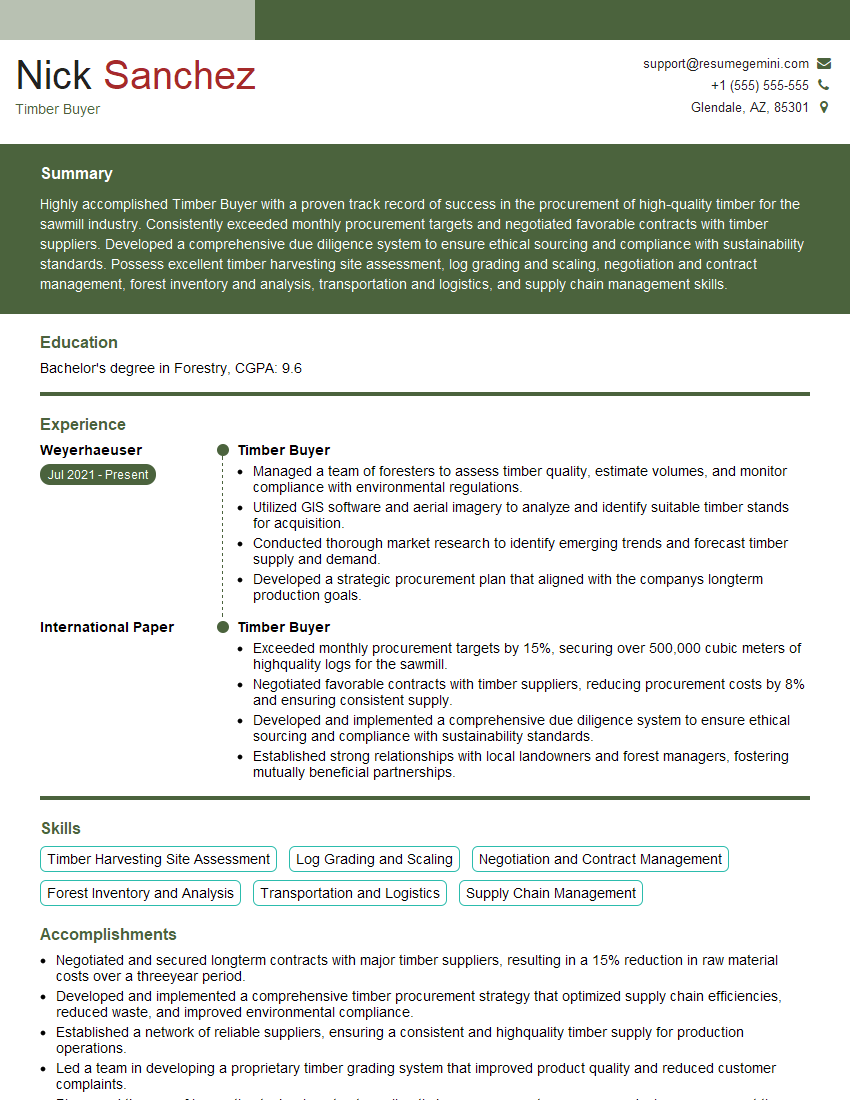
Timber Buyer Resume Sample

Arborist Resume Sample

Forester Resume Sample

Wood Technologist Resume Sample

Furniture Maker Resume Sample

Furniture Designer Resume Sample

Carver Resume Sample

Cabinet Maker Resume Sample

Shipwright Resume Sample

Woodworker Resume Sample

Timber Framer Resume Sample

Joiner Resume Sample

Pattern Maker Resume Sample

Wood Machinist Resume Sample

Wood Finisher Resume Sample

Wood Turner Resume Sample

Lumber Inspector Resume Sample
Explore more articles
Users Rating of Our Blogs
Share Your Experience
We value your feedback! Please rate our content and share your thoughts (optional).
What Readers Say About Our Blog
Very informative content, great job.
good