The thought of an interview can be nerve-wracking, but the right preparation can make all the difference. Explore this comprehensive guide to EarthImager interview questions and gain the confidence you need to showcase your abilities and secure the role.
Questions Asked in EarthImager Interview
Q 1. Explain the core functionalities of EarthImager.
EarthImager is a powerful Geographic Information System (GIS) software specializing in remote sensing image analysis. Its core functionalities revolve around acquiring, processing, analyzing, and visualizing imagery from various sources like satellites, aerial photography, and drones. This involves a range of capabilities including:
- Image Import and Management: EarthImager efficiently handles a wide variety of image formats, allowing for seamless integration of data from diverse sources.
- Georeferencing and Orthorectification: It provides tools to accurately align images with geographic coordinates, correcting for geometric distortions and creating accurate maps.
- Image Preprocessing: This includes tasks like atmospheric correction, geometric correction, and radiometric calibration to enhance image quality and accuracy.
- Image Classification and Analysis: EarthImager offers various classification techniques (supervised, unsupervised, object-based) to extract meaningful information from imagery, such as identifying land cover types or detecting changes over time.
- Data Visualization and Output: The software provides powerful visualization tools to display and interpret results, allowing for the creation of maps, charts, and reports.
Think of it like a digital darkroom and mapping studio combined, allowing you to transform raw imagery into valuable geographic information.
Q 2. Describe your experience with image preprocessing in EarthImager.
My experience with image preprocessing in EarthImager is extensive. I routinely handle tasks such as atmospheric correction, using techniques like dark object subtraction and empirical line methods to remove atmospheric effects and improve image clarity. For example, I once worked on a project analyzing deforestation in the Amazon rainforest. The initial satellite imagery was significantly affected by atmospheric haze. Using EarthImager’s atmospheric correction tools, I successfully removed the haze, revealing the extent of deforestation with much greater accuracy. Additionally, I’m proficient in geometric correction, using ground control points (GCPs) to rectify images and reduce geometric distortions, ensuring accurate spatial representation. I also regularly perform radiometric calibration to normalize pixel values across different images or sensors, ensuring consistency in analysis.
I’ve also used tools within EarthImager to handle noise reduction techniques, applying filters such as median filters to remove random noise while preserving important image features. This is crucial for ensuring the reliability of subsequent analyses like classification or change detection.
Q 3. How do you handle large datasets within EarthImager?
EarthImager handles large datasets effectively through a combination of techniques. Firstly, it utilizes efficient data structures and algorithms optimized for processing large raster files. This means that even datasets comprising gigabytes of data can be loaded and processed without significant performance degradation. Secondly, EarthImager supports parallel processing, allowing the software to distribute tasks across multiple CPU cores, significantly speeding up processing time. For extremely large datasets, I leverage the software’s capabilities for data subsetting. This involves processing the data in smaller, manageable chunks, analyzing each subset individually, and then combining the results for a comprehensive analysis. This is a crucial strategy to avoid memory overload and optimize processing time for very large images exceeding RAM capacity. Finally, I often use cloud-based storage and processing solutions in conjunction with EarthImager to handle exceptionally massive datasets, improving access and scalability.
Q 4. What are the different image classification techniques you’ve used in EarthImager?
My experience encompasses a range of image classification techniques within EarthImager. I frequently employ supervised classification methods, such as maximum likelihood and support vector machines (SVMs). These techniques require training the classifier using labeled samples of different land cover types. For example, I’ve used supervised classification to map urban areas, forests, and agricultural lands from satellite imagery. Unsupervised classification, particularly K-means clustering, is also a common tool in my workflow. This technique groups pixels based on their spectral similarity without requiring prior knowledge of land cover types. I’ve used this to identify distinct spectral clusters within an image, which can then be further investigated and interpreted. Furthermore, I’ve had considerable experience with object-based image analysis (OBIA), where image objects are created and classified based on their spectral, spatial, and contextual characteristics. OBIA is particularly useful for complex landscapes with heterogeneous features, allowing for a more detailed and accurate classification compared to pixel-based methods.
Q 5. Explain your experience with orthorectification in EarthImager.
Orthorectification is a crucial step in many of my projects, ensuring that images are geometrically corrected and accurately represent the Earth’s surface. In EarthImager, this involves using ground control points (GCPs) – points with known coordinates in both the image and a geographic reference system (like UTM or WGS84). The software uses these GCPs to model the geometric distortions within the image and apply a transformation to correct them. A Digital Elevation Model (DEM) is often integrated into the process to further improve the accuracy, especially in hilly or mountainous areas. The result is an orthorectified image with minimal geometric distortion, suitable for accurate measurements, analysis, and map production. For instance, while working on a project mapping infrastructure damage after a hurricane, accurate orthorectification was essential to precisely measure the affected areas and plan efficient recovery efforts.
Q 6. Describe your proficiency in using EarthImager’s georeferencing tools.
My proficiency in EarthImager’s georeferencing tools is high. I routinely georeference imagery from diverse sources, ensuring accurate spatial registration. This involves identifying GCPs within the image and assigning their corresponding geographic coordinates. I’m adept at using different coordinate reference systems (CRS) and employing various transformation models to achieve optimal georeferencing accuracy. I also utilize EarthImager’s built-in tools for assessing the accuracy of the georeferencing, using root mean square error (RMSE) values to evaluate the quality of the transformation. The software’s tools for managing and working with metadata associated with spatial information further enhance the accuracy and reproducibility of the georeferencing process, ensuring consistency across all my projects.
Q 7. How do you address geometric distortions in imagery using EarthImager?
Addressing geometric distortions in imagery using EarthImager involves a multi-step approach. The most common method is georeferencing, as described previously. This uses GCPs to map the image to a known coordinate system. For more complex distortions, I often utilize advanced geometric correction techniques within EarthImager. These techniques account for factors like sensor orientation, terrain relief, and atmospheric refraction. A DEM is frequently incorporated into these advanced correction techniques, providing elevation information that helps to model and correct distortions caused by terrain relief. Furthermore, EarthImager offers tools to assess the quality of the correction process, allowing me to iteratively refine the parameters and achieve the desired level of geometric accuracy. For example, when working with high-resolution aerial photography taken over mountainous terrain, using a DEM during orthorectification is crucial to eliminate the effects of relief displacement, ensuring accurate spatial measurements.
Q 8. Explain your experience with different projection systems within EarthImager.
EarthImager supports a wide range of map projections, crucial for accurate geographic representation. My experience spans working with projected coordinate systems like UTM (Universal Transverse Mercator), which is ideal for local-scale mapping, and geographic coordinate systems like WGS84 (World Geodetic System 1984), used for global positioning. I’ve also extensively used projected coordinate systems optimized for specific regions, such as Albers Equal-Area Conic for large areas with minimal distortion. Choosing the right projection depends heavily on the project’s geographic extent and the intended application. For instance, UTM minimizes distortion over relatively narrow zones, making it suitable for cadastral mapping or analyzing land use changes within a small area. In contrast, WGS84, while less accurate locally, is crucial for applications involving global datasets or overlays with GPS data. I’ve often used EarthImager’s projection tools to reproject datasets to a common coordinate system, allowing for seamless integration and analysis of data from multiple sources.
For example, I once worked on a project involving land cover classification using satellite imagery from multiple sources. Each image had a different projection. To properly analyze the data, I reprojected all the datasets to a common UTM zone, ensuring that the spatial relationships were accurate and allowing for a consistent analysis.
Q 9. Describe your workflow for creating thematic maps using EarthImager.
Creating thematic maps in EarthImager follows a structured workflow. It starts with data preparation, encompassing tasks such as importing raster and vector data, georeferencing if necessary, and applying appropriate spatial transformations. Next, I typically perform data analysis, which might include classification, spatial statistics, or overlay operations depending on the map’s objective. For example, to create a land use map, I might use supervised classification on satellite imagery. After analysis, data visualization is key; I leverage EarthImager’s tools to select appropriate symbology, define color ramps, create legends, and add informative titles and labels. Finally, I carefully review the map’s overall clarity, accuracy, and effectiveness in conveying information, ensuring it meets cartographic standards and is easily interpretable.
A recent project involved mapping deforestation rates. I imported Landsat imagery for two different time periods, performed image differencing to identify changes, classified the changes to identify deforestation areas, and created a thematic map showing the extent of forest loss using a visually striking color scheme. The final map was easily understood and effectively communicated the findings.
Q 10. How do you perform change detection analysis in EarthImager?
Change detection in EarthImager often involves comparing imagery from different time periods. A simple approach is image differencing, subtracting one image from another. Areas showing significant differences highlight changes. However, I often prefer more sophisticated methods like image registration, ensuring both images align perfectly before comparison. This step is critical to avoid false positives caused by misalignment. After image differencing or ratioing, I use thresholding or classification techniques to identify and classify the changes. For example, setting a threshold on the difference image can highlight areas where the change is above a specific value, possibly indicating land use changes. Advanced techniques, such as post-classification comparison, compare the classification maps generated from both imagery dates, providing more detailed information about the nature of change. I always carefully evaluate the results, considering factors like noise and potential sources of error.
For instance, in a flood impact assessment, I compared pre- and post-flood satellite imagery using image differencing, followed by thresholding to automatically delineate flooded areas. This provided quick and accurate information on the extent of damage.
Q 11. Explain your experience with image fusion techniques in EarthImager.
Image fusion in EarthImager involves combining data from different sources to create a more informative image. Common techniques include pan-sharpening, where high-resolution panchromatic imagery is fused with lower-resolution multispectral imagery to improve spatial resolution while retaining spectral information. This greatly enhances visual clarity, revealing more detail. Another technique is wavelet transform fusion, providing a flexible approach that can accommodate various image characteristics. The choice of technique depends on the data characteristics and desired outcome. I’ve extensively used pan-sharpening to enhance the spatial detail of satellite imagery for land cover mapping and urban planning applications.
In one project, combining high-resolution panchromatic imagery with multispectral Landsat data via pan-sharpening greatly improved the accuracy of urban land cover classification, making it easier to distinguish between different types of buildings and infrastructure.
Q 12. How do you evaluate the accuracy of your EarthImager analyses?
Accuracy assessment is paramount. For classification tasks, I typically use ground truth data – information collected on-site or through high-accuracy sources—to compare the classified map with the actual conditions. Metrics such as overall accuracy, producer’s accuracy, user’s accuracy, and the kappa coefficient provide quantitative measures of classification accuracy. For change detection, similar methods are used, comparing the detected changes with independently verified change information. Visual inspection plays a significant role, verifying the plausibility of the results and identifying potential outliers or errors. The choice of accuracy assessment method depends on the specific application and the nature of available ground truth data. The goal is always to ensure the results are reliable and fit for their intended purpose.
For instance, when mapping agricultural fields, I collected GPS-referenced data of field boundaries to verify the accuracy of a land-cover classification obtained using EarthImager.
Q 13. Describe your experience with EarthImager’s scripting capabilities.
EarthImager’s scripting capabilities, often using Python, are invaluable for automating tasks and performing complex analyses. I regularly use scripts to automate batch processing of large datasets, perform repetitive geoprocessing tasks, and develop custom tools tailored to specific projects. This increases efficiency and reduces the likelihood of human error. I’ve written scripts for tasks such as image pre-processing (geometric correction, atmospheric correction), batch conversion of data formats, and automated report generation. Furthermore, Python’s extensive libraries (NumPy, SciPy, etc.) can be integrated with EarthImager’s scripting functionality, further enhancing analytical capabilities. This automation significantly improves workflow and allows me to tackle complex projects effectively.
For example, I wrote a script to automate the classification of thousands of satellite images for a large-scale land cover mapping project, saving considerable time and effort compared to manual processing.
Q 14. How do you handle different data formats within EarthImager?
EarthImager handles a variety of data formats, including common raster formats (GeoTIFF, ERDAS IMAGINE, etc.) and vector formats (Shapefile, GeoJSON, etc.). It seamlessly integrates these different formats, allowing me to work with data from diverse sources. When dealing with less common formats, EarthImager frequently utilizes external libraries or tools, or it allows for format conversion through its built-in functionalities. Understanding the nuances of these formats, such as coordinate systems and metadata, is key to ensuring data integrity and accuracy in analyses. I carefully examine metadata associated with each dataset to verify its quality and compatibility before incorporating it into a project.
In one project, I integrated data from a variety of sources including GeoTIFF satellite imagery, shapefiles of transportation networks, and GeoJSON files containing point locations of environmental monitoring stations. EarthImager’s ability to handle these different formats seamlessly was crucial for the success of the project.
Q 15. Explain your experience with 3D modeling in EarthImager (if applicable).
My experience with 3D modeling in EarthImager is extensive. I’ve leveraged its capabilities to create high-resolution 3D subsurface models from various geophysical datasets, including seismic reflection, gravity, and magnetic data. The process typically involves importing the data, defining the survey parameters, and utilizing EarthImager’s sophisticated algorithms for processing and interpretation. For example, I’ve successfully constructed 3D models of hydrocarbon reservoirs, visualizing complex fault systems and stratigraphic features. This allows for a much more intuitive understanding of subsurface geology compared to 2D representations. The software’s ability to handle large datasets and its visualization tools are invaluable in this process. I’m also proficient in using EarthImager’s tools to create visualizations of 3D models, including cross-sections, depth slices, and 3D volume renderings, which are essential for communication and presentations to clients and stakeholders.
Career Expert Tips:
- Ace those interviews! Prepare effectively by reviewing the Top 50 Most Common Interview Questions on ResumeGemini.
- Navigate your job search with confidence! Explore a wide range of Career Tips on ResumeGemini. Learn about common challenges and recommendations to overcome them.
- Craft the perfect resume! Master the Art of Resume Writing with ResumeGemini’s guide. Showcase your unique qualifications and achievements effectively.
- Don’t miss out on holiday savings! Build your dream resume with ResumeGemini’s ATS optimized templates.
Q 16. Describe a challenging project you worked on using EarthImager and how you overcame it.
One particularly challenging project involved constructing a 3D geological model of a complex ore body using very noisy magnetic data. The data was heavily influenced by near-surface geological features, making it difficult to isolate the signal from the ore body itself. To overcome this, I employed several strategies within EarthImager. First, I carefully pre-processed the data, using various filtering techniques to reduce noise and enhance the signal-to-noise ratio. Next, I utilized EarthImager’s advanced inversion algorithms, experimenting with different regularization parameters to obtain a geologically plausible model. Finally, I integrated geological constraints from existing boreholes and surface mapping data into the inversion process, further refining the 3D model. Through this iterative process of data processing, inversion, and geological validation, I successfully created a high-quality 3D model that accurately represented the ore body’s geometry and significantly improved the accuracy of resource estimation.
Q 17. What are some limitations of EarthImager, and how do you address them?
While EarthImager is a powerful tool, it does have limitations. One major limitation is its computational demands. Processing large, high-resolution datasets can require significant computing power and time. To address this, I often employ strategies like data subsampling or using parallel processing techniques where possible. Another limitation is the inherent uncertainty in geophysical data interpretation. EarthImager provides tools to quantify uncertainty, but ultimately, geological interpretation involves making subjective judgments. To mitigate this, I incorporate geological knowledge and prior information into the interpretation workflow and validate my results against other datasets and geological evidence. Finally, the software’s reliance on accurate input data is crucial. Any errors or biases in the input data will propagate through the processing and interpretation stages. Therefore, meticulous quality control of input data is paramount.
Q 18. Compare and contrast EarthImager with other similar software.
EarthImager is similar to other geophysical modeling software packages like Petrel, Kingdom, and GOCAD. However, EarthImager distinguishes itself through its strong emphasis on 3D inversion techniques and its user-friendly interface. While other packages may offer more advanced features in specific areas, EarthImager excels at providing a balanced suite of tools for data processing, modeling, and visualization. For instance, compared to Petrel, which is more heavily focused on the oil and gas industry, EarthImager is more versatile and applicable to a wider range of geophysical problems. It might lack some of the specialized reservoir simulation tools in Petrel, but it offers superior capabilities in 3D inversion and handling various geophysical data types. Ultimately, the choice of software depends on the specific project requirements and the user’s familiarity with the different interfaces.
Q 19. How do you ensure the quality and accuracy of your EarthImager outputs?
Ensuring the quality and accuracy of EarthImager outputs is a multi-step process. It begins with rigorous data quality control – checking for errors, noise, and outliers in the input data. Next, I carefully select and apply appropriate processing algorithms within EarthImager, ensuring that the chosen methods are suitable for the specific data type and geological context. I meticulously document every step of the process, including the parameters used in each processing and modeling stage. Throughout the workflow, I regularly validate the intermediate and final results against independent data sets (e.g., borehole data, surface geology maps) to assess their plausibility and identify potential errors. Finally, I create comprehensive reports that document the methodology, results, and uncertainties associated with the outputs, ensuring transparency and reproducibility of my work.
Q 20. What are the ethical considerations related to using EarthImager for geospatial analysis?
Ethical considerations are paramount when using EarthImager for geospatial analysis. Data privacy and security are crucial, especially when dealing with sensitive information about land ownership, infrastructure, or environmental conditions. It’s essential to adhere to all relevant regulations and guidelines regarding data access, usage, and dissemination. Another key consideration is the potential for bias in the data or the interpretation process. I strive to identify and mitigate any potential biases and ensure that my analysis is objective and unbiased. Furthermore, it is crucial to be aware of the potential societal impacts of the results, considering their implications for resource management, environmental protection, and community development. Transparency in methods and results is essential to build trust and ensure responsible use of this powerful technology.
Q 21. Describe your experience with using EarthImager for specific applications (e.g., agriculture, urban planning).
I have used EarthImager extensively in various applications. In agriculture, I’ve used it to create 3D models of soil properties (e.g., moisture content, salinity) from ground-penetrating radar (GPR) data. These models can be used to optimize irrigation strategies and improve crop yields. In urban planning, I have employed EarthImager to analyze subsurface utilities (pipes, cables) from electromagnetic surveys. This is critical in minimizing disruption during construction projects and preventing damage to vital infrastructure. The 3D visualizations generated are incredibly helpful in communicating complex subsurface information to stakeholders, including engineers and city planners. My work in these fields consistently demonstrates EarthImager’s ability to translate complex geophysical data into practical insights for real-world decision-making.
Q 22. How do you stay updated on the latest advancements in EarthImager and geospatial technologies?
Staying current in the rapidly evolving field of geospatial technology and EarthImager specifically requires a multi-pronged approach. I actively participate in online communities like forums and user groups dedicated to EarthImager and related software. This allows for peer-to-peer learning and the sharing of best practices and solutions to common challenges. I regularly attend webinars and conferences focused on GIS, remote sensing, and EarthImager-specific updates, often presented by industry experts and software developers. Furthermore, I subscribe to relevant newsletters, journals, and industry publications to keep abreast of new features, algorithm improvements, and emerging trends in the field. Finally, I dedicate time to independent study, experimenting with new techniques and functionalities within EarthImager to enhance my skillset. For example, recently I explored the integration of LiDAR data with multispectral imagery, significantly improving the accuracy of my land cover classification models.
Q 23. What are your preferred methods for visualizing geospatial data in EarthImager?
My preferred methods for visualizing geospatial data in EarthImager hinge on the specific data and the analytical goals. For thematic maps depicting land use or soil types, I utilize categorized symbology with clear legends. For continuous data like elevation or temperature, I employ graduated color ramps, carefully selecting color schemes that avoid misinterpretations. 3D visualizations are crucial for understanding terrain, and I frequently use EarthImager’s 3D rendering capabilities, sometimes enhanced with draped imagery for context. Interactive maps allow for dynamic exploration and data analysis; I often create these leveraging EarthImager’s web map publishing tools. The selection process always prioritizes clarity, accuracy, and an effective communication of the underlying data’s story. For example, in a recent project analyzing deforestation patterns, a time series animation of vegetation indices overlaid on satellite imagery proved far more impactful than static maps.
Q 24. Explain your understanding of spatial statistics and their application in EarthImager.
Spatial statistics are fundamental to extracting meaningful insights from geospatial data within EarthImager. I use techniques like spatial autocorrelation analysis (e.g., Moran’s I) to identify patterns and clustering in data, understanding whether nearby locations exhibit similar characteristics. Geostatistical methods, such as kriging, are essential for interpolating values at unsampled locations, predicting soil properties or pollutant concentrations based on point measurements. Spatial regression modeling helps determine the relationship between variables, incorporating spatial dependencies. For instance, I used spatial regression to model the relationship between pollution levels and proximity to industrial sites. Point pattern analysis helps uncover the spatial distribution of features, such as the clustering of disease cases or the distribution of trees in a forest. These techniques are crucial for robust data interpretation and informed decision-making within EarthImager, enabling us to move beyond simply visualizing data to uncovering statistically significant relationships.
Q 25. How do you integrate data from different sources into EarthImager for analysis?
EarthImager excels in handling diverse data sources, and seamless integration is key to my workflow. I often integrate raster data like satellite imagery and DEMs with vector data such as shapefiles representing roads, buildings, or administrative boundaries. The process typically involves defining a common spatial reference system (CRS) for all datasets, ensuring alignment. EarthImager’s built-in tools make this straightforward, often involving on-the-fly projections. For tabular data containing attributes linked to spatial features, I utilize joins and relates to combine information. For example, in a project analyzing the impact of climate change on agriculture, I integrated satellite-derived NDVI data (raster), weather station measurements (tabular), and farm boundary polygons (vector) to produce a comprehensive analysis. Data quality control is critical; I thoroughly check for inconsistencies and errors before integration.
Q 26. Describe your experience with EarthImager’s data management tools.
My experience with EarthImager’s data management tools is extensive. I’m proficient in creating and organizing geodatabases, effectively managing both raster and vector data within a structured framework. Utilizing EarthImager’s metadata capabilities, I meticulously document datasets, ensuring data discoverability and reproducibility. I’m adept at applying data compression and tiling techniques to optimize storage and access times, particularly for large datasets. The ability to version datasets within EarthImager is invaluable for collaborative projects, enabling tracking of changes and easy reversion to previous states. Regular database maintenance is crucial, including cleaning up orphaned features and ensuring data consistency. This meticulous approach minimizes errors and ensures the long-term usability and integrity of our geospatial data assets.
Q 27. Explain your proficiency in using EarthImager’s tools for terrain analysis.
EarthImager provides a comprehensive suite of tools for terrain analysis, which I use extensively. Slope, aspect, and curvature analysis are fundamental for understanding landform characteristics and their implications. I utilize hydrological tools such as watershed delineation and flow accumulation to model water flow and identify potential drainage patterns. Viewshed analysis helps determine visibility from specific points, useful in site selection or planning. I’m comfortable using various interpolation techniques to create surface models from point data. For instance, I recently used EarthImager’s terrain analysis tools to model potential landslide risk in a mountainous region, combining elevation data with soil type and rainfall patterns.
Q 28. How would you troubleshoot a common issue encountered while working with EarthImager?
A common issue encountered is data projection inconsistencies. If datasets are not in the same projection, analysis results can be inaccurate or visually misleading. My troubleshooting steps include: 1) Identifying the projection of each dataset using EarthImager’s metadata viewer. 2) Selecting a common projection suitable for the study area. 3) Using EarthImager’s projection tools to reproject datasets to the common projection. 4) Verification: After re-projection, I perform visual checks and analyze the data to ensure consistency and accuracy. Another common problem is dealing with corrupted data files. This is often addressed by checking file integrity, attempting repair functions within EarthImager (if available), or resorting to backup copies. If these methods fail, the data may require replacement from the original source. Thorough understanding of data sources and regular backups are key to preventing and mitigating such issues.
Key Topics to Learn for EarthImager Interview
- Image Acquisition and Processing: Understand the fundamentals of remote sensing, including sensor types, data acquisition techniques, and preprocessing steps like atmospheric correction and geometric rectification. Consider the practical implications of different sensor resolutions and their impact on analysis.
- Image Classification and Analysis: Explore supervised and unsupervised classification methods. Be prepared to discuss the application of these techniques to real-world problems, such as land cover mapping, change detection, and urban planning. Consider the strengths and weaknesses of various classification algorithms.
- Data Visualization and Interpretation: Master the art of effectively communicating insights derived from EarthImager data. This includes creating meaningful maps, charts, and reports. Discuss different visualization techniques and their effectiveness in conveying complex information.
- Geospatial Data Management: Understand the principles of geodatabases and spatial data formats (e.g., GeoTIFF, Shapefiles). Be ready to discuss strategies for efficient data storage, retrieval, and integration with other datasets.
- Advanced Techniques (Optional): Depending on the role, you might also explore topics like object-based image analysis (OBIA), deep learning for remote sensing, or specific applications of EarthImager within a particular field (e.g., precision agriculture, environmental monitoring).
- Problem-Solving & Case Studies: Practice approaching hypothetical scenarios involving EarthImager data analysis. Focus on outlining your problem-solving approach, including data exploration, analysis strategy, and interpretation of results. Thinking through realistic use cases will strengthen your interview performance.
Next Steps
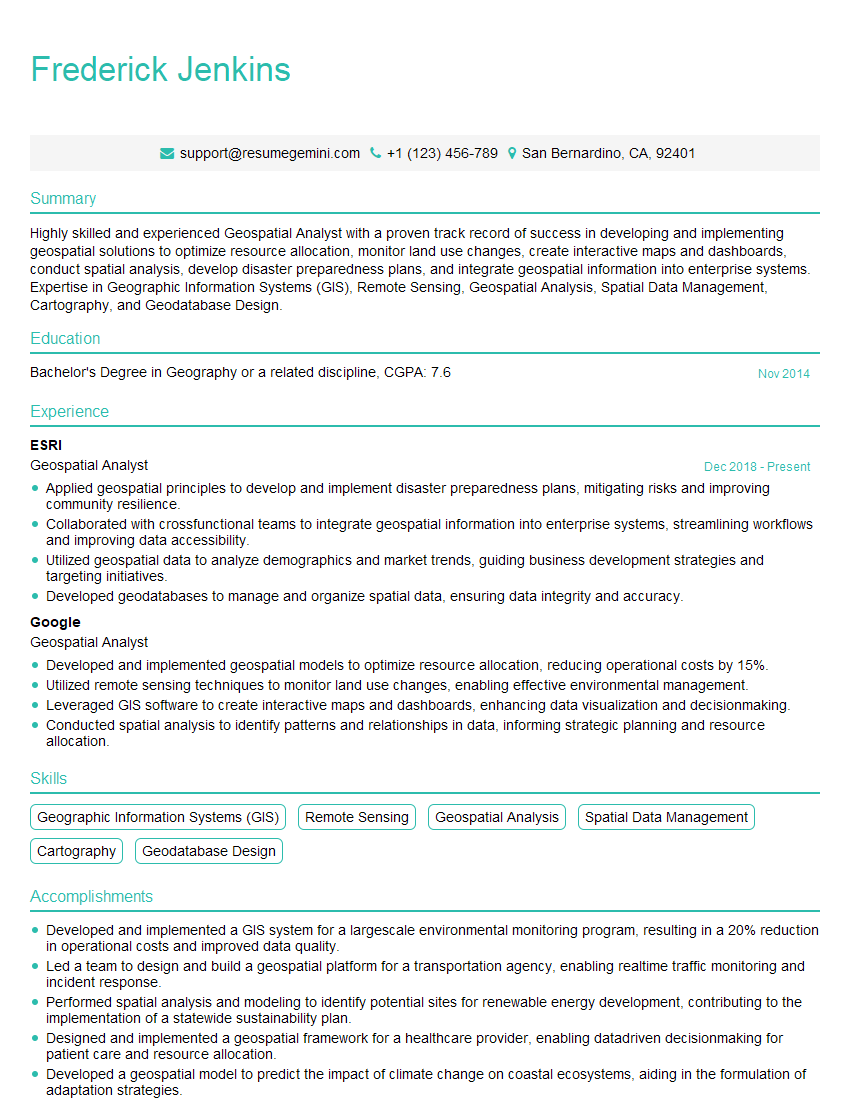
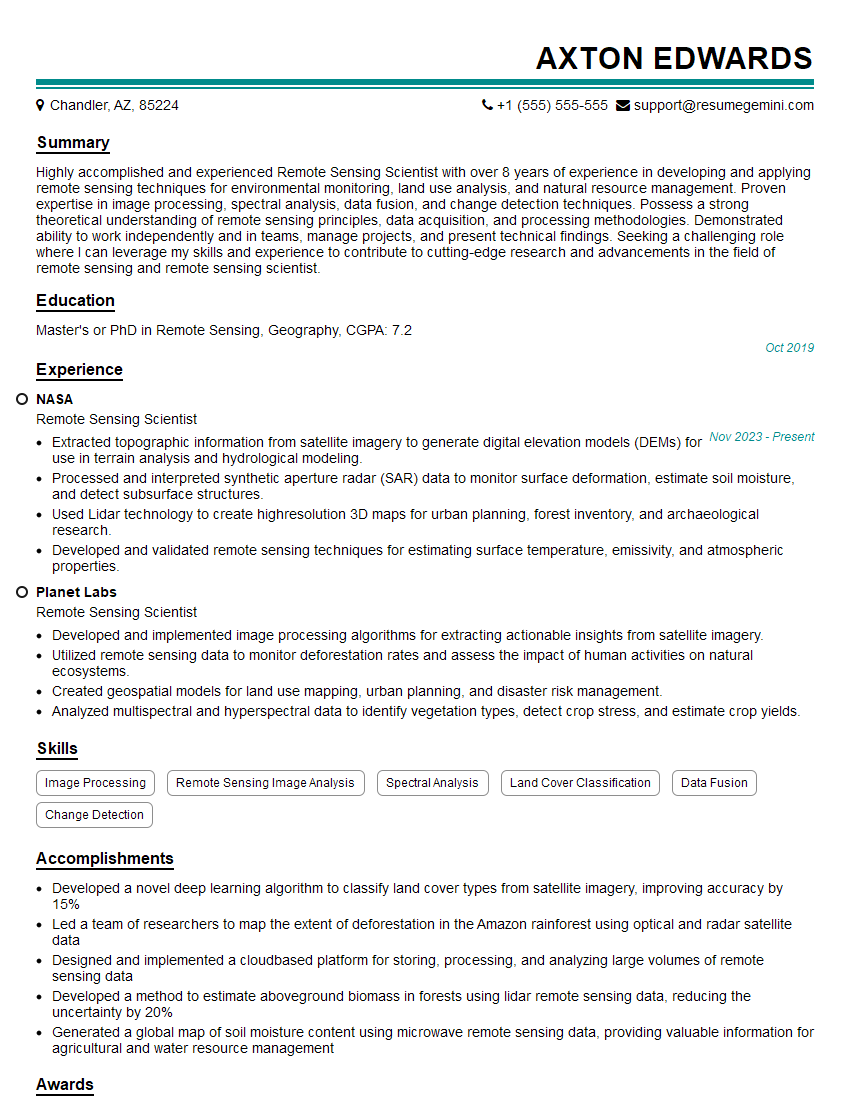
Mastering EarthImager significantly enhances your career prospects in the geospatial industry, opening doors to exciting roles in research, environmental management, and urban development. To maximize your chances of landing your dream job, creating a strong, ATS-friendly resume is crucial. We highly recommend using ResumeGemini to craft a professional and impactful resume that highlights your skills and experience effectively. ResumeGemini provides valuable tools and resources to optimize your resume for applicant tracking systems (ATS) and examples of resumes tailored to EarthImager are available to help guide you. Take the next step towards your career success – invest time in creating a resume that truly showcases your potential!
Explore more articles
Users Rating of Our Blogs
Share Your Experience
We value your feedback! Please rate our content and share your thoughts (optional).
What Readers Say About Our Blog
Very informative content, great job.
good