Unlock your full potential by mastering the most common Track Surfacing interview questions. This blog offers a deep dive into the critical topics, ensuring you’re not only prepared to answer but to excel. With these insights, you’ll approach your interview with clarity and confidence.
Questions Asked in Track Surfacing Interview
Q 1. Describe the different types of track surfacing materials and their applications.
Track surfacing materials are chosen based on factors like traffic volume, speed, climate, and cost. Common types include:
- Crushed Stone Ballast: The most common type, providing drainage, stability, and support for the sleepers (ties). Its size and gradation are crucial for optimal performance. Think of it as the foundation of the track.
- Gravel Ballast: Similar to crushed stone but with a wider range of particle sizes. Often used in less demanding applications or where crushed stone is unavailable.
- Slag Ballast: A byproduct of steel manufacturing, it offers good drainage but can be abrasive and potentially detrimental to the environment if not handled correctly. Its use is becoming less frequent due to environmental concerns.
- Concrete Sleepers/Ties: While not strictly surfacing material, these directly influence the track’s performance and interact with the ballast. Concrete sleepers offer superior strength and longevity compared to wooden sleepers.
- Polymer-Modified Ballast: This newer material offers enhanced stability and reduced maintenance compared to traditional ballast, especially in areas prone to settlement or high traffic loads. It’s a more expensive solution, however.
The choice of material is critical for track longevity and safety. For high-speed rail, a robust and well-graded crushed stone ballast is usually the preferred choice to ensure stability and minimal deformation under high dynamic loads. In contrast, less demanding lines might utilize gravel or even recycled materials, subject to rigorous testing and quality control.
Q 2. Explain the process of track tamping and its importance in maintaining track geometry.
Track tamping is a crucial process in track maintenance. It involves using specialized machinery to lift and compact the ballast around and under the sleepers, restoring the correct track geometry. Imagine it as ‘fluffing’ and ‘re-packing’ the foundation of the track.
The process typically involves:
- Lifting the sleepers: The tamping machine lifts the sleepers slightly to create space for ballast manipulation.
- Ballast cleaning: Excess debris and fine particles are removed from the ballast bed to ensure good drainage and compaction.
- Ballast distribution: Fresh ballast may be added as needed to fill voids and restore the proper ballast profile.
- Compaction: High-pressure tamping units compact the ballast, ensuring the track is level and stable. This is the heart of the process, restoring the track’s structural integrity.
Maintaining track geometry—the alignment and levelness of the track—is paramount for safe and efficient train operation. Poor track geometry leads to increased wear and tear on trains, reduced speed limits, and, importantly, an increased risk of derailments. Regular track tamping prevents this by ensuring a stable, level, and well-drained track bed. This also directly affects the ride comfort and speed capabilities of the rail line.
Q 3. What are the key indicators of poor track surfacing and how are they detected?
Indicators of poor track surfacing often present subtly, requiring attentive observation and precise measurements. Key indicators include:
- Track Gauge Irregularities: Variations in the distance between the rails, detectable using track geometry measurement tools.
- Level Irregularities (Cross-level and Alignment): Unevenness of the track surface, both across the track (cross-level) and along its length (alignment), measured with specialized instruments.
- Excessive Ballast Shoulder Erosion: Significant loss of ballast from the sides of the track, indicating potential instability.
- Visible Track Settlements: Noticeable dips or depressions in the track bed.
- Increased Track Maintenance Cycles: More frequent tamping and repairs suggest underlying problems with the track surfacing.
- Train-Induced Vibrations/Noise: Excessive vibrations or noise experienced by trains or nearby structures can indicate poor track geometry or settling.
These indicators are detected using a range of tools, including:
- Track Geometry Measurement Cars: These highly sophisticated vehicles use various sensors to provide precise measurements of track geometry.
- Manual Measuring Tools: Simpler instruments like levels, tapes, and gauges can be used for spot checks.
- Track Inspection Personnel: Regular visual inspections by experienced personnel are crucial for identifying early signs of deterioration.
It is important to note that early detection and addressing these issues prevents costly repairs and safety incidents down the line.
Q 4. How do you ensure the safety of personnel and equipment during track surfacing operations?
Safety during track surfacing operations is paramount. This requires a multi-faceted approach incorporating strict adherence to safety protocols and utilizing appropriate equipment.
- Site Safety Plans: Detailed plans that define safe working practices, emergency procedures, and communication protocols are essential. These plans are adapted for specific situations and revised regularly.
- Personal Protective Equipment (PPE): Mandatory use of PPE, including hard hats, safety glasses, high-visibility clothing, gloves, and safety footwear, is crucial.
- Traffic Control: Strict speed restrictions and other traffic control measures are implemented around the working area to protect both personnel and the equipment from passing trains.
- Equipment Safety Checks: Thorough pre-operational checks and regular maintenance of all equipment are necessary to prevent malfunctions.
- Personnel Training: All personnel must receive adequate training on safe working practices, operation of equipment, and emergency procedures.
- Communication Systems: Clear communication systems must be in place to ensure prompt coordination between work crews and train dispatchers.
In my experience, a strong emphasis on a safety-first culture, combined with proactive risk assessment and mitigation, has been critical in maintaining a safe working environment in track surfacing operations. We utilize regular safety meetings, toolbox talks, and near-miss reporting to reinforce safe practices and improve our procedures.
Q 5. What are the common causes of track settlement and how can they be prevented?
Track settlement, the sinking or lowering of the track bed, results from various factors. Understanding these factors is crucial for effective prevention.
- Poor Ballast Quality: Use of poorly graded or contaminated ballast can lead to uneven settlement.
- Inadequate Ballast Depth: Insufficient depth of ballast cannot properly support the loads imposed by trains, especially during high-traffic periods. The track bed is effectively too shallow.
- Subgrade Instability: Weak or unstable subgrade soils, often due to unsuitable foundation materials, can result in differential settlement of the track.
- Water Ingress: Water accumulation in the ballast can lead to saturation and loss of support, causing settling. This is a major contributing factor to track instability.
- Frost Heave: In cold climates, freezing and thawing cycles can cause expansion and contraction of the soil, resulting in uneven settlement.
- Vibrations: Continuous train vibrations can compact ballast and lead to its shifting and settlement over time. This is more significant with high-speed and heavy trains.
Prevention involves:
- Careful Subgrade Preparation: Proper compaction and treatment of subgrade soils to ensure stability.
- Use of High-Quality Ballast: Employing well-graded ballast that meets stringent quality standards.
- Adequate Ballast Depth: Ensuring sufficient depth to provide appropriate support for the anticipated train loads.
- Effective Drainage Systems: Implementing robust drainage systems to prevent water accumulation in the ballast.
- Regular Maintenance: Periodic tamping, cleaning, and ballast shoulder restoration to maintain proper track geometry.
Choosing the right ballast, maintaining proper drainage, and regularly monitoring track geometry with appropriate tools are vital for preventing settlement and ensuring the track’s long-term stability.
Q 6. Describe your experience with track geometry measurement tools and techniques.
My experience encompasses the use of a wide range of track geometry measurement tools and techniques, from traditional methods to cutting-edge technologies.
- Manual Measurement Techniques: I’ve extensively used levels, tapes, and gauges for spot checks and localized assessments, mainly to detect subtle issues during routine maintenance.
- Track Geometry Measurement Cars: I have considerable experience operating and interpreting data from various high-tech measuring cars. These systems utilize sophisticated sensors such as laser scanners, inclinometers, and accelerometers to produce detailed 3D profiles of the track, allowing for precise quantification of gauge, alignment, and level irregularities. This data allows for targeted and efficient track maintenance.
- Data Analysis Software: I’m proficient in using specialized software packages to analyze data acquired from measuring cars. This allows me to identify trends, prioritize maintenance needs, and quantify the severity of track defects.
- Unmanned Aerial Vehicles (UAVs): More recently, I’ve explored the use of UAVs with high-resolution cameras for rapid visual inspection of large stretches of track. UAV inspection is a time and cost-effective way to detect many surface defects.
The choice of tool depends on the project scope, the required level of detail, and available resources. For example, while manual measurements are suitable for small-scale inspections, automated systems are essential for larger-scale projects and high-speed lines where precision and efficiency are paramount.
Q 7. Explain the role of ballast in track stability and drainage.
Ballast plays a vital role in track stability and drainage. It acts as a buffer between the sleepers and the subgrade, distributing the load from the trains and providing drainage.
Stability: Ballast provides a stable and resilient foundation for the sleepers and rails. Its granular nature allows for efficient load distribution, preventing excessive stress concentration on the subgrade. The size and shape of the ballast particles are carefully chosen to maximize interlock and stability. Think of it as a cushion that supports the weight of the train.
Drainage: The well-graded nature of ballast allows for effective drainage of water away from the track bed. Water accumulation can lead to instability, frost heave, and other issues that compromise track safety and longevity. Ballast’s porosity and permeability allow for water to pass through the void spaces, preventing saturation and ensuring the stability of the track bed.
The interaction between ballast size, gradation, and compaction directly influences both stability and drainage. Poorly graded ballast or inadequate compaction can lead to reduced drainage, increased settlement, and reduced track life. Therefore, proper ballast selection and maintenance are crucial for optimizing both stability and drainage.
Q 8. How do you manage track surfacing projects within budget and schedule constraints?
Managing track surfacing projects within budget and schedule requires meticulous planning and execution. It’s akin to orchestrating a complex symphony – each instrument (task) must play its part in perfect harmony. My approach involves several key steps:
- Detailed Cost Estimation: This involves a thorough breakdown of materials (ballast, aggregates, etc.), labor costs, equipment rental, and unforeseen contingencies. I utilize specialized software to create accurate estimates, factoring in potential inflation and market fluctuations.
- Realistic Scheduling: I develop a comprehensive project schedule using Gantt charts or similar tools, identifying critical path activities and potential bottlenecks. This schedule includes buffer time to account for weather delays or unexpected issues. Regular progress monitoring using key performance indicators (KPIs) helps keep the project on track.
- Resource Allocation: Efficient resource allocation is crucial. This involves optimizing the use of equipment and personnel, ensuring the right people with the right skills are assigned to the right tasks at the right time. We leverage technology for real-time tracking of resources and productivity.
- Risk Management: Identifying potential risks (e.g., material shortages, equipment malfunctions, adverse weather) and developing mitigation strategies is essential. This might involve securing alternative suppliers, having backup equipment on standby, or adjusting the schedule proactively.
- Change Management: Inevitably, changes can arise. I establish clear processes for managing changes, evaluating their impact on the budget and schedule, and obtaining necessary approvals before implementing them.
For example, on a recent project involving the resurfacing of a high-speed rail line, we implemented a just-in-time delivery system for materials, reducing storage costs and minimizing waste, allowing us to complete the project under budget and ahead of schedule.
Q 9. Describe your experience with different types of track maintenance equipment.
My experience encompasses a wide range of track maintenance equipment, from smaller, specialized tools to large-scale machinery. This includes:
- Ballast Regulators: Used for maintaining the correct ballast profile and ensuring proper drainage. I’m proficient in operating and maintaining various models, from tamper-based regulators to those using laser guidance systems for increased accuracy.
- Tampers: These are essential for lifting, leveling, and consolidating track ballast. I’m experienced with both dynamic and static tampers, understanding their capabilities and limitations in different ground conditions.
- Track Liners: These machines are used for aligning and leveling the track structure. I have experience with hydraulic and computer-controlled lining systems, allowing for precise adjustments and the creation of smoother tracks.
- Ballast Cleaners: Crucial for removing debris and contaminants from the ballast, enhancing drainage and track stability. I’m familiar with various types, including those equipped with sifters and vacuum systems.
- Specialized Tools: Smaller tools, such as rail grinders, measuring instruments, and testing equipment, are essential for performing detailed inspections and making minor repairs.
My expertise extends beyond operation to preventative maintenance and troubleshooting. I understand the importance of regular maintenance schedules to minimize downtime and extend the lifespan of this vital equipment.
Q 10. How do you address issues related to track alignment and level?
Addressing track alignment and level issues requires a systematic approach, combining precise measurements with targeted adjustments. Imagine a perfectly straight line – that’s the ideal track alignment. Deviations from this need to be corrected.
- Survey and Measurement: High-precision surveying equipment, including laser levels and total stations, are employed to accurately measure track alignment and level. This data helps identify areas requiring attention.
- Track Geometry Analysis: Software is utilized to analyze the collected data, identifying misalignments and deviations from design specifications. This helps prioritize areas for adjustment.
- Targeted Adjustment: Using track lining equipment, adjustments are made to bring the track back to the desired alignment and level. This might involve jacking up sections of the track, making adjustments to the ballast, or using shims to fine-tune the rail position.
- Verification: After adjustments, a re-survey is performed to verify the accuracy of the corrections and ensure compliance with specified tolerances. This iterative process ensures optimal track geometry.
For instance, I once encountered significant alignment issues caused by ground settlement after heavy rainfall. Using precise measurements and a combination of track lining and ballast consolidation, we successfully restored the track to its optimal geometry, ensuring safe and efficient train operations.
Q 11. What are the common challenges faced during track surfacing in different weather conditions?
Weather conditions significantly impact track surfacing projects. Think of trying to build a sandcastle in a storm – it’s incredibly challenging. Similarly, extreme weather presents various challenges:
- Extreme Temperatures: High temperatures can soften asphalt, making it difficult to work with and potentially causing premature degradation. Low temperatures can hinder the setting of concrete and increase the risk of equipment malfunctions.
- Rainfall: Rain can saturate the ballast, making it unstable and difficult to work with. This can delay the project and compromise the quality of the finished surface. Effective drainage is crucial.
- Freezing Temperatures: Freezing temperatures can cause the ground to heave, leading to track misalignment and damage to equipment. Special techniques and materials may be required to work in freezing conditions.
- Wind: High winds can affect the operation of heavy machinery and create hazardous conditions for personnel.
- Snow and Ice: Snow and ice can completely halt operations. Clearance and de-icing measures are needed before work can commence.
Mitigation strategies include using weather forecasting to plan work schedules, adjusting techniques based on the prevailing conditions, and employing specialized equipment suitable for inclement weather. In severe weather, it’s crucial to prioritize safety and postpone work if necessary.
Q 12. Explain your understanding of track drainage systems and their importance.
Track drainage systems are absolutely crucial for maintaining track stability and ensuring safe and efficient train operation. They’re like the circulatory system of the track, preventing water buildup that could lead to instability and degradation.
- Purpose: Effective drainage systems remove excess water from the ballast, preventing saturation and ground instability. This helps maintain the proper ballast profile, ensures optimal track geometry, and minimizes the risk of washouts.
- Components: These systems typically involve a combination of elements such as ballast shoulders, cross drains, sub-ballast drainage layers (often using geotextiles), and surface ditches. The design must be tailored to the specific site conditions and expected rainfall levels.
- Importance: Poor drainage can lead to various problems: ballast degradation, track settlement, increased maintenance costs, and even derailments. A well-designed drainage system is critical for long-term track stability and safety.
- Maintenance: Regular inspection and maintenance of drainage systems are essential. This might involve cleaning ditches, clearing debris from cross drains, or repairing damaged components.
A failure to address drainage issues can lead to significant problems, potentially causing costly delays and safety risks. I have firsthand experience of how effective drainage systems minimize maintenance requirements and extend the life of the track structure.
Q 13. How do you ensure compliance with relevant safety regulations and standards during track surfacing?
Safety is paramount in track surfacing. We follow a strict safety protocol that goes beyond regulations, embracing a proactive safety culture.
- Compliance: We meticulously adhere to all relevant safety regulations and standards, including those set by national and international bodies like OSHA (in the US) and equivalent organizations worldwide. This involves regular safety training for all personnel and a commitment to using safe work practices.
- Risk Assessment: A comprehensive risk assessment is conducted before any work commences. This identifies potential hazards and establishes control measures to minimize risk. Regular monitoring and updates are crucial.
- Personal Protective Equipment (PPE): Appropriate PPE is provided and mandatory for all personnel. This includes safety helmets, high-visibility clothing, safety footwear, hearing protection, and eye protection, depending on the task.
- Site Safety Management: Establishing clear site rules, ensuring proper signage, and implementing traffic control measures are critical for managing the risks associated with heavy machinery and moving trains.
- Emergency Procedures: Detailed emergency response plans, including communication protocols and procedures for responding to injuries or accidents, are in place and regularly reviewed.
We conduct regular safety audits and toolbox talks to reinforce safe work practices and ensure continuous improvement. A proactive safety culture is not just a requirement but a fundamental value for our team.
Q 14. Describe your experience with track surfacing quality control procedures.
Quality control is an integral part of every track surfacing project. It’s about ensuring that the finished product meets the specified requirements and provides a safe and reliable surface for train operation. Our quality control procedures encompass:
- Material Testing: Regular testing of materials such as ballast and aggregates to ensure they meet the required specifications for strength, size, and cleanliness.
- In-Process Inspection: Continuous monitoring of the work process to identify and rectify any defects or deviations from the plan. This includes checking the alignment, level, and density of the track structure at various stages of construction.
- Dimensional Control: Regular measurements are taken to ensure that the track geometry meets the design specifications. This includes checks on track gauge, alignment, and level.
- Final Inspection: A thorough final inspection is carried out once the project is completed. This involves detailed checks of the track structure, drainage system, and other components to ensure everything meets the specified standards.
- Documentation: Meticulous record-keeping is crucial. This involves maintaining detailed logs of material usage, inspection results, and any corrective actions taken. This documentation forms a crucial part of the project’s audit trail.
We utilize a combination of manual and automated inspection methods, leveraging technology like laser scanning and GPS surveying to enhance accuracy and efficiency. Our commitment to quality control ensures that the track surface is safe, durable, and meets the highest standards.
Q 15. Explain the process of repairing damaged track sections.
Repairing damaged track sections involves a systematic process that begins with a thorough assessment of the damage. This includes identifying the type and extent of the damage – whether it’s a broken rail, damaged sleepers, or issues with the ballast. The process then involves several steps:
- Assessment and Planning: This involves using specialized tools and techniques like ultrasonic testing for rail defects, visual inspection of sleepers and ballast for damage, and potentially even ground penetrating radar for subsurface issues. A detailed plan is then created outlining the necessary repairs and the resources required.
- Preparation: The damaged section is isolated for safety. This often requires temporary speed restrictions or even complete track closures depending on the severity of the damage. Existing materials are removed and the area is prepared for the new materials.
- Repair Execution: This stage depends on the nature of the damage. For broken rails, welding or rail replacement might be necessary. Damaged sleepers may require replacement, and ballast may need to be cleaned, re-profiled, and topped up. Specialized machinery like tamper machines are used to accurately position and consolidate the ballast.
- Quality Control: Throughout the repair process, rigorous quality control checks are performed to ensure the work meets the required standards. This includes checking alignment, level, and gauge of the track.
- Testing and Commissioning: Once the repairs are complete, the track section undergoes thorough testing to ensure its structural integrity and safety before being reopened to train traffic.
For example, in a scenario where a section of ballast has subsided, the process would involve removing the affected ballast, recompacting the underlying sub-ballast, and then replacing and tamping the ballast to restore the correct track geometry and drainage. This ensures optimal track stability and reduces the risk of derailments.
Career Expert Tips:
- Ace those interviews! Prepare effectively by reviewing the Top 50 Most Common Interview Questions on ResumeGemini.
- Navigate your job search with confidence! Explore a wide range of Career Tips on ResumeGemini. Learn about common challenges and recommendations to overcome them.
- Craft the perfect resume! Master the Art of Resume Writing with ResumeGemini’s guide. Showcase your unique qualifications and achievements effectively.
- Don’t miss out on holiday savings! Build your dream resume with ResumeGemini’s ATS optimized templates.
Q 16. How do you troubleshoot common problems encountered during track surfacing operations?
Troubleshooting during track surfacing operations often involves identifying deviations from the desired track geometry (alignment, level, and gauge). Common problems include:
- Poor Track Geometry: This could be due to issues with the ballast, inadequate tamping, or settlement of the underlying substructure. We use laser-based measurement systems and track geometry cars to precisely measure the track’s alignment, level, and gauge. Discrepancies are then addressed using tamping machines and other specialized equipment.
- Ballast Fouling: Ballast contamination with fine particles reduces drainage and track stability. This is addressed by cleaning the ballast using specialized machinery. In severe cases, ballast replacement might be required.
- Insufficient Drainage: Poor drainage can lead to water accumulation, which weakens the substructure and trackbed. This requires improving drainage systems through measures like installing additional drainage pipes or modifying the track bed.
- Equipment Malfunctions: Malfunctions in tamping machines or other equipment can significantly impact the quality of the surfacing work. Regular maintenance, preventative checks, and skilled operators are key to minimizing this issue. Effective communication among the team to immediately identify and address equipment issues is critical.
A systematic approach involves analyzing the problem, identifying potential causes, testing hypotheses through measurements and observations, and implementing corrective actions. For instance, if the track alignment is consistently off, we might investigate whether it’s due to inconsistent tamping, settlement issues, or even underlying ground conditions requiring further investigation.
Q 17. Describe your experience with working with different types of railway track (e.g., ballasted, ballastless).
My experience spans both ballasted and ballastless track systems. Ballasted track, the more traditional type, uses a layer of ballast (crushed stone) to support the sleepers and rails. Maintenance often focuses on ballast cleaning, tamping, and drainage management. Ballastless track systems, in contrast, use concrete slabs or other materials as the track foundation. This requires different maintenance techniques, as issues are usually related to slab cracking, settlement, or the condition of the fastening systems. My work has involved using specialized equipment appropriate for each type of track. For example, in ballastless track maintenance, we use specialized grinders and repair systems for damaged concrete slabs. Working with ballastless tracks requires a different skillset, focusing on concrete repair, precise measurements, and understanding the specifics of the fastening system.
In one project, we worked on a high-speed line with ballastless track. The challenges were significant due to the tight tolerances and the need to minimize track closures. We employed advanced laser measurement systems and precise repair techniques to ensure minimal disruption to the train schedule.
Q 18. What are the key performance indicators (KPIs) for track surfacing projects?
Key Performance Indicators (KPIs) for track surfacing projects are crucial for measuring efficiency, quality, and safety. These include:
- Track Geometry Compliance: This measures how well the track meets the specified alignment, level, and gauge tolerances. It’s typically expressed as a percentage of compliance or the number of defects exceeding acceptable limits.
- Defect Density: This refers to the number of defects per kilometer of track. Lower defect density indicates better track quality.
- Maintenance Efficiency: This measures the time and resources taken to complete a surfacing task. It can be expressed as track kilometers surfaced per unit of time or cost per kilometer.
- Downtime Minimization: This measures the time the track is out of service during maintenance. Lower downtime indicates improved efficiency and reduces disruption to train operations.
- Safety Record: This measures the number of safety incidents during surfacing operations. A zero-incident rate is the ultimate goal.
- Cost-Effectiveness: Comparing the cost of maintenance with the achieved improvement in track quality.
Regular monitoring and analysis of these KPIs are essential for continuous improvement in track maintenance practices. For instance, tracking defect density over time allows for identification of sections requiring more frequent maintenance or highlighting the effectiveness of specific repair techniques.
Q 19. How do you prioritize track maintenance tasks based on risk assessment?
Prioritizing track maintenance tasks based on risk assessment is paramount for ensuring safety and optimizing resource allocation. We employ a risk-based approach, considering factors such as:
- Severity of potential consequences: A derailment risk would be prioritized higher than minor aesthetic issues.
- Probability of failure: Sections of track showing signs of significant degradation have higher priority.
- Traffic density: High-traffic lines receive higher priority compared to less frequently used lines.
- Historical data: Past incidents and maintenance records inform the assessment.
- Environmental factors: Areas susceptible to flooding or other environmental risks are also prioritized.
A risk matrix is often used to categorize tasks based on severity and likelihood. This helps to rank the tasks, ensuring that those with the highest risk are addressed first. For instance, a section of track with a high likelihood of failure and potentially severe consequences (like a derailment) will be prioritized over a section with low likelihood and less severe consequences.
Q 20. Explain your experience with track design and its impact on surfacing requirements.
Track design significantly impacts surfacing requirements. For instance, the type of curve, the gradient, and the speed limit all influence the stresses experienced by the track structure. A track designed for high-speed trains will require more stringent maintenance standards and more robust components compared to a low-speed line. My experience has included working with various track designs, from simple straight sections to complex curves and gradients on high-speed lines. Understanding the design parameters is crucial for predicting potential issues and planning appropriate maintenance strategies. For example, on sharp curves, the increased lateral forces necessitate regular checking for gauge widening and potential rail wear, requiring more frequent maintenance interventions compared to straight track sections.
In one project involving a new high-speed rail line, the initial design required adjustments to the ballast configuration to accommodate the high-speed train’s dynamic loads, ultimately leading to a more robust and less maintenance-intensive track in the long run.
Q 21. How do you manage conflicts between different track maintenance activities?
Managing conflicts between different track maintenance activities requires careful planning and coordination. This often involves:
- Integrated Planning: All planned maintenance activities are consolidated into a single schedule to identify and resolve potential conflicts. This may involve using specialized software for scheduling and resource allocation.
- Prioritization: Activities are prioritized based on risk and operational needs. For example, emergency repairs always take precedence over routine maintenance.
- Communication: Clear and constant communication is critical between different teams involved in track maintenance, including engineering, operations, and contractors.
- Flexibility: Being flexible and adaptable to unexpected issues or delays is essential. This often involves revising the schedule and re-prioritizing tasks as needed.
- Contingency Planning: Having backup plans in case of unforeseen circumstances or delays.
For example, if a major repair is scheduled on a busy section of track, we would need to coordinate carefully with train operations to minimize disruptions. This might involve scheduling the work during off-peak hours, implementing temporary speed restrictions, or providing advance notice to passengers.
Q 22. Describe your experience using track surveying equipment.
My experience with track surveying equipment is extensive, encompassing both traditional methods and modern technologies. I’m proficient in using laser-based instruments like total stations and level transits for precise measurements of track geometry, including alignment, level, and cross-level. This involves setting up instruments, taking readings, processing data using specialized software, and generating detailed reports. I’ve also worked with GPS-based systems for surveying large sections of track, offering greater efficiency and accuracy, especially in challenging terrains. For example, I used a Trimble total station during a recent project to survey 5 kilometers of track, detecting subtle irregularities in alignment that would have been missed using less precise methods. This ensured the track could be corrected before potential derailments occurred.
I’m familiar with various data processing software packages used to analyze the collected data, identify defects such as gauge widening, cant deficiency, and twist, and to generate reports suitable for track maintenance planning. My experience extends to the use of specialized software for generating cross-sections and longitudinal profiles to aid in the design and construction of track improvements.
Q 23. How do you ensure the long-term stability of track surfacing after completion of work?
Ensuring long-term stability of track surfacing requires a multi-faceted approach starting with proper sub-ballast preparation. This includes ensuring adequate compaction and drainage to prevent settlement and water accumulation. The selection of appropriate surfacing materials is crucial; high-quality ballast with consistent grading provides better support and resistance to degradation. Proper track geometry, achieved through accurate surveying and adjustments, plays a key role. Regular maintenance, including ballast cleaning and tamping, helps maintain the stability and integrity of the track structure over time.
Furthermore, effective drainage systems around the track bed prevent water from undermining the ballast and causing settlement. Regular inspections and timely repairs address any issues before they escalate. For example, during one project, we implemented a specialized drainage system along a particularly water-prone section of track. This system significantly reduced settlement and extended the lifespan of the track surfacing. Proper compaction techniques, using heavy machinery, ensures that the ballast is properly consolidated, minimizing future settlement and improving long-term stability. We use advanced testing methods to ensure that the subgrade and sub-ballast meets the necessary compaction requirements.
Q 24. What are the environmental considerations related to track surfacing materials and operations?
Environmental considerations are paramount in track surfacing. The extraction and processing of ballast materials can lead to habitat disruption and dust pollution. Minimizing these impacts requires careful planning and responsible sourcing of materials, potentially using recycled aggregates to reduce environmental footprint. Noise pollution generated during track maintenance activities, including tamping and ballast cleaning, can be mitigated through the use of quieter equipment and optimized work schedules. Water pollution from runoff containing ballast fines or chemicals used in track maintenance is another key concern. Implementing effective erosion control measures and properly managing waste materials are essential.
Furthermore, the selection of environmentally friendly surfacing materials is vital. For example, we’ve increasingly considered the use of recycled materials in ballast, lowering the environmental impact compared to using virgin materials. Proper disposal of used materials to prevent contamination of soil and groundwater is critical, and we prioritize responsible waste management throughout the project lifecycle. We also take into account the potential for noise and vibration, especially during night work. Noise mitigation strategies are put in place when necessary to reduce the disturbance to the surrounding communities.
Q 25. Explain your understanding of different types of track fasteners and their impact on surfacing.
Track fasteners play a critical role in transferring the load from the rail to the sleepers and ultimately to the ballast. Different types of fasteners offer various advantages and disadvantages impacting the surfacing. Common types include:
- Screw spikes: Offer good holding power and are relatively easy to install and maintain.
- Clip fasteners: Provide more flexibility and allow for easier rail replacement, but can sometimes lead to more vibration.
- Elastic fasteners: Designed to absorb vibrations and reduce noise, enhancing ride quality but they might be more expensive.
The choice of fastener significantly affects track stability and maintenance. For instance, a poorly designed or maintained fastener system can lead to gauge widening and other geometric irregularities, ultimately impacting the surfacing. The type of fastener chosen influences the maintenance requirements; some fasteners require more frequent inspections and replacements than others. Therefore, understanding their strengths and weaknesses is essential for optimizing track performance and longevity. For example, on high-speed lines, elastic fasteners are preferred to minimize vibration and noise.
Q 26. How do you communicate effectively with other teams involved in railway track maintenance?
Effective communication is crucial in railway track maintenance. I use a multi-pronged approach that includes regular meetings, clear documentation, and leveraging technology. Meetings with other teams like signaling engineers, track maintenance crews, and project managers help establish shared understanding of project objectives, timelines, and potential challenges. Detailed plans and specifications are meticulously documented and distributed to all relevant parties. We use digital platforms and project management software to track progress, share updates, and facilitate real-time communication.
Open communication channels encourage proactive problem-solving. I actively encourage feedback and address concerns promptly. For instance, during a recent project, we used a collaborative project management platform to manage tasks, enabling real-time tracking of progress, reducing delays, and ensuring all team members were aware of current activities. This led to effective coordination and timely completion of the project without unexpected complications.
Q 27. Describe a time you had to solve a complex problem related to track surfacing. What was your solution?
During a recent project, we encountered excessive settlement in a newly laid track section due to unexpected soft ground conditions. This threatened to delay the project significantly and could compromise the track’s stability. My solution involved a multi-step approach:
- Investigation: We conducted thorough ground investigations using ground penetrating radar to assess the extent of the soft ground and identify its properties.
- Design Modification: Based on the investigation results, we redesigned the track foundation, incorporating a deeper ballast layer and using geotechnical solutions such as vibro-compaction to improve the ground bearing capacity.
- Implementation: We implemented the modified design, carefully managing the construction process to ensure the stability of the foundation.
- Monitoring: Post-construction monitoring with repeated surveying and level checks validated the efficacy of the solution.
This systematic approach successfully resolved the issue, ensuring the long-term stability of the track section. The project was completed within the revised timeline, and importantly, the track’s structural integrity was never compromised.
Q 28. How familiar are you with current track surfacing technologies and innovations?
I’m very familiar with current track surfacing technologies and innovations. This includes advancements in ballast materials such as the use of recycled aggregates, which contribute to sustainability and reduce reliance on natural resources. Innovations in tamping machines, employing advanced control systems and GPS technology, enable greater precision and efficiency in track maintenance. There’s also increasing use of predictive maintenance techniques, employing sensor networks and data analytics to monitor track conditions and anticipate potential problems. This allows for proactive maintenance, reducing unexpected disruptions and optimizing resource allocation.
I am also aware of research into innovative surfacing materials such as polymer-modified ballast and alternative track structures designed to improve performance and reduce maintenance requirements. Staying updated on these advancements through industry publications, conferences, and professional development courses is an integral part of my professional practice. For example, I have recently researched the applications of 3D printing techniques for creating customized track components. Continuous learning ensures I apply the most effective and sustainable practices in track surfacing projects.
Key Topics to Learn for Track Surfacing Interview
- Track Geometry and Alignment: Understanding cant, curvature, and their impact on train performance. Practical application: Analyzing track plans and identifying potential alignment issues.
- Ballast and Subgrade Preparation: The importance of proper drainage, compaction, and material selection for track stability. Practical application: Evaluating subgrade conditions and recommending appropriate ballast solutions.
- Rail Installation and Maintenance: Techniques for rail laying, jointing, and fastening. Practical application: Troubleshooting rail defects and planning maintenance schedules.
- Track Maintenance and Repair: Common track defects (e.g., gauge widening, rail wear), and their repair methods. Practical application: Diagnosing track problems and selecting appropriate repair techniques.
- Track Inspection and Monitoring: Methods for inspecting track geometry and detecting defects (manual and automated). Practical application: Implementing a preventative maintenance program using data from track monitoring systems.
- Safety Regulations and Procedures: Understanding and adhering to safety regulations and best practices in track surfacing. Practical application: Developing and implementing safe work procedures.
- Material Selection and Properties: Understanding the properties of different materials used in track construction (e.g., rail steel, ballast, concrete sleepers). Practical application: Selecting appropriate materials for specific track conditions.
- Project Management and Planning: Planning and executing track surfacing projects effectively and efficiently. Practical application: Developing project timelines and budgets.
- Problem-Solving and Decision-Making: Analyzing track problems, identifying root causes, and developing effective solutions. Practical application: Troubleshooting complex track issues under pressure.
Next Steps
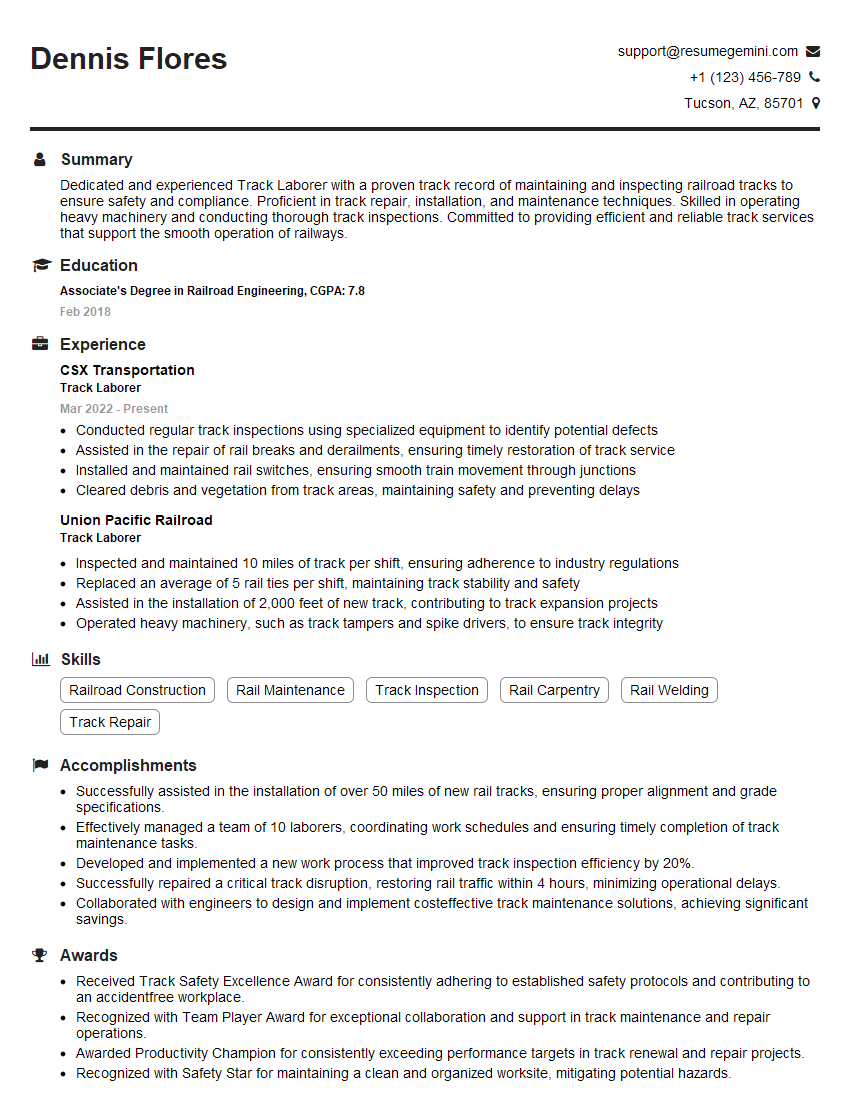
Mastering Track Surfacing opens doors to a rewarding career with excellent growth potential in the rail industry. A strong understanding of these key concepts will significantly improve your interview performance and land you your dream role. To increase your chances of getting noticed, creating an ATS-friendly resume is crucial. We recommend using ResumeGemini, a trusted resource for building professional resumes that highlight your skills and experience effectively. ResumeGemini offers examples of resumes tailored to the Track Surfacing field, helping you showcase your qualifications in the best possible light.
Explore more articles
Users Rating of Our Blogs
Share Your Experience
We value your feedback! Please rate our content and share your thoughts (optional).
What Readers Say About Our Blog
Very informative content, great job.
good