The right preparation can turn an interview into an opportunity to showcase your expertise. This guide to Wardrobe and Costume Design interview questions is your ultimate resource, providing key insights and tips to help you ace your responses and stand out as a top candidate.
Questions Asked in Wardrobe and Costume Design Interview
Q 1. Describe your experience with different fabric types and their suitability for various costumes.
Understanding fabric properties is crucial for costume design. Different fabrics offer unique characteristics impacting drape, texture, and suitability for specific characters and scenes. For instance,
- Silk: Luxurious and drapes beautifully, ideal for elegant gowns or period pieces. However, it’s delicate and requires careful handling, making it unsuitable for active fight scenes.
- Cotton: Durable, breathable, and easy to care for, perfect for everyday wear or casual costumes. Different cotton weaves (e.g., poplin, calico) offer varying levels of stiffness and texture.
- Wool: Warm and naturally insulating, good for historical or winter costumes. Its texture and weight can be advantageous for creating specific silhouettes, but it can be difficult to work with and may require specialist dry cleaning.
- Linen: Breathable and durable, often chosen for its crispness in summer costumes. It can wrinkle easily but its natural texture can lend itself to specific period designs.
- Synthetic fabrics (Polyester, Nylon, Spandex): Versatile and offer various properties, such as stretch, water resistance, and durability. Useful for creating special effects or incorporating movement into costumes, though they may not offer the same breathability or historical authenticity as natural fibres.
My experience encompasses working with a wide range of fabrics, allowing me to select the most appropriate material for each costume based on the character’s personality, the production’s setting, and the required movement and durability.
Q 2. Explain your process for sourcing and budgeting costume materials.
Sourcing and budgeting materials involves a multi-step process. It starts with a thorough reading of the script and collaborating with the director and other designers to establish a clear visual direction for the costumes.
- Research: I extensively research appropriate fabrics, trims, and embellishments, considering both aesthetic and budgetary requirements. This includes sourcing from local fabric stores, online retailers, and specialized suppliers.
- Estimating: Once the designs are finalized, I create detailed material lists including quantity and cost per item. This allows for precise budgeting. I always include a contingency for unforeseen issues, like fabric shrinkage or damage.
- Negotiation: I negotiate prices with suppliers, always looking for the best value while maintaining quality. I’m experienced in securing discounts for bulk purchases.
- Tracking: Throughout the production, I meticulously track all material purchases and expenditures, ensuring that the budget is adhered to. This involves maintaining detailed spreadsheets and records.
For example, for a period piece set in the 18th century, I might source authentic-looking fabrics from specialized suppliers while finding more affordable options for undergarments or less visible pieces. Balancing authenticity with budget is a key skill.
Q 3. How do you manage alterations and repairs during a production?
Alterations and repairs are inevitable during a production. Actors’ bodies change, accidents happen, and costumes inevitably show wear and tear.
- Quick Response Team: I ensure a dedicated team is in place during rehearsals and performances, ready to handle minor adjustments and emergency repairs.
- Detailed Documentation: Each costume is meticulously documented with detailed notes on construction, adjustments made during fittings, and potential weak points. This is crucial for quick and efficient repair.
- Emergency Kit: An emergency kit is prepared and readily accessible, containing essential tools, needles, threads, safety pins, and common repair materials.
- Prioritizing Repairs: Repairs are prioritized based on their urgency and impact on the performance. Minor issues might be addressed during breaks, while major issues require immediate attention.
For example, a torn seam on a historically accurate costume might be mended invisibly using period-appropriate techniques, ensuring the integrity of the design is maintained. Similarly, if an actor gains or loses weight, quick and discreet alterations can be made backstage.
Q 4. How do you collaborate effectively with other departments (e.g., set design, actors)?
Effective collaboration is paramount. I maintain open communication with the set designer, director, and actors from the beginning stages of the project.
- Early Consultation: I participate in initial design meetings to discuss the overall aesthetic, color palettes, and the practical aspects of the costumes in relation to the set. For instance, the texture and color of a costume might need to complement the set design.
- Actor Fittings: Multiple fittings are scheduled, offering actors opportunities to provide feedback on comfort, movement, and overall fit. These are collaborative discussions to ensure the costumes function well for the actor’s performance.
- Regular Communication: I maintain open communication throughout the entire process to ensure all parties are informed of any changes, challenges, or potential issues that may arise.
- Respectful Dialogue: I foster a respectful and collaborative environment where all voices are heard. It is essential to have open and honest discussion to find solutions.
For example, the set designer might choose certain fabrics or textures to reflect the setting of the play, which I would consider when selecting materials for the costumes. The actor’s preferences also hold significant weight, aiming for both costume accuracy and comfort.
Q 5. Describe your experience with historical costuming.
Historical costuming requires meticulous research and attention to detail. It’s not just about replicating clothing; it’s about understanding the social, cultural, and technological context of the period.
- Research & Accuracy: I utilize primary and secondary sources like paintings, written records, and museum collections to achieve historical accuracy. This includes understanding the construction techniques, fabrics, and embellishments of the era.
- Silhouette & Detail: I pay attention to specific historical silhouettes, including waistlines, necklines, and sleeve styles, and to the details such as embroidery, buttons, and lacing techniques. Each detail adds authenticity.
- Fabric Selection: The selection of fabrics is crucial. I strive to use fabrics as close as possible to those used in the period, considering their availability and cost. Authenticity sometimes requires compromises.
- Underlying Structures: I understand the construction of underlying garments, like corsets, stays, and petticoats, and their impact on the overall silhouette. This is particularly important for accurate representations of historical garments.
For instance, designing a costume for a Victorian-era character involves understanding the social conventions of the time and the layered nature of the clothing. This will involve research on fabrics, construction methods, and even the type of undergarments used. I consider the character’s social standing when choosing materials and embellishments.
Q 6. What software programs are you proficient in (e.g., CAD, Illustrator)?
Proficiency in design software is essential for efficient and precise costume design. I am proficient in:
- Adobe Illustrator: I use Illustrator for creating detailed costume sketches, technical drawings, and patterns. It allows for precise measurements and adjustments.
- Adobe Photoshop: Photoshop helps in creating color palettes, manipulating images for reference, and creating mood boards.
- CAD Software (e.g., CLO3D): I use CAD software to create 3D models of costumes, enabling virtual fittings and experimentation with different designs and fabrics before actual construction. This significantly reduces time and cost.
I also utilize various other digital tools for communication and project management, such as project management software and collaboration platforms, which improve the speed and precision of the design process.
Q 7. How do you ensure the safety and comfort of actors in their costumes?
Actor safety and comfort are top priorities. I design costumes that allow for freedom of movement, prevent injury, and respect the actor’s physical needs.
- Safe Materials: I select materials that are fire-retardant, particularly for period costumes using flammable fabrics like velvet or silk. This is a legal requirement in most productions.
- Fit & Movement: I ensure costumes fit comfortably and allow for the full range of movement required by the performance. This involves careful consideration of the actor’s body type and the nature of the role.
- Hidden Adjustments: I use techniques to provide hidden support or adjustments, such as built-in corsets or supportive undergarments, without compromising the aesthetic of the costumes. This might include using elastic or other supportive fabrics strategically.
- Feedback & Adjustments: I encourage continuous feedback from actors throughout the process. This ensures that any potential discomfort or safety concerns are addressed promptly.
For example, if a costume includes long trains or intricate accessories, I consider ways to modify it to prevent tripping or accidental damage. I would also ensure that any accessories, like jewellery, are securely fastened to prevent loss or injury.
Q 8. Explain your approach to creating a cohesive wardrobe for a film/stage production.
Creating a cohesive wardrobe starts long before the first stitch is sewn. It’s a collaborative process deeply intertwined with the story’s narrative, character arcs, and the director’s vision. My approach involves several key steps:
Initial Consultation and Research: I begin by thoroughly reviewing the script, understanding the setting, time period, and character relationships. Extensive research into the historical period, social class, and geographical location is crucial for accuracy and authenticity. For example, if designing for a Victorian-era drama, I’d delve into fashion plates, historical photographs, and museum archives to ensure period-appropriate silhouettes, fabrics, and accessories.
Mood Boards and Sketches: Visualizing the overall aesthetic is key. I create mood boards incorporating color palettes, fabric swatches, and image references. These boards act as a blueprint, guiding the design process. I then move to sketching individual costume designs, paying attention to details like silhouette, embellishments, and overall fit.
Collaboration with Director and Other Departments: Open communication with the director is vital. Understanding their artistic vision and aligning my designs with their interpretation of the characters is paramount. I also work closely with the set designer to ensure the costumes complement the overall visual landscape of the production.
Fabric Selection and Sourcing: The choice of fabrics greatly impacts the final look and feel. I meticulously select fabrics considering their texture, drape, color, and cost-effectiveness. This involves sourcing from various vendors and considering factors like availability and budget constraints. For instance, using a heavy brocade for a wealthy character versus a simple linen for a peasant would visually communicate their social standing.
Construction and Fitting: Once designs are finalized, the costumes are constructed, often by a team of skilled seamstresses. Multiple fittings are conducted to ensure a perfect fit and to make necessary adjustments. This is a crucial stage where the design comes to life and where any minor flaws can be corrected.
By following this methodical approach, I ensure the wardrobe not only looks visually stunning but also serves the narrative, enhancing character development and storytelling.
Q 9. How do you handle unexpected issues or challenges during a production run?
Unexpected issues are inevitable in any production. My approach to handling them involves a combination of proactive planning and resourceful problem-solving.
Contingency Planning: I always maintain a backup plan. This includes having extra fabric, readily available alternative designs, and a network of reliable seamstresses who can quickly address unexpected repairs or alterations. For instance, if a crucial costume is damaged, a backup version should be readily available.
Quick Thinking and Resourcefulness: When a problem arises, I assess the situation calmly, identifying the root cause and devising a solution rapidly. This may involve creatively repurposing existing garments, using readily available materials, or adjusting the script slightly to accommodate a costume malfunction. On one occasion, a crucial button broke right before a performance; I swiftly replaced it with a similar one from my emergency kit.
Effective Communication: Open and honest communication with the director, actors, and other members of the production team is essential. Keeping everyone informed of any challenges and collaboratively finding solutions minimizes delays and maintains a smooth workflow.
Problem-Solving Skills: My experience has honed my problem-solving skills. I can quickly adapt to changing circumstances, improvising solutions while staying within budget and schedule constraints.
Essentially, my ability to handle unexpected issues relies on preparedness, creativity, and effective communication – all traits vital for success in fast-paced production environments.
Q 10. Describe your experience with different sewing techniques.
My sewing techniques encompass a broad range, acquired over years of practice and professional experience. I am proficient in various hand-sewing techniques including:
Basic Stitches: Running stitch, backstitch, basting, slip stitch, blanket stitch etc., forming the foundation of garment construction.
Advanced Stitches: French seams, felled seams, bound buttonholes, and tailored techniques for creating structured garments.
Embroidery and Decorative Stitches: I am skilled in various embroidery techniques, adding decorative details to costumes and enhancing their overall aesthetic.
Furthermore, I have extensive experience with machine sewing, including:
Pattern Making and Cutting: Creating and adapting patterns to achieve the desired fit and silhouette.
Various Machine Stitches: Straight stitch, zigzag stitch, blind hem stitch, and other specialized stitches used for different garment constructions.
Industrial Sewing Machines: I am proficient with various industrial machines, enabling efficient and high-quality production for large projects.
I view sewing as both an art and a craft, combining technical proficiency with creative expression. My skills allow me to create costumes ranging from simple peasant garments to elaborate period pieces, effectively meeting the demands of diverse productions.
Q 11. How do you manage a large costume inventory?
Managing a large costume inventory involves a systematic approach that ensures efficiency and accuracy. This typically involves:
Detailed Inventory Database: Maintaining a comprehensive database, often using specialized software, is crucial. Each costume is meticulously cataloged with details such as garment type, size, materials, condition, and location. This allows for easy tracking and retrieval.
Organized Storage: Proper storage is essential to preserve the condition of the costumes. This includes using appropriate garment bags, hangers, and storage containers to protect from damage, pests, and environmental factors. A well-organized storage system minimizes searching time and ensures easy access.
Regular Maintenance and Cleaning: Costumes need regular maintenance including cleaning, repairs, and alterations. A schedule should be set to inspect costumes for damage and address any issues promptly. This extends the life span of the costumes and minimizes the risk of accidents during performances.
Regular Inventory Audits: Periodic audits confirm the accuracy of the inventory database and identify any missing or damaged items. This helps in identifying areas for improvement and helps in making timely adjustments in maintenance or procurement.
Digital Photography & Documentation: Photographs of each costume along with detailed descriptions assist in organizing and managing the inventory, especially when dealing with a large number of items.
By using these strategies, I ensure efficient management of the inventory, guaranteeing costumes are readily available in good condition whenever needed.
Q 12. Explain your experience with creating period-specific costumes.
Creating period-specific costumes demands meticulous research and attention to detail. My experience encompasses a wide range of historical periods. For example, recreating costumes for a Shakespearean play necessitates understanding the Elizabethan era’s fashion trends including ruffs, farthingales, and specific fabric choices. Researching contemporary paintings, portraits and written documents provides crucial insights into the era’s aesthetic.
For a Regency-era drama, I would focus on the elegant silhouettes, the use of fine fabrics like silk and muslin, and specific details like high waistlines, empire cuts, and delicate embellishments. Understanding the social hierarchies of the time is vital as costumes reflect the social standing of the characters.
In each case, accuracy is paramount. I collaborate with historical consultants when needed, ensuring authentic representation. This includes paying close attention to:
Silhouette: The overall shape and form of the garment, specific to the period.
Fabric and Materials: Using historically accurate fabrics and construction techniques.
Embellishments: Lace, embroidery, buttons, and other details are carefully selected to reflect the period’s aesthetic.
Accessories: Hats, jewelry, and other accessories are chosen to complete the look and reflect the character’s social status and personality.
The accuracy of period costumes is not merely about aesthetics; it enhances the believability of the production and enriches the audience’s experience.
Q 13. How do you interpret a director’s vision and translate it into costume design?
Interpreting a director’s vision and translating it into costume design is a crucial aspect of my role. It involves active listening, observation, and a collaborative approach.
Initial Discussions and Concept Meetings: I engage in extensive discussions with the director to thoroughly understand their artistic vision. We discuss the characters, their motivations, relationships, and overall tone of the production.
Script Analysis and Character Development: A deep understanding of the script is fundamental. I analyze each character’s personality, social standing, and arc to guide my design choices. For example, a character undergoing a transformation might be visually represented through a change in costume style.
Visual Inspiration and Reference Materials: I use mood boards, sketches, and visual reference materials to demonstrate my interpretation of the director’s vision. Sharing my ideas through visuals facilitates a shared understanding.
Flexibility and Collaboration: I maintain flexibility and openness to feedback, incorporating the director’s suggestions and adjustments throughout the design process. This collaborative approach ensures the costumes effectively communicate the director’s artistic intention.
Communication and Feedback: Ongoing communication is crucial. I ensure frequent feedback sessions with the director to ensure alignment and address any concerns or modifications.
The final costumes are a culmination of collaborative effort. My expertise in design and construction meets the director’s artistic direction, creating a harmonious and compelling visual narrative.
Q 14. Describe your experience with fitting and altering costumes on actors.
Fitting and altering costumes on actors requires patience, precision, and a strong understanding of human anatomy and tailoring techniques. It is a crucial step that ensures the costumes are comfortable, functional, and enhance the actors’ performance.
Initial Measurements and Muslin Fittings: Before final construction, I take precise measurements of the actors. I often make muslin mock-ups (prototype garments made from inexpensive fabric) for initial fittings. These allow for adjustments to the pattern and ensure a perfect fit before using expensive fabrics.
Multiple Fittings: Multiple fittings are usually necessary to fine-tune the costumes. These allow for adjustments to the fit, length, and other details. I use pins and marking tools during fittings to indicate areas for alteration.
Alterations and Adjustments: Alterations can range from simple adjustments like shortening sleeves to more complex changes like altering the bodice or skirt. I address issues with fit, comfort, and movement ensuring the costumes don’t restrict the actors’ performance.
Collaboration with Actors: I encourage communication with actors during fittings. Their feedback regarding comfort, movement restrictions, and overall feel is crucial. This collaborative approach ensures the costumes are not only visually appealing but also functional and comfortable for the performers.
Final Fitting and Approval: The final fitting ensures the costumes are perfect and ready for performance. Any minor adjustments are made, and the actors approve the final fit before the costumes are used in the production.
Proper fitting is essential; it allows the actors to move freely and comfortably, enhancing their performances and the overall visual impact of the production.
Q 15. How do you manage a team of wardrobe assistants or technicians?
Managing a wardrobe team requires strong leadership, clear communication, and a collaborative spirit. I believe in fostering a positive and efficient work environment where everyone feels valued and empowered. My approach involves:
- Clear Delegation and Responsibility: I assign tasks based on individual skills and experience, ensuring everyone understands their roles and deadlines. This might involve assigning a lead assistant for each actor or a specific area like laundry or alterations.
- Open Communication and Feedback: Regular team meetings are crucial to discuss progress, address challenges, and provide constructive feedback. I encourage open dialogue and create a safe space for team members to share their ideas and concerns.
- Effective Time Management: Wardrobe is often under pressure, so meticulous planning and scheduling are essential. I use project management tools to track deadlines and allocate resources efficiently. This might include creating detailed call sheets for each day of shooting.
- Mentorship and Training: I actively mentor and train my assistants, providing opportunities for professional development and skill enhancement. This could involve demonstrating advanced techniques or offering feedback on their work.
- Problem-Solving as a Team: When challenges arise (a ripped costume, a missing accessory), I encourage collaborative problem-solving, drawing on the team’s collective knowledge and resourcefulness. For example, we might brainstorm quick repairs or find creative solutions using on-hand resources.
For example, during a recent theatre production, I successfully managed a team of five assistants through a demanding three-week rehearsal and performance schedule by employing this system, resulting in flawless wardrobe changes and minimal issues.
Career Expert Tips:
- Ace those interviews! Prepare effectively by reviewing the Top 50 Most Common Interview Questions on ResumeGemini.
- Navigate your job search with confidence! Explore a wide range of Career Tips on ResumeGemini. Learn about common challenges and recommendations to overcome them.
- Craft the perfect resume! Master the Art of Resume Writing with ResumeGemini’s guide. Showcase your unique qualifications and achievements effectively.
- Don’t miss out on holiday savings! Build your dream resume with ResumeGemini’s ATS optimized templates.
Q 16. Explain your process for designing and creating custom-made costumes.
Designing and creating custom costumes is a meticulous process that requires creativity, technical skill, and a deep understanding of the character and the overall production. My process typically follows these steps:
- Initial Consultation and Research: I start by meeting with the director and actors to discuss the character’s personality, backstory, and any specific costume requirements. This might involve reviewing the script, studying historical references, or analyzing existing artwork.
- Design Development: Based on the consultation, I create sketches and mood boards to visualize the costume designs. I explore different fabrics, colors, and silhouettes to find the most appropriate aesthetic.
- Pattern Making and Drape: I create patterns, either by drafting them from scratch or modifying existing ones. For complex designs, I might use draping techniques to achieve the desired fit and shape on a dress form. This involves manipulating fabric directly on the form to create the desired form.
- Fabric Selection and Sourcing: The choice of fabric significantly impacts the final look and feel of the costume. I carefully select fabrics that are appropriate for the character, the period, and the production environment (e.g., stage, screen, location). I might research sustainable options or use vintage materials for specific projects.
- Construction: This involves cutting, assembling, and finishing the garment. I may collaborate with specialized artisans for certain techniques, such as embroidery or beading.
- Fitting and Alterations: Multiple fittings are crucial to ensure the costume fits perfectly and functions well. I make any necessary adjustments to achieve the desired fit and comfort for the actor.
- Final Touches and Accessories: Once the construction is complete, I add any final details, such as buttons, embellishments, or accessories, to complete the look.
For example, creating a historical gown involved extensive research into period-appropriate silhouettes, fabric weights, and construction techniques. I sourced authentic-looking materials and employed period-specific tailoring techniques to ensure historical accuracy.
Q 17. How do you stay updated on current fashion trends and relevant technologies?
Staying current in fashion and technology is vital for a wardrobe designer. My strategies include:
- Industry Publications and Blogs: I regularly read fashion magazines, trade publications, and online blogs to track trends and new developments in fabric technology, design software, and sustainable practices.
- Attending Fashion Shows and Trade Events: Participating in fashion shows, trade fairs, and industry conferences provides firsthand exposure to the latest trends, materials, and technologies.
- Networking with Industry Professionals: Building relationships with other designers, fabric suppliers, and technicians creates opportunities for knowledge exchange and collaboration.
- Utilizing Online Resources: Online platforms offer invaluable resources for research, including digital pattern libraries, fabric databases, and online tutorials on new techniques.
- Experimentation and Continuous Learning: I continually experiment with new materials, techniques, and technologies in my own work to stay ahead of the curve and explore creative possibilities.
For instance, recently I explored 3D printing for creating intricate costume details, discovering a cost-effective and efficient approach for unique embellishments. I also discovered a new sustainable fabric supplier focused on innovative eco-friendly materials, which has significantly enhanced my ability to work more sustainably.
Q 18. How do you handle conflicting creative visions within a team?
Conflicting creative visions are inevitable in collaborative projects. My approach involves:
- Open and Respectful Dialogue: I create a safe space for everyone to express their ideas openly and respectfully. Active listening is crucial to understanding each perspective.
- Compromise and Collaboration: I guide the team towards finding common ground and solutions that incorporate elements of different visions. This might involve making modifications to designs, incorporating suggestions, or creating a hybrid approach.
- Mediation and Facilitation: If disagreements escalate, I act as a mediator, facilitating constructive conversations and helping the team reach a mutually acceptable outcome.
- Referencing the Production Goals: I often refer back to the overall goals and objectives of the production to guide decision-making. This keeps the focus on what’s best for the project as a whole.
- Documentation and Visual Aids: Using sketches, mood boards, and fabric swatches helps clarify different visions and enables more concrete discussion.
For instance, in a previous project, the director and actor had differing opinions on the character’s costume. By facilitating a discussion, we reached a compromise that incorporated aspects of both ideas, resulting in a costume that fulfilled both the director’s vision and the actor’s comfort needs.
Q 19. Describe your experience with pattern making and drafting.
Pattern making and drafting are fundamental skills for any costume designer. My experience encompasses both flat pattern drafting and draping techniques. I’m proficient in creating patterns for various garments, from basic to complex designs.
Flat Pattern Drafting: This involves creating two-dimensional patterns on paper based on standard body measurements and design specifications. I use various drafting methods, including the sloper method which creates a basic pattern from which other designs can be derived. I’m adept at using software such as Adobe Illustrator for precision and efficiency.
Draping: This involves manipulating fabric directly on a dress form to create a three-dimensional pattern. This technique is particularly useful for creating unique or avant-garde designs or when working with unconventional fabrics. This approach allows for greater fluidity and adaptability in shape and drape.
My skills encompass a range of garment types, including dresses, skirts, trousers, jackets, and coats. I understand the principles of fit, ease, and grainline and am able to adjust patterns to accommodate different body types and design requirements. I frequently refer to reference books, industry standards, and my years of practical experience when developing patterns.
Q 20. How do you maintain the integrity and accuracy of historical costumes?
Maintaining the integrity and accuracy of historical costumes requires meticulous research, attention to detail, and a deep understanding of historical fashion. My process involves:
- Extensive Research: I thoroughly research the historical period, analyzing artwork, literature, and surviving garments to accurately recreate details.
- Authentic Materials and Techniques: I strive to use historically accurate fabrics, construction methods, and embellishments whenever possible. This might involve sourcing period-appropriate textiles or learning traditional hand-stitching techniques.
- Collaboration with Historians and Experts: For particularly challenging projects, I collaborate with historians or other experts in historical fashion to ensure accuracy.
- Consultation of Primary Sources: I consult original documents, such as pattern books or technical manuals from the relevant time period, where possible.
- Careful Documentation: I keep detailed records of my research and construction process, including sketches, fabric swatches, and notes on construction techniques.
For example, while recreating a Victorian-era gown, I meticulously researched the appropriate silhouette, fabric weights, and construction methods for that period. I ensured the use of period-appropriate embellishments, and used hand-sewing techniques as would have been standard for the time.
Q 21. What is your experience with different dyeing and finishing techniques?
My experience with dyeing and finishing techniques is extensive, ranging from traditional methods to contemporary processes. I’m proficient in a variety of techniques, including:
- Natural Dyeing: I have experience using natural dyes derived from plants, insects, and minerals to achieve specific colors and effects. This involves understanding the properties of different dye sources and the processes involved in extracting and applying the dyes.
- Synthetic Dyeing: I’m skilled in using synthetic dyes, which offer a wider range of colors and greater control over the dyeing process. This includes an understanding of dyeing methods and the properties of various fabrics.
- Fabric Finishing Techniques: I have experience with various fabric finishing techniques, such as printing, block printing, embroidery, beading, pleating, and more, to enhance the aesthetic qualities and durability of fabrics.
- Specialty Finishes: I can implement specialty finishes such as aging, distressing, or creating specific textural effects to achieve the desired look for a particular costume.
- Understanding Fiber Properties: A critical aspect is understanding how different fibers react to various dyeing and finishing techniques. This ensures the best results and helps prevent damage to the fabric.
For example, in a recent project, I used natural indigo dyeing to create a unique, vintage-inspired effect on a collection of denim costumes. This involved researching suitable indigo sources, preparing the dye bath, and carefully controlling the dyeing process to achieve the desired shade and texture.
Q 22. How do you balance aesthetic considerations with practical limitations in costume design?
Balancing aesthetics and practicality in costume design is a constant juggling act. The ideal costume is visually stunning and perfectly embodies the character, but it also needs to be comfortable, durable, and functional for the actor within the production’s constraints. Think of it like building a beautiful house – you want it to be architecturally impressive (aesthetic), but also structurally sound, energy-efficient, and safe to live in (practical).
Collaboration is Key: Close communication with the director, actors, and other members of the design team (set design, makeup, etc.) is essential. Early discussions about the production’s overall style, the character’s movements and activities, and the performance space (stage, film set, etc.) inform design choices.
Fabric Selection: The fabric is crucial. A beautiful silk might look amazing, but it might wrinkle easily, be difficult to clean, or be too delicate for a physically demanding role. Conversely, a durable canvas might be practical, but it may not capture the desired visual texture or drape.
Construction Techniques: Clever construction methods can bridge the gap. For example, using underlining to give structure and support to a delicate fabric while retaining its aesthetic appeal. Or incorporating hidden zippers and closures to improve ease of movement and costume changes.
Compromise and Iteration: Sometimes, compromises are necessary. A design sketch might need to be adjusted to accommodate the actor’s physique or limitations of the budget. This involves a process of iteration, where we refine the design through sketches, mock-ups, and fittings to find the best balance between form and function.
Q 23. Describe a challenging project you worked on and how you overcame the obstacles.
One particularly challenging project involved designing costumes for a historical period drama set in the 18th century. The budget was extremely tight, and the time frame was incredibly compressed. Authenticity was crucial; however, sourcing period-accurate fabrics and trims proved incredibly difficult and expensive.
To overcome these obstacles, I employed several strategies:
Resourcefulness: I researched alternative, more affordable fabrics that mimicked the look and texture of the historical originals. I discovered a supplier of reproduction trims, which helped cut down on costs without compromising the overall aesthetic.
Creative Problem-Solving: We decided to use a more limited color palette, which drastically reduced the amount of fabric needed. Also, I utilized simpler construction techniques where appropriate. For instance, instead of intricate hand-stitching, we employed more efficient machine stitching techniques wherever possible.
Teamwork: I collaborated closely with the costume shop to ensure efficient production. By working together, we were able to maximize efficiency and reduce labor costs. We also prioritized certain costumes that had to be more historically accurate to the detriment of others that required less screen time.
The final result was a visually stunning and historically convincing collection of costumes, delivered on time and within the very constrained budget. It demonstrated that ingenuity and effective resource management can successfully overcome significant production challenges.
Q 24. How do you address actor concerns regarding costume comfort or fit?
Addressing actor concerns about costume comfort and fit is paramount. Uncomfortable costumes can affect an actor’s performance and overall well-being. My approach is built on open communication, empathy, and a willingness to adjust designs as needed.
Early Consultation: I always schedule fittings with the actors early in the process. This allows for adjustments before the costumes are fully constructed. It also gives me a chance to understand their body type, their movement style, and any potential sensitivities.
Proactive Problem Solving: I proactively address potential issues, such as constricting necklines, ill-fitting garments, or scratchy fabrics. This might involve altering the design, substituting fabrics, or using undergarments to smooth out lines and improve comfort.
Respectful Dialogue: I maintain open communication with the actors throughout the process, encouraging them to share their feedback. It’s important to be understanding and responsive to their concerns, even if it means making significant design changes.
Trial Runs and Adjustments: Before the actual performances or filming, I arrange trial runs where actors can wear the costumes and provide feedback. This allows for final tweaks and adjustments to ensure comfort and freedom of movement.
Ultimately, a comfortable actor is a confident actor, leading to a better performance. Addressing concerns promptly fosters a collaborative and positive working relationship.
Q 25. Explain your experience with creating special effects for costumes.
My experience with special effects in costume design ranges from subtle enhancements to elaborate transformations. I’ve worked with a variety of techniques, from traditional methods to more advanced digital solutions.
Traditional Techniques: These include techniques like distressing fabrics to create a worn or aged look, using appliqué and embroidery to add intricate details, and employing specialized paints and dyes to achieve specific color effects.
Digital Techniques: This may involve working with digital printing to create unique patterns and textures, or using CGI to enhance costumes in post-production. In one project, we used CGI to seamlessly integrate a digital fire effect onto a costume for a fantasy film.
Prosthetic Appliances: I’ve worked extensively with prosthetic appliances, collaborating with skilled prosthetics artists to create realistic wounds, scars, or even partial transformations for characters. This requires careful consideration of the actor’s comfort, the practicality of application, and the overall visual effect.
Lighting and other effects: Using strategically placed lighting, internal lighting elements, or even fiber optics to create dazzling effects is a frequently employed method. The challenge is always integrating these effects in a way that is believable and unobtrusive.
The key to successful special effects in costume design is careful planning, meticulous execution, and collaboration with other specialists, such as makeup artists, special effects technicians, and CGI artists, ensuring a seamless and impressive result.
Q 26. How do you manage your time effectively during a fast-paced production?
Time management in fast-paced productions requires meticulous planning and efficient execution. It’s crucial to stay organized and prioritize tasks effectively.
Detailed Schedules: I develop detailed schedules, breaking down the costume design process into manageable stages with clearly defined deadlines. This includes fabric sourcing, pattern making, construction, fittings, and alterations. These schedules are always shared with the production team.
Prioritization: I prioritize tasks based on urgency and importance. For instance, crucial costumes for key scenes will take precedence over costumes with less screen time. This allows me to allocate resources effectively.
Efficient Workflow: I optimize my workflow by streamlining tasks and delegating responsibilities where appropriate. This involves careful planning of the construction process, ensuring that multiple aspects of costume creation are handled simultaneously.
Communication & Flexibility: Maintaining open communication with the production team is critical. This enables me to anticipate potential delays or changes in the schedule and adjust my plans accordingly. Flexibility is essential; fast-paced environments require the ability to adapt quickly.
Employing these strategies ensures that the costumes are created efficiently and on time, even amidst the pressures of a fast-paced production.
Q 27. Describe your experience with creating budgets and managing expenses for costumes.
Budgeting and expense management are crucial aspects of costume design. I have extensive experience developing accurate budgets and managing expenses effectively, even within tight constraints.
Detailed Cost Breakdown: I begin by developing a detailed cost breakdown, factoring in every expense, from fabric and trims to labor costs and potential alterations. I always include contingency for unforeseen issues.
Source Materials Strategically: I source materials strategically, comparing prices from different suppliers and exploring cost-effective alternatives without compromising quality. This could involve using less expensive fabrics cleverly or opting for more readily available trims.
Track Expenses Meticulously: I meticulously track all expenses, maintaining detailed records of purchases and invoices. This allows me to monitor spending against the budget and identify any potential overruns early on.
Negotiation and Value Engineering: Where possible, I negotiate with suppliers for better prices and engage in value engineering, identifying ways to reduce costs without compromising the overall aesthetic or functionality of the costumes.
Through careful planning and meticulous management, I ensure that the costumes are produced within budget without sacrificing the quality or integrity of the design.
Q 28. How do you adapt your costume design process for different mediums (e.g., film, stage, television)?
Adapting the costume design process to different mediums (film, stage, television) requires understanding the unique demands of each. The same design may need significant modification to suit a different medium.
Film: Film costume design often emphasizes detail and realism, as cameras capture minute details. Durability and ease of movement are key since filming may be long and grueling. We use fabrics that hold up well under multiple takes, and I always consider how the costumes will look under specific lighting conditions.
Stage: Stage costumes require durability and visibility from a distance. Fabrics and colors must be chosen to translate well under stage lighting. The costume needs to accommodate an actor’s movements on stage, including physicality and potential choreography.
Television: Television costumes often need to balance the cinematic quality of film with the speed and efficiency of stage productions. They need to be appropriate for both close-ups and long shots, and often must stand up to multiple days of shooting.
Regardless of the medium, the core principles of design remain, but the practical considerations and technical requirements will shift depending on the unique constraints of each production. I tailor my approach to each medium by working closely with the director and other members of the production team to ensure the costumes enhance the storytelling effectively while considering the unique challenges involved.
Key Topics to Learn for Wardrobe and Costume Design Interview
- Design Principles & Aesthetics: Understanding color theory, silhouette, and historical costume styles; applying these principles to create cohesive and impactful designs.
- Fabric & Garment Construction: Knowledge of various fabrics, their properties, and draping techniques; experience with pattern making, sewing, and alterations.
- Research & Development: Conducting thorough research on historical periods, cultural references, and character development to inform costume choices; sourcing materials and collaborating with artisans.
- Budgeting & Resource Management: Developing and adhering to budgets; sourcing cost-effective materials while maintaining design integrity; efficient time management and resource allocation.
- Collaboration & Communication: Effectively communicating design concepts to directors, actors, and other team members; working collaboratively to achieve a unified vision.
- Problem-Solving & Adaptability: Addressing unforeseen challenges such as alterations, fabric availability, and logistical constraints; adapting designs to meet practical needs while preserving artistic vision.
- Technical Skills & Software: Proficiency in relevant design software (e.g., Adobe Photoshop, Illustrator); experience with CAD (Computer-Aided Design) for pattern making and draping; knowledge of digital printing techniques.
- Portfolio Presentation & Storytelling: Articulating the design process and rationale behind your choices; effectively showcasing your work through a compelling portfolio that tells a story.
Next Steps
Mastering Wardrobe and Costume Design opens doors to exciting careers in film, theatre, television, and fashion. A strong understanding of these principles, coupled with practical experience, significantly boosts your job prospects. To stand out, create an ATS-friendly resume that highlights your skills and experience effectively. ResumeGemini is a trusted resource that can help you build a professional resume designed to impress recruiters. Examples of resumes tailored to Wardrobe and Costume Design are available to guide you through the process.
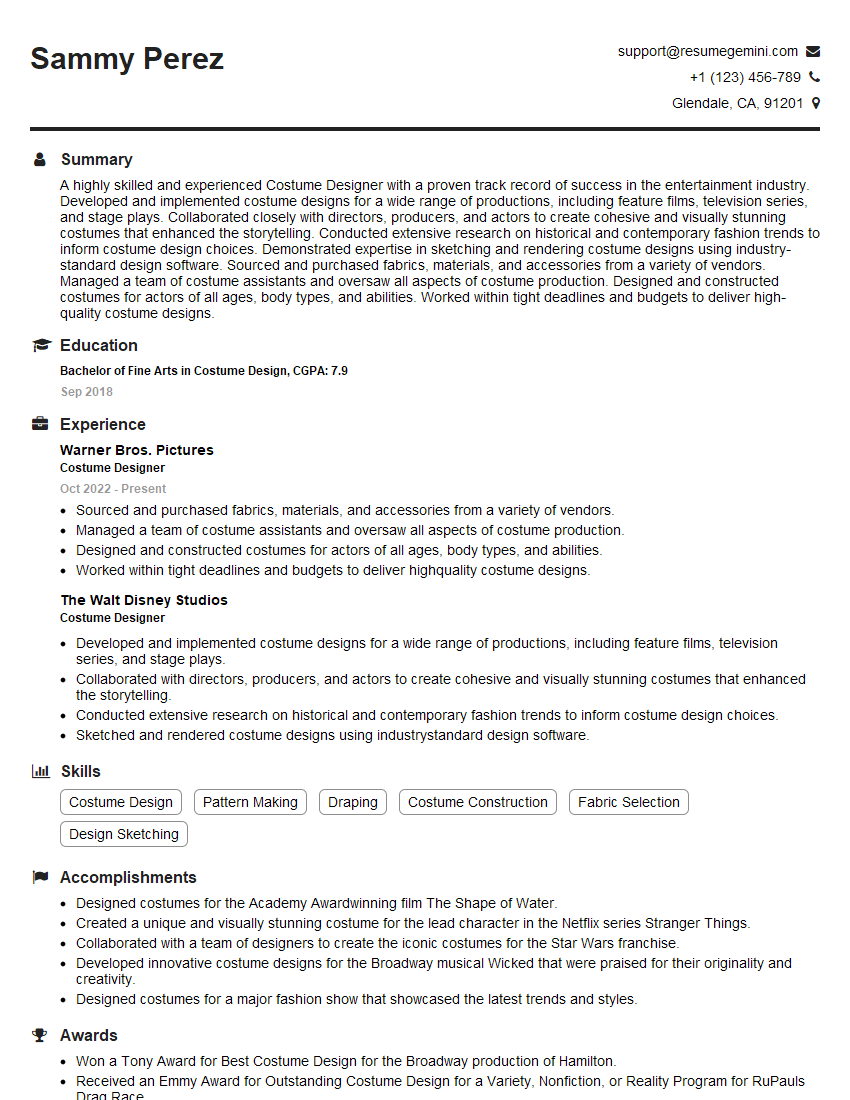
Costume Designer Resume Sample
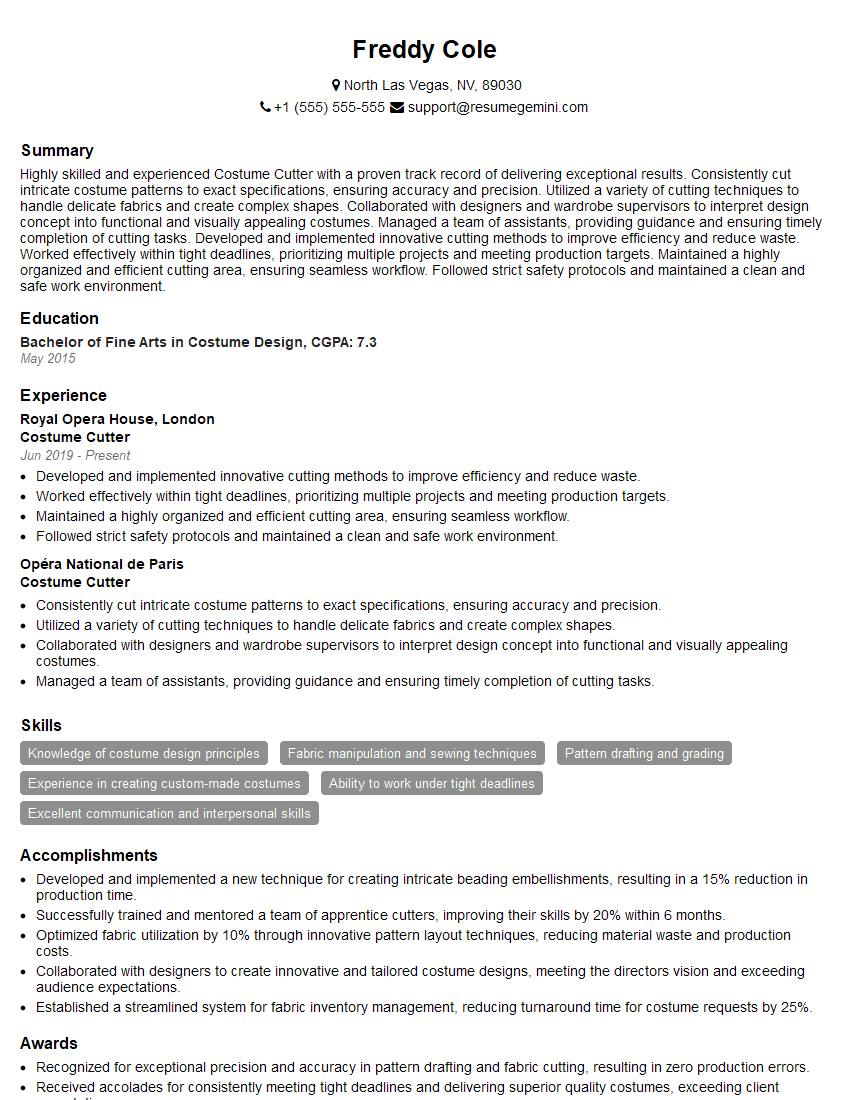
Costume Cutter Resume Sample
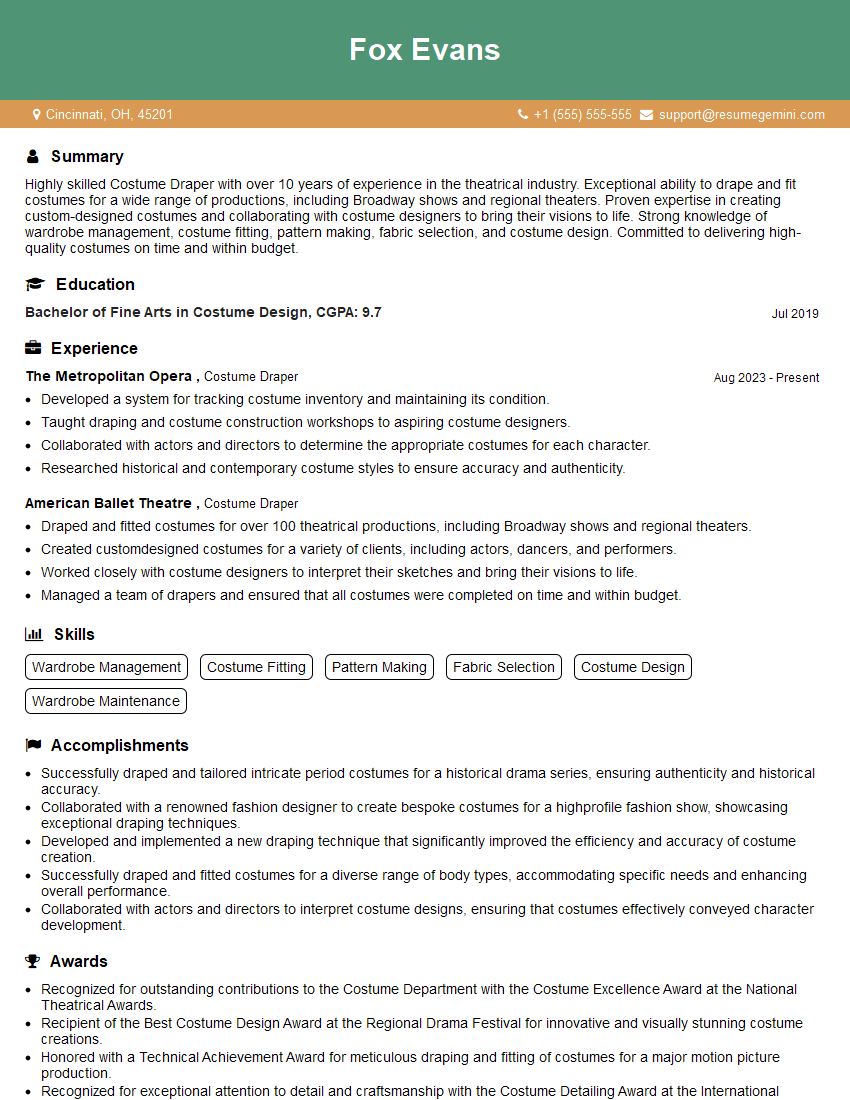
Costume Draper Resume Sample
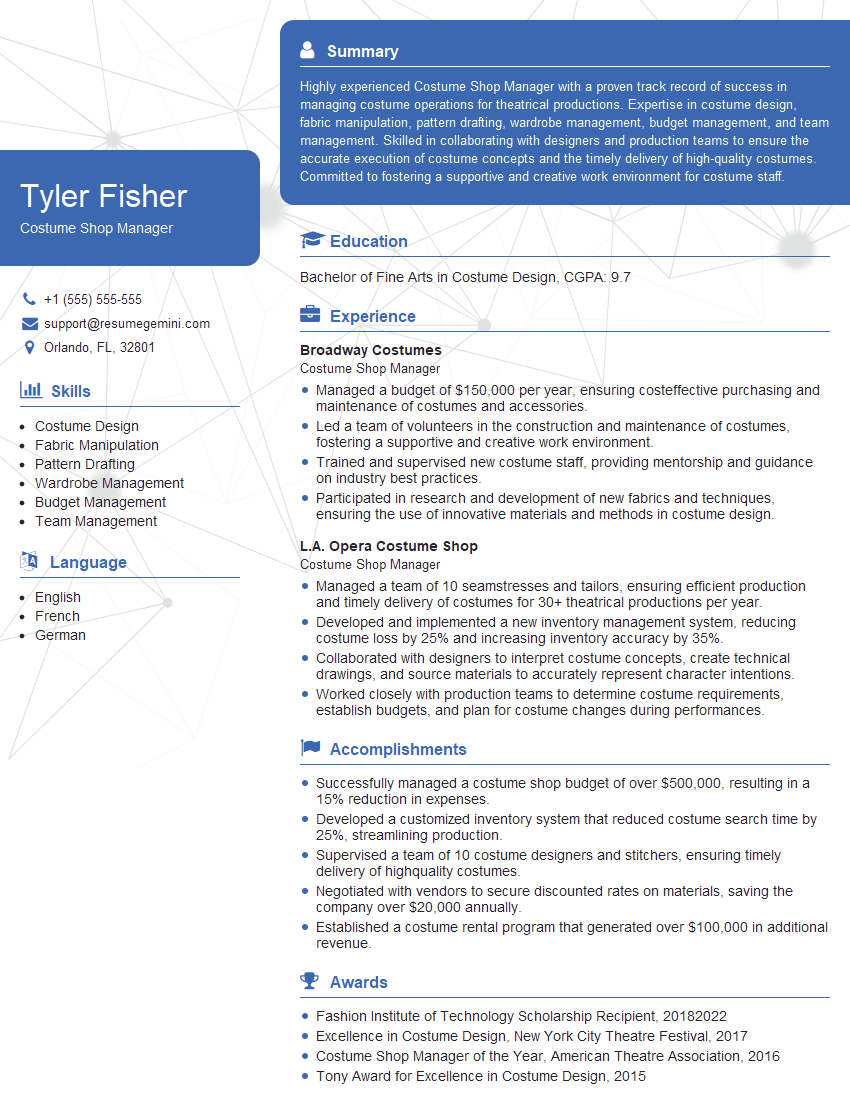
Costume Shop Manager Resume Sample
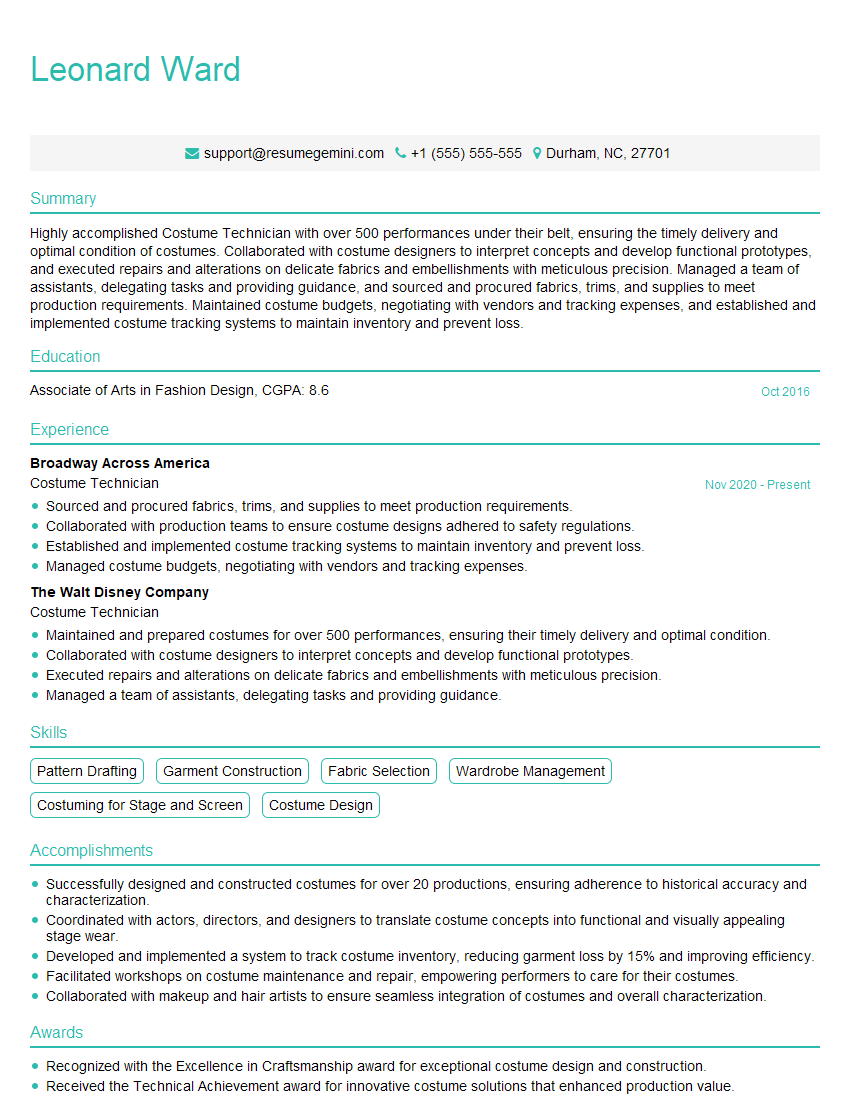
Costume Technician Resume Sample
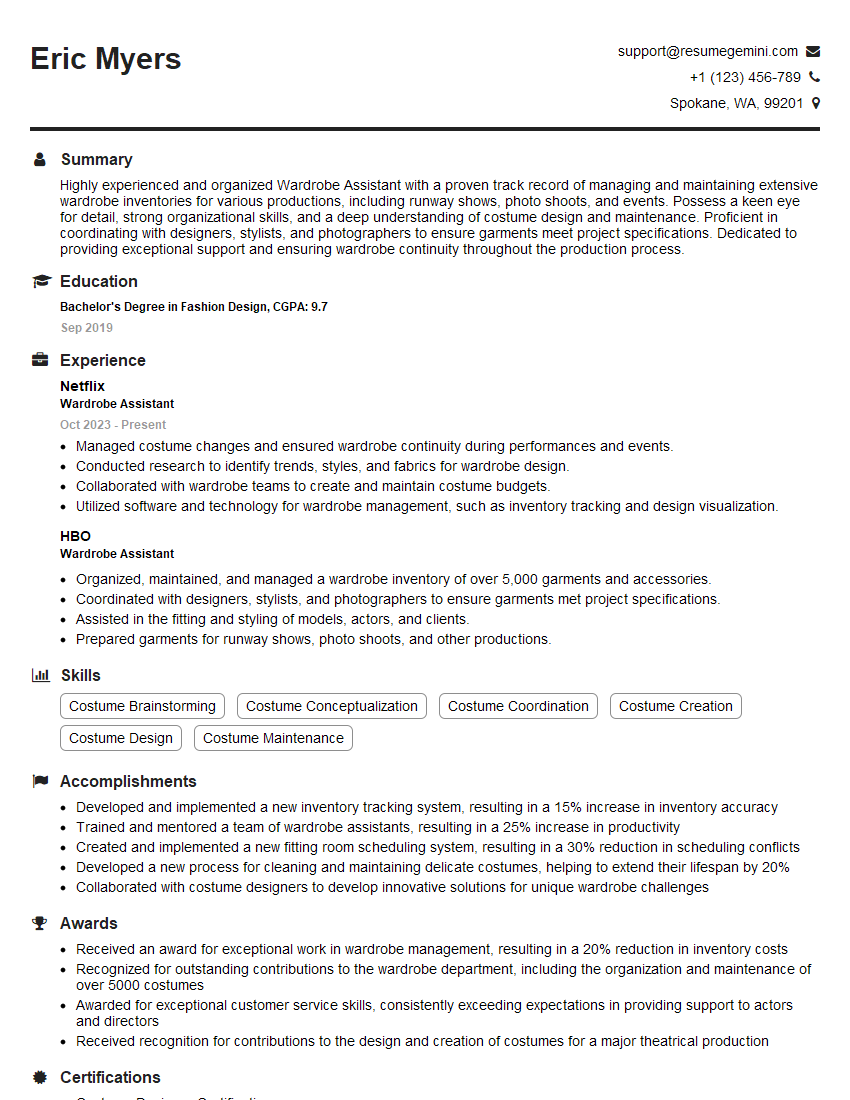
Wardrobe Assistant Resume Sample
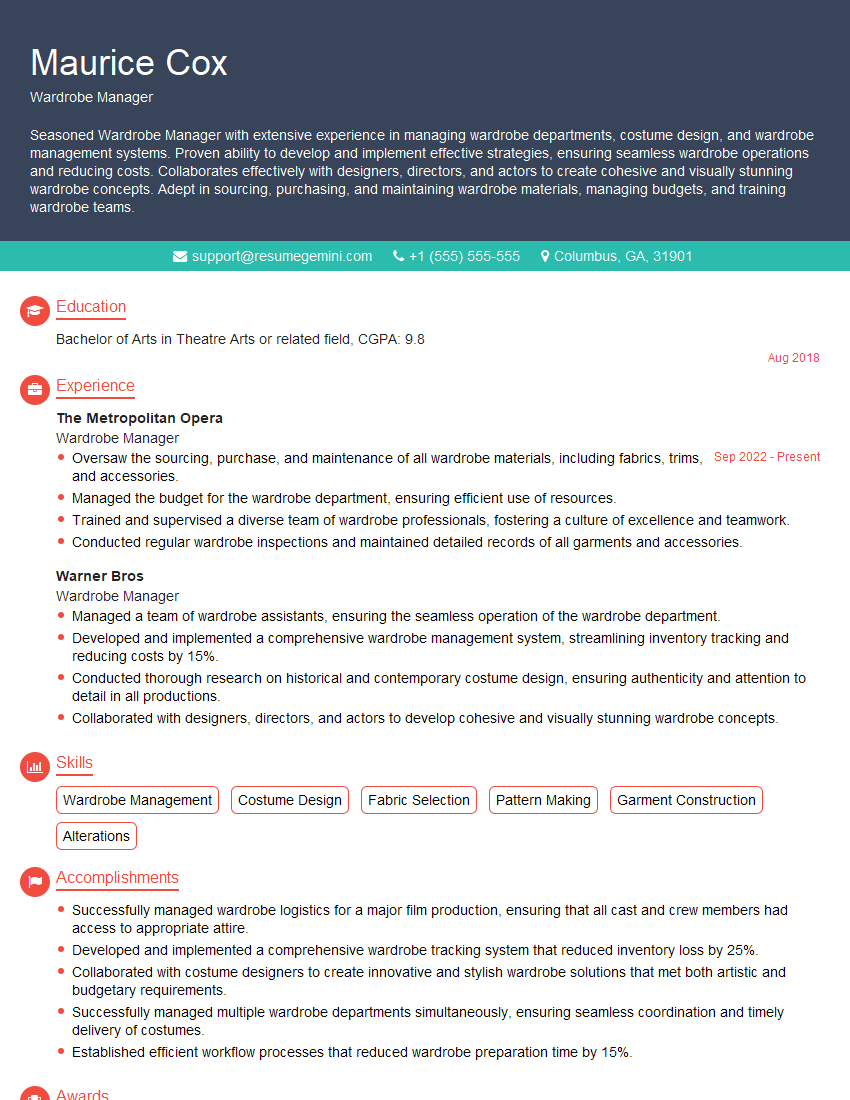
Wardrobe Manager Resume Sample
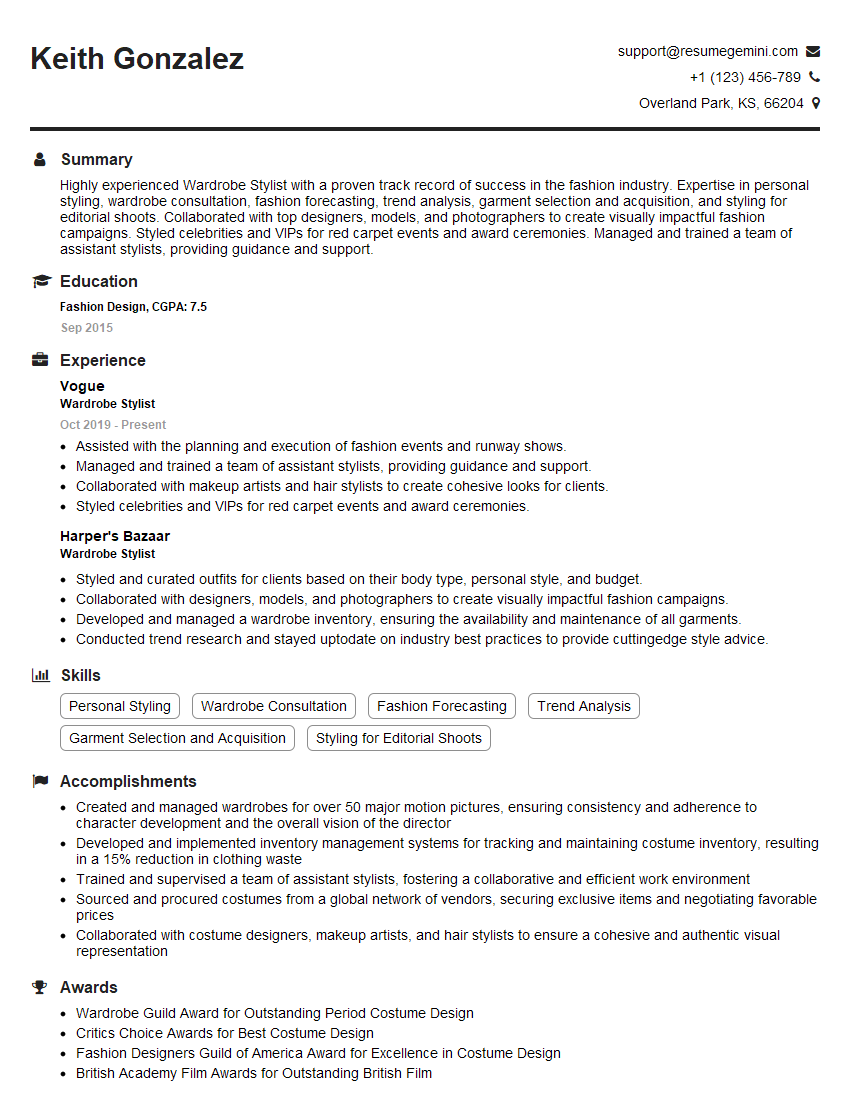
Wardrobe Stylist Resume Sample
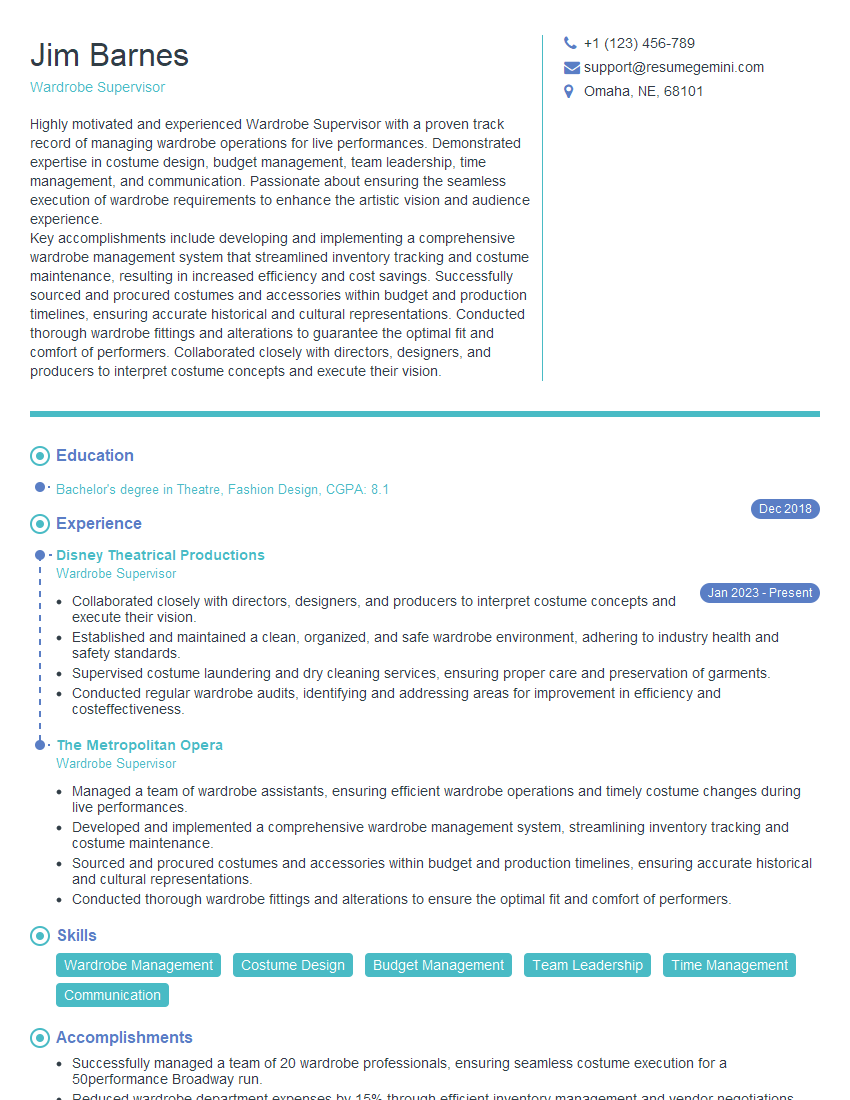
Wardrobe Supervisor Resume Sample
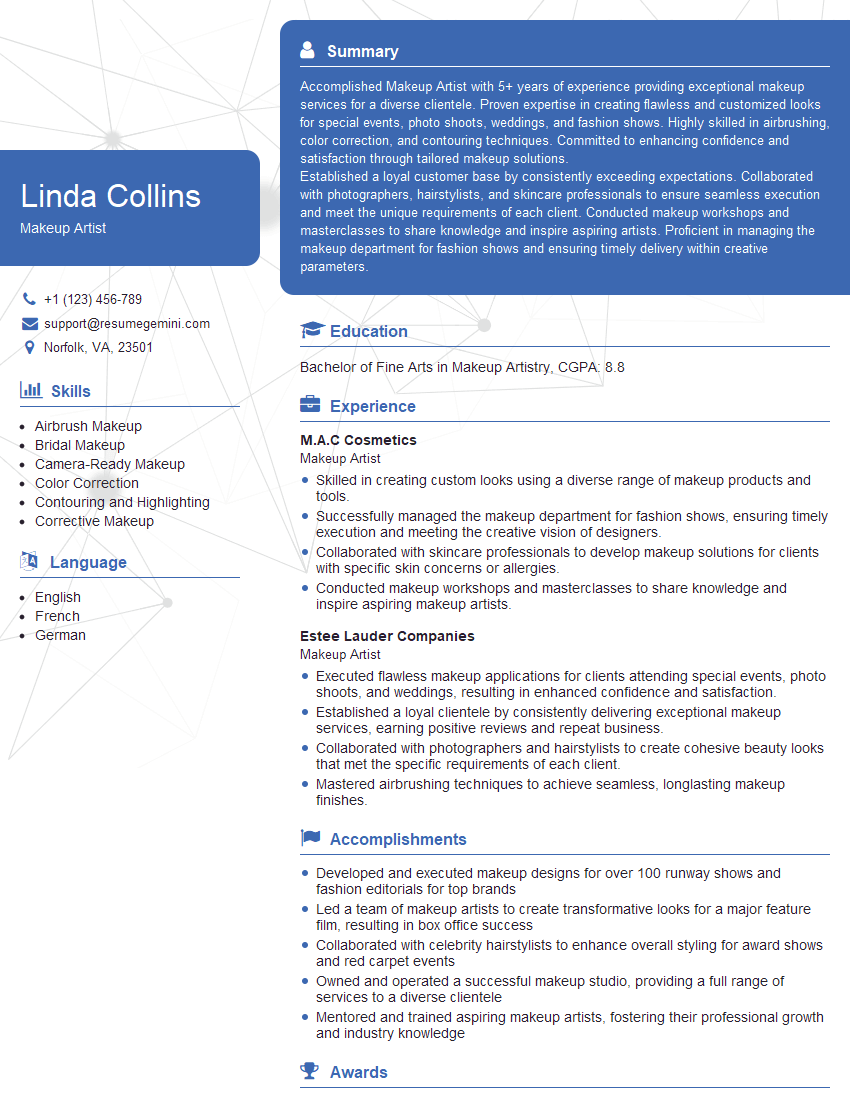
Makeup Artist Resume Sample
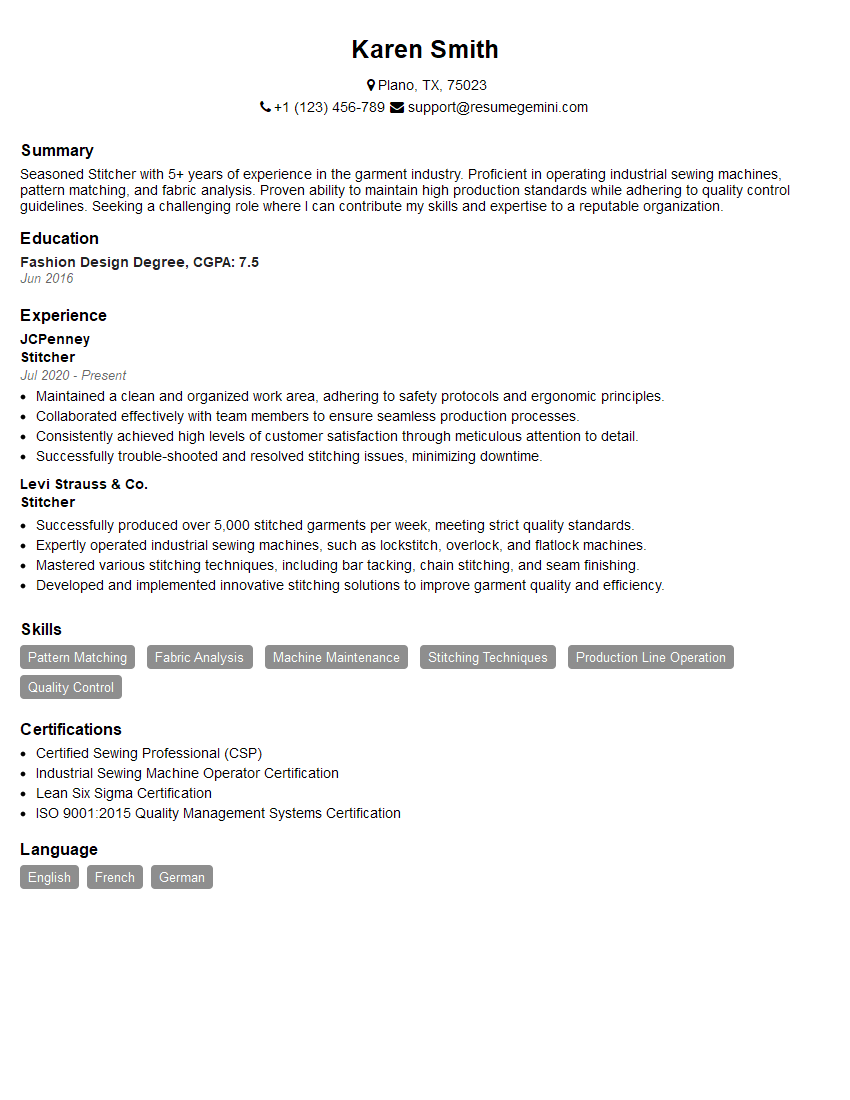
Stitcher Resume Sample
Explore more articles
Users Rating of Our Blogs
Share Your Experience
We value your feedback! Please rate our content and share your thoughts (optional).
What Readers Say About Our Blog
Very informative content, great job.
good