Unlock your full potential by mastering the most common Floral Wrapping and Presentation interview questions. This blog offers a deep dive into the critical topics, ensuring you’re not only prepared to answer but to excel. With these insights, you’ll approach your interview with clarity and confidence.
Questions Asked in Floral Wrapping and Presentation Interview
Q 1. Describe your experience with various floral wrapping techniques.
My experience with floral wrapping techniques spans a wide range, from classic bouquet wraps to more modern and artistic presentations. I’m proficient in various methods, including the spiral wrap, the hand-tied bouquet wrap, the nosegay wrap, and the presentation of flowers in boxes and baskets. The spiral wrap, for instance, is ideal for larger bouquets, creating a cohesive and elegant look. The hand-tied bouquet offers a more rustic, natural feel, and requires careful consideration of stem length and flower placement. I’ve also mastered techniques for wrapping individual stems for corsages and boutonnieres, ensuring a secure and aesthetically pleasing presentation. Each technique requires a different approach to paper handling and ribbon placement, emphasizing both structural integrity and visual appeal.
- Spiral Wrap: Creates a compact, professional look, suitable for larger arrangements.
- Hand-Tied Bouquet: Offers a more relaxed, natural aesthetic, perfect for informal events.
- Nosegay Wrap: Ideal for smaller, more delicate bouquets, emphasizing intimacy.
- Box/Basket Presentation: Allows for creative arrangement and presentation within a container.
Q 2. What types of floral wrapping paper are you familiar with?
My familiarity with floral wrapping paper extends to a wide variety of materials, each suited for different purposes and aesthetics. I regularly use tissue paper, crepe paper, cellophane, and various types of specialty wrapping papers. Tissue paper is great for its delicate texture and ability to protect delicate blooms. Crepe paper offers a more substantial feel and comes in a vast array of colors and textures, providing ample creative options. Cellophane adds a touch of modern elegance and offers excellent transparency, allowing the flowers to shine through. I also work with specialty papers like kraft paper for a rustic look, or patterned papers for festive occasions. The choice of paper is intrinsically linked to the overall aesthetic I want to achieve.
Q 3. How do you choose the appropriate wrapping materials for different flower types and occasions?
Selecting the right wrapping materials is crucial for a successful floral presentation. It’s a holistic process that considers the flower type, occasion, and desired aesthetic. For example, delicate orchids might necessitate soft tissue paper and a simple, elegant ribbon, while vibrant sunflowers could be wrapped in a more robust kraft paper with a bolder ribbon. A wedding bouquet calls for sophisticated materials, maybe a luxurious satin ribbon and high-quality paper, while a casual birthday bouquet might use more playful and colorful options. The color palette of the paper and ribbon should complement the flower colors; contrasting or complementary schemes are effective. The overall texture should also harmonize with the feel of the bouquet – a rustic bouquet might use a textured paper and twine, whereas a modern bouquet might use sleek cellophane.
Q 4. Explain your process for creating visually appealing floral arrangements.
Creating visually appealing floral arrangements begins with careful consideration of color, texture, and form. I start by selecting flowers with diverse textures and shades that complement each other. For instance, I might combine the delicate texture of baby’s breath with the bold color of roses and the unusual shape of orchids. The arrangement’s shape and size are also important – a cascading bouquet looks different from a round one. Placement of flowers is key: I ensure shorter flowers are nestled closer to the center, with taller ones reaching outward. Once the arrangement is complete, I carefully wrap it, ensuring the paper complements the flowers without overpowering them. The ribbon adds a final touch, tying the design together and echoing the occasion or the desired aesthetic.
Q 5. How do you handle delicate flowers during wrapping and presentation?
Handling delicate flowers requires a gentle touch and careful consideration. I always begin by removing any damaged or wilted petals or leaves. I use soft tissue paper to cushion the blossoms and prevent bruising during wrapping. I avoid tight wrapping, allowing for air circulation to maintain freshness. With particularly delicate flowers like lilies or orchids, I might use individual protective sleeves before wrapping the entire arrangement. The goal is to create a supportive structure that protects the flowers from damage without restricting their natural beauty.
Q 6. Describe your experience with ribbon tying and decorative elements in floral wrapping.
Ribbon tying and decorative elements are integral to the overall presentation. I’m proficient in various ribbon-tying techniques, from simple bows to more elaborate knots, choosing the type of ribbon – satin, grosgrain, burlap, or raffia – to match the overall style. I often incorporate additional decorative elements, like sprigs of greenery, small charms, or personalized tags, to enhance the aesthetic. The placement and style of these elements should be balanced and deliberate; too much decoration can detract from the flowers’ beauty. For instance, a simple, elegant bow complements a classic bouquet, whereas a more rustic arrangement might utilize twine and sprigs of eucalyptus.
Q 7. How do you ensure the longevity and freshness of flowers during presentation and transport?
Ensuring the longevity and freshness of flowers during presentation and transport involves several key steps. I start by ensuring the flowers are properly hydrated before wrapping. I use water-filled floral tubes or sleeves for individual stems. Choosing the right wrapping material is crucial; breathable materials prevent moisture buildup, which can cause premature wilting. During transport, I protect the arrangement from extreme temperatures and direct sunlight. I might include a cooling pack for longer journeys. Finally, I provide clear instructions to the recipient on how to care for the flowers properly – this includes keeping the flowers in a cool spot away from direct sunlight and changing the water regularly.
Q 8. What are some common challenges you encounter in floral wrapping and how do you overcome them?
One of the biggest challenges in floral wrapping is maintaining the flowers’ freshness and preventing damage during transport. Wilting, bruising, and stem breakage are common issues. To overcome these, I prioritize using appropriate wrapping materials. For instance, I use breathable paper like tissue paper to prevent moisture buildup, which causes wilting. For delicate blooms, I incorporate protective cushioning, like floral foam or soft padding, to avoid bruising. Furthermore, I carefully secure stems with floral tape, creating a stable base that prevents shifting and breakage during transit. Proper hydration is key; I always ensure the stems are cut and rehydrated before wrapping, and sometimes include small water packs within the wrapping to prolong vase life. For example, I learned early on that tightly wrapping thirsty flowers, like sunflowers, without water packs results in rapid wilting. It’s all about careful planning and attention to detail.
Q 9. How do you adapt your wrapping techniques to different budgets and customer preferences?
Adapting to different budgets and preferences involves creative problem-solving. For budget-conscious clients, I might suggest using more affordable but equally attractive materials, like simple kraft paper instead of luxurious ribbon. I can achieve a similar aesthetic effect by focusing on the artistry of the arrangement itself, using interesting textures and color combinations to make up for a less expensive wrapping. On the other hand, for clients with a higher budget, I’d explore the use of premium materials – perhaps hand-dyed silks, unique patterned papers, or elegant ribbons in complementary colors. I always maintain open communication with the client, presenting a range of options that reflect their budget and desired aesthetic, from rustic charm to sophisticated elegance. I’ll show them examples of different wrapping styles and materials so they can visualize the finished product. For example, for a rustic wedding bouquet, I might use burlap and twine, while a modern bridal bouquet would warrant elegant satin ribbons and a sleek box.
Q 10. How familiar are you with different floral arrangement styles (e.g., round, cascading, linear)?
I’m very familiar with various floral arrangement styles. The round bouquet is classic and versatile, emphasizing symmetry and balance. The cascading bouquet, often seen in weddings, creates a dramatic, flowing effect, letting the flowers cascade down elegantly. A linear bouquet, on the other hand, features a more structured, graphic design, using long, flowing lines and often incorporating foliage. I also have experience with other styles, such as hand-tied bouquets (casual and relaxed), nosegays (compact and tightly arranged), and crescent bouquets (half-moon shaped). Understanding these styles allows me to choose the most appropriate design for each occasion and customer preference, and to select the best wrapping to complement the style and the flowers.
Q 11. What software or tools are you proficient in for designing floral arrangements?
While I don’t use specific software for designing *floral wrapping* per se, I utilize design software for floral arrangement creation, which directly impacts the wrapping choices. I am proficient in programs like Adobe Photoshop and Illustrator to create visual mockups and explore color palettes. This allows me to visualize the arrangement’s overall look and choose wrapping materials that perfectly complement the design. For example, using Photoshop to visualize color combinations ensures that the wrapping won’t clash with the flower palette. Furthermore, strong skills in digital design improve communication with clients by allowing me to share design concepts easily and receive prompt feedback.
Q 12. Describe your experience with creating bouquets for different occasions (weddings, funerals, birthdays).
My experience spans various occasions. For weddings, the bouquets are often elaborate and carefully designed to match the theme and attire. I focus on creating a cohesive look, choosing the appropriate flowers, colors, and wrapping to convey elegance and romance. For funerals, the bouquets are more subdued and often use flowers associated with sympathy, like lilies and roses in muted tones. The wrapping would typically be simple yet elegant, reflecting the solemnity of the occasion. For birthdays, the approach is more playful and creative, utilizing a wider range of colors and flower types. The wrapping style is also more adaptable, ranging from vibrant and cheerful to sophisticated depending on the birthday person’s preference. I always tailor my approach to the unique emotional context of each event.
Q 13. How do you maintain hygiene and sanitation standards when handling flowers?
Maintaining hygiene and sanitation is paramount. I always wash my hands thoroughly before handling flowers and regularly sanitize my work surfaces. I use clean tools and avoid cross-contamination by using separate tools for different flower types or avoiding reuse of tools unless they are properly disinfected. I carefully dispose of any damaged flowers or debris to prevent bacterial growth. Furthermore, I’m cautious about handling any potentially harmful pesticides or chemicals on the flowers, wearing protective gloves whenever necessary. This practice not only safeguards the longevity and appearance of the flowers but also protects my health and the well-being of my clients.
Q 14. Explain your understanding of color theory and its application in floral design.
My understanding of color theory is fundamental to my design process. I use the color wheel to create harmonious color palettes, selecting combinations that enhance the flowers’ natural beauty. Understanding color temperature – warm (reds, oranges, yellows) versus cool (blues, greens, purples) – helps me set the mood of an arrangement. For instance, warm colors convey vibrancy and excitement, perfect for birthdays, while cool colors evoke calmness and serenity, ideal for funerals. I use contrasting colors to create visual interest and complementary colors for a more cohesive look. The principles of hue, saturation, and value guide my choices, helping me develop balanced and aesthetically pleasing designs, and these principles also inform my choices for wrapping paper and ribbons. The wrapping should subtly enhance, not detract from, the overall color scheme.
Q 15. How do you incorporate seasonal flowers into your arrangements?
Incorporating seasonal flowers is crucial for creating arrangements that are both beautiful and relevant. It allows me to leverage the natural beauty of what’s currently in bloom, resulting in fresher, more vibrant designs, and often, more cost-effective options. My approach involves several steps:
- Researching seasonal availability: I meticulously track seasonal flower calendars, paying attention to peak bloom times for local and imported varieties. This ensures I know which flowers offer the best quality and value at any given time.
- Building relationships with growers and suppliers: I foster strong relationships with local flower farms and wholesalers to ensure access to the freshest seasonal blooms. This also allows for more flexibility and sometimes even unique, unusual seasonal varieties.
- Creative design adaptation: Instead of forcing a design concept to use unavailable flowers, I adapt my designs to highlight the current seasonal offerings. For instance, the bold colors of summer sunflowers might inspire a vibrant, sun-drenched arrangement, while delicate winter anemones might lead to a more romantic, subdued palette.
- Color palette coordination: Seasonal flowers often come in distinct color palettes. I use this to my advantage, creating arrangements that reflect the mood and atmosphere of each season. For example, deep reds and burgundies in fall arrangements, or soft pastels in spring.
For example, during the spring, I might create arrangements featuring tulips, daffodils, and hyacinths, while in the fall, I’d focus on chrysanthemums, dahlias, and sunflowers. This ensures my designs always feel current and fresh.
Career Expert Tips:
- Ace those interviews! Prepare effectively by reviewing the Top 50 Most Common Interview Questions on ResumeGemini.
- Navigate your job search with confidence! Explore a wide range of Career Tips on ResumeGemini. Learn about common challenges and recommendations to overcome them.
- Craft the perfect resume! Master the Art of Resume Writing with ResumeGemini’s guide. Showcase your unique qualifications and achievements effectively.
- Don’t miss out on holiday savings! Build your dream resume with ResumeGemini’s ATS optimized templates.
Q 16. What are your preferred techniques for preserving floral arrangements?
Preserving floral arrangements is a delicate art, requiring careful technique to maintain their beauty for as long as possible. My preferred methods depend on the desired outcome and the type of flowers involved:
- Air drying: This is ideal for preserving flowers like lavender, roses, and statice. I carefully hang the flowers upside down in a cool, dark, and dry place, allowing them to dry naturally. This method maintains their natural color and form best.
- Pressing: For flat flowers like pansies and violets, pressing is perfect. I carefully place the flowers between sheets of absorbent paper inside heavy books, allowing the moisture to slowly escape.
- Freezing: For preserving larger flowers or bouquets for a short period, freezing can be surprisingly effective. I’ll carefully wrap the flowers in airtight plastic and place them in the freezer. This keeps the flowers intact, but they may lose some color and texture upon thawing.
- Resin preservation: For truly long-lasting preservation, casting flowers in resin offers a stunning and unique result. This technique requires careful attention to detail and specialized materials but yields breathtaking, three-dimensional preserved pieces.
The choice of preservation method depends heavily on the type of flowers, the desired aesthetic, and the length of time you want to preserve the arrangement. Often, I’ll combine methods for optimal results.
Q 17. Describe your experience with working under pressure and meeting deadlines.
I thrive under pressure and consistently meet deadlines. My experience in the fast-paced floral industry has honed my ability to prioritize tasks, manage my time effectively, and remain calm under pressure. I’ve managed multiple high-profile events simultaneously, including weddings, corporate galas, and funerals, always delivering on time and to the highest standards.
For example, I once had to create 50 centerpieces for a wedding reception in just two days, following a significant change in the client’s vision the day before. By delegating tasks effectively to my team, streamlining my workflow, and prioritizing the critical elements, I managed to deliver flawless centerpieces on time. This event solidified my ability to handle high-pressure situations efficiently and creatively.
Q 18. How do you handle customer complaints or requests for changes?
Handling customer complaints or requests for changes is a crucial part of my job. I believe in approaching each situation with empathy and professionalism. My process involves:
- Active listening: I carefully listen to the client’s concerns, allowing them to fully express their dissatisfaction.
- Understanding the issue: I thoroughly understand the nature of the complaint or request for change, asking clarifying questions if needed.
- Finding a solution: I collaboratively work with the client to find a satisfactory resolution. This might involve making adjustments to the arrangement, offering a partial refund, or providing a complimentary service.
- Following up: I always follow up with the client to ensure they are satisfied with the outcome. This shows commitment to customer satisfaction.
I view customer feedback as an opportunity for improvement. Even negative experiences offer valuable insights that help me refine my processes and better serve my clients.
Q 19. What are your salary expectations?
My salary expectations are commensurate with my experience and skills in the floral design field. Based on my expertise, proven track record, and the demands of this role, I am seeking a salary in the range of [Insert Salary Range]. I am open to discussing this further based on the specifics of the position and benefits package.
Q 20. What are your strengths and weaknesses as a floral designer?
My strengths as a floral designer lie in my creative vision, attention to detail, and ability to translate client ideas into stunning arrangements. I am adept at working with a variety of floral styles, from classic to modern, and I excel at creating arrangements that are both visually appealing and emotionally resonant.
A weakness I am actively working to improve is delegating tasks. While I have a strong work ethic and enjoy taking charge, I am conscious of the need to effectively delegate to build stronger teams and ensure efficient workflow, particularly during high-volume periods. I’m actively pursuing training in project management and team leadership to further improve this aspect of my skillset.
Q 21. Describe your experience with handling inventory and ordering supplies.
I have extensive experience managing inventory and ordering supplies. My approach involves a combination of meticulous tracking, forecasting, and relationship building with suppliers.
- Inventory Management System: I utilize a digital inventory management system to track stock levels, monitor consumption rates, and identify trends in flower and supply usage. This allows for precise ordering to minimize waste and ensure sufficient stock for upcoming projects.
- Forecasting Demand: Based on historical data and upcoming events, I forecast demand for various flowers and supplies, allowing me to proactively order materials and prevent shortages. This proactive approach minimizes last-minute sourcing and potential cost increases.
- Supplier Relationships: I maintain strong relationships with my suppliers, communicating regularly to ensure timely delivery and discuss potential price fluctuations or seasonal availability. Building strong relationships often leads to better pricing and preferential treatment.
- Quality Control: Upon receiving supplies, I meticulously inspect the quality of flowers and materials, ensuring they meet my high standards before storing them correctly to maintain freshness.
This systematic approach ensures efficient inventory management, minimizes waste, and enables me to procure the best quality supplies at the most competitive prices.
Q 22. Explain your approach to working as part of a team.
Teamwork is crucial in floral design, where collaborative efforts are essential for creating stunning arrangements and managing events efficiently. My approach centers around open communication, active listening, and a willingness to contribute my expertise while respecting the skills of others. I believe in a supportive environment where every team member feels valued and can share their ideas. For example, during a recent wedding, I collaborated closely with the event planner and other floral designers to coordinate the delivery and setup of hundreds of floral arrangements, ensuring a seamless and stress-free process for the client. We held regular briefings, delegated tasks based on individual strengths, and offered constructive feedback to refine our designs and workflow.
- Open Communication: I proactively share my progress and any challenges encountered.
- Active Listening: I carefully consider the input and ideas of my team members.
- Collaborative Problem-Solving: I participate actively in brainstorming sessions and contribute creative solutions.
Q 23. How do you stay updated on the latest trends in floral design?
Staying current in the dynamic world of floral design requires a multifaceted approach. I regularly attend industry conferences, workshops, and trade shows, such as the Society of American Florists (SAF) convention, to learn about new techniques, flower varieties, and design trends. I also subscribe to leading floral design magazines and follow influential floral artists on social media platforms like Instagram and Pinterest, which provide a constant stream of visual inspiration and innovative ideas. Further, I actively participate in online floral communities and forums, engaging in discussions and exchanging insights with other professionals. This multi-pronged strategy keeps my skills sharp and my creative vision fresh.
Q 24. What are your long-term career goals in the floral industry?
My long-term career goals involve establishing myself as a recognized authority in floral design and presentation, specializing in high-end event floral artistry. I aspire to open my own floral studio, creating unique and memorable experiences for clients by blending innovative designs with impeccable service. This studio would also serve as a platform for mentorship and training, allowing me to share my passion and expertise with aspiring floral designers. I envision fostering a creative community and contributing to the overall advancement of the floral industry through continuous innovation and exceptional craftsmanship.
Q 25. Describe a time you had to solve a creative problem in floral design.
In one instance, a client requested a large floral installation for a corporate event that incorporated their company’s logo, a stylized hummingbird. The challenge was to create a visually striking piece using only seasonal flowers available at the time, which had limited color options. My solution involved creating a layered effect using different shades of purples, pinks, and greens, mimicking the hummingbird’s iridescent feathers using strategically placed crystals and delicate foliage. I then used strategically placed larger blooms to outline the hummingbird’s form, which, when viewed from a distance, resembled the client’s logo. The resulting installation was highly praised, showcasing resourcefulness and an ability to transcend limitations.
Q 26. How do you ensure the safety of floral arrangements during transportation?
Safe transportation of floral arrangements is paramount. I use sturdy, appropriately sized boxes or containers, and always line them with protective materials like tissue paper or floral foam to prevent damage during transit. Delicate blooms are individually wrapped and secured to avoid crushing. For larger arrangements, I use supportive structures and additional bracing to maintain their shape and integrity during transport. Furthermore, arrangements are always transported in climate-controlled vehicles to prevent wilting or damage from extreme temperatures. The containers are clearly labeled with instructions for handling and care.
Q 27. What is your experience with different types of floral containers and vases?
My experience encompasses a wide range of floral containers and vases, from classic glass vases and ceramic vessels to contemporary metal containers and unique repurposed items. I’m familiar with the characteristics of different materials – glass’s transparency, ceramic’s versatility, metal’s modern aesthetic – and how they interact with various flower types and styles. I choose containers that complement the arrangement’s color palette, texture, and overall design concept. For instance, rustic wildflowers might be showcased in a weathered wooden crate, while elegant roses would be best presented in a sleek, minimalist vase. Understanding the water retention properties of different materials is also vital, ensuring the longevity of the arrangement.
Q 28. How do you balance aesthetics and functionality in floral wrapping and presentation?
Balancing aesthetics and functionality is crucial in floral wrapping and presentation. The wrapping should enhance the arrangement’s beauty while also protecting the flowers from damage and providing convenient transportation. For example, I might use elegant, high-quality wrapping paper that complements the color scheme of the bouquet, securing it with a ribbon that is both aesthetically pleasing and functional in holding the wrapping securely. If the arrangement needs to be transported, I might use a sturdy box lined with protective materials to ensure the flowers arrive in perfect condition. It’s about creating a holistic experience, where the presentation not only delights the eye but also serves a practical purpose.
Key Topics to Learn for Floral Wrapping and Presentation Interview
- Design Principles: Understanding color theory, balance, and visual harmony in floral arrangements. Practical application: Explaining how you would choose colors and arrange flowers for a wedding bouquet versus a sympathy arrangement.
- Materials and Techniques: Proficiency in using various wrapping papers, ribbons, baskets, and containers; mastery of different wrapping and presentation styles (e.g., hand-tied bouquets, spiral bouquets, presentation in vases). Practical application: Demonstrating knowledge of appropriate materials for different occasions and flower types.
- Flower Handling and Preservation: Techniques for properly handling and storing cut flowers to maintain freshness and longevity; knowledge of flower hydration and preservation methods. Practical application: Explaining your process for receiving and preparing a bulk flower order for arrangement.
- Sustainability and Eco-Friendly Practices: Awareness of environmentally conscious materials and practices in floral design and presentation. Practical application: Discussing your approach to minimizing waste and using sustainable packaging options.
- Client Communication and Consultation: Skills in understanding client preferences, offering design suggestions, and managing expectations. Practical application: Describing a challenging client interaction and how you successfully resolved it.
- Troubleshooting and Problem-Solving: Identifying and addressing common issues such as wilting flowers, damaged packaging, or logistical challenges. Practical application: Explaining your method for troubleshooting a last-minute order change or a damaged delivery.
Next Steps
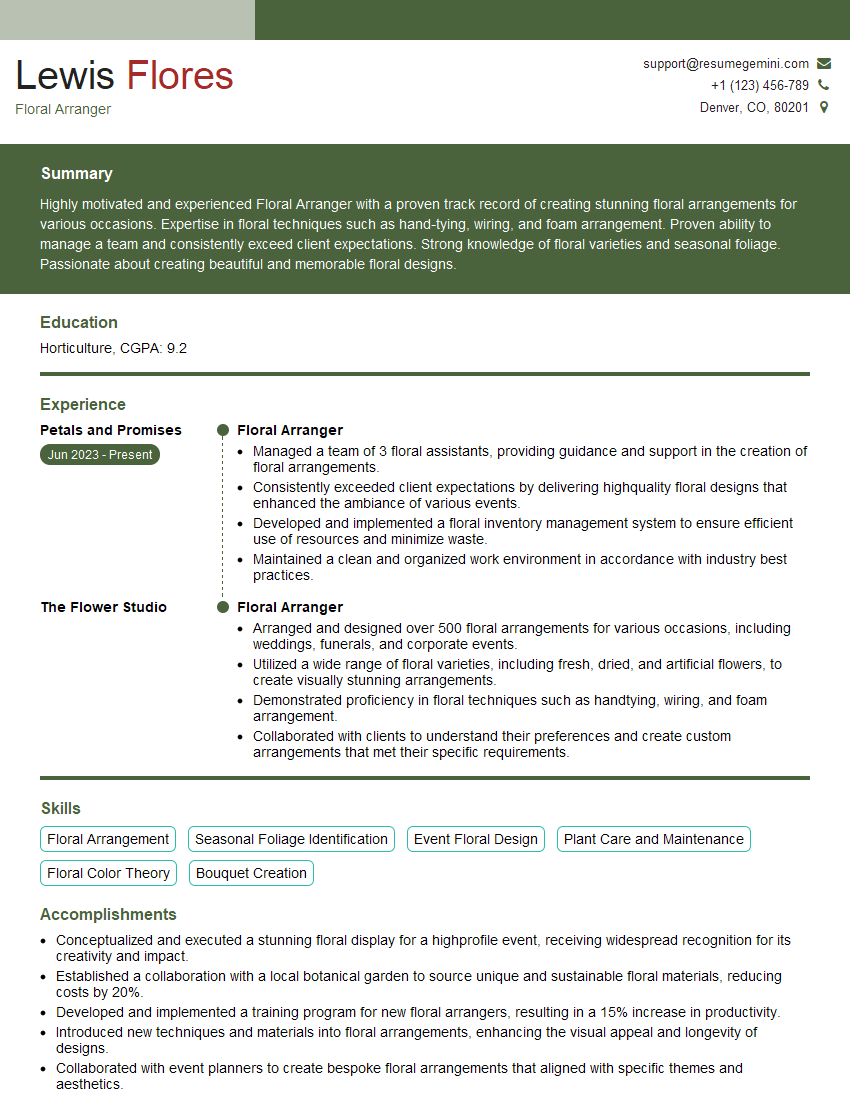
Mastering floral wrapping and presentation is crucial for career advancement in the floral industry. It allows you to showcase your creativity, technical skills, and client service abilities, leading to increased opportunities and higher earning potential. To maximize your job prospects, it’s essential to create an ATS-friendly resume that highlights your skills and experience effectively. We recommend using ResumeGemini, a trusted resource for building professional resumes, to create a document that showcases your talents to potential employers. Examples of resumes tailored to Floral Wrapping and Presentation are available to help guide you.
Explore more articles
Users Rating of Our Blogs
Share Your Experience
We value your feedback! Please rate our content and share your thoughts (optional).
What Readers Say About Our Blog
Very informative content, great job.
good