Feeling uncertain about what to expect in your upcoming interview? We’ve got you covered! This blog highlights the most important Quality Control and Inspection of Leveled Metal interview questions and provides actionable advice to help you stand out as the ideal candidate. Let’s pave the way for your success.
Questions Asked in Quality Control and Inspection of Leveled Metal Interview
Q 1. Describe your experience with various metal leveling techniques.
My experience encompasses a wide range of metal leveling techniques, both traditional and advanced. I’m proficient in using various types of leveling machines, including roll leveling, stretch leveling, and tension leveling. Each technique addresses different material characteristics and desired outcomes.
- Roll leveling: This is a common method using a series of precisely positioned rollers to reduce waviness and improve flatness. The number and configuration of rollers determine the effectiveness for different metal gauges and types. I’ve worked with machines utilizing both cold and controlled-temperature rolling to optimize the process for various materials like stainless steel and aluminum.
- Stretch leveling: This technique involves stretching the metal sheet under controlled tension, thus reducing residual stresses and improving flatness. It’s particularly useful for materials prone to springback after forming. My experience includes working with high-precision stretch leveling systems capable of handling large coils.
- Tension leveling: This combines stretching and rolling to achieve superior flatness and reduce internal stresses, leading to improved dimensional stability. I have a deep understanding of the interplay between tension, speed, and roller configuration in these systems.
My expertise extends to troubleshooting issues within these systems, optimizing parameters to match specific material properties and customer requirements, and ensuring consistent high-quality output.
Q 2. Explain how you would identify and classify different types of surface defects on leveled metal.
Identifying and classifying surface defects on leveled metal requires a systematic approach and a keen eye. I utilize a combination of visual inspection and measurement tools to categorize defects accurately.
- Scratches: Linear imperfections caused by abrasive contact; categorized by depth, length, and direction.
- Dents: Localized depressions in the surface; assessed by depth and diameter.
- Bowing/Waviness: Undulations across the sheet’s surface; measured using straight edges and levels.
- Edge defects: Irregularities along the edges, such as burrs, tears, or unevenness; measured with calipers and microscopes.
- Surface imperfections: Includes rolling marks, pitting, and other texture variations.
I use a standardized classification system, often incorporating numerical ratings for defect severity based on size and location, allowing for efficient reporting and tracking of quality trends.
Q 3. What are the common causes of imperfections in leveled metal sheets or coils?
Imperfections in leveled metal sheets or coils often stem from several sources, both during the metal production and the leveling process itself.
- Original material defects: Imperfections such as inclusions, pitting, or surface irregularities present in the raw metal sheet will often persist through the leveling process.
- Improper processing parameters: Incorrect roll gap settings, tension control, or speed adjustments during the leveling process can lead to waviness, bowing, or residual stress. For example, too much tension can create stretch marks, while insufficient tension might leave residual curvature.
- Equipment malfunction: Worn rollers, misaligned rollers, or other equipment issues contribute to defects. For instance, a damaged roller might cause repeated scratches or gouges.
- Material properties: The inherent characteristics of the metal (such as its yield strength and work hardening rate) can affect its response to leveling, potentially leading to unevenness or defects.
- Improper handling and storage: Scratches and dents can occur due to improper handling during transportation or storage of the leveled metal.
A thorough understanding of these contributing factors allows for proactive defect prevention and process optimization.
Q 4. How do you ensure the accuracy and precision of your measurements during inspection?
Accuracy and precision are paramount in metal leveling inspection. I employ several methods to ensure reliable measurements. Calibration is key; all measuring instruments are regularly calibrated against traceable standards. This includes digital calipers, micrometers, and laser flatness measuring systems. I use multiple measurements at different locations on the sheet or coil to minimize the impact of localized variations and calculate average values. I utilize statistical process control (SPC) techniques, charting data to monitor process stability and promptly identify deviations from established norms.
For instance, in measuring flatness, I would perform multiple readings across the length and width of a sheet, ensuring the measurements are taken at evenly spaced intervals. I also use multiple instruments and cross-check their readings, especially for critical measurements. This rigorous approach ensures data integrity and enhances confidence in the inspection results.
Q 5. What measurement tools and techniques are you familiar with for assessing flatness and gauge?
My experience encompasses a wide array of measurement tools and techniques for assessing flatness and gauge.
- Straight edges and levels: Basic tools for visual assessment of flatness, identifying significant bows or waviness.
- Dial indicators: Precise tools for measuring deflection and determining the degree of flatness. I use them in conjunction with straight edges to get precise readings across the length and width of sheets.
- Laser flatness measuring systems: Advanced systems that provide a highly accurate, non-contact measurement of flatness across a whole sheet or coil. These provide detailed data maps illustrating flatness variations.
- Micrometers and calipers: Used for precise measurement of material thickness (gauge) at various points on the sheet or coil.
- Optical comparators and microscopes: Employed for detailed inspection of surface defects, assessing their size, depth, and other characteristics.
The choice of tool depends on the required accuracy, the type of metal, and the size of the material being inspected.
Q 6. Describe your experience with different types of gauges used in metal leveling.
Different gauges are used throughout the metal leveling process, each serving a specific purpose. My experience includes working with various types:
- Mechanical gauges: These are simple, hand-held devices using a dial indicator to measure material thickness. They’re quick and useful for spot checks, but less accurate than other types.
- Digital gauges: Electronic devices providing highly accurate, digital readings of material thickness. They are typically faster and more precise than mechanical gauges.
- Automated gauge systems: These are integrated into the leveling lines providing continuous monitoring of thickness during the process, allowing for real-time adjustments.
The selection of a specific gauge depends on the required accuracy level, throughput needs, and the level of automation in the production line. For example, during high-speed production runs, automated gauge systems are preferable for consistent and continuous monitoring.
Q 7. How do you interpret and analyze inspection data to identify trends and patterns?
Interpreting and analyzing inspection data is crucial for identifying trends, predicting potential problems, and ensuring continuous improvement. I utilize statistical tools and techniques such as control charts and histograms to analyze the collected data, visualize patterns, and draw meaningful conclusions.
For instance, if a control chart shows an upward or downward trend in a particular defect type, it indicates a potential issue in the leveling process that needs investigation. Similarly, a histogram helps to identify the distribution of specific defect sizes, helping to determine the severity and frequency of the issue. By tracking these metrics, I’m able to identify correlations between process parameters and defect rates, providing insights for process optimization and reducing defect rates.
I also utilize data analysis software to identify patterns and trends which might not be immediately apparent from simple charting. For example, analyzing data from multiple batches might uncover a correlation between material source and defect types, aiding in identifying faulty raw materials. This data-driven approach ensures proactive quality management and continuous improvement of the leveling process.
Q 8. Explain your understanding of statistical process control (SPC) in the context of metal leveling.
Statistical Process Control (SPC) is a powerful tool for monitoring and improving the consistency of metal leveling processes. It involves collecting data on key characteristics like flatness, crown, and bow during the leveling process and using statistical methods to analyze this data. We look for trends, patterns, and variations that signal potential problems. This allows us to identify sources of defects before they impact a large volume of product.
For instance, we might use control charts like X-bar and R charts to track the average and range of flatness measurements over time. If a point falls outside the control limits or a pattern emerges (e.g., a series of points consistently increasing), it indicates a potential issue in the leveling process – maybe a worn roller, inconsistent feed rate, or even a problem with the incoming material. This allows for proactive adjustments to the equipment or process parameters to prevent producing defective leveled metal.
In a real-world scenario, I once used SPC to pinpoint a gradual increase in the crown of aluminum sheets. By analyzing the control charts, we discovered the problem was related to the temperature of the leveling rollers, which were slowly degrading over time. By adjusting the cooling system, we brought the process back into control and prevented significant waste.
Q 9. How do you handle discrepancies between inspection results and quality standards?
Discrepancies between inspection results and quality standards are addressed through a systematic investigation. First, we verify the accuracy of the inspection itself – checking calibration of instruments, verifying the inspection method was properly followed, and ensuring the inspector’s competence. If the inspection is sound, we then analyze the root cause of the non-conformance. This often involves examining the entire process, from raw material input to the final leveled product.
Let’s say flatness is consistently outside tolerance limits. We’d investigate several factors: the type and condition of the incoming material, settings of the leveling machine (roller gaps, speed, temperature), and even environmental conditions (temperature, humidity) within the leveling facility. Depending on the cause, actions range from adjusting machine settings to rejecting a batch of raw material to even modifying the process itself. A comprehensive report is generated documenting the findings, the corrective actions taken, and preventative measures to avoid similar issues in the future.
Q 10. What are the common industry standards and specifications for leveled metal?
Common industry standards and specifications for leveled metal vary depending on the metal type, intended application, and customer requirements. However, some general standards are often referenced. These include industry-specific standards set by organizations like ASTM International (American Society for Testing and Materials), which covers numerous aspects of metal properties and testing methods.
For instance, ASTM standards will specify acceptable tolerances for flatness, crown, and bow, often expressed as a percentage or a maximum allowable deviation from a perfectly flat plane. They also specify methods for measuring these properties. Customer specifications may add further constraints based on their specific application. For example, a customer manufacturing high-precision parts might require tighter tolerances than a customer producing less critical components. These specifications are crucial throughout the manufacturing process, ensuring that the finished product meets the required quality and performance standards.
Q 11. How do you ensure the accuracy and reliability of your inspection reports?
Ensuring accurate and reliable inspection reports involves meticulous attention to detail and a robust quality system. We use calibrated measuring instruments, checked regularly against traceable standards. All measuring equipment undergoes scheduled calibration and maintenance, with records meticulously documented. Our inspectors are trained and certified, demonstrating proficiency in using the equipment and interpreting the results.
We utilize standardized inspection procedures, following written protocols to ensure consistency. Each inspection is documented completely, including the date, time, lot number, material specifics, measuring instruments used, and the results obtained. This detailed documentation allows for traceability and supports any subsequent analysis. Statistical process control (SPC) techniques mentioned earlier further support the reliability of our results by detecting deviations early.
Q 12. Describe your experience with documenting and reporting your findings.
My experience with documenting and reporting findings is extensive. I utilize a combination of digital and hard-copy documentation methods. Each inspection is recorded using a standardized form that captures all relevant data. This information is then entered into a database system which allows for easy retrieval and analysis. The database provides summaries of inspection results, allowing for trend analysis over time. This allows us to proactively identify and address potential quality issues.
Formal reports are generated when significant deviations from standards are detected, or for customer-requested inspections. These reports summarize the inspection findings, highlight any non-conformances, and suggest corrective actions. They are reviewed by supervisors before being distributed to relevant stakeholders. The use of digital documentation facilitates efficient data sharing and reduces the risk of data loss or misinterpretation.
Q 13. How do you maintain the calibration and accuracy of measuring instruments?
Maintaining the calibration and accuracy of measuring instruments is paramount. We have a strict calibration schedule, with each instrument checked and calibrated at defined intervals, often following manufacturer recommendations or industry best practices. These intervals vary depending on the instrument and its criticality; high-precision instruments are calibrated more frequently.
Calibration is performed by certified technicians using traceable standards, ensuring that the measurements are accurate and reliable. All calibration records are meticulously maintained, including the date, results, and the identity of the technician who performed the calibration. Out-of-calibration instruments are immediately tagged and taken out of service until recalibrated. This strict adherence to calibration procedures ensures that all measurements made are accurate, reliable and the inspection reports reflect the actual quality of the leveled metal.
Q 14. Explain your experience with different types of metal leveling equipment.
My experience encompasses various types of metal leveling equipment, including roll leveling machines (both single- and multi-stand), stretcher leveling machines, and even specialized equipment for handling specific metal types or thicknesses. I’m familiar with both hydraulic and mechanical leveling systems and understand their respective advantages and limitations. Roll leveling is widely used for general-purpose leveling, while stretcher leveling might be preferred for specific applications requiring extremely precise flatness.
The choice of equipment depends on factors like the material’s properties (thickness, type of metal, its temper), the desired level of flatness, production volume, and budget constraints. I have hands-on experience troubleshooting issues related to various leveling processes. For example, I resolved a significant production bottleneck by identifying and correcting a misalignment in the rollers of a multi-stand roll leveling machine. This involved careful adjustment of roller position, resulting in a significant improvement in leveled metal quality and production efficiency.
Q 15. What is your experience in using inspection software and data management systems?
My experience with inspection software and data management systems is extensive. I’ve worked with various systems, from simple spreadsheet-based tracking to sophisticated, cloud-based solutions like [mention specific software names if you have experience with them – e.g., LIMS, QMS software]. My expertise goes beyond simply inputting data; I understand how to configure these systems to optimize data collection and analysis for leveled metal inspection. This includes setting up custom reports to track key metrics, such as defect rates, material properties, and processing times. For example, in a previous role, I implemented a new LIMS system that reduced our data entry time by 40% and significantly improved our ability to identify trends and root causes of quality issues. The system also facilitated easier traceability of materials throughout the production process, critical in the event of a recall or investigation.
I’m also proficient in using data analysis tools to extract meaningful insights from the collected data. This includes creating charts and graphs to visualize trends and patterns, identifying outliers, and using statistical methods to assess process capability. This allows for proactive adjustments to the leveling process, preventing defects and minimizing waste.
Career Expert Tips:
- Ace those interviews! Prepare effectively by reviewing the Top 50 Most Common Interview Questions on ResumeGemini.
- Navigate your job search with confidence! Explore a wide range of Career Tips on ResumeGemini. Learn about common challenges and recommendations to overcome them.
- Craft the perfect resume! Master the Art of Resume Writing with ResumeGemini’s guide. Showcase your unique qualifications and achievements effectively.
- Don’t miss out on holiday savings! Build your dream resume with ResumeGemini’s ATS optimized templates.
Q 16. How do you prioritize inspection tasks based on risk assessment?
Prioritizing inspection tasks involves a structured risk assessment process. I typically use a matrix that considers the severity of potential consequences (e.g., safety hazard, production downtime, customer dissatisfaction) and the likelihood of an issue occurring. High-severity, high-likelihood tasks are prioritized first. For example, in leveling metal, checking for critical dimensions that directly impact functionality would rank higher than inspecting for minor cosmetic flaws.
- Severity: Categorize potential consequences (critical, major, minor).
- Likelihood: Estimate the probability of each issue occurring (high, medium, low).
- Risk Score: Calculate a risk score by multiplying severity and likelihood (e.g., high severity x high likelihood = high risk).
This allows for a data-driven approach, ensuring that resources are allocated effectively to mitigate the highest risks. This also involves using historical data on defect rates and failure modes to inform the risk assessment. This helps in prioritizing areas that have historically shown higher failure rates.
Q 17. Describe a situation where you identified a quality issue and resolved it effectively.
In a previous project involving the leveling of stainless steel sheets for automotive applications, we experienced a significant increase in surface scratches during the final stages of the process. Initially, we suspected a problem with the final polishing stage. However, after a thorough investigation, including detailed visual inspection and microscopic analysis, we discovered that the scratches were actually originating much earlier – during the initial leveling process. The rollers were showing signs of wear, creating micro-fractures that caused the scratches during subsequent passes.
Our solution involved a multi-pronged approach: We immediately replaced the worn rollers, implemented a more frequent inspection schedule for roller wear, and developed a standardized procedure for roller maintenance. We also invested in a new roller alignment system to ensure consistent and optimal contact during the leveling process. The implementation of these corrective actions immediately reduced the number of surface scratches, bringing the defect rate back to acceptable levels. This situation highlighted the importance of comprehensive root cause analysis and the necessity of proactive maintenance procedures.
Q 18. Explain your understanding of different types of metal alloys and their properties.
My understanding of metal alloys and their properties is comprehensive. I’m familiar with a wide range of alloys, including those commonly used in leveling applications, such as:
- Stainless Steels (Austenitic, Ferritic, Martensitic): Understanding their different compositions (chromium, nickel, molybdenum content) is crucial as they influence workability, corrosion resistance, and response to the leveling process.
- Aluminum Alloys: Various alloys possess different strengths, formability, and responses to heat treatments – knowledge of these is vital to avoid damage during leveling.
- Carbon Steels: Their carbon content dictates their strength and hardness, influencing the choice of leveling parameters to prevent deformation or cracking.
- High-Strength Low-Alloy (HSLA) Steels: These steels offer superior strength-to-weight ratios; their unique characteristics must be considered to avoid damage during leveling.
Knowledge of these properties is essential to optimize the leveling process, selecting the right parameters to achieve the desired flatness without causing damage or introducing defects. This includes understanding the relationship between material properties and the potential for warping, buckling, or surface damage during the leveling operation.
Q 19. How do you ensure the safety and efficiency of the inspection process?
Ensuring the safety and efficiency of the inspection process involves a combination of procedural and technological measures. Safety is paramount. All inspectors are trained in safe handling procedures for various metal types, including the use of appropriate personal protective equipment (PPE), such as safety glasses, gloves, and hearing protection. This also involves understanding the potential hazards of the machinery and materials used in the leveling process.
For efficiency, we employ lean principles, optimizing the workflow to minimize wasted time and movement. This includes proper equipment layout, clear documentation of inspection procedures, and the use of automated inspection systems wherever appropriate. Automated systems improve consistency and reduce human error, freeing up inspectors to focus on higher-level tasks like root cause analysis and process improvement. For example, using vision systems to automate the detection of surface defects ensures a higher level of consistency and speeds up the inspection process.
Q 20. What is your experience with implementing corrective actions to prevent future quality issues?
Implementing corrective actions is a critical part of my role. It’s not just about fixing immediate problems but about preventing recurrence. My approach uses a structured methodology, often based on a PDCA cycle (Plan-Do-Check-Act):
- Plan: Identify the root cause of the quality issue, define corrective actions, and develop a plan for implementation.
- Do: Implement the corrective actions, ensuring proper training and communication.
- Check: Monitor the effectiveness of the corrective actions and track relevant metrics.
- Act: If the corrective actions are effective, standardize the process; if not, revise the plan and repeat the cycle.
For instance, if a consistent defect is linked to a specific machine setting, the corrective action might involve adjusting the machine parameters and implementing a control chart to monitor the setting and prevent future deviations. Effective corrective action ensures that quality issues are addressed promptly and permanently, preventing rework, waste, and customer dissatisfaction.
Q 21. Describe your experience with root cause analysis in a metal leveling environment.
Root cause analysis (RCA) in a metal leveling environment requires a systematic approach. I typically use the 5 Whys technique, combined with data analysis and visual inspection. The 5 Whys involves repeatedly asking “Why?” to delve deeper into the root cause of a problem. For example, if a batch of leveled sheets shows excessive warping:
- Why? Because the material was unevenly heated.
- Why? Because the heating furnace wasn’t properly calibrated.
- Why? Because the calibration was overdue.
- Why? Because the maintenance schedule wasn’t followed.
- Why? Because the maintenance schedule wasn’t enforced.
This helps pinpoint the underlying cause – in this case, a failure in the preventative maintenance program. This is then combined with data analysis, such as examining historical data on furnace temperatures and maintenance records, and visual inspection of the equipment. A thorough RCA ensures that corrective actions are targeted at the root cause, preventing similar issues in the future.
Q 22. How familiar are you with different non-destructive testing (NDT) methods?
My familiarity with Non-Destructive Testing (NDT) methods for leveled metal is extensive. I’m proficient in several techniques crucial for ensuring quality without damaging the material. These include:
- Visual Inspection: The first and often most important step. It involves carefully examining the metal’s surface for any defects like scratches, dents, pitting, or discoloration. Think of it as a thorough visual examination with magnification aids, sometimes using specialized lighting.
- Dimensional Measurement: Using tools like calipers, micrometers, and coordinate measuring machines (CMMs) to ensure the leveled metal meets precise dimensions and tolerances. This is vital for applications requiring tight specifications.
- Ultrasonic Testing (UT): This method uses high-frequency sound waves to detect internal flaws like cracks or inclusions. Imagine it like sonar, but for metal, providing a cross-sectional image to identify hidden problems.
- Magnetic Particle Inspection (MPI): Useful for detecting surface and near-surface cracks in ferromagnetic metals. A magnetic field is applied, and magnetic particles are sprayed on the surface. These particles accumulate at any crack, making them clearly visible. It’s like dusting for fingerprints, but for cracks in metal.
- Eddy Current Testing (ECT): This technique uses electromagnetic induction to detect surface and subsurface flaws in conductive metals. Changes in the eddy currents induced in the metal indicate the presence of defects. Think of it as a non-contact way to sense changes in the metal’s conductivity.
My experience encompasses applying these methods individually and in combination, depending on the specific metal type, application, and required quality level.
Q 23. How would you deal with a situation where a shipment of leveled metal fails to meet quality standards?
Dealing with a shipment of leveled metal that fails to meet quality standards requires a structured, methodical approach. My first step would be to immediately halt further processing or use of the affected material to prevent wider issues. Then:
- Thorough Investigation: A complete inspection of the failed shipment would be conducted using the appropriate NDT methods mentioned earlier, determining the root cause of the failure. This may involve analyzing the surface finish, checking for dimensional inconsistencies, or looking for internal defects.
- Documentation and Reporting: Detailed documentation of the findings, including photographic evidence and precise measurements, is crucial. A formal report summarizing the extent of the non-conformance, the root cause analysis, and proposed corrective actions would be prepared.
- Communication: Immediate communication with the supplier is essential to discuss the problem, share the findings, and initiate corrective actions to prevent future occurrences. This might involve discussing manufacturing processes, raw material quality, or shipping practices.
- Corrective Actions: Depending on the severity and cause of the failure, several options exist:
- Rejection and Return: If the defects are extensive or irreparable, the shipment would be rejected and returned to the supplier.
- Partial Acceptance: In some cases, the acceptable portions of the shipment may be salvaged if the defects are localized and repairable.
- Containment and Rework: If economically feasible, the defective parts might be reworked to bring them up to specification.
- Preventive Measures: Implementing preventive measures to avoid similar situations in the future is a critical aspect. This could involve stricter incoming inspection procedures, improved communication with the supplier, or changes to the leveling process itself.
Q 24. Explain your understanding of the impact of environmental conditions on metal leveling and inspection.
Environmental conditions significantly influence both metal leveling and inspection. Temperature and humidity are key factors. For instance:
- Temperature Fluctuations: Extreme temperature changes can cause residual stresses in the metal, affecting its flatness and potentially introducing warping or buckling. This makes consistent leveling challenging and can lead to inconsistencies during inspection.
- Humidity: High humidity can accelerate corrosion, potentially impacting the surface finish and making visual inspection more difficult. It can also affect the performance of certain NDT techniques, like MPI.
- Ambient Contaminants: Dust, airborne particles, and other contaminants can settle on the metal’s surface, obscuring defects and making accurate inspection challenging. A clean environment is crucial.
During inspection, environmental control is crucial for maintaining accuracy. Consistent temperature and humidity levels ensure that measurements are not affected by external factors. For example, precision dimensional measurements can be impacted by thermal expansion and contraction.
Q 25. What is your experience with working in a team environment to ensure quality control?
I have extensive experience working in team environments dedicated to quality control. Effective teamwork is vital in this field. My approach involves:
- Clear Communication: Open and transparent communication with all team members is key. This includes regular updates, collaborative problem-solving, and clear assignment of responsibilities.
- Shared Goals: Ensuring that everyone understands the quality goals and targets is crucial. This fosters a shared sense of responsibility and ownership.
- Collaborative Problem-Solving: I encourage a collaborative approach to problem-solving, leveraging the diverse skills and perspectives of team members. Brainstorming sessions and knowledge sharing are vital for identifying and resolving quality issues.
- Constructive Feedback: Providing constructive feedback and actively seeking feedback from colleagues allows continuous improvement of our methods and processes.
In a recent project involving a complex leveling process, our team efficiently identified and resolved a consistent defect by utilizing each member’s specialized skills – one focused on the leveling process itself, another on material analysis, and myself on the inspection and NDT techniques. This collaborative effort significantly improved our overall efficiency and product quality.
Q 26. How would you improve the efficiency of the inspection process?
Improving the efficiency of the inspection process requires a multifaceted approach:
- Automation: Implementing automated inspection systems, such as robotic vision systems or automated CMMs, can significantly speed up the process while improving consistency and accuracy.
- Process Optimization: Streamlining the inspection workflow, reducing redundant steps, and optimizing the sequence of inspections can improve efficiency. For instance, a better organization of inspection stations could minimize wasted time.
- Data Management: Utilizing sophisticated data management systems to track inspection data, analyze trends, and identify areas for improvement is crucial. Data analytics can help pinpoint recurring problems and suggest proactive solutions.
- Advanced NDT Techniques: Employing advanced NDT technologies like automated ultrasonic or eddy current systems allows for faster and more comprehensive inspection of large batches of materials.
- Training and Skill Development: Providing thorough training to inspectors on the use of advanced equipment and techniques increases the speed and quality of the inspection process.
For example, implementing an automated visual inspection system with machine learning algorithms could significantly reduce the time spent on manual visual checks, allowing inspectors to focus on more complex tasks.
Q 27. Describe your experience with different types of metal surface finishes.
My experience encompasses a wide variety of metal surface finishes, each requiring specific inspection techniques. Examples include:
- Mill Finish: This is the basic finish as it comes from the mill, often rough and uneven. Inspection focuses on verifying the absence of significant imperfections like scratches or rolling defects.
- Polished Finish: A highly reflective finish obtained through polishing. Inspection involves evaluating the smoothness, reflectivity, and the absence of scratches or blemishes. Microscopic examination might be necessary.
- Ground Finish: Achieved through grinding, it usually results in a smoother, more uniform surface than mill finish. Inspection checks for surface roughness, uniformity and the absence of grind marks.
- Coated Finishes: These finishes involve applying coatings like paint, powder coatings, or plating (like chrome or zinc). Inspection focuses on the quality of the coating, its uniformity, thickness, adhesion, and any underlying defects that might be visible.
- Etched Finishes: This finish creates textured surfaces often through chemical or electrochemical processes. Inspection assesses the depth, uniformity, and appearance of the etched pattern.
The choice of inspection method depends significantly on the specific surface finish. For example, visual inspection with a magnifying glass might be sufficient for a polished finish while a microscopic examination or thickness testing might be essential for a coated finish.
Q 28. How do you stay current with the latest advancements in metal leveling and inspection techniques?
Staying current with advancements in metal leveling and inspection techniques is a continuous process. My methods include:
- Professional Organizations: Active membership in professional organizations like ASM International (ASM) and the American Society for Nondestructive Testing (ASNT) provides access to publications, conferences, and networking opportunities.
- Industry Publications and Journals: I regularly read trade journals and publications dedicated to materials science, metal finishing, and NDT. This helps me stay abreast of emerging technologies and best practices.
- Conferences and Workshops: Attending industry conferences and workshops is invaluable for learning about new techniques and innovations directly from experts.
- Online Resources: I utilize online resources, such as professional websites and databases, to access the latest research papers and technical articles.
- Vendor Interactions: Engaging with equipment and technology vendors provides insights into the latest advancements and how they can be applied to improve our processes.
Recently, I’ve been studying advanced imaging techniques using AI for improved defect detection and classification in metal leveling, which holds great potential for increased efficiency and accuracy in our processes.
Key Topics to Learn for Quality Control and Inspection of Leveled Metal Interview
- Understanding Leveling Processes: Familiarize yourself with various metal leveling techniques (e.g., roll leveling, stretch leveling) and their impact on material properties.
- Surface Finish Inspection: Learn to identify and assess different surface imperfections (e.g., scratches, dents, stains) using appropriate measuring tools and techniques. Understand relevant industry standards for acceptable surface quality.
- Dimensional Accuracy: Master the use of measuring instruments (calipers, micrometers) to verify dimensional tolerances and specifications. Practice calculating deviations and understanding their significance.
- Material Properties and Testing: Understand the relationship between leveling processes and material properties (e.g., tensile strength, yield strength). Become familiar with relevant material testing methods (e.g., hardness testing, tensile testing).
- Quality Control Documentation and Reporting: Learn how to accurately document inspection findings, generate reports, and communicate effectively with other team members.
- Statistical Process Control (SPC): Gain understanding of basic SPC principles and their application in monitoring and improving the leveling process. Familiarize yourself with control charts and their interpretation.
- Root Cause Analysis and Problem Solving: Develop your ability to identify the root causes of quality defects and implement effective corrective actions. Learn problem-solving methodologies such as 5 Whys or Fishbone diagrams.
- Safety Procedures and Regulations: Understand relevant safety protocols and regulations pertaining to the handling and inspection of leveled metal.
Next Steps
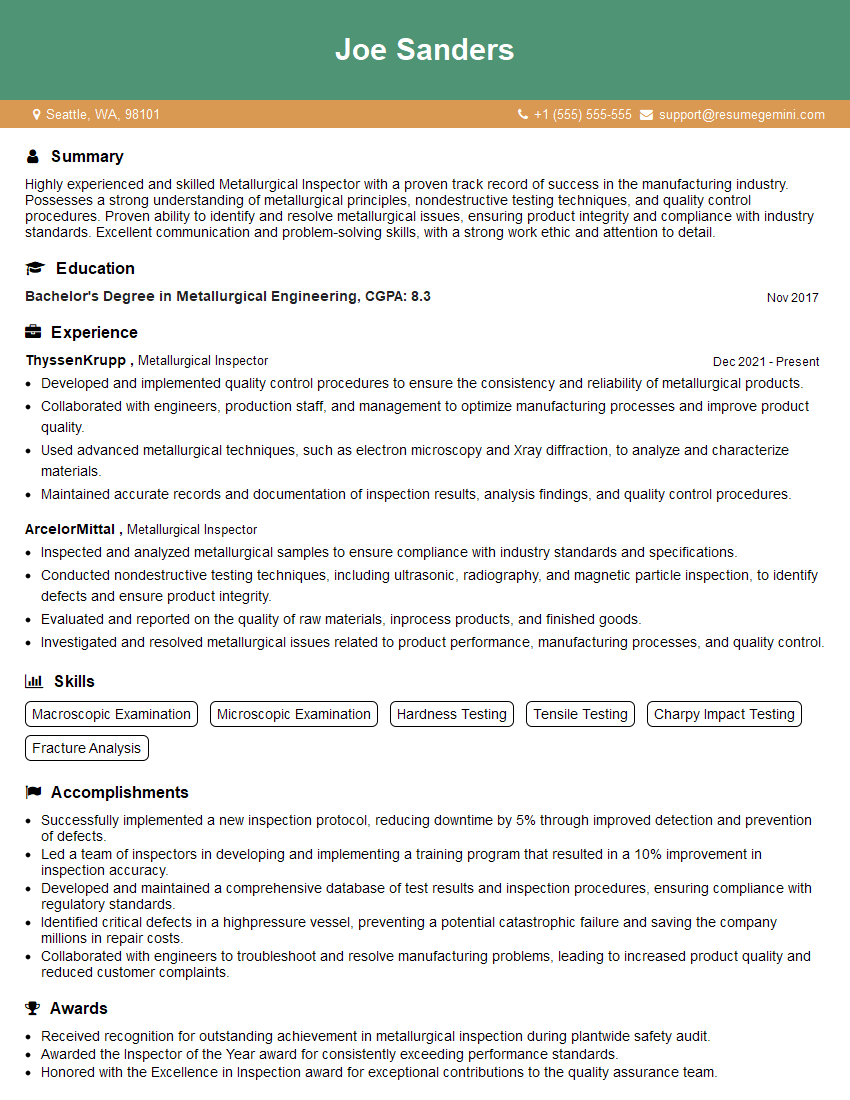
Mastering Quality Control and Inspection of Leveled Metal is crucial for career advancement in manufacturing and related fields. A strong understanding of these processes demonstrates your technical expertise and commitment to quality. To significantly boost your job prospects, focus on creating a compelling, ATS-friendly resume that highlights your skills and experience effectively. ResumeGemini is a trusted resource that can help you build a professional and impactful resume, tailored to the specific requirements of Quality Control and Inspection of Leveled Metal roles. Examples of resumes tailored to this field are provided to help you get started.
Explore more articles
Users Rating of Our Blogs
Share Your Experience
We value your feedback! Please rate our content and share your thoughts (optional).
What Readers Say About Our Blog
Very informative content, great job.
good