Cracking a skill-specific interview, like one for DieCutting Machine Operation, requires understanding the nuances of the role. In this blog, we present the questions you’re most likely to encounter, along with insights into how to answer them effectively. Let’s ensure you’re ready to make a strong impression.
Questions Asked in DieCutting Machine Operation Interview
Q 1. Describe your experience with different types of die-cutting machines (e.g., flatbed, rotary).
My experience encompasses a wide range of die-cutting machines, primarily flatbed and rotary types. Flatbed machines, like those using a platen press, excel at handling smaller runs and intricate designs, offering great flexibility in material thickness and die size. I’ve extensively used them for projects requiring precise cuts on thicker materials like corrugated board or chipboard. Rotary die cutters, on the other hand, are ideal for high-volume production runs of standardized designs. Their continuous operation dramatically increases efficiency, particularly for thin materials like paper or vinyl. I’ve worked with several models, each with different features such as automatic feeding and waste removal systems, which impact speed and overall production capacity. For instance, I’ve worked with a Bobst SP 102 rotary die cutter, known for its reliability and speed in high-volume packaging production, as well as a smaller flatbed machine suitable for short-run prototype work. The choice of machine greatly depends on the job requirements – volume, material, and design complexity being key factors.
Q 2. Explain the process of setting up a die-cutting machine for a new job.
Setting up a die-cutting machine for a new job is a methodical process demanding precision. First, I carefully review the job specifications, including material type, thickness, and the die design. I then select the appropriate machine – flatbed or rotary – based on the job’s volume and complexity. The die is then carefully mounted on the machine, ensuring its proper alignment and secure fixation to prevent slippage during operation. This frequently involves using precision shims for optimal height adjustment. Following this, I select the correct cutting pressure and speed parameters, adjusting them based on the material’s properties. A test run is always crucial, allowing me to fine-tune these settings and identify any potential issues before full-scale production begins. For example, if the material is too thick, I might need to increase the cutting pressure and slow down the speed to avoid machine damage or imperfect cuts. Conversely, thinner materials may require reduced pressure to avoid tearing or over-cutting. Once the test run shows consistently accurate cuts, the machine is ready for full production.
Q 3. How do you ensure the accuracy and precision of die-cut products?
Accuracy and precision are paramount in die-cutting. I employ several methods to ensure this. First, meticulous die preparation and mounting are essential to prevent misalignment. Regular calibration of the machine, including checking the pressure gauges and verifying the cutting depth, is critical. Furthermore, I carefully monitor the material feed mechanism to maintain consistent material flow, preventing skewing or misalignment during the cutting process. Regular quality checks during the production run, including random sampling and visual inspection, help detect any variations or defects early. For instance, I might use a precision measuring tool to randomly check the dimensions of the cut pieces against the specifications. Using digital measuring tools helps ensure accuracy to within a fraction of a millimeter. Finally, I maintain detailed records of all settings and adjustments for each job, aiding in maintaining consistency and troubleshooting in future runs.
Q 4. What are the common causes of die-cutting machine malfunctions, and how do you troubleshoot them?
Malfunctions in die-cutting machines can stem from various sources. Common issues include issues with the cutting pressure (too high or too low), leading to either crushed or incomplete cuts. Problems with the material feed mechanism can cause misalignment or jams. Worn or damaged dies can result in inaccurate cuts or even machine damage. Electrical malfunctions can also occur. Troubleshooting starts with a careful visual inspection, checking for obvious mechanical problems or debris. If a specific area malfunctions, the operator manual is consulted to check for potential problems specific to that component. I systematically check the pressure settings, the die alignment, and the feed mechanism before checking electrical connections and controls. For example, if the cuts are inconsistent, I’d first check the die for damage, then inspect the pressure settings and the material feed. Keeping detailed maintenance logs helps to trace the root cause of any issues more effectively.
Q 5. Describe your experience with different types of dies (e.g., steel rule, magnetic).
My experience encompasses various die types, including steel rule dies, magnetic dies, and kiss-cutting dies. Steel rule dies, known for their durability and precision, are widely used for intricate designs and high-volume production. They require specialized handling and maintenance. Magnetic dies offer flexibility and ease of changeover, particularly beneficial for smaller runs and frequent design changes. They are less robust and suitable for less abrasive materials. Kiss-cutting dies create partially cut pieces, often used for sticker or label production, requiring precise pressure control. The selection of the die type greatly depends on the specific job requirements, material type, production volume, and design complexity. For instance, a complex design with fine details might necessitate the precision of a steel rule die, whereas a simple design for a short run might be better suited to a magnetic die.
Q 6. How do you maintain and clean a die-cutting machine?
Regular maintenance is crucial for machine longevity and optimal performance. This involves daily cleaning of debris and loose material from the machine and dies. Lubricating moving parts, as recommended by the manufacturer, prevents wear and tear. Dies should be inspected regularly for damage or wear, and replaced or repaired as needed. More in-depth servicing, including checking belts and motors, is undertaken according to the manufacturer’s schedule. Proper storage of dies when not in use is essential to prevent damage or corrosion. The frequency of cleaning and maintenance will vary depending on the usage and the machine type, however, adhering to a strict schedule prevents unexpected breakdowns and ensures long-term efficiency. For example, regular lubrication of the machine’s moving parts can significantly reduce friction and extend its operational lifespan.
Q 7. What safety precautions do you take when operating a die-cutting machine?
Safety is my top priority. Before operating the machine, I always ensure that all safety guards are in place and functioning correctly. I never operate the machine with loose clothing or jewelry that could get caught in moving parts. Appropriate personal protective equipment (PPE), including safety glasses and gloves, is always worn. I follow established lockout/tagout procedures when performing maintenance or repairs, ensuring the machine is completely shut down and power is isolated. Regular safety training and awareness is maintained to ensure safety practices are always followed. Proper disposal of waste materials is also strictly observed, always in accordance with environmental regulations. Safety checks are performed before every job. For example, I meticulously ensure the cutting pressure is correctly adjusted, avoiding excessively high pressure that might lead to machine damage or injuries.
Q 8. How do you ensure the quality of the materials used in die cutting?
Ensuring the quality of materials is paramount in die cutting for achieving consistent results and minimizing waste. This involves a multi-step process starting with careful selection. I always check for things like thickness consistency, moisture content (especially crucial for paper and cardboard), and surface imperfections. For instance, if cutting cardstock, variations in thickness can lead to inconsistent cuts, resulting in some pieces being slightly under-cut or others over-cut. Similarly, moisture content affects the material’s rigidity and can cause warping during the cutting process. We use calibrated instruments to measure these parameters and ensure they fall within acceptable tolerances specified by the manufacturer. Beyond initial inspection, I regularly perform test cuts on a sample of the material batch to verify consistency and make adjustments to the machine settings if necessary. This ensures we’re not wasting a large run of materials due to a previously unnoticed defect.
Q 9. Explain the importance of proper die storage and handling.
Proper die storage and handling are essential for maintaining the sharpness and accuracy of the cutting dies, extending their lifespan, and preventing damage to the machine. Dies are precision tools and should be treated as such. We store our dies in specialized cases or racks designed to prevent damage from impacts or moisture. Each die is carefully labeled with its identification number and specifications. Before and after each use, I inspect the dies for any damage such as nicks, dents, or debris. Any visible damage needs immediate attention and may require sharpening or replacement, to avoid compromising the cut quality or damaging the machine. Furthermore, proper handling involves careful placement and removal of the dies from the machine using appropriate tools, to avoid accidental damage or injury. Think of a die like a very sharp knife; treating it with care ensures its longevity and prevents accidents.
Q 10. What is your experience with different types of cutting materials (e.g., paper, cardboard, plastics)?
My experience encompasses a wide range of cutting materials, including paper (various weights and types like coated, uncoated, and specialty papers), cardboard (from thin index to thick corrugated board), various plastics (thin films to rigid sheets), and even some textiles. The crucial factor in handling different materials is understanding their properties. Paper, for example, requires less pressure than cardboard or plastics because of its lower density and tensile strength. Plastics, on the other hand, can be more challenging, as some types may be brittle, requiring a slower speed to avoid cracking or shattering, while others might be more flexible and require higher pressure for a clean cut. I adapt the machine settings—pressure, speed, and sometimes even the cutting die itself—according to the specific material characteristics. For instance, when cutting thin plastic films, I may opt for a lower cutting pressure to avoid tearing, whereas when cutting thicker, more rigid plastics, I’ll increase the pressure and possibly reduce the cutting speed.
Q 11. How do you calculate the required pressure and speed for different materials?
Calculating the required pressure and speed for different materials is not a simple formula but rather an iterative process based on experience and experimentation. It’s a balance between achieving a clean, consistent cut and preventing damage to the material or the die. I start with the manufacturer’s recommended settings as a baseline for the specific material type and thickness. Then, I conduct test cuts on sample materials, adjusting pressure and speed incrementally until I achieve the desired result. I keep detailed records of these settings for each material type and thickness. Too little pressure, and the cut might be incomplete or uneven. Too much pressure can lead to material deformation, tearing, or even damage to the die. Similarly, too fast a speed may result in poor quality cuts, especially with thicker materials, while too slow a speed reduces overall production efficiency. Imagine adjusting the pressure and speed like fine-tuning an instrument—precise adjustments lead to a perfect output.
Q 12. Describe your experience with die-cutting different shapes and sizes.
I have extensive experience die-cutting a diverse range of shapes and sizes. From simple rectangular shapes used for packaging to intricate designs with multiple layers and fine details for promotional materials, my experience ensures accuracy and efficiency. The complexity of the shape and size directly influences the die design and the machine settings required. For intricate designs with many small details, I might choose a sharper die and use lower pressure and speed to avoid distortion or breakage. Larger pieces may require higher pressure and potentially a more robust die to ensure a clean, complete cut. Each project requires a careful consideration of the die design, material properties, and the optimal machine settings to achieve the desired result without compromising quality or efficiency. A recent project involved cutting thousands of intricately shaped labels for a high-end product. The precision and consistency required demonstrated the value of my experience in handling complex die-cutting tasks.
Q 13. How do you handle and resolve issues related to material jams or misfeeds?
Material jams or misfeeds are common issues in die cutting. My approach involves a systematic troubleshooting process. First, I pause the machine and carefully inspect the area where the jam occurred to identify the cause. Common causes include material wrinkles, improper feeding, or a build-up of waste material in the machine. If it’s a simple wrinkle, I carefully straighten the material and restart the machine. If there’s a build-up of waste, I carefully clean the machine using the appropriate tools. If the problem persists, I check the material’s characteristics and adjust the machine’s settings such as speed, pressure, or feeding mechanism. Sometimes, the problem could be with the die itself – a dull blade or a misaligned component. In such cases, I’ll request an assessment from our maintenance team. Documenting the issues, troubleshooting steps, and solutions is vital for preventing future problems. For example, repeated jams might indicate a need for machine maintenance or adjustments to the material handling process.
Q 14. What is your experience with automated die-cutting machines?
I have considerable experience operating automated die-cutting machines, including those with integrated feeding, stacking, and waste removal systems. Automation significantly increases efficiency and reduces manual labor, especially for high-volume production. While the fundamental principles remain the same, operating automated machines requires a deeper understanding of their control systems and programming capabilities. I am proficient in programming and adjusting machine parameters such as cutting pressure, speed, and material feed rate based on the specific material and the desired output. This might involve using touchscreens, software interfaces, or even specialized programming languages, depending on the machine’s sophistication. Regular maintenance and preventive checks are crucial for maintaining the efficiency and accuracy of automated machines. Working with automated systems is like conducting an orchestra – each component must work together flawlessly for a perfect output.
Q 15. How do you interpret and follow production specifications and work orders?
Interpreting production specifications and work orders for die-cutting is crucial for accuracy and efficiency. It involves carefully reviewing the documentation to understand the required quantity, material type, die number, cut specifications (e.g., dimensions, shapes, perforations), and quality standards. I start by checking the order for any ambiguities and clarifying them with the production supervisor before proceeding. For instance, a work order might specify ‘10,000 units of A4 size cardstock, using die #37B, with a 1cm bleed.’ I’d confirm the availability of die #37B, the correct cardstock, and ensure I understand the ‘1cm bleed’ requirement, which refers to extra material extending beyond the final cut for printing purposes. My process also involves double-checking all measurements and specifications against the provided blueprints or artwork.
- Step 1: Thoroughly read and understand all aspects of the work order.
- Step 2: Verify all materials and tooling are available and in good condition.
- Step 3: Clarify any uncertainties with supervisors or the design team.
- Step 4: Document any discrepancies or potential issues.
Career Expert Tips:
- Ace those interviews! Prepare effectively by reviewing the Top 50 Most Common Interview Questions on ResumeGemini.
- Navigate your job search with confidence! Explore a wide range of Career Tips on ResumeGemini. Learn about common challenges and recommendations to overcome them.
- Craft the perfect resume! Master the Art of Resume Writing with ResumeGemini’s guide. Showcase your unique qualifications and achievements effectively.
- Don’t miss out on holiday savings! Build your dream resume with ResumeGemini’s ATS optimized templates.
Q 16. Explain your experience with quality control procedures and inspection techniques.
Quality control is paramount in die-cutting. My experience includes implementing and adhering to rigorous inspection protocols at each stage of the process. This starts with a pre-production check of the die, ensuring it’s sharp, clean, and accurately aligned. During production, I regularly monitor the output, checking for consistent cuts, accurate dimensions, and the absence of defects such as miscuts, burrs, or creases. I utilize various inspection tools, including calipers, micrometers, and magnifying glasses, to meticulously assess the quality of the die-cut parts. After production, I conduct a final quality inspection, usually involving a random sampling of the finished products, to ensure the batch meets the required quality standards. Any inconsistencies are documented, and corrective actions are implemented. For example, if I notice a slight misalignment in the cuts, I would immediately investigate the cause, potentially adjusting the die setup or machine parameters to remedy the issue.
Q 17. How do you identify and report defects in die-cut products?
Defect identification and reporting is a crucial part of my role. I use a systematic approach, starting with visual inspection using appropriate magnification if needed. I categorize defects based on their nature – for instance, miscuts (pieces cut incorrectly), short cuts (incomplete cuts), double cuts (accidental extra cuts), creases, or contamination. I record the type of defect, the quantity affected, and the location within the production run. This information is documented using a standardized defect reporting form, usually accompanied by photographic evidence. A crucial element is accurately noting the root cause; was it a dull die, improper feeding of the material, or a machine malfunction? Accurate reporting ensures that corrective actions are taken to prevent recurrence. For example, if I consistently find burrs on a particular corner of the product, I will note that and investigate if it’s due to a burr on the die itself requiring sharpening or a machine setting needing adjustment.
Q 18. Describe your experience working within a team environment.
I thrive in team environments. In my previous role, I was part of a high-performing team responsible for meeting demanding production deadlines. Effective communication was key, and I actively participated in daily briefings to synchronize tasks and coordinate efforts with press operators, material handlers, and quality control inspectors. We relied heavily on collaborative problem-solving, with everyone contributing their expertise to address challenges. For instance, when a new, complex die was introduced, our team worked together to optimize the die-cutting process, identifying the ideal machine settings and material handling techniques to maximize efficiency and minimize defects. My contributions often involved sharing my understanding of the machine’s capabilities and limitations to ensure the team was well-informed and efficient.
Q 19. How do you handle pressure and meet tight deadlines?
Handling pressure and meeting tight deadlines requires a combination of planning, efficiency, and adaptability. I prioritize tasks based on urgency and importance, focusing on high-priority items first. I break down large projects into smaller, manageable tasks to maintain focus and track progress. I’m proficient in using production scheduling software, which assists in effective time management. For example, I’ve successfully managed multiple projects with overlapping deadlines by creating detailed schedules, proactively identifying potential bottlenecks, and communicating any delays or challenges to the team early on. My ability to remain calm under pressure, focus on solutions rather than dwelling on problems, and maintain clear communication is essential in these situations.
Q 20. How do you prioritize tasks and manage your time effectively?
Task prioritization and time management are essential for me. I typically use a combination of methods to manage my workload effectively, starting with a clear understanding of deadlines and priorities. I then break down larger tasks into smaller, more manageable steps, scheduling them strategically. For example, I might use a Kanban board or similar visual management tool to keep track of ongoing tasks and their status. Regularly reviewing my schedule and adapting it based on emerging priorities or unexpected delays is also key. Proactive communication with my team is crucial for efficiently resolving conflicts or potential delays. Furthermore, I’m adept at using time-tracking tools to analyze my productivity and identify areas where I can improve my efficiency.
Q 21. What is your experience with preventative maintenance on die-cutting machines?
Preventative maintenance is critical for ensuring the smooth and reliable operation of die-cutting machines. My experience includes performing routine checks, such as inspecting the blades for sharpness and damage, lubricating moving parts, and cleaning debris from the machine. I’m familiar with the manufacturer’s recommended maintenance schedules and adhere to them rigorously. Beyond routine checks, I’m also adept at identifying potential problems before they become major issues. For instance, I might notice a slight vibration in the machine, indicative of a potential bearing problem, and report it immediately to prevent costly downtime. My preventative maintenance efforts significantly contribute to the machine’s longevity, preventing costly repairs and ensuring consistent production quality. This often includes detailed record-keeping of all maintenance activities, allowing for efficient tracking and analysis.
Q 22. Describe your experience with using various measuring tools and gauges.
Accurate measurements are paramount in die-cutting. My experience encompasses using a wide range of tools, from simple rulers and calipers to more sophisticated instruments like micrometers and digital thickness gauges. I’m proficient in using dial indicators to check for flatness and parallelism in dies, ensuring precise registration. For example, when setting up a job requiring intricate cuts on a delicate substrate like thin film, a micrometer allows me to measure the material thickness to the nearest thousandth of an inch, preventing material slippage and ensuring the cut falls exactly where intended. Using a dial indicator on the die ensures accurate mounting on the press, eliminating misalignment which could lead to ruined materials or damaged dies.
- Rulers and Steel Rules: Used for quick measurements of larger dimensions and checking the overall dimensions of the die.
- Calipers: Essential for precise measurements of smaller components and material thicknesses.
- Micrometers: Provide highly accurate measurements down to thousandths of an inch, crucial for precise die setup and material handling.
- Dial Indicators: Used for checking flatness and parallelism of dies and press components, preventing misalignment.
- Digital Thickness Gauges: Measure material thickness quickly and accurately.
Q 23. How familiar are you with different types of die cutting substrates?
My experience includes working with a broad spectrum of die-cutting substrates. This ranges from paperboard and corrugated board in various weights and thicknesses, to plastics (like PVC and PET), films (both rigid and flexible), textiles, and even foams. Understanding the properties of each substrate is critical; for instance, paperboard requires different pressure settings compared to a more rigid plastic sheet. A thin film might require a very sharp, clean-cutting rule die to avoid tearing, while a thicker material could tolerate a slightly duller die. Recognizing these nuances prevents material damage and ensures a consistently high-quality finished product. I’m also familiar with the challenges of working with materials prone to stretching or warping, requiring adjustments in the die design and cutting process.
- Paperboard: Various weights and types, from thin index card to heavy-duty packaging board.
- Corrugated Board: Used extensively in packaging applications, requiring specific cutting techniques.
- Plastics (PVC, PET, etc.): Require consideration for material flexibility and potential for heat generation during cutting.
- Films (Rigid and Flexible): Delicate materials prone to tearing if not handled carefully.
- Textiles: Often require specialized dies and cutting techniques to prevent fraying or damage to the fibers.
- Foams: Can compress during cutting, requiring adjustments to the die and pressure.
Q 24. How do you ensure consistent product quality throughout a production run?
Consistent product quality is achieved through a combination of meticulous setup, continuous monitoring, and proactive adjustments. Before initiating a production run, I perform a thorough quality check on the die, ensuring there are no burrs or damage. I also meticulously check the material for consistency in thickness and moisture content. The press is set according to the job specifications, and test cuts are performed to verify the accuracy of cuts and registration. Throughout the run, I regularly monitor the output, checking for defects like miscuts, inconsistencies in pressure, and material flaws. Any deviation from the established quality standards triggers immediate action, which could involve adjusting pressure, replacing a dulling die section, or investigating a potential machine malfunction. Documentation of all settings and adjustments ensures traceability and helps identify potential issues.
Think of it like baking a cake – consistent results rely on following the recipe precisely and monitoring the baking process regularly. The same principle applies to die cutting.
Q 25. What is your understanding of the relationship between die design and final product quality?
The die design is fundamentally linked to the final product quality. A poorly designed die will inevitably lead to inconsistent or substandard output, regardless of the machine operator’s skill. Factors like die sharpness, rule type, stripping mechanism, and the overall die construction all impact the final cut’s precision and cleanliness. For example, a dull die will produce ragged edges and potentially tear the substrate, while an improperly designed stripping system might leave the cut piece stuck in the die, creating waste. In short, a well-designed die is robust, reliable, and precisely engineered to meet the specific requirements of the substrate and the desired cut. My experience involves reviewing die designs, identifying potential issues, and collaborating with design engineers to optimize the tooling for maximum quality and efficiency.
Q 26. How would you approach a situation where a die-cutting machine is consistently producing defects?
Troubleshooting a consistently defective output involves a systematic approach. First, I’d isolate the potential causes: is the issue related to the die, the material, the machine, or the setup? I’d meticulously examine the die for damage, dullness, or misalignment. I would inspect the substrate for inconsistencies, such as variations in thickness or moisture content. I would then check the machine’s settings – ensuring the pressure, speed, and cutting depth are correctly calibrated. If the problem persists, I would perform a systematic elimination process. Let’s say the problem was consistently misaligned cuts, I would start by verifying the die’s mounting accuracy, then inspect the machine’s registration system, and then check for any mechanical issues in the press. Detailed record-keeping throughout this process ensures that corrective actions can be verified and any repeated issues identified and addressed.
- Identify the defect: Precisely describe the nature of the defect (e.g., miscuts, tears, inconsistent pressure).
- Examine the die: Check for damage, dullness, or misalignment.
- Inspect the material: Ensure consistent material properties (thickness, moisture content).
- Verify machine settings: Check pressure, speed, and cutting depth.
- Systematic elimination: Methodically test each potential cause.
- Document all findings and actions: Maintain a detailed record for future reference and analysis.
Q 27. Describe your experience with using Computer Numerical Control (CNC) die-cutting systems.
I possess extensive experience operating CNC die-cutting systems, including programming, setup, and troubleshooting. My experience extends to various CNC systems and control interfaces. I’m comfortable with different programming languages and software used for CNC die-cutting machines. The ability to program and optimize CNC die-cutting significantly increases efficiency and reduces setup time. For example, using a CNC system allows for precise adjustments to the cutting parameters (speed, pressure, depth) on the fly, adapting to variations in material properties or desired cut quality. The ability to digitally store and recall job settings eliminates human error associated with manual setup, contributing to higher consistency and efficiency in production.
Q 28. What are some common problems associated with improper die maintenance, and how do you prevent them?
Improper die maintenance leads to numerous problems, including dulling of cutting rules, damage to stripping mechanisms, and misalignment, all resulting in poor quality cuts, increased waste, and potentially machine damage. Dull cutting rules produce ragged edges, increasing material waste and the risk of tearing. Damaged stripping mechanisms can cause cut pieces to stick, jamming the machine and potentially damaging the die. Misalignment, caused by damage to the die or mounting plate, leads to inaccurate cuts and registration errors. Preventing these issues requires a proactive approach, including regular inspection of the die for damage, cleaning to remove debris, sharpening or replacing dull cutting rules, and lubrication of moving parts. A preventative maintenance schedule is essential, and proactive detection of minor issues prevents more significant problems from developing.
- Dulling of cutting rules: Leads to ragged edges and increased material waste.
- Damage to stripping mechanisms: Causes cut pieces to stick and jam the machine.
- Misalignment: Results in inaccurate cuts and registration errors.
Regular cleaning, lubrication, and sharpening of the die, coupled with careful handling and storage, prevent the majority of these problems. Think of it like maintaining a car – regular servicing prevents bigger, more costly repairs down the line.
Key Topics to Learn for DieCutting Machine Operation Interview
- Machine Setup and Operation: Understanding the different types of die-cutting machines, their functionalities, and the proper procedures for setting up jobs, including die installation, material feeding, and pressure adjustment.
- Material Handling and Selection: Knowledge of various materials used in die-cutting (paper, cardboard, plastics, etc.), their properties, and how to select the appropriate material and settings for optimal results. This includes understanding material thickness and its impact on the cutting process.
- Die Design and Construction: Familiarity with die construction, including rule dies, flat dies, and rotary dies. Understanding how different die designs impact the final product and the implications for machine operation.
- Quality Control and Troubleshooting: Methods for inspecting finished products for defects (e.g., miscuts, imperfections), identifying the root causes of issues, and implementing corrective actions. This includes understanding common machine malfunctions and preventative maintenance.
- Safety Procedures and Regulations: Adherence to safety protocols, including lockout/tagout procedures, proper use of personal protective equipment (PPE), and understanding relevant industry safety regulations.
- Production Efficiency and Optimization: Techniques for maximizing production speed and efficiency while maintaining high quality standards. This includes understanding factors impacting production rates and strategies for improvement.
- Maintenance and Cleaning: Understanding routine maintenance tasks, cleaning procedures, and recognizing when professional maintenance is required. This includes knowing how to properly lubricate and inspect machine components.
Next Steps
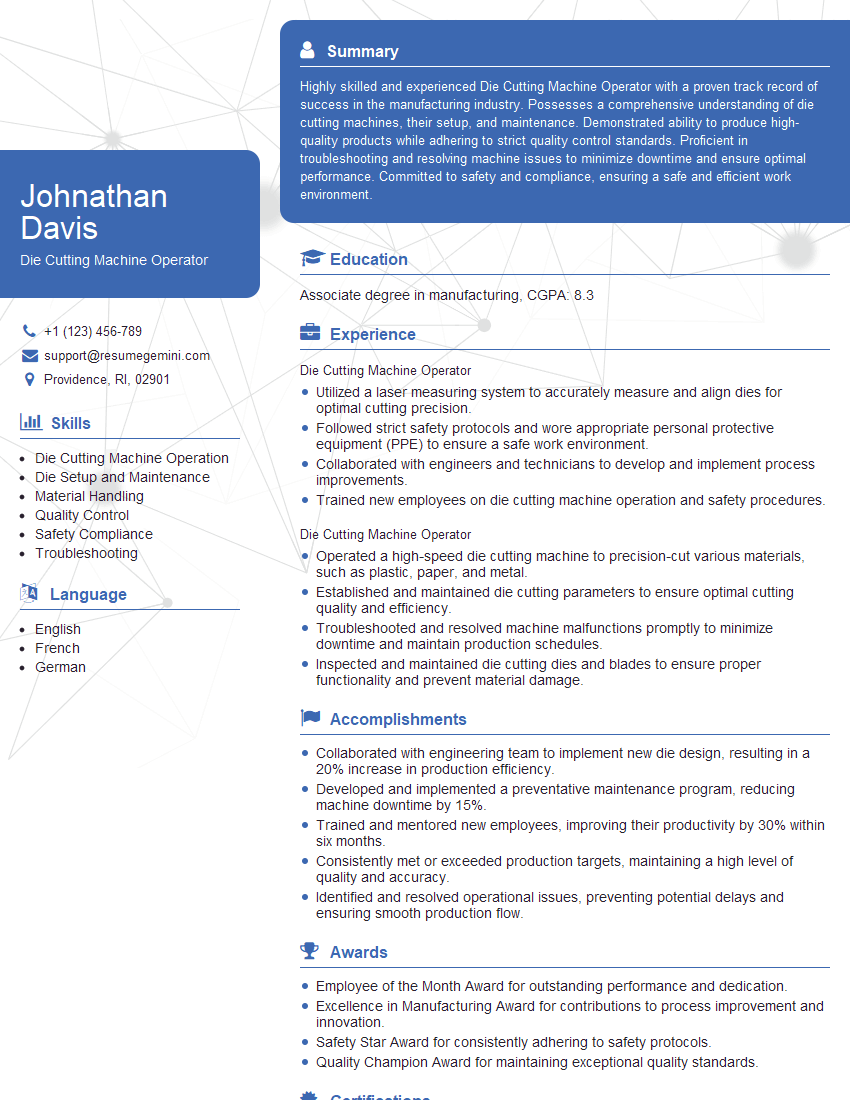
Mastering DieCutting Machine Operation opens doors to a rewarding career with opportunities for advancement and increased earning potential. A strong understanding of these critical skills makes you a highly valuable asset to any company. To maximize your job prospects, it’s crucial to present your skills effectively. Creating an ATS-friendly resume is essential for getting your application noticed. We recommend using ResumeGemini, a trusted resource for building professional resumes that highlight your skills and experience. ResumeGemini provides examples of resumes tailored to DieCutting Machine Operation to help you showcase your qualifications effectively. Take the next step towards your dream job – invest in a strong resume today.
Explore more articles
Users Rating of Our Blogs
Share Your Experience
We value your feedback! Please rate our content and share your thoughts (optional).
What Readers Say About Our Blog
Very informative content, great job.
good