Every successful interview starts with knowing what to expect. In this blog, we’ll take you through the top Electronic Engraving interview questions, breaking them down with expert tips to help you deliver impactful answers. Step into your next interview fully prepared and ready to succeed.
Questions Asked in Electronic Engraving Interview
Q 1. Explain the difference between laser and electrochemical engraving.
Laser engraving and electrochemical engraving are two distinct methods for marking materials, differing primarily in their energy source and resulting effects. Laser engraving uses a high-powered laser beam to ablate or vaporize material, creating a permanent mark. Think of it like a tiny, intensely hot scalpel precisely cutting away material. The depth and quality of the engraving are controlled by adjusting laser power, speed, and the number of passes. Electrochemical engraving, conversely, uses an electrical current applied through an electrolyte solution to etch the material. It’s like using a tiny, controlled chemical reaction to dissolve material away. This method is generally gentler and produces finer details in some materials, especially metals.
In short: Laser engraving is a subtractive process using focused light, while electrochemical engraving is a subtractive process using an electrical current and chemical reaction.
Example: Laser engraving is ideal for creating deep, sharp markings on wood or acrylic, while electrochemical engraving excels at producing fine lines and intricate designs on metals, like jewelry.
Q 2. Describe your experience with different types of engraving machines.
Throughout my career, I’ve had extensive hands-on experience with a variety of engraving machines. This includes both laser engravers – from CO2 lasers best suited for non-metals to fiber lasers ideal for precise metal marking – and electrochemical engraving systems. I’m proficient with both automated, computer-controlled systems, and those requiring more manual operation, particularly for intricate or bespoke projects. I’ve worked with machines ranging from small desktop units suitable for hobbyists to large-scale industrial systems capable of high-volume production. My experience also spans different manufacturers, allowing me to adapt to various machine interfaces and operating procedures.
For instance: I’ve used Epilog Zing laser systems extensively for detailed work on acrylic and wood, and a Universal Laser Systems machine for larger-format projects. In electrochemical engraving, I’ve worked with both automated systems used in industrial settings and smaller, manual units for detailed artistic work.
Q 3. What software are you proficient in for designing and controlling engraving processes?
My software proficiency covers a wide range of design and control applications relevant to electronic engraving. For design, I’m adept at using industry-standard vector graphics editors such as Adobe Illustrator and CorelDRAW, crucial for creating the precise outlines required for clean engravings. For controlling the engraving processes, I’m experienced with software specific to the different machine manufacturers, including the proprietary software for Epilog, Universal Laser Systems, and various electrochemical engraving systems. This includes the ability to create and manage job parameters, such as power, speed, passes, and focus, to achieve the desired engraving results. I also have experience with CAD software for integrating engraving designs into larger projects.
Example: I routinely use Adobe Illustrator to create detailed vector artwork, then import it into Epilog Laser’s software for processing. The software lets me fine-tune the laser parameters, preview the engraving, and send the job to the machine.
Q 4. How do you ensure accuracy and precision in your engraving work?
Accuracy and precision in engraving are paramount. I employ several strategies to ensure high-quality results. First, meticulous design is critical. I always use vector graphics, avoiding raster images that lack the sharp lines needed for precision. Second, careful calibration of the engraving machine is essential. This includes regular checks on the laser alignment (for laser systems) or electrode positioning (for electrochemical systems). Third, I carefully select appropriate settings for the specific material being engraved, considering factors like material thickness, type, and desired engraving depth. Finally, I often use test engravings on scrap material to fine-tune the settings before working on the final piece. This iterative process, along with regular machine maintenance, ensures optimal accuracy and precision.
Example: Before engraving a client’s logo onto a metal plaque, I’d first calibrate the machine, run a test engraving on a similar scrap metal piece to fine-tune laser power and speed, and make any necessary adjustments to the design or machine parameters before committing to the final engraving.
Q 5. What are the common safety precautions when operating electronic engraving equipment?
Safety is my top priority when operating electronic engraving equipment. For laser engraving, this includes wearing appropriate laser safety eyewear rated for the laser’s wavelength. Proper ventilation is crucial to eliminate fumes and airborne particles produced during the engraving process. The work area must be free from flammable materials. For electrochemical engraving, appropriate personal protective equipment (PPE) such as gloves and eye protection is essential to prevent contact with the electrolyte solutions, which can be corrosive. Always follow the manufacturer’s safety guidelines and instructions for each specific machine, and never operate equipment if it is malfunctioning or showing signs of damage.
Example: Before operating a CO2 laser engraver, I always put on laser safety glasses, ensure the exhaust system is functioning correctly, and clear the work area of any flammable materials.
Q 6. How do you troubleshoot common issues encountered during the engraving process?
Troubleshooting engraving issues involves a systematic approach. For laser engraving, common problems include inconsistent engraving depth, burning, or incomplete cuts. This often points to issues with the laser power, speed, focus, or material suitability. I troubleshoot these by first reviewing the machine settings and making adjustments accordingly. I may also check for any mechanical issues, such as the laser alignment or the movement of the engraving head. For electrochemical engraving, common issues include uneven etching or poor detail. This may indicate problems with the electrolyte solution concentration, current settings, or electrode placement. I would check the solution, ensure the correct current is applied, and adjust electrode placement as needed. Careful observation and a systematic approach to checking all potential sources of error help pinpoint the root cause of the problem.
Example: If I observe inconsistent engraving depth during a laser engraving job, I first check the laser power settings, the focus, and the speed. If the problem persists, I’d inspect the laser’s alignment and the machine’s mechanical components.
Q 7. Describe your experience with different engraving materials (metals, plastics, wood, etc.).
My experience encompasses a wide range of engraving materials. I have extensive experience engraving various metals, including stainless steel, brass, aluminum, and titanium, each requiring specific parameter adjustments due to their varying properties. Plastics like acrylic, polycarbonate, and ABS respond differently to laser engraving, needing adjustments for power and speed to prevent melting or burning. Wood engraving is another area of expertise, requiring different approaches depending on the type of wood, its density, and the desired level of detail. Additionally, I’ve worked with other materials like glass, leather, and even some ceramics, always adapting my techniques and parameters based on material-specific characteristics.
Example: Engraving stainless steel requires higher power and potentially multiple passes to achieve sufficient depth, whereas engraving acrylic requires more delicate settings to avoid burning.
Q 8. What are the limitations of each engraving method?
The limitations of various engraving methods depend heavily on the material being engraved and the desired outcome. Let’s examine some common methods:
- Laser Engraving: While versatile, laser engraving can be limited by material absorption rates. Materials that reflect laser light (highly polished metals, for instance) can be challenging to engrave deeply or cleanly. The laser’s power also restricts the depth and precision achievable; fine details might be blurred on thicker materials. Another limitation is the potential for thermal damage to heat-sensitive materials like plastics.
- Rotary Engraving: This method, using a rotating bit, excels at creating deep engravings, but suffers from limitations in detail and speed. Intricate designs take longer and the risk of breakage on sharp corners or fine lines is higher. The shape of the bit also dictates the available styles of engraving.
- CNC Milling Engraving: CNC milling offers superior precision and depth control compared to rotary engraving, especially for complex 3D designs. However, it is a slower process and requires significant investment in machinery. The cost of tooling can also add up, especially for specialized cuts.
- Chemical Etching: This method is excellent for creating intricate details on metal, but it is time-consuming and the depth of the engraving is limited by the chemical process. It also requires careful handling of chemicals and proper safety measures.
Ultimately, choosing the best method involves a careful assessment of the design’s complexity, material properties, budget constraints, and required level of precision.
Q 9. How do you calibrate and maintain engraving equipment?
Calibrating and maintaining engraving equipment is crucial for consistent quality and longevity. Regular maintenance is like a car’s tune-up; it prevents major issues down the line.
- Laser Engravers: Calibration often involves adjusting laser power and focus using test engravings on sample materials. Regular cleaning of the lens and mirrors is essential to maintain beam quality and prevent damage. Monitoring the laser’s alignment is also critical to ensuring accurate and consistent engravings.
- Rotary Engravers: Calibration focuses on the bit’s depth and speed settings. Regular bit changes are important to maintain sharpness and prevent damage to the material. Lubrication of moving parts is also vital to prevent wear and tear.
- CNC Machines: CNC machines require more complex calibration, including checking spindle alignment, axis movement accuracy, and software settings. Regular checks of the machine’s zero point and compensation for tool wear are essential. These often involve using specialized calibration tools and software.
In all cases, keeping the equipment clean, following manufacturer’s guidelines, and conducting regular tests are crucial steps in ensuring optimal performance and preventing costly repairs.
Q 10. Explain the process of setting up an engraving job, from design to final product.
Setting up an engraving job is a multi-stage process. Imagine it like creating a perfect cake: each step is critical to the final product.
- Design Creation: The process starts with the design, either created using vector graphics software (like Adobe Illustrator or CorelDRAW) or imported from a pre-existing design. The design should be carefully optimized for the chosen engraving method – minimizing unnecessary details and ensuring appropriate line thicknesses.
- Material Selection: The choice of material depends heavily on the design and desired outcome. Wood, metal, acrylic, and leather all offer different engraving characteristics and require different settings.
- Software Setup: The design is then imported into the engraving machine’s software, where parameters like engraving speed, depth, power (for laser), and bit type (for rotary) are carefully adjusted. This is where the expertise comes into play, as incorrect settings can ruin the material or produce poor results.
- Test Engraving: Before committing to the final product, a test run on a scrap piece of the same material is highly recommended to check settings and make any necessary adjustments. This step saves material and time in the long run.
- Engraving: Once the settings are confirmed, the final engraving process is initiated. Careful monitoring is essential during this stage, particularly for intricate designs.
- Post-Processing: Depending on the material and method, post-processing might be needed. This could include cleaning, polishing, or applying a protective coating.
The entire process demands meticulous attention to detail, ensuring consistency in each phase to get the desired quality.
Q 11. How do you handle complex or intricate engraving designs?
Handling complex or intricate designs requires a strategic approach and precise technique.
- Vector Optimization: Complex designs are best handled using vector graphics. Simplifying the design by removing unnecessary detail, optimizing line weights, and ensuring smooth curves reduces the chance of errors and improves engraving quality.
- Multiple Passes: For deep engravings or intricate details, multiple passes with adjusted settings might be necessary. This allows for controlled depth and reduces the risk of material damage.
- Software Capabilities: Using advanced software features like vector tracing, node editing, and specialized engraving algorithms is critical for accurate reproduction of fine details. Understanding your software’s limitations is equally important.
- Material Choice: The material itself impacts the outcome. Materials like acrylic or hardwoods often handle fine details better than softer materials.
- Machine Precision: Having a high-precision machine is essential for accurately engraving small and intricate elements. Regular calibration and maintenance play a critical role here.
Dealing with complex designs is a test of both design skills and technical proficiency. It’s not just about speed; it’s about precision and understanding the capabilities of your equipment.
Q 12. Describe your experience with quality control procedures in electronic engraving.
Quality control is paramount in electronic engraving. My experience emphasizes a multi-layered approach:
- Pre-Engraving Inspection: Thoroughly checking the design file for errors, inconsistencies, or areas that may cause problems during engraving. This includes verifying proper scaling and ensuring the design is suitable for the chosen material and engraving method.
- Process Monitoring: Closely monitoring the engraving process to identify and rectify any issues in real-time. This might involve adjusting settings, changing tools, or making minor corrections as needed.
- Post-Engraving Inspection: Carefully inspecting the finished product for flaws, inconsistencies, or defects. This includes checking for depth, sharpness, clean lines, and overall quality. I use magnification tools to spot subtle issues.
- Documentation: Maintaining detailed records of each job, including settings, materials, and quality control checks. This aids in identifying recurring problems and improving future processes.
- Client Approval: If applicable, obtaining client approval before proceeding to the final production run. This ensures the final product meets their expectations.
These combined checks help maintain high-quality output and ensure customer satisfaction. A proactive approach to quality control saves time and resources in the long run, avoiding costly rework and potential customer dissatisfaction.
Q 13. What are the different types of laser engraving systems you’re familiar with?
My experience encompasses a range of laser engraving systems, each with its own strengths and weaknesses:
- CO2 Laser Engravers: These are widely used for engraving non-metals like wood, acrylic, and leather due to their excellent material interaction. I’m proficient in operating both smaller, desktop models and larger, industrial systems. I understand the importance of optimizing power settings and beam focus for different materials.
- Fiber Laser Engravers: These are particularly suited for engraving metals and other highly reflective materials. Their high precision and speed make them ideal for intricate designs and mass production. I’m familiar with various fiber laser systems, including those employing galvanometer scanners for high-speed engraving.
- UV Laser Engravers: UV lasers are known for their ability to engrave a wider range of materials with great precision, including plastics, glass, and certain metals. Their smaller wavelengths allow for fine details and minimal heat-affected zones.
I’m comfortable working with different laser wavelengths and power levels, adapting my approach based on the project’s specific requirements.
Q 14. Explain your understanding of CNC machining principles applied to engraving.
CNC machining principles are fundamental to precision engraving, particularly for 3D and complex designs. Think of it as sculpting with extreme accuracy.
CNC engraving uses computer-controlled cutting tools (mills) to precisely remove material, creating the desired design. The process relies on:
- Computer-Aided Design (CAD): The design is created in a CAD program, generating precise instructions for the CNC machine.
- Computer-Aided Manufacturing (CAM): CAM software translates the CAD design into toolpaths – instructions guiding the machine’s movements.
- CNC Machine Control: The CNC machine’s controller interprets the toolpaths and directs the cutting tool’s movements with incredible accuracy.
- Cutting Tools: Various cutting tools are used depending on the material and desired depth. Proper tool selection is crucial for optimal performance and to avoid damage to the material.
Understanding the interplay between CAD, CAM, and the CNC machine’s capabilities is essential for producing high-quality engravings. Factors like feed rates, spindle speed, and depth of cut are critical parameters that must be precisely controlled to achieve the desired result. It’s not just about the tools, it’s about mastering the entire process.
Q 15. What is your experience with post-processing techniques (e.g., cleaning, finishing)?
Post-processing in electronic engraving is crucial for achieving a high-quality, professional finish. It encompasses a range of techniques aimed at cleaning, refining, and enhancing the engraved product. Think of it as the final polish that transforms a good engraving into a great one.
My experience includes:
- Cleaning: Removing debris and residue left behind by the engraving process using compressed air, ultrasonic cleaning baths (especially effective for intricate designs or delicate materials), or specialized cleaning solutions depending on the material. For instance, I’d use a different cleaning solution for stainless steel than I would for wood.
- Deburring: Carefully removing any sharp edges or burrs left by the engraving bit or laser. This is particularly important for safety and a smooth feel, especially on items handled frequently.
- Polishing: Using polishing compounds and appropriate tools to enhance the shine and smoothness of the engraved surface. This can range from simple buffing to more sophisticated techniques like electropolishing for metals.
- Finishing: Applying coatings like clear coats or lacquers to protect the engraving from wear and tear and enhance its longevity. The choice of finish depends on the material and desired aesthetic.
For example, when engraving a personalized gift on a wooden pen, I might use a fine-grit sandpaper followed by a wood polish and a protective clear coat to ensure it remains beautiful for years.
Career Expert Tips:
- Ace those interviews! Prepare effectively by reviewing the Top 50 Most Common Interview Questions on ResumeGemini.
- Navigate your job search with confidence! Explore a wide range of Career Tips on ResumeGemini. Learn about common challenges and recommendations to overcome them.
- Craft the perfect resume! Master the Art of Resume Writing with ResumeGemini’s guide. Showcase your unique qualifications and achievements effectively.
- Don’t miss out on holiday savings! Build your dream resume with ResumeGemini’s ATS optimized templates.
Q 16. How familiar are you with various engraving depth settings and their effects?
Engraving depth is a critical parameter affecting the final appearance and durability of the engraved product. It’s like controlling the volume of an etching – a subtle engraving might be elegant, while a deep one is more dramatic. The appropriate depth depends heavily on the material, the desired aesthetic, and the design itself.
- Shallow Engraving: Creates a subtle, almost embossed effect, ideal for delicate designs or materials that may not withstand deep cuts. This is often used for logos or decorative patterns on jewelry.
- Medium Engraving: Offers a good balance between visibility and material preservation, often preferred for names, dates, or other text.
- Deep Engraving: Produces a more pronounced and durable engraving, often used for creating highly visible markings on tools or identification plates. However, this could lead to material loss or weakening if the engraving is too deep.
I have extensive experience adjusting depth settings based on material properties. For instance, engraving hard materials like titanium requires significantly different depth settings and potentially more powerful machinery than engraving softer materials such as wood.
Q 17. How do you handle material variations that could affect engraving quality?
Material variations are a constant challenge in electronic engraving. Different materials have varying hardness, density, and reactivity to the engraving process. The key is to understand these variations and adjust the engraving parameters accordingly.
My approach involves:
- Material Identification: Accurately determining the material composition is the first step. This often involves visual inspection, but sometimes more sophisticated methods are necessary.
- Test Engravings: Performing test engravings on a sample piece of the material to determine the optimal settings for depth, speed, and power. This avoids ruining the final product.
- Parameter Adjustment: Fine-tuning the engraving parameters (depth, speed, power, and possibly bit type) based on the test results. This iterative process ensures high-quality results even with variations within a material batch.
- Software Compensation: Utilizing the capabilities of CAD/CAM software to compensate for material inconsistencies where possible, using features that modify toolpaths based on material properties.
For example, a slightly softer area in a piece of wood might require a reduction in power or engraving speed to prevent over-engraving in that area, while a hard spot may require an increase in power to achieve consistent depth.
Q 18. Describe your experience with different types of engraving bits or lasers.
My experience encompasses a wide range of engraving bits and lasers. The choice of tool significantly impacts the quality and type of engraving achievable.
- Engraving Bits (Rotary Engraving): I have experience with various bit materials (e.g., carbide, diamond), shapes (V-bits, ball-nose bits, flat bits), and sizes. The choice depends on the material, detail level, and desired engraving style. A V-bit provides sharp lines, while a ball-nose bit creates a smoother, rounded effect.
- Lasers (Laser Engraving): I’m proficient with both CO2 and fiber lasers. CO2 lasers are well-suited for engraving non-metals like wood and acrylic, while fiber lasers excel with metals and harder materials. I understand the importance of laser power, speed, and focal length adjustments for achieving precise and consistent results.
For instance, for intricate detail work on jewelry, I might opt for a small diamond-tipped engraving bit or a high-precision fiber laser. For marking larger metal plates, a robust carbide bit or a high-power CO2 laser might be more appropriate.
Q 19. What are your skills in using CAD/CAM software for engraving design?
CAD/CAM software is the backbone of modern electronic engraving. I am highly proficient in using such software to design and generate the toolpaths required for the engraving process. My skills include:
- Design Creation: Generating intricate and precise designs using vector-based graphics editors within the CAD software.
- Toolpath Generation: Using the CAM modules to create efficient and accurate toolpaths which dictate the movement of the engraving bit or laser.
- Parameter Optimization: Setting appropriate parameters such as engraving depth, speed, and power based on the material and design.
- Simulation: Using software simulation capabilities to preview the engraving process and identify potential problems before initiating the actual engraving.
- Software Proficiency: I’m proficient in industry-standard software such as AutoCAD, SolidWorks, and various CAM packages specific to CNC routers and laser engravers.
For example, when engraving a complex 3D design onto a metal plate, I’ll use the CAM software to generate a toolpath that strategically guides the engraving bit across the surface to ensure accurate representation of the model.
Q 20. How do you ensure the longevity and durability of engraved products?
Ensuring the longevity and durability of engraved products requires a multifaceted approach combining proper materials, techniques, and post-processing steps.
- Material Selection: Choosing materials appropriate for the intended application and environmental conditions is crucial. For outdoor applications, I’d select weather-resistant materials. For items handled frequently, I’d prioritize scratch-resistant materials.
- Engraving Technique: The engraving technique itself impacts durability. Deep, well-defined engravings are generally more durable than shallow ones. Proper parameter setting avoids weak points in the engraving.
- Protective Coatings: Applying protective coatings, like clear coats, powder coatings, or anodizing (for metals), significantly enhances resistance to wear, scratches, and corrosion.
- Proper Handling and Storage: Proper storage and handling practices are essential for minimizing damage. This includes avoiding contact with harsh chemicals, storing items in appropriate environments, and using protective packaging.
For example, a custom engraved stainless-steel nameplate for outdoor use would benefit from deep engraving and a durable powder coat to resist the elements.
Q 21. Explain your approach to managing a high-volume engraving workload.
Managing high-volume engraving workloads efficiently requires a structured and organized approach. My strategy involves:
- Workflow Optimization: Implementing a streamlined workflow from design to post-processing minimizes processing time and maximizes efficiency.
- Automation: Leveraging automation wherever possible – this could include automated material handling, automated tool changes, or automated post-processing steps, depending on equipment capabilities.
- Batch Processing: Grouping similar engraving jobs together to optimize machine setup and reduce downtime.
- Quality Control: Implementing rigorous quality control checks at each stage of the process to identify and correct errors early on, preventing rework and delays.
- Inventory Management: Effective inventory management of materials and supplies to prevent delays due to shortages.
I utilize project management tools to track progress, deadlines, and resource allocation. A well-organized system allows me to handle a significant number of engraving jobs without compromising quality or timeliness. This includes using software for scheduling and tracking projects, managing customer orders, and coordinating resources across different stages of production.
Q 22. Describe your problem-solving skills as they relate to electronic engraving challenges.
My problem-solving approach in electronic engraving centers around a systematic, multi-faceted strategy. I begin by thoroughly analyzing the issue, identifying the specific problem – is it a design flaw, a machine malfunction, a material incompatibility, or an operator error? This initial assessment often involves visual inspection, testing the machine’s various components, and reviewing the engraving parameters (depth, speed, power, etc.).
Next, I employ a process of elimination. For example, if the engraving is too shallow, I might systematically check the power supply, the bit’s condition, and the material’s properties. If the lines are uneven, I focus on the machine’s movement, checking for alignment issues or vibrations. I often document my findings meticulously, using diagrams and notes to trace the problem’s source. Once the root cause is identified, I implement a solution, which may involve adjusting machine settings, replacing worn parts, altering the design, or even modifying the engraving process entirely. Finally, I always verify the solution’s effectiveness and document the entire troubleshooting process for future reference.
For instance, I once encountered a problem where the engraved lines were intermittently fading. By carefully examining the power supply and checking voltage fluctuations, I discovered a faulty capacitor causing intermittent power drops. Replacing this capacitor immediately resolved the issue.
Q 23. How do you stay current with advancements in electronic engraving technology?
Staying current in the dynamic field of electronic engraving requires a multifaceted approach. I actively participate in industry conferences and workshops, attending presentations and networking with other professionals to learn about the latest advancements. This allows me to exchange ideas and gain insights into innovative techniques and technologies.
I subscribe to relevant trade journals and online publications that specialize in laser technology, CNC machining, and materials science. These resources keep me updated on new software, hardware, and materials impacting the field. Additionally, I regularly engage with online forums and communities dedicated to electronic engraving, where experts share their experiences, troubleshoot problems, and introduce cutting-edge solutions.
Furthermore, I maintain relationships with key suppliers and manufacturers, actively seeking information about new products and improvements. Hands-on experimentation with new equipment and materials in a controlled setting is also critical for understanding their capabilities and limitations.
Q 24. Explain your experience with different power sources and their application in engraving.
My experience encompasses a wide range of power sources used in electronic engraving, each with specific applications and limitations. The most common are:
- Laser Engraving: Utilizes laser beams as the power source. The laser’s intensity and wavelength determine the material’s interaction and the engraving depth. Different materials require different laser powers and wavelengths for optimal results. For instance, a CO2 laser is ideal for engraving wood and acrylic, while a fiber laser excels with metals.
- Rotary Engraving (CNC): Employs electric motors to drive a rotating engraving bit. The power source here is the electric motor, whose speed and torque influence the engraving speed and depth. Higher power motors are needed for harder materials and deeper engravings. Bit selection is crucial, with diamond bits for harder materials and carbide bits for softer ones.
- Electrochemical Engraving (ECM): Employs an electrical current to dissolve the material, creating the engraving. The power source is a controlled DC power supply that precisely adjusts the current. The process is primarily used on conductive materials like metals.
Choosing the right power source depends heavily on the material being engraved, the desired depth and precision of the engraving, and the overall production throughput required.
Q 25. Describe a time you had to troubleshoot a complex engraving issue. What was your approach?
I once encountered a situation where a newly installed CNC engraving machine was producing inconsistent results – some sections of the engraving were deeper than others, leading to a marred final product. My troubleshooting approach involved a systematic investigation:
- Data Verification: I first checked the design file for errors or inconsistencies that could be causing the uneven engraving. I found no issues in the digital design.
- Machine Inspection: I inspected the machine’s mechanical components for any signs of misalignment, wear, or damage. I discovered a slight wobble in the spindle, causing uneven pressure on the material.
- Calibration Check: I performed a full calibration of the machine’s axes to ensure they were moving precisely and accurately, and this showed some minor discrepancies.
- Testing: I ran several test engravings using different materials and settings to isolate the problem. This confirmed that the spindle wobble was indeed the root cause.
- Resolution: I tightened the spindle mount, effectively eliminating the wobble. I then recalibrated the machine and conducted further test engravings to verify the solution’s success.
This systematic approach highlighted the importance of thorough inspection, methodical testing, and precise adjustments in achieving consistent and high-quality results.
Q 26. How would you train a new employee on the safe operation of electronic engraving equipment?
Training a new employee on the safe operation of electronic engraving equipment involves a multi-stage process that prioritizes safety and competence. It begins with comprehensive safety training, covering:
- Personal Protective Equipment (PPE): The importance of wearing safety glasses, hearing protection (especially with laser engraving), and appropriate clothing to prevent burns or injuries from flying debris.
- Machine Operation: A detailed explanation of the machine’s controls, functions, and emergency shut-off procedures. This includes practical demonstrations and hands-on practice under close supervision.
- Material Handling: Safe handling procedures for different materials to avoid cuts or exposure to hazardous substances. Proper disposal procedures for waste materials.
- Laser Safety (if applicable): Detailed instruction on laser safety regulations and procedures, including the use of laser safety glasses and avoidance of direct eye contact with the laser beam.
- Emergency Procedures: Clear instructions on how to respond to various emergencies, including equipment malfunctions, power outages, or accidents.
Throughout the training, emphasis is placed on practical application, with progressively challenging tasks assigned under supervision. Continuous assessment of the employee’s understanding and skill proficiency ensures safety and high-quality work.
Q 27. What are some environmental considerations in electronic engraving (waste management, etc.)?
Environmental considerations in electronic engraving are significant. Waste management is a key aspect. Depending on the material being engraved and the engraving process used, various types of waste are generated:
- Material Waste: Excess material removed during the engraving process needs to be collected and disposed of properly according to local regulations. This might include wood scraps, metal shavings, or plastic waste.
- Hazardous Waste: Some materials, like certain plastics or metals, can release hazardous fumes or particles during engraving. Appropriate ventilation and filtration systems are crucial to minimize environmental impact.
- Spent Bits/Tools: Used engraving bits or tools often need special disposal methods due to their potential abrasiveness or hazardous coatings.
- Laser Waste (if applicable): Laser engraving can generate particulate matter and exhaust gases that need proper filtration and ventilation.
Proper waste management practices involve segregating waste, using appropriate containers, and ensuring compliant disposal according to local environmental regulations. Investing in appropriate dust collection systems, filtration units, and waste recycling programs significantly reduces the environmental footprint of the engraving operation.
Q 28. What are your salary expectations for this electronic engraving position?
My salary expectations for this electronic engraving position are in the range of [Insert Salary Range] annually. This figure is based on my extensive experience, proven skills, and the market rate for professionals with my qualifications and expertise in this specific niche. I am confident that my contributions will significantly benefit your organization.
Key Topics to Learn for Electronic Engraving Interview
- Laser Engraving Principles: Understanding the physics behind laser engraving, including laser types, beam characteristics, and material interaction.
- Software Proficiency: Mastering design software (e.g., AutoCAD, CorelDRAW) used to create engraving designs and generate machine-readable files (e.g., DXF, AI).
- Machine Operation & Maintenance: Hands-on experience with electronic engraving machines, including setup, calibration, troubleshooting, and preventative maintenance.
- Material Selection & Properties: Knowledge of various materials suitable for electronic engraving (metals, plastics, wood) and their behavior during the engraving process.
- Parameter Optimization: Ability to adjust laser power, speed, and other parameters to achieve desired engraving depth, quality, and efficiency.
- Safety Procedures: Understanding and adhering to all safety protocols related to laser operation and handling of engraving materials.
- Quality Control & Inspection: Methods for inspecting engraved products for defects and ensuring consistency in quality.
- Design Considerations: Understanding design limitations imposed by the engraving process and adapting designs accordingly.
- Troubleshooting & Problem Solving: Ability to diagnose and resolve common issues encountered during the engraving process.
- Advanced Techniques: Explore techniques like 3D engraving, rotary engraving, or specialized material engraving for showcasing advanced knowledge.
Next Steps
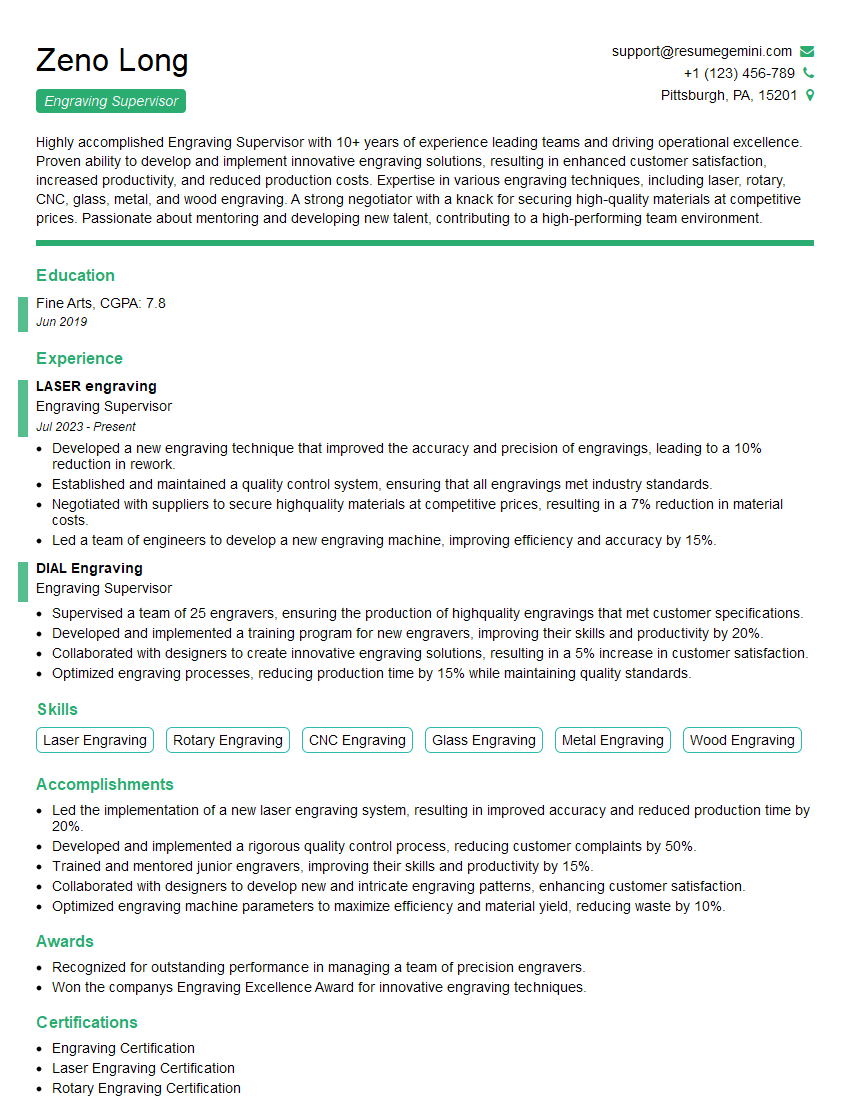
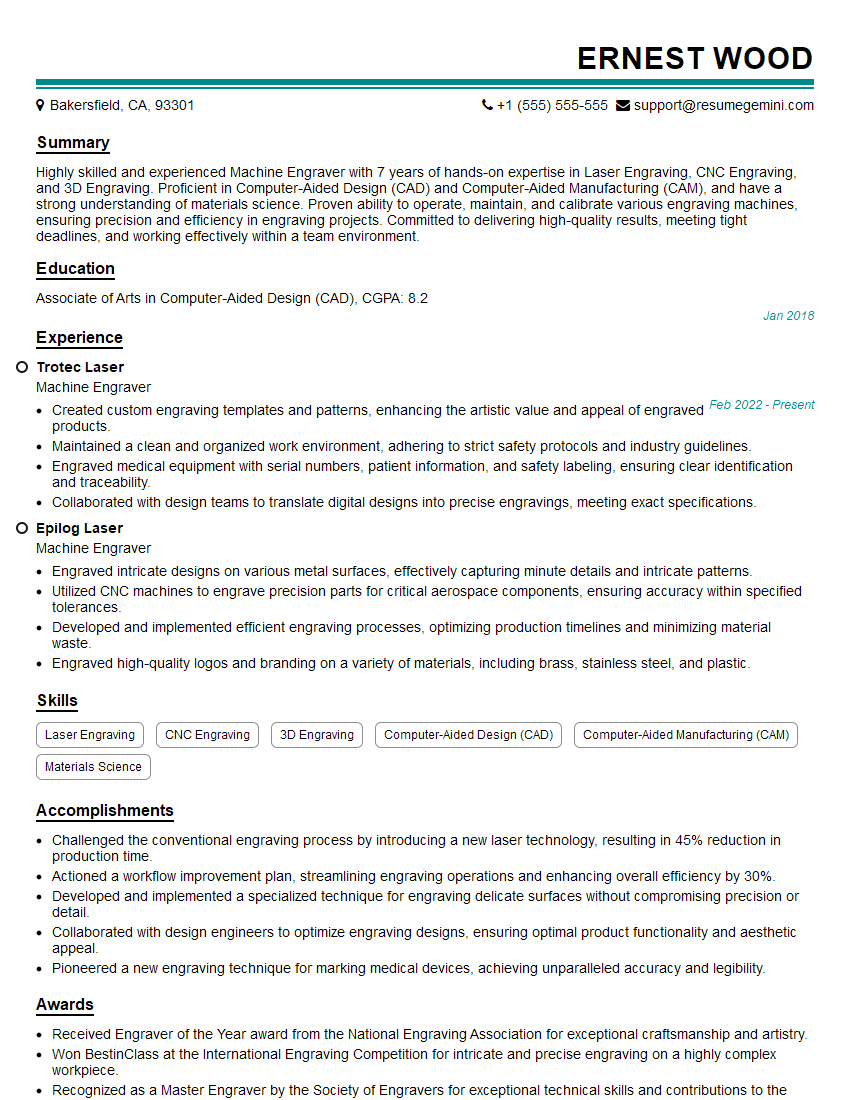
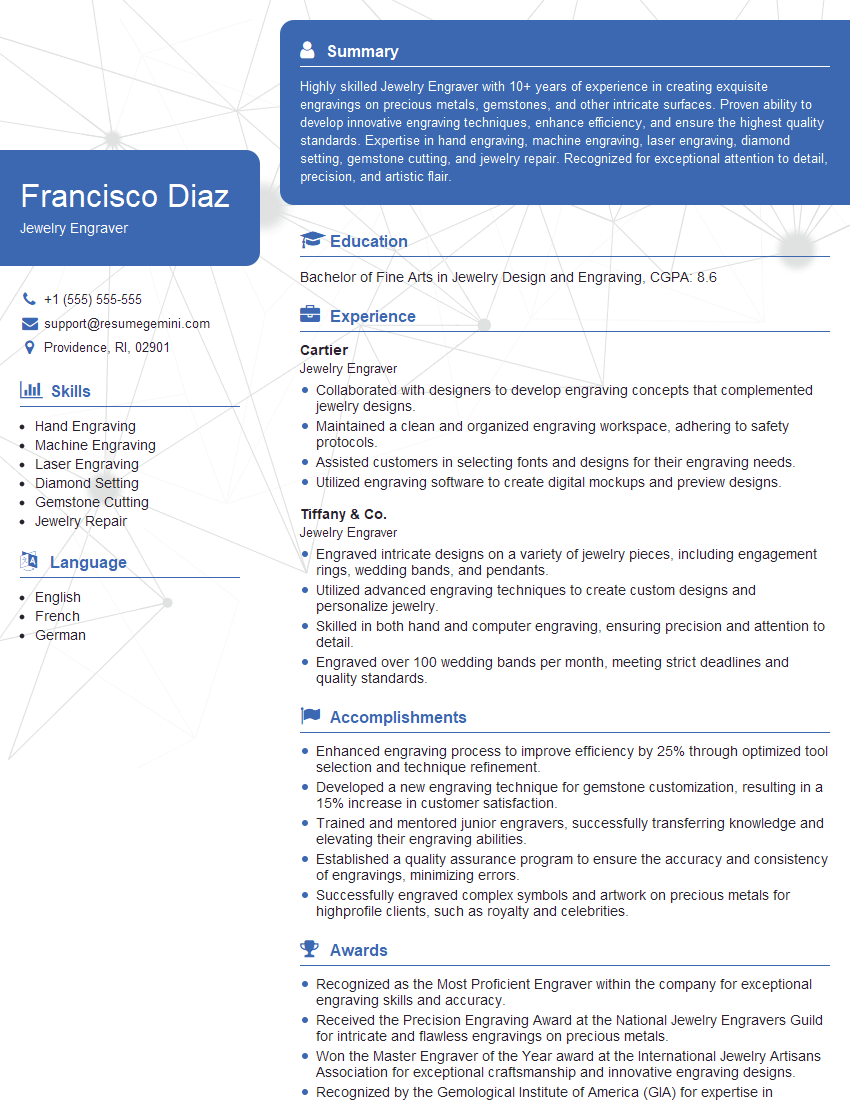
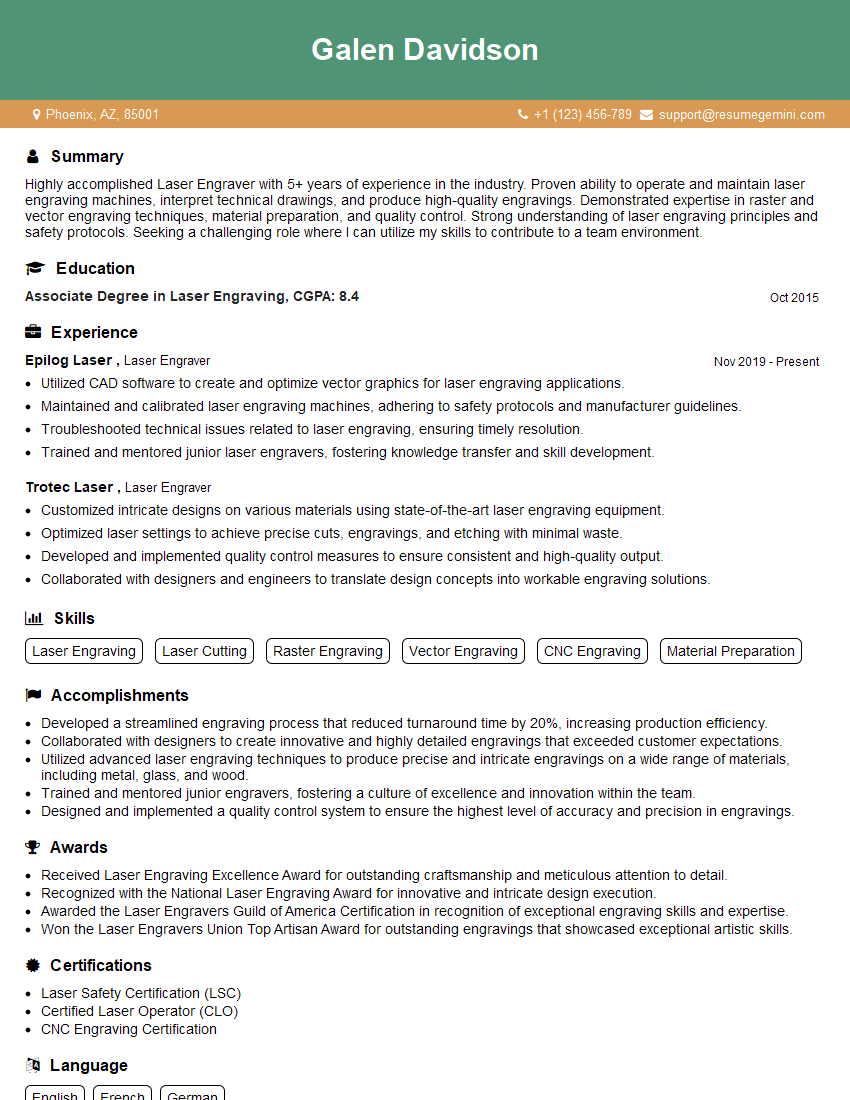
Mastering electronic engraving opens doors to exciting career opportunities in manufacturing, personalized product creation, and artistic design. To maximize your job prospects, crafting a strong, ATS-friendly resume is crucial. ResumeGemini is a trusted resource to help you build a professional and impactful resume that highlights your skills and experience effectively. Examples of resumes tailored specifically to the Electronic Engraving field are available to help you get started.

Explore more articles
Users Rating of Our Blogs
Share Your Experience
We value your feedback! Please rate our content and share your thoughts (optional).
What Readers Say About Our Blog
Very informative content, great job.
good