Preparation is the key to success in any interview. In this post, we’ll explore crucial Plate Developing interview questions and equip you with strategies to craft impactful answers. Whether you’re a beginner or a pro, these tips will elevate your preparation.
Questions Asked in Plate Developing Interview
Q 1. Explain the process of plate developing in detail.
Plate developing is the crucial process of converting a latent image on a printing plate into a visible, printable image. Think of it like revealing a hidden picture: the plate starts with an invisible image, and the developer brings it to life.
The process typically involves immersing the exposed plate in a chemical solution, the developer. This developer selectively dissolves the unexposed areas of the plate, leaving behind the image area. The precise chemistry and duration of development are critical for achieving the desired result. For example, in a typical workflow, a Computer-to-Plate (CTP) plate is exposed to UV light or a laser, hardening the exposed areas while leaving the unexposed areas relatively soft. The developer then removes the unexposed areas, leaving a raised image that can accept ink.
The steps generally include:
- Plate Exposure: The plate is exposed to light (UV or laser) through a film or digital file. This creates a latent image.
- Plate Development: The exposed plate is processed in a developer solution. This selectively removes the unexposed areas.
- Plate Washing: The plate is rinsed to remove residual developer.
- Plate Gumming (optional): A gum arabic solution is applied to protect the image area and prevent unwanted ink adhesion.
- Plate Drying: The plate is dried before mounting on the printing press.
Variations exist depending on the plate type and the specific press requirements, but the core principle remains consistent – selectively removing the unwanted areas to reveal the image.
Q 2. What are the different types of printing plates used in the industry?
The printing industry uses a variety of plates, each with its own strengths and weaknesses. The choice depends heavily on the printing process, budget, and quality requirements.
- PS Plates (Photosensitive Plates): These are traditional plates requiring a film intermediary. They are relatively inexpensive but require more steps.
- CTP Plates (Computer-to-Plate): These plates eliminate the film step, allowing direct imaging from a computer. They are highly efficient but represent a greater initial investment. Within CTP plates, we find subdivisions based on the exposure method:
- Thermal CTP Plates: These plates utilize heat to create the image. They are known for their sharpness and fine detail, often used for high-quality applications.
- Violet CTP Plates: These plates use violet laser light for exposure. They offer high resolution and good stability. They are generally faster than thermal plates.
- Flexographic Plates: These plates are used in flexible packaging and label printing. They are made from photopolymer materials and offer excellent durability.
- Offset Plates: These are the workhorses of offset printing. They come in various forms, including surface plates and aluminum plates.
The ongoing development of plate technology constantly introduces new materials and processes, pushing the boundaries of print quality and efficiency.
Q 3. Describe the characteristics of a properly developed printing plate.
A properly developed printing plate boasts several key characteristics, all contributing to optimal print quality and press performance.
- Clean Image Area: The image area should be sharp, crisp, and free from any developer residue or imperfections. Think of it as a clean canvas ready for ink.
- Completely Clean Non-Image Area: The non-image area should be completely clean, ensuring there’s no unwanted ink transfer. Any developer residue would result in smearing or ghosting in the final print.
- Appropriate Thickness: The plate needs to have the right thickness for its intended application, offering proper resilience against wear and tear during the printing run. An excessively thin plate could be prone to damage while an overly thick plate would increase waste.
- Uniformity: The plate should have a consistent surface, without blotches or uneven areas. Inconsistency would translate to variations in ink density on the printed material.
- Absence of Scratches or Defects: Any physical damage could lead to ink transfer problems or inconsistencies on the printed product.
Assessing these factors visually and sometimes with a specialized plate inspection tool ensures the plate is ready for printing and guarantees the intended print quality.
Q 4. How do you identify and troubleshoot common plate developing issues?
Troubleshooting plate developing issues requires a systematic approach. The first step is careful observation to pinpoint the problem’s nature.
Common Issues and Solutions:
- Weak Image: This often indicates insufficient exposure or an exhausted developer. Solution: increase exposure time or replace the developer.
- Muddy Image: This points to overexposure or excessive development time. Solution: reduce exposure time or shorten development time.
- Pinholes: Tiny holes in the image area suggest dust contamination during exposure or developing. Solution: meticulously clean the plate before exposure and maintain cleanliness during processing.
- Scratches or Defects: These are typically caused by handling errors or equipment problems. Solution: Handle plates with care and regularly inspect your developing equipment.
- Uneven Development: This can be due to uneven plate temperature, developer inconsistency, or inadequate agitation. Solution: ensure consistent plate temperature, monitor developer levels, and use proper agitation techniques.
Detailed logs and regular maintenance of developing equipment are key to minimizing troubleshooting.
Q 5. What safety precautions are necessary during plate developing?
Safety is paramount during plate developing. Many developers contain chemicals that can be harmful if mishandled.
- Personal Protective Equipment (PPE): Always wear appropriate PPE, including gloves, eye protection, and a lab coat. This protects against skin and eye contact with chemicals.
- Ventilation: Ensure adequate ventilation to reduce exposure to fumes. Work in a well-ventilated area or use a fume hood.
- Proper Handling Procedures: Follow all manufacturer’s instructions for handling and disposal of developers and other chemicals. Improper disposal can lead to environmental pollution and harm.
- Emergency Procedures: Be familiar with emergency procedures, including what to do in case of spills or skin contact. Keep readily available emergency eye-wash stations and spill kits.
- Chemical Storage: Store chemicals in accordance with their safety data sheets (SDS) in designated areas. Store away from heat and incompatible materials.
Regular training on chemical safety is essential for all personnel involved in plate developing.
Q 6. Explain the importance of proper plate cleaning and storage.
Proper cleaning and storage are critical for maintaining plate quality and extending their lifespan. Plates left unclean or improperly stored can degrade rapidly, leading to printing issues and wasted materials.
Cleaning: After development and before storage, plates should be thoroughly cleaned to remove any residual developer, ink, or gum arabic. A plate cleaner specifically designed for the plate type is essential. Any remaining residue can contaminate future print runs.
Storage: Plates should be stored in a clean, dry, and dark environment. Avoid exposure to extreme temperatures or humidity, as this can lead to plate degradation and potentially affect print quality. Plates should also be stored flat to prevent warping. Many use protective sleeves or specialized containers to minimize damage and maintain cleanliness.
Neglecting proper cleaning and storage results in reduced plate lifespan, increased waste and rework, and ultimately, impacts the cost-effectiveness of the printing process.
Q 7. What are the differences between thermal and violet CTP plates?
Thermal and violet CTP plates are both crucial in Computer-to-Plate technology, but they differ significantly in their exposure mechanism and resulting characteristics.
- Exposure Method: Thermal plates use heat from a thermal printhead for exposure, while violet plates use a violet laser.
- Resolution: Violet plates generally offer higher resolutions compared to thermal plates, leading to finer details and crisper images. This makes them ideal for high-resolution printing applications.
- Speed: Violet laser exposure is typically faster than thermal exposure, increasing throughput and efficiency in high-volume printing.
- Plate Durability: Both types offer good durability, but violet plates might demonstrate a slightly higher resistance to scratching and wear.
- Cost: Thermal plates are generally less expensive per plate than violet plates, but the overall cost effectiveness must also consider the processing speed.
The choice between thermal and violet CTP plates depends on factors such as budget, required resolution, print speed, and the specific printing requirements.
Q 8. How do you ensure consistent image quality during plate developing?
Consistent image quality in plate developing hinges on meticulous control over several key variables. Think of it like baking a cake – you need the right ingredients and precise measurements for a perfect result. In plate developing, this translates to maintaining consistent processing parameters.
Chemical Concentration: Precisely monitoring and maintaining the concentration of developer chemicals is paramount. Using automated replenishment systems helps maintain consistent chemical strength throughout the process, preventing variations in development times and image density. Regular testing with a densitometer is crucial for quality control.
Temperature Control: Temperature fluctuations directly impact development speed and image quality. Processors equipped with temperature control systems are essential. Imagine trying to bake a cake in an oven with fluctuating temperatures – the outcome would be inconsistent. Similarly, inconsistent temperature leads to uneven development and image degradation.
Processing Time: Accurate processing time is critical. Over-development can lead to excessive graininess and loss of detail, while under-development results in weak images with low density. Automated systems and timers are used to ensure consistent processing duration.
Plate Type and Chemistry Compatibility: Different plates (e.g., thermal, violet, UV) require specific developer chemistries. Using the incorrect chemistry will inevitably lead to poor quality and even plate damage. Always refer to the plate manufacturer’s instructions for compatibility.
By carefully managing these factors, we can produce consistently high-quality plates, reducing waste and ensuring predictable results on the press. For instance, in a high-volume printing operation, inconsistent plate quality would translate to significant financial losses due to reprints and press downtime.
Q 9. Describe your experience with different types of plate processors.
My experience encompasses a wide range of plate processors, from traditional manual systems to fully automated high-throughput units. Each type has its strengths and weaknesses. Think of it like choosing the right tool for the job.
Manual Processors: These offer greater flexibility and are often cheaper to purchase initially, but they are labour-intensive and prone to variations in image quality due to the human element. I’ve worked with several different types of manual processors, learning to adjust my technique to suit various plate sizes and chemistries.
Semi-Automatic Processors: These offer a balance between automation and manual control. They automate some steps, such as washing and drying, but still require manual loading and unloading of plates. These are commonly found in medium-volume printing shops.
Fully Automated Processors: These are high-speed, high-volume systems that automate the entire processing cycle. They offer the highest level of consistency and efficiency, reducing processing time significantly and minimizing operator error. My experience includes working with various models from leading manufacturers, such as those with integrated quality control features.
The choice of processor largely depends on the printing environment and production volume. In larger print facilities, the higher initial investment in a fully automated system is justified by increased productivity and consistent quality.
Q 10. What are the key factors influencing plate life and durability?
Plate life and durability are crucial for efficient and cost-effective printing. Several factors significantly impact their longevity:
Plate Type: Different plate types (e.g., thermal, CtP) have inherent differences in their durability. Thermal plates are generally more susceptible to damage than CtP plates, for instance.
Storage Conditions: Proper storage is essential. Plates should be kept in a cool, dry, dark environment to prevent premature degradation and maintain image quality. Exposure to extreme temperatures or humidity can significantly shorten plate life.
Handling and Processing: Careful handling during processing and on press is vital. Scratches, bends, or other damage can reduce plate lifespan and impact print quality. Implementing proper handling procedures and training is essential.
Printing Conditions: Aggressive printing conditions (e.g., high ink density, fast printing speeds) can increase wear and tear on the plate.
Cleaning and Maintenance: Regular cleaning of the plates during processing can help to extend their life. Removing excess ink and debris is essential.
For example, I once worked on a project where improper storage led to a significant loss of plates due to degradation. Implementing better storage procedures and training reduced losses significantly.
Q 11. How do you manage plate inventory and ensure availability?
Efficient plate inventory management is critical for smooth printing operations. We utilize a combination of strategies:
Inventory Tracking System: A robust inventory management system (often software-based) keeps track of plate types, quantities, and expiry dates. This allows for accurate forecasting and prevents stockouts or the accumulation of obsolete plates.
FIFO (First-In, First-Out) System: Using a FIFO system for plate storage ensures that older plates are used first, minimizing the risk of expiration.
Regular Audits: Regular audits of the plate inventory help identify potential problems and adjust ordering to meet demand.
Supplier Relationships: Maintaining strong relationships with reliable suppliers ensures timely delivery and availability of plates, preventing production delays.
In one instance, implementing a new inventory management software system enabled us to reduce waste by 15% by optimizing our ordering and avoiding obsolete stock.
Q 12. Explain the process of plate mounting and registration.
Plate mounting and registration are critical steps in ensuring accurate image placement on the printed sheet. Think of it as aligning a jigsaw puzzle perfectly. Precise registration is essential for avoiding misalignment and poor print quality.
The process typically involves:
Plate Mounting: Carefully securing the processed plate onto a mounting base. This requires precision and accuracy to ensure the plate is firmly and correctly positioned.
Registration: Aligning the plate’s image with pre-determined registration marks on the printing press. This involves careful adjustment of the plate’s position using fine-tuning mechanisms on the press. Sophisticated technologies, such as laser registration systems, significantly improve accuracy.
Techniques include using mounting tape, adhesive, or mechanical clamps. The choice depends on the plate material and press type. Incorrect mounting can result in plate slippage or damage during printing, while poor registration leads to misaligned images and necessitates costly reprints.
Q 13. How do you handle defective or damaged plates?
Defective or damaged plates must be identified and handled promptly to avoid disruptions and waste. The approach involves:
Inspection: Plates should be carefully inspected before, during, and after processing for any defects, such as scratches, damage to the image area, or inconsistencies in development.
Root Cause Analysis: Identifying the root cause of defects is vital to prevent recurrence. This may involve examining the processing parameters, plate handling procedures, or even the quality of the plates themselves.
Disposal: Defective plates should be disposed of according to environmental regulations. This usually involves specialized waste handling procedures for chemical waste.
Replacement: Replacing defective plates is necessary to maintain production schedules. A well-managed inventory ensures sufficient stock is available for quick replacement.
For instance, consistent scratches on plates led us to review our plate handling procedures. Implementing better training and revised handling protocols eliminated the problem.
Q 14. What are the environmental considerations related to plate developing?
Environmental considerations are paramount in plate developing. The process generates chemical waste, and proper handling is crucial to protect both the environment and the health of workers.
Waste Management: Proper disposal of developer solutions and other chemical waste is essential. This requires adherence to local, regional, and national environmental regulations. Often, specialized waste contractors are employed for safe and compliant disposal.
Water Consumption: Plate processing involves significant water consumption. Implementing water-saving techniques, such as efficient rinsing systems, reduces the environmental footprint.
Chemical Selection: Choosing less harmful and more environmentally friendly developer chemistries is increasingly important. Many manufacturers now offer eco-friendly options.
Air Quality: Ventilation systems are essential to maintain good air quality and prevent worker exposure to harmful fumes.
We actively participate in programs for responsible chemical disposal and water conservation, reducing our environmental impact and contributing to a more sustainable printing process.
Q 15. What software or systems are you familiar with for plate management?
Plate management software is crucial for efficiency and quality control in a print shop. I’m familiar with several systems, each with its strengths. For example, Prinect from Heidelberg offers comprehensive plate management capabilities, from job scheduling and workflow automation to detailed tracking of plate usage and costs. It integrates seamlessly with their presses and prepress equipment. Other systems I’ve worked with include Esko Automation Engine, known for its robust automation features and integration with various prepress software, and various MIS (Management Information Systems) that incorporate plate tracking modules.
These systems typically allow for:
- Plate tracking: Monitoring the status of each plate from creation to disposal, including its use on the press and any potential issues encountered.
- Inventory management: Maintaining an accurate count of available plates and predicting future needs based on production schedules.
- Workflow automation: Automating tasks such as plate ordering, imaging, and processing, reducing manual intervention and potential errors.
- Cost tracking: Analyzing plate costs and identifying areas for potential savings.
My experience includes configuring and troubleshooting these systems, optimizing workflows, and training staff on their efficient use.
Career Expert Tips:
- Ace those interviews! Prepare effectively by reviewing the Top 50 Most Common Interview Questions on ResumeGemini.
- Navigate your job search with confidence! Explore a wide range of Career Tips on ResumeGemini. Learn about common challenges and recommendations to overcome them.
- Craft the perfect resume! Master the Art of Resume Writing with ResumeGemini’s guide. Showcase your unique qualifications and achievements effectively.
- Don’t miss out on holiday savings! Build your dream resume with ResumeGemini’s ATS optimized templates.
Q 16. How do you maintain the quality and consistency of your plate developing process?
Maintaining quality and consistency in plate developing is paramount for consistent print quality. This involves a multi-pronged approach:
- Precise chemical control: Regularly checking and adjusting the concentration of developing chemicals using a spectrophotometer or titration, ensuring they are within the manufacturer’s specifications. We use automated chemical replenishment systems wherever possible to minimize variation.
- Process parameters: Precisely controlling factors like developing time, temperature, and agitation, using calibrated equipment and following established Standard Operating Procedures (SOPs). Even minor deviations can impact quality.
- Regular maintenance: Performing routine maintenance on the developing machine, ensuring that components like rollers, pumps, and temperature sensors are functioning correctly. This also includes cleaning the machine regularly to prevent buildup of chemicals and debris.
- Quality checks: Regularly checking the developed plates for defects like pinholes, scratches, or uneven development using both visual inspection and densitometry. This helps identify problems early and correct them before they cause press issues.
- Environmental control: Maintaining a stable temperature and humidity in the platemaking area. Fluctuations in the environment can impact plate development and quality.
Imagine baking a cake – you need the precise ingredients and consistent oven temperature to get a perfect result. Platemaking is similar: consistent process parameters lead to consistent results.
Q 17. Describe your experience with different plate materials (e.g., aluminum, polyester).
My experience encompasses various plate materials, each with its own properties and applications. Aluminum plates are the industry standard, offering a good balance of cost, image quality, and durability. They are suitable for a wide range of printing applications, but their longevity can depend on the printing conditions and press type. I’ve worked extensively with different aluminum alloys, optimizing the processing parameters for each to achieve optimal results.
Polyester plates, on the other hand, offer significant advantages in terms of flexibility and lightweight nature, making them ideal for certain applications like flexographic printing. They are also more environmentally friendly due to their easier recyclability. However, they have limitations regarding durability compared to aluminum, and the processing parameters must be carefully managed to avoid image defects.
The choice of plate material depends largely on factors like print run length, printing method, substrate, and the desired level of image quality and durability. I possess the expertise to select the appropriate plate material for a given job and fine-tune the processing parameters to maximize results.
Q 18. What is your experience with plate stripping and proofing?
Plate stripping and proofing are essential steps to ensure print quality and efficiency. Plate stripping involves carefully removing the developed plate from its carrier, ensuring no damage to the image. This usually involves a combination of manual dexterity and appropriate tools to avoid scratching or bending the plate. I use specialized stripping tools and ensure proper handling to prevent damage.
Proofing, on the other hand, involves making a test print of the plate to check image quality, registration, and color accuracy before the full-scale printing run begins. This allows for adjustments to be made if necessary, minimizing waste and ensuring the final print meets the client’s specifications. We use various proofing methods depending on the application, from soft proofs for initial checks to hard proofs that closely match the final print.
In a real-world example, I once identified a minor registration issue during proofing that would have resulted in significant waste had it not been caught. Prompt identification and correction saved the company both time and materials.
Q 19. How do you measure and control the chemical concentrations used in plate developing?
Precise chemical concentration control is crucial for consistent plate development. We employ several methods:
- Titration: A common method where a chemical solution of known concentration is added to a sample of the developing chemical until a specific reaction occurs. This allows us to determine the exact concentration of the chemical in the processing solution.
- Spectrophotometry: This method uses light absorption to determine the concentration. We use a spectrophotometer to measure the absorbance of the chemical solution at a specific wavelength. This provides a quick and precise measurement of the concentration.
- Automated replenishment systems: Many modern developing machines have built-in systems that automatically monitor and adjust chemical concentrations, maintaining optimal levels throughout the process. These minimize manual intervention and human error.
- Regular monitoring and documentation: We maintain detailed records of all chemical concentrations, replenishments, and any adjustments made. This allows us to track trends, identify potential issues, and ensure compliance with quality standards.
Accurate measurement and control are essential; deviations can lead to poor image quality, inconsistencies, and ultimately, costly press downtime.
Q 20. Describe your troubleshooting skills regarding plate-related press issues.
Troubleshooting plate-related press issues requires a systematic approach. I start by gathering information: what is the specific problem? What are the symptoms (e.g., dot gain, scumming, poor ink transfer)? When did it start? What plate material and processing parameters were used?
Then, I systematically check several areas:
- Plate quality: I inspect the plate for defects such as scratches, pinholes, or uneven development. Densitometry measurements can also help identify problems.
- Press settings: I check press parameters such as impression pressure, ink flow, and dampening solution. Incorrect settings can lead to various print defects.
- Developing process: I review the plate developing parameters (time, temperature, agitation) to identify any deviations from the established SOPs. This might involve checking the chemical concentrations as well.
- Plate mounting: Incorrect plate mounting can cause registration problems and poor ink transfer. This involves checking plate alignment on the cylinder.
My experience allows me to quickly isolate the cause of the problem and implement a solution, minimizing press downtime and ensuring consistent print quality. For instance, I once resolved a case of significant dot gain by identifying a subtle misalignment in the press dampening system, rather than assuming a plate processing issue.
Q 21. Explain the relationship between plate developing and the overall printing process.
Plate developing is an integral part of the overall printing process. It’s a crucial step that directly impacts print quality, efficiency, and cost-effectiveness. The quality of the developed plate determines the fidelity with which the image will be transferred to the printing substrate.
Think of it as preparing the canvas before painting. A poorly prepared canvas will lead to a subpar painting, regardless of the artist’s skill. Similarly, even the best printing press and inks cannot compensate for defects in the plate. Poorly developed plates can lead to various print defects, including:
- Scumming: Unwanted ink on non-image areas.
- Dot gain: Enlargement of halftone dots, leading to loss of detail and contrast.
- Poor ink transfer: Insufficient or uneven ink coverage.
- Registration problems: Misalignment of colors or image elements.
Therefore, a carefully controlled plate developing process is essential for achieving consistent, high-quality prints, maximizing press uptime, and minimizing waste.
Q 22. How do you ensure the proper exposure settings for your chosen plate type?
Determining the correct exposure settings for a plate is crucial for optimal print quality. It’s a balancing act; too little exposure leads to weak images, while too much results in overexposed, muddy prints. The process involves understanding the plate’s sensitivity (measured in ISO or similar units), the intensity of the imaging device (e.g., CTP imager’s laser power), and the desired image density.
Firstly, consult the plate manufacturer’s specifications. They provide recommended exposure parameters for their plates, often specifying exposure energy (mJ/cm²) as a starting point. Secondly, a test strip is essential. This involves making several exposures of the same image at slightly varying settings (e.g., varying exposure time). By visually comparing the results, one can determine the optimal exposure that yields the best image contrast and density. Finally, sophisticated plate imagers often have automated exposure control systems that adjust settings based on the image data, further optimizing the process.
For example, if I’m using a thermal CTP plate with a specified exposure energy of 120 mJ/cm², I’ll create a test strip with exposures ranging from 110 to 130 mJ/cm², comparing the results for sharpness and density to fine-tune the setting for best results on the specific press and ink used.
Q 23. What are the different types of plate developers and their applications?
Plate developers are chemical solutions used to process exposed printing plates, bringing out the image and making it ready for printing. The choice of developer depends on the type of plate. There are several types:
- Solvent-based developers: These are commonly used for conventional offset plates (e.g., lithographic plates). They dissolve the unexposed areas of the plate, leaving the image intact. They can vary in aggressiveness, with some being designed for faster processing, while others are formulated for finer detail retention. Solvent-based developers typically involve specialized handling and disposal processes due to their environmental impact.
- Water-based developers: These are often used with newer, more environmentally friendly plate types, such as some types of computer-to-plate (CTP) plates. They’re generally less hazardous to handle and dispose of, making them preferred in many settings. They usually have a gentler action, requiring longer processing times.
- Processor developers: These are integral parts of automated plate processing machines. These processors use precise control and optimized chemical formulations for highly efficient and consistent processing. They often include multiple stages (developer, gumming, and drying) in a controlled environment.
The application choice depends largely on the plate type, the required processing speed, and the environmental regulations in place. For instance, a high-volume print shop might favor an automated processor with water-based developer for speed, consistency, and environmental consciousness, while a smaller print shop might use a manual process with a solvent-based developer for specific plate requirements.
Q 24. How do you maintain and clean your plate developing equipment?
Maintaining and cleaning plate developing equipment is paramount for optimal performance and plate life. Neglect leads to inconsistent results, reduced plate life, and potential damage to the equipment.
- Regular Cleaning: The developer tanks must be cleaned regularly, ideally at the end of each day. This involves removing any leftover developer and then rinsing thoroughly with water. For solvent-based developers, a specialized cleaning solution might be required to remove any residue. The rollers and other moving parts of processing machines require regular cleaning to remove developer and debris, preventing buildup and ensuring smooth operation.
- Chemical Management: Developer solutions must be monitored regularly to ensure they are within the proper concentration and pH range. Using developer solution that’s too old or weak leads to poor plate quality. Regular testing with appropriate test kits is essential.
- Preventative Maintenance: This involves regular inspection of the equipment for any signs of wear or damage. For automated systems, preventative maintenance schedules should be strictly adhered to, and qualified technicians should be involved for more complex repairs or adjustments.
Think of it like maintaining a car – regular cleaning and maintenance prevent larger issues down the line. The same principle applies to plate developing equipment; regular cleaning and maintenance practices significantly extend the life of the equipment, and more importantly, help to maintain the consistency and quality of the final product.
Q 25. Describe your experience with different types of plate scanners or imagers.
My experience encompasses various plate scanners and imagers, ranging from older drum scanners to modern, high-resolution, direct-to-plate (DTP) systems. Drum scanners provided excellent quality but are slow and less efficient. Modern CTP imagers are incredibly fast and precise, offering resolutions exceeding 2400 dpi. These systems vary in their image processing capabilities, some offering advanced features like screening, color correction, and image optimization routines directly integrated into their workflow.
I’ve worked with systems from different manufacturers, each with its own unique software and operating procedures. I’m proficient in troubleshooting common issues like image registration problems, exposure inconsistencies, and hardware malfunctions. For example, I once resolved a problem with a CTP imager by identifying a faulty laser diode, leading to a significant improvement in image consistency across the plate. My experience also extends to the use of various plate types with each imager, ensuring optimal settings are employed to get the most from each.
Q 26. How do you ensure compliance with industry safety and environmental regulations?
Compliance with safety and environmental regulations is paramount. This involves several key aspects:
- Handling chemicals safely: This includes using appropriate personal protective equipment (PPE), such as gloves, eye protection, and respirators, when handling chemicals. Proper ventilation is crucial to avoid exposure to harmful fumes. Waste chemicals must be collected and disposed of in accordance with local regulations, typically involving specialized waste handlers.
- Equipment safety: Regular inspections of equipment to ensure proper functioning and safety features are in place are crucial. This prevents accidental injuries and environmental contamination.
- Record Keeping: Detailed records of chemical usage, waste disposal, and maintenance activities are essential for demonstrating compliance to regulatory bodies.
- Training: All personnel involved in plate developing must receive appropriate training on safe handling procedures, waste disposal methods, and emergency response protocols.
I am familiar with and meticulously follow all relevant OSHA and EPA guidelines, ensuring that every aspect of the process, from chemical handling to waste disposal, is carried out in compliance. Regular training updates ensure that I am aware of any changes in regulations.
Q 27. What are your strengths and weaknesses in relation to plate developing?
My strengths in plate developing lie in my ability to troubleshoot problems effectively, my understanding of the interplay between different plate types and processing techniques, and my commitment to safety and environmental compliance. I’m adept at optimizing processes for efficiency and quality, and I have a strong foundation in the underlying chemistry and physics involved.
My weakness, if I had to identify one, is that I am always striving to learn and improve my understanding of the latest technologies and materials. The industry is constantly evolving, introducing new plate types and processing techniques, and remaining at the forefront of that progress is always my goal.
Q 28. Describe a time you solved a challenging problem related to plate developing.
One challenging problem I encountered involved a sudden drop in the quality of prints from a particular plate type. The images appeared weak and lacked contrast, even after checking the exposure settings and the developer solution. After systematic investigation, including examining the plates themselves under a microscope, I discovered that the plates were being improperly stored, resulting in a loss of their chemical stability. The plates were being stored in a warm, humid environment, which accelerated their deterioration.
My solution involved implementing stricter storage conditions, maintaining a cool, dry environment for the plates. I also instituted a first-in-first-out (FIFO) system to ensure that the oldest plates were used first. This systematic approach resolved the problem, resulting in a significant improvement in print quality and minimizing waste. This experience taught me the importance of understanding the plate’s lifespan and the impact of storage conditions on their performance.
Key Topics to Learn for Plate Developing Interview
- Plate Making Processes: Understand the various methods of plate creation, including CTP (Computer-to-Plate) technologies, and their respective advantages and limitations. Consider the impact of different plate materials on print quality.
- Developer Chemistry and Solutions: Familiarize yourself with the chemical processes involved in plate development, including the role of different developer components and their impact on image quality and plate lifespan. Be prepared to discuss troubleshooting common chemical issues.
- Plate Processing Equipment: Gain a comprehensive understanding of the various machines and equipment used in plate developing, including automated processors and their maintenance requirements. Understand the principles behind their operation and troubleshooting procedures.
- Quality Control and Troubleshooting: Develop your ability to identify and resolve common issues encountered during plate development, such as plate defects, inconsistent ink transfer, and developer solution problems. Know how to implement quality control measures to maintain consistent print quality.
- Safety Procedures and Regulations: Understand and be able to articulate the safety precautions and regulations surrounding the handling of chemicals and equipment used in plate developing. Demonstrate awareness of environmental considerations.
- Automation and Optimization: Discuss your knowledge of automated plate processing systems and how to optimize their performance for efficiency and quality. Consider the role of data analysis in process improvement.
Next Steps
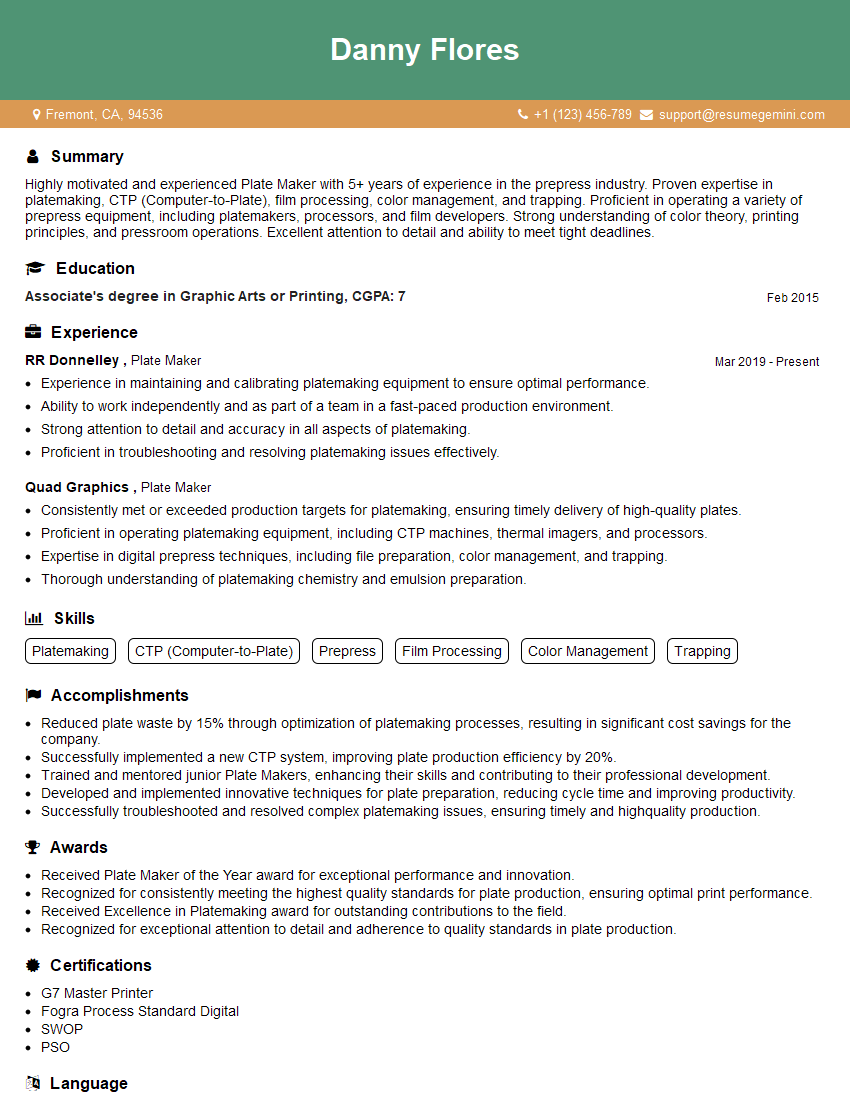
Mastering plate developing opens doors to exciting opportunities in the printing and publishing industries, offering diverse roles with excellent growth potential. To maximize your job prospects, it’s crucial to create a resume that effectively showcases your skills and experience to Applicant Tracking Systems (ATS). ResumeGemini is a trusted resource that can help you build a professional, ATS-friendly resume designed to get noticed. We provide examples of resumes tailored specifically to the Plate Developing field to help you get started. Invest time in crafting a compelling resume – it’s your first impression with potential employers.





Explore more articles
Users Rating of Our Blogs
Share Your Experience
We value your feedback! Please rate our content and share your thoughts (optional).
What Readers Say About Our Blog
Very informative content, great job.
good