Every successful interview starts with knowing what to expect. In this blog, we’ll take you through the top Configuration Audit and Compliance interview questions, breaking them down with expert tips to help you deliver impactful answers. Step into your next interview fully prepared and ready to succeed.
Questions Asked in Configuration Audit and Compliance Interview
Q 1. Explain the difference between configuration management and configuration auditing.
Configuration management and configuration auditing are closely related but distinct processes. Think of it like building a house: configuration management is the process of building the house according to a blueprint (desired state), ensuring all components are correctly installed and interconnected. Configuration auditing is the process of inspecting the finished house to verify that it was built according to the blueprint and meets all specifications and regulations.
Configuration Management (CM) is a proactive process focused on establishing and maintaining the desired state of IT systems. It involves defining, controlling, and tracking changes to system configurations. This includes tasks like baselining, change management, and version control.
Configuration Auditing (CA), on the other hand, is a reactive (though ideally, regularly scheduled) process. It involves systematically examining the actual state of IT systems to verify that they conform to established baselines, policies, and compliance requirements. It’s about verifying what is against what should be.
In short, CM prevents deviations, while CA detects them. They work best together – a robust CM program significantly reduces the workload of CA.
Q 2. Describe the key components of a robust configuration audit program.
A robust configuration audit program comprises several key components:
- Clearly Defined Scope and Objectives: Specify the systems, applications, and configurations to be audited, and the specific compliance requirements or standards to be checked (e.g., PCI DSS compliance for payment systems, HIPAA compliance for healthcare data).
- Documented Baseline: This is a snapshot of the desired configuration state, acting as the reference point for the audit. This might include documentation, configuration files, or even automated scripts that define the ideal state.
- Audit Methodology: A well-defined process for conducting the audit, including procedures for data collection, analysis, and reporting. This often involves a combination of automated tools and manual reviews.
- Automated Tools: Leveraging tools for automated configuration scanning and vulnerability assessment is crucial for efficiency and accuracy. These tools can scan systems for deviations from baselines, missing patches, and security misconfigurations.
- Qualified Auditors: Individuals with the necessary technical skills and knowledge to understand the systems being audited and to interpret audit results accurately.
- Regular Scheduling and Reporting: Audits should be scheduled regularly (frequency depending on risk and regulatory requirements) with comprehensive reports detailing findings, recommendations, and remediation plans.
- Remediation Process: A clear process for addressing identified vulnerabilities and ensuring that corrective actions are implemented and verified.
Q 3. What are the common methodologies used in configuration audits?
Several methodologies are used in configuration audits, often in combination:
- Compliance-Based Auditing: This focuses on verifying adherence to specific regulatory frameworks (e.g., ISO 27001, NIST Cybersecurity Framework, HIPAA, PCI DSS). The audit plan is directly derived from the compliance requirements.
- Risk-Based Auditing: This approach prioritizes the most critical systems and configurations based on their potential impact on the business. High-risk systems are audited more frequently and thoroughly.
- Automated Scanning: Using automated tools to scan systems and identify deviations from established baselines. This is highly efficient for large-scale audits.
- Manual Review: This involves a more in-depth, hands-on examination of specific configurations, often required for complex or customized systems. It allows auditors to look beyond what automated tools might miss.
- Sampling: Selecting a representative subset of systems or configurations for audit when a full audit is not feasible. This requires careful planning to ensure the sample accurately reflects the entire population.
The choice of methodology often depends on the organization’s size, complexity, and specific risk profile.
Q 4. How do you ensure the accuracy and completeness of audit findings?
Ensuring accuracy and completeness of audit findings requires a multi-pronged approach:
- Verification and Validation: Findings should be independently verified by multiple auditors or through cross-checking with other data sources. This helps eliminate human error and bias.
- Automated Tools: Using reputable and regularly updated automated scanning tools reduces manual effort and improves consistency. Cross-referencing results from multiple tools can improve accuracy.
- Clearly Defined Audit Procedures: Detailed, documented procedures ensure consistency and reduce the risk of overlooking critical information. A checklist approach is highly beneficial.
- Traceability: Maintaining a clear audit trail of all activities, including evidence gathering, analysis, and reporting, enables easy verification and accountability.
- Peer Review: Having another experienced auditor review the findings helps identify potential errors or omissions and improves the overall quality of the report.
- Data Integrity Checks: Implementing checksums or other data integrity checks to ensure that the collected data has not been tampered with or corrupted.
Q 5. What are the key regulatory compliance frameworks you are familiar with (e.g., ISO 27001, NIST, SOX)?
I’m familiar with several key regulatory compliance frameworks, including:
- ISO 27001: This international standard specifies requirements for establishing, implementing, maintaining, and continually improving an information security management system (ISMS).
- NIST Cybersecurity Framework (CSF): A voluntary framework developed by the National Institute of Standards and Technology (NIST) that provides a set of guidelines and best practices for managing cybersecurity risks.
- Sarbanes-Oxley Act (SOX): A US law that mandates stringent financial reporting and internal control requirements for publicly traded companies. Configuration audits play a role in demonstrating compliance with internal controls over financial reporting.
- PCI DSS (Payment Card Industry Data Security Standard): A set of security standards designed to ensure that ALL companies that accept, process, store or transmit credit card information maintain a secure environment.
- HIPAA (Health Insurance Portability and Accountability Act): A US law protecting the privacy and security of Protected Health Information (PHI).
My experience encompasses applying these frameworks to various IT environments, tailoring audit procedures to specific requirements and industry best practices.
Q 6. Explain your experience with using audit management tools.
I have extensive experience using various audit management tools, including both commercial and open-source solutions. These tools help streamline the audit process by automating tasks such as:
- Automated vulnerability scanning: Identifying security weaknesses and misconfigurations in systems.
- Configuration compliance checking: Comparing actual configurations against defined baselines or standards.
- Report generation: Creating comprehensive reports that document audit findings and recommendations.
- Workflow management: Tracking the progress of audits and assigning tasks to auditors.
- Centralized data storage: Providing a secure repository for audit evidence and documentation.
For instance, I’ve used ServiceNow for managing the entire audit lifecycle, from planning and execution to reporting and remediation. I’m also proficient in using open-source tools like OpenVAS and Nessus for vulnerability scanning and integrating their results into a broader audit process. The specific tool selection always depends on the scope and needs of the audit.
Q 7. How do you identify and assess configuration vulnerabilities?
Identifying and assessing configuration vulnerabilities involves a multi-step process:
- Baseline Definition: Establishing a clear baseline of the desired configuration state for each system or application. This acts as a reference point for comparison.
- Vulnerability Scanning: Employing automated tools to scan systems for known vulnerabilities and misconfigurations. These tools can identify missing patches, weak passwords, insecure network settings, and other common vulnerabilities.
- Configuration Deviation Analysis: Comparing the actual configuration against the established baseline to identify any deviations. This helps pinpoint areas where systems don’t conform to security best practices.
- Risk Assessment: Assessing the potential impact of each identified vulnerability on the organization. This considers factors like the likelihood of exploitation and the potential consequences of a successful attack.
- Prioritization: Prioritizing vulnerabilities based on their risk level. Critical vulnerabilities should be addressed first.
- Remediation: Implementing corrective actions to address identified vulnerabilities. This may involve patching software, changing configurations, or implementing compensating controls.
- Verification: Verifying that the implemented remediation actions have successfully addressed the vulnerabilities.
A crucial aspect is staying current with vulnerability databases and security advisories to ensure that scanning tools are up-to-date and that emerging threats are addressed promptly. This is an ongoing process that requires constant monitoring and vigilance.
Q 8. Describe your experience with conducting risk assessments related to configurations.
Risk assessments in configuration audits are crucial for identifying potential vulnerabilities and ensuring compliance. My approach involves a systematic process combining qualitative and quantitative methods. I begin by defining the scope – specifying the systems, applications, and configurations under review. Then, I identify potential threats and vulnerabilities, considering factors such as unauthorized access, malware, data breaches, and system failures. This often involves reviewing existing documentation, conducting interviews with stakeholders, and utilizing vulnerability scanning tools. Next, I assess the likelihood and impact of each identified risk. For example, a misconfigured database server with weak passwords (high likelihood, high impact) would receive a higher priority than an outdated but unused software component (low likelihood, low impact). Finally, I document all findings and present them in a clear and concise report, offering recommendations for mitigation.
For instance, in a recent audit of a financial institution, we identified a risk related to insecure network settings. By quantifying the potential impact of a data breach (financial loss, reputational damage, regulatory penalties), we were able to prioritize this finding over less critical issues like minor software license discrepancies.
Q 9. How do you prioritize findings in a configuration audit?
Prioritizing findings in a configuration audit requires a structured approach. I typically employ a risk-based prioritization method, considering factors like the likelihood of exploitation and the potential impact of a compromise. I use a scoring system that assigns weights to severity (critical, high, medium, low), likelihood (high, medium, low), and business impact. This allows for objective ranking of vulnerabilities. Critical vulnerabilities with immediate impact – such as unpatched critical security flaws – always take precedence. This approach ensures that the most significant issues are addressed first, minimizing potential risks to the organization.
Imagine a scenario where we find both a critical vulnerability (e.g., remote code execution) and a minor configuration issue (e.g., outdated documentation). The critical vulnerability, with its potential for severe impact, would be prioritized for immediate remediation, despite the relatively minor nature of the other finding.
Q 10. What is your approach to documenting and reporting audit findings?
Thorough documentation and reporting are essential. My approach involves creating a comprehensive report that clearly communicates audit findings, using a structured format for consistency and clarity. The report includes an executive summary outlining key findings, a detailed description of the audit methodology, a list of identified vulnerabilities with their severity level and associated risks, evidence supporting the findings (screenshots, log extracts, etc.), and prioritized recommendations for remediation. I use clear, non-technical language where possible to make the report accessible to a wide audience. I also make use of visualizations like graphs and charts to illustrate key findings, making the report more engaging and easier to understand.
For example, I use a spreadsheet to track each finding, including its ID, description, severity, location, supporting evidence, remediation steps, and status (open, in progress, closed). This provides a clear overview and streamlines the reporting process. The final report is reviewed with stakeholders to ensure accuracy and to obtain their buy-in on the proposed remediation plan.
Q 11. How do you handle discrepancies or disagreements during an audit?
Discrepancies or disagreements are addressed through a collaborative and objective process. My approach focuses on open communication and evidence-based discussions. I would first review the specific discrepancy with the involved parties, providing supporting documentation and explanations for my findings. If the disagreement persists, I encourage a structured discussion with all parties involved, facilitating open dialogue and ensuring that everyone understands the context and supporting evidence. If consensus cannot be reached, I escalate the issue to a higher-level authority for resolution, documenting all steps taken throughout the process. Transparency and fairness are paramount in these situations.
For instance, if a disagreement arises on the severity of a vulnerability, we might engage an independent security expert to provide a second opinion. A documented chain of communication ensures accountability and a clear record of the decision-making process.
Q 12. Explain your experience with remediation of configuration issues.
Remediation of configuration issues is a critical phase. My approach is collaborative and iterative. After identifying issues, I work with the responsible parties (system administrators, developers, etc.) to develop and implement remediation plans. These plans include specific steps, timelines, and responsible individuals. I follow up regularly to monitor progress and ensure that the issues are resolved effectively. Post-remediation, I conduct verification tests to confirm that the issues have been addressed and that the systems are now compliant. The entire process is meticulously documented, including the steps taken to address each finding and the evidence demonstrating successful remediation.
For example, a misconfigured firewall rule would be addressed by modifying the rule to restrict unauthorized access. We would then verify the change by attempting to access the system from the previously allowed but now restricted IP address.
Q 13. How do you ensure the confidentiality, integrity, and availability of configuration data?
Ensuring the confidentiality, integrity, and availability (CIA triad) of configuration data is paramount. My approach employs a multi-layered security strategy. Confidentiality is ensured through access control mechanisms, limiting access to authorized personnel only. Strong passwords, multi-factor authentication, and encryption (both in transit and at rest) are vital. Integrity is maintained through version control, audit trails, and checksum verification to prevent unauthorized modifications. Availability is ensured through redundancy, backups, and disaster recovery planning. The data is stored securely, following best practices for data security and compliance with relevant regulations (e.g., GDPR, HIPAA).
For instance, configuration data is stored in an encrypted database accessible only through secure connections and with granular access controls. Regular backups are performed and stored offsite to protect against data loss.
Q 14. How do you manage audit trails and evidence?
Managing audit trails and evidence is vital for accountability and demonstrating compliance. I use a combination of automated logging and manual documentation to create a complete audit trail. Automated tools capture system events and changes, while manual documentation records decisions, findings, and remediation steps. All evidence is securely stored and version controlled. Chain of custody is meticulously maintained to ensure the integrity and authenticity of the evidence. This detailed record provides a comprehensive history of the audit, facilitating future investigations and demonstrating compliance efforts.
This might involve using a dedicated audit logging system that records all changes to configuration files, along with timestamps and user IDs. This data is then used to create comprehensive reports demonstrating compliance with security policies and regulations.
Q 15. Describe your experience with different types of audit sampling techniques.
Audit sampling is crucial when examining a large population of configurations. Instead of checking every single item, we select a representative sample to draw conclusions about the whole. Different techniques offer varying levels of assurance and efficiency.
- Random Sampling: Every item has an equal chance of being selected. This is good for unbiased results but might miss clusters of issues.
- Stratified Sampling: The population is divided into subgroups (strata), and samples are taken from each. For example, we might stratify by server type (web servers, database servers) to ensure representation from each critical area. This is more efficient than random sampling if you suspect different strata may have different error rates.
- Systematic Sampling: We select every nth item from the population. Simple to implement, but prone to bias if there’s a pattern in the data at intervals matching your sampling frequency.
- Cluster Sampling: We sample groups (clusters) of items instead of individual items. For instance, selecting entire departments’ configurations for review. Less expensive than other methods but can introduce higher sampling error.
- Judgmental Sampling: We use expert knowledge to select items believed to be most representative or high-risk. Faster than random, but relies heavily on the auditor’s expertise and can introduce bias if not done carefully.
The choice of technique depends on the audit objective, resource constraints, and the nature of the population being audited. I tailor my approach to each situation, ensuring that the sample size provides statistically significant results.
Career Expert Tips:
- Ace those interviews! Prepare effectively by reviewing the Top 50 Most Common Interview Questions on ResumeGemini.
- Navigate your job search with confidence! Explore a wide range of Career Tips on ResumeGemini. Learn about common challenges and recommendations to overcome them.
- Craft the perfect resume! Master the Art of Resume Writing with ResumeGemini’s guide. Showcase your unique qualifications and achievements effectively.
- Don’t miss out on holiday savings! Build your dream resume with ResumeGemini’s ATS optimized templates.
Q 16. How do you stay current with changes in regulations and best practices?
Staying updated in this field is paramount. Regulations and best practices are constantly evolving, necessitating continuous learning. I utilize several methods:
- Professional Certifications: Maintaining certifications like CISSP, CISA, or similar keeps me abreast of the latest standards and best practices.
- Industry Publications and Conferences: I regularly read publications like SANS Institute reports, attend conferences like RSA, and follow relevant industry blogs to learn about emerging threats and regulatory changes.
- Online Courses and Webinars: Platforms like Coursera and LinkedIn Learning offer valuable courses on updated regulations and technologies.
- Networking: Participating in professional groups and networking events allows me to share knowledge and learn from peers and experts.
- Regulatory Websites: I regularly check websites like NIST, the various government cybersecurity agencies (e.g., CISA, NCSC), and relevant industry bodies for updates on standards and compliance requirements. For example, I actively monitor updates to NIST Cybersecurity Framework and ISO 27001.
This multi-faceted approach ensures I remain at the forefront of the field and can provide clients with the most up-to-date guidance and solutions.
Q 17. What is your approach to testing the effectiveness of security controls?
Testing the effectiveness of security controls requires a multi-pronged approach. My strategy involves a combination of techniques:
- Vulnerability Scanning and Penetration Testing: These techniques identify vulnerabilities in systems and applications and assess the effectiveness of controls in preventing exploitation. We might use tools like Nessus or OpenVAS for vulnerability scanning and conduct ethical hacking simulations.
- Configuration Review: We examine system configurations to ensure they adhere to security best practices and organizational policies. This might involve checking firewall rules, access control lists, and software patching levels.
- Log Analysis: We review system logs to identify suspicious activities, security breaches, and the efficacy of security controls in detecting and responding to incidents. For instance, examining logs for failed login attempts.
- Security Audits: We perform regular audits to assess compliance with security standards, policies, and regulations.
- Testing of Incident Response Plans: We simulate security incidents to evaluate the organization’s preparedness and the effectiveness of its incident response plan.
The specific tests I use are tailored to the organization’s specific security posture and the criticality of the systems being assessed. For example, a financial institution would require a much more rigorous testing approach than a small retail business.
Q 18. How do you communicate audit results effectively to both technical and non-technical audiences?
Clear and effective communication is crucial for successful audits. I tailor my communication approach to the audience:
- Technical Audiences: I use precise language, technical details, and relevant diagrams and reports to explain findings clearly and concisely. I focus on the technical aspects of vulnerabilities and remediation strategies, providing detailed logs and code examples if needed.
- Non-Technical Audiences: I employ plain language, avoiding jargon, and focus on the high-level implications of the findings. I explain the risks in simple terms and focus on the business impact of vulnerabilities. I use visuals, like charts and summaries, to make the information easily digestible.
Regardless of the audience, I use a consistent structure for my reports. This includes an executive summary highlighting key findings, detailed descriptions of vulnerabilities, and recommended remediation actions. I also present findings in a clear and organized manner, using tables and graphs to visualize the data.
For instance, when presenting to management, I will focus on the business risk associated with vulnerabilities, quantifying the potential financial loss or reputational damage. For technical teams, I will delve into the technical details, offering specific solutions and helping them understand how to implement fixes effectively.
Q 19. How do you handle sensitive data during an audit?
Handling sensitive data during an audit requires strict adherence to confidentiality and privacy regulations. My approach involves:
- Data Minimization: I only access and process the minimum amount of data necessary to conduct the audit.
- Data Encryption: All sensitive data is encrypted both in transit and at rest using strong encryption algorithms. This includes utilizing secure file transfer protocols (like SFTP) and data encryption at rest (like disk encryption).
- Access Control: Access to sensitive data is restricted to authorized personnel only, through the use of strong password policies and multi-factor authentication.
- Data Anonymization: Where possible, I anonymize or pseudonymize data to protect the identity of individuals.
- Secure Storage: All sensitive data is stored securely, adhering to organizational policies and data security standards. This includes using secure storage facilities, data loss prevention (DLP) tools and regular backups.
- Compliance with Regulations: I strictly adhere to all relevant data privacy regulations, such as GDPR, CCPA, and HIPAA, based on the region and the type of data being handled.
I maintain a detailed audit trail of all data accessed and processed, documenting the purpose, methods used, and individuals involved. This ensures accountability and transparency throughout the process. I also thoroughly document all my actions and maintain detailed records of data access and handling.
Q 20. Describe your experience with different audit reporting formats.
I have experience with various audit reporting formats, adapting my approach to the specific needs of the client and the nature of the audit.
- Executive Summaries: Concise summaries of key findings, risks, and recommendations for management.
- Detailed Reports: Comprehensive documents providing in-depth analysis, evidence, and technical details.
- Spreadsheets: Used to present quantitative data, such as the number of vulnerabilities identified or the percentage of systems compliant with security standards.
- Visualizations: Charts, graphs, and dashboards to present data in an easily understandable format, especially useful for non-technical audiences.
- Compliance Reports: Reports demonstrating compliance (or non-compliance) with specific standards, regulations, and frameworks (e.g., SOC 2, ISO 27001).
- Web-Based Dashboards: Interactive dashboards allowing clients to track progress, review findings, and access reports online.
I’m proficient in using various tools to generate reports, including scripting languages (like Python) to automate the process where appropriate. The ultimate goal is to present information clearly, accurately, and in a format that facilitates effective decision-making.
Q 21. Explain the concept of continuous auditing.
Continuous auditing is a real-time or near real-time approach to auditing, as opposed to the traditional periodic audits. Instead of performing infrequent, comprehensive audits, continuous auditing uses automated tools and processes to monitor and analyze data continuously, providing insights into the organization’s security posture on an ongoing basis.
Think of it like this: a traditional audit is like a yearly physical checkup, providing a snapshot of your health at a specific point in time. Continuous auditing is more like a wearable fitness tracker – providing constant feedback on your activity levels, heart rate, and sleep patterns.
It leverages technologies such as:
- Data Analytics: Analyzing large datasets to identify trends and anomalies in real-time.
- Automated Monitoring Tools: Continuously monitoring system configurations, security events, and user activity.
- Real-time Alerting: Providing immediate notifications when security events or configuration deviations occur.
The benefits of continuous auditing include early detection of threats, improved compliance posture, reduced audit fatigue, and a more efficient use of resources. However, it requires significant investment in technology and expertise to implement effectively.
Q 22. What are some common challenges you’ve faced during configuration audits?
Common challenges in configuration audits often stem from incomplete or inaccurate documentation, lack of standardized processes, and the sheer volume of configurations to review. For instance, I once audited a large network where the documentation was severely outdated, leading to significant discrepancies between the documented and actual configurations. This made identifying misconfigurations and vulnerabilities incredibly time-consuming. Another recurring challenge is resistance from personnel unfamiliar with or resistant to audit processes. They may view audits as burdensome or an unnecessary distraction from their daily tasks. Finally, the ever-evolving technological landscape necessitates continuous upskilling to remain proficient in auditing various systems and technologies.
- Outdated or incomplete documentation: This significantly hampers the accuracy and efficiency of the audit.
- Lack of standardized processes: Inconsistent methodologies across different teams make it difficult to maintain consistency and efficiency.
- Resistance from personnel: A lack of understanding or buy-in from staff can hinder the process.
- Rapid technological changes: Keeping pace with the latest technologies and security vulnerabilities is critical.
Q 23. How do you prioritize and manage multiple audit projects simultaneously?
Managing multiple audit projects effectively requires a structured approach. I employ a project prioritization matrix considering factors like risk, regulatory deadlines, and business impact. For example, projects with high security risks and imminent regulatory deadlines receive top priority. I use project management tools like Jira or Asana to track progress, assign tasks, and monitor deadlines across multiple projects. This approach involves breaking down larger audits into smaller, manageable tasks and assigning them to team members with the appropriate skills. Regular status meetings and communication are crucial to ensure everyone is aligned and on track. Think of it like a conductor of an orchestra; each project is a different instrument, and the conductor (me) ensures each plays its part harmoniously and on time.
Q 24. Describe your experience with using automated tools for configuration audit.
Automated tools are indispensable in modern configuration auditing. I have extensive experience using tools like Chef InSpec, Ansible, and Puppet to automate the assessment of configurations against defined baselines and compliance standards. For example, I used Chef InSpec to scan hundreds of servers for compliance with PCI DSS standards, significantly reducing the time and effort compared to manual checks. These tools allow for repeatable and consistent audits, identifying deviations from the expected configuration. They also generate comprehensive reports that simplify the identification and remediation of vulnerabilities. However, it’s crucial to remember that automated tools are most effective when combined with human expertise to interpret results and address complex issues that might require manual investigation.
Q 25. How do you perform a gap analysis between current configuration and compliance requirements?
A gap analysis compares the current state of the system’s configuration against established compliance requirements. This involves defining the compliance baseline (e.g., using a standard like ISO 27001 or NIST Cybersecurity Framework) and then comparing it to the actual configuration. I typically use a combination of automated tools (as mentioned above) and manual review to identify discrepancies. The analysis is documented in a report detailing the identified gaps and the severity of each non-compliance finding. The report might include a matrix showing each control requirement, its current status (compliant/non-compliant), and suggested remediation steps. For instance, if the baseline requires all servers to have firewalls enabled, the gap analysis will highlight any servers without enabled firewalls. This systematic approach ensures a thorough understanding of the vulnerabilities and allows for prioritization of remediation efforts.
Q 26. What’s your experience with different types of audit evidence (e.g., documentary, testimonial, physical)?
My experience encompasses all three types of audit evidence: documentary, testimonial, and physical. Documentary evidence includes policies, procedures, configurations files, logs, and system documentation. Testimonial evidence involves interviews with personnel responsible for system administration and security. Physical evidence may involve inspecting physical devices or data centers. For example, while auditing a network security configuration, I would review network diagrams (documentary), interview network administrators about their security procedures (testimonial), and physically inspect network devices for any signs of tampering (physical). The weight assigned to each type of evidence depends on its reliability and relevance. Documentary evidence is valuable but must be corroborated, testimonial evidence relies on witness credibility, and physical evidence provides a direct observation of the system’s state. A strong audit uses a combination of all three for robust validation.
Q 27. How do you ensure that the audit process is independent and objective?
Independence and objectivity are paramount in maintaining the credibility of an audit. To ensure this, I maintain a clear separation from the systems I audit. This includes not having any involvement in the day-to-day operations of the systems under review, avoiding any conflicts of interest, and following a predefined audit plan that is approved by relevant stakeholders. I also document all audit procedures and findings meticulously, providing a clear audit trail. This level of transparency ensures accountability and minimizes the potential for bias. Think of it like a judge in a courtroom; their impartiality ensures fairness and the integrity of the legal proceedings. Similarly, my role as auditor is to ensure a fair and unbiased assessment of the systems’ security posture.
Q 28. Explain your understanding of the relationship between configuration management and incident response.
Configuration management and incident response are intrinsically linked. Effective configuration management plays a crucial role in preventing and responding to security incidents. A well-managed configuration, accurately documented and controlled, provides a baseline for identifying deviations caused by malicious activities or configuration errors. This allows for faster identification of compromised systems during an incident. For example, if a system’s configuration deviates from the known baseline, this might signal a security breach. Furthermore, a robust configuration management system provides the information needed to restore systems to a known good state after an incident, minimizing downtime and data loss. In short, good configuration management enables proactive security and greatly improves the efficiency of incident response.
Key Topics to Learn for Configuration Audit and Compliance Interview
- Understanding Compliance Frameworks: Gain a solid grasp of relevant frameworks like ISO 27001, NIST Cybersecurity Framework, HIPAA, etc. Consider the practical implications of each and how they influence audit processes.
- Configuration Management Best Practices: Explore methods for managing and tracking system configurations, including version control, change management, and baseline establishment. Think about how these practices contribute to a successful audit.
- Audit Planning and Execution: Learn how to plan and execute effective audits, including scoping, evidence gathering, and reporting. Consider the challenges involved in different audit methodologies.
- Risk Assessment and Mitigation: Understand how to identify and assess security risks related to system configurations. Explore methods for mitigating those risks and documenting your findings.
- Vulnerability Management and Remediation: Learn the process of identifying vulnerabilities, prioritizing remediation efforts, and verifying the effectiveness of implemented fixes. Consider how this integrates into a comprehensive audit program.
- Reporting and Documentation: Master the art of creating clear, concise, and professional audit reports. Practice presenting complex technical information in an easily understandable manner.
- Tools and Technologies: Familiarize yourself with common tools used in Configuration Audit and Compliance, such as vulnerability scanners, configuration management databases, and reporting software. Be prepared to discuss their strengths and weaknesses.
- Automation and Scripting: Explore how automation can streamline audit processes and improve efficiency. Consider the role of scripting languages in automating tasks like configuration checks and report generation.
Next Steps
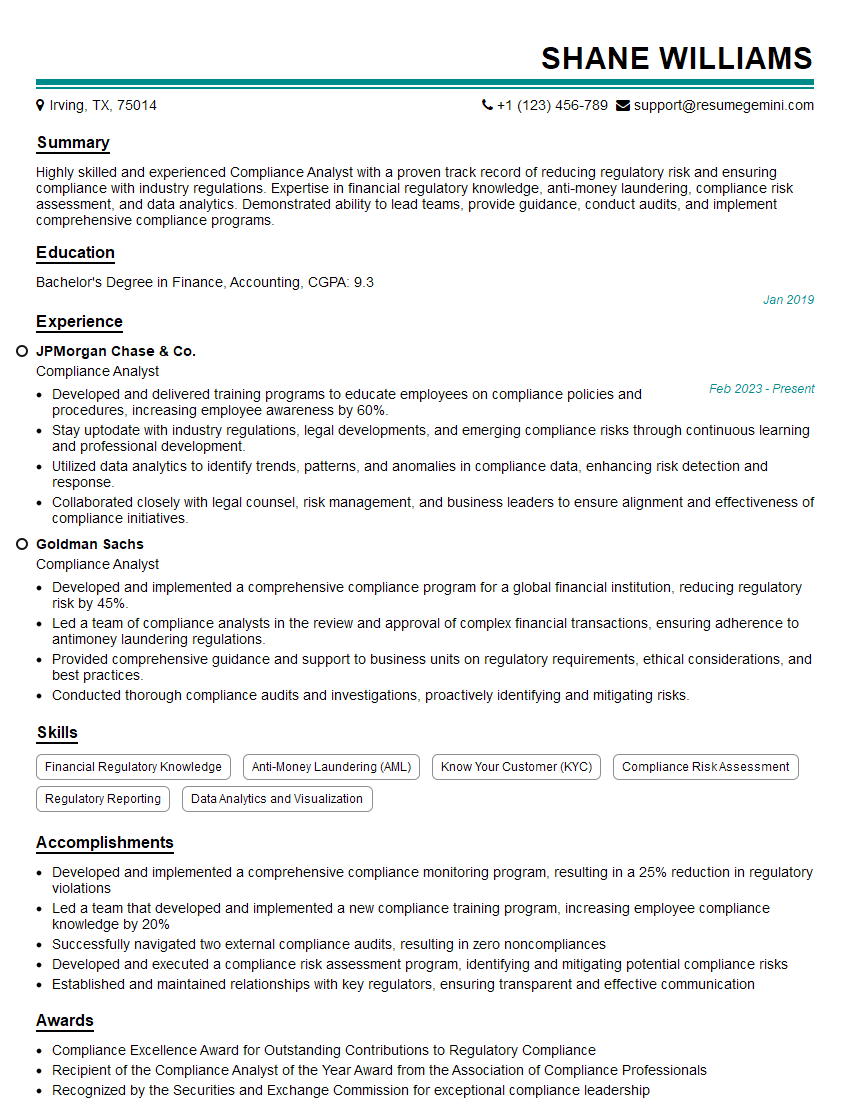
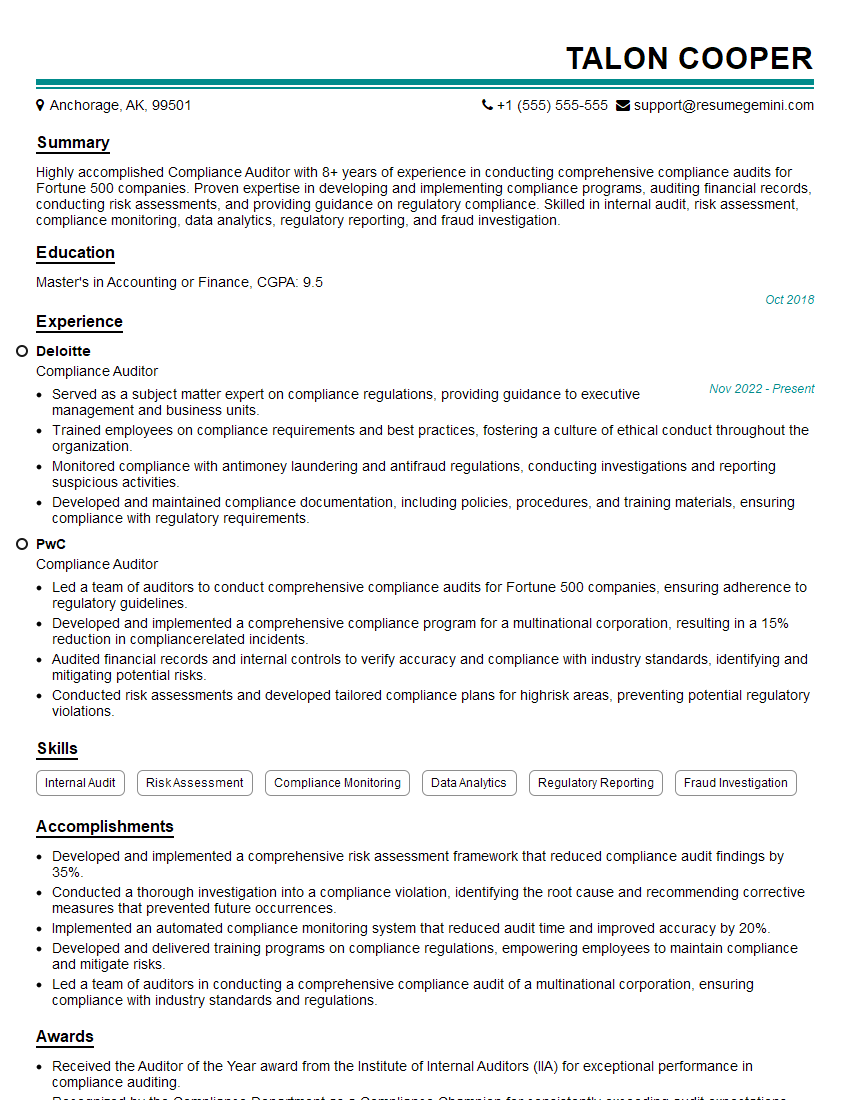
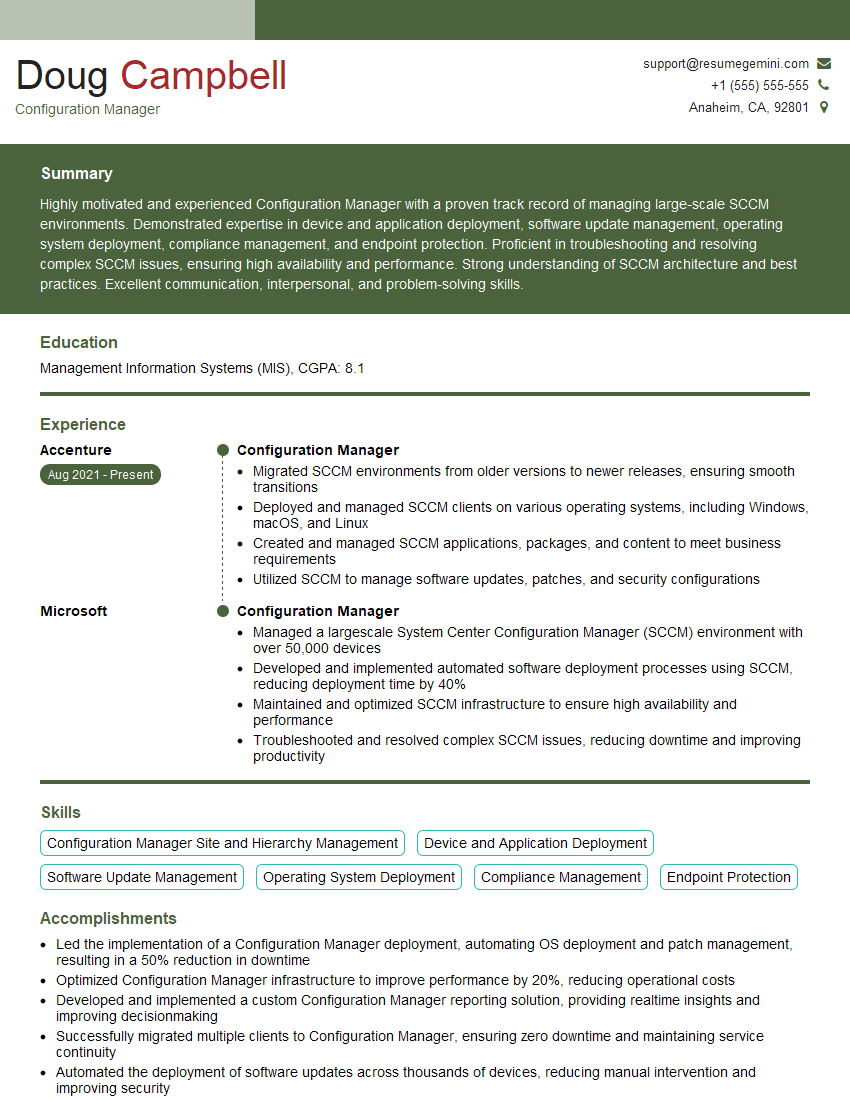
Mastering Configuration Audit and Compliance opens doors to exciting career opportunities in cybersecurity and IT governance. A strong understanding of these concepts significantly enhances your value to potential employers. To maximize your job prospects, invest time in crafting an ATS-friendly resume that showcases your skills and experience effectively. ResumeGemini is a trusted resource to help you build a professional and impactful resume. Examples of resumes tailored to Configuration Audit and Compliance are available to guide you through the process, enabling you to present your qualifications compellingly and increase your chances of securing your dream role.
Explore more articles
Users Rating of Our Blogs
Share Your Experience
We value your feedback! Please rate our content and share your thoughts (optional).
What Readers Say About Our Blog
Very informative content, great job.
good