Interviews are opportunities to demonstrate your expertise, and this guide is here to help you shine. Explore the essential Grapevine Irrigation interview questions that employers frequently ask, paired with strategies for crafting responses that set you apart from the competition.
Questions Asked in Grapevine Irrigation Interview
Q 1. Explain the principles of drip irrigation in a vineyard setting.
Drip irrigation in vineyards delivers water directly to the roots of the grapevines, minimizing water waste and maximizing efficiency. Think of it like giving each vine a personal drink instead of flooding the entire field. This precise application reduces evaporation and runoff, crucial in arid or semi-arid regions where vineyards often thrive.
The system uses a network of pipes, tubing, and emitters. Water is delivered at a slow and controlled rate, allowing it to penetrate the soil gradually. This slow release prevents surface runoff and promotes deeper root penetration, leading to healthier, more drought-resistant vines. The emitters, often small drippers or bubblers, are strategically placed near the vine’s root zone, ensuring targeted hydration.
For example, in a steeply sloped vineyard, drip irrigation is significantly more efficient than flood irrigation, preventing water from running downhill and being lost.
Q 2. Describe different types of irrigation systems used in grapevine cultivation.
Several irrigation systems are used in grapevine cultivation, each with its advantages and disadvantages. The choice depends on factors like vineyard size, topography, soil type, and budget.
- Drip Irrigation: As discussed earlier, this is a highly efficient method, delivering water directly to the roots. Subsurface drip irrigation, where the tubing is buried, further minimizes evaporation.
- Micro-sprinkler Irrigation: This system uses small sprinklers to deliver water over a larger area than drip irrigation. It’s suitable for areas with sandy soils or where a slightly wider watering radius is needed.
- Overhead Sprinkler Irrigation: This more traditional method is less efficient due to higher evaporation and potential for leaf wetting (which can promote disease). It’s generally less favored for vineyards but might be used in specific situations.
- Flood Irrigation: This is the least efficient method, involving flooding the entire vineyard area. It’s rarely used in modern vineyards due to water waste and potential negative impact on soil structure. It might be seen in older, less intensively managed vineyards.
Q 3. How do you determine the appropriate water requirement for grapevines?
Determining the appropriate water requirement for grapevines is a multifaceted process that involves considering several key factors. It’s not a one-size-fits-all solution.
- Evapotranspiration (ET): This is the combined effect of evaporation from the soil and transpiration from the plant. Weather data (temperature, humidity, wind speed, solar radiation) is used to estimate ET, which is a key component of water requirement calculations.
- Soil Type: Different soil types have different water-holding capacities. Sandy soils drain quickly requiring more frequent irrigation while clay soils retain water longer.
- Vine Growth Stage: Water needs vary dramatically throughout the growing season. The highest water demand is usually during fruit development.
- Root Depth: The deeper the roots, the more water the vine can access. Proper soil management practices can encourage deeper root growth.
Professionals often use crop coefficients (Kc) in conjunction with ET to refine estimates of water requirement. These coefficients reflect the specific water use of grapevines at different stages of growth. Specialized software and online tools can aid in these calculations.
Q 4. What are the key factors influencing irrigation scheduling?
Irrigation scheduling is crucial for optimizing water use and maximizing yield. Several factors influence the decision of when and how much to irrigate.
- Soil Moisture: This is the primary factor. Regular monitoring of soil moisture levels is essential to avoid both overwatering and underwatering.
- Weather Conditions: High temperatures, low humidity, and strong winds increase evapotranspiration, leading to higher water demands.
- Vine Growth Stage: Water requirements vary significantly throughout the growing season. Higher water needs are observed during periods of rapid growth and fruit development.
- Grape Variety: Some varieties are more drought-tolerant than others.
- Yield Goals: Higher yield targets usually require more irrigation.
In practice, a combination of monitoring techniques, including soil moisture sensors and weather data, is often used to fine-tune irrigation schedules.
Q 5. Explain the concept of soil moisture sensors and their role in irrigation management.
Soil moisture sensors are invaluable tools for precision irrigation management. They directly measure the water content in the soil, providing real-time data for informed irrigation decisions. Think of them as a soil’s personal hydration monitor.
These sensors, typically buried in the root zone, can be wired or wireless, transmitting data to a central monitoring system or directly to an irrigation controller. This data allows for precise scheduling, avoiding overwatering and ensuring that the vines receive the appropriate amount of water at the optimal time. They help move away from guesswork and towards data-driven irrigation management.
Different types of sensors exist, including those that measure volumetric water content (VWC), which is a common measure of soil moisture.
Q 6. How do you calibrate an irrigation system to ensure even water distribution?
Calibrating an irrigation system is vital to ensure even water distribution throughout the vineyard. Uneven distribution leads to inconsistent vine growth and reduced yield.
Calibration involves measuring the flow rate of each emitter or zone in the system. This is usually done using simple measurement tools, such as graduated cylinders and stopwatches. The goal is to ensure that all emitters deliver a consistent flow rate within a specified tolerance. Pressure regulators may need adjustments to achieve uniform distribution across different parts of the vineyard, especially those at varying elevations.
After initial installation, regular calibration checks should be performed to detect any clogs, leaks, or other issues that might affect flow rates. This helps prevent uneven watering and maintains the system’s efficiency over time.
Q 7. Describe your experience with different irrigation controllers and their functionalities.
My experience encompasses several irrigation controllers, each with unique functionalities. These controllers automate the irrigation process, scheduling and controlling water delivery based on pre-programmed settings or sensor data.
- Basic Time-Clock Controllers: These controllers operate on a simple schedule, turning the system on and off at predetermined times. They are suitable for smaller vineyards or where precise control is not critical.
- Sensor-Based Controllers: These controllers integrate with soil moisture sensors or weather stations, adjusting irrigation schedules based on real-time data. This approach is highly efficient and leads to optimal water use.
- Computerized Controllers: More sophisticated controllers offer advanced features such as remote monitoring, data logging, and integration with weather forecasting services. They allow for complex scheduling algorithms and provide detailed reports on water use.
In my experience, sensor-based controllers offer the best balance of efficiency and cost-effectiveness for most vineyards, particularly those aiming for sustainable water management.
Q 8. How do you troubleshoot common irrigation system problems, such as leaks or clogging?
Troubleshooting grapevine irrigation problems like leaks and clogging requires a systematic approach. First, I visually inspect the entire system, looking for obvious issues such as broken pipes, loose fittings, or emitter malfunctions. Leaks are often identified by damp soil or puddles. For clogging, I check emitters for debris buildup.
- Leaks: I use a pressure gauge to pinpoint the location of leaks within the system. A significant pressure drop between two points indicates a leak somewhere in between. Repairing leaks involves replacing damaged pipes or fittings, ensuring tight connections to prevent further water loss.
- Clogging: Clogged emitters usually restrict water flow. I flush the system with a high-pressure cleaning solution, which helps dislodge sediment and debris. Regular flushing prevents clogging and prolongs the life of the emitters. For stubborn clogs, I may use a specialized cleaning tool or replace the emitter.
- Systematic Approach: I work my way through the system, starting from the main water source, checking each component—valves, pipes, filters, and emitters. A well-maintained system with regular cleaning and inspection reduces the frequency of such issues.
For example, in one vineyard, a significant drop in water pressure pointed to a leak near the base of a trellised vine. Upon closer inspection, we found a small hole in the main lateral line, caused by rodent activity. Repairing this quickly restored water pressure and saved a significant amount of water.
Q 9. What are the advantages and disadvantages of deficit irrigation in grapevine production?
Deficit irrigation, where less water than the vine’s full requirement is supplied, presents a trade-off in grapevine production.
- Advantages:
- Water Conservation: This is the primary advantage, reducing water usage and operational costs.
- Improved Water Use Efficiency: The vines become more drought-tolerant, enhancing their ability to extract water from the soil more efficiently.
- Enhanced Flavor Concentration: Mild water stress can sometimes lead to higher sugar concentration and improved flavor profile in the grapes.
- Disease Reduction: Less moisture can help suppress certain fungal diseases.
- Disadvantages:
- Reduced Yield: Deficit irrigation inevitably leads to lower yields, especially in severe cases.
- Grape Quality Variability: The effects on grape quality are unpredictable and can be detrimental if the stress is too severe or improperly managed.
- Risk of Vine Stress: Inadequate water can weaken the vines, making them more susceptible to diseases and pests.
- Difficult to Manage: Implementing deficit irrigation effectively requires careful monitoring and precise control of the amount and timing of water applications.
It’s crucial to carefully assess the potential benefits and risks of deficit irrigation based on the specific vineyard conditions, grape variety, and market demand for fruit quality.
Q 10. Explain the impact of irrigation on grapevine yield and quality.
Irrigation significantly influences both grapevine yield and quality. Adequate water supply promotes vigorous growth, leading to higher yields. However, over-irrigation can dilute sugar concentration and negatively impact flavor.
- Yield: Sufficient water availability throughout the growing season is essential for optimal vegetative growth and fruit set. Water stress during critical growth stages can drastically reduce yield.
- Quality: Water stress during ripening can enhance sugar accumulation and color development, leading to better quality grapes. However, excessive water can dilute sugar content, reduce acidity, and negatively impact the overall quality of the grapes.
Imagine a scenario where a vineyard experiences a drought. Insufficient irrigation during berry development could lead to smaller berries with lower sugar concentrations, reducing both yield and quality. Conversely, over-irrigation could lead to large, watery berries with poor flavor and potentially increased susceptibility to diseases.
Q 11. How does irrigation affect soil salinity and drainage?
Irrigation practices directly impact soil salinity and drainage. Over-irrigation can lead to the accumulation of salts in the root zone, while poor drainage exacerbates this problem. Conversely, appropriate irrigation can help manage salinity and improve drainage.
- Soil Salinity: Irrigation water often contains dissolved salts. When irrigation exceeds evapotranspiration (water loss through evaporation and plant transpiration), salts can accumulate in the soil profile, hindering root growth and reducing vine vigor. This is especially problematic in poorly drained soils.
- Drainage: Well-drained soils allow excess water to leach salts out of the root zone. Poor drainage, however, traps salts and can lead to salinity buildup. The choice of irrigation method (e.g., drip irrigation versus flood irrigation) also affects drainage.
Regular soil testing is essential to monitor salinity levels. Strategies to manage salinity include leaching the soil with excess irrigation water, selecting salt-tolerant rootstocks, and optimizing irrigation scheduling to prevent salt accumulation.
Q 12. Describe your experience with water budgeting and irrigation scheduling software.
Water budgeting is crucial for efficient irrigation management. It involves estimating the total water required by the vines throughout the growing season. I have extensive experience using various irrigation scheduling software to optimize water application.
For water budgeting, I consider factors such as:
- Evapotranspiration (ET): This represents water loss from the soil and plants. Weather data, including temperature, humidity, wind speed, and solar radiation, are critical inputs for accurate ET estimation.
- Soil characteristics: Soil type and its water-holding capacity greatly influence irrigation needs.
- Vine growth stage: Water requirements change significantly throughout the growing season, with higher demands during periods of rapid growth.
- Grape variety: Different varieties have different water needs.
Irrigation scheduling software uses this data to determine the optimal irrigation amount and frequency. Examples of software I’ve used include CIMIS and Weather Station Software. These programs help me create customized irrigation schedules, ensuring water application is matched to actual crop needs, minimizing waste and maximizing yield and quality.
Q 13. What are the environmental considerations related to grapevine irrigation?
Environmental considerations in grapevine irrigation are paramount. Sustainable irrigation practices are vital to minimize environmental impact.
- Water conservation: Efficient irrigation techniques, such as drip irrigation, reduce water consumption compared to traditional flood irrigation.
- Energy consumption: Pumping water requires energy. Optimizing irrigation schedules and employing energy-efficient pumps reduce the carbon footprint.
- Nutrient runoff: Excessive irrigation can leach nutrients from the soil, potentially contaminating water bodies. Careful fertilizer management and efficient irrigation can mitigate this.
- Soil erosion: Improper irrigation can contribute to soil erosion. Using appropriate irrigation techniques and maintaining soil health prevent erosion.
- Greenhouse gas emissions: The production and distribution of irrigation equipment have associated greenhouse gas emissions. Choosing sustainable materials and optimizing irrigation processes can reduce these emissions.
In my work, I always strive to adopt environmentally friendly approaches, integrating sustainable practices into every aspect of irrigation management.
Q 14. How do you integrate weather data into your irrigation management strategies?
Integrating weather data is essential for precise irrigation management. I utilize real-time weather data from various sources, including on-site weather stations and regional climate information.
- Real-time data: Weather stations provide continuous monitoring of temperature, humidity, rainfall, wind speed, and solar radiation. This data allows for dynamic adjustments to irrigation schedules based on immediate weather conditions.
- Predictive modeling: Sophisticated models can forecast future weather conditions, helping me anticipate changes in water needs and proactively adjust irrigation strategies.
- Evapotranspiration estimation: Weather data are crucial for calculating evapotranspiration (ET), a key component in water budgeting. Accurate ET estimates ensure that irrigation is aligned with plant water demands.
- Irrigation scheduling software: Many irrigation scheduling programs incorporate weather data to automatically generate tailored irrigation plans.
For instance, if a heatwave is predicted, I can adjust the irrigation schedule to provide supplemental water to the vines to prevent water stress. Conversely, if significant rainfall is expected, I can postpone irrigation to avoid overwatering.
Q 15. Explain your experience with different irrigation water sources (e.g., well water, surface water).
My experience encompasses a wide range of irrigation water sources. I’ve extensively worked with both well water and surface water systems, understanding the unique challenges and advantages each presents. Well water, while often reliable, can be affected by fluctuating water tables and mineral content requiring specific pump and filtration considerations. I’ve managed projects where we’ve had to install specialized pumps to handle high mineral content, preventing scaling and damage to the irrigation system. Surface water, on the other hand, offers a potentially larger volume, but its quality can vary significantly depending on rainfall, runoff, and seasonal factors. I’ve implemented strategies to monitor water quality regularly for sediment, algae, and other contaminants, using appropriate filtration and treatment methods to protect the system and maintain plant health.
For example, on one project utilizing surface water from a nearby reservoir, we experienced significant fluctuations in water levels throughout the growing season. To mitigate this, we implemented a system of strategically placed holding tanks and a variable frequency drive (VFD) on the main pump to adjust the flow rate based on reservoir levels, ensuring consistent pressure throughout the system.
Career Expert Tips:
- Ace those interviews! Prepare effectively by reviewing the Top 50 Most Common Interview Questions on ResumeGemini.
- Navigate your job search with confidence! Explore a wide range of Career Tips on ResumeGemini. Learn about common challenges and recommendations to overcome them.
- Craft the perfect resume! Master the Art of Resume Writing with ResumeGemini’s guide. Showcase your unique qualifications and achievements effectively.
- Don’t miss out on holiday savings! Build your dream resume with ResumeGemini’s ATS optimized templates.
Q 16. Describe your experience with maintaining irrigation pumps and related equipment.
Maintaining irrigation pumps and equipment is crucial for efficient and reliable operation. My experience includes regular preventative maintenance schedules, troubleshooting malfunctions, and performing necessary repairs. This involves checking pump pressure, lubricating moving parts, inspecting for leaks, and cleaning strainers regularly. I’m proficient in working with various pump types, including centrifugal pumps, submersible pumps, and booster pumps. I also understand the importance of proper motor care and the role of VFDs in optimizing pump performance and energy efficiency. I can effectively diagnose problems like cavitation, bearing failure, or impeller wear and implement the appropriate solutions.
For instance, I once encountered a situation where a submersible pump in a deep well failed unexpectedly. Using my knowledge of well systems, I successfully diagnosed the problem as a faulty motor winding, arranged for its timely replacement, and minimized downtime with minimal disruption to the irrigation schedule.
Q 17. How do you assess the effectiveness of your irrigation system?
Assessing irrigation system effectiveness involves a multifaceted approach. First, I visually inspect the system for uniformity of water distribution across the entire field, ensuring there are no blocked emitters or leaks. Then, I utilize soil moisture sensors at various points across the field to quantify actual water delivery. Comparing this data to evapotranspiration rates (the amount of water lost through evaporation and plant transpiration), calculated using weather data and crop factors, helps me determine the irrigation efficiency. Yield monitoring, comparing the harvest to previous years or expected yields based on water use, is another crucial aspect of assessment. I also incorporate regular leaf tissue analysis to ensure adequate nutrient uptake, as poor irrigation can affect nutrient availability.
In one project, we discovered inconsistent water application based on visual observation and soil moisture readings. Further investigation revealed a clogged main line filter. Cleaning the filter not only improved the efficiency of the irrigation system but also helped us pinpoint a necessary improvement in the filter maintenance schedule.
Q 18. What are the common pests and diseases associated with improper irrigation?
Improper irrigation creates ideal conditions for various pests and diseases. Overwatering leads to root rot in many plants, creating susceptibility to fungal pathogens. Poor drainage increases the risk of soilborne diseases. On the other hand, underwatering stresses plants, leaving them vulnerable to insect infestations. For example, consistent underwatering may cause plants to attract aphids, while overwatering and poor drainage encourages the development of root-knot nematodes.
To mitigate these problems, we focus on optimizing irrigation scheduling to prevent both over and underwatering, incorporating proper drainage, and implementing soil health practices to improve resilience.
Q 19. How do you manage irrigation during periods of drought or excessive rainfall?
Managing irrigation during drought requires careful planning and adaptation. This involves implementing water-wise irrigation techniques like deficit irrigation (controlled reduction of irrigation water), using soil moisture sensors for precise scheduling, and selecting drought-tolerant crops. During excessive rainfall, the focus shifts to efficient drainage to prevent waterlogging, which can damage plant roots and lead to fungal diseases. This could include using subsurface drainage or adjusting irrigation schedules to compensate for excess rainfall.
During a severe drought, I successfully implemented a deficit irrigation strategy on a vineyard, reducing water usage by 20% without significantly impacting yield. This involved closely monitoring soil moisture and adjusting irrigation frequency based on the sensor data.
Q 20. Explain your understanding of water rights and permits for irrigation.
Understanding water rights and permits is paramount in irrigation management. This includes knowing the legal framework governing water allocation in a specific region, the types of permits required for water extraction (e.g., well permits, surface water diversions), and adherence to water use regulations. This also involves awareness of water conservation mandates and potentially incorporating water-efficient irrigation technologies to meet legal requirements. It’s crucial to stay updated on any changes in water laws and regulations that impact permitted water usage.
I have been involved in obtaining and managing water permits for multiple projects, ensuring compliance with all local, state, and federal regulations. This included preparing detailed applications, conducting water use assessments, and working with regulatory agencies to receive the necessary permits.
Q 21. Describe your experience with pressure-compensating emitters.
Pressure-compensating emitters are critical for uniform water distribution, especially on uneven terrain or with varying pipe lengths. These emitters maintain a consistent flow rate regardless of the water pressure variations within the system. This ensures that all plants receive equal amounts of water, regardless of their location in the field. They contribute to increased efficiency and reduced water waste compared to standard emitters.
In a recent vineyard project, the use of pressure-compensating emitters proved invaluable in achieving even water distribution on a sloping hillside. This resulted in improved vine growth and yield, demonstrating the benefit of using this type of emitter in challenging terrain.
Q 22. How do you calculate the evapotranspiration rate for grapevines?
Calculating evapotranspiration (ET) for grapevines is crucial for efficient irrigation. ET represents the water lost from the vineyard through evaporation from the soil surface and transpiration from the plants. We don’t use a single, simple formula; instead, we employ several methods, depending on available resources and accuracy needs.
- Penman-Monteith Equation: This is considered the most accurate method, requiring meteorological data such as temperature, humidity, solar radiation, and wind speed. It’s complex but provides a precise ET estimate. Software packages and online calculators are often used to simplify calculations.
- Simplified Equations: These methods, like the Hargreaves-Samani or Blaney-Criddle equations, require fewer weather parameters and are useful when detailed meteorological data is scarce. However, they are less precise.
- Reference ET and Crop Coefficients: This involves using a reference ET value (typically for grass) obtained from a weather station and multiplying it by a crop coefficient (Kc) specific to grapevines at different growth stages. The Kc values vary depending on factors like vine age, canopy cover, and stress level.
For example, if the reference ET is 5 mm/day and the Kc for a mature grapevine is 0.7, the ET for the vineyard would be 3.5 mm/day (5 mm/day * 0.7). This value then informs our irrigation scheduling.
Q 23. What are the energy efficiency considerations in grapevine irrigation?
Energy efficiency in grapevine irrigation is paramount, impacting both environmental sustainability and operational costs. We aim to minimize energy consumption while delivering the optimal amount of water to the vines.
- Choosing the Right Irrigation System: Drip irrigation is generally the most energy-efficient system because it directly delivers water to the root zone, minimizing evaporation losses. Pressure-compensating emitters further enhance efficiency by ensuring uniform water distribution.
- Optimizing Pumping Systems: Variable frequency drives (VFDs) on pumps allow for adjusting pump speed based on demand, reducing energy use during periods of lower irrigation needs. Regular pump maintenance is also crucial for optimal performance and energy efficiency.
- Scheduling Irrigation Wisely: Implementing irrigation scheduling based on actual ET rates, rather than fixed schedules, conserves energy and water. Soil moisture sensors can help automate this process, ensuring water is applied only when necessary.
- Using Renewable Energy Sources: Employing solar power to run pumps and other irrigation equipment can significantly reduce reliance on fossil fuels and lower the carbon footprint of the operation.
For instance, a vineyard using solar-powered drip irrigation with VFDs on its pumps will consume significantly less energy than one using a traditional flood irrigation system.
Q 24. Describe your experience with automated irrigation systems.
My experience with automated irrigation systems spans over 15 years. I’ve worked extensively with various systems, from simple timer-based controllers to sophisticated weather-based systems incorporating soil moisture sensors and GPS technology.
In one project, we implemented a fully automated system for a large vineyard. The system used weather data from a nearby station, soil moisture sensors throughout the vineyard, and a central control unit. The system automatically adjusted irrigation schedules based on real-time ET calculations and soil moisture levels, leading to significant water savings and improved vine health. We also incorporated remote monitoring capabilities, allowing for adjustments and troubleshooting from anywhere with internet access. The system used a SCADA (Supervisory Control and Data Acquisition) system to monitor and control the irrigation remotely.
The transition to automation isn’t simply a matter of installing new equipment; it requires careful planning, sensor placement strategy, and thorough staff training. Data analysis and system calibration are vital to optimizing performance and minimizing errors.
Q 25. How do you monitor and control soil salinity in an irrigated vineyard?
Monitoring and controlling soil salinity is essential for maintaining grapevine health and yield. High salinity levels can significantly impact water uptake and nutrient availability.
- Regular Soil Sampling: We conduct regular soil sampling at various locations within the vineyard to assess salinity levels. Samples are analyzed in a laboratory for electrical conductivity (EC), which is an indicator of salinity.
- Irrigation Water Quality Monitoring: The salinity of the irrigation water itself needs to be monitored regularly to prevent the accumulation of salts in the soil. High salinity irrigation water will need to be addressed with strategies such as using specific irrigation techniques or water sources.
- Drainage Systems: Adequate drainage is crucial for leaching excess salts from the root zone. Installing subsurface drainage systems can help manage salinity issues in areas with poor drainage.
- Irrigation Management: Appropriate irrigation scheduling and application methods can help minimize salt accumulation. For example, using frequent, low-volume irrigation events is often preferred over infrequent, high-volume events.
- Soil Amendments: In severe cases, soil amendments such as gypsum can be used to help improve soil structure and reduce salinity.
For example, if soil salinity levels consistently exceed a certain threshold, we might implement a leaching fraction into the irrigation schedule, applying extra water to flush excess salts from the root zone.
Q 26. How do you address issues related to nutrient leaching due to irrigation?
Nutrient leaching due to irrigation is a significant concern. Excessive irrigation can dissolve and carry away essential nutrients, reducing their availability to grapevines and potentially contaminating groundwater.
- Optimized Fertilization Practices: Applying fertilizers in a controlled manner, often using drip fertigation (applying fertilizers through the irrigation system), is crucial. This method minimizes nutrient loss by delivering nutrients directly to the root zone.
- Soil Testing and Nutrient Management: Regular soil testing helps determine the nutrient levels in the soil. Based on this information, we can adjust fertilization practices accordingly, avoiding over-fertilization, which contributes to leaching.
- Appropriate Irrigation Scheduling: Implementing precise irrigation schedules based on actual ET and soil moisture levels reduces the risk of leaching. Avoiding excessive irrigation is key.
- Cover Crops: Planting cover crops can help improve soil structure and reduce nutrient runoff, minimizing leaching.
For instance, if soil tests indicate high levels of nitrates, we might reduce nitrogen fertilization rates and potentially adjust irrigation scheduling to prevent excessive leaching of this nutrient.
Q 27. Explain the importance of regular maintenance of irrigation equipment.
Regular maintenance of irrigation equipment is critical for ensuring efficient and reliable operation, preventing breakdowns, and maximizing the lifespan of the system. Neglecting maintenance can lead to water waste, reduced yields, and costly repairs.
- Regular Inspections: We conduct routine inspections of the entire irrigation system, checking for leaks, clogged emitters, damaged pipes, and malfunctioning components.
- Cleaning and Flushing: Regularly cleaning and flushing the irrigation lines helps remove sediment and other debris that can clog emitters and reduce water flow.
- Pump Maintenance: Pump maintenance includes regular oil changes, inspections for wear and tear, and adjustments to ensure optimal performance and energy efficiency.
- Sensor Calibration: Soil moisture sensors and other electronic components should be regularly calibrated to ensure accurate readings and avoid incorrect irrigation decisions.
- Winterization: In colder climates, proper winterization of the irrigation system is essential to prevent damage from freezing temperatures.
A simple example is regularly checking the pressure in the irrigation lines. A sudden drop in pressure can indicate a leak, which, if left unaddressed, can lead to significant water waste and potentially damage to the vineyard.
Q 28. How do you balance irrigation needs with the overall vineyard management plan?
Balancing irrigation needs with the overall vineyard management plan is crucial for optimizing grape quality and yield. Irrigation is just one part of a holistic approach to vineyard management.
- Integration with other practices: Irrigation decisions should be integrated with other management strategies such as pruning, fertilization, pest control, and canopy management. For instance, more vigorous pruning might reduce the water demand of the vines.
- Yield Goals: The irrigation plan should align with the desired yield targets. Higher yield aspirations might require more water, but this needs to be balanced with the potential for water stress during sensitive periods.
- Grape Quality Considerations: Excessive irrigation can negatively impact grape quality, leading to lower sugar concentration and acidity. A balance is needed to provide sufficient water for growth while avoiding over-watering.
- Economic Factors: Water costs and energy consumption need to be considered when developing an irrigation strategy. Cost-effective irrigation practices are often favored.
- Sustainability: Sustainable water management practices are increasingly crucial. Minimizing water consumption and improving water use efficiency is a priority.
For instance, a vineyard aiming for high-quality wine production may prioritize moderate irrigation during the ripening phase to ensure optimal sugar accumulation and acidity, even if it means slightly lower yields.
Key Topics to Learn for Grapevine Irrigation Interview
- Irrigation System Design: Understanding different irrigation system types (drip, micro-sprinkler, etc.) and their suitability for grapevines, considering factors like soil type, vine spacing, and water availability.
- Water Management Strategies: Practical application of techniques like soil moisture monitoring, scheduling irrigation based on evapotranspiration, and optimizing water usage for efficient vine growth and yield.
- Irrigation System Maintenance: Troubleshooting common issues like clogged emitters, leaks, and pressure regulation problems; understanding preventative maintenance schedules and procedures.
- Water Quality and its Impact: Analyzing the effects of salinity, pH levels, and nutrient content on grapevine health and yield; implementing strategies for water quality improvement.
- Irrigation Technology & Automation: Familiarity with smart irrigation controllers, sensors, and data logging systems; understanding the benefits and challenges of automated irrigation management.
- Sustainable Irrigation Practices: Exploring methods to reduce water consumption, minimize environmental impact, and promote water conservation in viticulture.
- Economic Aspects of Irrigation: Analyzing the cost-effectiveness of different irrigation systems and strategies; understanding the relationship between water usage, yield, and profitability.
Next Steps
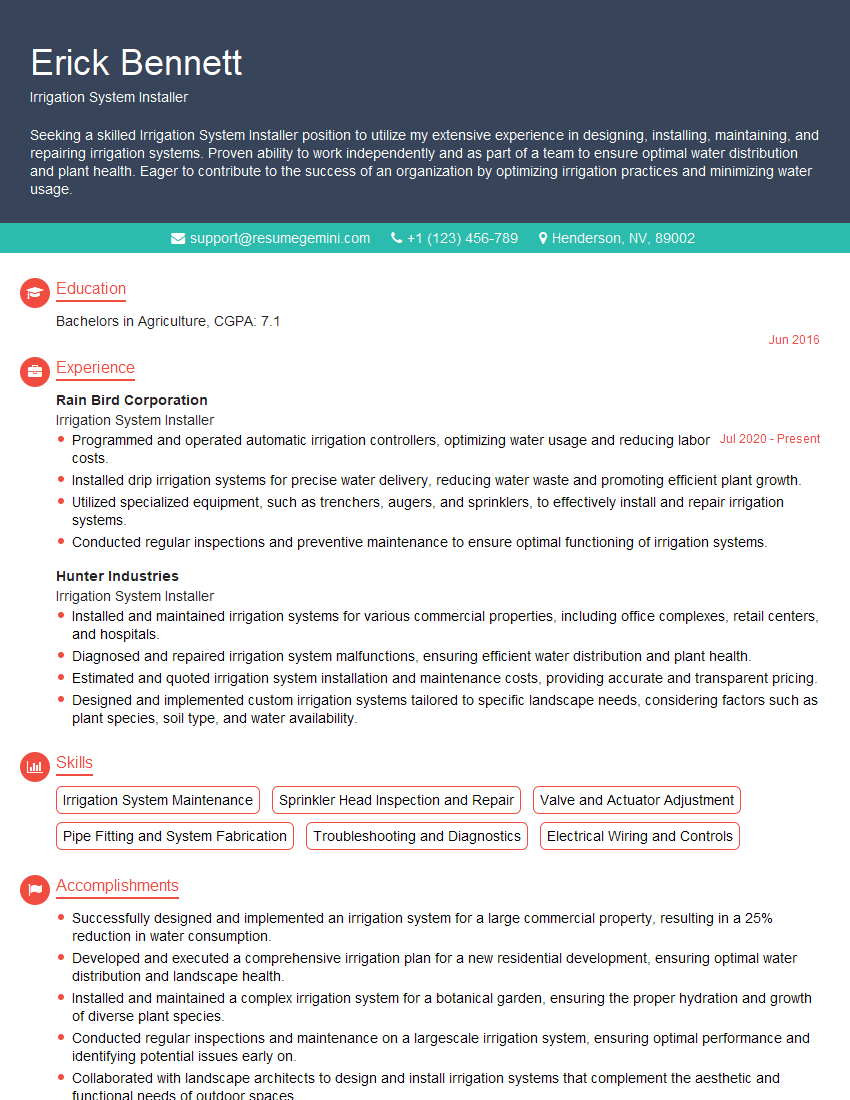
Mastering Grapevine Irrigation opens doors to exciting career opportunities in the thriving wine industry. A strong understanding of these principles is highly valued by employers, making you a competitive candidate. To maximize your job prospects, creating an ATS-friendly resume is crucial. This ensures your application gets noticed by recruiters and hiring managers. We strongly recommend using ResumeGemini, a trusted resource, to build a professional and impactful resume. ResumeGemini provides examples of resumes tailored to Grapevine Irrigation roles, helping you craft a compelling application that highlights your skills and experience effectively.
Explore more articles
Users Rating of Our Blogs
Share Your Experience
We value your feedback! Please rate our content and share your thoughts (optional).
What Readers Say About Our Blog
Very informative content, great job.
good