Preparation is the key to success in any interview. In this post, we’ll explore crucial Machine Translation and Localization interview questions and equip you with strategies to craft impactful answers. Whether you’re a beginner or a pro, these tips will elevate your preparation.
Questions Asked in Machine Translation and Localization Interview
Q 1. Explain the difference between machine translation (MT) and human translation.
Machine Translation (MT) and human translation are fundamentally different approaches to conveying meaning across languages. Human translation relies on the linguistic expertise, cultural understanding, and nuanced judgment of a trained translator. They carefully consider the source text’s context, intent, and target audience to produce a translation that is not only accurate but also natural and culturally appropriate. Think of it like crafting a bespoke suit – tailored to fit perfectly.
In contrast, Machine Translation uses computer algorithms to automatically translate text. While MT has made significant strides in recent years, it still lacks the human touch. It often struggles with nuances, idioms, and cultural references, sometimes producing literal translations that sound awkward or even nonsensical. Imagine using a pre-made, off-the-rack suit – it might fit adequately, but it won’t be as perfect as a custom-made one.
In short: Human translation is precise, nuanced, and culturally sensitive, while MT is fast, economical, and suitable for less demanding tasks.
Q 2. What are the main types of machine translation engines?
Machine translation engines generally fall into two main categories: rule-based and statistical/neural.
Rule-based MT (RBMT): These systems rely on a set of pre-defined linguistic rules and dictionaries to translate text. They work by analyzing the source text’s grammatical structure and applying rules to transform it into the target language. However, creating and maintaining these rule sets is complex and time-consuming, making them less adaptable to new languages or domains.
Statistical Machine Translation (SMT) and Neural Machine Translation (NMT): These approaches use massive amounts of parallel corpora (text in two or more languages) to learn statistical relationships between words and phrases. SMT relies on statistical models to predict the most likely translation, whereas NMT employs artificial neural networks for a more sophisticated, context-aware translation. NMT has largely superseded SMT due to its superior performance and ability to handle complex linguistic phenomena more effectively. For example, NMT can better understand the context of a word based on surrounding words.
Q 3. Describe the post-editing process for machine translation.
Post-editing in machine translation is the process of refining a machine-translated text to ensure accuracy, fluency, and cultural appropriateness. It’s a crucial step to improve the quality of MT output and make it suitable for publication or other professional uses. This isn’t just simple proofreading; it often involves significant rewriting and restructuring of sentences.
The post-editing process typically involves:
- Error correction: Identifying and correcting grammatical errors, typos, and factual inaccuracies.
- Fluency improvement: Restructuring sentences to make them sound more natural in the target language.
- Style adaptation: Adjusting the style and tone to match the target audience and purpose.
- Cultural adaptation: Replacing culturally inappropriate terms or expressions with suitable alternatives.
The level of post-editing required depends on the quality of the MT output and the intended use of the translated text. Light post-editing might only involve correcting minor errors, while heavy post-editing may require a complete overhaul of the translated text. Think of it as taking a rough sketch and turning it into a finished masterpiece.
Q 4. What are some common challenges in machine translation?
Machine translation faces several significant challenges:
Ambiguity: Natural language is inherently ambiguous. A single word or phrase can have multiple meanings, making it difficult for MT systems to choose the correct interpretation without sufficient context.
Idioms and colloquialisms: Idioms and colloquial expressions often don’t translate literally, requiring a deep understanding of both languages’ cultural contexts. MT systems often struggle with these.
Lack of context: MT systems typically analyze text in isolation, without access to the broader context that a human translator would have. This can lead to misinterpretations and inaccurate translations.
Domain-specific terminology: Specialized terminology in fields like medicine or law presents a challenge for MT systems that haven’t been trained on that specific vocabulary.
Cultural differences: Cultural nuances and conventions are often lost in translation, requiring human intervention to ensure cultural appropriateness.
Q 5. How do you handle ambiguity in machine translation output?
Handling ambiguity in MT output requires a multi-pronged approach. There is no single solution; it depends on the type and severity of the ambiguity.
Contextual analysis: Leveraging the surrounding text to infer the intended meaning. Improved NMT models are increasingly better at this.
Disambiguation techniques: Employing algorithms that analyze word sense and select the most likely meaning based on the context and statistical probabilities.
Human intervention: In cases where the ambiguity is significant or cannot be resolved automatically, human post-editors are essential to make the correct interpretation.
Training data: Improving the quality and quantity of training data can help MT systems learn to handle ambiguous situations more effectively.
For example, the word ‘bank’ can refer to a financial institution or the side of a river. An MT system needs to consider the surrounding words to determine the intended meaning. If the sentence discusses interest rates, it’s likely ‘bank’ refers to a financial institution.
Q 6. Explain the concept of translation memory (TM).
Translation Memory (TM) is a database that stores previously translated segments of text along with their translations. It’s a powerful tool used in both human and computer-assisted translation. Think of it as a highly organized and searchable archive of your past translation work.
When a translator encounters a segment of text that has already been translated, the TM identifies it and suggests the previous translation. This significantly speeds up the translation process and ensures consistency across projects. It reduces repetition and potential errors, especially beneficial in large-scale projects with repeated phrases or terminology.
TMs work by comparing the source text segments against its database. If a perfect or near-perfect match is found (with a certain percentage of similarity), the previously translated segment is suggested to the translator. The translator can then accept, reject, or edit the suggested translation.
Q 7. What are computer-assisted translation (CAT) tools, and how do they work?
Computer-Assisted Translation (CAT) tools are software applications designed to assist human translators in their work. They significantly improve efficiency and consistency by offering several features, such as:
Translation Memory (TM): As described above, this feature reuses previously translated segments, ensuring consistency and reducing translation time.
Terminology Management: CAT tools allow translators to create and manage terminology databases, ensuring consistent use of specialized terms across projects.
Quality Assurance (QA) Checks: CAT tools perform various checks to identify potential errors, such as inconsistencies, typos, and missing translations.
Project Management Features: Many CAT tools offer project management features, such as tracking progress, assigning tasks, and collaborating with other translators.
Examples of popular CAT tools include SDL Trados Studio, MemoQ, and Across. These tools integrate features to streamline the human translation process and enhance its accuracy and efficiency. They essentially act as powerful assistants to human translators, allowing them to focus on the more intricate aspects of the work.
Q 8. What are some common CAT tools you are familiar with?
Computer-Assisted Translation (CAT) tools are indispensable in the localization industry. They streamline the translation process, improve consistency, and boost efficiency. I’m proficient in several leading CAT tools, including SDL Trados Studio, memoQ, and Across Language Server. Each offers unique features, but they share core functionalities like translation memory (TM), terminology management, and quality assurance checks.
For example, SDL Trados Studio’s TM stores previously translated segments, automatically suggesting translations for recurring phrases and ensuring consistency across projects. memoQ excels in its project management capabilities, allowing for efficient collaboration among translators, reviewers, and project managers. Across Language Server stands out for its integration with various content management systems, simplifying the workflow for large-scale localization projects.
- SDL Trados Studio: Known for its robust TM and comprehensive features.
- memoQ: Strong in project management and collaboration tools.
- Across Language Server: Excellent for integration with various CMS systems.
Q 9. Describe the process of localization for software.
Software localization is a multifaceted process involving adapting software to a specific target market. It’s more than just translation; it encompasses cultural adaptation, technical adjustments, and rigorous testing. The process typically involves these steps:
- Planning and Analysis: Identifying the target markets, analyzing the software’s functionality, and defining the scope of the localization project.
- Extraction: Extracting translatable text from the software’s source code, user interface (UI), and documentation.
- Translation: Translating the extracted text into the target languages, considering cultural nuances and terminology consistency.
- Review and Editing: Professional linguists review the translations to ensure accuracy, consistency, and fluency.
- Testing and Quality Assurance (QA): Rigorous testing to ensure functionality and usability in the target language and culture. This includes linguistic QA and functional QA.
- Integration: Integrating the translated text back into the software.
- Deployment: Releasing the localized software to the target market.
For example, localizing a date/time picker requires careful attention to the date format (e.g., MM/DD/YYYY vs. DD/MM/YYYY) as well as the cultural conventions surrounding time zones and number formats.
Q 10. What are some cultural considerations in localization?
Cultural considerations are paramount in localization. Overlooking these aspects can lead to misunderstandings, negative brand perception, and even product failure. Key cultural considerations include:
- Language: Direct translation isn’t always sufficient. Idioms, metaphors, and humor often need creative adaptation to resonate with the target audience. For example, a phrase like “break a leg” in English needs a culturally appropriate equivalent in the target language.
- Numbers and Dates: Different cultures use different number and date formats. These need to be adjusted to match local conventions.
- Colors and Symbols: Colors and symbols carry different meanings across cultures. For instance, the color white signifies mourning in some cultures, while it represents purity in others.
- Measurements and Units: Using appropriate units of measurement (metric vs. imperial) is crucial.
- Religious and Political Sensitivities: Avoiding potentially offensive or controversial content is essential for respectful localization.
- Gender and Inclusivity: Using inclusive language that respects gender diversity and avoids stereotypes is becoming increasingly important.
A simple example: localizing a website selling clothing may need to adapt sizing charts to the target market’s standard measurements (e.g., centimeters instead of inches).
Q 11. Explain the difference between internationalization and localization.
Internationalization (i18n) and localization (l10n) are closely related but distinct processes in software development. Internationalization is the design and development of a product to facilitate adaptation to different languages and regions without engineering changes. It’s the preparation for localization. Localization is the actual adaptation of a product to a specific target market. Think of it as building a house (i18n) with adaptable features (like easily replaceable wall panels for different colors) and then decorating and furnishing that house (l10n) to fit a specific culture and taste.
For example, i18n involves using Unicode characters, separating text from code, and designing UI elements that can accommodate longer text strings in other languages. Localization, on the other hand, involves translating the text, adapting images and icons, and modifying date/time formats to suit the target market. Failing to internationalize properly makes localization much harder, more costly, and prone to errors.
Q 12. How do you ensure consistency in terminology across a localization project?
Consistency in terminology is crucial for maintaining a professional and coherent brand image across localized products. Several strategies help achieve this:
- Create a Terminology Database: A centralized repository storing terms and their approved translations. This serves as the single source of truth for all translators.
- Style Guides and Glossaries: These documents outline preferred terms, writing style, and translation conventions.
- Translation Memory (TM): CAT tools use TMs to reuse previously translated segments, automatically ensuring consistency.
- Regular Review and Updates: Periodically reviewing the terminology database to ensure it’s up-to-date and reflects current usage.
- Collaboration and Training: Training translators on the use of the terminology database and style guides enhances consistency.
For example, if a software company uses “user profile” consistently in English, the localized versions should also use a consistent translation (e.g., “Profil utilisateur” in French) across the product. Inconsistent translations may lead to confusion and negative user experience.
Q 13. What is a terminology database, and how is it used in localization?
A terminology database is a structured repository that stores terms and their translations in various languages. It’s a core component of efficient and consistent localization. It contains information like the term in the source language, its translation in target languages, contextual examples, and relevant metadata.
In localization, a terminology database helps maintain consistency across projects. Translators can consult the database to ensure they use approved translations for specific terms, avoiding inconsistencies and potential errors. The database also helps in managing terminology updates and ensuring consistency across different projects and departments within an organization. This ultimately improves the quality and efficiency of the localization process, reducing costs and enhancing brand consistency.
For instance, imagine a company with a technical product. A terminology database would store technical terms (like ‘bandwidth’ or ‘firewall’) and their approved translations in all target languages. This ensures that every instance of ‘bandwidth’ is translated into the same equivalent in each language. Furthermore, the database could track the terms’ usage frequency, assisting with project management and highlighting terms that require further clarification or updates.
Q 14. Describe your experience with quality assurance (QA) in translation and localization.
Quality assurance (QA) in translation and localization is a critical stage, ensuring the final product is accurate, consistent, and culturally appropriate. My experience includes performing both linguistic QA and functional QA.
Linguistic QA involves reviewing translations for accuracy, fluency, consistency, and adherence to style guides. This includes checking for grammatical errors, typos, and inconsistencies in terminology. I’m adept at using CAT tools’ QA features like automated checks and leveraging linguistic resources to assess quality. I also incorporate a multi-stage review process, including self-review, peer review, and final review by a senior editor.
Functional QA focuses on testing the localized software to ensure its functionality matches the source language version. This involves testing all aspects of the software to ensure that the localized text is displayed correctly, and all features function as expected in the target language and cultural context. This often involves using specialized QA tools and working closely with software developers. For example, I’ve worked on projects where functional QA uncovered issues with date/time formats, currency conversions, and UI element placement.
Through rigorous QA processes, I ensure the localized products meet the highest quality standards, protecting the client’s brand reputation and optimizing user experience.
Q 15. What are some common QA metrics used in translation?
Quality assurance (QA) in translation relies on several key metrics to assess the accuracy and fluency of the translated text. These metrics often combine automated checks with human evaluation.
- Word Error Rate (WER): This measures the percentage of words that are incorrectly translated, inserted, deleted, or substituted. Lower WER indicates higher accuracy. For example, a WER of 5% means that 5% of the words in the translated text are incorrect.
- Character Error Rate (CER): Similar to WER but focuses on characters instead of words. Useful for languages where word boundaries are less clear.
- BLEU (Bilingual Evaluation Understudy): This is an automated metric that compares the translated text to one or more reference translations. It scores the translation based on the overlap of n-grams (sequences of n words) between the translated text and the reference(s). A higher BLEU score generally indicates better quality.
- TER (Translation Edit Rate): This metric measures the number of edits (insertions, deletions, substitutions) needed to transform the translated text into a reference translation. A lower TER suggests higher quality.
- Human Evaluation: While automated metrics are helpful, human evaluation is crucial. This involves native speakers assessing the translation for fluency, accuracy, cultural appropriateness, and overall quality. This is often done using rating scales or checklists.
The choice of metrics depends on the project’s specific needs and resources. For instance, a large-scale project might prioritize automated metrics like BLEU for efficiency, while a project with high stakes (e.g., legal documents) will rely heavily on human evaluation.
Career Expert Tips:
- Ace those interviews! Prepare effectively by reviewing the Top 50 Most Common Interview Questions on ResumeGemini.
- Navigate your job search with confidence! Explore a wide range of Career Tips on ResumeGemini. Learn about common challenges and recommendations to overcome them.
- Craft the perfect resume! Master the Art of Resume Writing with ResumeGemini’s guide. Showcase your unique qualifications and achievements effectively.
- Don’t miss out on holiday savings! Build your dream resume with ResumeGemini’s ATS optimized templates.
Q 16. How do you handle feedback from clients or reviewers?
Handling client or reviewer feedback is a critical aspect of the localization process. It’s essential to approach feedback professionally and constructively. My process involves:
- Active Listening: Carefully reviewing all feedback, paying close attention to the specific points raised.
- Clarification: If any feedback is unclear or ambiguous, I proactively seek clarification from the client or reviewer to ensure a shared understanding.
- Prioritization: I categorize feedback based on its urgency and impact. Critical errors are addressed first.
- Implementation: Implementing changes systematically, keeping track of the revisions made and documenting any decisions.
- Communication: Regularly updating the client or reviewer on the progress of the revisions, and responding promptly to any further questions or concerns. This often involves providing a detailed change log or summary of the revisions made.
- Version Control: Utilizing version control systems (like Git) to track changes and allow for easy rollback if necessary.
For example, if a client points out a cultural inaccuracy, I’ll research the appropriate translation and explain the correction in detail. Maintaining transparent and consistent communication throughout this process is key to building strong client relationships and ensuring project success.
Q 17. Explain your experience with project management in translation and localization.
My project management experience in translation and localization spans several years and includes various project types and sizes. I’m proficient in using project management methodologies like Agile and Waterfall, adapting them to the specific requirements of each project.
- Project Planning: I define project scopes, set realistic timelines, and allocate resources effectively. This includes identifying the necessary translators, editors, and reviewers, as well as defining the QA processes.
- Resource Allocation: I match translators with projects based on their expertise in specific subject matters and languages. I also manage the workflow, ensuring that tasks are completed on time and within budget.
- Tooling: I am comfortable using CAT tools (Computer-Assisted Translation) like SDL Trados Studio, memoQ, and Across, as well as project management software like Asana or Jira to streamline workflows.
- Communication: Maintaining consistent communication with clients and team members, using regular updates and reporting mechanisms to ensure transparency and address potential issues proactively.
- Risk Management: Identifying and mitigating potential risks, such as delays, budget overruns, and quality issues. This might involve creating contingency plans and incorporating buffer time into the schedule.
In a recent project, I successfully managed the localization of a large software application into 10 languages, adhering to strict deadlines and quality standards, leading to high client satisfaction.
Q 18. How do you manage deadlines and budgets in a translation project?
Managing deadlines and budgets effectively is crucial for successful translation projects. My approach involves:
- Accurate Estimation: I carefully estimate the time and cost required for each project phase, considering factors such as word count, subject matter complexity, and required turnaround time.
- Detailed Project Breakdown: Breaking down the project into smaller, manageable tasks with clear deadlines for each. This allows for better tracking of progress and easier identification of potential delays.
- Regular Monitoring: Continuously tracking progress against the planned schedule and budget, using project management tools to monitor task completion and resource allocation.
- Proactive Communication: Communicating any potential delays or budget concerns proactively to the client, offering solutions and alternative approaches.
- Contingency Planning: Building in buffer time and contingency funds to account for unexpected issues or delays.
For instance, if a translator falls behind schedule, I might reallocate resources, or find a secondary translator to assist, while keeping the client informed of the situation and proposed solution.
Q 19. Describe your experience with different file formats used in localization (e.g., XLIFF, PO).
I have extensive experience with various file formats used in localization, including:
- XLIFF (XML Localization Interchange File Format): This is a widely used standard for exchanging translation files between CAT tools and other localization software. It allows for preserving source text formatting and metadata, enabling better consistency.
- PO (Portable Object) files: Commonly used in software localization for translating text strings within applications. These files are usually created and managed with tools like `gettext`.
- CSV (Comma Separated Values): A simple format suitable for translating relatively straightforward text data, often used for simpler projects or parts of larger projects.
- HTML (HyperText Markup Language): Used for translating website content. Careful handling is required to preserve HTML tags and avoid breaking the website’s structure.
- JSON (JavaScript Object Notation): Frequently used for translating text strings in mobile applications and web services.
I’m adept at handling different encoding schemes and character sets to ensure compatibility across various platforms and tools. My experience includes extracting translatable text from diverse source formats, such as code bases, presentations, and marketing materials, preparing them for translation, and then integrating them back into their respective applications after the translation is completed.
Q 20. How do you handle large-scale localization projects?
Managing large-scale localization projects requires a structured and scalable approach. My strategy involves:
- Project Decomposition: Breaking the project into smaller, manageable modules based on language, content type, or other relevant factors.
- Team Management: Building and managing a team of experienced translators, editors, and reviewers, ensuring efficient communication and collaboration.
- Technology Leverage: Using CAT tools, Translation Management Systems (TMS), and other technologies to automate repetitive tasks, improve efficiency, and maintain consistency.
- Quality Control: Implementing a robust quality control process involving multiple levels of review and testing to ensure accuracy and consistency across all languages and regions.
- Workflow Optimization: Implementing streamlined workflows to manage large volumes of content and ensure timely delivery.
- Risk Mitigation: Planning for potential risks, including delays, resource constraints, and quality issues, and developing mitigation strategies.
One example includes a multilingual project where I successfully coordinated the localization of a massive e-commerce platform into 20+ languages within a tight timeline. I leveraged TMS to manage workflows, translators, and linguistic quality assurance effectively.
Q 21. What are some common risks and challenges in localization projects?
Localization projects present several common risks and challenges:
- Cultural Differences: Misinterpretations of cultural nuances can lead to inappropriate or offensive translations. Careful research and culturally sensitive approaches are vital.
- Technical Challenges: Software localization can involve complex technical issues, such as encoding problems, differences in text formatting, and compatibility with various platforms.
- Time Constraints: Meeting tight deadlines requires meticulous planning, efficient resource allocation, and proactive risk management.
- Budgetary Limitations: Balancing cost and quality is a constant challenge. Finding ways to optimize processes and leverage technology can help to control costs.
- Quality Control Issues: Maintaining consistent quality across multiple languages and regions requires a robust quality assurance process.
- Communication Barriers: Effective communication between the client, project manager, and translation team is critical to ensure that everyone is on the same page.
Successfully mitigating these risks requires thorough planning, proactive communication, a robust QA process, and the ability to adapt to unforeseen circumstances. For example, we might use a style guide to ensure consistency, and schedule regular check-in meetings with the client to discuss progress and address concerns.
Q 22. How do you mitigate risks in translation and localization projects?
Mitigating risks in translation and localization projects requires a proactive, multi-faceted approach. It’s like building a house – you wouldn’t start without a solid blueprint. Similarly, thorough planning is key. This involves clearly defining the scope, target audience, and desired quality level right from the start.
- Thorough Planning and Scope Definition: A detailed project brief outlining the source material, target languages, deadlines, and quality standards is paramount. This minimizes misunderstandings and scope creep.
- Selecting the Right Team: Choosing experienced translators and reviewers specializing in the subject matter and target language(s) is crucial. Their expertise directly impacts the accuracy and quality of the translation.
- Leveraging Technology: Translation Memory (TM) systems and Computer-Assisted Translation (CAT) tools significantly improve consistency and reduce costs. They also allow for efficient quality assurance.
- Robust Quality Assurance (QA) Processes: Implementing multiple levels of review, including linguistic and technical checks, ensures accuracy and consistency. This might involve having a native speaker review the translated text for fluency and cultural appropriateness.
- Risk Assessment and Contingency Planning: Identifying potential risks, such as unexpected delays or linguistic challenges, early on and developing mitigation strategies is essential. This may involve having backup translators or adjusting deadlines proactively.
- Communication and Collaboration: Maintaining open and transparent communication channels between all stakeholders—clients, translators, reviewers, and project managers—is vital for a smooth project workflow.
For example, I once worked on a project translating technical manuals for medical devices. By meticulously outlining the terminology and incorporating a rigorous QA process, we avoided potentially dangerous inaccuracies that could have resulted from ambiguity in the source material.
Q 23. What are your preferred methods for managing translation memories?
My preferred methods for managing translation memories involve a combination of best practices and leveraging the capabilities of modern CAT tools. Think of a TM as a highly organized and constantly updated library of previously translated segments. Effective management ensures consistency and efficiency across projects.
- Choosing the Right CAT Tool: I’m proficient with industry-leading tools like SDL Trados Studio, memoQ, and Across. Each has its strengths, and the choice depends on project requirements and team preferences.
- Regular Cleaning and Maintenance: TMs need regular maintenance to remove outdated or inaccurate entries. This ensures that the TM remains a reliable resource and doesn’t propagate errors.
- Proper Segmentation: Consistent segmentation practices are critical for effective TM leveraging. Inconsistencies in segmenting can lead to the TM failing to find matches.
- Leveraging Fuzzy Matching: Understanding and effectively utilizing fuzzy matching capabilities allows for the reuse of segments that are similar but not identical, greatly improving productivity.
- Version Control: Keeping track of TM versions is essential, particularly in large-scale projects with multiple revisions. This facilitates seamless collaboration and prevents confusion.
- Quality Assurance Checks: Regularly reviewing and validating the entries in the TM is crucial for maintaining its accuracy and reliability.
For instance, in a recent project involving the localization of a large software application, I successfully implemented a strategy to regularly clean and maintain our TM, which resulted in a 20% increase in translation speed and a significant reduction in cost without compromising quality.
Q 24. Describe your experience with different types of translation (e.g., technical, literary).
My experience spans various translation types, each requiring a unique approach. It’s like being a chef – you wouldn’t prepare a gourmet dish the same way you’d make a quick snack. Each requires different skills and techniques.
- Technical Translation: This involves translating documents with highly specialized terminology, such as manuals, patents, and software documentation. Accuracy and precision are paramount, requiring deep understanding of the subject matter. I’ve worked extensively on technical documentation for the automotive and aerospace industries.
- Literary Translation: This requires a deep understanding of the source text’s nuances, style, and cultural context to convey the author’s intent and tone in the target language. This demands strong literary skills and sensitivity to language subtleties. I’ve translated short stories and poems from French and Spanish into English.
- Marketing and Advertising Translation: This involves translating marketing materials, website content, and advertising copy, requiring creativity and an understanding of the target audience’s cultural preferences and linguistic style. I have experience in localizing marketing campaigns for international brands.
For example, while translating a technical manual for a medical device, I had to ensure that the translation was not only accurate but also conformed to specific regulatory standards. Conversely, translating a poem required me to capture the rhythm, rhyme, and emotional depth of the original text while maintaining its stylistic integrity in the target language.
Q 25. How do you stay up-to-date with the latest trends and technologies in machine translation and localization?
Staying current in the rapidly evolving fields of machine translation and localization is critical. I employ a multi-pronged approach that resembles continuously upgrading my professional toolkit.
- Professional Development Courses and Workshops: I regularly participate in online courses and workshops to learn about new technologies and best practices in the field.
- Industry Conferences and Events: Attending conferences like the TAUS conference provides valuable networking opportunities and exposure to the latest advancements in the field.
- Reading Industry Publications and Blogs: Staying abreast of the latest developments through specialized publications and blogs helps me stay informed about emerging trends and challenges.
- Active Participation in Online Communities: Engaging in discussions on professional forums and LinkedIn groups allows me to learn from other experts and share my own knowledge.
- Experimenting with New Tools and Technologies: I actively explore and experiment with new CAT tools, machine translation engines, and localization platforms to enhance my skills and keep my knowledge up to date.
For instance, I recently completed a course on neural machine translation, enabling me to better leverage and assess the capabilities of these advanced systems in my projects.
Q 26. Explain your experience working with translation agencies or clients.
I’ve had extensive experience collaborating with both translation agencies and clients directly. Each interaction has been valuable in honing my skills and understanding the dynamics of the localization industry. It’s like collaborating on a complex puzzle, and success hinges on teamwork and effective communication.
- Working with Translation Agencies: I’ve worked with several reputable agencies, adhering to their established workflows, quality standards, and project management systems. This experience has broadened my understanding of the agency landscape and the needs of diverse clients.
- Direct Client Collaboration: I’ve also worked directly with clients, ranging from small startups to multinational corporations. This has provided insight into their specific needs and priorities, allowing me to tailor my approach accordingly.
- Building Strong Client Relationships: I always prioritize open communication, transparency, and meeting deadlines to cultivate positive relationships with both agencies and clients. Understanding their specific requirements and providing clear updates are crucial.
- Adaptability to Different Workflows: My experience has equipped me with the ability to adapt to diverse project management methodologies, whether Agile or Waterfall, which allows me to integrate seamlessly into existing workflows.
A recent example involved working directly with a client on a large-scale e-commerce website localization project. By actively communicating progress and addressing their concerns proactively, we built a strong relationship and completed the project successfully, exceeding their expectations.
Q 27. What are your salary expectations for this role?
My salary expectations for this role are commensurate with my experience and skills, and are within the industry standard for a professional with my qualifications. I’m open to discussing a compensation package that reflects the responsibilities and challenges associated with this position. I’d prefer to discuss this further in person after learning more about the specific requirements and benefits offered.
Q 28. Why are you interested in this particular position?
I’m highly interested in this position because it aligns perfectly with my professional goals and offers a stimulating environment where I can contribute my expertise. The opportunity to work on challenging projects, utilize cutting-edge technologies, and collaborate with a talented team is particularly appealing. Furthermore, [mention specific aspects of the job description or company that interest you, e.g., the company’s commitment to innovation, the nature of the projects, the company culture]. I believe my skills and experience make me an ideal candidate to excel in this role and make a significant contribution to the team’s success.
Key Topics to Learn for Machine Translation and Localization Interview
- Machine Translation (MT) Engines and Architectures: Understand different MT approaches (statistical, rule-based, neural), their strengths and weaknesses, and how they impact translation quality. Explore the architecture of popular MT systems.
- Post-Editing and Quality Assurance (QA): Learn practical techniques for effectively post-editing machine-translated text, focusing on accuracy, fluency, and cultural appropriateness. Understand QA methodologies and metrics used in MT evaluation.
- Localization Principles and Best Practices: Grasp the nuances of adapting content for different target markets, including cultural adaptation, terminology management, and linguistic considerations.
- Translation Memory (TM) and Computer-Assisted Translation (CAT) Tools: Familiarize yourself with popular CAT tools and how they leverage TMs to increase efficiency and consistency in translation projects.
- Data Preprocessing and Cleaning for MT: Understand the importance of preparing high-quality training data for MT systems and techniques for cleaning and preparing diverse datasets.
- Evaluation Metrics for MT and Localization: Learn about different metrics used to assess the quality of MT outputs and localized content, such as BLEU, METEOR, and human evaluation.
- Ethical Considerations in MT and Localization: Discuss the ethical implications of MT and localization, including bias in algorithms, cultural sensitivity, and responsible use of technology.
- Problem-solving in MT and Localization: Prepare examples of how you’ve tackled challenges related to low-quality translations, inconsistencies, or cultural misunderstandings. Focus on your approach to troubleshooting.
Next Steps
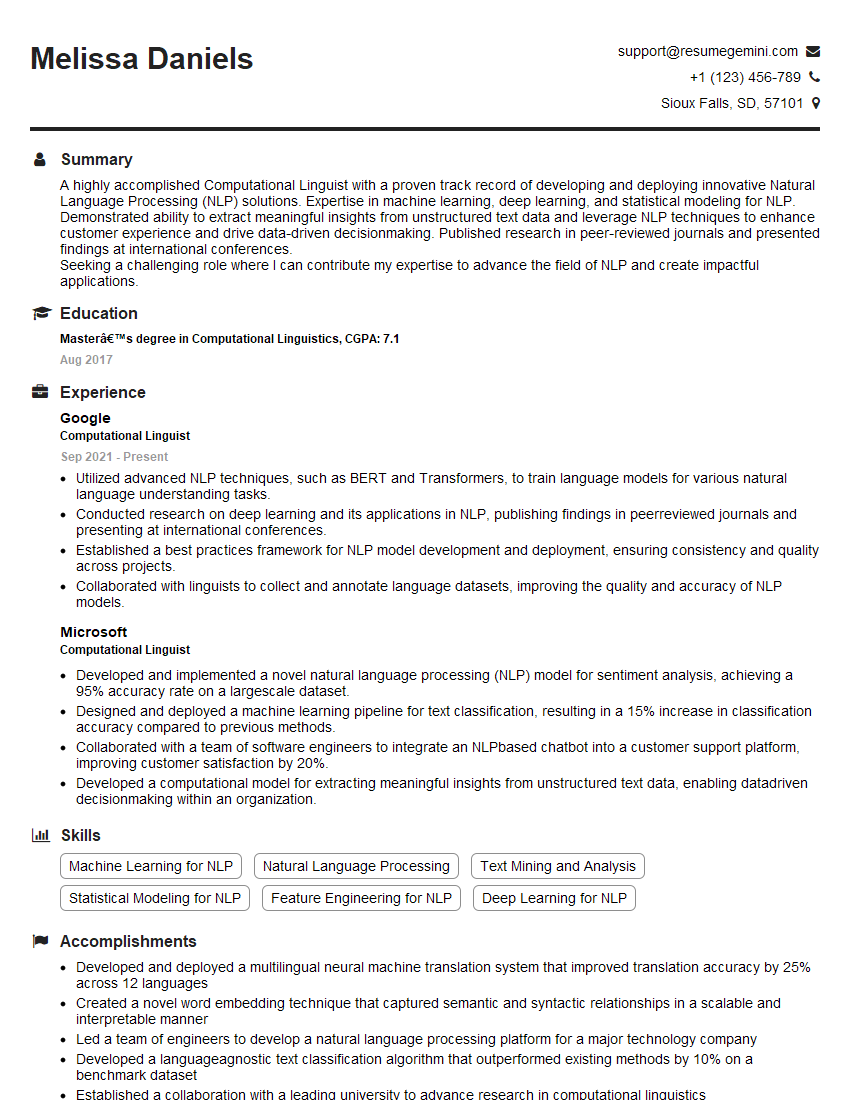
Mastering Machine Translation and Localization opens doors to exciting and rewarding careers in a rapidly growing field. Demonstrating expertise in these areas significantly enhances your job prospects. To maximize your chances, it’s crucial to present your skills effectively. Crafting an ATS-friendly resume is key to getting your application noticed. ResumeGemini is a trusted resource that can help you build a professional and impactful resume. We provide examples of resumes tailored to Machine Translation and Localization to guide you through the process. Invest time in building a strong resume—it’s your first impression with potential employers.
Explore more articles
Users Rating of Our Blogs
Share Your Experience
We value your feedback! Please rate our content and share your thoughts (optional).
What Readers Say About Our Blog
Very informative content, great job.
good