Cracking a skill-specific interview, like one for Proficient in using data management software, requires understanding the nuances of the role. In this blog, we present the questions you’re most likely to encounter, along with insights into how to answer them effectively. Let’s ensure you’re ready to make a strong impression.
Questions Asked in Proficient in using data management software Interview
Q 1. Explain the difference between OLTP and OLAP databases.
OLTP (Online Transaction Processing) and OLAP (Online Analytical Processing) databases serve fundamentally different purposes. Think of OLTP as your everyday bank account – designed for quick, frequent updates and transactions. OLAP, on the other hand, is like a detailed financial report summarizing years of transactions; it’s optimized for complex queries and analysis.
- OLTP: Optimized for high-speed transactions. Data is highly structured and normalized to minimize redundancy. Queries are typically short and simple, like updating a balance or adding a new customer. Examples include systems used for online banking, e-commerce order processing, and airline reservations.
- OLAP: Designed for complex analytical queries against large datasets. Data is often denormalized to improve query performance; redundancy is accepted for speed. Queries are typically complex, involving aggregations, calculations, and data mining. Examples include analyzing sales trends, customer segmentation, and financial forecasting. OLAP often uses dimensional modeling, a data structure designed to make querying easier and faster.
In essence, OLTP focuses on speed and efficiency of individual transactions, while OLAP prioritizes complex analysis of historical data. They often work together; the transactional data from OLTP systems is used to populate the data warehouse used for OLAP analysis.
Q 2. Describe your experience with SQL and NoSQL databases.
I have extensive experience with both SQL and NoSQL databases. My SQL experience spans several relational database management systems (RDBMS), including MySQL, PostgreSQL, and SQL Server. I’m proficient in writing complex queries involving joins, subqueries, aggregations, and window functions. I’ve used SQL extensively for data manipulation, schema design, and data integrity enforcement.
My NoSQL experience includes working with MongoDB and Cassandra. I understand the strengths and weaknesses of different NoSQL data models – document, key-value, graph, and column-family – and can choose the appropriate database for a specific application. For example, I’ve used MongoDB for applications requiring flexible schemas and high scalability, and Cassandra for distributed applications needing high availability and fault tolerance.
I’m comfortable choosing between SQL and NoSQL depending on the project requirements. For applications requiring ACID properties (Atomicity, Consistency, Isolation, Durability) and strict data relationships, SQL is generally the better choice. For applications where scalability and flexibility are paramount, and ACID properties are less critical, NoSQL databases often provide a better solution. I’ve successfully deployed projects using both, always tailoring my database choice to the specific application needs.
Q 3. What are the different types of database normalization?
Database normalization is a process used to organize data to reduce redundancy and improve data integrity. It involves a series of steps, called normal forms, each addressing different types of redundancy. The most common normal forms are:
- First Normal Form (1NF): Eliminate repeating groups of data within a table. Each column should contain only atomic values (single values, not lists or arrays). For example, if you have a table storing customer addresses, don’t have multiple addresses in a single column; create a separate table for addresses.
- Second Normal Form (2NF): Be in 1NF and eliminate redundant data that depends on only part of the primary key (in tables with composite keys).
- Third Normal Form (3NF): Be in 2NF and eliminate transitive dependencies. This means no non-key column should depend on another non-key column.
- Boyce-Codd Normal Form (BCNF): A stricter version of 3NF. It addresses certain anomalies that 3NF doesn’t completely resolve.
Choosing the appropriate level of normalization depends on the specific application. Higher normal forms generally lead to less redundancy but can also increase query complexity. It is a balance between reducing redundancy and maintaining query performance.
Q 4. How do you ensure data quality and integrity?
Ensuring data quality and integrity is crucial. My approach involves a multi-faceted strategy:
- Data Validation: Implementing input validation at the application level to prevent incorrect or inconsistent data from entering the database. This includes data type validation, range checks, and constraint enforcement.
- Data Cleansing: Regularly cleaning the database to identify and correct inaccurate or incomplete data. This often involves identifying and handling missing values, outliers, and inconsistent data formats.
- Data Constraints: Defining constraints in the database schema (e.g., primary keys, foreign keys, unique constraints, check constraints) to enforce data integrity. This prevents invalid data from being inserted or updated.
- Data Monitoring: Regularly monitoring data quality through automated checks and reports. This includes identifying anomalies, tracking data errors, and monitoring data completeness.
- Data Governance Policies: Establishing clear data governance policies and procedures to ensure consistency and accuracy. This involves defining roles and responsibilities, establishing data standards, and implementing data quality metrics.
I’ve used various tools and techniques to achieve these objectives, including automated data quality tools and custom scripts to identify and correct data issues. Proactive measures are key to preventing issues down the line.
Q 5. Explain the ETL process (Extract, Transform, Load).
ETL (Extract, Transform, Load) is a crucial process for moving data from various sources into a data warehouse or other target system. It involves three key steps:
- Extract: This step involves reading data from various sources, which can include databases, flat files, APIs, and cloud storage. The extraction process needs to be efficient and handle different data formats and structures.
- Transform: This is the most complex step and often involves data cleansing, data validation, data conversion, and data enrichment. Data is cleaned, transformed into a consistent format, and possibly enhanced with additional data from other sources. This might involve handling missing values, standardizing data formats, and performing calculations.
- Load: In this step, the transformed data is loaded into the target system. This may involve creating new tables, updating existing data, or appending data to existing tables. The loading process needs to be efficient and handle large volumes of data.
I’ve used various ETL tools, such as Informatica PowerCenter and Apache Kafka, and have also developed custom ETL pipelines using scripting languages like Python. A well-designed ETL process is essential for ensuring the quality and consistency of data in the target system.
Q 6. What are your preferred data visualization tools?
My preferred data visualization tools depend on the specific needs of the project. However, I have extensive experience with several popular tools:
- Tableau: Excellent for creating interactive dashboards and visualizations, particularly for business intelligence purposes. Its user-friendly interface makes it easy to create compelling visuals from complex datasets.
- Power BI: A strong competitor to Tableau, offering similar functionalities with good integration with Microsoft products. It’s a robust tool for self-service BI.
- Python libraries (Matplotlib, Seaborn, Plotly): These provide more control and flexibility for creating customized visualizations. They are particularly useful for data scientists and analysts who need fine-grained control over the visualization process.
The choice of tool often depends on factors like the size of the dataset, the complexity of the analysis, the technical skills of the team, and the integration requirements with existing systems. I always strive to select the best tool for the job based on these considerations.
Q 7. Describe your experience with data modeling.
Data modeling is crucial for designing efficient and effective databases. My experience encompasses both conceptual and logical data modeling. I’m proficient in using Entity-Relationship Diagrams (ERDs) to represent the relationships between entities and attributes. I use industry standard notations (e.g., Crow’s Foot notation) to clearly represent the relationships.
In conceptual modeling, I focus on understanding the business requirements and translating them into a high-level representation of the data. This phase focuses on defining entities, attributes, and their relationships without getting into implementation details. In logical modeling, I translate the conceptual model into a database-specific schema. This stage involves choosing appropriate data types, defining constraints, and optimizing the model for performance. I frequently utilize CASE tools to assist in the modeling process.
For example, I recently worked on a project where we needed to design a database for a new e-commerce platform. I started by interviewing stakeholders to understand their requirements and then created an ERD to represent the entities (customers, products, orders, etc.) and their relationships. This ERD was then translated into a relational database schema, taking into account performance considerations and data integrity requirements.
Q 8. How do you handle missing data in a dataset?
Missing data is a common challenge in any dataset. Handling it effectively is crucial for maintaining data integrity and drawing accurate conclusions. My approach involves a multi-step process that begins with understanding the nature of the missing data – is it Missing Completely at Random (MCAR), Missing at Random (MAR), or Missing Not at Random (MNAR)?
Identification and Analysis: I start by identifying the extent and pattern of missing values using descriptive statistics and visualizations. This helps determine the type of missingness and its potential impact on analysis.
Imputation Techniques: The choice of imputation method depends on the type of missing data and the characteristics of the dataset. For MCAR data, simple imputation methods like mean/median/mode imputation might suffice. However, for MAR or MNAR data, more sophisticated techniques are necessary. I frequently employ multiple imputation using chained equations (MICE) or k-nearest neighbors (k-NN) to create multiple plausible datasets, accounting for the uncertainty introduced by missing data. For categorical variables, I might use methods like predictive mean matching.
Deletion: In some cases, especially if the missing data is substantial and non-random, removing rows or columns with significant missing data might be a necessary step. This approach, however, should be used cautiously to avoid introducing bias.
Model-Based Approaches: For specific analytical tasks, like regression modeling, I can incorporate missing data handling directly into the model. For example, using maximum likelihood estimation (MLE) for models which are designed to handle missing data directly.
Data Validation Post-Imputation: After imputing missing values, it’s vital to validate the results. This involves comparing the distribution and relationships of variables before and after imputation to ensure that the imputed values are realistic and do not distort the dataset.
Example: In a customer churn prediction project, missing values in customer demographics were imputed using k-NN imputation, considering similar customers with complete data. This approach ensured that the imputed values aligned with the overall customer profile.
Q 9. What are some common data security challenges and how do you address them?
Data security is paramount. Common challenges include unauthorized access, data breaches, and data loss. My approach to addressing these involves a multi-layered strategy:
Access Control: Implementing robust access control mechanisms, including role-based access control (RBAC) and least privilege principles, restricts access to sensitive data to only authorized personnel. This minimizes the risk of accidental or malicious data exposure.
Encryption: Employing strong encryption techniques, both at rest and in transit, protects data from unauthorized access even if a breach occurs. This includes database encryption, file encryption, and secure communication protocols (HTTPS, TLS).
Data Masking and Anonymization: For development and testing purposes, sensitive data can be masked or anonymized to protect privacy without compromising the usability of the data. Techniques include data perturbation, tokenization, and generalization.
Regular Security Audits and Penetration Testing: Regular security audits and penetration testing identify vulnerabilities and weaknesses in the data security infrastructure before they can be exploited by malicious actors.
Data Loss Prevention (DLP): Implementing DLP measures prevents sensitive data from leaving the organization’s controlled environment without authorization. This might include monitoring data transfers and blocking unauthorized uploads or downloads.
Regular Backups and Disaster Recovery: Regular backups and a robust disaster recovery plan minimize data loss in the event of hardware failures, natural disasters, or cyberattacks.
Example: In a previous role, I implemented encryption for all sensitive customer data stored in a cloud database, integrated with multi-factor authentication for all user access. This significantly reduced the risk of unauthorized data access.
Q 10. What is data governance and why is it important?
Data governance is a collection of processes, policies, and standards that ensure the high-quality, trustworthy, accessible, and compliant usage of an organization’s data. Think of it as the overall framework that manages and protects data assets.
Its importance lies in several key areas:
Improved Data Quality: Data governance establishes standards and processes for data collection, validation, and cleansing, leading to better data quality and accuracy.
Reduced Risk and Compliance: It ensures compliance with relevant regulations and industry standards (e.g., GDPR, HIPAA), reducing the risk of legal penalties and reputational damage.
Enhanced Decision-Making: High-quality, reliable data fuels better business decisions. Data governance ensures that decisions are based on accurate and trustworthy information.
Increased Efficiency: Clear data governance frameworks streamline data processes, improving efficiency and productivity across the organization.
Better Collaboration: Data governance fosters collaboration and communication between different departments and stakeholders, improving data sharing and utilization.
Example: Implementing a data governance framework that includes data dictionaries, data quality rules, and data lineage tracking significantly improved data quality and reduced the time spent resolving data inconsistencies in a previous project.
Q 11. Explain your experience with data warehousing.
I have extensive experience with data warehousing, having designed, implemented, and maintained several data warehouses across various industries. My experience encompasses the entire data warehousing lifecycle, from requirements gathering and design to implementation and ongoing maintenance.
Design and Modeling: I’m proficient in designing dimensional models using star schema and snowflake schema, optimizing for performance and scalability. I utilize tools such as Erwin Data Modeler to create and manage data models.
ETL Processes: I have extensive experience with Extract, Transform, Load (ETL) processes, using tools like Informatica PowerCenter and Apache Kafka to extract data from various sources, transform it according to business requirements, and load it into the data warehouse. I understand the importance of optimizing ETL processes for speed and efficiency.
Data Warehousing Technologies: I’m familiar with various data warehousing technologies, including relational databases (e.g., SQL Server, Oracle), cloud-based data warehouses (e.g., Snowflake, Amazon Redshift), and columnar databases (e.g., Parquet). I can select the most appropriate technology based on the specific needs of the project.
Performance Tuning: I’m skilled in performance tuning data warehouse queries and ETL processes to ensure optimal performance and responsiveness. Techniques include query optimization, indexing, and partitioning.
Example: In one project, I redesigned a legacy data warehouse using a cloud-based solution (Snowflake), resulting in a 50% reduction in query execution times and significant cost savings.
Q 12. Describe your experience with cloud-based data management solutions (e.g., AWS, Azure, GCP).
I have significant experience with cloud-based data management solutions, primarily AWS, Azure, and GCP. My experience covers various aspects, including data storage, processing, and analytics.
AWS: I’ve worked extensively with AWS services like S3 (for data storage), Redshift (for data warehousing), EMR (for big data processing), and Glue (for ETL). I understand how to optimize these services for cost and performance.
Azure: I have experience using Azure services like Azure Data Lake Storage, Azure Synapse Analytics (for data warehousing), and Azure Databricks (for big data processing). I am familiar with Azure’s security and governance features.
GCP: My experience with GCP includes working with BigQuery (for data warehousing and analytics), Cloud Storage (for data storage), and Dataproc (for big data processing). I understand how to leverage GCP’s scalability and flexibility.
Cloud Data Management Best Practices: I am adept at implementing cloud data management best practices, including data governance, security, and cost optimization strategies for cloud environments.
Example: In a project involving migrating an on-premises data warehouse to AWS Redshift, I implemented a robust migration plan, optimized data loading procedures, and ensured seamless integration with existing business intelligence tools.
Q 13. What is a data lake and how does it differ from a data warehouse?
A data lake is a centralized repository that stores raw data in its native format, without any pre-defined schema. It’s like a large, unstructured pool of data ready for exploration. A data warehouse, on the other hand, is a structured repository that stores data in a pre-defined schema, optimized for analytical queries. It’s like a highly organized library, meticulously cataloged and readily searchable.
Here’s a table summarizing the key differences:
| Feature | Data Lake | Data Warehouse |
|---|---|---|
| Schema | Schema-on-read (no predefined schema) | Schema-on-write (predefined schema) |
| Data Structure | Unstructured, semi-structured, and structured data | Structured data |
| Data Processing | Batch and real-time processing | Primarily batch processing |
| Scalability | Highly scalable | Scalable, but often requires planning for growth |
| Querying | Can be challenging for complex queries | Optimized for analytical queries |
| Cost | Can be initially less expensive | Can be more expensive due to processing and storage |
In essence, a data lake is ideal for storing large volumes of raw data for future analysis and exploration, while a data warehouse is best suited for storing structured data optimized for specific analytical queries.
Example: A company might use a data lake to store all its raw sensor data from its manufacturing plants, then process and load subsets of this data into a data warehouse for reporting and analysis.
Q 14. What experience do you have with big data technologies (e.g., Hadoop, Spark)?
I have substantial experience with big data technologies, including Hadoop and Spark. My experience spans data ingestion, processing, and analysis using these platforms.
Hadoop: I’m familiar with the Hadoop Distributed File System (HDFS) for distributed storage and MapReduce for parallel processing of large datasets. I have experience with Hadoop ecosystem tools like Hive (for data warehousing on Hadoop), Pig (for data transformation), and HBase (for NoSQL database).
Spark: I’ve used Spark for both batch and real-time data processing, leveraging its in-memory computation capabilities for faster processing compared to MapReduce. I’m proficient in using Spark SQL, Spark Streaming, and MLlib (for machine learning).
Big Data Architectures: I understand how to design and implement big data architectures, considering factors like scalability, fault tolerance, and data governance.
Example: In a project involving analyzing terabytes of log data to detect fraudulent transactions, I built a Spark-based solution that processed the data in near real-time, significantly improving the accuracy and speed of fraud detection.
Q 15. Explain your experience with data integration tools.
Data integration tools are crucial for consolidating data from disparate sources into a unified view. My experience spans several tools, including Informatica PowerCenter, Talend Open Studio, and Apache Kafka. I’ve worked extensively with ETL (Extract, Transform, Load) processes, using these tools to extract data from various databases (SQL Server, Oracle, MySQL), flat files (CSV, TXT), and cloud-based systems (AWS S3, Azure Blob Storage). For instance, in a previous role, I integrated customer data from a CRM system, sales data from an ERP, and website analytics data into a central data warehouse. This involved designing and implementing ETL pipelines, handling data transformations (data cleansing, formatting, and enrichment), and ensuring data quality throughout the process. I’m also proficient in using APIs to integrate data from various web services.
In another project, I used Apache Kafka to build a real-time data pipeline, streaming data from various sources to a data lake for subsequent analysis. This involved configuring Kafka brokers, producers, and consumers, and ensuring message ordering and fault tolerance. The ability to choose the right tool for the job, based on factors such as data volume, velocity, and variety, is essential for successful data integration.
Career Expert Tips:
- Ace those interviews! Prepare effectively by reviewing the Top 50 Most Common Interview Questions on ResumeGemini.
- Navigate your job search with confidence! Explore a wide range of Career Tips on ResumeGemini. Learn about common challenges and recommendations to overcome them.
- Craft the perfect resume! Master the Art of Resume Writing with ResumeGemini’s guide. Showcase your unique qualifications and achievements effectively.
- Don’t miss out on holiday savings! Build your dream resume with ResumeGemini’s ATS optimized templates.
Q 16. How do you optimize database performance?
Optimizing database performance is a multifaceted task that involves understanding the query patterns, database structure, and hardware limitations. My approach typically involves a combination of techniques:
- Query Optimization: I use tools like SQL Profiler to analyze slow-running queries and identify bottlenecks. This might involve rewriting queries using appropriate indexes, optimizing joins, and using set-based operations instead of cursor-based operations. For example, replacing a nested loop join with a hash join can significantly improve performance.
SELECT * FROM table1, table2 WHERE table1.id = table2.id;(Inefficient) could be replaced withSELECT * FROM table1 INNER JOIN table2 ON table1.id = table2.id;(More efficient, provided appropriate indexes are in place). - Indexing: Proper indexing is crucial. I analyze query patterns to determine which columns need indexes and what types of indexes (B-tree, hash, etc.) are most appropriate. Over-indexing can also negatively impact performance, so careful planning is necessary.
- Database Design: A well-designed database is the foundation of good performance. Normalization helps reduce data redundancy and improve data integrity, leading to faster query execution. Understanding data relationships and choosing the right data types are also vital.
- Hardware Optimization: Ensuring adequate hardware resources (CPU, memory, storage) is essential. Solid-state drives (SSDs) can significantly improve I/O performance compared to traditional hard drives. Database tuning options like increasing buffer pool size can also enhance performance.
- Caching: Utilizing caching mechanisms, both at the database level and application level, can reduce the load on the database and improve response times.
By employing a systematic approach that incorporates these techniques, I can significantly improve database performance, leading to faster query response times, increased scalability, and better overall system efficiency.
Q 17. Describe your experience with database backup and recovery.
Database backup and recovery are essential for ensuring data integrity and business continuity. My experience encompasses various backup strategies, including full backups, incremental backups, and differential backups. I’m proficient in using both native database backup utilities (e.g., SQL Server Management Studio, Oracle RMAN) and third-party backup software.
The choice of backup strategy depends on factors such as recovery time objective (RTO) and recovery point objective (RPO). For instance, for critical systems with low RTO and RPO requirements, I might use a combination of frequent incremental backups and full backups. I also implement regular backup testing to verify that backups can be restored successfully and that the recovery process is efficient. This involves restoring backups to a separate test environment and validating the data integrity. I also document the backup and recovery procedures thoroughly, ensuring that others can easily follow them.
In addition to regular backups, I also implement high availability strategies, such as database mirroring or clustering, to minimize downtime in case of hardware failure. These techniques provide redundancy and allow for automatic failover to a secondary database instance. A robust backup and recovery plan is crucial for mitigating the risk of data loss and ensuring business resilience.
Q 18. What is ACID properties in database transactions?
ACID properties are fundamental to ensuring data integrity and consistency in database transactions. They stand for:
- Atomicity: A transaction is treated as a single, indivisible unit of work. Either all changes within the transaction are committed, or none are. Think of it like an all-or-nothing approach. If any part of the transaction fails, the entire transaction is rolled back.
- Consistency: A transaction must maintain the database’s integrity constraints. It must begin in a valid state and end in a valid state. This means that the transaction cannot leave the database in an inconsistent state (e.g., violating a foreign key constraint).
- Isolation: Concurrent transactions must be isolated from one another. This means that one transaction’s changes should not be visible to other concurrent transactions until it’s committed. This prevents data corruption and race conditions.
- Durability: Once a transaction is committed, the changes are permanently saved to the database and will survive even system failures. The data is persistent, even in the event of a power outage or system crash.
For example, transferring money from one bank account to another requires an atomic transaction. If the debit from one account succeeds but the credit to the other fails, the system would be in an inconsistent state, violating the ACID properties. These properties are crucial for ensuring reliable and consistent data management in database systems.
Q 19. How do you handle data conflicts?
Data conflicts arise when multiple users or processes attempt to modify the same data simultaneously. The method for handling these conflicts depends on the specific context and the database system being used. Common strategies include:
- Optimistic Locking: This approach assumes that conflicts are rare. Before updating data, a version number or timestamp is checked. If the version number has changed since the data was read, a conflict is detected, and the update is rejected. The user is then notified and can retry the operation.
- Pessimistic Locking: This approach assumes that conflicts are frequent. A lock is placed on the data before it’s accessed, preventing other users from modifying it until the lock is released. This can lead to performance bottlenecks if locks are held for extended periods.
- Last-Write-Wins: This approach simply chooses the last modification as the correct one, discarding earlier changes. This is generally not recommended as it can lead to data loss.
- Merge/Conflict Resolution: This allows users to manually resolve conflicts by reviewing and selecting the correct version of the data. This is often used in collaborative editing scenarios.
The best approach depends on the application requirements. For applications where data consistency is paramount, pessimistic locking might be suitable, while for applications where performance is critical, optimistic locking might be preferred. A well-designed application should clearly communicate to the user how data conflicts are handled and provide mechanisms for resolution.
Q 20. Explain your experience with data profiling.
Data profiling is the process of analyzing data to understand its characteristics, quality, and structure. This involves examining data values, identifying data types, checking for inconsistencies, and discovering patterns. My experience with data profiling includes using both manual techniques and automated tools. Manual techniques involve creating queries and reports to analyze specific aspects of the data. Automated tools, such as IBM Infosphere Information Server or Talend Data Quality, streamline this process by providing comprehensive reports and visualizations.
Data profiling helps in several ways:
- Data Quality Assessment: It helps identify data quality issues like missing values, duplicates, outliers, and inconsistencies. This is critical for making informed decisions about data cleansing and transformation.
- Data Understanding: It reveals the distribution, range, and other characteristics of data values, helping to understand the data’s underlying patterns and relationships.
- Data Modeling: Profiling results can inform database design decisions. It helps in selecting appropriate data types and defining relationships between tables.
- Data Integration: Understanding data profiles helps in transforming and integrating data from diverse sources more effectively.
For example, I used data profiling in a project to analyze customer demographics data. The profiling revealed that a significant percentage of zip codes were invalid, and certain fields had inconsistent formatting. This information was crucial for implementing data cleansing procedures to improve data quality.
Q 21. What are your preferred methods for data cleansing?
Data cleansing, also known as data scrubbing, is the process of identifying and correcting or removing inaccurate, incomplete, irrelevant, duplicated, or improperly formatted data. My preferred methods are a combination of automated and manual techniques. Automated techniques often involve using scripting languages (like Python with libraries like Pandas) or specialized data cleansing tools. Manual techniques might involve reviewing and correcting data anomalies on a case-by-case basis.
Specific techniques include:
- Standardization: Converting data into a consistent format. For example, standardizing date formats or address formats.
- Validation: Checking data against predefined rules or constraints. For example, ensuring that zip codes are valid or that email addresses have a correct format.
- Deduplication: Identifying and removing duplicate records. This might involve using techniques like fuzzy matching to identify records with similar but not identical values.
- Imputation: Filling in missing values. This might involve using statistical methods (e.g., mean, median, mode) or more sophisticated techniques like machine learning.
- Parsing: Extracting specific information from unstructured or semi-structured data.
I always prioritize a structured approach, starting with data profiling to understand the data’s characteristics and identify the most significant cleansing needs. Then, I choose the most appropriate techniques based on the nature of the data and the available resources. Thorough documentation and testing are crucial to ensure that the cleansing process is effective and doesn’t introduce new errors. For instance, when dealing with sensitive personal data, I always consider privacy regulations and data security best practices.
Q 22. Describe your experience with schema design.
Schema design is the process of defining the structure and organization of data within a database. It’s like creating the blueprint for a house – you need to carefully plan where each room (table) goes, what it will contain (columns), and how the rooms connect (relationships). A well-designed schema is crucial for data integrity, efficiency, and scalability.
My experience involves working with relational databases (like PostgreSQL and MySQL) and NoSQL databases (like MongoDB). For relational databases, I focus on normalization techniques to reduce redundancy and improve data consistency. I consider factors like data types, constraints (primary keys, foreign keys, unique constraints), and indexes during the design process. For NoSQL databases, the approach is more flexible, often involving schema-less designs or denormalization to optimize for specific query patterns. For example, in a project involving e-commerce data, I designed a schema with separate tables for products, customers, and orders, with foreign keys linking them to ensure efficient retrieval of related information. In another project using MongoDB, a flexible schema allowed us to easily handle evolving product data with different attributes without requiring major schema changes.
- Normalization: Reducing data redundancy through database design
- Data Types: Choosing appropriate data types (INT, VARCHAR, DATE, etc.) to store data efficiently
- Constraints: Defining rules to ensure data integrity (e.g., NOT NULL, UNIQUE)
- Relationships: Defining how different tables connect (one-to-one, one-to-many, many-to-many)
Q 23. How do you troubleshoot database errors?
Troubleshooting database errors involves a systematic approach. It’s like being a detective, piecing together clues to find the root cause. I typically start by examining error messages carefully, looking for keywords and error codes. Then I check database logs for more detailed information.
My process involves these steps:
- Identify the Error: Carefully read the error message and identify the source (e.g., application code, database server, network).
- Check Logs: Examine database logs for more context, timestamps, and related events.
- Verify Connectivity: Ensure the application has proper network connectivity to the database server.
- Review Queries: If the error relates to a specific query, review the query syntax for errors, and analyze query execution plans to find performance bottlenecks.
- Check Table Structure: Ensure the table structure is correct and that the data types are appropriate.
- Check Constraints: Verify that data integrity constraints (primary keys, foreign keys, etc.) are not violated.
- Test with simpler queries: If the error is in a complex query, gradually break it down into simpler queries to isolate the problem.
- Seek external help: If necessary, consult online forums or the database documentation for solutions, or seek help from database administrators.
For example, once I encountered a ‘deadlock’ error in a high-traffic application. By analyzing the database logs, I identified two concurrent transactions trying to lock the same rows simultaneously. The solution involved adjusting the transaction isolation level and optimizing the database schema to reduce contention.
Q 24. What is your experience with indexing and query optimization?
Indexing and query optimization are essential for database performance. Indexing is like creating a detailed table of contents for a book – it allows for quick lookups of specific information. Query optimization is the art of writing efficient queries that minimize database resource usage.
I have extensive experience creating indexes (B-tree, hash, full-text) in relational databases to speed up frequently accessed data. I use query analyzers and execution plans to identify performance bottlenecks and optimize queries. For instance, I’ve used techniques like:
- Choosing the right index type: Selecting appropriate indexes based on query patterns and data distribution
- Using EXPLAIN PLAN: Analyzing query execution plans to understand how the database processes queries
- Optimizing joins: Choosing efficient join strategies (e.g., INNER JOIN, LEFT JOIN)
- Using appropriate data types: Selecting appropriate data types for columns to improve query performance
- Avoiding unnecessary subqueries: Rewriting queries to eliminate or minimize subqueries
In a previous project, I improved a slow reporting query by adding a composite index on multiple columns frequently used in the WHERE clause. This reduced query execution time from several minutes to a few seconds, significantly improving report generation speed.
Q 25. Describe a time you had to solve a complex data management problem.
I once faced a complex data management problem involving a large dataset with inconsistencies and missing values. The data was from multiple sources and lacked a unified structure. The challenge was to clean, transform, and load this data into a data warehouse for business intelligence reporting.
My approach involved:
- Data Profiling: Thoroughly analyzing the data to understand its structure, identify missing values, and detect inconsistencies.
- Data Cleaning: Handling missing values using techniques like imputation and removal, correcting inconsistencies, and standardizing data formats.
- ETL Process Design: Designing an Extract, Transform, Load (ETL) process using a data integration tool to automate data cleaning, transformation, and loading into the data warehouse.
- Data Transformation: Transforming the data to a consistent format, aggregating data, and creating new calculated fields.
- Data Loading: Efficiently loading the transformed data into the data warehouse.
- Testing and Validation: Rigorously testing the data quality after loading to ensure accuracy and completeness.
This involved using scripting languages like Python with libraries such as Pandas and data integration tools like Informatica to automate the ETL process. The successful resolution ensured the data warehouse could provide reliable insights for business decision-making.
Q 26. What is your experience with version control for data management projects?
Version control is essential for managing changes in data management projects, just as it is for software development. It allows for tracking changes, collaboration, and rollback to previous versions if needed.
I have experience using Git for version control in data management projects. We often use Git to track changes to data schemas, ETL scripts, and data transformation rules. Branching allows for parallel development and testing of changes without affecting the main codebase. This ensures that we have a complete history of changes and can easily revert to previous versions if necessary. We also use Git to manage different environments (development, testing, production) by creating different branches for each environment.
Using Git for version control enhances collaboration, facilitates easier debugging and troubleshooting, and ultimately, increases the reliability and maintainability of data management projects.
Q 27. What are your strengths and weaknesses in data management?
My strengths lie in my ability to design efficient and scalable database schemas, troubleshoot complex database issues, and optimize query performance. I’m also adept at using various data management tools and technologies and possess strong problem-solving and analytical skills. I enjoy collaborating with others and explaining complex technical concepts in a clear and concise manner.
One area I’m continually working to improve is my expertise in advanced NoSQL database technologies. While I have experience with MongoDB, I aim to deepen my knowledge of other NoSQL databases and their specific use cases.
Q 28. Where do you see yourself in 5 years in the field of data management?
In five years, I see myself as a senior data management professional, potentially leading data warehousing or data engineering projects. I envision myself mentoring junior colleagues, contributing to architectural decisions, and staying at the forefront of advancements in data management technologies. My goal is to continue expanding my skillset, particularly in areas like big data technologies and cloud-based data platforms, to remain a valuable asset in the ever-evolving field of data management.
Key Topics to Learn for Proficient in using Data Management Software Interviews
- Data Modeling and Database Design: Understanding relational databases (SQL), NoSQL databases, and choosing the right database for a specific application. Consider ER diagrams and normalization techniques.
- Data Cleaning and Transformation: Practical experience with techniques like handling missing values, outlier detection, data standardization, and data deduplication. Mention specific tools you’ve used.
- Data Warehousing and ETL Processes: Familiarize yourself with the concepts of data warehousing, data lakes, and the Extract, Transform, Load (ETL) process. Be ready to discuss your experience with ETL tools.
- Data Querying and Analysis (SQL): Mastering SQL queries (SELECT, JOIN, WHERE, GROUP BY, etc.) is crucial. Practice writing efficient and optimized queries. Showcase your ability to analyze and interpret query results.
- Data Visualization and Reporting: Demonstrate proficiency in creating clear and insightful visualizations using tools like Tableau, Power BI, or similar. Be prepared to discuss different chart types and their applications.
- Data Governance and Security: Understanding data governance principles, data security best practices, and compliance regulations (e.g., GDPR, HIPAA) is increasingly important.
- Specific Software Proficiency: Highlight your expertise in specific data management software (e.g., Salesforce, SAP, Oracle, specific cloud-based solutions). Be prepared to discuss your experience with their features and functionalities.
- Problem-solving and Troubleshooting: Be ready to discuss how you approach and solve problems related to data quality, data integrity, and performance issues in data management systems.
Next Steps
Mastering data management software is key to unlocking exciting career opportunities in today’s data-driven world. Strong skills in this area translate directly into higher earning potential and greater career advancement. To maximize your job prospects, focus on crafting an ATS-friendly resume that effectively showcases your abilities. ResumeGemini is a trusted resource that can help you build a professional and impactful resume. We provide examples of resumes tailored to highlight proficiency in data management software, ensuring your application stands out from the competition.
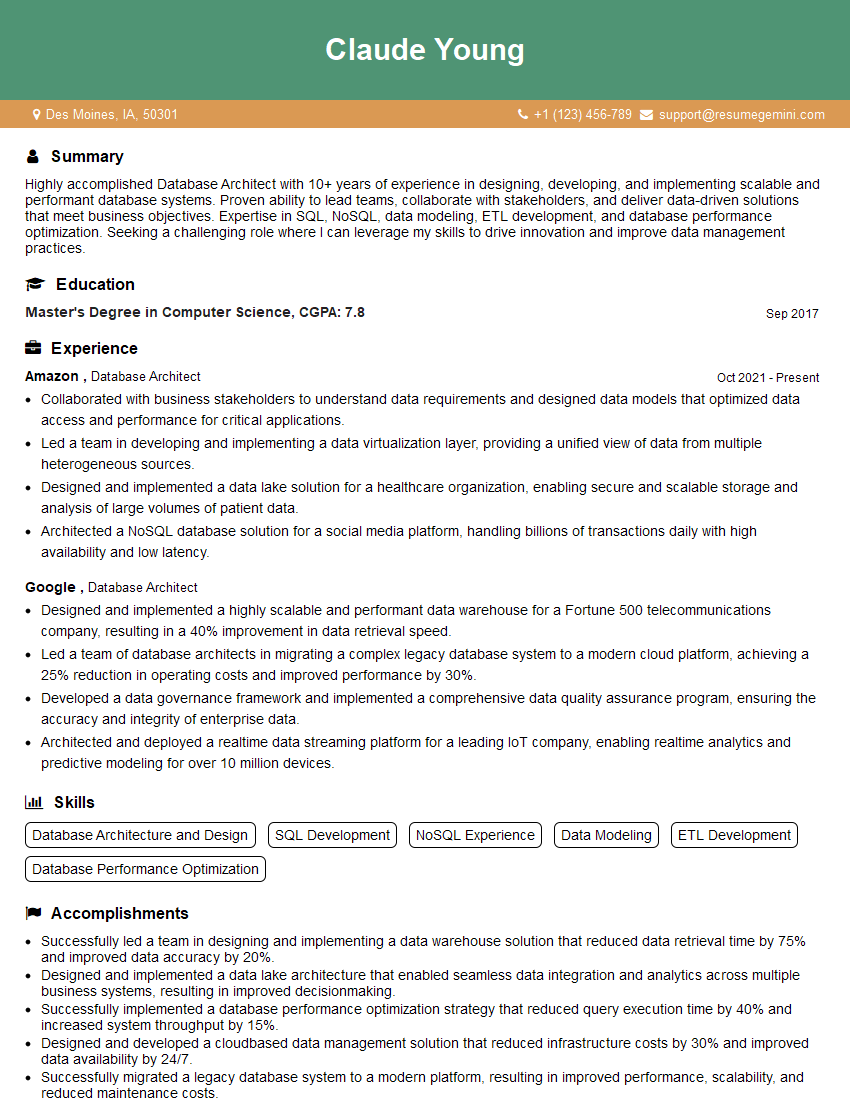
Database Architect Resume Sample

Data Analyst Resume Sample
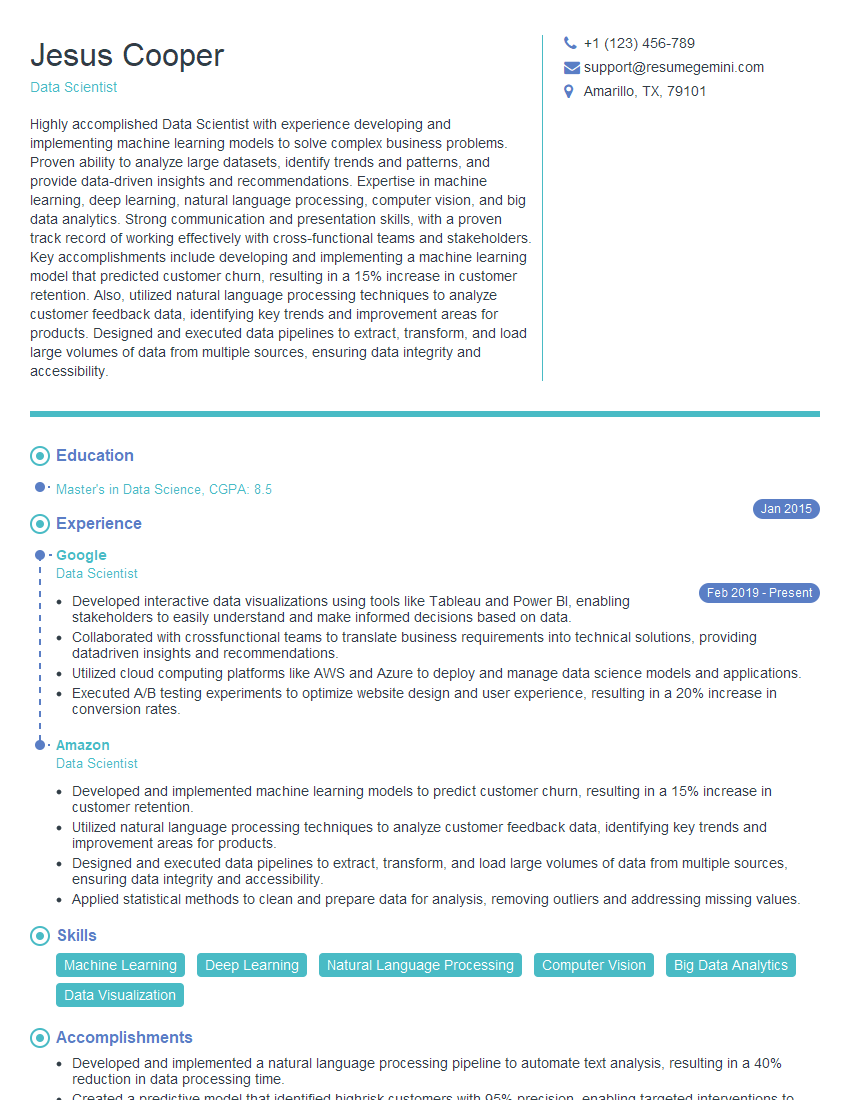
Data Scientist Resume Sample
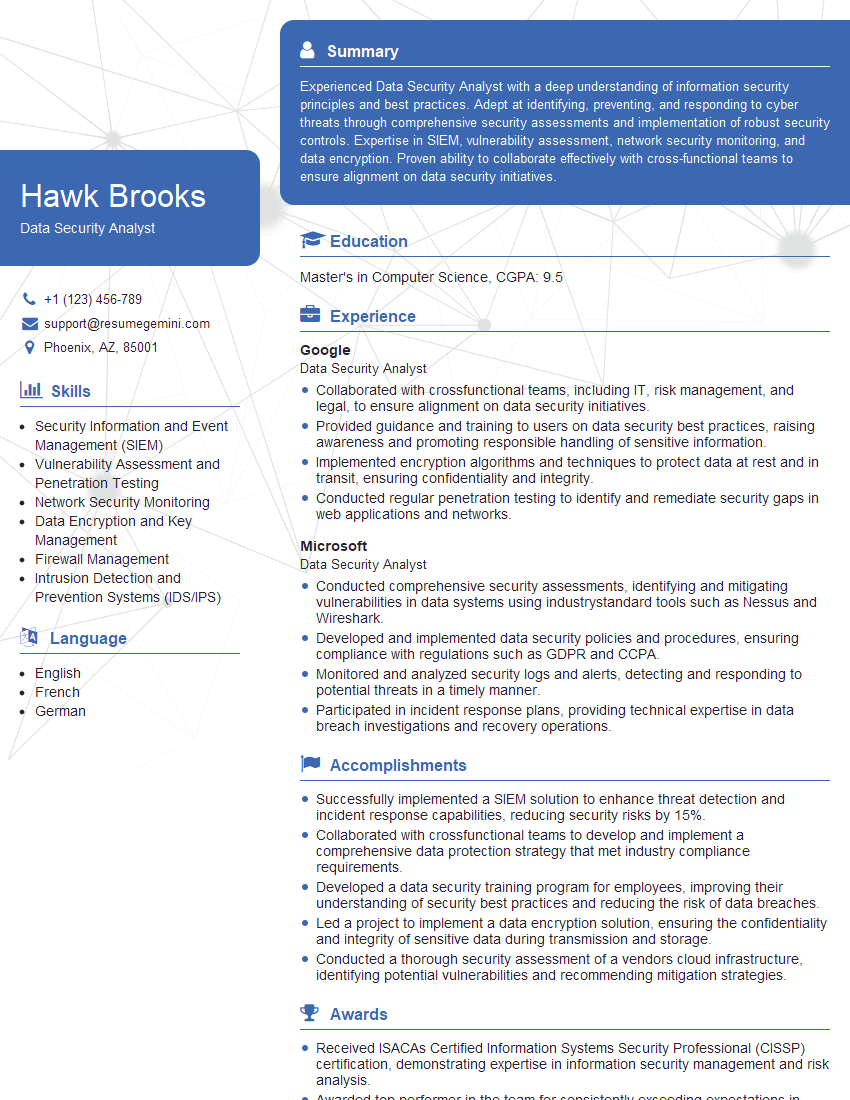
Data Security Analyst Resume Sample
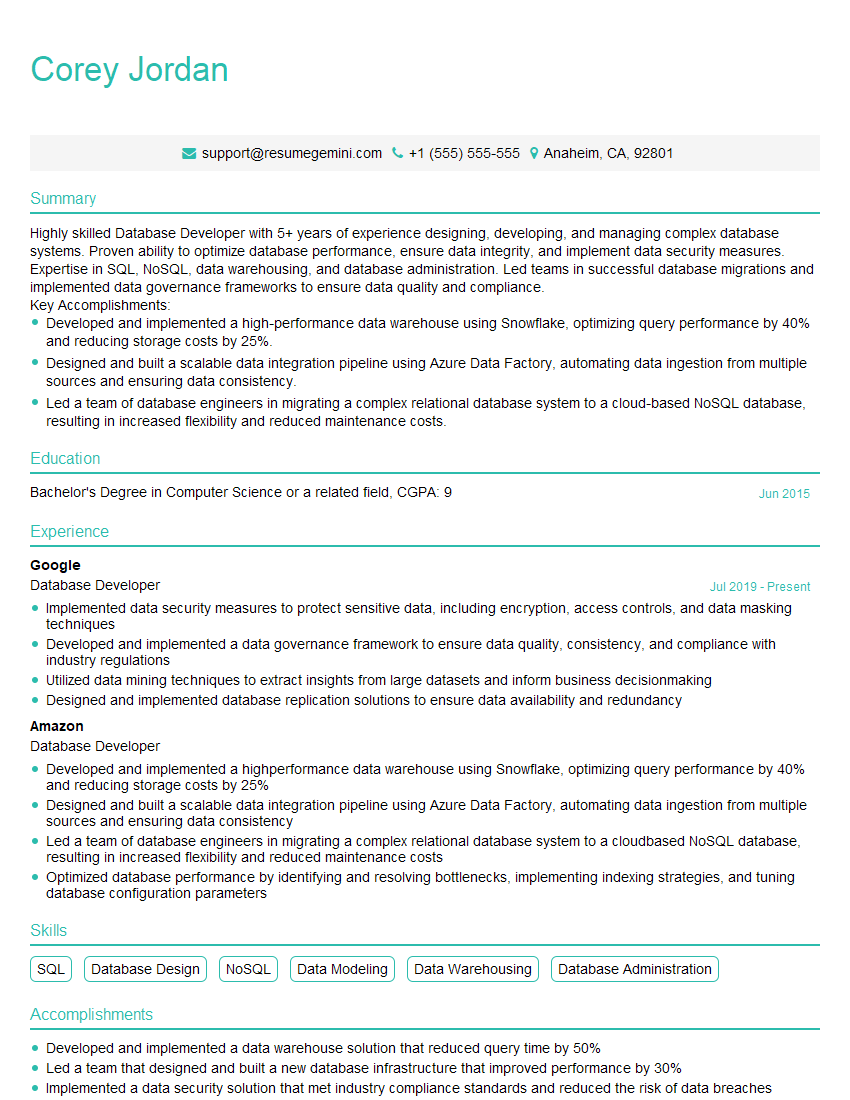
Database Developer Resume Sample
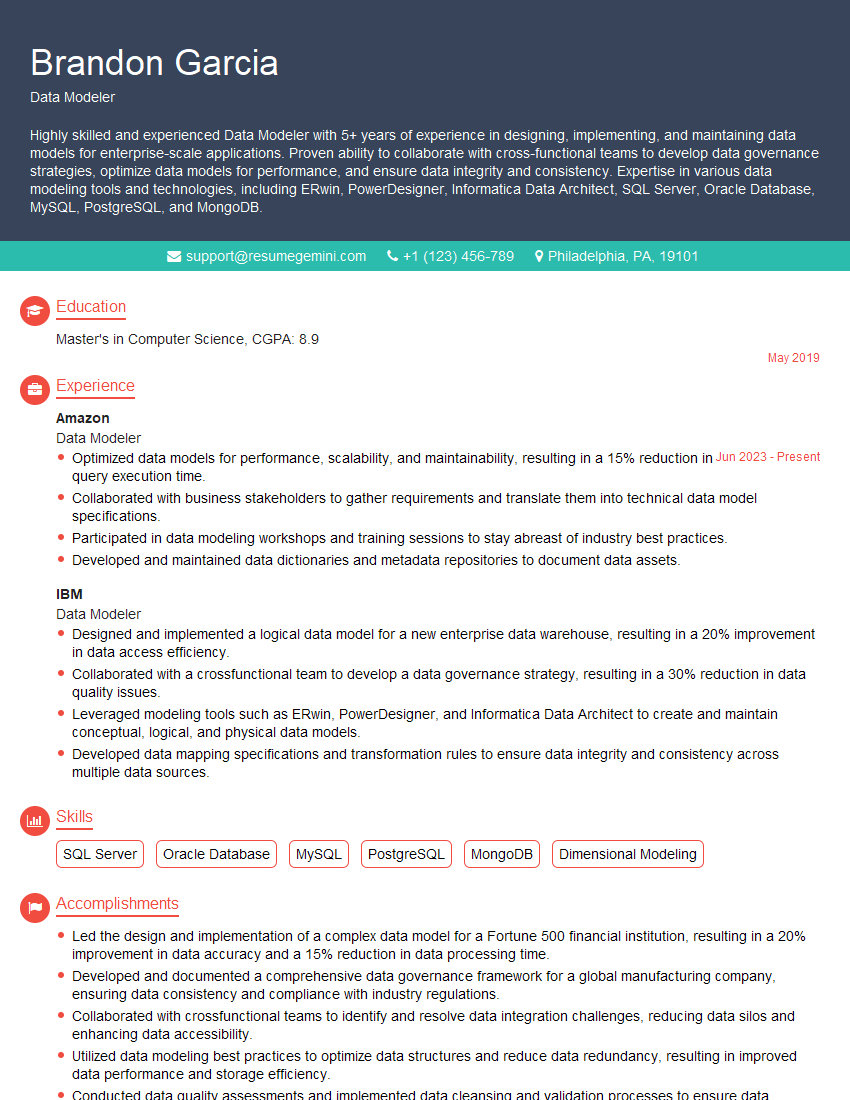
Data Modeler Resume Sample
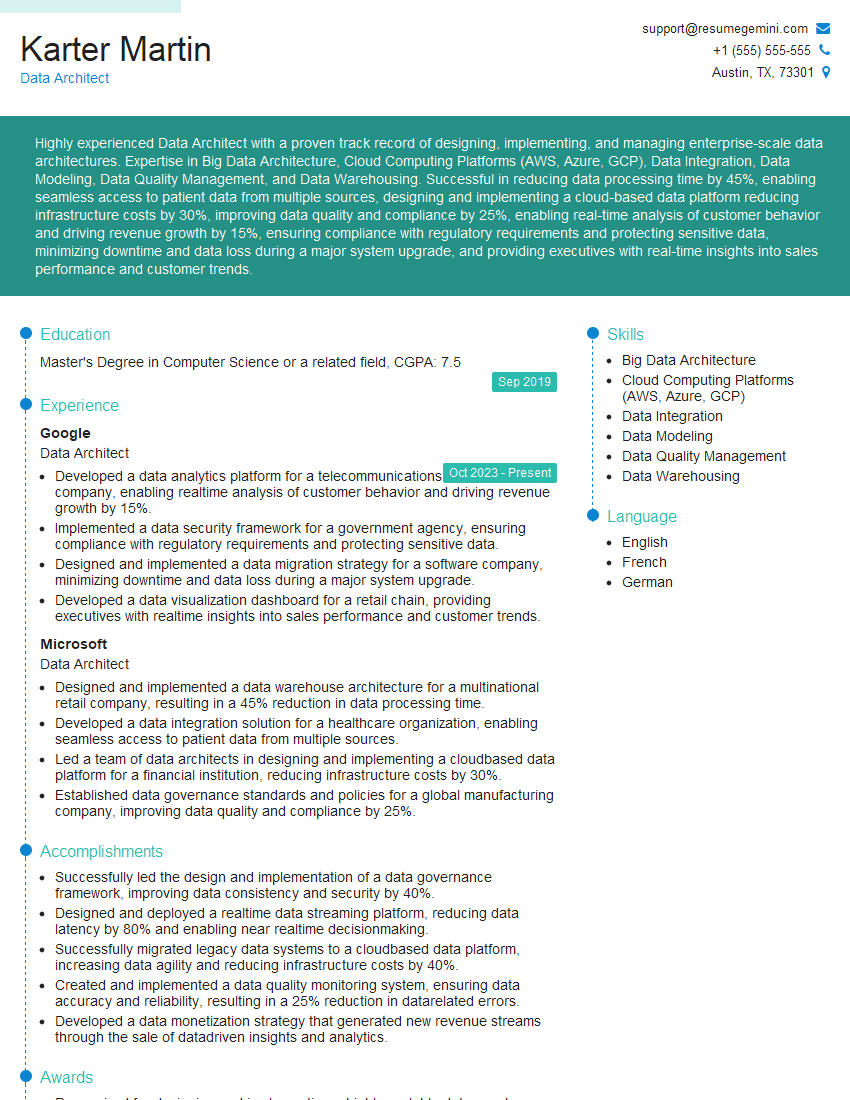
Data Architect Resume Sample
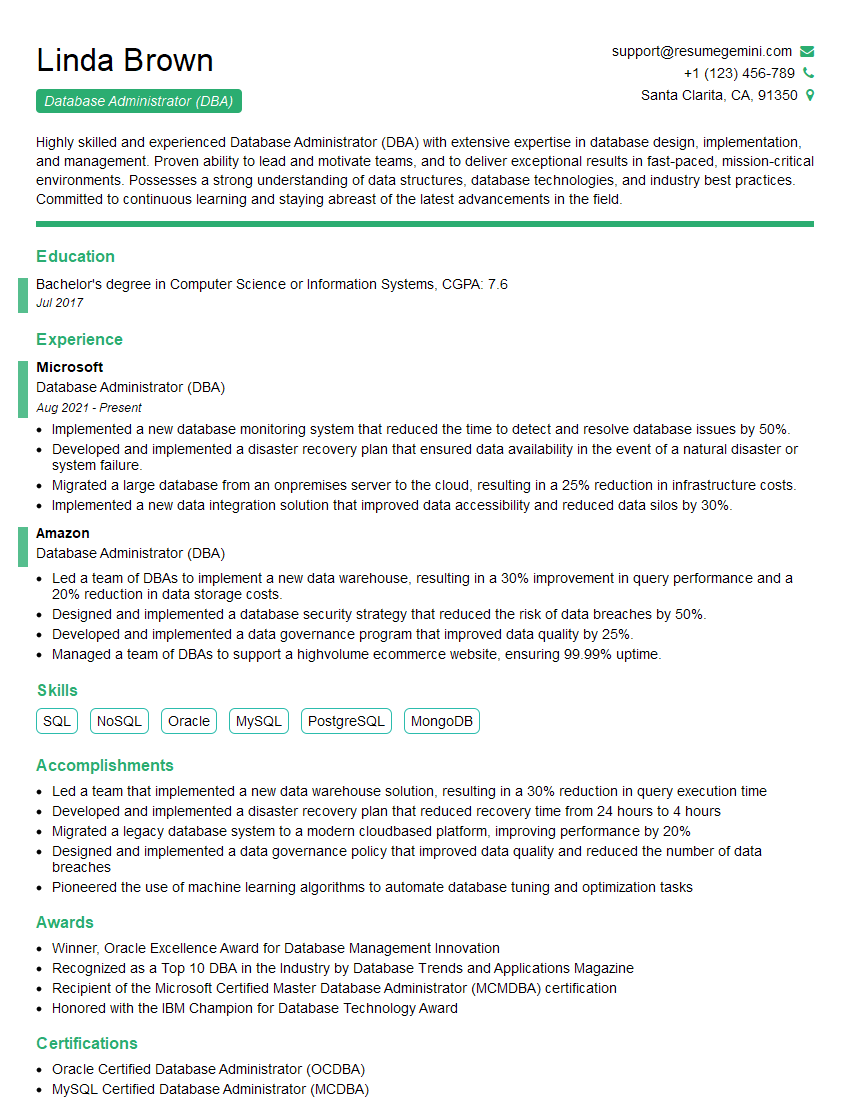
Database Administrator (DBA) Resume Sample
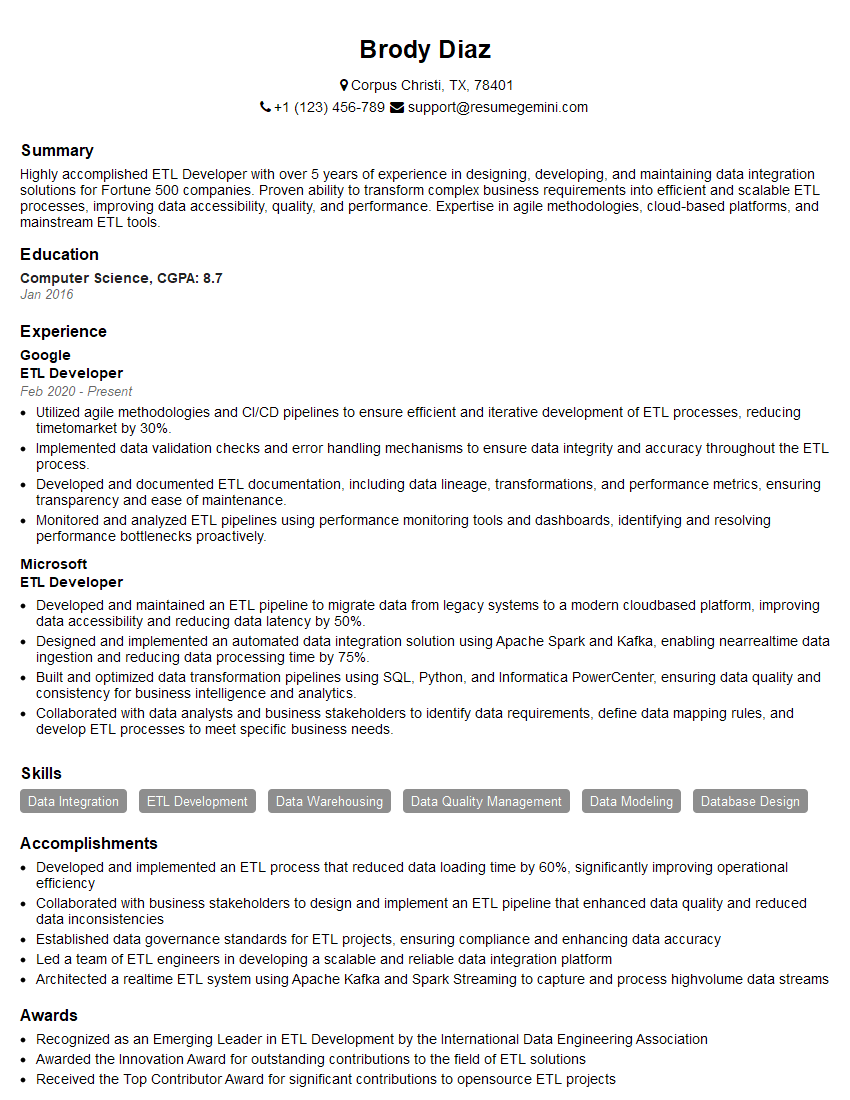
ETL Developer Resume Sample
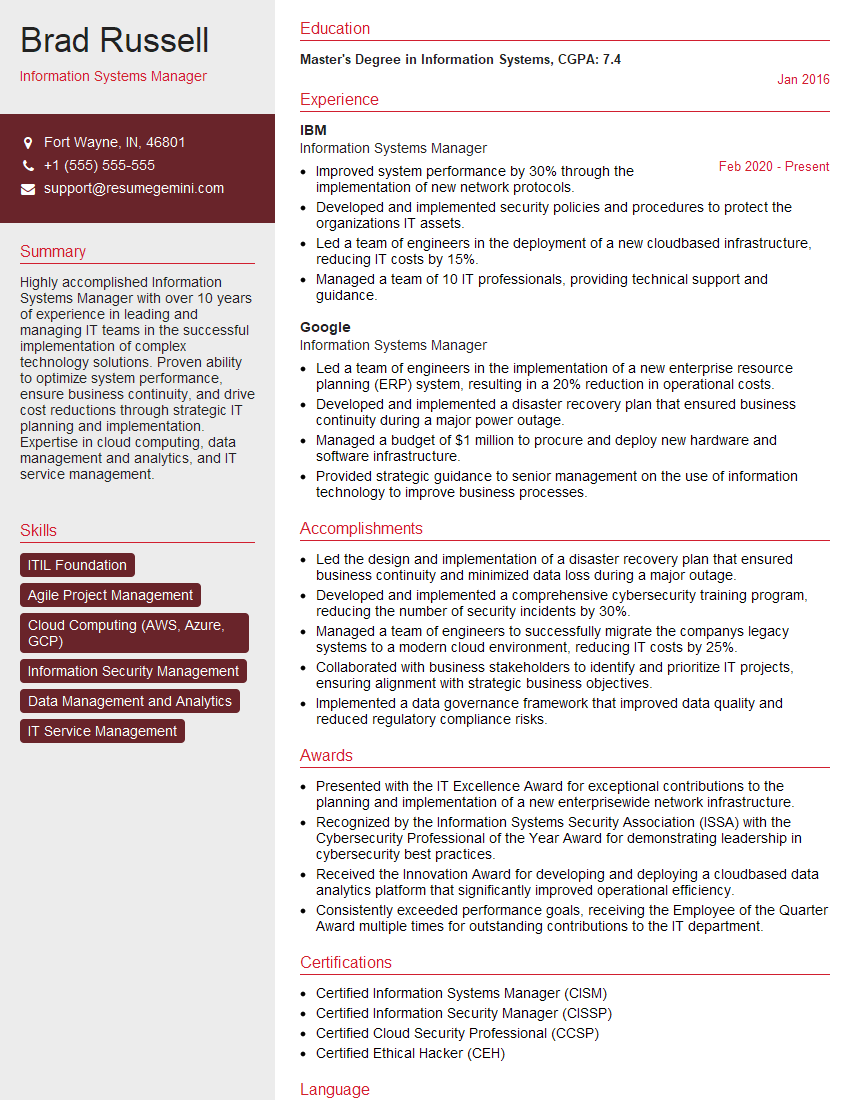
Information Systems Manager Resume Sample
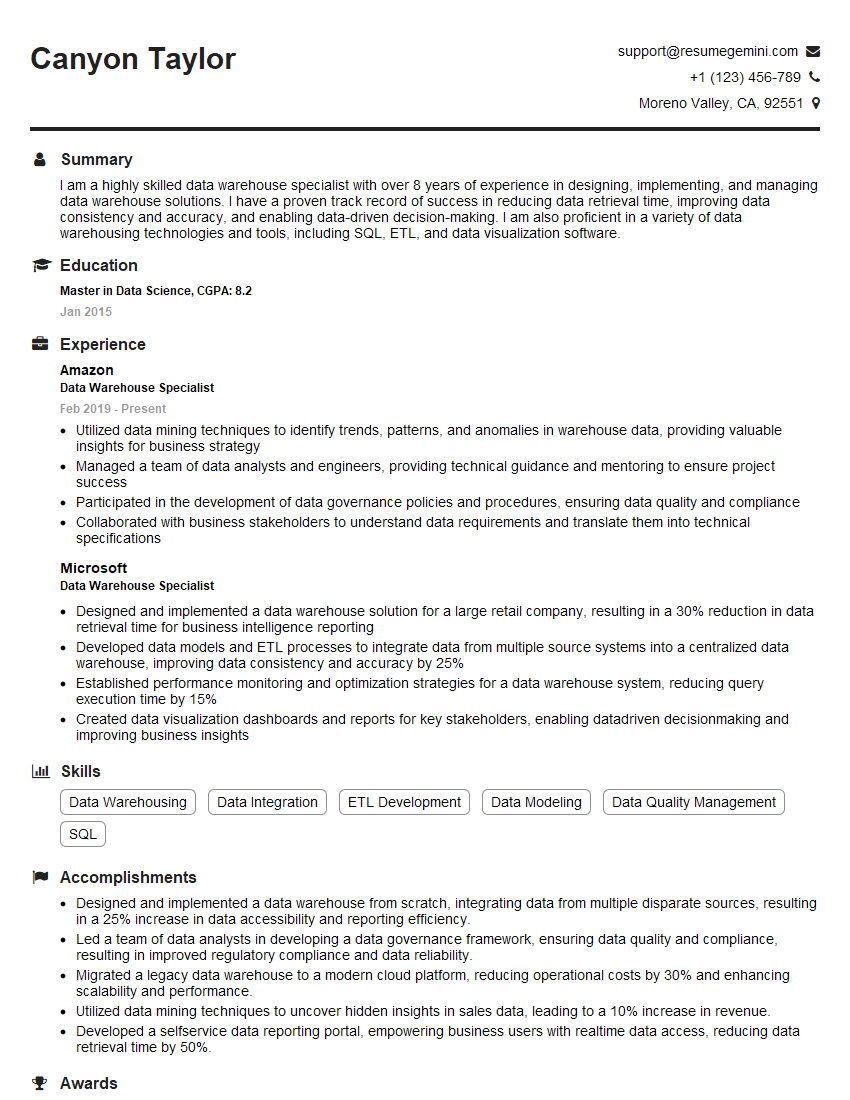
Data Warehouse Specialist Resume Sample
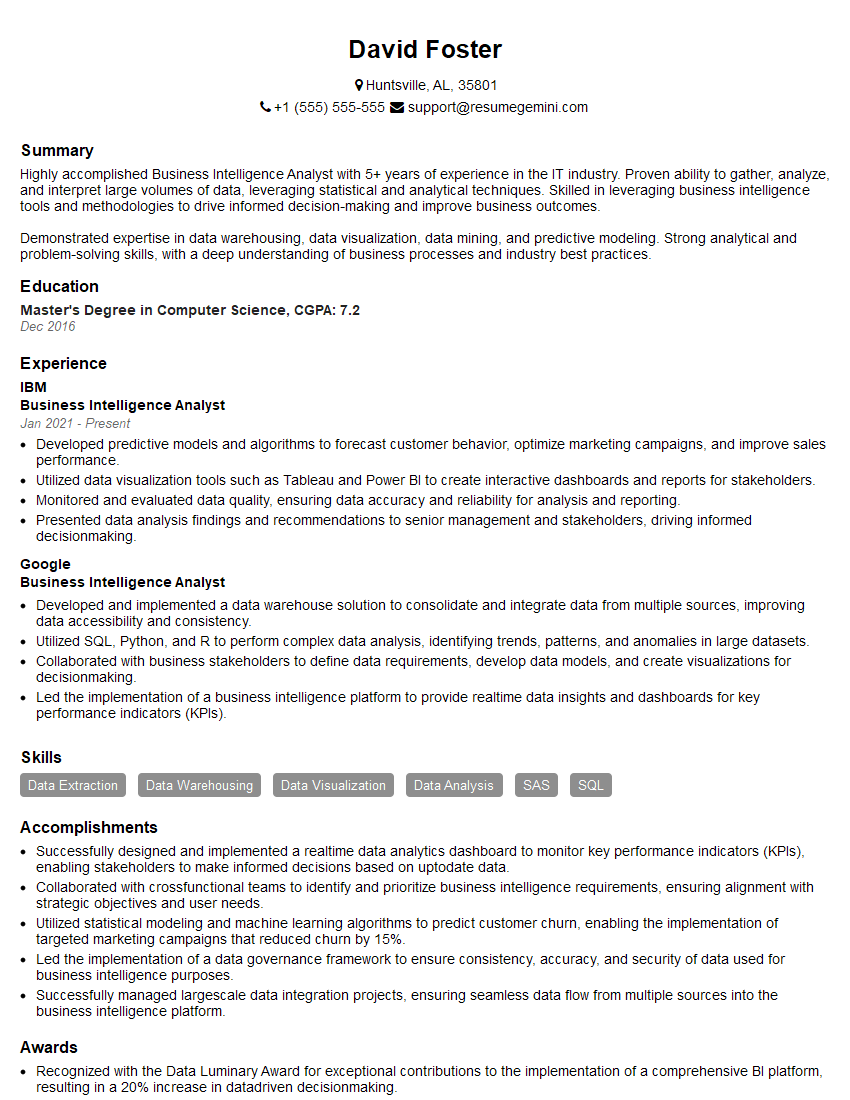
Business Intelligence Analyst Resume Sample
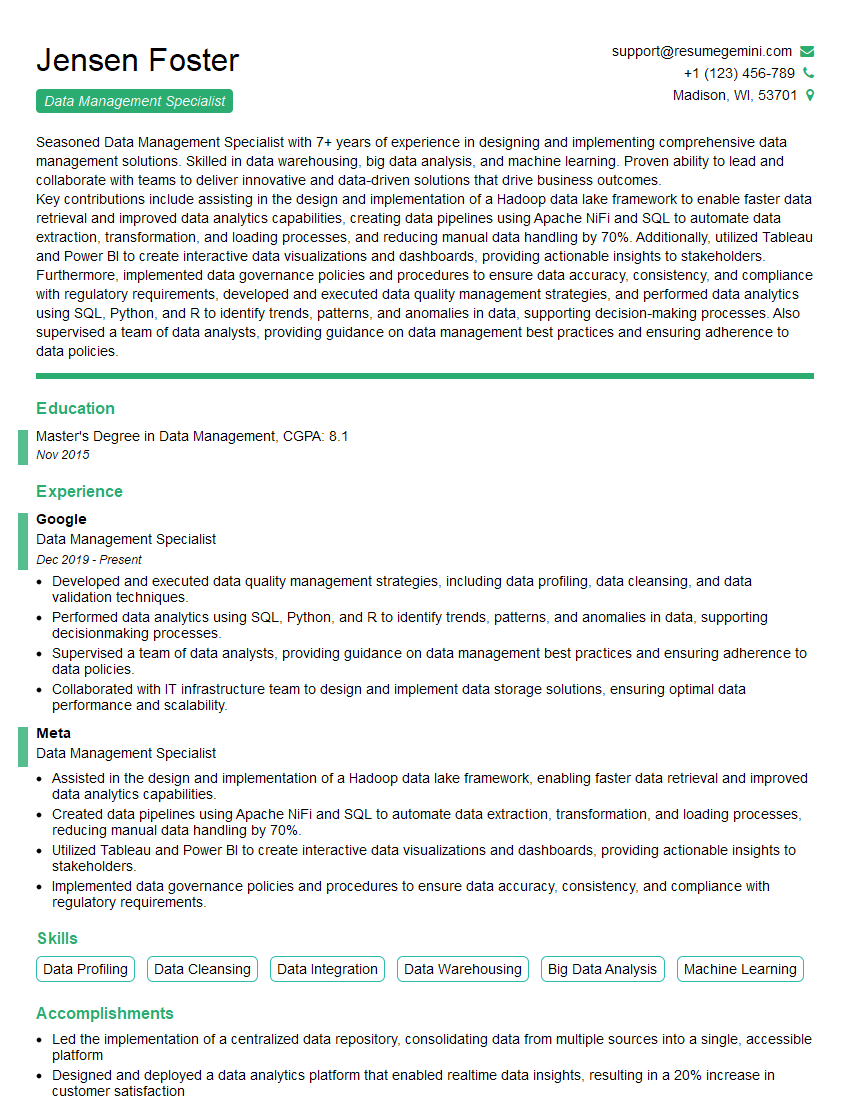
Data Management Specialist Resume Sample
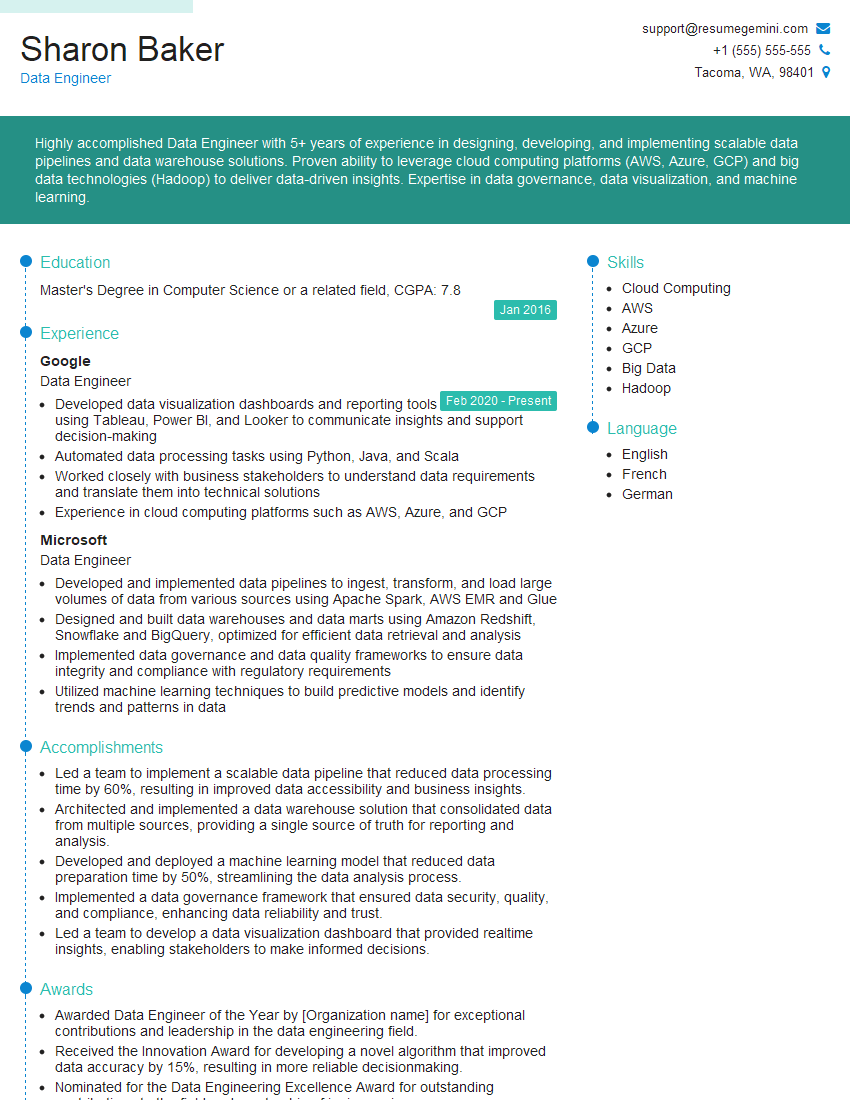
Data Engineer Resume Sample
Explore more articles
Users Rating of Our Blogs
Share Your Experience
We value your feedback! Please rate our content and share your thoughts (optional).
What Readers Say About Our Blog
Very informative content, great job.
good