Preparation is the key to success in any interview. In this post, we’ll explore crucial Control Systems and Dynamics interview questions and equip you with strategies to craft impactful answers. Whether you’re a beginner or a pro, these tips will elevate your preparation.
Questions Asked in Control Systems and Dynamics Interview
Q 1. Explain the difference between open-loop and closed-loop control systems.
The core difference between open-loop and closed-loop control systems lies in their feedback mechanisms. An open-loop system operates without feedback; its output is solely determined by its input. Think of a toaster: you set the time (input), and it toasts for that duration regardless of whether the bread is actually toasted. The system doesn’t ‘check’ if the bread is done.
In contrast, a closed-loop system, also known as a feedback control system, uses feedback to compare the actual output to the desired output (setpoint). The difference, called the error, is then used to adjust the input, striving to minimize the error and achieve the desired output. A thermostat is a perfect example: it measures the room temperature (output), compares it to the set temperature (setpoint), and adjusts the heating/cooling accordingly.
Here’s a simple table summarizing the key differences:
| Feature | Open-Loop | Closed-Loop |
|---|---|---|
| Feedback | No | Yes |
| Accuracy | Lower | Higher |
| Sensitivity to Disturbances | High | Low |
| Example | Toaster, traffic light timer | Thermostat, cruise control |
Q 2. Describe the characteristics of a stable control system.
A stable control system is one that exhibits bounded behavior in response to bounded inputs. In simpler terms, if you give it a reasonable command, it will produce a reasonable response, and that response will settle down to a steady state without oscillating wildly or growing indefinitely. Imagine a self-balancing robot: a stable system will maintain its balance even if slightly disturbed. An unstable system, however, might topple over from a minor nudge.
Key characteristics of a stable system include:
- Bounded Output: The system’s output remains within a certain range, preventing unbounded growth.
- Convergence to Setpoint: Given a setpoint, the system’s output will eventually approach and stay close to that value.
- Damping: Oscillations, if present, decay over time, preventing persistent oscillations.
Instability, conversely, can manifest as sustained oscillations, exponential growth of the output, or unpredictable behavior.
Q 3. What are the different types of controllers (e.g., PID, lead-lag)?
Controllers are the brains of a control system, determining how to adjust the input based on the error signal. Several types exist, each with its strengths and weaknesses:
- Proportional (P) Controller: The control action is proportional to the error.
u(t) = K_p * e(t), whereu(t)is the control signal,K_pis the proportional gain, ande(t)is the error. Simple to implement, but prone to steady-state error (offset). - Integral (I) Controller: Addresses steady-state error by accumulating the error over time.
u(t) = K_i * ∫e(t)dt, whereK_iis the integral gain. Eliminates offset but can cause overshoot and oscillations. - Derivative (D) Controller: Responds to the rate of change of the error, anticipating future error.
u(t) = K_d * de(t)/dt, whereK_dis the derivative gain. Improves stability and reduces overshoot, but sensitive to noise. - PID Controller: Combines P, I, and D actions for optimal performance.
u(t) = K_p * e(t) + K_i * ∫e(t)dt + K_d * de(t)/dt. Widely used due to its versatility. - Lead-Lag Controller: Shapes the system’s frequency response, improving stability and transient response. Often used to compensate for undesirable system dynamics.
The choice of controller depends heavily on the specific application and system characteristics.
Q 4. Explain the concept of gain margin and phase margin.
Gain margin and phase margin are crucial stability metrics derived from the system’s frequency response. They tell us how much further we can push the system’s gain or phase before it becomes unstable. Think of them as safety margins for stability.
Gain Margin (GM): The amount by which the system’s gain can be increased before instability occurs. It’s expressed in decibels (dB). A higher GM indicates greater stability. A GM of 0 dB means the system is on the verge of instability.
Phase Margin (PM): The amount of additional phase lag required to bring the system to the verge of instability. It’s expressed in degrees. A higher PM indicates better stability and less overshoot. A PM of 0 degrees means the system is at the stability limit.
Both GM and PM are determined using Bode plots or Nyquist plots. Generally, a good design aims for a GM of at least 6 dB and a PM of at least 45 degrees, although the specific requirements vary based on application demands.
Q 5. How do you tune a PID controller?
PID controller tuning is the process of finding the optimal values for K_p, K_i, and K_d to achieve desired performance. There’s no single ‘best’ method, and the optimal values depend on the system’s characteristics and the desired response.
Several techniques exist:
- Ziegler-Nichols Method: A simple empirical method based on the system’s ultimate gain and period. It provides initial estimates for
K_p,K_i, andK_d. - Trial and Error: A systematic approach where parameters are adjusted iteratively, observing the system’s response. Requires understanding of how each parameter affects performance.
- Optimization Algorithms: Sophisticated methods (e.g., genetic algorithms) can automatically find optimal tuning parameters. This often requires specialized software.
Regardless of the method used, it’s essential to carefully observe the system’s response, iteratively adjusting the parameters until satisfactory performance is achieved. Consider factors such as rise time, settling time, overshoot, and steady-state error.
Q 6. What is the Nyquist stability criterion?
The Nyquist stability criterion is a graphical method for determining the stability of a closed-loop system based on its open-loop frequency response. It’s especially useful for systems with time delays or complex transfer functions where other methods might be difficult to apply.
The criterion states that the number of unstable closed-loop poles is equal to the number of clockwise encirclements of the -1 point by the Nyquist plot of the open-loop transfer function. The Nyquist plot is a plot of the open-loop transfer function in the complex plane as frequency varies from -∞ to ∞. If the plot doesn’t encircle the -1 point, the closed-loop system is stable.
For example, if the Nyquist plot encircles the -1 point twice clockwise, the closed-loop system will have two unstable poles, indicating instability.
Q 7. Explain the Bode plot and its significance in control system analysis.
A Bode plot is a graphical representation of the frequency response of a system. It consists of two plots: a magnitude plot (in dB) and a phase plot (in degrees), both plotted against frequency (usually on a logarithmic scale).
Significance in Control System Analysis:
- Stability Analysis: Gain margin and phase margin are easily determined from the Bode plot, enabling a quick assessment of the system’s stability.
- Frequency Response Analysis: The Bode plot shows how the system responds to different frequencies, highlighting resonant frequencies and bandwidth.
- Controller Design: Bode plots are used in designing compensators (like lead-lag controllers) to shape the system’s frequency response and improve its performance.
- System Identification: From experimental data, Bode plots can be created to estimate the system’s transfer function.
In essence, the Bode plot provides a comprehensive overview of a system’s dynamic behavior across a range of frequencies, making it a powerful tool for both analysis and design of control systems.
Q 8. What is the root locus method, and how is it used?
The root locus method is a graphical technique used in control systems engineering to analyze the behavior of a closed-loop system as a gain parameter is varied. It visually shows how the poles of the closed-loop transfer function move in the complex plane as the gain changes. This is crucial because the location of the poles dictates the system’s stability and response characteristics (overshoot, settling time, etc.).
Imagine you’re adjusting the volume on a stereo. Increasing the gain is like turning up the volume. The root locus shows you how the system’s response (the sound) changes as you increase (or decrease) this gain. It helps determine the range of gain values that will lead to a stable and desirable system response.
How it’s used: The method involves plotting the root loci, which are paths traced by the closed-loop poles as the gain varies from zero to infinity. These paths are determined based on the open-loop transfer function. Software tools readily automate the process, but understanding the underlying principles is key. You analyze the locations of the poles on the locus to assess the system’s performance and stability. If poles move into the right-half of the s-plane (for continuous-time systems, or outside the unit circle for discrete-time systems), the system becomes unstable.
Example: Consider a simple feedback system with an open-loop transfer function G(s)H(s) = K/(s(s+2)). The root locus plot would show how the closed-loop poles change as the gain K is varied. By examining the locus, you can determine the range of K that results in a stable system and a desired response time.
Q 9. What are state-space representations, and what are their advantages?
State-space representation is a powerful mathematical model used to describe dynamic systems. Unlike transfer function representations, it uses a set of first-order differential equations (for continuous-time) or difference equations (for discrete-time) to model the system. The system’s behavior is represented by state variables, which capture the system’s internal state at any given time.
Imagine a car. Its state might be defined by its position, velocity, and engine speed. These are our state variables. State-space representation describes how these variables change over time based on the system’s inputs (e.g., acceleration, braking) and internal dynamics. It’s represented by the equations:
ẋ = Ax + Buy = Cx + Duwhere:
xis the state vectoruis the input vectoryis the output vectorA,B,C, andDare matrices that define the system’s dynamics.
Advantages:
- Handles multiple inputs and outputs easily: Unlike transfer functions, which can become complex with multiple inputs and outputs, state-space representations handle these naturally through matrices.
- Deals with non-linear systems: While the basic form above is linear, the framework easily extends to model non-linear systems through linearization or other techniques.
- Suitable for computer simulations and control design: State-space models are readily implemented in software for simulations and control design algorithms (like LQR, Kalman filter).
Q 10. Explain the concept of controllability and observability.
Controllability and observability are fundamental concepts that determine if a system’s state can be controlled or observed, respectively. They are crucial for designing effective control systems.
Controllability: A system is controllable if it’s possible to steer the system from any initial state to any desired final state within a finite time interval by applying appropriate control inputs. Think of driving a car – you control its state (position, velocity) using the steering wheel, accelerator, and brakes. If these controls cannot influence the car’s state, then the system is uncontrollable (e.g., a car with a broken steering mechanism).
Observability: A system is observable if its internal state can be fully determined from observations of its output. Consider a black box with internal variables. If you can infer the internal states of the box by just observing its output, then the system is observable. If not, the internal state remains hidden, even with perfect knowledge of the inputs and outputs.
Mathematical Tests: Controllability and observability can be assessed mathematically using the controllability and observability matrices derived from the state-space representation. These matrices are tested for rank; full rank signifies controllability/observability.
Q 11. How do you design a controller using pole placement?
Pole placement, also known as eigenvalue assignment, is a controller design technique where you place the closed-loop poles of the system at desired locations in the complex plane. The location of these poles directly influences the system’s transient response characteristics (speed of response, overshoot, damping).
Design Process:
- Obtain a state-space representation of the plant (system to be controlled): This gives you the matrices
A,B,C, andD. - Choose desired pole locations: These locations are chosen based on the desired transient response. Generally, poles further to the left in the s-plane represent faster responses, but might increase control effort.
- Design a state-feedback controller: This typically involves finding a gain matrix
Ksuch that the closed-loop system matrix (A - BK) has eigenvalues at the desired locations. There are various techniques for computingK, including Ackermann’s formula and other numerical methods. These methods often involve solving a set of linear equations. - Verify the design: Simulate the closed-loop system to check if it meets the specifications.
Example: You might want a faster response for a robotic arm’s movement, so you would place the closed-loop poles further to the left in the complex plane during the design process. However, placing them too far left might lead to excessive control effort and instability. Careful selection is needed.
Q 12. Describe the LQR (Linear Quadratic Regulator) controller.
The Linear Quadratic Regulator (LQR) is an optimal control technique used to design a state-feedback controller that minimizes a quadratic cost function. This cost function balances the desired performance (reaching a setpoint quickly) with the control effort needed to achieve it.
Concept: Imagine you want to reach a specific point quickly, but you don’t want to slam on the brakes or accelerate too aggressively. The LQR controller finds the optimal balance between these objectives. The cost function is defined as:
J = ∫(xTQx + uTRu)dtwhere:
xis the state vectoruis the input vectorQis a positive semi-definite weighting matrix that penalizes deviations from the desired state.Ris a positive definite weighting matrix that penalizes large control inputs.
The LQR controller calculates the optimal gain matrix K that minimizes the cost function J. This results in a state-feedback controller of the form: u = -Kx. The matrices Q and R are design parameters. Adjusting these allows you to tune the balance between minimizing the state error and minimizing the control effort.
Q 13. Explain the Kalman filter and its applications.
The Kalman filter is an optimal estimation algorithm used to estimate the state of a dynamic system from noisy measurements. It’s widely used in various applications where precise state estimation is crucial despite the presence of uncertainty and noise.
Concept: Imagine tracking a moving object using a sensor that provides noisy measurements of its position. The Kalman filter takes these noisy measurements and combines them with a model of the object’s motion to produce a more accurate estimate of its position and velocity. It leverages both the system dynamics (how the object moves) and the sensor measurements to minimize estimation errors.
Applications:
- Navigation systems (GPS): Filtering out noise from GPS signals to provide accurate location estimates.
- Robotics: Estimating the robot’s position and orientation based on sensor readings (e.g., encoders, IMUs).
- Aircraft control: Estimating aircraft states (position, velocity, attitude) from various sensors.
- Financial modeling: Predicting future values of financial assets.
The Kalman filter is a recursive algorithm that updates its estimate based on each new measurement. It uses a prediction step (based on the system model) and an update step (based on the new measurement) to continually refine its estimation. It’s a powerful tool for optimally combining information from noisy sensors and system models.
Q 14. What is the difference between continuous-time and discrete-time systems?
Continuous-time and discrete-time systems represent different ways of modeling dynamic systems. The key difference lies in how time is handled.
Continuous-time systems: These systems are modeled using differential equations. They describe the system’s behavior at every instant in time. Time is a continuous variable, meaning it can take on any value within a given range. Think of a smoothly changing voltage or the temperature of a room gradually changing.
Discrete-time systems: These systems are modeled using difference equations. They describe the system’s behavior at specific, discrete points in time. Time is a discrete variable, meaning it can only take on specific values (often equally spaced intervals). Examples include digitally controlled systems (like a microcontroller controlling a motor) or sampled data systems (like readings from a sensor taken every second).
Relationship: Continuous-time systems can be converted to discrete-time systems through discretization techniques (like Euler’s method or the Z-transform). This is commonly done for digital implementation of controllers designed for continuous-time systems.
Example: A continuous-time system might be described by dx/dt = -2x + u, while its discrete-time equivalent might be x[k+1] = 0.8x[k] + 0.1u[k] (assuming a specific sampling time). The continuous model shows how x changes at every instant, while the discrete model only shows x at discrete time steps.
Q 15. How do you handle nonlinearities in control systems?
Nonlinearities in control systems, sadly, are the rule rather than the exception. Real-world systems rarely behave in a perfectly linear fashion. These nonlinearities can significantly complicate control design, potentially leading to poor performance or instability. Fortunately, several techniques exist to tackle them.
Linearization: For systems that are only mildly nonlinear around an operating point, we can linearize the system. This involves finding a linear approximation of the nonlinear system using techniques like Taylor series expansion. This linearized model is then used to design a linear controller. The caveat here is that the controller’s performance will degrade if the system operates far from the linearization point. Think of it like approximating a curve with a straight line – it works well locally, but less so globally.
Gain Scheduling: This approach involves creating multiple linear controllers, each valid for a different operating region of the system. As the system’s operating point changes, the controller is switched accordingly. This is like having multiple maps, each covering a different terrain, and choosing the right one depending on your location. The smoothness of the transitions between controllers is critical for stability.
Feedback Linearization: A more sophisticated method where a nonlinear transformation is applied to the system to create an equivalent linear system. A linear controller is then designed for the transformed system. However, this method requires a specific mathematical structure of the nonlinear system.
Sliding Mode Control (SMC): This robust control technique handles uncertainties and nonlinearities by forcing the system’s state trajectories to follow a specific sliding surface in the state space. SMC can tolerate large uncertainties but might suffer from chattering – high-frequency oscillations – which can be mitigated using techniques like boundary layer control.
Fuzzy Logic Control: This method uses fuzzy sets and rules to model the system’s behavior. It’s particularly useful when a precise mathematical model is unavailable or difficult to obtain. It’s like using common sense and heuristic rules to control the system, making it adaptable to complex nonlinearities.
The choice of method depends heavily on the specific nature of the nonlinearity, the system’s complexity, and the desired performance specifications. For example, linearization is sufficient for a mildly nonlinear system operating within a narrow range, while SMC might be preferable for systems with significant uncertainties and nonlinearities.
Career Expert Tips:
- Ace those interviews! Prepare effectively by reviewing the Top 50 Most Common Interview Questions on ResumeGemini.
- Navigate your job search with confidence! Explore a wide range of Career Tips on ResumeGemini. Learn about common challenges and recommendations to overcome them.
- Craft the perfect resume! Master the Art of Resume Writing with ResumeGemini’s guide. Showcase your unique qualifications and achievements effectively.
- Don’t miss out on holiday savings! Build your dream resume with ResumeGemini’s ATS optimized templates.
Q 16. What are some common methods for system identification?
System identification is the crucial process of building a mathematical model of a dynamic system from experimental data. This model is then used for control system design, simulation, and analysis. Several methods are available, each with strengths and weaknesses:
Step Response Method: This classic method involves applying a step input to the system and measuring its output. The parameters of a simplified model (e.g., first-order or second-order) are then estimated from the step response characteristics (rise time, settling time, overshoot).
Frequency Response Method: This involves applying sinusoidal inputs of varying frequencies to the system and measuring the magnitude and phase of the output. This data is used to construct a Bode plot, which provides information about the system’s frequency response characteristics, allowing for model estimation.
Impulse Response Method: This involves applying an impulse input (a very short, large amplitude signal) to the system and measuring the output. The impulse response directly reveals the system’s dynamics, which can be used for model building.
Correlation Methods: These advanced methods use correlation techniques to identify the system’s impulse response or transfer function from input-output data. They are particularly useful when dealing with noisy data or when the system’s input is not easily controlled.
Parameter Estimation Techniques: These methods, such as least squares estimation or maximum likelihood estimation, utilize collected input-output data to find the best-fit parameters for a chosen model structure. Software packages often provide tools for these estimations.
The choice of method often depends on the system’s characteristics, the available data, and the desired level of model complexity. For instance, a simple system might be adequately modeled using the step response method, whereas complex systems might necessitate more sophisticated parameter estimation techniques.
Q 17. Explain the concept of robustness in control systems.
Robustness in control systems refers to the ability of a controller to maintain acceptable performance despite uncertainties and disturbances. In essence, a robust controller is one that can handle the unexpected. Imagine building a bridge – you wouldn’t just design it for perfect conditions; you need to account for wind, earthquakes, and material imperfections. The same principle applies to control systems.
Factors contributing to the need for robustness include:
- Model uncertainties: The mathematical model used for control design is often a simplification of the real system. There will be discrepancies.
- Parameter variations: System parameters (e.g., mass, friction) might change over time or with operating conditions.
- External disturbances: Unexpected forces or inputs can affect the system’s behavior.
Strategies for achieving robustness include:
H-infinity control: Minimizes the effect of disturbances and uncertainties on the system’s output.
μ-synthesis: A robust control design method that accounts for structured uncertainties.
LQG/LTR (Linear Quadratic Gaussian/Loop Transfer Recovery): This combines optimal control techniques with loop shaping to achieve robustness.
Adaptive control: The controller parameters are automatically adjusted to compensate for changes in the system’s dynamics.
A lack of robustness can lead to poor performance, instability, or even system failure. A well-designed robust control system ensures reliable performance even under adverse conditions.
Q 18. Describe different sampling methods used in discrete-time control systems.
Discrete-time control systems deal with sampled data, meaning the system’s inputs and outputs are measured and updated at discrete time instants. The sampling method significantly impacts the system’s performance and stability. Common methods include:
Uniform Sampling (Periodic Sampling): This is the most common method, where samples are taken at fixed intervals. This simplicity makes analysis and controller design easier. The sampling period, T, is crucial – too large a T can lead to instability or poor performance, while too small a T increases computational burden.
Non-uniform Sampling (Aperiodic Sampling): Samples are taken at irregular intervals. This is often used when resources are limited or when the sampling rate needs to be adjusted based on system conditions. Analysis is significantly more complex.
Multi-rate Sampling: Different parts of the system are sampled at different rates. This can improve efficiency in systems with components with varying dynamic behavior.
Event-driven Sampling: Samples are taken only when a specific event occurs. This is reactive and suitable when resources are scarce or when changes are localized and rare.
The choice of sampling method depends on the system’s characteristics and the control objectives. While uniform sampling is often preferred for its simplicity, non-uniform or multi-rate sampling may be necessary to optimize performance or resource usage in more complex scenarios. The sampling theorem (Nyquist-Shannon) provides guidelines on selecting an appropriate sampling frequency to avoid aliasing, which can lead to inaccurate system representation.
Q 19. What is anti-windup and why is it important?
Anti-windup is a crucial mechanism used in control systems to prevent undesirable behavior caused by integrator windup. Integrators, common in control loops, continuously accumulate the control error. When the actuator saturates (reaches its physical limits), the integrator continues to accumulate the error even though the actuator isn’t responding. This leads to a large accumulated error (the ‘windup’), and when the saturation is released, the system might overshoot or exhibit oscillatory behavior.
Anti-windup strategies address this by modifying the integrator’s behavior during actuator saturation. Common methods include:
Back-calculation anti-windup: The integrator’s state is adjusted based on the difference between the desired actuator output and the actual saturated output.
Conditional integration: The integrator is only updated when the actuator is not saturated.
Trapped integrator: The integrator is ‘trapped’ within a certain range, preventing excessive accumulation during saturation.
Anti-windup is critical because it improves the transient response, reduces overshoot, and prevents undesirable oscillations during actuator saturation events, ensuring smoother and more predictable system behavior.
Consider a simple temperature control system. If the heater is at maximum power (saturated) and the temperature is still below the setpoint, the integrator will continue to wind up, leading to a large overshoot when the heater finally cools down. Anti-windup would prevent this overshoot by limiting the integrator’s accumulation.
Q 20. How do you handle disturbances in a control system?
Disturbances are unwanted inputs to a system that can degrade its performance. Handling them effectively is paramount for robust control design. Techniques used to mitigate the impact of disturbances include:
Feedback Control: This is the cornerstone of disturbance rejection. By measuring the system’s output, the controller can generate a corrective input to counteract the effect of disturbances. The effectiveness depends on the controller design and the system’s dynamics. Think of a cruise control system compensating for inclines – the feedback from the car’s speed is used to adjust the engine throttle.
Feedforward Control: This involves estimating the effect of the disturbance and compensating for it in advance. It’s effective when the disturbance can be measured or predicted. For example, in a robotic arm, predicting the force of gravity on the arm and compensating for it through the controller.
Disturbance Observers: These are special estimators designed to estimate the disturbance signal based on system measurements. This estimate is then used to compensate for the disturbance’s effect.
Robust Control Design: Methods like H-infinity and μ-synthesis explicitly consider disturbances during controller design, thereby enhancing the system’s robustness against them.
Kalman Filtering: This powerful technique is utilized in systems with noisy measurements to estimate the system’s state and disturbances, enhancing control precision.
The optimal strategy depends on the nature of the disturbance, its measurability, and the desired level of performance. Often, a combination of these techniques yields the best results. For example, a feedback controller with a disturbance observer can provide robust disturbance rejection even with noisy measurements.
Q 21. Explain the concept of feedback linearization.
Feedback linearization is an advanced nonlinear control technique that transforms a nonlinear system into an equivalent linear system through a change of coordinates and feedback. This allows for the application of standard linear control design methods. The method is not always applicable, requiring specific structural properties of the nonlinear system.
The process involves two main steps:
Input-state linearization: Find a transformation of the system’s state variables and a feedback control law that linearizes the input-output relationship.
Linear controller design: Design a linear controller for the linearized system using well-established methods like pole placement or LQR.
Feedback linearization has advantages in handling certain classes of nonlinear systems, allowing the use of mature linear design tools. However, it requires careful analysis and computation and is not universally applicable. For systems where it’s applicable, it offers a powerful way to achieve high-performance control by leveraging the benefits of both linear and nonlinear control theory.
Imagine controlling a robotic arm. The dynamics are highly nonlinear due to factors like gravity and inertia. Feedback linearization could transform these complex dynamics into a simpler linear system, making control design easier while retaining good performance.
Q 22. What are some common control system design methodologies?
Control system design methodologies are systematic approaches to creating controllers that achieve desired system behavior. The choice of methodology depends heavily on the system’s complexity, performance requirements, and constraints. Some common methods include:
Classical Control Design: This approach utilizes frequency-domain techniques like Bode plots and Nyquist plots to analyze and design controllers. It’s effective for simpler systems and focuses on achieving desired transient and steady-state responses. For example, designing a PID controller for a temperature control system often utilizes this method.
Modern Control Design (State-Space): This method uses state-space representation to model the system and employs techniques like pole placement, optimal control (LQR), and robust control (H-infinity) to design controllers. It’s powerful for complex, multi-input, multi-output (MIMO) systems and allows for more sophisticated control objectives. A good example is designing a controller for a robotic arm to track a complex trajectory.
Robust Control: This focuses on designing controllers that maintain performance despite uncertainties and disturbances in the system. Methods like H-infinity synthesis are used to minimize the effect of uncertainties on system behavior, crucial for real-world applications where models are often imperfect.
Adaptive Control: This approach dynamically adjusts controller parameters based on real-time system performance. It’s useful when system parameters change significantly over time, such as in a chemical process where temperature or pressure fluctuates.
Predictive Control (MPC): This method predicts future system behavior and optimizes control actions to achieve desired objectives over a future time horizon. It’s effective for systems with constraints and delays, like controlling the flow of materials in a manufacturing plant.
Q 23. Describe your experience with MATLAB/Simulink for control system design.
MATLAB/Simulink is an integral part of my control systems design workflow. I have extensive experience using it for modeling, simulation, and controller design. I routinely use Simulink to build block diagrams representing complex systems, including feedback loops, sensors, actuators, and controllers. The ability to simulate various scenarios and analyze system responses is invaluable. For example, I’ve used Simulink to model the dynamics of a quadrotor drone, designing a controller to stabilize it and track desired trajectories. I then use MATLAB’s control system toolbox to design controllers (PID, LQR, etc.), analyze their performance using tools like Bode plots and root locus diagrams, and refine the design based on simulation results. I’m also proficient in using the Simulink Real-Time (RT) environment for hardware-in-the-loop (HIL) simulations, bridging the gap between simulation and real-world testing.
%Example MATLAB code snippet for designing a PID controller s = tf('s'); G = 1/(s*(s+1)); % Plant transfer function Kp = 1; Ki = 0.1; Kd = 0.01; C = Kp + Ki/s + Kd*s; % PID controller sys_cl = feedback(C*G,1); %Closed loop system step(sys_cl); %Step response analysisQ 24. What is your experience with real-time control systems?
My experience with real-time control systems encompasses several projects involving embedded systems and hardware interfaces. I’ve worked on projects requiring precise timing and responsiveness, such as: designing a control system for a robotic arm using a microcontroller to interface with motor drivers and sensors, ensuring precise joint movement; developing a real-time data acquisition system to monitor and control industrial processes, handling high-frequency data streams and implementing feedback control algorithms; and building a real-time control system for a temperature-sensitive experiment, involving careful selection of hardware to ensure accurate temperature regulation.
I am familiar with various real-time operating systems (RTOS) like FreeRTOS and VxWorks and have experience with programming in languages like C and C++ for embedded systems. Debugging and optimizing real-time code for performance and stability are crucial skills I’ve honed through these experiences. The challenges involved often involve dealing with limited computational resources, strict timing constraints, and the need for robust error handling.
Q 25. Describe a challenging control systems problem you solved.
One particularly challenging project involved designing a control system for a highly nonlinear and unstable system – a magnetic levitation system. The goal was to levitate a metal ball using an electromagnet, requiring precise control of the electromagnetic force to counter gravity and maintain stability. The system’s inherent nonlinearity and sensitivity to disturbances made it difficult to control. My approach involved:
Nonlinear Modeling: Accurately modeling the system’s nonlinear dynamics using physics-based equations.
Linearization: Linearizing the model around an operating point to design a linear controller (a PID controller was initially attempted).
Feedback Linearization: Implementing feedback linearization techniques to compensate for the system’s nonlinearity.
Advanced Control Techniques: Investigating advanced control strategies like sliding mode control or model predictive control for improved robustness and stability. Ultimately, a combination of feedback linearization and a robust state-space controller provided the best results.
Iterative Design and Tuning: Extensive simulation and experimental testing were crucial in tuning the controller parameters for optimal performance and stability. The process involved many iterations of adjustment, refinement, and troubleshooting.
The success of this project highlighted the importance of a strong theoretical understanding combined with practical experience in system identification, nonlinear control design, and experimental validation.
Q 26. How would you approach designing a controller for a specific application (e.g., robot arm, temperature control)?
Designing a controller, whether for a robot arm or a temperature control system, follows a structured approach:
System Modeling: Create a mathematical model of the system to capture its dynamics. This could involve using transfer functions, state-space representations, or other appropriate techniques. For a robot arm, this might involve considering inertia, friction, and actuator dynamics; for temperature control, it would involve heat transfer equations and thermal properties.
Controller Selection: Choose a suitable controller type based on the system’s characteristics and performance requirements. PID controllers are often used for simpler systems, while more advanced techniques like LQR, MPC, or sliding mode control might be necessary for complex, nonlinear, or constrained systems.
Controller Design: Design the controller using appropriate design techniques. This often involves tuning controller parameters to achieve desired performance characteristics (e.g., settling time, overshoot, steady-state error). For example, root locus analysis or frequency response methods could be employed for classical controller design.
Simulation and Analysis: Simulate the closed-loop system using software like MATLAB/Simulink to analyze its performance and identify potential issues. This allows for iterative design and refinement of the controller.
Implementation and Testing: Implement the controller on the actual system and conduct thorough testing to verify its performance and stability under various operating conditions. This often involves hardware-in-the-loop (HIL) simulation.
For a robot arm, the controller might need to precisely track a trajectory in space, requiring consideration of kinematic and dynamic constraints. For temperature control, the controller might focus on maintaining a specific temperature setpoint with minimal overshoot and settling time, considering factors like heat transfer rates and environmental disturbances.
Q 27. Explain your understanding of different types of sensors and actuators used in control systems.
Sensors and actuators are the vital interfaces between a control system and the physical world. Sensors measure system variables, providing feedback to the controller, while actuators apply control actions to modify the system’s behavior. Examples include:
Sensors:
Temperature Sensors: Thermocouples, RTDs, thermistors
Position Sensors: Potentiometers, encoders, resolvers, accelerometers, gyroscopes
Velocity Sensors: Tachometers
Pressure Sensors: Piezoresistive, capacitive
Flow Sensors: Venturi meters, ultrasonic flow meters
Force/Torque Sensors: Strain gauges
Actuators:
Electric Motors: DC motors, stepper motors, servo motors
Hydraulic Actuators: Hydraulic cylinders, hydraulic motors
Pneumatic Actuators: Pneumatic cylinders
Valves: Solenoid valves, proportional valves
Heaters/Coolers: Used in temperature control systems
The selection of sensors and actuators is critical. Factors to consider include accuracy, precision, range, bandwidth, cost, robustness, and compatibility with the controller and the rest of the system. For instance, a high-precision servo motor might be required for a robotic arm application, while a simpler DC motor could suffice for a less demanding task. Similarly, the choice of temperature sensor depends on the required accuracy and the temperature range.
Key Topics to Learn for Control Systems and Dynamics Interview
- System Modeling: Understanding how to represent dynamic systems using transfer functions, state-space representations, and block diagrams. Consider practical applications in areas like robotics or process control.
- Stability Analysis: Mastering techniques like the Routh-Hurwitz criterion, Bode plots, and Nyquist plots to determine system stability and robustness. Explore how these relate to real-world system performance and safety.
- Controller Design: Familiarize yourself with various control strategies such as PID control, lead-lag compensation, and state-feedback control. Think about how different controller types address specific system challenges.
- Frequency Response Analysis: Understanding the relationship between system input and output in the frequency domain. Practice interpreting Bode and Nyquist plots to understand system behavior under different frequencies.
- Time Response Analysis: Analyzing system transient and steady-state responses to various inputs (step, ramp, impulse). Relate these responses to key performance indicators like rise time, settling time, and overshoot.
- Digital Control Systems: Understanding the differences and challenges in implementing control algorithms in a digital environment, including sampling, quantization, and zero-order hold effects. Explore applications in embedded systems.
- State-Space Methods: Proficiency in state-space modeling, controllability and observability analysis, and designing state-feedback controllers. Consider its applications in more complex systems.
- Nonlinear Control Systems: A basic understanding of nonlinear system behavior and control strategies for nonlinear systems. This can demonstrate advanced knowledge.
Next Steps
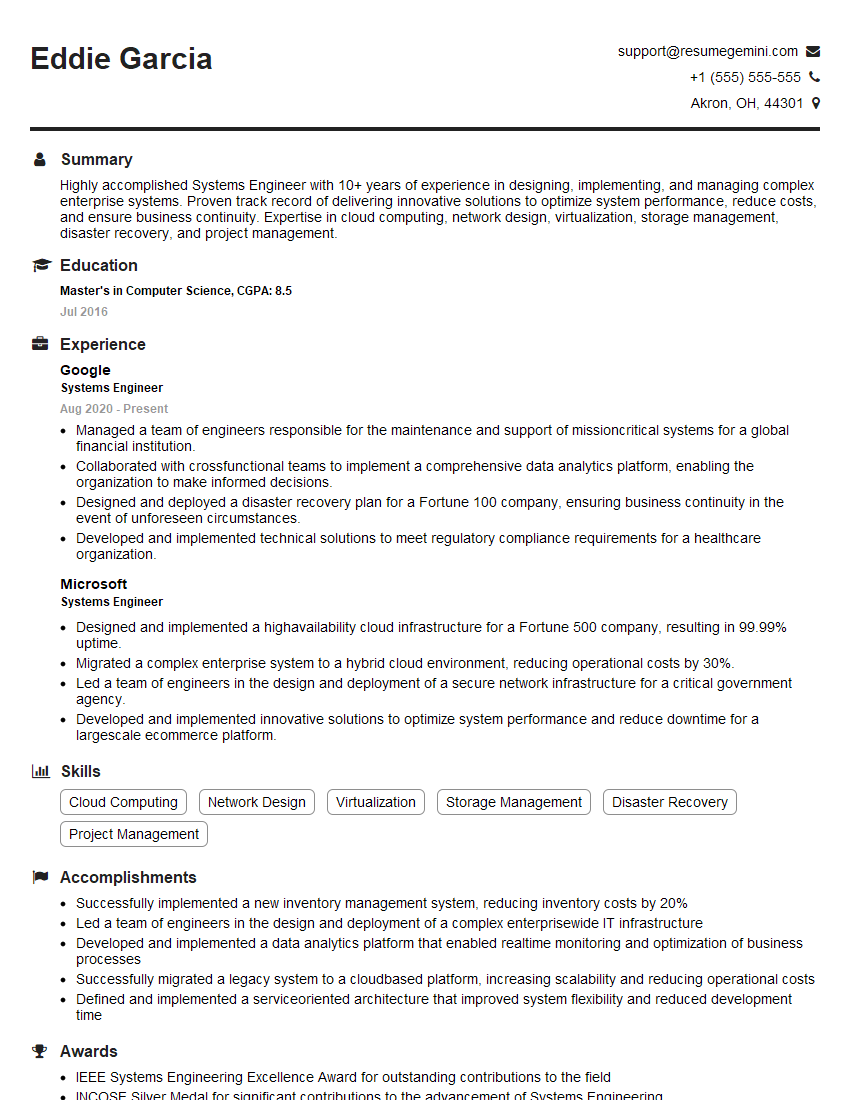
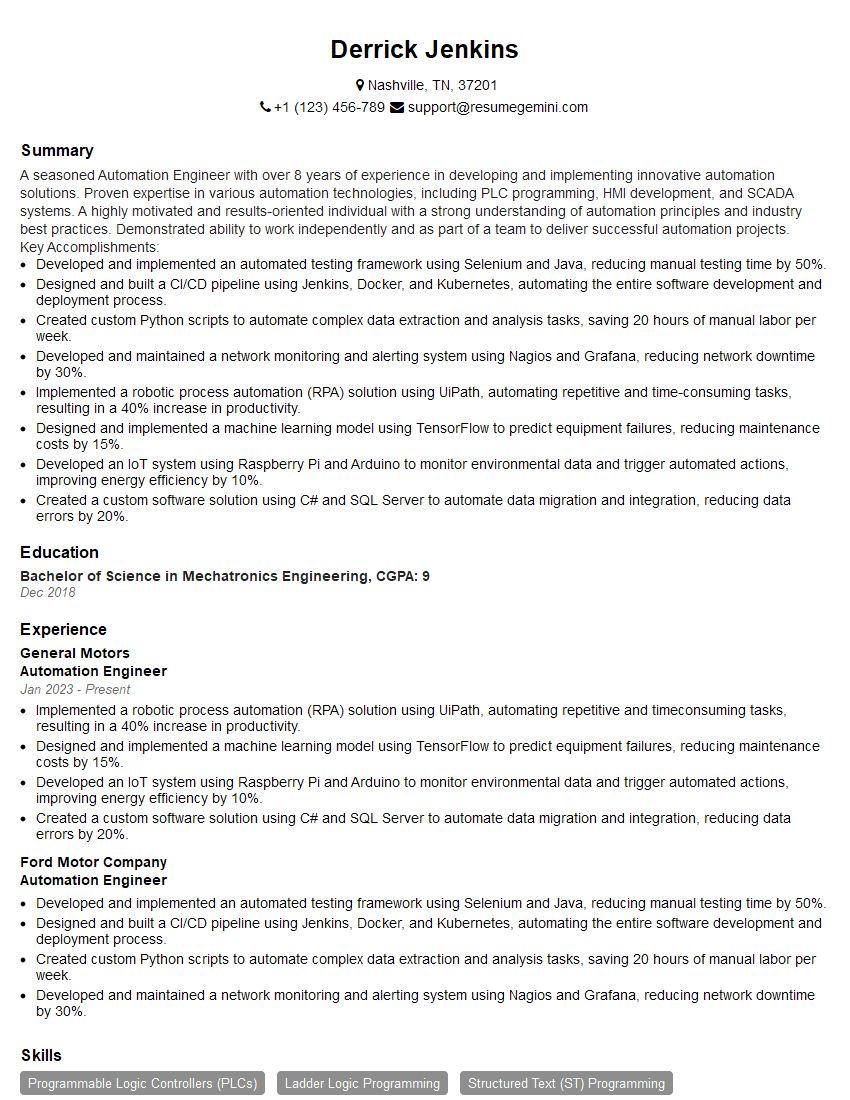
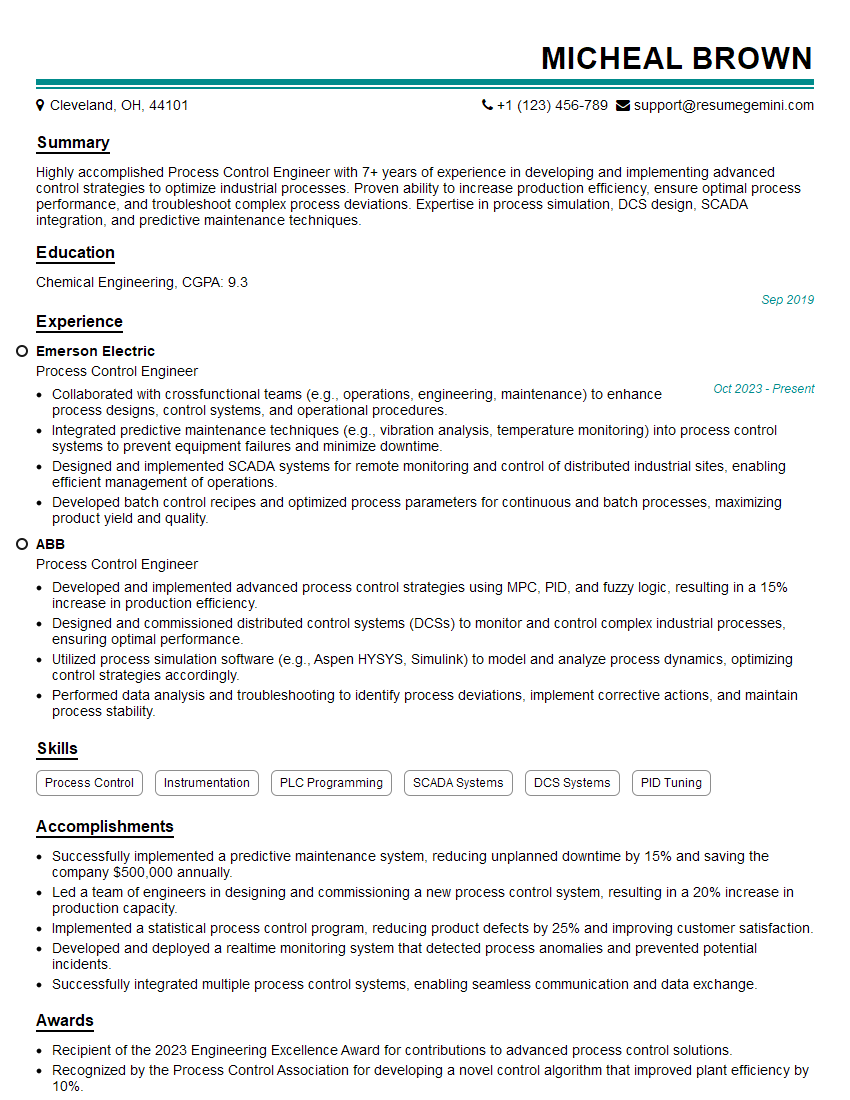
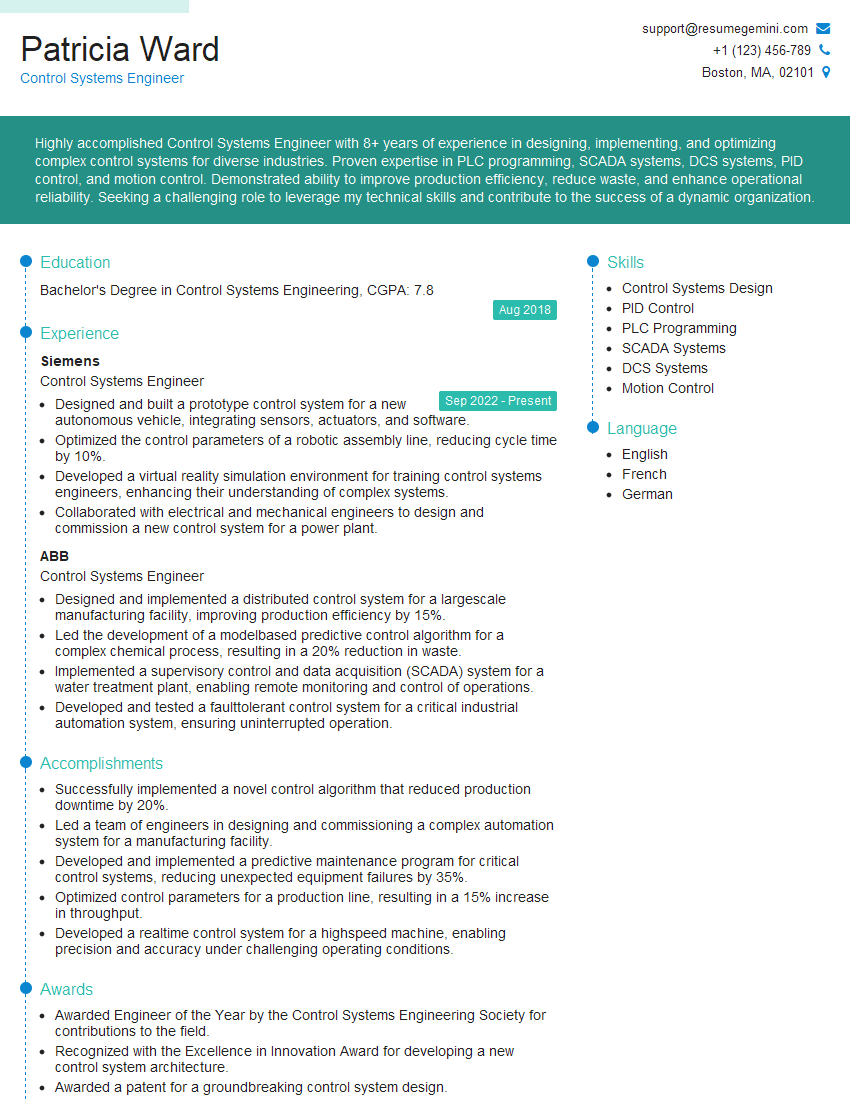
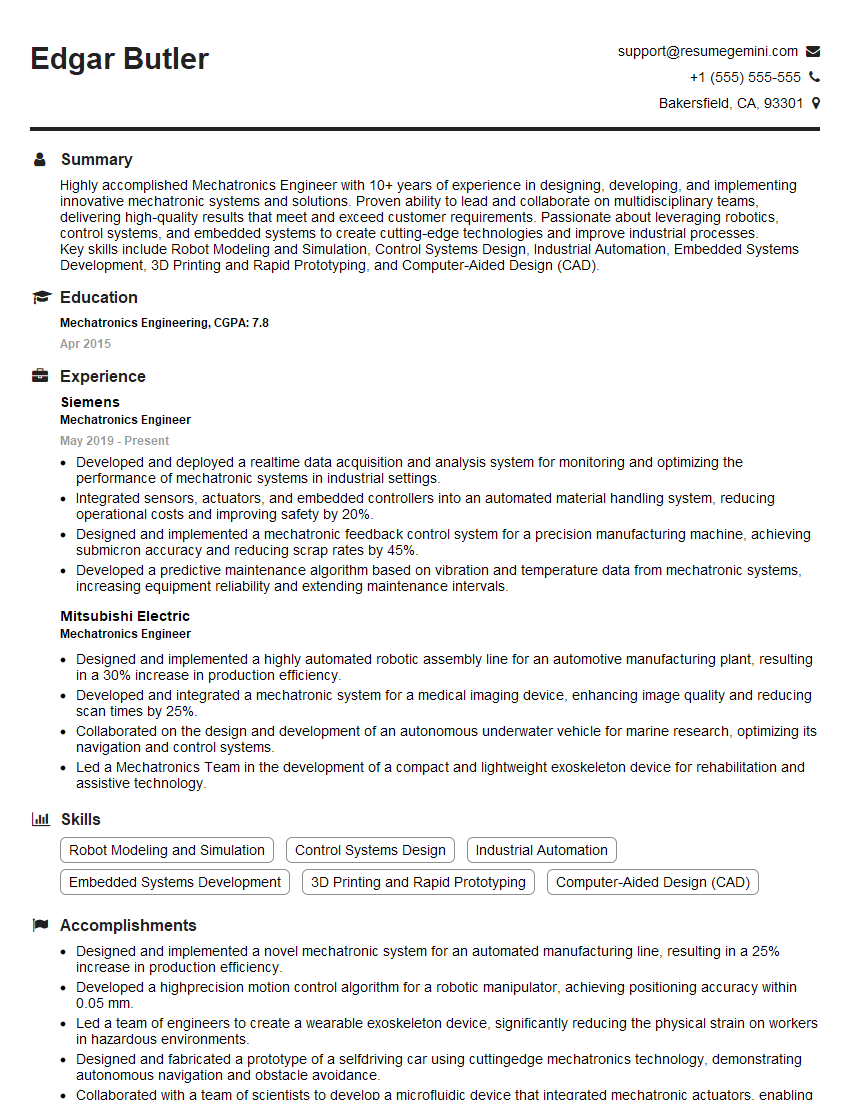
Mastering Control Systems and Dynamics is crucial for a successful career in various engineering fields, opening doors to exciting opportunities in automation, robotics, aerospace, and more. A strong foundation in these concepts showcases your analytical abilities and problem-solving skills, highly valued by employers. To maximize your job prospects, create an ATS-friendly resume that effectively highlights your skills and experience. ResumeGemini is a trusted resource that can help you build a professional and impactful resume. Examples of resumes tailored to Control Systems and Dynamics are available to guide you through the process.

Explore more articles
Users Rating of Our Blogs
Share Your Experience
We value your feedback! Please rate our content and share your thoughts (optional).
What Readers Say About Our Blog
Very informative content, great job.
good