The thought of an interview can be nerve-wracking, but the right preparation can make all the difference. Explore this comprehensive guide to Splicer Operation interview questions and gain the confidence you need to showcase your abilities and secure the role.
Questions Asked in Splicer Operation Interview
Q 1. Explain the different types of fiber optic connectors.
Fiber optic connectors are crucial for terminating fiber optic cables, enabling easy connection and disconnection. Different connectors cater to various needs in terms of size, performance, and application. Here are some common types:
- SC (Subscriber Connector): A common and reliable connector, known for its push-pull design and ease of use. Often found in enterprise networks and telecommunications.
- FC (Ferrule Connector): This connector uses a threaded coupling mechanism, providing excellent repeatability and stability, making it suitable for applications requiring high precision and durability. Common in test and measurement equipment.
- ST (Straight Tip Connector): While older technology, you’ll still find ST connectors. They feature a bayonet-style locking mechanism. Its simple design and low cost contributed to its past popularity.
- LC (Lucent Connector): A smaller and more compact connector than SC, popular in high-density applications like data centers. Its small size allows for more connectors in limited space.
- MT-RJ (Mechanical Transfer – Reduced Jacket): This connector holds two fibers in a single connector, doubling the fiber count in a single port, thus saving space.
The choice of connector depends on factors like the environment (e.g., harsh conditions may favor the robust FC), the density requirements (high-density applications prefer LC), and the existing infrastructure.
Q 2. Describe the process of fusion splicing fiber optic cables.
Fusion splicing is a precise technique used to permanently join two fiber optic cables. It involves melting the ends of the fibers together using an electric arc, creating a strong, low-loss connection. Here’s the process:
- Fiber Preparation: The fiber ends are carefully cleaved (broken) using a specialized cleaver to create a perfectly perpendicular surface. This is crucial for minimizing light loss.
- Fiber Alignment: The cleaved fibers are aligned within the fusion splicer’s clamps, ensuring precise alignment of the cores. High-precision splicers use cameras to achieve optimal alignment.
- Fusion: An electric arc is applied to the aligned fiber ends, melting and fusing them together. The splicer precisely controls the arc’s duration and power.
- Splice Verification: After fusion, the splicer measures the optical loss of the splice. This is an important quality control step to ensure the connection’s quality.
- Splice Protection: The fused splice is protected by a heat-shrink tube or a protective sleeve to prevent physical damage and environmental degradation.
Fusion splicing results in incredibly strong, durable, and low-loss connections, making it the preferred method for permanent installations.
Q 3. What are the common causes of fiber optic cable damage?
Fiber optic cables, while robust, can be damaged in various ways. Here are some common causes:
- Physical Bending or Crushing: Excessive bending, especially beyond the minimum bend radius, can damage or break the fiber. Similarly, crushing the cable can crush the fiber core.
- Rodents: Rodents can chew through the protective outer layers and even the fiber itself, causing significant damage and service disruption.
- Improper Installation: Poor installation techniques, such as sharp bends or insufficient cable support, can weaken the cable over time.
- Environmental Factors: Exposure to extreme temperatures, moisture, chemicals, and UV radiation can degrade the fiber’s performance and integrity.
- Construction Activities: Excavation or ground movement can damage buried cables.
Preventing damage requires careful planning during installation, choosing appropriate cable types for the environment, and regular cable inspections.
Q 4. How do you identify and troubleshoot fiber optic cable faults?
Identifying and troubleshooting fiber optic faults involves a systematic approach:
- Visual Inspection: A thorough visual inspection of the cable and connectors is the first step. Look for any signs of physical damage, broken fibers, or loose connectors.
- Optical Power Meter (OPM): An OPM measures the optical power at different points along the fiber path. Comparing the input and output power helps identify locations with significant loss.
- Optical Time-Domain Reflectometer (OTDR): An OTDR is a powerful tool for locating faults along a fiber optic cable. It sends pulses of light down the fiber and measures the reflections, revealing the location and severity of faults like breaks or splices with high loss.
- Light Source and Visual Fault Locator (VFL): A light source sends light through the fiber, while a VFL helps trace the fiber’s path and identify breaks or bends by illuminating the area where light is lost.
Troubleshooting often involves a combination of these techniques to pinpoint the exact location and cause of the fault.
Q 5. What safety precautions are necessary when working with fiber optic cables?
Safety is paramount when working with fiber optic cables. Here are crucial safety precautions:
- Eye Protection: Always wear appropriate eye protection. Even low power lasers can cause eye damage. Use laser safety eyewear with the correct optical density rating.
- Protective Clothing: Wear gloves to protect your hands and prevent cuts from sharp fibers or connector components.
- Proper Tools: Use the correct tools for the job, such as fiber cleavers, fusion splicers, and connector installation tools. Improper tools can easily damage the fibers.
- Grounding: Proper grounding procedures should be followed to prevent static electricity from damaging the fiber.
- Laser Safety Training: Training on laser safety practices is essential to mitigate potential hazards.
Ignoring these precautions can lead to serious injury or damage to equipment.
Q 6. Describe the different types of cable splices.
Fiber optic cable splices can be categorized into two main types:
- Fusion Splices: As previously discussed, these splices permanently join fibers by melting them together. They offer low loss and high reliability.
- Mechanical Splices: These splices use mechanical alignment and clamping mechanisms to connect fibers. They are generally faster to install than fusion splices but may have slightly higher loss.
Within mechanical splices, there are several subtypes, each with different alignment mechanisms and connector types. The choice of splice type depends on factors like loss budget, installation time, and budget constraints.
Q 7. Explain the difference between mechanical splicing and fusion splicing.
The key difference between mechanical and fusion splicing lies in the method of joining the fibers:
- Fusion Splicing: Uses an electric arc to melt and fuse the fiber ends together, creating a permanent, homogeneous connection. This results in very low signal loss and high reliability.
- Mechanical Splicing: Employs a mechanical alignment mechanism to hold the fiber ends together. While faster to install, these splices can introduce slightly higher optical loss and are not as durable as fusion splices.
Think of it like welding metal (fusion) versus bolting it together (mechanical). Welding creates a stronger, more seamless joint, while bolting is quicker but potentially less strong. The choice often depends on project needs and budget constraints.
Q 8. What tools and equipment are used in fiber optic splicing?
Fiber optic splicing requires precision tools to ensure a low-loss connection. The essential tools include a fiber cleaver for creating perfectly perpendicular fiber ends, a fusion splicer which uses an electric arc to melt and fuse the fiber ends, a microscope for inspecting the splice quality, and various cleaning tools such as alcohol wipes and fiber cleaning pens to remove any dust or debris that might affect the splice.
- Fiber Cleaver: This tool creates a precisely perpendicular cleave, crucial for low loss. Imagine trying to connect two straws—a jagged end would significantly reduce airflow, just as a poorly cleaved fiber reduces light transmission.
- Fusion Splicer: This is the heart of the process. It aligns the fibers with microscopic accuracy and then uses a controlled electric arc to fuse them together, creating a permanent, low-loss connection. Think of it like welding two metal pieces together.
- Microscope: This allows for visual inspection of the splice before and after fusion, ensuring a perfect connection. A detailed view helps catch any imperfections.
- Cleaning Supplies: Maintaining cleanliness is paramount! Dust or contamination can significantly increase the splice loss. It’s like trying to connect two pipes with dirt inside; the connection will be weak and inefficient.
Q 9. How do you test the quality of a fiber optic splice?
Testing the quality of a fiber optic splice is crucial to ensure optimal network performance. We primarily use an Optical Time-Domain Reflectometer (OTDR) to measure the optical loss at the splice point. This instrument sends a light pulse down the fiber and analyzes the reflected signal, identifying any losses or reflections caused by the splice or other imperfections. An ideal splice will have minimal loss, typically less than 0.1dB. Additionally, we visually inspect the splice using the microscope on the fusion splicer to ensure the fusion is complete and there are no air gaps or imperfections. Imagine a leaky pipe – any small gap would represent a loss of water, similarly a flawed splice would mean a loss of optical signal.
Other tests might include:
- Optical Power Meter: Measures the optical power before and after the splice to determine the loss.
- Visual Inspection: A quick check for any obvious imperfections.
Q 10. What are the different types of fiber optic cables?
Fiber optic cables are categorized by their type and design. The most common types are single-mode and multi-mode fibers.
- Single-Mode Fiber: This type has a smaller core diameter and is designed to transmit a single light ray with minimal modal dispersion. This makes it ideal for long-distance, high-bandwidth applications like long-haul telecommunications networks. Think of a single lane highway—the signal travels efficiently.
- Multi-Mode Fiber: This fiber has a larger core diameter, allowing multiple light rays to travel simultaneously. This makes it suitable for shorter-distance applications and slower data transmission rates. Imagine a multi-lane highway—multiple signals can travel at once, but there’s more chance of traffic (signal interference).
- Loose Tube Cables: These consist of fibers housed in loose tubes within a cable jacket. It allows for more flexibility in installation and protection from stress.
- Tight-Buffered Cables: These have a protective coating directly applied to each individual fiber.
The choice of cable depends heavily on the specific application and the distance the signal needs to travel.
Q 11. Explain the importance of proper cable preparation before splicing.
Proper cable preparation is paramount for achieving a high-quality splice. A poorly prepared fiber will result in high loss, potentially compromising the entire network’s performance. Preparation includes carefully stripping the cable jacket and outer coatings without damaging the fibers themselves. Then, the fiber end must be precisely cleaved to create a perfectly perpendicular surface. Imagine trying to build a house with crooked bricks; it wouldn’t stand well. Similarly, a bad cleave will significantly impact the splice quality.
Steps involved:
- Careful Stripping: Removing the outer jacket and coatings without nicking the fiber.
- Precise Cleaving: Creating a perfectly perpendicular end face using a cleaver.
- Cleaning: Removing any dust or debris using cleaning supplies.
Q 12. How do you manage fiber optic cable slack?
Managing fiber optic cable slack is vital to prevent stress and damage to the fibers, which can lead to signal loss and breakage. Excessive slack can lead to kinks and microbends, compromising the signal quality. Insufficient slack can lead to tension on the splices and connectors during installation or maintenance. Slack needs to be managed strategically, often using slack loops or carefully planned cable routes. Think of a loose cable as a coiled spring — it needs to be properly organized to avoid putting stress on any single point.
Methods of management:
- Slack Loops: Creates a reserve of cable length to accommodate future movements or expansions. They should be properly secured.
- Cable Trays and Management Systems: Proper routing helps maintain an organized and stress-free cable installation.
Q 13. Describe the process of terminating a fiber optic cable.
Terminating a fiber optic cable involves connecting the end of the fiber to a connector, which then plugs into a device like a transceiver or patch panel. This requires precise preparation and careful handling. The process typically includes cleaving the fiber, preparing the connector, and using epoxy or other adhesive to bond the fiber to the connector. The process must be done meticulously to ensure a good connection with minimal loss.
Steps:
- Fiber Preparation: Cleaning and cleaving the fiber to create a precise end face.
- Connector Preparation: Preparing the connector ferrule (the part the fiber is inserted into).
- Fiber Insertion and Bonding: Inserting the prepared fiber into the connector ferrule and securing it with epoxy or adhesive.
- Curing/Polishing: Allowing the adhesive to cure properly, then polishing the connector end face to achieve a smooth surface.
Q 14. What are the different types of cable connectors?
Several types of fiber optic connectors are available, each with its own advantages and disadvantages. The choice of connector depends on factors like application, cost, and environmental conditions.
- SC (Subscriber Connector): A common, inexpensive connector known for its simplicity and reliability.
- FC (Ferrule Connector): Known for its precision and high performance. It is often preferred in demanding applications.
- LC (Lucent Connector): A smaller connector that is becoming increasingly popular, especially in high-density environments.
- ST (Straight Tip): An older connector type that is gradually being phased out.
The type of connector is crucial for proper mating and signal transmission. Choosing the incorrect connector could lead to connection failures.
Q 15. How do you maintain your splicing equipment?
Maintaining splicing equipment is crucial for ensuring reliable performance and longevity. It involves a multi-faceted approach encompassing regular cleaning, careful handling, and preventative maintenance.
- Regular Cleaning: After each use, I meticulously clean all tools and equipment, removing any debris, fiber fragments, or adhesive residue. This prevents cross-contamination and ensures precise operation.
- Careful Handling: Splicing equipment is delicate; rough handling can damage sensitive components. I always use designated cases and carry bags and avoid dropping or impacting the equipment.
- Preventative Maintenance: This includes checking for any loose components, worn parts, or malfunctions. For example, I regularly inspect fusion splicer electrodes for signs of wear, and I calibrate the machine according to manufacturer recommendations. This often involves using test fibers to ensure accurate splice loss readings.
- Storage: When not in use, equipment is stored in a controlled environment – clean, dry, and free from extreme temperature fluctuations – to prevent corrosion and damage.
Think of it like maintaining a precision instrument – consistent care leads to accurate and reliable results, minimizing costly downtime and ensuring the quality of the splices.
Career Expert Tips:
- Ace those interviews! Prepare effectively by reviewing the Top 50 Most Common Interview Questions on ResumeGemini.
- Navigate your job search with confidence! Explore a wide range of Career Tips on ResumeGemini. Learn about common challenges and recommendations to overcome them.
- Craft the perfect resume! Master the Art of Resume Writing with ResumeGemini’s guide. Showcase your unique qualifications and achievements effectively.
- Don’t miss out on holiday savings! Build your dream resume with ResumeGemini’s ATS optimized templates.
Q 16. What are the common causes of cable failure?
Cable failures can stem from various causes, broadly categorized into environmental factors, installation issues, and inherent material weaknesses.
- Environmental Factors: Exposure to extreme temperatures, moisture, rodents, and physical stress (e.g., ground movement, heavy equipment) are frequent culprits. Water ingress is a particularly common cause of fiber optic cable failure, leading to attenuation and signal loss.
- Installation Issues: Improper handling, bending radius violations (bending the cable too sharply), poor termination techniques, and inadequate cable protection during installation can all contribute to failures. Over-tensioning during pulling can weaken the cable structure.
- Material Weaknesses: Manufacturing defects, the aging of cable materials (degradation of the outer jacket or weakening of fiber strands), and inherent vulnerabilities to specific environmental conditions (e.g., UV degradation) can also lead to failure.
For instance, I once encountered a cable failure traced to rodent damage, where small rodents had chewed through the outer protective jacket, exposing the fiber optics to moisture. Proper cable protection and routing are vital to prevent such scenarios.
Q 17. Describe the importance of proper record keeping in cable splicing.
Proper record-keeping in cable splicing is paramount for several reasons: it ensures accountability, aids in troubleshooting, facilitates future maintenance, and complies with industry regulations.
- Accountability: Detailed records document the location, type of splice, date of installation, and the technician involved. This establishes accountability and allows for tracing of any issues back to their source.
- Troubleshooting: Comprehensive records help diagnose problems quickly. If a section of cable fails, the splice records can identify the location of potential issues for efficient repairs.
- Future Maintenance: Access to previous splice information enables informed decisions during future maintenance. Knowing the history of a particular splice can guide the decision to repair or replace it.
- Compliance: Many industry regulations mandate detailed record-keeping. Failure to comply can result in penalties and compromise project validity.
I typically use a standardized format including splice location coordinates (GPS data is invaluable), cable type and identification numbers, splice loss measurements, and associated photographs. Digital record-keeping software further enhances efficiency and searchability.
Q 18. How do you deal with a difficult or inaccessible splice location?
Dealing with difficult or inaccessible splice locations requires careful planning, specialized equipment, and a safety-first approach.
- Risk Assessment: A thorough risk assessment is crucial. Factors such as confined spaces, overhead work, or hazardous environments need to be identified and mitigated. This might involve obtaining permits for working at height or in confined spaces.
- Specialized Equipment: The use of specialized equipment, such as fiber optic cameras for inspection within ducts or small hand-held fusion splicers for tight spaces, might be necessary.
- Safety Precautions: Appropriate personal protective equipment (PPE), including harnesses, fall protection, and respirators, must be used as needed. Working safely within these limitations is always prioritized.
- Alternative Access Routes: Sometimes, finding an alternative access route or working with the client to temporarily improve access may be necessary.
For example, I once worked in a confined space beneath a busy highway. We needed permits, utilized specialized lighting, and took rigorous safety measures to ensure the well-being of the team while completing the splice.
Q 19. Explain the process of splicing different cable types.
Splicing different cable types requires understanding the specific characteristics of each type and using appropriate techniques. The process often varies significantly depending on whether it’s fiber optic or copper cable.
- Fiber Optic Splicing: Fusion splicing is the most common method, involving precisely aligning the fibers using a fusion splicer and then fusing them with an electric arc. Mechanical splicing is an alternative, using mechanical connectors to join the fibers. The type of fiber (single-mode, multi-mode) will also influence the splicing methods and required precision.
- Copper Cable Splicing: Techniques vary based on cable size and type. This may involve crimping connectors, using compression fittings, or employing specialized splicing techniques such as twisting and soldering for smaller gauge wires.
It’s essential to follow manufacturer’s recommendations for each cable type. Improper splicing techniques can lead to signal degradation, increased attenuation, and potential service disruptions. For example, incorrect fiber alignment in fusion splicing can result in high splice loss, requiring rework or replacement.
Q 20. How do you handle emergency situations on the job site?
Handling emergency situations requires swift action, clear communication, and prioritization of safety.
- Assessment: Quickly assess the situation to determine the nature of the emergency and the extent of any immediate hazards. This might involve assessing potential electrical hazards, gas leaks, or structural issues.
- Safety First: Prioritize the safety of myself and others involved. This might involve evacuating the area, securing the site, or providing first aid if needed.
- Communication: Clearly communicate the situation to relevant authorities, such as emergency services or the client. Provide concise updates on the situation and any necessary actions.
- Containment: Take immediate steps to contain the situation, preventing further damage or injury. This could include switching off power, closing valves, or securing loose materials.
I’ve had to deal with equipment malfunctions in the field, quickly assessing the problem and contacting support to minimize downtime. Proper training and readiness are paramount in mitigating any potential risks during an emergency.
Q 21. What are the industry standards and regulations for fiber optic splicing?
Industry standards and regulations for fiber optic splicing are crucial for ensuring network reliability, safety, and interoperability. These standards are frequently updated to accommodate technological advancements and improved practices.
- TIA-568 and ISO/IEC standards: These sets of standards provide guidelines for cabling infrastructure, including fiber optic splicing techniques, testing procedures, and documentation requirements.
- National and regional regulations: Many countries have specific regulations governing the installation and maintenance of telecommunication networks, including fiber optic systems. These regulations often address safety standards, permitting requirements, and quality control measures.
- Manufacturer’s specifications: Adhering to the manufacturer’s guidelines for specific equipment and fiber types is crucial for optimal performance and warranty compliance.
- Splice loss requirements: Acceptable splice loss levels are specified in various standards to ensure signal quality. These specifications often consider both average splice loss and maximum allowable loss per splice.
Compliance with these standards is non-negotiable and directly impacts network performance and operational safety. Staying abreast of the latest updates in standards and regulations is an ongoing professional responsibility.
Q 22. Explain the concept of optical loss and how it relates to splicing.
Optical loss in fiber optic communication refers to the reduction in the power of an optical signal as it travels through the fiber. Think of it like water flowing through a pipe – some water is lost due to friction along the pipe’s walls. In fiber optics, this loss is caused by several factors, including absorption (light energy converted to heat), scattering (light bouncing off imperfections in the fiber), and bending losses (light escaping the fiber core due to sharp bends).
Splicing, the process of joining two optical fibers, directly impacts optical loss. A poorly executed splice introduces significant additional loss due to misalignment of the fiber cores or air gaps between the fibers. A well-executed splice, however, minimizes this additional loss, ensuring efficient signal transmission. The goal is to achieve a splice loss as close as possible to zero.
For example, a poor splice might introduce an extra 0.5dB of loss, while a good splice might only add 0.1dB. This seemingly small difference can accumulate significantly over long distances, impacting the overall system performance. Therefore, proper splicing techniques are critical for minimizing optical loss and maintaining signal strength.
Q 23. How do you interpret OTDR results?
Interpreting OTDR (Optical Time-Domain Reflectometer) results involves analyzing a trace that shows the backscattered light from the fiber. This trace reveals information about the fiber’s characteristics along its length. Think of it as an ultrasound for fiber optics.
Key aspects to interpret are:
- Event Identification: Splices, connectors, and fiber faults show up as distinct features on the trace. A clean splice will exhibit a small, sharp drop, while a faulty splice might show significant loss.
- Loss Measurement: The OTDR quantifies the optical loss at each event and along the fiber. This is crucial for identifying areas of high loss, which could be due to poor splices or other fiber damage. We measure the loss in decibels (dB).
- Fiber Length: The OTDR precisely measures the length of the fiber segment.
- Reflections: Significant reflections indicate problems like poor connectors or breaks in the fiber.
By analyzing these aspects, we can pinpoint the location and severity of problems within the fiber optic link. This allows for targeted troubleshooting and repairs, saving time and resources. For instance, a large reflection at a splice indicates a poor connection requiring rework.
Q 24. Describe your experience with different splicing machines.
Throughout my career, I’ve gained extensive experience with various splicing machines, from basic fusion splicers to advanced units with automated features. I’m proficient with both the popular Sumitomo and Fujikura fusion splicers, and have also used various types of mechanical splicers for quicker, less precise applications. The Sumitomo machines, for example, are known for their user-friendly interface, while the Fujikura models often have more advanced features for high-precision work. My experience encompasses not only operating these machines but also maintaining and troubleshooting them.
My experience extends to understanding the nuances of each machine’s capabilities and limitations. This helps me select the appropriate machine for a given task, considering factors like fiber type, required precision, and time constraints. For example, in a high-count fiber deployment, using an automated splicer significantly boosts efficiency compared to manual splicing.
Q 25. How do you ensure the long-term integrity of your splices?
Ensuring long-term splice integrity involves several crucial steps, starting with proper splice preparation and ending with careful post-splice protection. Think of it like building a sturdy bridge; the foundation and protection are as important as the main structure.
- Cleanliness: Thorough cleaning of the fiber ends is paramount to minimize contamination and maximize splice quality. Any dust or debris will affect the overall quality of the connection.
- Precise Alignment: Achieving accurate core alignment is crucial for minimizing splice loss. This requires the right technique and attention to detail during the splicing process.
- Protective Sleeves: Using high-quality, UV-cured sleeves ensures environmental protection, safeguarding the splice from moisture, temperature fluctuations, and physical damage.
- OTDR Verification: Post-splice testing with an OTDR confirms the quality and performance of the splice, ensuring it meets specifications.
- Proper Handling: Avoiding excessive bending or tension on the fiber around the splice point is crucial for preventing stress-induced failures.
Regular inspections and proactive maintenance of the fiber optic network also contribute significantly to the long-term integrity of the splices.
Q 26. How do you prioritize multiple splicing tasks?
Prioritizing multiple splicing tasks involves a strategic approach that balances urgency, complexity, and resource allocation. I usually employ a combination of methods.
- Urgency Assessment: Tasks with critical deadlines or impacting service availability are always prioritized. For example, a fiber cut requiring immediate restoration is the highest priority.
- Impact Analysis: The potential impact of a delay on each task is assessed. Tasks with wider implications are prioritized higher.
- Resource Allocation: Efficiently allocating resources (equipment, personnel) is vital. Grouping similar tasks together can optimize the workflow and minimize downtime.
- Task Complexity: Complex tasks requiring specialized equipment or expertise might require more time and resources, influencing their position in the queue.
Ultimately, a well-defined workflow and efficient communication are key to effectively managing and prioritizing multiple splicing tasks.
Q 27. Describe a challenging splicing situation and how you resolved it.
I once encountered a challenging situation while splicing in a harsh, high-altitude environment during a fiber optic cable installation in mountainous terrain. The weather conditions were extremely challenging with strong winds, freezing temperatures and high precipitation. The thin air also affected the splicer’s performance slightly. Initially, achieving a satisfactory splice was difficult due to the adverse conditions affecting both the fiber and the equipment.
To resolve the issue, I employed the following steps:
- Improved Protection: I set up a temporary windbreak to minimize the impact of wind on the splicing process. Also I kept the equipment warm and dry.
- Modified Techniques: I slightly adjusted my splicing technique to adapt to the altered conditions, focusing on careful and precise handling of the fibers.
- Enhanced Cleanliness: Given the high amount of debris from the environment I took extra care to thoroughly clean the fiber ends before each splice to prevent contamination.
- Multiple OTDR Verifications: After each splice, I meticulously tested the result using an OTDR to guarantee optimal splice quality and ensure that the conditions weren’t significantly degrading the performance of the fiber.
Through careful adaptation, meticulous work and persistent attention to detail, I successfully completed the splicing tasks despite the adverse conditions, maintaining the integrity of the fiber optic cable installation.
Q 28. What are your career goals related to Splicer Operation?
My career goals center around leveraging my expertise in Splicer Operation to contribute to increasingly complex and challenging projects within the field of fiber optic network infrastructure. I aim to become a recognized expert in advanced splicing techniques, including those applicable to emerging technologies. I also want to expand my knowledge in the maintenance of various networking equipment.
Specifically, I’m interested in gaining more experience with high-count fiber splicing and working with specialized fiber types. Furthermore, I’m keen on improving my supervisory skills to effectively mentor and train less experienced personnel, thereby contributing to the development of the next generation of Splicer Operators. Ultimately, I strive for a leadership role where I can apply my expertise and management skills to ensure the seamless and efficient operation of large-scale fiber optic networks.
Key Topics to Learn for Splicer Operation Interview
- Understanding Splicer Types and Applications: Familiarize yourself with various splicer types (e.g., fusion, mechanical) and their suitability for different fiber optic cable types and applications (e.g., telecommunications, data centers).
- Fiber Optic Cable Preparation and Cleaving: Master the techniques for preparing fiber optic cables for splicing, including cleaning, stripping, and cleaving to achieve optimal end-face quality. Understand the importance of precision and the impact of improper preparation on splice loss.
- Splicing Techniques and Procedures: Gain a thorough understanding of the step-by-step procedures for various splicing methods. This includes fusion splicing, mechanical splicing, and the use of specialized tools and equipment.
- Testing and Measurement: Learn how to use optical time-domain reflectometers (OTDRs) and other testing equipment to measure splice loss, identify faults, and ensure the quality of the splice. Understand the interpretation of test results and troubleshooting common issues.
- Safety Procedures and Regulations: Become familiar with relevant safety regulations and best practices for working with fiber optic cables and splicing equipment. This includes handling precautions, eye protection, and proper disposal of materials.
- Troubleshooting and Problem Solving: Develop your ability to diagnose and troubleshoot common problems encountered during splicing, such as high splice loss, connector issues, or equipment malfunctions. Practice your problem-solving approach.
- Industry Standards and Best Practices: Stay updated on industry standards and best practices related to fiber optic splicing. Understand the importance of adhering to these standards for ensuring consistent quality and reliability.
Next Steps
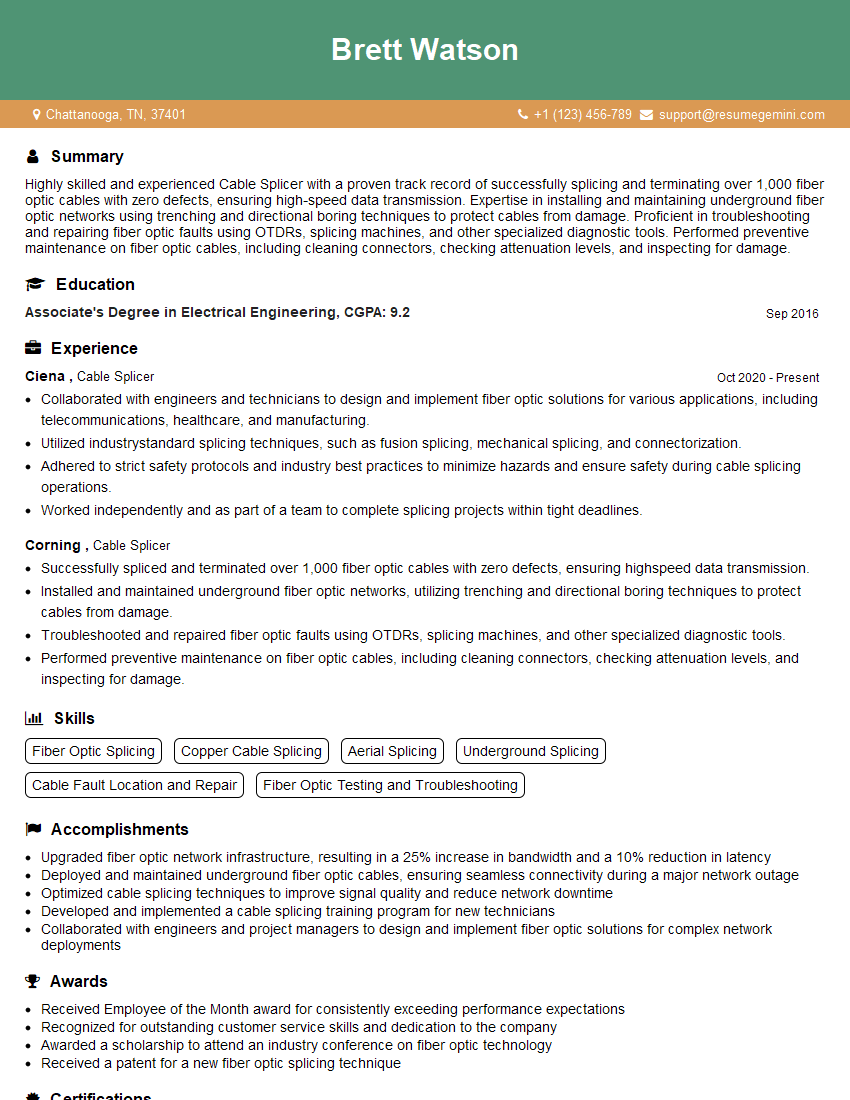
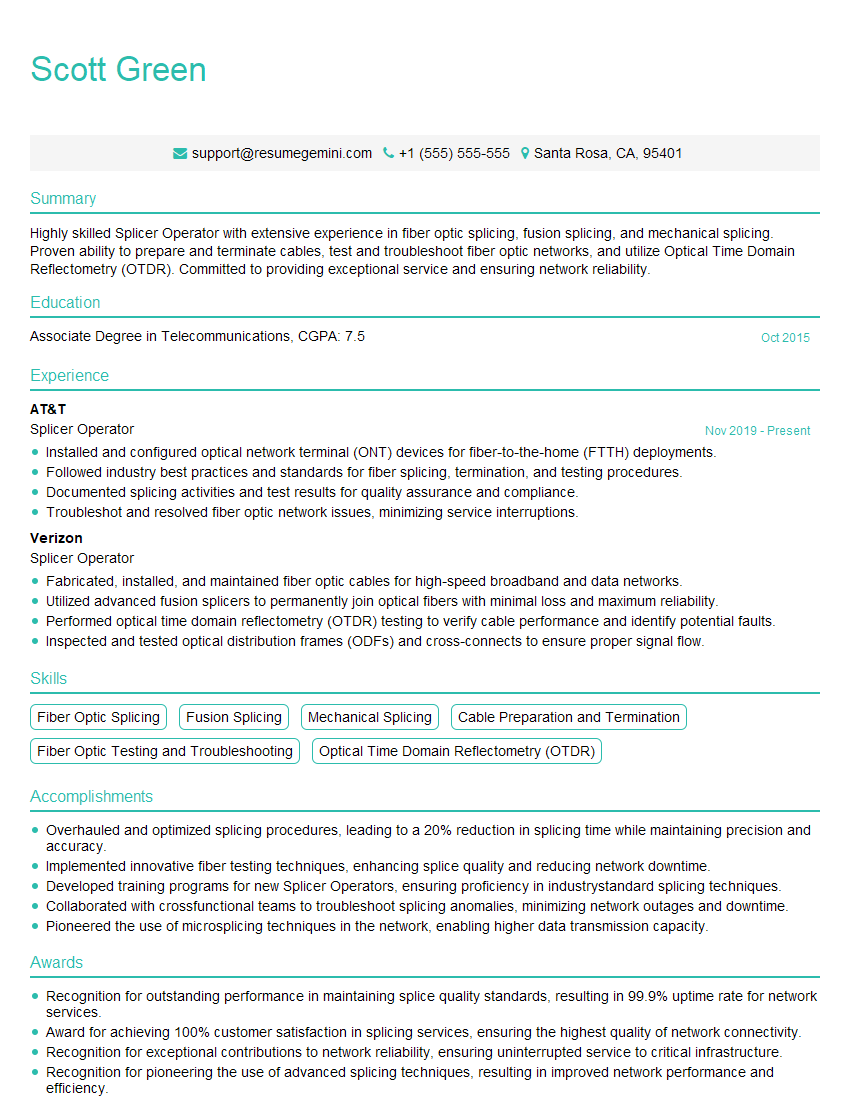
Mastering Splicer Operation opens doors to exciting career opportunities in a rapidly growing field. To maximize your chances of landing your dream job, a well-crafted resume is crucial. An ATS-friendly resume ensures your qualifications are effectively communicated to potential employers. We highly recommend leveraging ResumeGemini, a trusted resource, to build a professional and impactful resume. ResumeGemini provides examples of resumes tailored to Splicer Operation to guide you in creating a winning application. Take the next step toward your successful career today!
Explore more articles
Users Rating of Our Blogs
Share Your Experience
We value your feedback! Please rate our content and share your thoughts (optional).
What Readers Say About Our Blog
Very informative content, great job.
good