Interviews are more than just a Q&A session—they’re a chance to prove your worth. This blog dives into essential Diver Supervision interview questions and expert tips to help you align your answers with what hiring managers are looking for. Start preparing to shine!
Questions Asked in Diver Supervision Interview
Q 1. Explain the roles and responsibilities of a Dive Supervisor.
A Dive Supervisor is the ultimate authority on a dive operation, responsible for the safety and well-being of all divers under their charge. This responsibility extends from meticulous pre-dive planning to post-dive debriefing and encompasses all aspects of the dive. It’s akin to being the air traffic controller of an underwater operation.
- Pre-dive planning: This includes site assessment, risk assessment, dive profile creation, equipment checks, and contingency planning.
- Supervision during the dive: Constant monitoring of divers’ behavior, air consumption, and adherence to the dive plan. This often includes visual observation and communication via surface markers or underwater communication systems.
- Post-dive procedures: Ensuring divers safely surface, conduct proper decompression stops if required, complete thorough equipment rinsing and maintenance, and participate in a debriefing to identify any potential areas for improvement.
- Team management: Effective leadership, clear communication, conflict resolution, and ensuring team members are adequately trained and equipped.
- Emergency response: Immediate and decisive action in case of any emergency, employing appropriate rescue techniques and first aid.
- Legal and regulatory compliance: Adherence to all relevant diving regulations, safety standards, and company policies.
Q 2. Describe your experience with dive planning and execution.
My experience in dive planning and execution spans over 15 years, encompassing diverse environments from coral reefs to shipwrecks. I’ve been involved in both recreational and commercial diving projects. Dive planning for me always begins with a thorough risk assessment, considering factors such as weather conditions, water visibility, currents, depth, and the experience level of the divers. I use specialized dive planning software to create detailed dive profiles, factoring in decompression requirements and contingency plans for potential issues. Execution involves a meticulous briefing, thorough equipment checks, constant monitoring during the dive, and a post-dive debriefing to analyze what worked well and areas for improvement. For example, during a recent wreck penetration dive, we carefully planned decompression stops based on the planned bottom time and depth. The pre-dive briefing emphasized navigation procedures and emergency procedures in case of disorientation within the wreck. The dive proceeded flawlessly with all divers adhering to the plan.
Q 3. How do you ensure diver safety during different dive types?
Diver safety is paramount and varies depending on the dive type. For example, technical dives necessitate far stricter protocols than recreational dives. My approach is layered and proactive:
- Recreational Dives: Focus on buddy systems, pre-dive briefings covering basic safety procedures, constant visual monitoring, and readily available emergency equipment (surface markers, first aid kit).
- Technical Dives: Rigorous pre-dive planning, including detailed decompression profiles and contingency plans, mandatory redundancy in equipment, more advanced communication, and specialized training for all divers involved. I insist on adherence to strict decompression protocols. We use specialized decompression software and tables to ensure safety.
- Commercial Dives: Strict adherence to project-specific safety protocols and regulatory guidelines. I’ll usually maintain a detailed dive log, which documents all aspects of the operation.
In all cases, maintaining clear communication with the divers is crucial. Regular checks on air consumption are vital and should be implemented for all dive types.
Q 4. What are the key elements of a pre-dive briefing?
A pre-dive briefing is crucial for a safe and successful dive. It’s not just a formality; it’s a life-saving exercise. A comprehensive briefing should cover:
- Dive Site Overview: Description of the dive site, including depth, bottom topography, potential hazards (currents, marine life, obstructions), and points of interest.
- Dive Plan: Detailed explanation of the planned dive profile, including maximum depth, bottom time, ascent rate, and planned decompression stops (if any).
- Communication Procedures: Methods for communication between divers and the surface team, including hand signals and surface markers. I’ll always ensure everyone understands the signals before we commence the dive.
- Emergency Procedures: Clear and concise instructions on what to do in case of an emergency, such as an out-of-air situation, equipment malfunction, or diver distress.
- Contingency Plans: Strategies for handling unexpected scenarios such as adverse weather conditions, equipment failure, or diver injury.
- Equipment Checks: Visual inspection of divers’ equipment to ensure everything is in working order.
The briefing should be interactive, ensuring all divers understand and ask questions. A well-conducted briefing sets the stage for a safe and enjoyable dive.
Q 5. Outline the emergency procedures for a diver in distress.
Emergency procedures are critical and should be practiced regularly. My response will always prioritize the immediate safety of the diver in distress.
- Assessment: Rapid assessment of the situation to determine the nature of the emergency (e.g., out-of-air, entanglement, injury).
- Alert the Team: Immediately alert other team members of the emergency situation.
- Initiate Rescue: Employ appropriate rescue techniques based on the nature of the emergency, such as emergency ascent, assisting with equipment issues, or providing first aid if needed. Using dive floats and signaling devices is essential.
- Surface Assistance: Ensure assistance is ready upon the diver’s ascent, including immediate first aid and necessary medical treatment.
- Post-Incident Review: Thorough analysis of the incident to identify contributing factors and implement preventive measures to avoid future occurrences.
Regular drills and training are vital to maintain proficiency in these procedures. We often conduct mock emergency scenarios during training exercises.
Q 6. How do you manage a dive team effectively?
Effective dive team management involves clear communication, shared responsibility, and fostering a culture of safety. I emphasize teamwork, delegation of tasks, and a thorough understanding of roles.
- Pre-dive planning: Involving team members in the planning process fosters ownership and responsibility.
- Clear Roles & Responsibilities: Every member should know their role and responsibilities before, during, and after the dive.
- Open Communication: A safe environment where team members feel comfortable voicing concerns without fear of reprisal.
- Conflict Resolution: Addressing any conflicts promptly and professionally.
- Regular Feedback: Providing constructive feedback to enhance team performance and improve safety practices.
I strongly believe that a well-trained and cohesive team is the foundation of a successful and safe dive operation. Trust and mutual respect within the team are essential.
Q 7. What are your methods for monitoring divers’ air supply and decompression?
Monitoring divers’ air supply and decompression is paramount. I employ a combination of methods:
- Regular Air Checks: Divers provide regular air status updates, especially during longer dives. Visual checks of remaining air pressure in the tanks are also performed.
- Dive Computers: All divers use dive computers that monitor depth, bottom time, and decompression obligations. These data are vital for ensuring that divers do not exceed their safe limits.
- Decompression Tables and Software: For technical and commercial dives, I use decompression software to create and adjust dive plans as necessary, factoring in environmental conditions and diver performance.
- Surface Monitoring: Constant observation of divers from the surface. This helps to keep track of their location, behavior, and air usage.
- Post-Dive Decompression Stops: Ensuring divers make required decompression stops, if any, following established procedures.
Failure to properly monitor these factors can lead to serious diving accidents and potentially fatal outcomes. The use of redundant equipment and safety measures is always incorporated into my diving protocols.
Q 8. Explain the importance of decompression stops and procedures.
Decompression stops are crucial in diving to allow the body to gradually release dissolved inert gases, primarily nitrogen, that have accumulated in the tissues during a dive. Failure to do so can lead to decompression sickness (DCS), also known as ‘the bends,’ a potentially fatal condition. The procedure involves ascending slowly to predetermined depths (stops) for specific durations, allowing the body to off-gas safely.
The importance lies in the physics of gas solubility: at greater depths, higher pressure forces more gas into the tissues. A rapid ascent would cause these gases to form bubbles, obstructing blood flow and damaging tissues. Decompression procedures, often calculated using dive computers or dive tables, are carefully designed to minimize this risk. For example, a deep dive might require multiple stops at progressively shallower depths, with longer stop times at the deeper stops. The dive plan will always dictate the decompression profile to be followed.
Imagine a carbonated drink: opening it quickly releases gas rapidly. Similarly, a fast ascent releases dissolved nitrogen quickly, potentially leading to bubbles forming in the bloodstream. Decompression stops are like slowly unscrewing the cap, allowing the gas to escape gradually and safely.
Q 9. How familiar are you with relevant diving standards and regulations (e.g., IMCA)?
I am very familiar with diving standards and regulations, particularly those published by the International Marine Contractors Association (IMCA). My experience includes working extensively with IMCA D016 (Diving Operations), which covers all aspects of offshore diving, from pre-dive planning to emergency response. I understand the importance of adhering to these standards to ensure safety and legal compliance. I’m also familiar with other relevant standards such as those related to saturation diving and hyperbaric chamber operations. My experience extends to national and international regulations that govern commercial diving, ensuring operations align with best practice and legal requirements across various jurisdictions. This includes understanding the roles and responsibilities of each member of the diving team in compliance with the standards and regulations.
Q 10. Describe your experience with different types of diving equipment.
My experience encompasses a wide range of diving equipment, including both open-circuit and closed-circuit rebreathers. I am proficient in the operation and maintenance of various types of diving regulators, buoyancy compensators (BCDs), dry suits, wet suits, underwater communication systems, and underwater lighting equipment. I’ve worked with different types of diving cylinders, including steel and aluminum, and understand the principles of gas blending and the safe handling of various breathing gases, including enriched air nitrox and trimix. I’m also experienced with specialized equipment like underwater cameras and video systems for recording dives and inspections. My skills extend to ensuring equipment is properly inspected and maintained before, during and after each dive operation.
For example, I have extensive experience with surface-supplied diving equipment which requires a different skill set to the use of self-contained underwater breathing apparatus (SCUBA) and rebreathers. I understand the critical role of the surface support team in safely managing the surface supplied diving operation.
Q 11. How do you conduct dive site surveys and risk assessments?
Dive site surveys and risk assessments are fundamental to safe diving operations. A thorough survey involves a detailed examination of the dive site, including water depth, currents, visibility, bottom topography, potential hazards (e.g., obstructions, marine life, unstable structures), and environmental conditions. This information is then used to conduct a risk assessment that identifies potential hazards, analyzes their likelihood and severity, and develops mitigation strategies. This often includes a review of weather forecasts, tidal predictions, and other environmental considerations.
My approach uses a structured methodology. First, I gather information from charts, previous dive reports, and local knowledge. Then, I conduct a visual inspection of the site, often using underwater video or sonar. Finally, I create a risk assessment matrix, prioritizing hazards and outlining control measures. This process may involve consultation with other experts, such as marine biologists or geologists, depending on the complexities of the site.
For instance, when surveying a wreck dive, I would assess the structural integrity of the wreck, the presence of entrapment hazards, and the potential for silt disturbance. The risk assessment would then outline measures to minimize these risks, such as careful buoyancy control, use of appropriate lighting, and establishing clear communication protocols within the dive team.
Q 12. Explain your understanding of hyperbaric chambers and their use.
Hyperbaric chambers are pressure vessels used to treat diving-related injuries, such as decompression sickness and arterial gas embolism. They allow for the controlled recompression of divers to force dissolved gases back into solution, reducing the formation of bubbles and promoting their resorption. The chambers are operated by trained medical personnel, and treatment protocols are tailored to the specific injury and the diver’s diving profile.
My understanding encompasses the operation and maintenance of hyperbaric chambers, including safety procedures, emergency protocols, and the administration of oxygen therapy within the chamber. I understand the importance of accurate chamber pressure monitoring and the critical role of communication between the chamber and the medical team. I am familiar with various recompression treatments, and I know how to monitor the patient’s vital signs and other physiological parameters during the recompression process to identify any adverse reactions or complications.
During my career, I’ve witnessed firsthand the life-saving potential of hyperbaric treatment in the management of serious diving incidents. It’s essential to have access to a properly equipped chamber and a skilled hyperbaric medical team within reasonable proximity to diving operations.
Q 13. How do you handle conflicts or disagreements within the dive team?
Conflict resolution is a key skill for a dive supervisor. I approach disagreements with a focus on open communication and a collaborative problem-solving approach. My first step is to actively listen to all perspectives, ensuring that everyone feels heard and understood. I then facilitate a discussion aimed at finding common ground and identifying solutions that are acceptable to all team members. If the conflict involves safety concerns, the safety of the divers will always take precedence. I am not afraid to make the difficult decisions and may choose to suspend the dive entirely if necessary.
I believe in establishing clear lines of authority and responsibility from the outset. Clear communication channels and protocols minimize the likelihood of misunderstandings and conflicts. However, if a conflict does arise, my approach prioritizes safety and teamwork, seeking to resolve the issue swiftly and fairly. In cases of persistent conflict or serious misconduct, I will escalate the matter to the appropriate management level.
Q 14. Describe your experience with dive incident reporting and investigation.
Dive incident reporting and investigation are crucial for continuous improvement and accident prevention. My experience includes conducting thorough investigations into dive incidents, ranging from minor equipment malfunctions to serious injuries. I follow a structured process, starting with the immediate collection of evidence and witness statements. I then analyze the incident, identifying contributing factors and root causes using established incident investigation techniques. A detailed report is prepared that includes recommendations for preventing similar incidents in the future. This report is shared with all relevant stakeholders, and corrective actions are implemented.
For example, if a diver experiences a near-miss due to equipment failure, a thorough investigation would involve inspecting the faulty equipment, analyzing the maintenance logs, and reviewing the diver’s pre-dive checks. The report will provide recommendations for improving equipment maintenance procedures and diver training.
Transparency and thoroughness are critical aspects of this process to ensure that lessons learned from incidents are effectively applied to prevent future occurrences and improve the overall safety of future operations.
Q 15. How do you communicate effectively with divers underwater and on the surface?
Effective underwater communication is crucial for diver safety and mission success. On the surface, we primarily use hand signals, a universally understood system, supplemented by voice communication via radio or dedicated underwater communication systems. For example, a diver might signal an ‘out of air’ emergency using a specific hand gesture, immediately alerting the supervisor. Underwater, we rely heavily on pre-agreed hand signals and sometimes specialized communication equipment like underwater telephones or diver-to-surface communication systems (DSCS). These systems allow for voice communication, but range and clarity can be affected by water conditions. Clear, concise pre-dive briefings that establish communication protocols are critical, rehearsing responses to potential scenarios such as equipment malfunctions or unexpected encounters. Post-dive debriefs are equally important to assess communication effectiveness and identify areas for improvement. In one instance, during a complex wreck survey, a slight miscommunication about the location of a specific artifact almost led to a collision. A quick review of our signals and procedures afterward prevented this in future dives.
Career Expert Tips:
- Ace those interviews! Prepare effectively by reviewing the Top 50 Most Common Interview Questions on ResumeGemini.
- Navigate your job search with confidence! Explore a wide range of Career Tips on ResumeGemini. Learn about common challenges and recommendations to overcome them.
- Craft the perfect resume! Master the Art of Resume Writing with ResumeGemini’s guide. Showcase your unique qualifications and achievements effectively.
- Don’t miss out on holiday savings! Build your dream resume with ResumeGemini’s ATS optimized templates.
Q 16. What are your methods for maintaining dive equipment and ensuring its proper function?
Maintaining dive equipment is paramount. My method involves a meticulous pre-dive inspection, meticulously checking each component – from the regulator and BCD to the dive computer and wetsuit – for any damage, leaks, or malfunctions. I adhere strictly to manufacturer recommendations for maintenance, including regular servicing by qualified technicians. Post-dive, I rinse all equipment thoroughly with fresh water to remove salt and debris, paying close attention to delicate parts. I meticulously log all maintenance procedures and repairs. For example, I regularly test the pressure gauge, noting the readings in my logbook. This proactive approach helps prevent equipment failure underwater. One time, a meticulous pre-dive check revealed a small crack in a diver’s mask, preventing a potentially serious issue in low visibility conditions. Regular equipment maintenance is not just about safety; it extends the lifespan of our equipment and saves operational costs in the long run.
Q 17. How do you handle challenging weather conditions during a dive operation?
Challenging weather significantly impacts dive operations, requiring careful planning and risk assessment. Before a dive, I meticulously analyze weather forecasts, paying close attention to wind speed, wave height, and visibility. High winds and strong currents can create hazardous conditions, while poor visibility reduces safety margins. If conditions deteriorate beyond acceptable limits, the dive is postponed or cancelled. I ensure the dive boat is appropriately equipped for rough seas, and we implement strict safety protocols including the use of surface markers and backup communication systems. In one dive, an unexpected storm forced us to abort the operation and quickly return to the surface. Our pre-planned emergency procedures were critical in ensuring the safety of the team. Remember, diver safety always trumps schedule. A delayed dive is far better than a compromised one.
Q 18. Describe your experience with underwater welding or cutting operations.
I possess significant experience in underwater welding and cutting operations, holding certifications in both hyperbaric and saturation diving techniques applicable to underwater welding and cutting. My experience encompasses a variety of techniques, including arc welding, oxy-fuel cutting, and specialized plasma arc cutting. Safety is paramount; these operations require strict adherence to safety protocols, including proper gas mixing, ventilation, and fire prevention measures. I always carry out a thorough risk assessment before commencing any underwater welding or cutting operation, accounting for factors such as current, visibility, and the type of work to be performed. For example, in one underwater construction project, precise underwater cutting was essential for fitting structural components. The success of the operation relied on carefully planning and executing each cut to ensure the structural integrity of the completed structure.
Q 19. Explain your understanding of different types of dive profiles.
Dive profiles are graphical representations of a dive’s parameters over time, crucial for understanding dive safety and decompression. Common profiles include: No-Decompression Dive Profiles (remaining within no-decompression limits); Decompression Dive Profiles (requiring planned decompression stops to off-gas inert gases); and Repetitive Dive Profiles (dives performed after previous dives within a short period, necessitating more careful decompression planning). Understanding these profiles is essential for preventing decompression sickness (‘the bends’). I use dive computers and decompression software to plan and monitor dive profiles, ensuring diver safety. A diver’s experience and training level dictates the type of dive profile undertaken, and I always ensure appropriate training and supervision are in place. For example, a deep, technical dive necessitates a meticulous decompression profile to minimize the risk of decompression sickness.
Q 20. How do you ensure the proper use and maintenance of diving support vessels?
Proper use and maintenance of diving support vessels are vital for diver safety and operational effectiveness. This includes regular inspections of the vessel’s hull, engines, safety equipment (life rafts, EPIRBs), and communication systems. I ensure all crew members are adequately trained in safety procedures, including emergency response protocols. The vessel’s maintenance log is meticulously updated, detailing all inspections, repairs, and servicing. I ensure compliance with all relevant maritime regulations and safety standards. Regular training for the crew is equally important and helps maintain operational efficiency and safety standards. In one instance, a pre-dive inspection revealed a problem with the vessel’s navigation system. Addressing this before the dive prevented a potential navigation issue and ensured a safe dive.
Q 21. Describe your experience with underwater video and photography techniques.
My experience with underwater video and photography involves a variety of techniques, from still photography to high-definition video recording. This includes using specialized underwater housings, lighting equipment, and cameras. I am proficient in various filming techniques, such as using a wide-angle lens for capturing expansive views of marine environments. Post-production editing and image enhancement are also part of my workflow. Good underwater imagery requires patience, skill, and attention to detail. For instance, during a recent coral reef survey, high-definition video provided valuable documentation of marine life and habitat, providing important data for marine conservation efforts. Proper lighting is critical for capturing crisp and clear images, and understanding light penetration at different depths is crucial for achieving professional-quality results.
Q 22. How familiar are you with different types of underwater communication systems?
Underwater communication is crucial for diver safety and operational efficiency. I’m familiar with several systems, each with its strengths and weaknesses. These include:
- Acoustic communication: This uses sound waves for communication. Examples include underwater telephones and diver-to-surface communication systems using a diver’s umbilical or a separate acoustic pinger. These are reliable over moderate distances, but water conditions like currents can impact clarity.
- Hardwired communication: This involves a physical connection, such as an umbilical cord, connecting the diver to the surface. This offers reliable communication and can also transmit data, but limits diver mobility.
- Hand signals: While not a technical system, standardized hand signals are essential for short-range communication in case of equipment malfunction. Divers need to be proficient in these, regardless of the other systems in use.
- Diver-to-diver communication: This usually relies on hand signals or, if close enough, direct speech through masks. For larger teams, a combination of systems is preferable.
My experience includes using all these methods, adapting choices based on the specific dive operation’s demands. For example, in a complex wreck penetration dive, a hardwired system would be preferred for safety, while in a shallower, open water survey, acoustic communication might suffice.
Q 23. How do you manage the logistics of a complex dive operation?
Managing the logistics of a complex dive operation requires meticulous planning and attention to detail. It’s like orchestrating a symphony – every instrument needs to be in the right place at the right time. This includes:
- Pre-dive planning: This involves detailed risk assessments, dive plans (including contingency plans), equipment checks, and briefing divers on the task at hand. The environment and the specific dive objectives heavily influence this stage.
- Resource allocation: This includes personnel, equipment, vessels, and support systems. Proper allocation ensures efficient operations and minimizes downtime.
- Communication protocols: Establishing clear communication channels is paramount. This often involves multiple communication systems and designated communication personnel on the surface.
- Safety protocols: Implementing rigorous safety protocols, including emergency response plans and decompression procedures, is non-negotiable. Regular safety checks throughout the operation are essential.
- Post-dive procedures: This includes equipment maintenance, debriefing the dive team to analyze performance and identify areas for improvement, and submitting dive reports to stakeholders.
For instance, in a large-scale underwater pipeline inspection, I would coordinate multiple dive teams, support vessels, and remote underwater vehicles (ROVs) – all needing synchronized deployment and communication to ensure the inspection is conducted efficiently and safely.
Q 24. Explain your understanding of diver fatigue and its prevention.
Diver fatigue is a significant risk factor that can lead to errors and accidents. It’s a combination of physical and mental exhaustion. Understanding the causes is vital for prevention.
- Physical fatigue: Results from exertion, cold water, and prolonged immersion. The pressure, and even the dive equipment, contribute to physical demands on the body.
- Mental fatigue: Caused by stress, concentration, and environmental factors, such as poor visibility or challenging conditions. Problem-solving during a dive is demanding.
Prevention strategies include:
- Adequate rest: Divers need sufficient rest before, during (if possible), and after a dive. This includes scheduled breaks, proper sleep, and avoidance of strenuous activities before the dive.
- Proper hydration and nutrition: Staying hydrated and consuming nutritious foods will improve energy levels and performance. Dehydration exacerbates fatigue.
- Appropriate work-rest cycles: Scheduling appropriate work and rest periods during dives significantly reduces fatigue and increases efficiency.
- Teamwork and support: Recognizing fatigue in team members is vital. Supporting each other and utilizing buddy systems is a primary safety measure.
- Environmental monitoring: Cold water and adverse weather significantly increase fatigue. Monitoring and adapting plans as needed are critical.
I always ensure my team members are well-rested and receive proper breaks to avoid the negative consequences of fatigue. I’ve witnessed firsthand how inadequate rest can lead to mistakes and near-miss situations. Promoting a culture of safety and respect for individual limitations is essential.
Q 25. Describe your experience with using underwater positioning systems.
Underwater positioning systems are crucial for precise operations, particularly in challenging environments. My experience encompasses various systems:
- Ultra-short baseline (USBL) systems: These use acoustic signals from a transponder on the diver to determine their position relative to a surface unit. Accurate but range-limited.
- Long baseline (LBL) systems: These use multiple transponders on the seabed to provide more accurate and longer-range positioning. Used in complex, larger-scale operations.
- GPS (with suitable underwater adaptations): Though limited by water depth, GPS can provide positioning data at the surface, providing a reference point for divers’ activities.
- Inertial navigation systems (INS): These are self-contained systems used for short-term positioning but are prone to drift over time. Often used in conjunction with other systems.
I’ve worked with LBL systems during underwater pipeline surveys, ensuring the divers precisely located pipeline anomalies. In salvage operations, USBL systems are useful for tracking divers near the wreck.
Q 26. How do you ensure compliance with environmental regulations during dive operations?
Environmental compliance is paramount. I ensure compliance through:
- Thorough pre-dive site assessments: Identifying sensitive areas and potential environmental impacts is crucial. We consult environmental impact assessments and relevant regulations before undertaking any dive operation.
- Appropriate dive techniques: Minimizing disturbance to marine life is key. We use techniques that reduce sediment resuspension, avoid contact with sensitive habitats, and follow best practices for minimizing our environmental footprint.
- Proper waste management: All waste generated during dives is appropriately managed and disposed of following relevant regulations. This includes the proper handling of hazardous materials.
- Environmental monitoring: This might include documenting observations of marine life or taking water samples to assess potential impacts. We often work closely with environmental scientists to mitigate any risks.
- Compliance documentation: Detailed dive logs, incident reports, and environmental monitoring data are carefully documented and maintained to demonstrate compliance and facilitate future improvements.
For example, when conducting a survey in a coral reef, we’d use specialized equipment to minimize damage and ensure no contact with the reef. All our waste would be collected and appropriately disposed of ashore to prevent pollution.
Q 27. Describe your experience with training and mentoring junior divers.
Training and mentoring junior divers is a vital aspect of my role. I follow a structured approach which includes:
- On-the-job training: I provide hands-on training and guidance, closely supervising junior divers during actual dives. This is supplemented with regular classroom sessions.
- Skills development: This includes teaching both technical and practical diving skills, emphasizing safe dive practices, emergency procedures, and equipment handling. Regular skills assessments ensure competency.
- Mentorship: I offer guidance and support beyond technical skills, fostering a safe and supportive environment for learning and growth. This includes encouraging critical thinking and problem-solving.
- Feedback and evaluation: Providing regular and constructive feedback, and conducting performance evaluations, allows for continuous improvement and highlights areas needing further attention.
I’ve mentored several junior divers who are now experienced professionals. I believe a good mentor builds confidence, encourages safe diving practices, and fosters a team spirit, ensuring that every diver works at their highest level of competency.
Q 28. How would you handle a situation where a diver suffers decompression sickness?
Decompression sickness (DCS), also known as the bends, is a serious condition requiring immediate action. My response involves:
- Immediate ascent: The diver is brought to the surface as quickly as safely possible, while maintaining controlled ascent rates to minimize further injury.
- Oxygen administration: High-flow oxygen is administered immediately to help the body re-absorb nitrogen bubbles.
- Contacting emergency medical services (EMS): EMS is contacted immediately to arrange for hyperbaric chamber treatment. This is vital, as a hyperbaric chamber recompresses the diver to force the bubbles out of their system.
- Maintaining a calm and supportive environment: I would ensure the diver remains calm and comfortable while awaiting medical attention. Anxiety can worsen symptoms.
- Detailed documentation: Detailed records are kept of the dive profile, symptoms, and treatment provided. This information is crucial for determining the cause and preventing future incidents.
Once in the hyperbaric chamber, medical professionals take over, administering oxygen at increased pressure and monitoring the diver’s progress. My role post-incident would involve cooperating with the medical team and conducting a thorough investigation into the cause of the DCS.
Key Topics to Learn for Diver Supervision Interview
- Diver Safety Procedures and Regulations: Understanding and applying relevant safety standards, emergency protocols, and legal requirements for diving operations.
- Risk Assessment and Mitigation in Diving: Identifying potential hazards, analyzing risks, and implementing effective mitigation strategies to ensure diver well-being.
- Dive Planning and Execution: Developing detailed dive plans, considering environmental factors, diver capabilities, and equipment requirements. Successfully executing these plans and adapting to changing conditions.
- Communication and Teamwork in Diving: Mastering clear and concise communication techniques, both above and below water, to ensure effective teamwork and coordination within the dive team.
- Emergency Response and Procedures: Knowing how to respond effectively to various diving emergencies, including equipment malfunctions, decompression sickness, and other potential incidents.
- Dive Equipment Maintenance and Inspection: Understanding the proper maintenance and inspection procedures for all diving equipment to ensure its optimal performance and safety.
- Environmental Awareness and Conservation: Demonstrating awareness of the marine environment, its fragility, and responsible diving practices to minimize environmental impact.
- Legal and Ethical Considerations: Understanding the legal and ethical responsibilities associated with diver supervision, including reporting requirements and professional conduct.
- Leadership and Team Management: Effectively leading and managing a dive team, delegating tasks, and fostering a positive and safe working environment.
- Problem-Solving and Decision-Making under Pressure: Demonstrating the ability to analyze situations, make sound decisions, and solve problems effectively, especially in high-pressure or emergency situations.
Next Steps
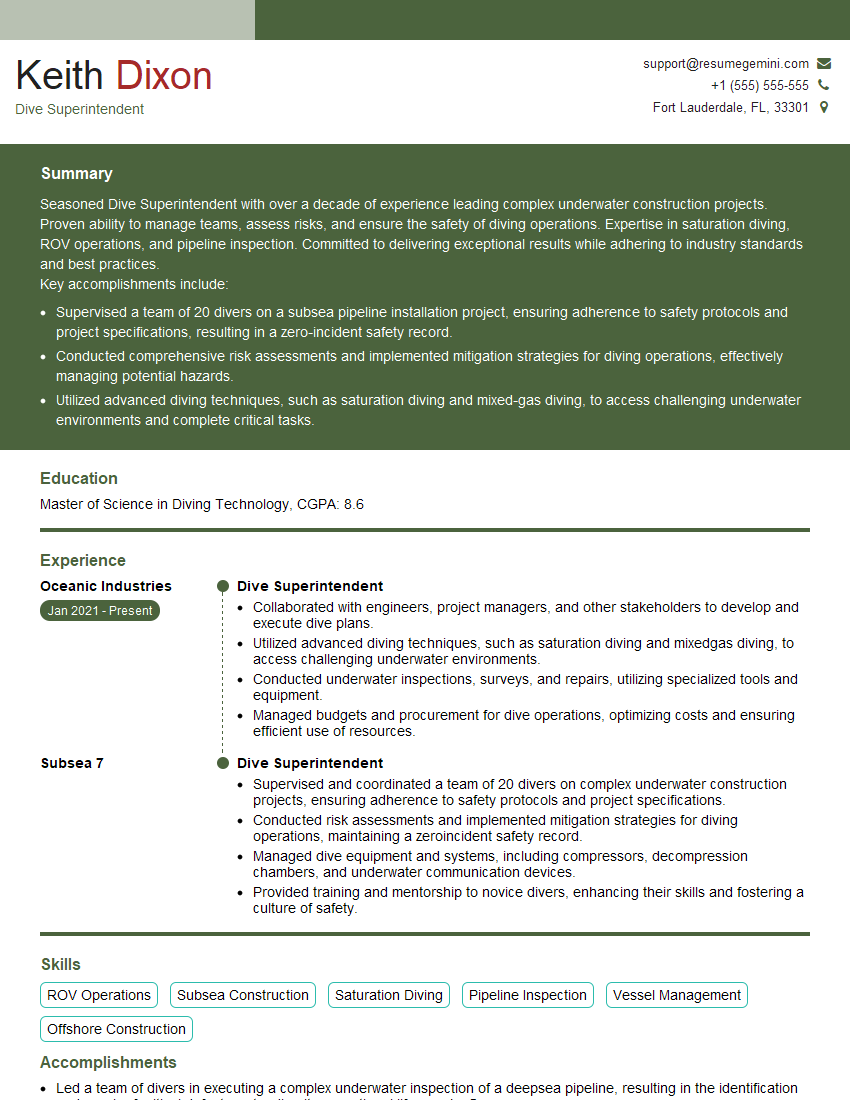
Mastering Diver Supervision is crucial for career advancement in the diving industry, opening doors to leadership roles and increased responsibility. A strong, ATS-friendly resume is vital to showcasing your skills and experience effectively to potential employers. To create a compelling resume that highlights your qualifications and expertise, leverage the power of ResumeGemini. ResumeGemini provides a user-friendly platform to craft professional resumes, and we offer examples of resumes tailored specifically to Diver Supervision to help guide your process. Invest time in crafting a standout resume—it’s your first impression and a critical step in your career journey.
Explore more articles
Users Rating of Our Blogs
Share Your Experience
We value your feedback! Please rate our content and share your thoughts (optional).
What Readers Say About Our Blog
Very informative content, great job.
good