The right preparation can turn an interview into an opportunity to showcase your expertise. This guide to Technical Volleyball Knowledge interview questions is your ultimate resource, providing key insights and tips to help you ace your responses and stand out as a top candidate.
Questions Asked in Technical Volleyball Knowledge Interview
Q 1. Explain the different types of volleyball serves and their strategic applications.
Volleyball serves are categorized based on technique and trajectory. Strategic application depends heavily on the opponent’s weaknesses and the desired outcome.
- Floater Serve: This serve relies on minimal spin, making it unpredictable in its trajectory and difficult to read. It’s strategically used to disrupt the receiving team’s rhythm and force errors. Imagine a knuckleball in baseball – hard to anticipate.
- Topspin Serve: Generated by hitting the ball above its center, this serve dips sharply downwards. Effective for targeting a specific area of the court, forcing a difficult pass. It’s great for targeting a weaker passer.
- Jump Serve: A powerful serve executed with a jump. This can generate extreme speed and spin, making it a formidable weapon, often used to score directly or disrupt reception greatly. Think of a tennis serve – power and placement combined.
- Underhand Serve: Generally used by beginners, this low-trajectory serve is less powerful but easier to control. Strategically, it can be used to place the ball accurately to specific zones.
- Skyball Serve: A high arcing serve often used for tactical reasons. It can be difficult to judge properly and can force the team into a poor passing position, setting up for attacking.
The choice of serve depends on the match situation, the server’s skills, and the opponent’s weaknesses. A coach might utilize a mix of floaters and topspin serves to keep the receiving team guessing.
Q 2. Describe the optimal passing technique for different types of serves.
Optimal passing technique hinges on anticipating the serve and using proper body mechanics. Different serves require adjustments:
- Floater Serve: Requires a wider platform (using both arms and hands) to increase the contact surface area and control the unpredictable trajectory. The focus is on making a soft, controlled platform for the setter.
- Topspin Serve: A slightly higher pass, anticipating the dip. The arms and hands should be positioned to direct the ball slightly upwards, countering the downward spin and preventing the pass from being too low. Think of gently scooping the ball.
- Jump Serve: Requires quick reaction time and possibly a more aggressive pass. The receiver needs to quickly assess the speed and direction to effectively make a pass that is slightly harder but still accurate. Good footwork and anticipation are critical.
- Underhand Serve: This usually requires a simpler pass, though accuracy and speed still are factors to consider, and the position needs to be adjusted accordingly.
In all cases, the platform should be stable, and the arms and hands should be coordinated, working together as a single unit. Proper footwork is crucial for optimal positioning and balance.
Q 3. How would you analyze a team’s offensive and defensive strategies?
Analyzing a team’s strategy involves observing patterns in their play. This includes their offensive and defensive formations, player roles, and response to different situations.
- Offensive Analysis: Look for their preferred attack patterns (e.g., quick sets, pipe attacks, wide attacks). Identify their go-to hitters and their favored hitting zones. Note their tendencies after specific serves or passes.
- Defensive Analysis: Observe their blocking system (height, angles, timing), their digging strategy (formation, player roles), and their overall positioning. Identify which players take on which defensive tasks and observe their effectiveness.
Analyzing video recordings is essential for in-depth analysis; you can pause, rewind, and examine individual plays repeatedly. A detailed scouting report highlighting these strengths and weaknesses is key to formulating effective strategies against them.
For example, if a team constantly uses a quick set to their middle hitter, you’d focus your blocking on that hitter and anticipate the quick set.
Q 4. What are the key elements of a successful volleyball blocking system?
A successful blocking system depends on communication, timing, and technique. Key elements include:
- Read/Anticipation: Blockers need to anticipate the hitter’s intentions by reading the setter and the hitter’s body language. This takes experience and keen observation.
- Timing: Jumping simultaneously with or just slightly before the hitter’s swing is crucial for effective blocking.
- Positioning: Proper positioning of the blockers relative to the hitter and the net is essential to effectively cover the hitting space.
- Block height: The block needs to be high enough to challenge the hitter’s swing but not so high that they can hit around it.
- Teamwork & Communication: Effective blocking requires excellent teamwork and communication, to coordinate and avoid collisions between blockers.
- Footwork: Proper footwork is crucial for optimal jump and reach during the block.
Think of a well-coordinated blocking system as a tightly woven net – multiple players working together to close off hitting angles.
Q 5. Explain different offensive systems and their advantages/disadvantages.
Volleyball offenses utilize various systems designed to utilize the team’s strengths and exploit opponent’s weaknesses.
- 4-2 Offense: Two setters and four hitters; one setter focuses on back row attacks and the other focuses on front-row hitters. It is highly versatile but requires skilled setters.
- 6-2 Offense: Two setters, and potentially six hitters. Both setters can attack. This system is fast-paced but requires high levels of teamwork and skill from all players.
- 5-1 Offense: One setter and five hitters. It maximizes attacking options but relies heavily on the setter’s skill and decision-making.
Advantages and Disadvantages: Each system has its strengths and weaknesses. The 4-2 provides flexibility, while the 6-2 prioritizes speed. The 5-1 is potent when the setter is highly skilled. The choice depends on the team’s skill set and strategic goals. A team with several excellent hitters might choose a 5-1 system to maximize their attacking potential.
Q 6. How do you assess and improve a player’s hitting technique?
Assessing and improving a player’s hitting technique involves a multifaceted approach.
- Technique Analysis: Observe their approach, arm swing, contact point, and follow-through. Video analysis is invaluable in this stage. Look for inconsistencies in their technique.
- Drill work: Focused drills target specific aspects, such as approach footwork, jump height, arm swing, and contact point.
- Strength and Conditioning: Proper strength and conditioning improve jump height, power, and consistency. This may involve strength training and plyometrics.
- Game Situation: Hitting technique needs to adapt during actual matches. Working on different attacks and adapting to different block schemes is crucial.
For example, if a player has a weak approach, drills will focus on footwork, improving their jumping power, and ensuring a balanced approach before contact. Through consistent practice and tailored coaching, technique can be significantly improved.
Q 7. Describe the components of effective volleyball setting.
Effective volleyball setting is the foundation of a successful offense. It requires precision, timing, and anticipation.
- Platform: Creating a stable and consistent platform using fingers is crucial for controlling the direction and speed of the set.
- Contact Point: The contact point should be high enough to provide the hitter with ample time and space to make a clean swing.
- Set Location: The location of the set must be appropriate for the hitter, considering their location, and the type of attack being used.
- Accuracy and Timing: Precision and correct timing are key to ensuring that the hitter can make a successful attack. This reduces errors for the hitter.
- Anticipation and Read: A good setter reads the hitter and anticipates their move to set accurately.
Think of the setter as the quarterback of the volleyball team, they are orchestrating the offense by guiding the ball to the optimal spot for a successful attack.
Q 8. What are some common errors in volleyball and how would you correct them?
Common errors in volleyball are often technique-related, stemming from improper footwork, inefficient arm swings, and poor body positioning. Let’s break down some examples and their corrections:
Error: Poor approach for a jump serve. The player rushes, doesn’t establish a balanced platform, or doesn’t use proper momentum.
Correction: We focus on a controlled, three-step approach, emphasizing a balanced stance before the jump. Drills involving slow-motion approaches with emphasis on body posture and foot placement are crucial. We also use video analysis to identify specific flaws in their approach run.
Error: Inconsistent passing technique leading to erratic sets. The player may not contact the ball correctly, using their arms instead of their platform, or not moving their feet properly to get in position.
Correction: We emphasize platform formation – ensuring the forearms are parallel and close together, forming a solid base. We use numerous passing drills, progressively increasing ball speed and focusing on consistent contact point, footwork, and body positioning. The use of a passing machine and partner drills helps to build muscle memory and consistency.
Error: Poor blocking technique, such as reaching with arms only and failing to utilize the full body.
Correction: We work on the principles of vertical jump, using body weight efficiently to gain height and reach. We use plyometric exercises to improve explosive power, and blocking drills simulating game situations to practice timing, positioning, and reading the hitter’s approach.
Addressing these errors requires patience, repetition, and a strong focus on proper technique. We use a combination of individual and team drills, providing immediate feedback and gradually increasing the difficulty.
Q 9. How do you design effective drills to improve player skills?
Designing effective drills requires understanding the specific skill being targeted and the players’ current skill level. The drills should be progressive, starting with fundamental movements and gradually increasing complexity. For example:
Skill: Overhand serve consistency. Drill: Start with stationary serves, focusing on proper grip and toss. Progress to a standing serve with a toss, then a three-step approach. Introduce targets to enhance accuracy. This uses a graduated approach to the skill, improving accuracy and power simultaneously.
Skill: Defensive digging. Drill: Start with low balls, focusing on proper platform formation and arm movement. Progress to higher balls, increasing speed and introducing different angles. Include a moving component, incorporating footwork and quick reactions.
Skill: Setting accuracy. Drill: Start with sets to stationary partners at close proximity focusing on a clean toss. Progress to sets at higher distance to improve power and control, increasing the speed and distance as accuracy improves. We use targets to improve consistency and set a precise location. This progressive drill also incorporates aspects of teamwork.
Each drill needs clear objectives, specific instructions, and progressive difficulty. We ensure the drills are engaging, providing immediate feedback to promote learning and motivation. Using game-like situations within drills helps players apply their skills in realistic scenarios.
Q 10. Explain your approach to player development and talent identification.
My approach to player development integrates talent identification with tailored training programs. Talent identification isn’t solely about raw athleticism but also involves assessing a player’s:
Technical skills: Passing, setting, hitting, serving, and blocking proficiency.
Tactical awareness: Understanding game strategy, reading the opponent, and making smart decisions.
Mental fortitude: Maintaining composure under pressure, handling setbacks, and exhibiting leadership qualities.
Physical attributes: Speed, agility, power, and endurance.
Once identified, players are placed into appropriate development pathways. Younger players might receive more fundamental training, whereas advanced players receive specialized drills tailored to improve their strengths and address their weaknesses. This development pathway is dynamic and continuously adjusted based on performance and assessment.
Q 11. How do you adapt training plans based on player’s individual strengths and weaknesses?
Adapting training plans is crucial for individual player growth. We use a detailed assessment process to pinpoint individual strengths and weaknesses, which informs the training plan. For example:
Strong server, weak passer: We would focus on improving the passing technique through dedicated passing drills, emphasizing footwork and platform technique, while maintaining the serving routine as a strength.
Powerful hitter, slow reaction time: We would incorporate plyometrics and agility drills to enhance reaction speed and explosiveness, supporting the player’s hitting strength.
Excellent team player, low individual confidence: We might include drills fostering individual confidence and leadership within the team dynamic to balance strengths and weaknesses.
Regular monitoring and feedback are essential. We use performance metrics and observations during practice and games to continuously assess progress and adjust the training plan accordingly. This iterative process ensures that the training aligns with the individual player’s journey toward improvement.
Q 12. Describe your experience using video analysis to improve player performance.
Video analysis is an indispensable tool in my coaching arsenal. We record practices and games, allowing us to review individual and team performance in detail. This helps identify subtle technical errors that may be missed during live coaching sessions. For example:
Identifying flaws in hitting technique: Slow-motion playback helps us pinpoint issues like inconsistent arm swing, late contact, or poor follow-through. We then design specific drills to correct these issues.
Analyzing defensive positioning: Reviewing game footage reveals weaknesses in court coverage, allowing us to implement strategies for better defensive positioning and rotations.
Assessing team tactics: Video analysis assists in evaluating offensive and defensive strategies, helping us understand their effectiveness and make necessary adjustments.
We use the video analysis to not only identify weaknesses but also highlight successes, reinforcing positive behaviors and building player confidence. Sharing video analysis with players empowers them to self-assess their performance, fostering a culture of continuous improvement.
Q 13. What are the key metrics you use to assess team performance?
Assessing team performance involves a multi-faceted approach, using both quantitative and qualitative metrics. Key metrics include:
Points scored/conceded: A fundamental indicator of offensive and defensive efficiency.
Serving percentage: Measures the effectiveness of the team’s serve, including aces and faults.
Passing percentage: Indicates the consistency of the team’s passing.
Setting percentage: Measures the accuracy and efficiency of sets.
Hitting percentage: Reflects the success rate of attacks.
Blocking percentage: Indicates the effectiveness of blocking efforts.
Dig percentage: Measures the success rate of defensive digs.
Qualitative observations: Teamwork, communication, mental toughness, and overall game strategy.
These metrics, combined with qualitative observations, provide a comprehensive understanding of the team’s strengths and weaknesses. We use this data to inform training plans and make strategic decisions.
Q 14. How do you manage player conflict and maintain team morale?
Managing player conflict and maintaining team morale requires a proactive and empathetic approach. The key is to address conflicts promptly and fairly, creating a supportive and respectful team environment.
Open communication: We encourage players to communicate their concerns openly and honestly. Regular team meetings provide a forum for addressing issues.
Fairness and consistency: Consistent application of rules and expectations ensures that all players are treated fairly.
Mediation and conflict resolution: If conflicts arise, I intervene to facilitate a resolution through active listening and mediation, ensuring that all parties feel heard and understood.
Team-building activities: Team bonding exercises, outside of training, create a positive atmosphere and foster camaraderie.
Positive reinforcement: Celebrating successes and recognizing individual efforts helps build team morale and motivation.
Ultimately, building a strong team culture where players respect each other and support each other’s success is crucial for maintaining high morale and addressing conflict effectively.
Q 15. Explain your understanding of volleyball rules and regulations.
Volleyball rules and regulations govern gameplay, ensuring fairness and consistency. They cover aspects like scoring, serving, faults, and substitutions. A basic understanding includes knowing that a rally starts with a serve, points are scored on every rally (in most modern formats), and a team can only touch the ball up to three times before sending it over the net. Faults include foot faults on the serve, double-touches, carrying, and lifting. Understanding the intricacies of net violations, back-row players’ attack limitations, and substitution procedures is crucial. The specific rules may vary slightly depending on the level of play (e.g., high school, collegiate, professional), but the fundamental principles remain the same. For example, in professional leagues, there are more specific regulations regarding libero substitutions and video reviews. Effective knowledge of the rules enables a coach to analyze plays, strategize effectively, and properly guide players, ensuring adherence to regulations during matches.
- Serving: The serve must be hit behind the end line and must clear the net.
- Rotation: Players must rotate clockwise after winning a sideout.
- Faults: Examples include foot faults, carrying the ball, and touching the net during play.
Career Expert Tips:
- Ace those interviews! Prepare effectively by reviewing the Top 50 Most Common Interview Questions on ResumeGemini.
- Navigate your job search with confidence! Explore a wide range of Career Tips on ResumeGemini. Learn about common challenges and recommendations to overcome them.
- Craft the perfect resume! Master the Art of Resume Writing with ResumeGemini’s guide. Showcase your unique qualifications and achievements effectively.
- Don’t miss out on holiday savings! Build your dream resume with ResumeGemini’s ATS optimized templates.
Q 16. How do you create a positive and effective team culture?
Building a positive and effective team culture involves fostering a sense of unity, trust, and mutual respect. It’s about creating an environment where players feel valued, supported, and empowered. This begins with clear communication, establishing team goals, and defining roles and responsibilities. Open discussions, regular feedback, and constructive criticism are essential for addressing issues and promoting growth. Team-building activities, both on and off the court, strengthen bonds and enhance camaraderie. Celebrating successes, both big and small, keeps morale high. Finally, leading by example, displaying integrity, and demonstrating fairness are crucial for fostering a culture of trust and respect. For example, in one team I coached, we instituted a ‘player of the week’ award based on effort and sportsmanship, not just skill, boosting team cohesion significantly.
Q 17. Describe your experience with scouting opposing teams.
Scouting opposing teams is crucial for effective game planning. This involves analyzing their strengths and weaknesses, identifying key players, understanding their typical formations, and predicting their strategies. I use a multi-faceted approach. This includes watching game footage (both live and recorded), studying their previous match statistics, and collecting information on their individual player tendencies. For example, I might note a team’s preference for quick attacks or their reliance on a specific hitter. I use this information to tailor our training sessions, focusing on specific drills to counter their strengths and exploit their weaknesses. This allows us to devise a targeted game plan, enhancing our chances of victory. The information gathered isn’t just about their individual skills; it’s about identifying their patterns of play, their communication style, and their overall team dynamics. This holistic approach provides a comprehensive understanding of the opponent, enabling me to make well-informed coaching decisions.
Q 18. How do you utilize data analysis to inform coaching decisions?
Data analysis plays a pivotal role in modern volleyball coaching. I utilize data to objectively assess player and team performance. This includes tracking statistics like serve effectiveness, attack percentage, blocking efficiency, and reception success rate. Using software or spreadsheets, I analyze this data to identify trends and patterns. For instance, I might notice a player’s attack percentage is significantly lower when receiving a specific type of serve. This information can then inform training sessions, leading to targeted improvement. I also use data to compare our performance against opponents, revealing our areas of strength and weakness relative to the competition. Furthermore, I incorporate video analysis to identify technical flaws in players’ movements or strategic lapses during gameplay. This data-driven approach is not about simply collecting numbers; it’s about using them to build a more effective team through informed training plans and strategic adjustments.
Q 19. What is your philosophy on player training and conditioning?
My philosophy on player training and conditioning emphasizes a holistic approach encompassing physical, technical, tactical, and mental aspects. Physical conditioning builds strength, endurance, and agility—crucial for the demands of the sport. Technical training refines skills like serving, passing, setting, and attacking, focusing on proper technique and consistency. Tactical training hones strategic awareness, decision-making, and gameplay strategies, both individually and as a team. Mental training is equally important, covering aspects like focus, resilience, and stress management. The training program is tailored to each player’s individual needs, abilities, and goals. I focus on gradual progression and avoid overtraining, always prioritizing player health and well-being. Regular evaluation and adjustments are essential to ensure the training plan remains effective and supportive of the player’s growth and development. For example, a strength training program must be carefully balanced with flexibility training to prevent injury.
Q 20. Explain your understanding of biomechanics in volleyball.
Understanding biomechanics in volleyball is essential for optimizing player performance and preventing injuries. Biomechanics examines the forces acting on the body during various volleyball movements, like jumping, hitting, and passing. Analyzing these movements allows for the identification of efficient techniques and the correction of movement flaws. For instance, analyzing a player’s jumping technique can identify areas where energy is wasted or where improper form increases injury risk. By understanding the principles of leverage, momentum, and force, coaches can help players refine their techniques to enhance power, accuracy, and efficiency while mitigating the risk of injury. This requires a fundamental understanding of kinetics (forces causing movement) and kinematics (description of movement itself). For example, using video analysis and motion capture technology, we can assess the angles, speeds, and forces involved in a player’s spike, providing specific feedback for improvement.
Q 21. How do you adapt your coaching style to different age groups and skill levels?
Adapting coaching style to different age groups and skill levels is fundamental to effective coaching. Younger players, for example, require a more simplified approach, emphasizing fun, fundamental skills, and positive reinforcement. Drills should be engaging and age-appropriate, focusing on building a strong foundation rather than complex strategies. With more experienced players, the training becomes more specialized, integrating advanced techniques, tactical strategies, and game-specific drills. Communication also needs adaptation; concise and clear instruction is essential for younger players, whereas more sophisticated discussions and detailed analysis are appropriate for experienced players. I adjust the intensity and duration of training to align with players’ physical and mental capabilities. The feedback approach also varies – providing encouragement and positive feedback to younger players is key, while providing more constructive criticism and detailed analysis is helpful for more experienced players. Creating a supportive and encouraging environment for all skill levels ensures player engagement and maximizes learning.
Q 22. How would you evaluate the effectiveness of a particular training session?
Evaluating the effectiveness of a volleyball training session requires a multifaceted approach, going beyond simply observing effort. We need to assess both the physiological and skill-based outcomes.
Physiological Metrics: This includes monitoring heart rate variability (HRV) to gauge recovery, using lactate threshold testing to measure aerobic capacity, and tracking jump height and power output to assess strength and conditioning gains. For example, if we implement a plyometric training block, we’d expect to see a noticeable improvement in vertical jump height after several weeks. A lack of improvement would signal a need for adjustments to the program.
Skill-Based Assessment: This involves quantifiable measures of technical proficiency. We can use video analysis to track serve accuracy, passing consistency (percentage of successful passes), and attack effectiveness (kill percentage). For instance, if we focus on improving the consistency of the second contact (passing), we expect to see a reduction in errors and an increase in successful passes. We’d use video analysis to both identify areas needing attention and track improvement.
Qualitative Feedback: Player feedback is crucial. Post-session questionnaires or discussions can reveal areas of enjoyment, frustration, or perceived difficulty in the session. This helps to gauge player engagement and identify aspects of training that require modification or clarification.
Combining these quantitative and qualitative measures provides a holistic picture of the training session’s effectiveness, allowing for data-driven adjustments to future sessions and maximizing training impact.
Q 23. Describe your experience with injury prevention and rehabilitation in volleyball.
Injury prevention and rehabilitation are paramount in volleyball. My approach is proactive and involves a multi-pronged strategy.
Warm-up and Cool-down Routines: I meticulously design dynamic warm-up routines that focus on mobility, flexibility, and activation of key muscle groups used in volleyball. This is followed by a thorough cool-down including stretching and foam rolling to aid muscle recovery and reduce stiffness.
Strength and Conditioning Program: This program emphasizes functional strength training – exercises that mirror the demands of volleyball movements. We incorporate exercises to improve core stability, explosive power (plyometrics), and injury-resistant muscle strength. For example, I’d prescribe specific exercises to strengthen the rotator cuff muscles to prevent shoulder injuries common in volleyball.
Technical Skill Refinement: Proper technique significantly reduces the risk of injury. I work with players to ensure they execute skills correctly, minimizing strain on joints and muscles. Video analysis is instrumental in detecting flaws in technique that can contribute to injury.
Rehabilitation Protocols: In case of injury, I work closely with physical therapists and medical professionals to implement appropriate rehabilitation programs. This includes graded exercise progression, ensuring a safe and effective return to play. We use modalities like ultrasound and electrotherapy to reduce pain and inflammation, alongside targeted exercises to restore strength and range of motion.
I believe in a holistic approach, prioritizing injury prevention through proactive measures and providing comprehensive rehabilitation should an injury occur. My experience includes working with various injuries such as ankle sprains, knee injuries, and shoulder impingements, employing evidence-based rehabilitation strategies for successful recovery.
Q 24. How do you incorporate technology (e.g., video analysis, wearable tech) into your coaching?
Technology plays a pivotal role in enhancing training efficiency and player development. I integrate various technologies:
Video Analysis: We use video recording and software to meticulously analyze game footage and training drills. This allows us to identify strengths and weaknesses in individual players and the team as a whole, providing specific, data-driven feedback. For example, analyzing a player’s approach to the net reveals subtle timing issues that are often missed with the naked eye.
Wearable Technology: GPS trackers and heart rate monitors provide valuable insights into player exertion levels during training and matches. This allows for objective measurement of training load and helps prevent overtraining. We use this data to tailor the intensity and duration of training sessions to optimize performance and minimize risk of injury.
Data Analytics Platforms: These platforms combine data from multiple sources (video analysis, wearable sensors, performance tests) to create a comprehensive picture of each player’s development. This enables evidence-based adjustments to training plans and performance strategies.
The use of these technologies allows for a more data-driven and personalized coaching approach, contributing to improved player performance and overall team success. It allows for objective evaluation and tracking of progress, supplementing subjective observations and ensuring that training strategies are effective and efficient.
Q 25. What are some innovative training methods you have utilized?
I’ve incorporated several innovative training methods, focusing on optimizing performance and minimizing injury risk.
Reactive Agility Training: This involves using tools like agility ladders and cone drills with unpredictable changes in direction, improving a player’s responsiveness and quickness on the court. This translates directly to the dynamic nature of volleyball movements.
Plyometric Training with Variation: We move beyond simple box jumps. I incorporate varied plyometric drills like depth jumps, lateral bounds, and medicine ball throws to develop explosive power and enhance lower-body strength, specifically targeting the muscles used in jumping and landing.
Functional Movement Screen (FMS): This assessment identifies movement restrictions and asymmetries that may predispose a player to injury. By addressing these limitations early, we can improve movement efficiency and decrease injury risk. It’s a proactive injury prevention measure.
Strength Training with Eccentric Emphasis: Eccentric training (the lengthening phase of a muscle contraction) is particularly important for volleyball due to the high impact nature of landing. We incorporate exercises with eccentric emphasis (like slow, controlled squats) to build muscle strength and resilience, reducing the risk of muscle strains and tears.
These innovative methods not only improve athletic performance but also reduce the incidence of common volleyball injuries. The focus is always on functional strength and agility, directly transferable to the demands of the sport.
Q 26. Explain your understanding of different volleyball formations.
Volleyball formations are strategic arrangements of players on the court, each with specific roles and responsibilities. Understanding these formations is crucial for effective gameplay.
4-2 Formation: This is a very common formation. Two setters and four hitters are used. It’s adaptable to various offensive and defensive strategies. The two setters can specialize, one might be better at quick sets, and the other for higher sets.
6-2 Formation: Uses two setters that alternate sets. This offers greater versatility and less predictable attack patterns, allowing for more strategic choices depending on the opponent’s defense.
5-1 Formation: Has one dedicated setter and five hitters. This formation focuses on maximizing offensive power but requires a highly skilled setter and excellent team coordination.
Variations and Adaptations: Coaches often modify these basic formations based on the team’s strengths and weaknesses, the opponent’s style of play, and the specific game situation. For example, a team might switch between a 4-2 and a 5-1 formation depending on the score or the effectiveness of specific offensive plays.
My understanding of formations extends beyond just knowing the player positions. I’m adept at strategically utilizing and adapting formations based on game dynamics. The choice of formation is a tactical decision, and the effectiveness depends on the players’ skills and the coach’s ability to implement and adjust the strategy based on real-time performance.
Q 27. How do you integrate strength and conditioning into volleyball training?
Integrating strength and conditioning into volleyball training is vital for improving performance and preventing injuries. My approach focuses on functional strength, power, and agility, directly relevant to the demands of the sport.
Functional Strength Training: We incorporate exercises that mimic volleyball movements such as squats, lunges, and core work. This helps develop strength in relevant muscle groups, improving power and stability during jumps, spikes, and serves. I emphasize compound exercises that work multiple muscle groups simultaneously for optimal efficiency.
Plyometric Training: Plyometrics are critical for enhancing explosive power, crucial for jumping and hitting in volleyball. We focus on varied plyometric exercises, including box jumps, depth jumps, and medicine ball throws, progressing intensity gradually to minimize injury risk.
Agility and Speed Training: We include agility drills and sprint training to improve quickness, reaction time, and movement efficiency on the court. This is incorporated strategically to balance strength training and prevent muscle imbalances.
Flexibility and Mobility: Regular stretching and mobility exercises are incorporated to improve range of motion and prevent muscle tightness, thereby reducing the risk of injury. This is crucial for maintaining athleticism and preventing stiffness that can impair performance.
The strength and conditioning program is meticulously planned and integrated with on-court training. It’s not a separate entity but an integral component of the overall training plan, designed to enhance performance and optimize recovery.
Q 28. Describe your experience with developing and implementing a long-term training plan.
Developing and implementing a long-term training plan requires a comprehensive understanding of the athlete’s physical capabilities, their goals, and the demands of the sport. My approach is based on periodization, a structured approach that divides training into distinct periods with specific goals.
Pre-Season: This phase focuses on building a base level of fitness, introducing technical and tactical work, and establishing team cohesion. We emphasize general conditioning, injury prevention exercises, and introductory skill development.
In-Season: This phase prioritizes maintaining fitness and honing skills for competition. Training is more specific, integrating game-like drills and strategic practice. We monitor player fatigue and recovery closely to avoid overtraining.
Post-Season: This is a recovery and active rest period. The focus is on injury rehabilitation, general fitness maintenance, and active rest to allow the body to recover fully. Some light training maintains a base level of fitness.
Off-Season: This phase involves a more significant increase in training volume and intensity. We work on strength, conditioning, and improving technique to provide a solid base for the next season. The focus is on strength and conditioning to improve power and endurance.
Throughout the entire process, regular performance monitoring, player feedback, and adjustments to the plan based on progress and unforeseen events are crucial. A long-term plan is not static; it evolves based on the team’s performance and needs. This dynamic approach is what ensures that the plan remains effective and achieves its objectives over the long term.
Key Topics to Learn for Technical Volleyball Knowledge Interview
- Serving Techniques and Strategies: Understanding various serving styles (float, jump serve, topspin), their effectiveness in different game situations, and the biomechanics behind optimal power and accuracy.
- Passing and Reception: Mastering platform technique, footwork, and communication for efficient and consistent ball control. Analyzing different passing systems and their advantages.
- Setting: Understanding the nuances of setting – platform, hand position, body mechanics, and various setting techniques (high, back, quick). Analyzing set accuracy and its impact on offensive plays.
- Attacking: Analyzing different attacking approaches (hitting lines, angles, shots), jump approaches, and understanding the importance of timing and deception. Exploring different attacking systems.
- Blocking: Understanding blocking techniques, footwork, reading the hitter’s approach, and team blocking strategies. Analyzing the impact of effective blocking on point scoring.
- Defensive Strategies: Understanding different defensive formations (e.g., 6-2, 5-1), the importance of digging, and the strategic placement of players based on opponent’s offensive capabilities.
- Game Strategy and Tactics: Understanding various offensive and defensive formations, the importance of court awareness, and strategic decision-making during gameplay. Analyzing team dynamics and their impact on performance.
- Volleyball Analytics and Data Analysis: Utilizing data to understand team strengths and weaknesses, informing training plans, and optimizing game strategy. Understanding basic statistical measures in volleyball.
- Coaching Methodologies and Player Development: Understanding different coaching philosophies and their application in training and player development. Analyzing player performance and providing constructive feedback.
Next Steps
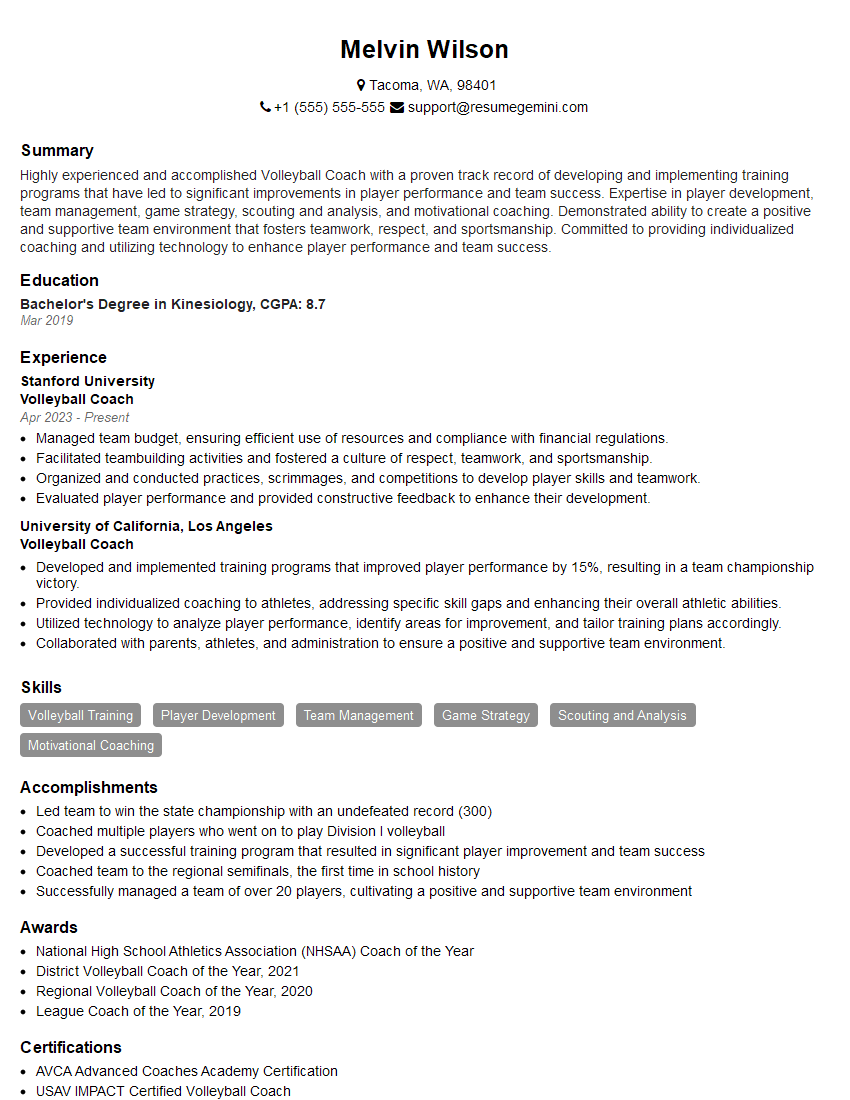
Mastering technical volleyball knowledge is crucial for career advancement in coaching, performance analysis, sports science, and other related fields. A strong understanding of these concepts demonstrates expertise and allows you to contribute significantly to a team’s success. To maximize your job prospects, create an ATS-friendly resume that highlights your skills and experience effectively. ResumeGemini is a trusted resource that can help you build a professional and impactful resume. Examples of resumes tailored to Technical Volleyball Knowledge are available to help guide you through the process.
Explore more articles
Users Rating of Our Blogs
Share Your Experience
We value your feedback! Please rate our content and share your thoughts (optional).
What Readers Say About Our Blog
Very informative content, great job.
good