Feeling uncertain about what to expect in your upcoming interview? We’ve got you covered! This blog highlights the most important Valance and Cornice Construction interview questions and provides actionable advice to help you stand out as the ideal candidate. Let’s pave the way for your success.
Questions Asked in Valance and Cornice Construction Interview
Q 1. What types of materials are commonly used in valance and cornice construction?
The materials used in valance and cornice construction are diverse, chosen based on factors like style, budget, and desired durability. Common choices include:
- Wood: Provides a classic, sturdy look. Various types are used, from lightweight pine for simpler designs to richer hardwoods like oak or cherry for more elaborate cornices. Wood often requires painting or staining to match the décor.
- MDF (Medium-Density Fiberboard): A cost-effective alternative to solid wood, MDF is easily carved and shaped, making it popular for intricate designs. It requires priming and painting to achieve a finished look.
- Foam Core: Lightweight and easy to work with, foam core is ideal for less demanding applications or for creating lightweight, decorative elements. It’s often covered with fabric.
- Fabric: An essential component, especially for valances. Options range from simple cotton and linen to more luxurious silks, velvets, and brocades. The fabric choice significantly influences the overall style and drape of the valance.
- Hardware: This includes brackets, screws, and other fastening elements required for secure installation. The choice of hardware should complement the overall aesthetic.
The selection of materials often involves balancing aesthetics with practicality and budget constraints. For instance, a formal living room might call for a solid wood cornice, whereas a child’s bedroom might be better suited to a lighter, more durable MDF valance.
Q 2. Describe your experience with different valance and cornice styles.
My experience encompasses a wide range of valance and cornice styles, from traditional to contemporary. I’ve worked with:
- Box Pleated Valances: These offer a classic, clean look achieved through precisely folded fabric panels.
- Swag and Jabot Valances: More ornate and dramatic, these feature draped fabric sections creating a luxurious feel. The precise shaping and draping require significant skill.
- Simple Board Cornices: These provide a minimalist, clean line, often used in modern or contemporary settings.
- Decorative Cornices with Mouldings: More elaborate cornices, incorporating carved or molded details, add architectural interest to a room. These can be quite intricate in design and construction.
- Fabric-covered Cornices: These combine the structural support of a solid core (wood or MDF) with the softness and decorative appeal of fabric.
Each style necessitates a different approach to construction and installation, demanding a deep understanding of materials, techniques, and the desired aesthetic outcome. For example, achieving the perfect drape in a swag and jabot valance requires precise fabric manipulation and careful consideration of the weight and texture of the fabric.
Q 3. How do you measure for valances and cornices?
Accurate measurements are crucial for a successful valance and cornice installation. The process involves several key steps:
- Determine the length and width: Measure the window or area to be covered accurately. For valances, measure the width of the window and add extra fabric for pleats or fullness. For cornices, measure the length of the area you wish to cover, ensuring a proper overhang on either side.
- Measure the height: For valances, measure the desired drop from the top of the window frame or the ceiling. For cornices, measure the distance from the wall to the desired projection.
- Consider the window treatments: If the valance or cornice is paired with curtains or blinds, account for their depth and overlap in your measurements.
- Note any obstructions: Identify any obstacles, such as crown molding or recessed lighting, that might affect the installation.
- Record all measurements carefully: Keep a detailed record of all measurements, including sketches or diagrams for complex shapes.
Using a measuring tape and a level is essential for precise measurements. Always double-check measurements to avoid costly errors.
Q 4. Explain the process of installing a valance.
Installing a valance involves several steps:
- Prepare the header board: Construct or acquire the header board (wood, MDF, or foam core) according to the measurements taken. Ensure it is properly primed and painted if necessary.
- Attach the header board: Securely attach the header board to the wall or window frame using appropriate fasteners. Ensure it is level and securely fixed.
- Prepare the fabric: Cut and hem the fabric according to the required dimensions and style of the valance (adding seam allowance). Iron the fabric for a crisp look.
- Attach the fabric: Securely attach the fabric to the header board using staples, tacks, or adhesive, ensuring even tension and smooth draping. This can be done directly or with the help of an interlining for better structure.
- Install the header board assembly: Mount the completed valance assembly to the wall or window frame using appropriate brackets or other hardware. Ensure it is level and securely fixed.
The specific method of attaching the fabric will depend on the valance’s style and the fabric used. For instance, box pleated valances require precise folding and securing, while simpler designs may involve simpler attachment techniques.
Q 5. What are the common challenges encountered during valance and cornice installation?
Common challenges during valance and cornice installation include:
- Inaccurate measurements: Leading to ill-fitting valances or cornices.
- Uneven surfaces: Requiring extra steps to ensure a level and secure installation.
- Difficult-to-access areas: Making installation more challenging and time-consuming.
- Working with complex designs: Requiring precise cutting, shaping, and assembly skills.
- Matching fabrics and textures: Ensuring consistent color and texture when using multiple fabric pieces or combining fabrics with other materials.
- Dealing with existing architectural details: Integrating the valance or cornice with existing crown molding or other architectural features.
Careful planning and preparation, including accurate measurements and a thorough understanding of the project’s specifics, significantly minimize these challenges.
Q 6. How do you handle difficult installations?
Handling difficult installations requires a combination of experience, problem-solving skills, and the right tools. My approach involves:
- Thorough assessment: Carefully analyze the challenges and develop a strategy to address them. This might involve using specialized tools or techniques.
- Creative solutions: Finding innovative ways to overcome obstacles. For instance, using shims to level uneven surfaces or employing specialized cutting tools for intricate designs.
- Adaptability: Being flexible and willing to adjust plans as needed based on unforeseen issues encountered during the installation process.
- Attention to detail: Ensuring that every step is executed with precision to avoid errors and guarantee a successful outcome. This includes double-checking measurements and carefully inspecting the finished product.
- Seeking assistance when needed: If faced with extremely complex or unusual situations, I’m not afraid to seek help from colleagues or specialists.
For example, I once encountered a project with severely uneven walls. By carefully measuring each section and using shims to level the header board, I ensured a perfectly straight and secure installation.
Q 7. Describe your experience working with different fabrics.
My experience encompasses a broad spectrum of fabrics, each with unique properties that influence the design and installation process:
- Lightweight fabrics (e.g., cotton, linen, voile): These are easy to work with, but may require interlining for better structure and drape, especially in valances with more elaborate designs.
- Medium-weight fabrics (e.g., chintz, damask): Offer a good balance of drape and structure, making them versatile for various styles.
- Heavyweight fabrics (e.g., velvet, brocade): Create a luxurious look but require more care during handling and installation; their weight may necessitate additional support.
- Specialty fabrics: These include fabrics with unique patterns, textures, or finishes that may require specialized handling and care during installation to maintain their aesthetic qualities.
Understanding the properties of different fabrics is crucial for selecting the appropriate materials for a specific project and for ensuring successful installation. For example, the weight and drape of a heavy velvet will greatly influence the design and construction of the valance to ensure it hangs properly without being too bulky.
Q 8. How do you ensure proper alignment and symmetry during installation?
Ensuring proper alignment and symmetry in valance and cornice installation is paramount for a professional finish. It’s like building a perfectly balanced cake – even the slightest misalignment throws off the entire aesthetic.
- Precise Measurements: I begin with meticulous measurements of the window or wall space. Using a laser level ensures accuracy and helps avoid common mistakes.
- Center Point Determination: I carefully identify the center point of the installation area. This becomes the reference point for all subsequent measurements and placements. Think of it as the central axis of a perfectly balanced wheel.
- Marking and Layout: I use a pencil to mark the placement points on the wall or ceiling, meticulously checking the symmetry before any fastening begins. This step is crucial to prevent costly rework later on.
- Level and Plumb Check: Throughout the installation process, I frequently use a level and a plumb bob to ensure that everything is perfectly aligned both horizontally and vertically. This is particularly important for cornices, as any misalignment becomes very noticeable.
- Test Fitting: Before final fastening, I perform a test fit to verify the alignment and symmetry. This allows for adjustments before permanently attaching the valance or cornice.
By following these steps, I guarantee a perfectly aligned and symmetrical installation, resulting in a polished and professional appearance.
Q 9. What safety precautions do you take during installation?
Safety is my top priority during any installation. Working at heights or with power tools demands utmost caution. My approach is methodical and incorporates several key safety measures.
- Proper PPE: I always wear appropriate personal protective equipment (PPE), including safety glasses, gloves, and a dust mask, to protect myself from potential hazards like flying debris and harmful particles.
- Secure Work Area: I ensure a stable and secure work area, using scaffolding or a sturdy ladder when working at heights and always maintaining three points of contact. This is non-negotiable.
- Power Tool Safety: When using power tools like saws or drills, I ensure they are in perfect working order, and always follow the manufacturer’s safety guidelines. Using sharp blades and bits is critical, as dull tools increase the risk of accidents.
- Fall Protection: When working at heights, I always employ appropriate fall protection measures, such as harnesses and safety lines. This precaution is essential to mitigate the risk of serious injury.
- Tool Storage: Proper tool storage and organization is key to a safe and efficient work environment. Tools are always put away securely when not in use.
Adhering to these safety protocols not only protects me but also ensures the quality of the finished product. A safe work environment allows for focus and precision.
Q 10. How do you maintain the quality and durability of the finished product?
Maintaining the quality and durability of the finished product requires attention to detail at every stage, from material selection to the final finish.
- High-Quality Materials: I always source high-quality, durable materials – whether it’s wood, plaster, or polyurethane – that are resistant to warping, cracking, and fading. Using inferior materials is false economy.
- Proper Preparation: Thorough surface preparation before installation is critical. This includes cleaning, sanding, and priming to ensure proper adhesion and prevent future problems.
- Precise Cutting and Joining: Accurate cuts and strong joints are essential for a durable structure. I use the appropriate tools and techniques to ensure clean, precise cuts and strong, lasting joints.
- Appropriate Finishes: I apply high-quality paints, stains, or sealants to protect the finished product from moisture, UV damage, and general wear and tear. The right finish enhances both looks and durability.
- Regular Maintenance: While not directly related to construction, I always advise clients on proper maintenance to prolong the lifespan of their valances and cornices. A little care can go a long way.
By meticulously following these steps, I ensure that my valances and cornices remain beautiful and functional for many years to come.
Q 11. What tools and equipment are essential for valance and cornice construction?
The tools and equipment needed for valance and cornice construction vary depending on the materials used and the complexity of the design, but some essentials include:
- Measuring Tools: Tape measure, laser level, square, plumb bob
- Cutting Tools: Miter saw, hand saw, jigsaw (for intricate cuts), coping saw
- Joining Tools: Clamps, wood glue, nails, screws, dowels
- Finishing Tools: Sandpaper (various grits), paintbrushes, rollers, spray gun (for larger projects)
- Safety Equipment: Safety glasses, gloves, dust mask, hearing protection, ladder/scaffolding
- Other: Woodworking planes, chisels, router (for decorative elements), caulking gun
Having the right tools is crucial for efficiency, accuracy, and safety. I always ensure that my equipment is well-maintained and in good working condition.
Q 12. Describe your experience with different types of woodworking tools.
My experience with woodworking tools spans many years and encompasses a wide range of tools and techniques.
- Hand Tools: I’m proficient with various hand tools, including chisels, planes, saws, and files. These tools are indispensable for fine detail work and intricate designs. I’ve used them to create custom mouldings and intricate carvings for many clients.
- Power Tools: I’m equally comfortable with power tools like routers, table saws, miter saws, and planers. These tools increase efficiency and precision, especially on larger projects. For example, a router can effortlessly create intricate profiles on a cornice.
- Specialized Tools: Depending on the project, I may also utilize specialized tools such as molding machines or CNC routers for more complex designs. This allows for high levels of accuracy and repeatability.
My experience allows me to select the most appropriate tool for any given task, ensuring both efficiency and a high-quality finish. The right tool in the right hands makes all the difference.
Q 13. How do you deal with damaged or defective materials?
Dealing with damaged or defective materials requires a careful and methodical approach.
- Inspection: Upon receiving materials, I carefully inspect them for any defects. This prevents incorporating flawed pieces into the project.
- Replacement: If defects are found, I immediately contact the supplier for replacements. Timely replacement is crucial to keep projects on schedule.
- Repair (when feasible): In some cases, minor defects can be repaired. However, this is only done if the repair doesn’t compromise the structural integrity or the aesthetic appeal of the finished product. I’ll always consult the client on this option.
- Documentation: I always maintain thorough documentation of any damaged or defective materials, including photos and communication with suppliers. This protects both the client and myself.
Proactive identification and management of damaged materials ensure the timely and successful completion of every project, protecting the client’s investment.
Q 14. What is your experience with custom designs and client specifications?
I have extensive experience working with custom designs and client specifications. This is often the most rewarding aspect of my work.
- Consultation: I begin by meeting with clients to understand their vision, discussing their preferences, and reviewing their design ideas. Active listening is crucial.
- Design Development: I collaborate with clients to refine their ideas, offering suggestions and ensuring that the design is both aesthetically pleasing and structurally sound. Sometimes, a small tweak makes a huge difference.
- Material Selection: I help clients select appropriate materials based on their budget, desired aesthetic, and the intended lifespan of the project. Material choices impact both the look and the cost of the project.
- Detailed Drawings: I create detailed drawings and specifications to ensure that everyone is on the same page. A picture is worth a thousand words, especially in construction.
- Project Management: I oversee the entire process, from design to installation, ensuring that the final product meets the client’s expectations. Client satisfaction is paramount.
I thrive on the challenge of creating unique and personalized valances and cornices that perfectly complement the client’s style and home.
Q 15. How do you estimate the time and cost for a valance and cornice project?
Estimating time and cost for a valance and cornice project involves a detailed breakdown of several factors. It’s not a simple formula, but rather a process of careful assessment.
- Measurements and Design Complexity: The intricacy of the design significantly impacts time. A simple box valance will be quicker than an elaborate swaged cornice with multiple layers and curves. I always allow extra time for unexpected complexities discovered during installation.
- Material Selection: Heavier fabrics, intricate woodwork, or specialized hardware add to both time and cost. For example, hand-carved wooden cornices will take considerably longer and cost more than simpler, pre-fabricated options.
- Labor Costs: This depends on the number of installers needed, their hourly rates, and the overall project scope. I factor in travel time and potential overtime.
- Material Costs: This includes the cost of fabric, wood, hardware, adhesives, and finishing materials. I work with clients to identify cost-effective alternatives without compromising quality.
- Contingency: I always include a contingency buffer (typically 10-15%) to account for unforeseen issues, like material defects or adjustments needed on site.
For example, a simple valance for a standard window might take a day and cost between $200-$400, while a large, elaborate cornice project could take a week or more and cost several thousand dollars. I provide detailed, itemized quotes to ensure transparency.
Career Expert Tips:
- Ace those interviews! Prepare effectively by reviewing the Top 50 Most Common Interview Questions on ResumeGemini.
- Navigate your job search with confidence! Explore a wide range of Career Tips on ResumeGemini. Learn about common challenges and recommendations to overcome them.
- Craft the perfect resume! Master the Art of Resume Writing with ResumeGemini’s guide. Showcase your unique qualifications and achievements effectively.
- Don’t miss out on holiday savings! Build your dream resume with ResumeGemini’s ATS optimized templates.
Q 16. Explain your experience with project management.
My project management experience spans over 15 years. I manage projects by following a structured approach ensuring both efficiency and client satisfaction.
- Initial Consultation: This includes a thorough site visit, detailed measurements, and discussions about design preferences and budget.
- Detailed Proposal: I provide a comprehensive proposal outlining the scope of work, materials, timeline, and cost breakdown.
- Scheduling and Procurement: I manage the scheduling of installers and subcontractors and ensure timely procurement of all necessary materials.
- On-site Supervision: I supervise the installation process, ensuring adherence to safety standards and quality control.
- Regular Communication: I maintain open communication with clients, providing updates and addressing concerns promptly.
- Project Completion and Handover: This includes a final inspection, addressing any finishing touches, and providing client instruction on care and maintenance.
One particularly challenging project involved the restoration of antique cornices in a historic building. Careful planning and meticulous execution, combined with constant communication with the preservation society, ensured the successful completion of the project to the client’s and historical society’s full satisfaction.
Q 17. How do you maintain a clean and organized work area?
Maintaining a clean and organized work area is paramount for safety, efficiency, and professional presentation. My approach involves several key steps:
- Pre-Project Preparation: Before starting, I ensure the work area is clear of obstructions. This involves protecting the floor and covering furniture with drop cloths.
- Organized Tool Storage: I use labeled containers and tool belts to keep tools organized and readily accessible. This prevents unnecessary searching and minimizes the risk of accidents.
- Waste Management: I regularly dispose of waste materials, keeping the work area free from clutter. I follow all local regulations regarding waste disposal.
- Regular Cleaning: I take breaks throughout the day to clean up debris and keep the workspace tidy. This also helps maintain a professional image for the client.
- Post-Project Cleanup: At the end of the project, I conduct a thorough cleanup, removing all tools, materials, and waste.
I believe a clean work area leads to a more efficient and safer workflow, ultimately resulting in a higher-quality finished product. It also demonstrates respect for the client’s property.
Q 18. How do you handle customer complaints or concerns?
Handling customer complaints or concerns is a crucial aspect of providing excellent service. My approach emphasizes active listening, understanding, and finding mutually agreeable solutions.
- Listen Empathetically: I actively listen to the client’s concerns without interruption, ensuring I fully understand their perspective.
- Acknowledge and Validate: I acknowledge the validity of their concerns, even if I don’t necessarily agree with their assessment. A simple phrase like, “I understand your frustration” can go a long way.
- Investigate Thoroughly: I thoroughly investigate the issue, gathering all necessary information to determine the cause and potential solutions.
- Propose Solutions: I propose concrete solutions, outlining the steps I will take to rectify the problem. This may involve adjustments, repairs, or replacements.
- Follow Up: I follow up with the client to ensure they are satisfied with the resolution.
In one instance, a client had concerns about the color of the fabric used. After a careful review and discussion, we discovered a slight mismatch due to lighting conditions during installation. I replaced the fabric section at no extra cost, ensuring the client’s satisfaction and maintaining a positive business relationship.
Q 19. What are the key differences between various valance construction techniques?
Valance construction techniques vary significantly depending on the desired style and complexity. Here are key differences:
- Box Valances: Simple, rectangular structures, often made from fabric stretched over a wooden frame. They’re easy to construct and cost-effective.
- Swag and Cascade Valances: More elaborate designs involving draped fabric, creating soft, flowing lines. These require more skill and precision in fabric manipulation and measuring.
- Tailored Valances: Similar to curtains, these valances offer a more formal and structured look. They may be lined and require precise sewing and finishing.
- Cornice Valances: These use a rigid board or molding as a base, often embellished with decorative trim. This is the most structural approach and allows for intricate designs.
- DIY Techniques: Simpler valances can be constructed using readily available materials and simpler techniques, while more complex styles typically require professional expertise.
The choice of technique depends on factors such as the client’s budget, aesthetic preferences, and the overall style of the room. I discuss the options with clients to find the best match for their needs and budget.
Q 20. How do you select appropriate hardware for valance and cornice installations?
Selecting appropriate hardware is vital for both the functionality and aesthetic appeal of valances and cornices. My selection process involves considering several factors:
- Weight of the Valance/Cornice: Heavier pieces require stronger and more robust hardware to ensure secure attachment.
- Material Compatibility: Hardware should be compatible with the materials used in the valance or cornice (wood, metal, fabric).
- Mounting Location: The type of wall or ceiling will influence the hardware choice. Drywall requires different fasteners than solid plaster or brick.
- Aesthetic Considerations: The hardware should complement the overall design style. A modern valance might use sleek, minimalist hardware, whereas a traditional cornice might use ornate brackets.
- Durability and Finish: The hardware should be durable and resistant to wear and tear. The finish should match the overall décor.
For example, I might use heavy-duty brackets and screws for a large, wooden cornice, but smaller hooks and rings for a lightweight fabric valance. I always ensure hardware is installed correctly and securely for longevity and safety.
Q 21. What are the common problems encountered with fabric selection for valances?
Fabric selection for valances presents several challenges. Careful consideration must be given to several properties:
- Weight and Drape: Heavy fabrics can be difficult to manipulate and might require stronger support structures. Lightweight fabrics might lack the body needed for certain styles.
- Durability and Cleanability: Fabrics should be durable enough to withstand regular use and cleaning. Stain resistance and washability are important considerations, especially for high-traffic areas.
- Colorfastness: The fabric’s color should not fade or bleed due to light exposure or cleaning. I always check the manufacturer’s information on colorfastness before making a selection.
- Texture and Pattern: The texture and pattern of the fabric significantly impact the overall aesthetic. This must complement the room’s décor and style.
- Maintenance Requirements: Some fabrics require specialized cleaning methods or treatments, increasing the overall cost and maintenance needs.
I often advise clients to select fabrics that balance aesthetics, practicality, and ease of maintenance. For instance, a durable linen blend might be suitable for a high-traffic room, while a delicate silk would be better suited for a less-used space.
Q 22. Describe your experience with different types of cornice boards.
My experience encompasses a wide range of cornice boards, from the simplest polyurethane molding to intricate, hand-carved wooden pieces. I’m familiar with various materials including wood (e.g., pine, oak, MDF), polyurethane, plaster, and even high-end materials like plaster-of-Paris for truly bespoke projects. Each material presents unique challenges and opportunities. For instance, polyurethane is easily manipulated and cost-effective, ideal for quick installations and projects with tighter budgets. Wood, on the other hand, allows for intricate detailing and a more luxurious finish but requires more skill and precision in cutting, shaping and installation. Plaster cornices, while offering an elegant look, require more experience due to their fragility and the need for precise application and drying.
- Polyurethane: Lightweight, easy to cut and install, versatile, cost-effective.
- Wood: Durable, allows for intricate designs, requires skilled craftsmanship, higher cost.
- Plaster: Elegant finish, fragile during installation, requires specialized tools and expertise.
I’ve worked on projects ranging from simple, modern designs using sleek polyurethane cornices to elaborate Victorian-style installations requiring intricate, hand-carved wooden pieces. This diverse experience allows me to select the optimal material and design to suit any client’s needs and aesthetic preferences.
Q 23. Explain how you ensure a professional finish on valances and cornices.
Achieving a professional finish on valances and cornices involves meticulous attention to detail throughout the entire process, from initial measurements and cutting to final installation and finishing. This includes precision cutting to ensure clean lines and perfect mitered corners. Any gaps or imperfections are unacceptable. I always use high-quality caulking and paintable fillers to seamlessly blend materials and eliminate any visible joints.
Proper preparation is crucial. Before installation, I carefully prime and sand all surfaces to ensure a smooth, even base for the paint. I meticulously apply paint using high-quality brushes and rollers, ensuring even coverage and avoiding drips or runs. Finally, a thorough final inspection checks for any imperfections before declaring the job complete. It’s about more than just attaching the cornice – it’s about creating a seamless, aesthetically pleasing integration with the existing decor.
For example, when installing a wooden cornice, I meticulously sand the edges and corners to prevent splintering or roughness, and I use a fine-grit sandpaper to achieve a smooth surface before painting. With polyurethane, I often use a paintable caulk to fill tiny gaps, ensuring a perfect, flush fit to the wall. These are small details that significantly elevate the professional look.
Q 24. How do you troubleshoot common installation problems?
Troubleshooting common installation problems requires a systematic approach. I start by identifying the specific issue. Is it a measurement error? A problem with the materials? A difficulty with installation techniques?
- Inconsistent measurements: Re-measuring and adjusting cuts are essential. Double-checking measurements against the window frame is a crucial step in preventing issues.
- Gaps or misalignment: This can be caused by improper cuts or inaccurate fitting. High-quality fillers and caulking are crucial to resolve these, allowing for a professional finish. Careful sanding after filling is key.
- Material damage: This might require replacing damaged sections, which requires ordering matching material and carefully matching the existing finish.
I always keep a small arsenal of tools and materials on hand to fix minor problems immediately, including wood filler, caulk, sandpaper, and touch-up paint. In the rare event of a more complex issue, I analyze the situation and work with the customer to find the best solution, often including consulting the manufacturer’s guidelines.
Q 25. Describe your experience working with different types of window treatments.
My experience includes working with various window treatments, including curtains, blinds, shades, and shutters. Understanding how cornices and valances interact with these treatments is essential for a cohesive design. For instance, a valance installed above curtains should complement the fabric and style of the curtains, providing a visually appealing transition. Cornices can be custom designed to integrate seamlessly with blinds or shutters. The goal is to create a balanced and aesthetically pleasing window treatment solution.
On several projects, I’ve collaborated with interior designers to ensure the cornice or valance perfectly complements the overall design concept and integrates smoothly with other window treatments. A project that stands out involved installing a custom-made wooden cornice that incorporated a hidden track system for sheer curtains, offering both functionality and visual appeal.
Q 26. How do you ensure proper ventilation when installing valances?
Proper ventilation is crucial to prevent moisture buildup and potential mold growth, especially in areas with high humidity. While valances themselves don’t directly impede airflow, improper installation can. I ensure adequate ventilation by avoiding completely sealing the valance to the wall, allowing a small air gap. This gap can be created by using spacers or carefully adhering to the manufacturer’s installation instructions, if applicable. Additionally, I always choose materials that allow some breathability, such as wood or breathable fabrics.
In bathrooms or kitchens, where humidity is higher, I would recommend using moisture-resistant materials like polyurethane or properly sealed wood and incorporating extra ventilation measures, potentially consulting with a ventilation specialist to ensure optimal airflow.
Q 27. What are your experience working in compliance with building codes?
Compliance with building codes is paramount. I am familiar with local and national building codes related to window treatments, including regulations on fire safety, material specifications, and installation methods. This includes understanding requirements for fire-resistant materials in certain areas and ensuring that the chosen materials and installation methods meet all relevant safety standards. I always obtain necessary permits when required and ensure my work adheres strictly to all applicable regulations. Before starting any project, I thoroughly review the relevant building codes and ensure the materials and installation techniques I use comply with them.
Q 28. How do you work effectively as part of a team?
Effective teamwork is crucial in this field. I excel at collaborating with designers, contractors, and other tradespeople. I’m comfortable communicating effectively, providing clear updates on my progress, and adapting to the needs of the team. A recent project involved coordinating with an electrician to ensure proper placement of lighting fixtures around the installed cornices. Open communication and a willingness to compromise are key for successful collaboration. I also value being able to actively listen and contribute my unique skills and expertise to the overall project success.
Key Topics to Learn for Valance and Cornice Construction Interview
- Understanding Valance and Cornice Types: Familiarize yourself with the different types of valances and cornices (e.g., box valances, swag valances, crown moldings), their design features, and appropriate applications in various architectural styles.
- Material Selection and Properties: Learn about common materials used in valance and cornice construction (wood, plaster, polyurethane, etc.), their strengths, weaknesses, and suitability for different projects. Understand factors influencing material choice, such as budget, durability, and aesthetic preferences.
- Installation Techniques and Best Practices: Study the practical aspects of installing valances and cornices, including accurate measurements, proper fastening methods, and finishing techniques. Consider different installation scenarios and potential challenges.
- Design Principles and Aesthetics: Develop an understanding of how valances and cornices contribute to overall interior design. Explore design principles like balance, proportion, and scale, and how these apply to the selection and placement of these architectural elements.
- Blueprint Reading and Interpretation: Practice interpreting architectural blueprints and specifications related to valances and cornices to accurately understand project requirements.
- Problem-Solving and Troubleshooting: Prepare for scenarios where you might encounter unexpected problems during installation or design. Think through how you would approach troubleshooting common issues and finding solutions.
- Safety Procedures and Regulations: Understand relevant safety regulations and procedures for working with construction materials and tools.
Next Steps
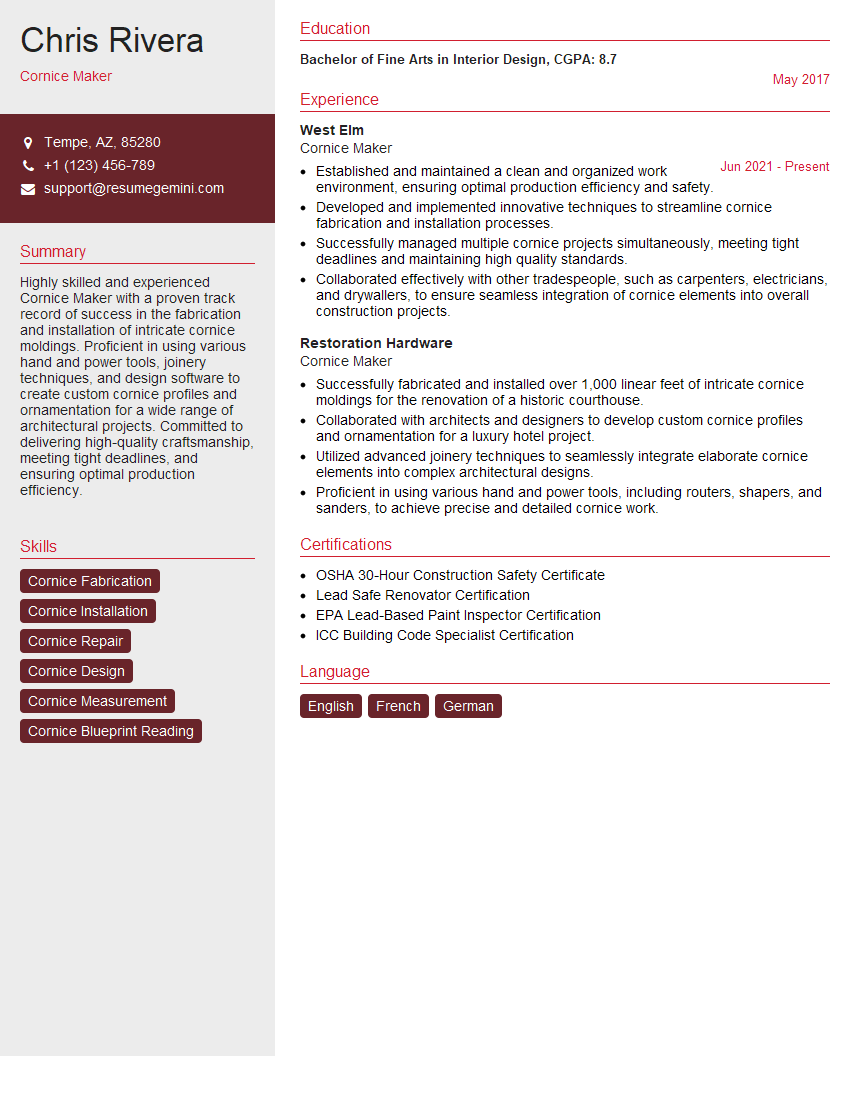
Mastering the intricacies of valance and cornice construction demonstrates a commitment to detail and craftsmanship, highly valued in the construction industry. This expertise opens doors to diverse and rewarding career opportunities, allowing you to showcase your skills and advance professionally. To significantly boost your job prospects, create a compelling and ATS-friendly resume that highlights your relevant skills and experience. We strongly recommend leveraging ResumeGemini, a trusted resource for crafting professional resumes that stand out. ResumeGemini provides examples of resumes tailored to Valance and Cornice Construction companies, helping you create a document that effectively presents your qualifications to potential employers.
Explore more articles
Users Rating of Our Blogs
Share Your Experience
We value your feedback! Please rate our content and share your thoughts (optional).
What Readers Say About Our Blog
Very informative content, great job.
good