The thought of an interview can be nerve-wracking, but the right preparation can make all the difference. Explore this comprehensive guide to Flight Control interview questions and gain the confidence you need to showcase your abilities and secure the role.
Questions Asked in Flight Control Interview
Q 1. Explain the difference between open-loop and closed-loop control systems in flight control.
Open-loop and closed-loop control systems differ fundamentally in how they maintain desired aircraft behavior. Imagine driving a car: in an open-loop system, you set the steering wheel to a certain angle (your input), and the car responds accordingly, without any feedback on whether it’s actually going where you intend. You’re blindly relying on the car’s mechanics. In a closed-loop system (feedback control), you’d continuously monitor the car’s position (using sensors) and adjust the steering based on its deviation from your desired path. This constant feedback ensures better accuracy and robustness.
In flight control, an open-loop system might involve pre-programmed commands to control the aircraft’s flight path. For example, a simple autopilot might rely solely on pre-calculated commands to maintain altitude based on time and speed. This is generally less accurate and susceptible to disturbances like wind gusts. A closed-loop system, however, incorporates sensors measuring the actual altitude, comparing it to the desired altitude, and adjusting the control surfaces accordingly to correct any deviations. This continuous feedback ensures stability and precision.
In summary, open-loop systems are simpler but less accurate, while closed-loop systems are more complex but offer significantly better precision and adaptability to changing conditions. Modern flight control systems almost exclusively use closed-loop architectures.
Q 2. Describe the role of sensors in a flight control system.
Sensors are the eyes and ears of a flight control system, providing essential real-time data about the aircraft’s state. Without accurate sensor data, the control system is blind and can’t effectively maintain stability or execute maneuvers. Key sensors include:
- Accelerometers: Measure linear acceleration in various axes, crucial for determining aircraft attitude and velocity changes.
- Gyroscopes: Detect angular rates (rotation) around the aircraft’s axes, helping determine its orientation and rate of turn.
- Air Data Sensors (ADS): Provide information about airspeed, altitude, and air pressure, essential for navigation and performance monitoring.
- GPS Receivers: Determine the aircraft’s position and velocity relative to the Earth’s surface.
- Angle of Attack (AOA) sensors: Measure the angle between the aircraft’s wing and the oncoming airflow, important for stall avoidance.
- Magnetometers: Measure the Earth’s magnetic field to determine heading.
The quality and accuracy of sensor data are paramount to the successful operation of the entire flight control system. Sensor failures can lead to catastrophic consequences, hence redundancy and fault detection mechanisms are often incorporated.
Q 3. What are the key components of a typical flight control system architecture?
A typical flight control system architecture comprises several interconnected components:
- Sensors: As discussed earlier, these provide real-time data about the aircraft’s state.
- Signal Conditioning Unit: This component processes the raw sensor signals, filtering out noise and converting them into a usable format.
- Flight Control Computer (FCC): The brain of the system; it receives processed sensor data, compares it to desired commands, calculates necessary control surface deflections, and sends commands to the actuators.
- Flight Control Laws: These are algorithms, or sets of mathematical equations, that determine how the FCC responds to sensor data and commands. They define the control system’s behavior.
- Actuators: These convert the FCC’s commands into physical movements of the control surfaces (ailerons, elevators, rudder).
- Control Surfaces: These are the moving parts of the aircraft (ailerons, elevators, rudder, flaps, slats) that manipulate airflow to control the aircraft’s attitude and trajectory.
This architecture ensures a closed-loop control system, where sensor feedback continually adjusts the control surfaces to maintain stable and predictable flight.
Q 4. Explain the concept of stability augmentation systems.
Stability augmentation systems (SAS) are crucial components in many flight control systems, especially for aircraft that are inherently unstable or have undesirable handling qualities. They enhance the aircraft’s stability by actively compensating for undesirable dynamics and disturbances. Imagine trying to balance a pencil on its tip – it’s inherently unstable. SAS acts like a skilled hand, constantly making small adjustments to counteract any deviations and keep the aircraft stable.
For example, some aircraft designs have a tendency to oscillate or experience undesirable yaw motion. An SAS would continuously monitor these motions using sensors (like gyroscopes and accelerometers) and provide corrective inputs to the control surfaces, damping the oscillations and improving stability. This results in a more comfortable and controllable flight experience for the pilot. SAS enhance safety and makes it easier to control the aircraft, especially in turbulent conditions.
Q 5. Describe different types of flight control actuators and their applications.
Flight control actuators are the muscle of the flight control system, converting the electrical signals from the FCC into mechanical movement of the control surfaces. Different types exist, each with its own strengths and weaknesses:
- Hydraulic Actuators: These are powerful and widely used, providing high force and precision. They are often preferred for large aircraft where significant forces are required to move control surfaces.
- Electric Actuators: These are becoming increasingly popular due to their lighter weight, higher reliability, and easier maintenance compared to hydraulic systems. They are well-suited for smaller aircraft and UAVs.
- Electromechanical Actuators: These combine electric motors with mechanical components to achieve precise control. They offer a good balance between power and efficiency.
- Pneumatic Actuators: These use compressed air to move control surfaces, often employed in less demanding applications or as backup systems.
The choice of actuator depends on factors such as aircraft size, required force, weight constraints, and redundancy requirements. For instance, a large airliner would likely use hydraulic actuators for their power, while a small UAV might rely on lightweight electric actuators.
Q 6. What are the challenges of designing flight control systems for unmanned aerial vehicles (UAVs)?
Designing flight control systems for unmanned aerial vehicles (UAVs) presents unique challenges compared to manned aircraft:
- Weight and Size Constraints: UAVs often have strict limitations on weight and size, requiring compact and lightweight actuators and components.
- Power Limitations: UAVs typically operate on batteries, limiting the power available for flight control systems. Efficient power management is critical.
- Environmental Factors: UAVs may operate in harsh environments with high winds, extreme temperatures, and unpredictable conditions, requiring robust and reliable flight control systems.
- Autonomous Operation: UAVs often operate autonomously, requiring sophisticated algorithms for navigation, obstacle avoidance, and mission execution. This demands advanced flight control software and artificial intelligence.
- Safety and Reliability: Ensuring safety and reliability is paramount, especially in scenarios involving autonomous operation and potential risks to people or property. Redundancy and fault-tolerant designs are critical.
These challenges drive innovation in areas like miniaturized sensors, efficient actuators, and advanced control algorithms. The development of robust and reliable flight control systems is crucial for the continued growth of UAV technology.
Q 7. Explain the concept of gain scheduling in flight control.
Gain scheduling is a control technique used to adapt the flight control system’s performance to changing flight conditions. Imagine driving a car: you’d steer differently at high speeds than at low speeds. Gain scheduling is analogous to adjusting the steering sensitivity based on speed. It improves the control system’s performance across a wide range of operating points.
In flight control, aircraft dynamics vary significantly with altitude, airspeed, and angle of attack. Gain scheduling involves modifying the control system’s gains (parameters that determine the strength of the controller’s response) based on these varying flight conditions. This ensures optimal performance and stability across the entire flight envelope. For example, at high altitudes, the air is thinner, affecting the aircraft’s responsiveness. Gain scheduling would adjust the gains to compensate for this, maintaining predictable handling qualities.
Gain scheduling improves the robustness of the flight control system, allowing it to effectively handle a wider range of operational conditions. It leads to better performance, enhanced stability, and improved safety.
Q 8. How do you handle sensor failures in a flight control system?
Sensor failures are a critical concern in flight control systems, as inaccurate or missing data can lead to catastrophic consequences. Handling them involves a multi-layered approach, prioritizing redundancy and robust fault detection and isolation (FDI) techniques. Imagine a scenario where your car’s speedometer fails – you’d likely rely on other cues like road signs or your sense of speed. Similarly, aircraft use multiple sensors for the same measurement (e.g., multiple airspeed sensors).
Redundancy: Employing multiple sensors for each critical parameter is the cornerstone of sensor failure mitigation. If one sensor fails, the system can seamlessly switch to a backup. This often includes diverse sensor types to reduce the likelihood of correlated failures.
Cross-checking and Consistency Checks: The system constantly compares readings from different sensors. Significant discrepancies trigger an alert and initiate a failure detection process. For example, if one airspeed sensor reports significantly higher speed than the others, it’s likely faulty.
Fault Detection and Isolation (FDI): Sophisticated algorithms analyze sensor data to identify faulty sensors and isolate them from the control system. These algorithms use techniques like Kalman filtering, parity checks, and analytical redundancy to estimate the true value even with faulty sensor readings.
Sensor Data Fusion: Combining data from multiple sensors through sophisticated algorithms like weighted averaging or Kalman filters provides a more robust and reliable estimate of the aircraft’s state, even with some sensor failures. This effectively reduces the impact of individual sensor errors.
Fail-Operational/Fail-Passive Modes: Design strategies ensure that the aircraft can continue to operate safely even with certain sensor failures. In a fail-operational mode, the system degrades gracefully; in a fail-passive mode, the aircraft might enter a safe state, but some control authority is lost.
Q 9. Describe your experience with flight control system simulation and modeling.
My experience in flight control system simulation and modeling spans several projects, from small UAVs to larger commercial aircraft. I’ve extensively utilized tools like MATLAB/Simulink, and specialized flight simulation software. Modeling involves creating mathematical representations of the aircraft’s dynamics, actuators, sensors, and control laws. This allows for testing various scenarios without risking a real aircraft.
For example, I worked on a project simulating the longitudinal dynamics of a small unmanned aerial vehicle (UAV). We used a 6-DOF model (six degrees of freedom) accounting for forces and moments in pitch, roll, and yaw. This model was then integrated with a control law model to assess the response to different commands and disturbances. This involved detailed modeling of the actuators, including their dynamics and saturation limits. We used Simulink to create the model and conducted extensive simulations to analyze the stability and performance of the UAV in various flight conditions, including wind gusts and sensor noise.
The process frequently includes creating high-fidelity models for validation and verification purposes, which can then be used for hardware-in-the-loop (HIL) testing, where the simulated model interacts with real flight control hardware.
Q 10. What are the common methods for designing flight control laws?
Designing flight control laws is a critical aspect of flight control system development. The goal is to create algorithms that maintain stability and achieve desired flight performance. Several methods are commonly used:
Classical Control Design: This involves using techniques like PID (Proportional-Integral-Derivative) controllers, lead-lag compensators, and root locus analysis. These methods are relatively simple to understand and implement but might struggle with highly complex systems.
Modern Control Design: This uses more advanced techniques such as state-space methods (Linear Quadratic Regulator (LQR), Linear Quadratic Gaussian (LQG)), and H-infinity control. These methods are suitable for handling multivariable systems with complex interactions, offering greater robustness and performance.
Robust Control Design: This addresses uncertainties and disturbances in the system. Methods like H-infinity and μ-synthesis ensure performance and stability even when model parameters deviate from their nominal values. Imagine a situation where the aircraft’s weight changes due to fuel consumption – robust control ensures the aircraft maintains stability and performance despite this change.
Adaptive Control: This is used when there are significant uncertainties or changes in the system over time. The controller adjusts itself to maintain performance. For example, an adaptive control system could compensate for changes in aerodynamic characteristics due to icing.
The selection of the design method depends on the aircraft complexity, performance requirements, and the level of uncertainty. Often, a hybrid approach incorporating aspects of several methods is employed.
Q 11. Explain the concept of control allocation in flight control.
Control allocation deals with distributing control commands among multiple actuators to achieve desired aircraft responses. Aircraft often have several control surfaces (ailerons, elevators, rudders, spoilers, thrust vectoring) that contribute to the overall control. Control allocation determines how to best utilize these actuators to follow pilot inputs or autopilot commands. Imagine it like this: a driver uses the steering wheel and pedals to control the car. Control allocation is like the system that translates the driver’s actions into specific movements of the wheels and brakes.
The challenges lie in handling actuator limitations (saturation, rate limits), failures, and prioritizing control authority during emergencies. Optimized allocation algorithms ensure efficient and robust control even with constraints. Techniques such as linear programming, quadratic programming, and pseudoinverse methods are often employed to solve the control allocation problem.
For instance, if one actuator fails, a clever control allocation strategy will redistribute the control commands among the remaining actuators to maintain stable flight. This might involve prioritizing control of critical parameters like pitch and roll over less critical ones.
Q 12. Describe your experience with different flight control architectures (e.g., fly-by-wire, fly-by-light).
I have extensive experience with various flight control architectures, including:
Fly-by-Wire (FBW): This replaces traditional mechanical linkages with electronic signals. It offers advantages such as improved control precision, enhanced flight envelope protection, and reduced pilot workload. I’ve worked on projects involving the design and implementation of FBW systems, including the development of flight control laws and the integration of flight management systems.
Fly-by-Light (FBL): This uses fiber optic cables instead of wires for transmitting control signals. It offers advantages in terms of weight reduction, immunity to electromagnetic interference, and increased data bandwidth. Though less common than FBW, FBL systems are becoming increasingly important in advanced aircraft applications. My experience includes simulating and analyzing the performance of FBL systems under various conditions, focusing on aspects like signal integrity and fault tolerance.
The choice of architecture depends on the aircraft type, size, and performance requirements. In some cases, hybrid architectures might be used, combining aspects of both FBW and FBL.
Q 13. What are the safety considerations in flight control system design?
Safety is paramount in flight control system design. Numerous considerations are critical:
Redundancy and Fault Tolerance: Multiple layers of redundancy are incorporated to ensure that the system can continue functioning even with component failures. This includes redundant sensors, actuators, and processing units.
Safety Integrity Levels (SILs): Formal safety assessments, often based on standards like DO-178C, are used to determine the required safety integrity level for different components and functions of the flight control system.
Fail-Operational and Fail-Safe Mechanisms: The system should be designed to either continue operating safely even with failures (fail-operational) or enter a safe state if a critical failure occurs (fail-safe). This often involves designing protective mechanisms that prevent unsafe flight conditions.
Certification: Rigorous testing and certification processes are required to ensure the flight control system meets the highest safety standards before being used in an aircraft.
Human Factors: The design should be intuitive and easy for pilots to use, even during stressful situations. Pilot training and procedures are crucial aspects of overall flight safety.
Q 14. How do you ensure the reliability and fault tolerance of a flight control system?
Ensuring reliability and fault tolerance in flight control systems requires a holistic approach. Key strategies include:
Hardware Redundancy: Multiple sensors, actuators, and processors are used to ensure that the system can continue functioning even if one component fails. This often incorporates diverse components to reduce the probability of correlated failures.
Software Redundancy: Independent software channels can perform the same function. This is crucial for detecting and mitigating software faults.
Fault Detection, Isolation, and Recovery (FDIR): Sophisticated algorithms are implemented to detect and identify faults, isolate faulty components, and recover to a safe state. This often involves sophisticated data fusion algorithms and decision-making logic.
Health Monitoring: The system constantly monitors its own health and performance. Any anomalies trigger alarms or initiate corrective actions. This includes monitoring sensor readings, actuator responses, and software execution.
Formal Methods: Rigorous mathematical techniques are used to verify the correctness and reliability of the software and algorithms. This involves verifying properties like stability and safety through model checking and formal verification techniques.
Extensive Testing: Flight control systems undergo extensive testing, including simulations and hardware-in-the-loop testing, to verify their reliability and fault tolerance under various conditions.
These strategies work together to create a system that is highly resilient to faults and ensures the continued safe operation of the aircraft.
Q 15. Explain the role of redundancy in flight control systems.
Redundancy in flight control systems is paramount for safety. It’s the practice of incorporating multiple independent systems or components to perform the same function. If one fails, others can take over, preventing catastrophic failures. Think of it like having backup systems in place – a primary flight control computer and one or more backups. Each system operates independently, constantly cross-checking each other’s outputs. This cross-checking ensures that if a single component malfunctions, the discrepancy is detected, and the system relies on the valid data from the redundant components. This layered approach is crucial because a single point of failure in a flight control system could have devastating consequences.
The level of redundancy varies depending on the aircraft’s criticality and certification requirements. A simple aircraft might have dual hydraulic systems for redundancy in flight surface actuation, while a complex airliner might have triplex or even quadruplex systems for critical functions, including flight control computers and sensors. The specific type of redundancy (e.g., active vs. passive) and the level of redundancy are meticulously evaluated during the design phase to meet safety targets.
Career Expert Tips:
- Ace those interviews! Prepare effectively by reviewing the Top 50 Most Common Interview Questions on ResumeGemini.
- Navigate your job search with confidence! Explore a wide range of Career Tips on ResumeGemini. Learn about common challenges and recommendations to overcome them.
- Craft the perfect resume! Master the Art of Resume Writing with ResumeGemini’s guide. Showcase your unique qualifications and achievements effectively.
- Don’t miss out on holiday savings! Build your dream resume with ResumeGemini’s ATS optimized templates.
Q 16. Describe your experience with flight control system testing and verification.
My experience in flight control system testing and verification spans over 15 years, encompassing various phases from unit testing to flight testing. I’ve been involved in developing and executing comprehensive test plans, including simulations, hardware-in-the-loop (HIL) testing, and flight testing. In HIL testing, we simulate real-world flight conditions to evaluate the system’s response to various inputs and potential failures. This allows us to rigorously test the system’s behavior before it ever sees actual flight. Flight testing, of course, is the ultimate verification stage, where we assess the system’s performance in a real aircraft.
During testing, I use techniques like fault injection to simulate failures and verify the system’s robustness. For instance, we might simulate sensor failures, actuator malfunctions, or software glitches to evaluate how the system reacts and the efficacy of its redundancy mechanisms. Detailed data analysis and rigorous documentation are crucial throughout the entire process to ensure traceability and compliance with regulatory requirements. I’ve worked extensively with DO-178C (Software Considerations in Airborne Systems and Equipment Certification) guidelines, ensuring the software meets the highest levels of safety and reliability.
Q 17. What are the common types of flight control system malfunctions and how are they addressed?
Common flight control system malfunctions can broadly be categorized into hardware and software issues. Hardware malfunctions could involve actuator failures (e.g., hydraulic leaks, jammed surfaces), sensor failures (e.g., faulty gyroscopes, inaccurate airspeed readings), or problems with the power distribution system. Software malfunctions can result from software bugs, memory errors, or unexpected input conditions. These can manifest in various ways, like incorrect commands being sent to actuators or faulty interpretations of sensor data.
Addressing these malfunctions involves a multi-layered approach. Redundancy, as discussed earlier, is a primary defense. Fault detection and isolation (FDI) algorithms constantly monitor system parameters and identify anomalies. Once a malfunction is detected, the system attempts to isolate the faulty component and switch to a redundant element. In some cases, the system might enter a degraded mode of operation, limiting functionality to ensure safety. Fail-operational design ensures that the system can continue to operate safely even with a single or multiple failures. Finally, comprehensive diagnostics and alerting systems provide pilots with vital information about system status and potential malfunctions.
Q 18. Explain the concept of handling qualities in flight control.
Handling qualities describe how easily and predictably an aircraft responds to pilot inputs. They are a crucial aspect of flight control system design, as they directly impact pilot workload, safety, and passenger comfort. Good handling qualities result in an aircraft that is easy to control, predictable in its response, and comfortable to fly. Poor handling qualities lead to increased pilot workload, difficulty in maintaining control, and a potentially dangerous flight experience.
Handling qualities are often assessed using metrics defined in standards like MIL-F-8785C. These metrics quantify characteristics such as responsiveness, stability, and controllability. For instance, the aircraft’s response to control inputs (like the stick or rudder) is analyzed for its speed and smoothness. Stability relates to how well the aircraft maintains its desired flight path, while controllability addresses the ease with which pilots can maneuver the aircraft. The goal is to achieve a balance between responsiveness and stability, creating a flight control system that meets both safety and performance requirements.
Q 19. How do you design a flight control system for different flight regimes (e.g., takeoff, cruise, landing)?
Flight control systems are designed differently for various flight regimes because the aerodynamic characteristics and operational requirements of the aircraft change significantly during takeoff, cruise, and landing. During takeoff, the primary concern is achieving positive climb rate and maintaining stability. The flight control system needs to provide sufficient control authority to overcome the high lift and drag forces. In cruise, the focus shifts to maintaining stability and efficiency, and the control system might emphasize smooth and precise control with minimal energy expenditure. During landing, control authority is essential for precise trajectory control and the ability to handle crosswinds and other atmospheric disturbances.
This is achieved through scheduling and gain adjustments to the flight control laws. For example, the gain of the control system might be increased during takeoff to provide quicker responsiveness, while it might be reduced during cruise to prevent overreactions to minor disturbances. Different control laws, or even separate control systems, can be used for each flight regime. This approach ensures optimal performance and safety throughout the flight envelope. Flight control systems typically incorporate sensors (air data, inertial) that provide real-time information about the aircraft’s state, and these inputs are used to adjust the control system accordingly, dynamically modifying the parameters based on the current flight condition.
Q 20. What are the challenges of integrating flight control systems with other aircraft systems?
Integrating flight control systems with other aircraft systems presents several significant challenges. The key challenge is ensuring seamless interaction and avoiding unwanted interactions that could compromise safety or performance. For instance, integrating with the autopilot system requires careful coordination to ensure that the flight control system responds appropriately to autopilot commands. Similarly, integration with the environmental control system (ECS) is crucial because any failures in ECS can affect the aerodynamic stability of the aircraft, which the flight control system needs to accommodate.
Another major challenge arises from the need for robust fault tolerance and safety considerations. A failure in one system can trigger unintended consequences in another. For example, a failure in the power generation system could affect flight controls if sufficient backup power isn’t available. This necessitates careful design of the interfaces, fault detection mechanisms, and cross-system communication protocols to minimize the impact of potential failures. Rigorous testing, including integration testing and system-level testing, is essential to validate the interactions between these systems. The certification process for such complex integrated systems also requires extensive documentation and verification to meet strict safety standards.
Q 21. Describe your experience with different software development methodologies for flight control systems.
My experience encompasses various software development methodologies, including Waterfall, Agile, and Model-Based Design (MBD). The choice of methodology depends on the project’s specific needs, complexity, and regulatory requirements. Waterfall, though less flexible, has been utilized for projects with well-defined requirements and stable architectures. It provides a structured approach ideal for critical systems where rigorous documentation is essential. Agile methodologies, on the other hand, are preferred for projects requiring adaptability and iterative development. They allow for rapid prototyping, testing, and continuous feedback.
However, the majority of my work in flight control systems employs Model-Based Design (MBD). MBD uses models as the primary artifact for design, analysis, verification, and validation. This approach enhances traceability and enables early detection of errors. Tools like MATLAB/Simulink, along with supporting verification and validation tools, are widely used to develop, simulate, and test the flight control models. The models provide a virtual environment for comprehensive testing before actual code generation and hardware implementation, minimizing risks and reducing development time and costs. This rigorous approach adheres to the strict standards required for safety-critical systems like those used in aerospace.
Q 22. Explain the concept of control surface effectiveness.
Control surface effectiveness refers to how well a control surface, like an aileron, elevator, or rudder, changes the aircraft’s attitude or trajectory in response to a pilot’s input. It’s essentially a measure of how much aerodynamic force is generated per unit of control surface deflection. A high effectiveness means a small deflection generates a large change, while low effectiveness requires larger deflections. This effectiveness is influenced by many factors, including airspeed, altitude, angle of attack, and the control surface’s design and location.
For example, at high altitudes where the air is thin, control surface effectiveness decreases because there are fewer air molecules to interact with the control surfaces. Conversely, at high speeds, the effectiveness might increase due to increased dynamic pressure. This necessitates careful consideration during flight control system design, often involving gain scheduling to adjust the system’s response based on flight conditions.
Q 23. How do you account for aerodynamic effects in flight control system design?
Accounting for aerodynamic effects is crucial in flight control system design as they are the primary forces influencing an aircraft’s motion. We use aerodynamic models, often derived from wind tunnel testing or computational fluid dynamics (CFD), to represent these effects mathematically. These models capture the relationships between control surface deflections, airspeed, angle of attack, and resulting forces and moments (pitch, roll, yaw).
For instance, we might use a simplified model like a linear relationship between aileron deflection and roll rate for initial design, but a more complex nonlinear model accounting for factors like stall effects would be needed for a complete flight envelope simulation. This often involves incorporating lookup tables or advanced aerodynamic models into the control system’s software. Failure to accurately account for aerodynamic effects can lead to instability and poor handling qualities.
Q 24. Describe your experience with real-time operating systems (RTOS) in the context of flight control.
I have extensive experience using real-time operating systems (RTOS) like VxWorks and QNX in flight control applications. RTOS are essential because they provide the deterministic timing and task management capabilities crucial for safety-critical systems. In flight control, we need precise control over when tasks execute – for example, sensor readings must be processed and commands sent to actuators within very tight deadlines.
My experience includes designing and implementing flight control algorithms within an RTOS environment, managing tasks with priorities to ensure critical functions are never missed, and working with the RTOS’s scheduling mechanisms to optimize performance and meet timing constraints. I’ve also tackled issues related to memory management, inter-process communication, and error handling within the RTOS framework, always prioritizing safety and reliability.
Q 25. What are the different types of aircraft stability and how do they affect flight control system design?
Aircraft stability is categorized into static and dynamic stability. Static stability refers to the aircraft’s initial response to a disturbance; a statically stable aircraft will tend to return to its original state after a small perturbation. Dynamic stability describes how the aircraft behaves over time after a disturbance; it can be further classified as stable, neutrally stable, or unstable.
- Static Longitudinal Stability: This relates to the aircraft’s pitch response. A stable aircraft will pitch down if it pitches up, and vice-versa.
- Dynamic Longitudinal Stability: This considers how the pitching motion decays over time. Oscillations might be damped (stable), constant (neutrally stable), or growing (unstable).
- Static Lateral-Directional Stability: This relates to the aircraft’s response in roll and yaw. A stable aircraft will tend to return to level flight after a disturbance.
- Dynamic Lateral-Directional Stability: Similar to longitudinal stability, this refers to how the rolling and yawing motions decay over time. Dutch roll, spiral divergence, and other modes of motion are relevant here.
These stability characteristics significantly influence flight control system design. For example, an inherently unstable aircraft requires a more active and robust flight control system to maintain stability and controllability, often incorporating advanced control algorithms like autopilots.
Q 26. Explain the concept of longitudinal and lateral directional flight control.
Longitudinal and lateral-directional flight control refer to the different axes of control around which an aircraft maneuvers.
- Longitudinal control manages motion around the lateral axis (roll), primarily achieved using elevators on the horizontal stabilizer. This controls pitch and affects the aircraft’s climb and descent rates, as well as its airspeed.
- Lateral-directional control manages motion around the vertical axis (yaw) and longitudinal axis (roll). Rudder pedals control yaw, while ailerons on the wings control roll. Coordinated turns involve using both ailerons and rudder to control roll and yaw simultaneously, avoiding unwanted side effects like skidding or slipping.
Understanding the interplay between these axes is fundamental. For example, during a coordinated turn, aileron input induces roll, causing yaw due to adverse yaw (a consequence of lift differences between the wings), which is counteracted by the rudder. This intricate relationship necessitates a well-integrated flight control system.
Q 27. Describe your experience with flight control system certification and compliance.
I have extensive experience with flight control system certification and compliance, mainly working with DO-178C (Software Considerations in Airborne Systems and Equipment Certification) standards. This involves activities like hazard analysis, requirements traceability, software verification and validation, and generating extensive documentation to demonstrate compliance.
My role has included developing and executing test plans, reviewing software code for adherence to coding standards, and participating in certification audits. I’m familiar with the rigor required to achieve certification, and the importance of meticulous documentation and process adherence to ensure the safety and reliability of flight control systems.
Q 28. What are your preferred methods for debugging and troubleshooting flight control system issues?
Debugging and troubleshooting flight control system issues require a systematic and methodical approach. My preferred methods include:
- Data analysis: Examining flight data recordings (FDR) to identify anomalies and trends. This often involves correlation of multiple sensor signals to pinpoint the source of a problem.
- Simulation: Using high-fidelity flight simulators to reproduce the issue and test potential solutions in a safe environment.
- Software debugging tools: Utilizing debuggers and tracing tools to step through the software code and isolate the root cause of a software fault.
- Hardware-in-the-loop (HIL) testing: Connecting the flight control software to realistic simulated hardware to validate the system’s response in different scenarios.
- Fault injection testing: Intentionally introducing faults into the system to assess its fault tolerance and recovery capabilities.
Each approach complements the others. For instance, initial data analysis might point towards a specific area of the code, which is then investigated further using debuggers. Simulation helps verify the effectiveness of proposed fixes before implementing them in the actual system. A layered approach is key to thorough debugging in a safety-critical domain.
Key Topics to Learn for Flight Control Interview
- Air Traffic Management Fundamentals: Understanding the principles of air traffic control, including airspace classifications, flight rules (VFR/IFR), and communication procedures.
- Navigation and Meteorology: Knowledge of navigation systems (GPS, VOR, ILS), weather patterns, and their impact on flight operations. Practical application includes interpreting weather reports and assessing their implications for flight safety.
- Emergency Procedures: Familiarity with emergency protocols, including handling various types of emergencies (e.g., engine failure, medical emergencies) and coordinating with emergency services.
- Radar and Surveillance Systems: Understanding how radar systems work, interpreting radar data, and utilizing surveillance technologies for efficient air traffic management. Practical application includes tracking aircraft movements and managing conflicts.
- Communication and Coordination: Mastering clear, concise, and professional communication with pilots, other controllers, and support staff. This includes understanding aviation terminology and radio communication procedures.
- Regulations and Procedures: Thorough knowledge of relevant aviation regulations, safety standards, and operational procedures. This requires understanding the legal framework governing air traffic control.
- Conflict Resolution and Decision-Making: Ability to effectively manage and resolve conflicts between aircraft, prioritize tasks, and make timely decisions under pressure. This requires strong problem-solving skills and the ability to think critically.
- Human Factors in Air Traffic Control: Understanding the impact of human factors (fatigue, stress, workload) on performance and safety. This includes techniques for managing stress and maintaining situational awareness.
Next Steps
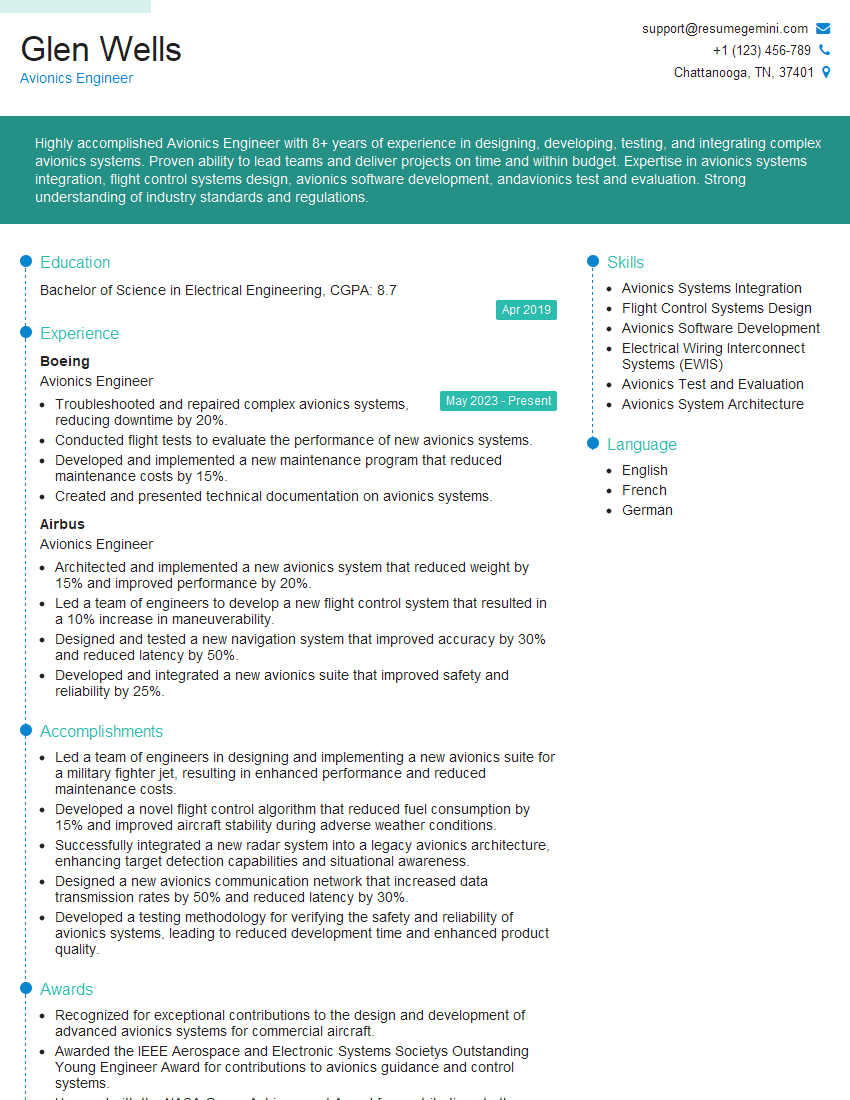
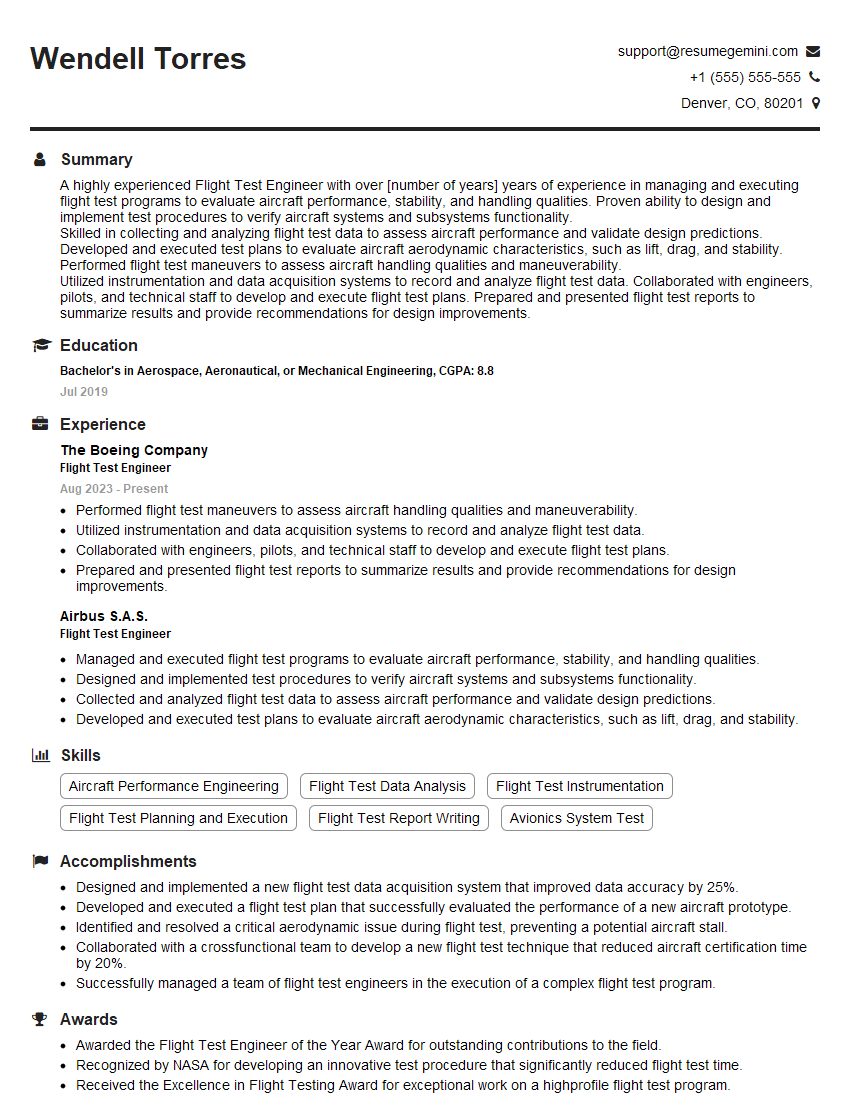
Mastering the intricacies of Flight Control opens doors to a rewarding and challenging career in aviation, offering excellent growth opportunities and the satisfaction of contributing to safe and efficient air travel. To significantly increase your chances of landing your dream role, creating a strong, ATS-friendly resume is crucial. This is where ResumeGemini can help. ResumeGemini is a trusted resource for building professional, impactful resumes, and we provide examples specifically tailored to the Flight Control field to help you showcase your skills and experience effectively. Let ResumeGemini help you craft a resume that reflects your expertise and helps you take the next step in your career.
Explore more articles
Users Rating of Our Blogs
Share Your Experience
We value your feedback! Please rate our content and share your thoughts (optional).
What Readers Say About Our Blog
Very informative content, great job.
good