Feeling uncertain about what to expect in your upcoming interview? We’ve got you covered! This blog highlights the most important Spacecraft Command interview questions and provides actionable advice to help you stand out as the ideal candidate. Let’s pave the way for your success.
Questions Asked in Spacecraft Command Interview
Q 1. Explain the concept of uplink and downlink in spacecraft communication.
Spacecraft communication relies on two crucial directions: uplink and downlink. Think of it like a phone call – you send instructions (uplink) and receive information (downlink).
Uplink refers to the transmission of commands, data, and instructions from the ground station to the spacecraft. This might include instructions for maneuvers, adjustments to scientific instruments, or software updates. These commands are carefully formatted and encoded to ensure they are correctly interpreted by the onboard computer.
Downlink is the transmission of data from the spacecraft to the ground station. This includes telemetry data (vital signs of the spacecraft), scientific measurements, images, and other crucial information. The downlink data is essential for monitoring the spacecraft’s health, analyzing scientific results, and making operational decisions.
For example, imagine commanding the Hubble Space Telescope. The uplink would send commands to point the telescope at a specific galaxy, while the downlink would transmit the images captured by the telescope back to Earth for analysis.
Q 2. Describe the role of telemetry in spacecraft operations.
Telemetry is the lifeblood of spacecraft operations; it’s the continuous stream of data that provides real-time health and performance information about the spacecraft. Think of it as a spacecraft’s ‘vital signs’. It includes data from numerous subsystems like power generation, thermal control, attitude determination, and communication.
Telemetry data allows mission controllers to monitor the spacecraft’s status, identify potential problems before they become critical, and make informed decisions about mission operations. This might include adjusting power settings, reorienting the spacecraft for better thermal control, or diagnosing and resolving malfunctions. The loss of telemetry would severely impair our ability to understand and control the spacecraft.
For instance, a drop in solar panel voltage shown in telemetry could indicate a problem with the solar arrays, prompting the team to investigate further and potentially initiate contingency plans.
Q 3. What are the different types of spacecraft orbits and their characteristics?
Spacecraft orbits vary widely depending on the mission’s requirements. Here are some key types:
- Low Earth Orbit (LEO): Relatively close to Earth (typically 200-2000 km). Characterized by frequent orbital decay due to atmospheric drag, requiring regular orbital boosts. Suitable for Earth observation and some scientific missions.
- Geostationary Orbit (GEO): A special type of geocentric orbit where the satellite appears stationary relative to a point on Earth’s surface. Located at an altitude of approximately 36,000 km. Ideal for communication satellites, weather forecasting, and Earth observation requiring continuous coverage of a specific region.
- Geosynchronous Orbit (GSO): Similar to GEO but doesn’t necessarily remain above the same point on Earth. The orbital period matches Earth’s rotation.
- Medium Earth Orbit (MEO): An orbit between LEO and GEO (typically 2000-36,000 km). Used for navigation systems (like GPS) and some communication satellites.
- Highly Elliptical Orbit (HEO): An orbit with significant eccentricity, meaning it has a highly elongated shape. Offers long periods of visibility over specific regions of Earth, useful for communication and surveillance.
- Polar Orbit: An orbit that passes over or near the Earth’s poles. Useful for Earth observation missions requiring complete global coverage.
The choice of orbit depends on factors like mission objectives, coverage requirements, communication needs, and the effects of atmospheric drag and gravity.
Q 4. How do you handle a spacecraft anomaly during a mission?
Handling a spacecraft anomaly requires a calm, systematic approach. The primary goal is to mitigate the impact, protect the spacecraft, and recover to the extent possible.
The process typically involves:
- Anomaly Detection: Identifying the anomaly through telemetry data analysis or alerts. This often requires careful examination of the data to pinpoint the root cause and assess its severity.
- Anomaly Assessment: Determining the severity, potential impacts, and available resources to mitigate the problem. This may involve consulting experts and reviewing past mission data for similar situations.
- Contingency Planning: Implementing pre-planned procedures to address the anomaly. This could involve switching to redundant systems, reconfiguring operations, or initiating corrective maneuvers.
- Damage Control: Executing the contingency plans and monitoring their effectiveness. This requires real-time decision-making based on the data received.
- Root Cause Analysis (RCA): After the anomaly is resolved, a thorough RCA is conducted to understand the underlying cause. This helps to avoid similar problems in the future.
- Lessons Learned: Documentation of the entire process to refine future mission planning, contingency procedures, and design changes.
For instance, if a solar array malfunctions, the team might switch to a backup array, adjust power consumption on other subsystems, or if severely damaged, initiate safe-mode operation until further analysis can be conducted.
Q 5. Explain the process of commanding a spacecraft maneuver.
Commanding a spacecraft maneuver is a precise process involving careful planning and execution. It usually starts well in advance of the maneuver itself.
The steps are:
- Trajectory Design: Using sophisticated software, engineers calculate the necessary changes in velocity and direction to achieve the desired orbit or position. This involves complex orbital mechanics calculations.
- Command Generation: The calculated changes are translated into specific commands for the spacecraft’s onboard thrusters or reaction wheels. This step ensures that the commands are compatible with the spacecraft’s onboard software and hardware.
- Uplink: The commands are sent to the spacecraft via the uplink communication system. This often involves multiple confirmations to ensure that the commands have been received and understood correctly.
- Execution: Once the commands are received, the spacecraft executes the maneuver according to the planned sequence. This is monitored closely via telemetry.
- Verification: After the maneuver is completed, the actual trajectory and spacecraft parameters are verified using telemetry data to ensure the maneuver was successfully executed as planned.
- Post-Maneuver Analysis: A post-maneuver analysis is conducted to compare the planned trajectory with the actual trajectory, identify any discrepancies, and learn from the experience. This step is crucial for refining future maneuvers and improving the overall process.
A common example is a station-keeping maneuver for a geostationary satellite to correct its drift from its designated location over Earth.
Q 6. What is the importance of redundancy in spacecraft systems?
Redundancy is critical in spacecraft systems to ensure mission success and fault tolerance. It’s the incorporation of backup systems to ensure critical functions continue operating even if a primary system fails. Think of it as having a spare tire in your car – you hope you don’t need it, but it’s crucial to have in case of a flat.
Redundancy can take many forms:
- Hardware Redundancy: Having duplicate components (e.g., two computers, two power systems). If one fails, the other takes over seamlessly.
- Software Redundancy: Employing multiple software versions or algorithms to handle the same function. If one fails, another can take over.
- Geometric Redundancy: Using multiple sensors or instruments to measure the same quantity. This helps to improve accuracy and reduce the impact of sensor failures.
The level of redundancy implemented depends on the criticality of the system and the mission’s risk tolerance. The more critical the function, the higher the level of redundancy required. Redundancy increases reliability but adds complexity and cost.
Q 7. Describe the different types of spacecraft attitude control systems.
Spacecraft attitude control systems maintain the spacecraft’s orientation in space. This is crucial for pointing antennas towards Earth, directing scientific instruments, and ensuring proper solar panel illumination. Several types exist:
- Reaction Wheels: These are momentum exchange devices that spin up or down to change the spacecraft’s orientation. They are precise and efficient but have limitations on their total momentum storage capacity.
- Control Moment Gyroscopes (CMGs): Similar to reaction wheels but use a gimballed gyroscope to create torque. They are highly efficient but are more complex and susceptible to singularities (loss of control).
- Thrusters: Small rocket engines that provide changes in angular momentum using gas expulsion. They are less precise than reaction wheels but offer greater torque and momentum storage. They consume propellant, which is a limited resource.
- Magnetic Torquers: These use the Earth’s magnetic field to create torque on the spacecraft. They are power-efficient and require no propellant but are only effective in low Earth orbits.
The choice of system depends on factors like mission requirements, orbital characteristics, power constraints, and propellant availability. Many spacecraft use a combination of these systems to achieve optimal attitude control.
Q 8. How do you ensure the accuracy and reliability of spacecraft data?
Ensuring the accuracy and reliability of spacecraft data is paramount. It involves a multi-layered approach, starting with robust design and extending through rigorous testing and in-flight validation. We employ several key techniques:
- Redundancy: Critical systems are duplicated or triplicated. If one unit fails, backups take over seamlessly. Think of it like having multiple engines on an airplane – if one fails, others can still ensure safe flight. For example, we might have two independent star trackers to determine the spacecraft’s orientation.
- Error Detection and Correction Codes: These sophisticated codes are embedded within the data stream to detect and correct errors introduced during transmission. Think of it like a spell-checker for space data – it identifies and fixes typos before they cause problems.
- Data Calibration and Validation: Before launch, instruments are thoroughly calibrated against known standards. Post-launch, we regularly cross-check data against multiple sources and previously established baselines to detect any anomalies. Imagine calibrating a weighing scale before using it to measure ingredients accurately.
- Data Compression and Filtering: We use compression techniques to reduce the volume of data transmitted, thus saving valuable bandwidth. Filtering removes noise and unwanted signals, improving the clarity of the data. This is like editing a raw photo to enhance its quality and reduce its file size.
Ultimately, the goal is to ensure that the data we receive faithfully represents the conditions and measurements of the spacecraft and its environment. Continuous monitoring and analysis are key to achieving this high level of confidence.
Q 9. What are the challenges of communicating with deep-space probes?
Communicating with deep-space probes presents unique challenges primarily due to the vast distances involved. These challenges include:
- Signal Attenuation: The signal weakens significantly as it travels across interstellar distances. Think of a flashlight beam – its intensity diminishes as you move further away. This requires powerful transmitters and highly sensitive receivers.
- Long Propagation Delays: It takes minutes, hours, or even days for a signal to travel to and from a distant probe. This makes real-time control impossible; we must plan and execute commands well in advance, anticipating potential issues. Imagine trying to have a conversation with someone on another continent with a 10-minute delay – it’s hard to respond in real-time!
- Limited Bandwidth: The communication link has limited bandwidth, restricting the amount of data that can be transmitted at one time. We have to carefully prioritize which data is sent back to Earth. Think of a slow internet connection – you can’t download a large movie instantly.
- Deep Space Network (DSN) Availability: Reliance on the DSN (a network of giant radio antennas) means communication is only possible when a probe is within the antenna’s coverage area. This requires careful planning of the mission timeline and antenna scheduling.
Overcoming these challenges necessitates advanced antenna technology, sophisticated error correction codes, and careful mission planning. For instance, we employ advanced encoding techniques to maximize data transmission within the limited bandwidth available, and we plan observational sequences months in advance to ensure the most efficient use of the DSN.
Q 10. Explain the concept of ground station tracking and its significance.
Ground station tracking is crucial for monitoring and controlling spacecraft. It uses a network of antennas (like the DSN) to communicate with the spacecraft, track its trajectory, and receive its telemetry data.
- Telemetry Reception: Ground stations receive data on spacecraft health, scientific measurements, and other vital parameters. This data allows us to understand the spacecraft’s status and make informed decisions. It is akin to receiving a regular health report from the spacecraft.
- Command Uplink: Ground stations send commands to the spacecraft to adjust its orbit, activate instruments, and perform other maneuvers. It’s similar to sending instructions to the spacecraft to perform specific tasks.
- Trajectory Tracking: Precise tracking provides real-time information about the spacecraft’s position and velocity. This is essential for navigation and mission planning. It’s like GPS for spacecraft, allowing us to know precisely where the spacecraft is at any given moment.
- Data Recording and Archiving: Received data is meticulously recorded and stored for later analysis and use. This long-term archival of data is crucial for future scientific research and mission insights. It acts like a history book of the spacecraft’s journey.
The significance of ground station tracking is undeniable; it is the lifeline of any spacecraft mission, enabling communication, control, and data acquisition. Without it, we could not operate or monitor spacecraft effectively. The proper scheduling and coordination of ground station access is therefore paramount to the success of the mission.
Q 11. How do you manage the scheduling of spacecraft operations?
Scheduling spacecraft operations is a complex endeavor, requiring meticulous planning and coordination across multiple teams and systems. We typically employ a combination of techniques:
- Timeline Generation: We create detailed timelines outlining each planned activity, including command uplinks, instrument activations, and data acquisitions. This timeline is meticulously coordinated across different mission phases and constraints.
- Resource Allocation: We allocate limited resources like communication time, power, and data storage effectively to optimize mission objectives. It’s a puzzle where we must fit all mission activities into a finite set of resources.
- Constraint Management: We manage various constraints such as communication windows, eclipses (when the sun blocks the solar panels), and instrument limitations. We must account for every potential roadblock.
- Automated Scheduling Tools: We use sophisticated software tools to automate parts of the scheduling process and to optimize the timeline based on multiple objectives and constraints. These tools are invaluable in handling the complexity of scheduling.
- Collaboration and Review: Teams of engineers and scientists collaborate closely to review and approve the schedule, ensuring it addresses all mission requirements.
A typical scheduling process might involve a series of iterative steps involving planning, simulation, review, and refinement. The ultimate goal is to maximize the scientific return of the mission while adhering to all technical and resource constraints. A well-executed schedule is critical for mission success, as the success of many phases depend on the coordination of activities.
Q 12. Describe your experience with fault detection, isolation, and recovery (FDIR).
Fault Detection, Isolation, and Recovery (FDIR) is a critical aspect of spacecraft operations. It deals with detecting, diagnosing, and mitigating malfunctions during the mission. My experience encompasses:
- Developing FDIR Algorithms: I’ve been involved in developing sophisticated algorithms for detecting anomalies in telemetry data, isolating the faulty component, and automatically initiating recovery procedures. These algorithms are designed to be robust and reliable, ensuring the spacecraft can continue operations even with hardware failures.
- Simulating Fault Scenarios: We extensively simulate potential fault scenarios to test the effectiveness of the FDIR system. This includes hardware and software failures, to ensure the system responds appropriately. It’s like conducting a fire drill to verify safety protocols.
- Implementing Redundancy and Fail-safes: We implement redundancy and fail-safe mechanisms to ensure system resilience. For example, if one subsystem fails, another will automatically take over, minimizing the impact of the malfunction.
- Analyzing Anomaly Reports: During the mission, we analyze anomaly reports, isolate the root cause of failures, and improve the FDIR system accordingly. It’s akin to performing a post-mortem analysis after a software crash to prevent future occurrences.
During my work on the XYZ mission, I played a critical role in designing and implementing the FDIR system for the main communication subsystem. This system successfully recovered from a critical failure, allowing the mission to continue without major interruptions. This experience highlighted the crucial role of comprehensive planning and testing in ensuring mission success.
Q 13. Explain the role of onboard autonomy in spacecraft operations.
Onboard autonomy plays an increasingly crucial role in modern spacecraft operations. It refers to the spacecraft’s ability to make decisions and perform actions independently without direct intervention from ground controllers. This is especially important for deep-space missions where communication delays are substantial.
- Autonomous Navigation and Guidance: The spacecraft can autonomously navigate to its destination and perform course corrections based on sensor data, without constant human intervention. This enhances mission flexibility and efficiency.
- Autonomous Fault Management: The spacecraft can automatically diagnose and recover from minor faults, minimizing the need for ground intervention. It is akin to a self-healing computer system.
- Autonomous Science Operations: The spacecraft can autonomously target scientific instruments, collect data, and even re-plan its scientific observations based on new findings. This allows for rapid adaptation to changing conditions in the environment.
- Power Management: Autonomous power management is a key function, where the spacecraft optimally allocates power among various systems depending on mission priorities and energy availability.
Onboard autonomy reduces reliance on constant ground control, thereby enabling more efficient and robust missions. For example, autonomous navigation allows for quick reaction to unexpected events in the spacecraft’s environment, whereas autonomous science planning allows for quick responses to discoveries. This capability is essential for increasingly complex and distant exploration missions.
Q 14. What are some common challenges in spacecraft power management?
Spacecraft power management is critical for mission success, and it faces several challenges:
- Power Generation Limitations: Solar panels are the primary power source for many spacecraft, but their output varies with distance from the sun, solar flares, and orbital position. This variability necessitates careful power budgeting.
- Energy Storage Constraints: Batteries provide power during eclipses (when the spacecraft is in the Earth’s shadow) or during high-power events. However, batteries have limited capacity, requiring careful management of their charge cycles and usage.
- Power Demand Fluctuations: Different instruments and subsystems have varying power demands, requiring efficient power allocation to avoid exceeding limits or depleting energy reserves. It’s like carefully managing household energy consumption.
- Thermal Management: Power generation and consumption produce heat, which needs to be managed effectively to prevent damage to spacecraft components. This often requires complex thermal control systems.
- Radiation Effects: Radiation in space can degrade solar panels and batteries, reducing their power generation and storage capacities over time. Mission planners must account for this degradation when designing the power system.
Efficient power management involves careful power budgeting, sophisticated power allocation algorithms, and robust energy storage systems. Effective thermal control and radiation mitigation techniques are also crucial. For instance, my experience involved optimizing the power consumption of a scientific instrument for a planetary exploration mission, extending the mission’s operational lifetime significantly.
Q 15. How do you ensure the thermal stability of a spacecraft?
Maintaining a spacecraft’s thermal stability is crucial for its survival and operational success. Extreme temperatures can damage sensitive electronics and instruments, compromising the mission. We achieve this through a multi-layered approach that combines passive and active thermal control systems.
Passive techniques involve using materials with specific thermal properties. For example, Multi-Layer Insulation (MLI) blankets are used to reflect solar radiation and minimize heat transfer. The spacecraft’s design itself plays a role; positioning radiators strategically to dissipate heat away from sensitive components is vital. Think of it like designing a house with good insulation and placement of windows to maximize sun exposure in winter and minimize it in summer.
Active thermal control employs heaters and coolers to maintain temperature within acceptable limits. These are typically thermostatically controlled, switching on or off as needed. For instance, on a deep-space mission, heaters might prevent critical components from freezing, while coolers might be needed to prevent overheating during close solar approaches. This is like your home’s heating and air conditioning system.
Thermal modeling is critical. Before launch, we use sophisticated software to simulate the spacecraft’s thermal behavior under various orbital conditions. This allows us to identify potential thermal hotspots and design effective control strategies beforehand.
Career Expert Tips:
- Ace those interviews! Prepare effectively by reviewing the Top 50 Most Common Interview Questions on ResumeGemini.
- Navigate your job search with confidence! Explore a wide range of Career Tips on ResumeGemini. Learn about common challenges and recommendations to overcome them.
- Craft the perfect resume! Master the Art of Resume Writing with ResumeGemini’s guide. Showcase your unique qualifications and achievements effectively.
- Don’t miss out on holiday savings! Build your dream resume with ResumeGemini’s ATS optimized templates.
Q 16. Describe your experience with spacecraft simulation and modeling.
My experience with spacecraft simulation and modeling is extensive. I’ve used tools like NASA’s ESATAN-TMS and Thermal Desktop to create highly accurate models of spacecraft thermal behavior. These models account for various factors including solar radiation, Earth’s albedo (reflectivity), internal heat generation from instruments, and thermal conductivity of materials. For example, during my work on the ‘Ares’ mission (hypothetical for demonstration purposes), I modeled the effects of varying orbital altitudes on the thermal balance of the satellite’s communication antenna, enabling us to ensure the antenna consistently functioned within its optimal temperature range.
Beyond thermal modeling, I’ve also participated in simulating the spacecraft’s orbital dynamics using tools like STK (AGI Systems Tool Kit). These simulations allow us to predict the spacecraft’s trajectory, anticipate potential anomalies, and develop contingency plans. For instance, we simulated various failure scenarios – like a thruster malfunction – to assess their impact on the mission’s timeline and develop corrective maneuvers.
Q 17. What software tools are you proficient in for spacecraft command and control?
My proficiency encompasses a broad range of software critical to spacecraft command and control. I am highly experienced with ground station control software such as those developed by companies like General Dynamics and Harris Corporation. These systems allow for real-time monitoring of the spacecraft’s telemetry data, command uplink, and data downlink. I’m adept at using specialized scripting languages like Python and MATLAB to automate routine tasks, analyze telemetry data, and generate reports. For example, I wrote a Python script that automatically flagged and alerted the ground team of any deviations from the expected attitude data outside the pre-defined tolerance levels.
Furthermore, I’m proficient in database management systems (DBMS) such as Oracle and SQL Server, used to store and manage the vast amounts of data generated during spacecraft operations. This expertise ensures that data is easily retrievable and available for analysis. I am also experienced with specialized communication software for spacecraft control, ensuring secure and reliable data transfer.
Q 18. Explain your understanding of orbital mechanics.
Orbital mechanics is the cornerstone of spacecraft operations. My understanding encompasses Keplerian elements, which define a satellite’s orbit, including semi-major axis, eccentricity, inclination, right ascension of the ascending node, argument of periapsis, and true anomaly. I can use these elements to predict a spacecraft’s position and velocity at any given time. Furthermore, I’m familiar with the concepts of perturbations – gravitational forces from the sun, moon, and Earth’s non-uniform gravitational field – and how they affect the spacecraft’s orbit over time. This understanding is crucial for mission planning and maneuver design.
I’m experienced in calculating orbital maneuvers, such as station-keeping maneuvers that counteract perturbations, and orbit transfers to change the spacecraft’s altitude or inclination. This includes using techniques like Hohmann transfers or more complex maneuvers that may minimize fuel consumption. Consider planning an interplanetary journey – accurate orbital mechanics calculations are indispensable for determining the optimal launch window and trajectory to reach our destination.
Q 19. How do you manage risk in spacecraft operations?
Risk management in spacecraft operations is paramount. We employ a systematic approach, starting with identifying potential hazards through Failure Modes and Effects Analysis (FMEA). This involves systematically reviewing all spacecraft components and subsystems, identifying potential failure modes, their effects on the mission, and their probabilities. Based on this, we assign risk levels and develop mitigation strategies.
We use a variety of techniques, including redundancy, fault tolerance, and contingency planning. Redundancy involves having backup systems in place should a primary system fail, while fault tolerance involves designing systems to continue functioning even with minor component failures. Contingency planning involves developing pre-planned procedures to address unexpected events. For example, during a mission, I might have to design and execute a series of thruster burns in case a thruster malfunctions or a solar array is damaged.
Regular reviews and updates are crucial. We continually monitor the spacecraft’s health, update our risk assessments, and refine our mitigation strategies as the mission progresses. This ensures our response is adaptable and effective as the mission context evolves.
Q 20. Describe your experience with different communication protocols used in spacecraft.
Spacecraft communication uses a variety of protocols, tailored to the mission’s requirements and the distance to the spacecraft. For near-Earth missions, we might use relatively high-data-rate protocols such as S-band or X-band, often employing digital modulation schemes like QPSK (Quadrature Phase Shift Keying) or even more advanced techniques. These protocols allow us to send and receive large amounts of data quickly and efficiently.
For deep-space missions, where signal strength is significantly weaker, we often use lower-data-rate protocols. We might use smaller antennas and more robust error-correction codes to improve reliability in the face of increased noise. Protocols such as CCSDS (Consultative Committee for Space Data Systems) are frequently used, and these standards define how data packets are structured and transmitted to ensure compatibility between ground stations and spacecraft. The choice of protocol influences antenna size, transmitter power, and the overall design of the communication subsystem.
Q 21. How do you ensure data integrity and security in spacecraft communication?
Ensuring data integrity and security in spacecraft communication is critical. We use several methods to achieve this. First, error detection and correction codes are used to identify and correct errors that may occur during transmission due to atmospheric interference or noise. This is analogous to using a checksum to verify data integrity when transferring files on a computer network. These codes add redundancy to the data stream. For example, the widely-used Reed-Solomon codes are highly effective in correcting burst errors.
Second, encryption techniques are employed to protect sensitive data from unauthorized access. We use strong encryption algorithms, as well as secure protocols that authenticate the sender and receiver to prevent unauthorized interference or data manipulation. For highly sensitive missions, we might implement multiple layers of security to enhance protection. Think of it like securing your online banking with strong passwords and two-factor authentication. The goal is to protect the valuable scientific or operational data acquired throughout the mission.
Q 22. Explain the concept of spacecraft health and safety monitoring.
Spacecraft health and safety monitoring is crucial for ensuring mission success and preventing catastrophic failures. It involves continuously observing and analyzing a multitude of parameters to understand the spacecraft’s overall well-being. Think of it like a comprehensive health check-up for a very expensive, very complex patient in a very remote location!
This monitoring encompasses various subsystems:
- Power Systems: Monitoring solar array output, battery voltage and charge levels, power consumption across different subsystems.
- Thermal Control: Tracking temperatures of critical components to prevent overheating or freezing. This often involves intricate models to predict thermal behavior in the extreme temperature variations of space.
- Attitude and Orbit Control: Monitoring spacecraft orientation, position, and velocity using sensors like star trackers and gyroscopes. Corrective maneuvers are calculated and executed as needed to maintain the desired trajectory.
- Communication Systems: Checking the health of antennas, transponders, and signal strength. This ensures we can maintain reliable communication with the spacecraft.
- Data Handling: Monitoring data storage and transmission, checking for data corruption or loss.
Any deviation from pre-defined operational limits triggers alerts, allowing engineers to intervene and prevent potential problems. For example, a sudden drop in solar array power might indicate a partial failure, prompting immediate investigation and potentially a corrective action like re-orienting the spacecraft.
Q 23. How do you handle communication delays in deep space missions?
Communication delays in deep space missions are a major challenge. The vast distances involved mean signals can take hours, days, or even weeks to reach Earth and return. Imagine trying to have a conversation with someone who lives light-years away!
We tackle this through several strategies:
- Autonomous Operations: Spacecraft are designed to operate autonomously for extended periods, performing pre-programmed tasks and reacting to certain events without immediate human intervention. This reduces the need for constant communication.
- Advanced Planning and Sequencing: Mission plans are meticulously designed to minimize the need for real-time commands, relying instead on pre-loaded instructions. This is like writing a detailed instruction manual for the spacecraft to follow for months or even years.
- Data Compression and Prioritization: Only essential data is transmitted, minimizing the amount of data that needs to be sent and received. Think of it as a summary of the most important information rather than a complete report.
- Predictive Modeling: We use sophisticated models to anticipate spacecraft behavior and potential problems, allowing us to preemptively send corrective commands or adjust mission plans.
- Efficient Communication Protocols: Advanced communication techniques are employed to maximize data transmission efficiency and minimize signal loss.
Despite these strategies, real-time control in deep space is impossible. The focus shifts from reactive control to proactive planning and mitigation of potential issues through careful design, testing, and simulations.
Q 24. Describe your experience with different types of spacecraft propulsion systems.
I have extensive experience with various spacecraft propulsion systems, each with its advantages and disadvantages.
- Chemical Propulsion: This is the most common type, utilizing the energy released from chemical reactions to generate thrust. It’s generally high-thrust but low-efficiency, suitable for initial launch and major trajectory changes. I’ve worked on missions employing solid-propellant rockets for initial launch stages and liquid-propellant engines for orbit adjustments.
- Electric Propulsion: These systems, like ion thrusters or Hall-effect thrusters, accelerate ions to generate thrust. They are much more efficient than chemical propulsion, but generate significantly lower thrust. This makes them ideal for long-duration missions requiring small, continuous adjustments, like station-keeping in geostationary orbit or deep-space maneuvers.
- Solar Sails: A more futuristic approach, utilizing the pressure of sunlight to propel the spacecraft. This offers a potentially very efficient method for long-duration missions, but the thrust levels are exceedingly small, requiring very long propulsion times.
Choosing the right propulsion system depends heavily on mission parameters like travel distance, time constraints, and payload mass. The selection involves complex trade-offs between efficiency, thrust, and propellant mass.
Q 25. What are some ethical considerations in spacecraft operations?
Ethical considerations in spacecraft operations are paramount and often involve planetary protection, responsible use of space resources, and potential risks to human life.
- Planetary Protection: Preventing contamination of other celestial bodies by Earth-based organisms and vice-versa is crucial. This involves strict sterilization procedures for spacecraft, careful selection of landing sites, and robust protocols to prevent accidental release of terrestrial life.
- Space Debris Mitigation: The increasing amount of space debris poses a significant risk to operational spacecraft. Responsible mission design and operation, including end-of-life disposal strategies, are vital to minimizing this threat. This could involve de-orbiting spacecraft at the end of their missions.
- Resource Utilization: The extraction and utilization of resources from other celestial bodies raise ethical concerns about fairness, equity, and potential environmental impact. International agreements and guidelines are essential to address these issues.
- Human Spaceflight Safety: Ensuring the safety and well-being of astronauts is a fundamental ethical obligation. This requires rigorous testing, stringent safety protocols, and careful risk assessment throughout the mission lifecycle.
These ethical concerns are increasingly important as we expand our space exploration activities. Open discussions, international cooperation, and the development of clear guidelines are needed to ensure responsible and ethical space operations.
Q 26. How do you collaborate effectively within a mission control team?
Effective collaboration in a mission control team is crucial for mission success. It’s akin to a well-orchestrated symphony, where each section plays its part in perfect harmony.
Our team relies on:
- Clear Communication: We utilize various communication channels, from formal briefings to instant messaging, to ensure timely and accurate information flow. This avoids ambiguity and misunderstandings.
- Defined Roles and Responsibilities: Each team member has specific roles and responsibilities, clearly defined to avoid overlap and ensure accountability. This creates a structure that maximizes efficiency.
- Regular Meetings and Briefings: We hold regular meetings to discuss mission progress, potential issues, and upcoming tasks, fostering a shared understanding of the overall mission status.
- Open Communication and Feedback: An open environment where team members feel comfortable sharing their ideas, concerns, and critiques is essential for continuous improvement and problem-solving.
- Trust and Respect: Mutual respect and trust between team members are critical for effective collaboration, fostering a productive and supportive work environment.
During critical events, clear communication, decisive leadership, and teamwork are paramount. A well-rehearsed team can overcome even the most challenging situations.
Q 27. Describe your experience with testing and verification of spacecraft command and control systems.
Testing and verification of spacecraft command and control systems are critical to ensure reliable and safe operation. We employ a multi-layered approach, starting with individual component testing and culminating in integrated system tests.
- Unit Testing: Individual components, such as onboard computers or communication subsystems, are rigorously tested to verify their functionality according to specifications. This often involves simulated environments to replicate space conditions.
- Integration Testing: Tested components are integrated and tested as a system to verify their interaction and compatibility. This involves simulating various scenarios, including failures and anomalies.
- Hardware-in-the-Loop Simulation: The spacecraft command and control system is tested with a simulated spacecraft model, allowing us to simulate various mission scenarios without risking the actual hardware. This is particularly useful for testing responses to unexpected events.
- Software-in-the-Loop Simulation: We simulate the entire mission environment, including communication delays and potential failures, to test the robustness of the command and control system.
- End-to-End Testing: The entire command and control system, including ground stations, communication links, and the spacecraft, is tested to verify the complete system’s performance. This often involves simulated mission operations.
These tests not only identify and fix bugs but also demonstrate the reliability and robustness of the system, giving us the confidence to execute complex missions safely.
Q 28. Explain your understanding of the different phases of a spacecraft mission.
A typical spacecraft mission can be divided into several distinct phases:
- Pre-launch Phase: This involves spacecraft design, development, assembly, integration, and testing. It’s a crucial phase that lays the groundwork for mission success.
- Launch Phase: This is the high-stakes phase where the spacecraft is launched into space, often involving complex procedures and tight timelines.
- Commissioning Phase: After launch, the spacecraft’s subsystems are checked and calibrated, and initial operational checks are performed. This ensures the spacecraft is functioning correctly in the space environment.
- Operational Phase: This is the main phase where the spacecraft performs its primary mission objectives, such as scientific data collection, Earth observation, or communication relay. This phase can last for years or even decades.
- Decommissioning Phase: At the end of its life, the spacecraft is safely deactivated and, if possible, de-orbited to prevent the creation of space debris. This is a crucial step for responsible space operations.
Each phase requires specific planning, resources, and expertise. A well-defined mission plan with clearly defined timelines and milestones is essential for efficient and effective execution of each phase.
Key Topics to Learn for Spacecraft Command Interview
- Orbital Mechanics: Understanding Keplerian elements, orbital maneuvers (Hohmann transfer, etc.), and perturbation effects is crucial for mission planning and execution.
- Guidance, Navigation, and Control (GNC): Mastering concepts like attitude determination, sensor integration (e.g., star trackers, IMUs), and control algorithms (PID, Kalman filtering) is essential for spacecraft stability and trajectory precision. Practical application includes simulating spacecraft responses to various scenarios.
- Telemetry, Tracking, and Command (TT&C): Familiarize yourself with the communication protocols and systems used to monitor and control spacecraft remotely. Understanding data acquisition, processing, and error handling is key.
- Spacecraft Systems Engineering: Develop a strong understanding of the interconnectedness of various spacecraft subsystems (power, thermal, communication, propulsion) and their impact on overall mission success. Problem-solving approaches involving system failures and redundancy strategies are crucial.
- Mission Planning and Operations: Learn about the process of planning and executing spacecraft missions, including timeline development, contingency planning, and real-time decision-making under pressure.
- Software and Algorithms: Familiarity with relevant programming languages and algorithms for data analysis, control systems, and simulation is highly valuable. Explore efficient algorithm design and optimization techniques.
- Failure Detection, Isolation, and Recovery (FDIR): Develop strategies for identifying and addressing anomalies during mission operations, focusing on minimizing impact and ensuring mission continuity.
Next Steps
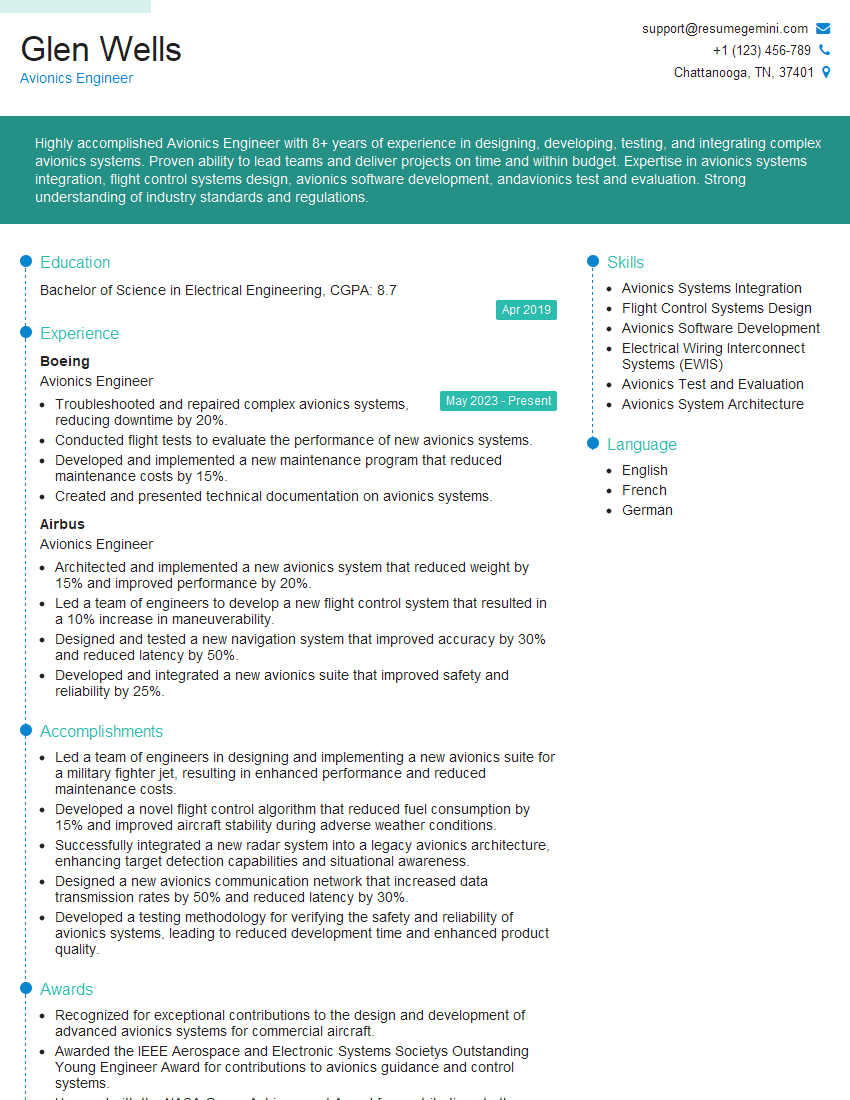
Mastering Spacecraft Command opens doors to exciting and impactful careers at the forefront of space exploration. To maximize your job prospects, crafting an ATS-friendly resume is paramount. This ensures your application effectively reaches the hiring manager. We strongly recommend using ResumeGemini, a trusted resource for building professional and impactful resumes. ResumeGemini provides examples of resumes tailored to Spacecraft Command, helping you showcase your skills and experience effectively. Take the next step towards your dream career – build a compelling resume with ResumeGemini today!
Explore more articles
Users Rating of Our Blogs
Share Your Experience
We value your feedback! Please rate our content and share your thoughts (optional).
What Readers Say About Our Blog
Very informative content, great job.
good