Feeling uncertain about what to expect in your upcoming interview? We’ve got you covered! This blog highlights the most important Design for Lean Manufacturing (DFLM) interview questions and provides actionable advice to help you stand out as the ideal candidate. Let’s pave the way for your success.
Questions Asked in Design for Lean Manufacturing (DFLM) Interview
Q 1. Explain the principles of Design for Lean Manufacturing (DFLM).
Design for Lean Manufacturing (DFLM) is a systematic approach to designing products and processes that minimize waste and maximize value from the customer’s perspective. It’s not just about making things cheaper; it’s about designing for efficient production, ease of assembly, and reduced defects before manufacturing even begins. The core principles revolve around understanding customer needs, eliminating waste, and continuously improving processes. This involves a shift from a traditional design-then-manufacture approach to a more integrated, collaborative effort across design, engineering, and manufacturing teams. The focus is on optimizing the entire value stream, not just individual components or steps.
Q 2. Describe the relationship between DFLM and Value Stream Mapping.
Value Stream Mapping (VSM) is an indispensable tool within DFLM. It’s a visual representation of all the steps involved in bringing a product from concept to delivery, highlighting both value-added and non-value-added activities. DFLM uses VSM to identify areas for improvement during the design phase, preventing waste from being baked into the product or process. By mapping the future state *before* implementation, teams can proactively design out waste, improving efficiency from the start. Imagine designing a car: using VSM during DFLM helps determine if the chosen design necessitates an inefficient assembly line – allowing for adjustments to the design itself before manufacturing begins, thus saving significant time and resources later.
Q 3. How does DFLM contribute to reducing waste in manufacturing?
DFLM significantly reduces waste by integrating lean principles into the design process. Instead of addressing waste after a product is designed and manufactured, DFLM proactively minimizes it from the outset. This is achieved through careful consideration of material selection, simplifying designs, reducing the number of parts, and designing for ease of assembly. By streamlining the design, you automatically reduce the potential for defects, rework, inventory buildup, and transportation costs – all major sources of waste in manufacturing. For instance, designing a product with modular components allows for easier assembly and repair, reducing downtime and wasted effort.
Q 4. What are the seven types of waste identified in Lean Manufacturing, and how does DFLM address them?
Lean manufacturing identifies seven types of waste (often remembered by the acronym TIMWOOD): Transportation, Inventory, Motion, Waiting, Overproduction, Over-processing, and Defects. DFLM tackles these by:
- Transportation: Designing products and layouts to minimize material movement.
- Inventory: Designing for just-in-time production and minimizing buffer stock.
- Motion: Designing ergonomic workstations and efficient assembly processes.
- Waiting: Designing for smooth workflow and eliminating bottlenecks.
- Overproduction: Designing for customer demand and avoiding unnecessary production.
- Over-processing: Designing simple, efficient processes and eliminating unnecessary steps.
- Defects: Designing for quality and error-proofing processes to prevent defects.
For example, a poorly designed product might require excessive movement of parts during assembly (motion waste), leading to increased assembly time and potential for errors (defects). DFLM addresses this by designing the product for simpler assembly, reducing movement and minimizing defects.
Q 5. Explain the concept of ‘takt time’ and its importance in DFLM.
Takt time is the rate at which a finished product needs to be completed to meet customer demand. It’s calculated by dividing available production time by customer demand. Imagine a bakery that needs to produce 100 loaves of bread in 8 hours (480 minutes). The takt time is 480 minutes / 100 loaves = 4.8 minutes per loaf. In DFLM, takt time is crucial because it establishes the pace for the entire production process. Designs are optimized to match this pace, ensuring that production aligns with customer demand and avoids overproduction or delays. Failing to consider takt time during design can lead to inefficiencies and wasted resources.
Q 6. Describe your experience with Kaizen events and their role in DFLM implementation.
Kaizen events, or Kaizen workshops, are short, focused improvement projects involving cross-functional teams. In my experience, these events are critical for implementing DFLM. We typically use a structured approach, involving data gathering, process mapping (often with VSM), brainstorming solutions, implementing changes, and tracking results. I’ve led several Kaizen events focused on improving the design and manufacturing of a specific component. By involving engineers, designers, and production personnel, we identified and eliminated unnecessary steps in the assembly process, reducing lead time and improving quality. These events provide a platform for continuous improvement and reinforce the collaborative nature of DFLM.
Q 7. How do you identify and eliminate non-value-added activities in a manufacturing process using DFLM principles?
Identifying and eliminating non-value-added activities requires a systematic approach. We begin by creating a detailed VSM of the current state, meticulously documenting every step in the process. Then, we analyze each step to determine its value-added contribution from the customer’s perspective. Any activity that doesn’t directly add value to the product or enhance its functionality is considered non-value-added. This might include unnecessary inspections, excessive handling, or waiting times. Once identified, we brainstorm solutions using tools like the 5 Whys technique to understand the root cause of these activities and develop countermeasures. For instance, we might redesign a component to simplify its assembly, eliminating unnecessary steps and reducing handling time. After implementing the changes, we track the results to measure the impact on efficiency and quality, ensuring that improvements are sustainable.
Q 8. Explain the concept of ‘pull systems’ in Lean Manufacturing and how it relates to DFLM.
In Lean Manufacturing, a pull system is a production methodology where goods are produced only when needed, in response to actual customer demand. Instead of pushing products through the system based on forecasts (a push system), a pull system relies on signals from downstream processes to trigger production upstream. This prevents overproduction, a major source of waste in traditional manufacturing.
In DFLM, the pull system is even more crucial because it directly impacts product design. By designing for the pull system from the start, we can ensure that the product is designed for efficient flow, minimizing waste and maximizing value. For example, we might design modular products to allow for flexible production in response to demand fluctuations. Think of a modular furniture system where customers can choose specific components, avoiding unnecessary inventory of pre-assembled sets.
The relationship is symbiotic: DFLM focuses on eliminating waste from the *design* phase, making the implementation of a pull system easier and more effective. A poorly designed product can cripple even the most sophisticated pull system.
Q 9. How do you measure the effectiveness of DFLM initiatives?
Measuring the effectiveness of DFLM initiatives requires a multi-faceted approach, focusing on both qualitative and quantitative data. We can’t just look at one metric; we need a holistic view.
- Lead Time Reduction: Track the time it takes to design, manufacture, and deliver a product. Significant reduction signifies improved flow.
- Inventory Reduction: Monitor inventory levels of raw materials, work-in-progress, and finished goods. A decrease indicates better inventory management and reduced waste.
- Defect Rate Reduction: Measure the number of defects found in the product. A lower defect rate indicates improved quality and reduced rework.
- Throughput Improvement: Calculate the rate at which products are completed and delivered. An increase means better efficiency.
- Customer Satisfaction: Gather feedback from customers to measure satisfaction with product quality and delivery time. This provides vital qualitative data.
- Employee Engagement: Assess employee morale and engagement. A happier and more involved workforce is crucial for successful Lean implementation.
These metrics should be tracked over time to monitor progress and identify areas for improvement. Regular review and adjustment are key to ongoing success.
Q 10. What are some common challenges encountered when implementing DFLM, and how do you overcome them?
Implementing DFLM presents challenges, often rooted in organizational culture and ingrained habits. Resistance to change, lack of management support, and insufficient employee training are common hurdles.
- Resistance to Change: People are naturally resistant to changes in their routines. This can be overcome through clear communication, training, and demonstrating the benefits of DFLM. Involving employees in the process is crucial.
- Lack of Management Support: DFLM requires strong commitment from top management. Without leadership buy-in, initiatives often fail. This requires demonstrating ROI and securing management sponsorship from the beginning.
- Insufficient Employee Training: DFLM tools and techniques require proper training. Without it, implementation will be ineffective. A phased rollout with focused training at each stage is ideal.
- Data Silos: Information might be scattered across departments. Data integration and visualization tools need to be established to support informed decision making.
Overcoming these challenges requires a strategic approach: pilot projects to demonstrate success, ongoing communication, clear goals, and consistent monitoring and improvement.
Q 11. Describe your experience using tools like 5S, Poka-Yoke, and Kanban in a DFLM context.
I have extensive experience using 5S, Poka-Yoke, and Kanban in various DFLM projects. They are invaluable tools for improving efficiency and quality.
- 5S (Sort, Set in Order, Shine, Standardize, Sustain): I’ve used 5S to organize workplaces, reducing wasted time searching for tools and materials. This improves workflow and reduces errors. For example, implementing 5S in a production line led to a 15% reduction in cycle time.
- Poka-Yoke (Mistake-Proofing): I’ve designed Poka-Yoke mechanisms to prevent common errors during assembly. A simple example is color-coding parts to ensure correct assembly. In one project, Poka-Yoke reduced defect rates by 20%.
- Kanban: I’ve used Kanban systems to visualize workflow, limit work-in-progress, and improve pull system implementation. Kanban boards are instrumental in managing production and improving flow. We saw a significant reduction in lead time after implementing a Kanban system.
These tools are not used in isolation; they work synergistically to create a more efficient and effective manufacturing process. 5S provides a foundation for implementing Poka-Yoke and Kanban effectively.
Q 12. How do you incorporate DFLM principles into product design?
Incorporating DFLM principles into product design means designing for manufacturability, assembly, and ease of use. It’s about designing out waste from the very beginning.
- Design for Manufacturing (DFM): This ensures the product is easy and cost-effective to manufacture. We aim to minimize parts, simplify assembly, and use standard components.
- Design for Assembly (DFA): This focuses on making assembly as simple and efficient as possible, reducing assembly time and errors. Techniques like modular design and standardized fasteners are key.
- Design for Serviceability (DFS): This simplifies maintenance and repair. Easily accessible components reduce downtime and repair costs. We should design products to be easily disassembled and repaired.
- Design for Disassembly (DFD): This considers the end-of-life of the product, making it easy to disassemble and recycle, reducing environmental impact.
By considering these aspects during the design phase, we can reduce lead times, costs, defects, and waste in the entire lifecycle of the product. For instance, designing a product with fewer parts directly impacts manufacturing costs, assembly time, and the risk of defects.
Q 13. Explain your understanding of ‘jidoka’ (automation with a human touch).
Jidoka, often translated as ‘automation with a human touch,’ is a core Lean principle that combines automation with built-in quality control mechanisms. It empowers employees to stop the production line whenever a defect is detected. This is crucial because it prevents defects from propagating downstream, saving time and resources.
The ‘human touch’ aspect is vital. It’s not simply about robots; it’s about empowering workers to actively participate in quality control. This improves product quality, reduces waste, and fosters a culture of continuous improvement. A great example is the use of Andon cords, where workers can immediately halt the production line if a problem is encountered. This empowers them to take ownership of quality, rather than passively letting defects pass through.
Jidoka leads to higher quality products, reduced waste, and improved worker engagement.
Q 14. How do you use data analysis to support DFLM implementation?
Data analysis is indispensable for supporting DFLM implementation. It provides insights into process performance, identifies areas for improvement, and measures the effectiveness of implemented changes.
- Process Mapping: Visualizing processes through value stream mapping identifies bottlenecks and areas of waste.
- Statistical Process Control (SPC): Using SPC charts helps identify and address process variations, leading to improved quality and reduced defects.
- Data Visualization: Dashboards and other visual tools present key metrics (lead time, defect rates, inventory levels) clearly, making it easier to monitor progress and make informed decisions.
- Root Cause Analysis (RCA): Techniques like the 5 Whys help identify the root cause of problems, leading to effective corrective actions.
- Predictive Analytics: Using historical data to predict future demand and optimize production schedules.
Data-driven decision-making is key to continuous improvement in a DFLM environment. Analyzing data helps to prioritize initiatives, measure the impact of changes, and ensure that efforts are focused on areas with the greatest potential for improvement.
Q 15. Describe a situation where you successfully applied DFLM principles to improve a manufacturing process.
In a previous role at a medical device manufacturer, we were struggling with long lead times and high inventory costs for a specific assembly process. Applying DFLM principles dramatically improved efficiency. We began by mapping the value stream, identifying all steps involved in the assembly, from raw material arrival to finished product shipment. This revealed significant non-value-added activities such as excessive movement of materials, unnecessary waiting times, and redundant quality checks.
Using 5S methodology, we reorganized the workspace, making it more efficient and safer. We implemented Kanban to manage inventory flow and reduce excess stock. We also used Value Stream Mapping (VSM) to identify and eliminate bottlenecks. For example, we discovered that a particular soldering station was a significant constraint. By optimizing the process at that station, including retraining the operator and using a more efficient soldering tool, we drastically reduced the overall lead time. Finally, we implemented Poka-Yoke (error-proofing) techniques to prevent common assembly errors. This resulted in a 30% reduction in lead time, a 25% decrease in inventory, and a 15% improvement in quality.
Career Expert Tips:
- Ace those interviews! Prepare effectively by reviewing the Top 50 Most Common Interview Questions on ResumeGemini.
- Navigate your job search with confidence! Explore a wide range of Career Tips on ResumeGemini. Learn about common challenges and recommendations to overcome them.
- Craft the perfect resume! Master the Art of Resume Writing with ResumeGemini’s guide. Showcase your unique qualifications and achievements effectively.
- Don’t miss out on holiday savings! Build your dream resume with ResumeGemini’s ATS optimized templates.
Q 16. What are the key differences between DFLM and traditional design approaches?
Traditional design approaches often focus on optimizing individual components or processes in isolation, sometimes neglecting the overall system’s efficiency and the customer’s needs. DFLM, on the other hand, takes a holistic view, focusing on eliminating waste throughout the entire value stream. It emphasizes continuous improvement and customer value. This contrasts with traditional methods that might focus heavily on detailed specifications and engineering drawings without thoroughly considering waste reduction and flow.
- Traditional: Component-centric, often sequential design process, emphasis on specifications.
- DFLM: System-centric, iterative design process, emphasis on eliminating waste (muda) and maximizing customer value.
Imagine designing a car: traditional methods might optimize the engine’s performance without considering the overall assembly process or the customer’s need for fuel efficiency. DFLM would consider the entire process, from design and manufacturing to delivery, to minimize waste and create a more efficient and valuable product for the customer.
Q 17. Explain the role of standardization in DFLM.
Standardization is crucial in DFLM as it establishes consistent processes, reduces variability, and improves predictability. This reduces waste and ensures consistent quality. Standardization involves defining best practices and documenting them. This can encompass various aspects of the manufacturing process, such as work instructions, assembly methods, tools, and quality control checks.
Consider a simple example: standardizing the tightening torque for a specific bolt. Without standardization, different workers might apply varying amounts of torque, leading to inconsistent quality, potential failures, and rework. With standardization, a clearly defined torque specification is used, resulting in consistent quality and reduced waste.
Effective standardization isn’t about rigid inflexibility. It’s a foundation upon which continuous improvement can be built. Regular audits and reviews ensure standardization remains relevant and effective. This allows for adjustments based on continuous improvement efforts while still maintaining a baseline of consistency.
Q 18. How do you ensure that DFLM initiatives align with overall business goals?
Aligning DFLM initiatives with overall business goals requires clear communication, data-driven decision-making, and a strong understanding of the company’s strategic objectives. It’s essential to frame DFLM improvements in terms of their contribution to those larger goals, such as increased profitability, improved customer satisfaction, or reduced lead times.
This often involves quantifying the benefits of DFLM projects. For example, showing how reducing lead times directly impacts revenue or demonstrating how eliminating waste contributes to cost savings. Using a balanced scorecard approach can visually represent how improvements in lean metrics translate to higher-level business goals. Regular reporting and feedback mechanisms are also crucial to track progress and ensure the initiatives remain aligned with the company’s overarching strategy.
Q 19. What is your experience with implementing DFLM in a specific industry?
I have extensive experience implementing DFLM principles in the automotive industry, specifically within a tier-one supplier manufacturing automotive lighting systems. We faced challenges with high defect rates, long changeover times, and inconsistent production flow. We implemented DFLM principles to address these issues, focusing on several key areas:
- Value Stream Mapping: We mapped the entire production process, identifying bottlenecks and waste. This revealed significant inefficiencies in material handling and machine setups.
- Cellular Manufacturing: We reorganized the production line into smaller, more flexible cells, reducing material handling distances and improving operator efficiency.
- SMED (Single-Minute Exchange of Die): We implemented SMED techniques to reduce changeover times, increasing the overall equipment effectiveness (OEE).
These improvements resulted in a significant reduction in defects, shorter lead times, and increased production capacity, ultimately leading to increased profitability and improved customer satisfaction. The success was directly attributable to the holistic application of DFLM across various aspects of the production system.
Q 20. Describe your experience with different Lean methodologies beyond DFLM.
Beyond DFLM, I have significant experience with various Lean methodologies, including Kaizen events, Six Sigma, and Total Productive Maintenance (TPM). Kaizen events, or rapid improvement workshops, have been instrumental in identifying and eliminating localized inefficiencies. Six Sigma methodologies, focusing on data-driven decision-making and process control, have complemented DFLM by providing a robust framework for analyzing and improving process capability.
TPM plays a critical role in improving equipment reliability and reducing downtime, which are integral to achieving the goals of lean manufacturing. Integrating these methodologies strengthens the impact of DFLM, creating a more robust and sustainable improvement system. For example, identifying a root cause of a machine failure using Six Sigma DMAIC methodology, implementing a preventative maintenance plan through TPM, and then documenting the improved process as part of a standardized work instruction using DFLM principles.
Q 21. How do you handle resistance to change during DFLM implementation?
Resistance to change is a common challenge during DFLM implementation. Addressing this requires proactive communication, education, and engagement with all stakeholders. I find a collaborative approach is essential. This involves actively involving employees in the change process, ensuring they understand the benefits and how it will impact their roles. This might involve training sessions explaining the principles of DFLM, demonstrating the tools and techniques, and providing opportunities for employees to share their ideas and concerns.
Transparency is key. Clearly communicating the goals of DFLM, the expected benefits, and the planned implementation steps can address uncertainty and alleviate concerns. Demonstrating early successes – even small wins – can build momentum and encourage buy-in. Addressing concerns directly, actively listening to feedback, and recognizing and rewarding contributions from employees are all crucial to overcome resistance and foster a culture of continuous improvement.
Q 22. How do you communicate the benefits of DFLM to stakeholders?
Communicating the benefits of Design for Lean Manufacturing (DFLM) to stakeholders requires tailoring the message to their specific interests and understanding. I typically start by highlighting the direct impact on their key performance indicators (KPIs). For example, for executives, I’d focus on improved profitability through reduced waste, increased efficiency, and faster time-to-market. For engineering teams, the emphasis would be on simplified designs, reduced complexity, and improved product quality. For operations, the focus would be on streamlined processes, reduced lead times, and improved worker satisfaction.
I use a combination of methods, including presentations with clear visuals, real-world case studies showing successful DFLM implementations (perhaps a similar company in their industry), and data-driven reports demonstrating the potential return on investment (ROI). Interactive workshops are also valuable, allowing stakeholders to actively participate in identifying waste and brainstorming solutions. Finally, continuous monitoring and reporting of progress on key metrics keeps everyone engaged and demonstrates tangible results.
For instance, I once worked with a company struggling with high inventory costs. By showing them how DFLM could reduce their lead times and optimize their supply chain, I was able to get buy-in for a project that ultimately resulted in a 20% reduction in inventory holding costs.
Q 23. What software or tools are you familiar with for supporting DFLM initiatives?
Several software and tools support DFLM initiatives, each with strengths in different areas. I’m proficient with tools like:
- Value Stream Mapping Software: These tools help visualize the entire process flow, identifying bottlenecks and areas for improvement. Examples include Lucidchart and Creately.
- Process Simulation Software: Software like Arena or AnyLogic allows for modeling different scenarios to predict the impact of changes before implementation, minimizing risk.
- CAD Software with integrated DFMA capabilities: Many CAD software packages now include features for Design for Manufacturing and Assembly (DFMA), allowing engineers to evaluate the manufacturability and assemblability of designs early in the process. Examples include SolidWorks and Autodesk Inventor.
- Project Management Software: Tools like Jira or Asana help track progress on improvement projects, ensuring that tasks are completed on time and within budget.
- Data Analytics Tools: Tools like Tableau or Power BI are essential for collecting, analyzing, and visualizing data related to process performance and identifying areas for improvement.
The specific tools I choose depend on the project’s scope and the client’s existing infrastructure. My focus is always on selecting the most effective tool to address the specific challenge at hand.
Q 24. Explain your understanding of the role of continuous improvement in DFLM.
Continuous improvement is the bedrock of DFLM. It’s not just a one-time event but an ongoing commitment to eliminating waste and enhancing efficiency. It’s about creating a culture where improvement is actively sought and implemented at every level of the organization.
Within DFLM, continuous improvement manifests in several ways:
- Kaizen Events: Short, focused workshops involving cross-functional teams to identify and eliminate waste in a specific process.
- Gemba Walks: Regular visits to the actual work area (Gemba) to observe processes firsthand, identify problems, and gather data.
- 5S Methodology: Organizing the workplace to improve efficiency and reduce waste (Sort, Set in Order, Shine, Standardize, Sustain).
- Visual Management: Using visual cues (e.g., Kanban boards) to track progress, identify issues, and promote transparency.
- Data-Driven Decision Making: Using data to track performance, identify trends, and prioritize improvement initiatives.
The key to successful continuous improvement is creating a culture of learning and adaptation, where employees are empowered to identify and solve problems. This requires strong leadership, effective communication, and a commitment to data-driven decision-making.
Q 25. How do you balance the need for efficiency with the need for quality in a DFLM context?
Balancing efficiency and quality in DFLM is crucial. They are not mutually exclusive; in fact, they are interdependent. Improving efficiency without compromising quality can lead to significant gains, while focusing solely on quality without addressing efficiency can lead to unsustainable costs.
Here’s how I approach this balance:
- Early Quality Planning: Integrating quality considerations into the design process from the start, using techniques like Failure Mode and Effects Analysis (FMEA) to identify and mitigate potential problems.
- Process Capability Analysis: Assessing the capability of processes to meet quality specifications, identifying areas needing improvement to achieve a desired level of consistency.
- Mistake-Proofing (Poka-Yoke): Designing processes to prevent errors from occurring in the first place through techniques like jigs, fixtures, and checklists.
- Statistical Process Control (SPC): Using statistical methods to monitor process performance and identify deviations from quality standards before they lead to major issues.
- Continuous Improvement Initiatives: Regularly reviewing processes to identify and eliminate sources of variation that can negatively impact both efficiency and quality.
By focusing on prevention rather than detection, we can improve quality while reducing waste and increasing efficiency. For example, implementing a mistake-proofing system might initially increase design complexity but will significantly reduce rework, scrap, and customer complaints in the long run, leading to greater overall efficiency and profitability.
Q 26. Describe your experience with root cause analysis in a Lean manufacturing environment.
Root cause analysis (RCA) is critical in a Lean environment. It helps us move beyond treating symptoms to addressing the underlying causes of problems, preventing recurrence. My experience encompasses various RCA techniques, including:
- 5 Whys: A simple, iterative questioning technique to drill down to the root cause by repeatedly asking “Why?”
- Fishbone Diagram (Ishikawa Diagram): A visual tool that helps identify potential causes of a problem by categorizing them into different contributing factors (e.g., people, materials, methods, machines).
- Fault Tree Analysis (FTA): A top-down approach that systematically identifies the events that can lead to a specific undesirable outcome.
In practice, I often use a combination of these methods. For instance, I might start with the 5 Whys to get a quick overview, then use a Fishbone diagram to more systematically explore potential causes, and finally, utilize FTA for more complex problems.
For example, in a previous project, we experienced frequent machine downtime. Using the 5 Whys, we identified that the downtime was caused by improper maintenance. A Fishbone diagram helped us further explore the causes of this, revealing that inadequate training for maintenance personnel was a key factor. This allowed us to implement targeted training programs to prevent future downtime.
Q 27. How do you prioritize improvement projects within a DFLM framework?
Prioritizing improvement projects within a DFLM framework requires a systematic approach that considers both the potential impact and the feasibility of implementation. I typically employ a prioritization matrix, often incorporating the following criteria:
- Impact: The potential benefit of the project in terms of cost savings, improved quality, reduced lead times, or increased customer satisfaction. This is often quantified using metrics such as cost reduction or defect rate reduction.
- Feasibility: The ease of implementing the project, considering factors such as resources required, technological feasibility, and organizational support. This might involve assessing the availability of personnel, budget, and necessary technology.
- Urgency: The time sensitivity of the problem, considering the potential impact of delays and the severity of the consequences.
These criteria can be combined into a simple matrix, with projects ranked based on their scores. For example, a project with high impact, high feasibility, and high urgency would receive the highest priority. I also use data analysis to quantify potential impact, relying on historical data and process capability analysis to support decision making. This avoids emotional decision-making and ensures objective prioritization.
Visual management tools like a prioritized project Kanban board are also valuable for tracking progress and ensuring that the most important projects are receiving the necessary attention.
Key Topics to Learn for Design for Lean Manufacturing (DFLM) Interview
- Value Stream Mapping (VSM): Understanding the creation and analysis of VSMs to identify waste and bottlenecks in manufacturing processes. Practical application: Analyzing a real-world manufacturing process and proposing improvements based on VSM findings.
- Lean Principles & Tools: Mastery of core Lean principles (e.g., eliminating waste, continuous improvement, respect for people) and associated tools (e.g., 5S, Kaizen, Kanban). Practical application: Demonstrating how to apply these principles and tools to solve a specific manufacturing problem.
- Design for Manufacturing (DFM): Integrating DFM principles into the product design phase to minimize manufacturing costs and improve efficiency. Practical application: Analyzing a product design and identifying areas for improvement from a DFM perspective.
- Process Improvement Methodologies: Familiarity with various process improvement methodologies (e.g., DMAIC, Six Sigma) and their application in a Lean Manufacturing context. Practical application: Describing a scenario where you used a process improvement methodology to solve a manufacturing challenge.
- Waste Reduction Techniques: Understanding the seven types of waste (muda) and developing strategies to eliminate or minimize them in manufacturing operations. Practical application: Identifying and proposing solutions for waste in a given manufacturing process.
- Cellular Manufacturing & Work Cells: Understanding the principles and benefits of cellular manufacturing and designing efficient work cells. Practical application: Designing a work cell layout for a specific product or process.
- Problem-Solving Methodologies: Experience with structured problem-solving techniques (e.g., A3 reporting, root cause analysis) Practical application: Illustrating your ability to systematically approach and solve a complex manufacturing problem.
Next Steps
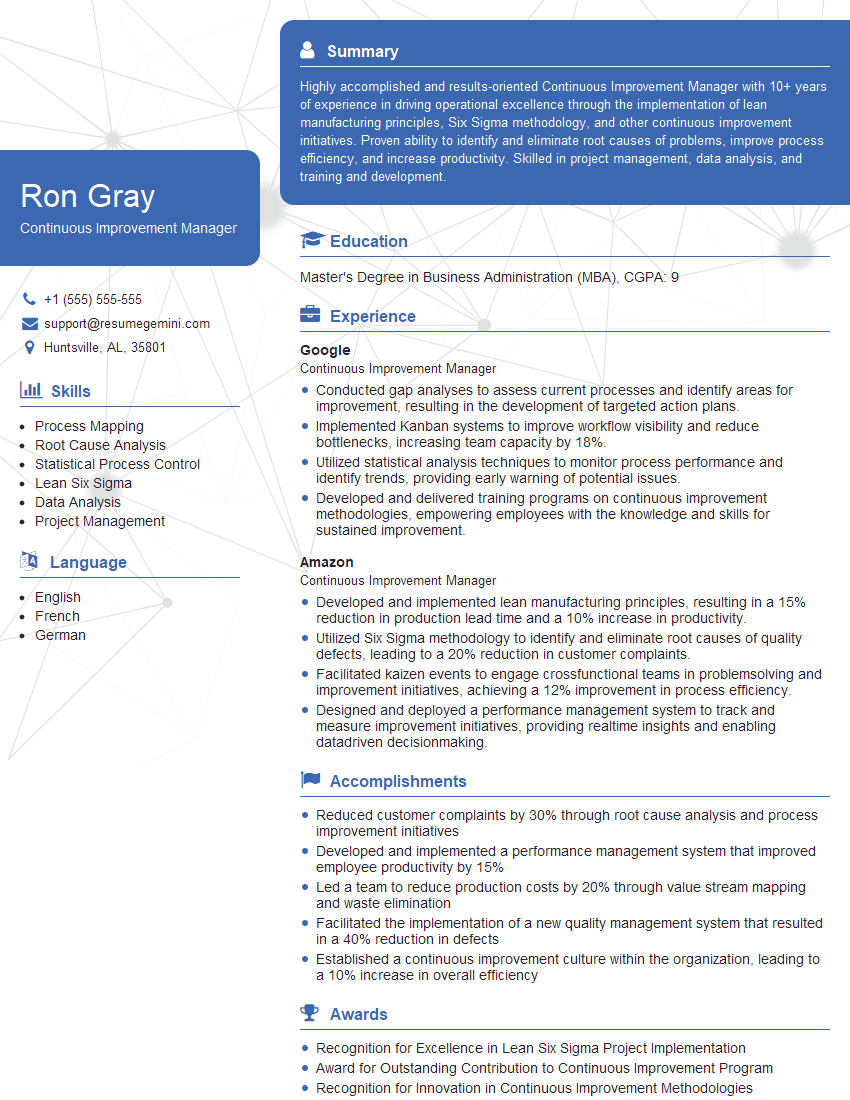
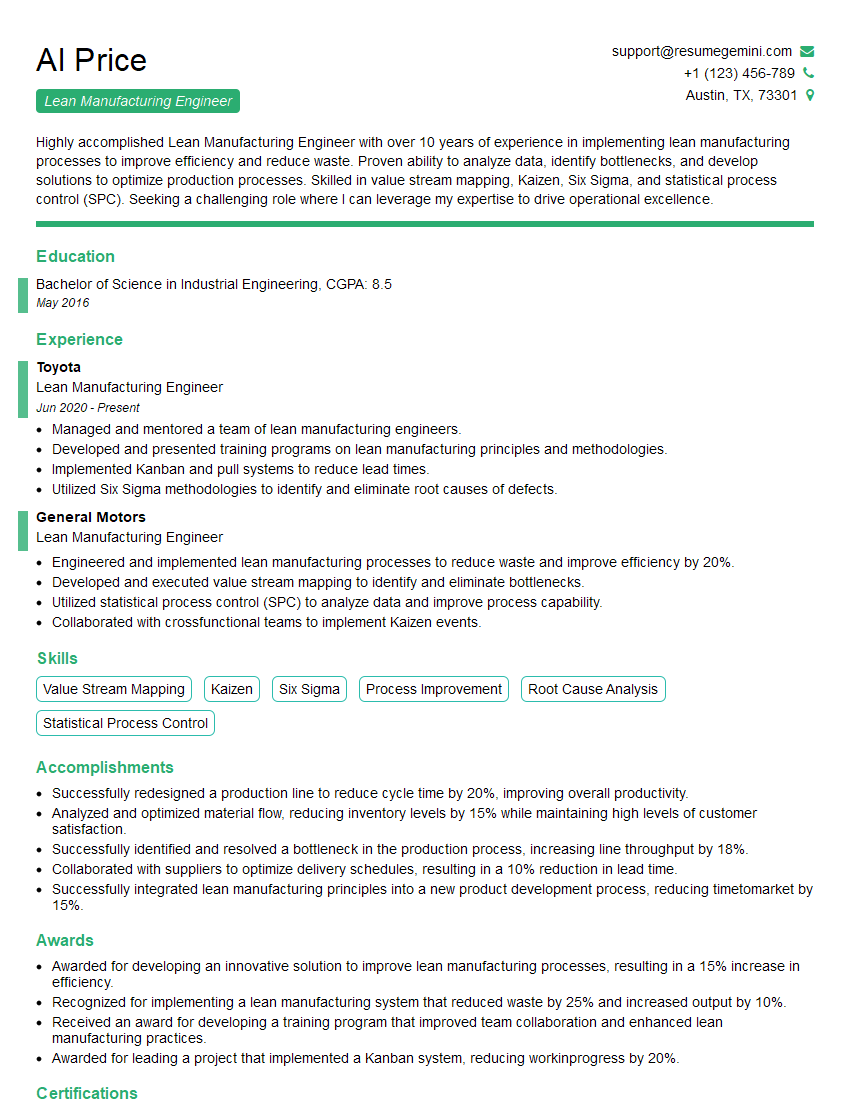
Mastering Design for Lean Manufacturing (DFLM) significantly enhances your career prospects in manufacturing and operations. It demonstrates a valuable skillset highly sought after by employers. To maximize your chances of securing your dream role, it’s crucial to create a compelling and ATS-friendly resume that highlights your DFLM expertise. ResumeGemini is a trusted resource that can help you build a professional and impactful resume. They provide examples of resumes tailored to Design for Lean Manufacturing (DFLM) roles, giving you a head start in showcasing your qualifications effectively. Take the next step towards your career goals today!
Explore more articles
Users Rating of Our Blogs
Share Your Experience
We value your feedback! Please rate our content and share your thoughts (optional).
What Readers Say About Our Blog
Very informative content, great job.
good