Every successful interview starts with knowing what to expect. In this blog, we’ll take you through the top Understanding of Various Sporting Rules and Regulations interview questions, breaking them down with expert tips to help you deliver impactful answers. Step into your next interview fully prepared and ready to succeed.
Questions Asked in Understanding of Various Sporting Rules and Regulations Interview
Q 1. Explain the offside rule in soccer.
The offside rule in soccer is designed to prevent attackers from gaining an unfair advantage by being too close to the opponent’s goal before the ball is played. Essentially, a player is in an offside position if they are in the opponent’s half of the field and closer to the opponent’s goal line than both the ball and the second-to-last defender (excluding the goalkeeper).
However, being in an offside position isn’t a foul in itself. A player is only penalized for offside if, at the moment the ball is played to them by a teammate, they are involved in active play. This involvement could be anything from interfering with play, playing the ball, or gaining an advantage by being in that position. For example, if a player is offside but not interfering with play (e.g., standing still and not touching the ball), no foul is called.
Example: Imagine a forward sprints past the last defender and receives a pass. If, at the moment the pass is made, the forward is closer to the goal line than both the ball and the second-to-last defender, and they then score a goal, the goal will be disallowed for offside.
Practical Application: Understanding the offside rule requires judgment; referees must carefully assess a player’s position relative to both the ball and the defenders. It’s a crucial rule impacting the flow and fairness of the game.
Q 2. Describe the difference between a foul and a penalty in basketball.
In basketball, a foul and a penalty are closely related but distinct. A foul is any illegal contact or action against an opponent. This could range from minor infractions, such as pushing or holding, to more serious ones like flagrant fouls (violent actions).
A penalty is the consequence of a foul. The type of penalty depends on the severity and nature of the foul and the game situation. Penalties might include:
- Free throws: Awarded to the player fouled if the foul occurred while they were shooting.
- Possession arrow: The team fouled might get possession of the ball.
- Technical foul: A penalty for unsportsmanlike conduct, often resulting in free throws for the other team.
- Flagrant foul: A serious foul, often leading to ejection from the game.
Example: A player illegally screens an opponent, which is a foul. The penalty might be awarding possession to the screened player’s team. If a player hits an opponent forcefully, it’s a flagrant foul, resulting in free throws and potential ejection.
Practical Application: Understanding the differences between fouls and their associated penalties helps players avoid infractions and coaches to strategize effectively during the game, influencing gameplay and game strategy significantly.
Q 3. What constitutes a legal catch in American football?
A legal catch in American football is a complex rule, but in essence, a receiver must have control of the ball, with both feet inbounds, or any part of their body inbounds, before going out of bounds. The receiver must maintain control long enough to be considered a catch and after he has established control, he cannot lose possession while making a football move.
Key elements of a legal catch include:
- Control: The receiver must have complete control of the ball. A ‘secure’ catch means the player has the football well secured and has had sufficient time to firmly grip and gain possession. This means a player cannot have just ‘tipped’ the ball.
- Inbounds: The player must have possession while both feet or any part of their body is touching the playing field, this can be the ground, the sideline or the end zone.
- Football move: After the player has caught the ball, a football move is considered any action a player takes with the ball once they have caught it, such as turning to run or giving a handoff. The player cannot lose control after a football move.
- Going to the ground: If a receiver catches the ball while going to the ground, they must maintain control throughout the process and maintain the catch until hitting the ground.
Example: A receiver catches the ball, takes a step with one foot, and is then tackled. The referee will look to verify whether he had control long enough, feet were down at any point and maintained this during a football move, and he wasn’t trying to keep the ball in bounds on the ground after the catch. If all conditions are met, it is a legal catch. A simple ‘tip’ or losing control of the ball while in a football move will make the catch illegal.
Practical Application: The legal catch rule is frequently challenged and reviewed, highlighting the importance of clear understanding for both players and referees. Game outcomes often hinge on interpretations of this rule.
Q 4. How is a tie-breaker determined in tennis?
Tie-breakers in tennis vary depending on the level of play and the format of the match.
In most professional matches, a tie-break is played when a set reaches 6-6. The tie-break itself is a smaller set played to 7 points, with a margin of two points required to win. This means if the score is 6-6, the game must continue until the player has a margin of two points. So, a 7-5 score would win the tiebreak and the set.
In some formats, especially at lower levels, a tie-break might be played to a different point total (such as 10 points) or have different scoring rules. For Grand Slam matches and some professional matches, the tiebreaker rules can be different depending on the stage of the match and can involve alternative match tiebreaks as a set alternative.
Example: If the score is 6-6 in a set, a tie-break is initiated. If Player A wins the tie-break 7-5, Player A wins the set.
Practical Application: The tie-break rule helps to resolve matches efficiently and avoid excessively long sets.
Q 5. Explain the various types of penalties in ice hockey.
Ice hockey penalties are diverse and range from minor to major infractions, resulting in different lengths of time spent in the penalty box. Some common penalty types include:
- Minor Penalty (2 minutes): This is given for less serious infractions such as tripping, slashing, hooking, holding, interference and many more. The penalized team plays short-handed for the duration of the penalty.
- Major Penalty (5 minutes): This is given for more serious offences like boarding, charging, checking from behind, or fighting. The penalized team plays short-handed for the duration of the penalty.
- Misconduct Penalty (10 minutes): This penalty is for unsportsmanlike conduct, typically involving behavior that is disrespectful to the officials or another player. Players leave the game after 10 minutes and return after 10 minutes are over. The team plays short-handed during the penalty
- Match Penalty (Game Misconduct): This is the most serious penalty; an ejection from the game. This is usually given for violent conduct that endangers an opponent. The team plays short-handed for the remainder of the game.
- Double Minor (4 minutes): This is basically two minor penalties; often given for infractions that could be considered a major. Usually involves multiple actions that constitute different minor penalties that were committed consecutively.
Example: A player slashes another player’s stick, leading to a 2-minute minor penalty. A player tackles another violently, resulting in a 5-minute major penalty. A player insults the referee after a call is made, leading to a 10-minute misconduct penalty. A player makes a dangerous hit on an opponent, resulting in an immediate ejection and a match penalty.
Practical Application: Understanding ice hockey penalties helps spectators follow the flow of play and understand why teams are playing short-handed. For players, knowledge of these rules is crucial for avoiding penalties and playing fairly.
Q 6. Describe the process for reviewing a controversial play in baseball.
In baseball, controversial plays are reviewed through the use of instant replay. While the specific procedures vary slightly depending on the league and the circumstances, the process generally involves these steps:
- Managerial Challenge: A manager can challenge a call made by the umpire, using one of their allocated challenges per game. The challenge must be made immediately and while the play is still occurring and before the next play begins.
- Replay Review: Upon a challenge, a designated replay official examines available video replays. Replay can be done at various angles.
- Umpire Decision: The replay official ultimately decides if the umpire’s call on the field is correct or incorrect. The review can result in a call that is upheld, overturned, or changed based on evidence from the review. If no evidence is provided to overturn the play, the umpire’s decision stands.
- Confirmation of Review: The umpire on the field announces the decision to all the players, coaches, and fans present, including whether it was a challenge made by the manager or an automatic review and why the decision was made.
Example: An umpire calls a batter out on strikes. The manager challenges the call, believing the pitch was a ball. After reviewing the replay, the replay official determines the pitch was indeed a ball, and the call is overturned. The batter returns to the plate.
Practical Application: Instant replay aims to improve the accuracy of calls in the game, reducing potential errors. However, the process requires clear protocols and experienced replay officials to ensure consistent and fair decisions.
Q 7. What are the key differences between rugby union and rugby league rules?
Rugby union and rugby league, while sharing a common ancestor, differ significantly in their rules:
- Tackling and Play the Ball: In rugby union, after a tackle, the ball must be released immediately (the ruck occurs after). In rugby league, the tackled player is allowed to play the ball (make a play with the ball) once the referee deems them to be grounded.
- Scoring: Both sports have tries (touchdowns) as the primary method of scoring points. However, the methods of scoring additional points differ, with rugby union having conversions, and penalty goals whereas rugby league only has conversions and drop goals. The way these scoring systems are designed affect the game’s strategies.
- Forward Passes: Rugby union allows for the ball to be passed backward or sideways from a ruck, whereas rugby league allows only one type of forward pass in the game. In rugby league, the forward pass is considered illegal and will lead to a penalty.
- Scrums: Rugby union heavily features scrums—formations where teams push against each other to gain possession of the ball. Rugby league has a ‘tap’ penalty as the equivalent of a scrum, the game doesn’t use scrums as often as rugby union does.
- Lineouts: Rugby union uses lineouts after a ball goes out of bounds. Rugby league mostly uses a throw-in, similar to a basketball throw-in.
- Substitutions: Rugby union allows many substitutions and multiple replacements per game, whereas rugby league had much more limited replacement rules.
Example: In a tackle, a rugby union player must release the ball immediately after being tackled, leading to a ruck, while in rugby league, the tackled player can play the ball immediately after being tackled.
Practical Application: The differences in tackling, passing, and scoring mechanisms lead to contrasting styles of play. Rugby union tends to be more focused on set-pieces and forward play, while rugby league emphasizes running and attacking plays.
Q 8. How are points awarded in cricket?
In cricket, points, or more accurately, runs, are awarded to the batting team in a variety of ways. The primary method is by hitting the ball bowled by the opposing team and running between the wickets. Each successful run adds one run to the team’s score. Other ways to score include:
- Boundaries: Hitting the ball to the boundary rope. A four is awarded if the ball reaches the boundary after bouncing, while a six is awarded if it reaches the boundary on the full.
- Extras: These are runs awarded to the batting team due to errors by the bowling team, including wides (balls bowled too wide of the stumps), no-balls (illegal deliveries), byes (runs scored off a ball that misses the bat and doesn’t hit the body), and leg byes (runs scored off a ball that hits the batsman’s body and doesn’t hit the bat).
- Penalties: In rare cases, penalties like penalty runs can be awarded for breaches of the rules by the fielding team.
Imagine a batsman hitting the ball and running three times between the wickets before the fielding team retrieves it. This earns three runs. If they then hit a boundary on the full, that adds six more, resulting in a total of nine runs from that single delivery. This accumulated score ultimately determines the winner of the match.
Q 9. Explain the ‘free kick’ rule in soccer and when it applies.
In soccer (football), a free kick is awarded to the opposing team when a foul is committed by a player. This allows the team that suffered the foul to take a kick towards the opponent’s goal with the defending players having to remain a certain distance away. The distance of the defending players depends on the location of the foul.
A free kick is awarded for various infractions, including:
- Tripping: Intentionally obstructing an opponent’s progress by tripping them.
- Pushing/Shoving: Using physical force against an opponent.
- Handling the ball: Deliberately touching the ball with the hands or arms (except for the goalkeeper in their penalty area).
- Dangerous play: Tackling recklessly or endangering an opponent.
- Offside: A player being in an advanced position compared to the second-to-last defender when the ball is played to them.
For example, if a player tackles another player from behind and causes them to fall, a free kick would be awarded to the fouled team. The location of the free kick would be at the point of the foul. The severity of the foul (like a dangerous tackle) may lead to a more serious sanction such as a yellow or red card.
Q 10. Describe the different types of fouls in volleyball.
Volleyball fouls can be broadly categorized into contact fouls and non-contact fouls. Contact fouls involve physical contact with the opponent, whereas non-contact fouls relate to violations of the rules without direct physical contact.
- Contact Fouls: These often involve illegal blocking, hitting, or contact with an opposing player. Examples include hitting an opponent’s arm while attempting a block, or pushing an opponent.
- Non-Contact Fouls: This category includes a wide range of violations. Examples include:
- Foot Fault: Stepping over the boundary line when serving or attacking.
- Double Touch: A player touching the ball twice consecutively.
- Carrying/Lifting: Throwing or lifting the ball instead of hitting it.
- Net Fault: Touching the net while the ball is in play.
- Back Row Attack: A back row player hitting the ball completely above the net without a block.
- Four-Hit Violation: A team exceeding the maximum number of hits allowed in a rally.
For instance, if a player hits the ball twice in a row, it’s a double touch, a direct fault. If a player steps over the service line while serving, it’s a foot fault, leading to a point for the opposing team.
Q 11. What is the difference between a major and minor penalty in lacrosse?
In lacrosse, penalties are classified as major or minor based on the severity of the infraction. Minor penalties result in a short-duration penalty, typically one or two minutes. Major penalties lead to longer penalties, usually three to five minutes. The team committing the penalty plays a man-down (or woman-down). A player can receive multiple penalties that can be served consecutively or concurrently (depending on the officiating team’s judgement).
Examples include:
- Minor Penalties: These include common fouls like slashing (hitting an opponent with the stick), holding (illegally restraining an opponent), and tripping.
- Major Penalties: These are usually more severe, and are sometimes based on intent. Examples include cross-checking (hitting an opponent with the stick from the side or back), checking from behind, and illegal body checks.
A minor penalty for slashing would mean the offending team plays shorthanded for a minute or two. A major penalty for a dangerous cross-check, potentially resulting in injury, could lead to a longer penalty and possible ejection from the game.
Q 12. Explain the concept of ‘time-outs’ in various sports.
Time-outs are brief interruptions in play, used by coaches to strategize, make substitutions, or address player concerns. The number of time-outs allowed and their duration vary significantly across different sports:
- Basketball: Teams are typically granted a limited number of time-outs per game, lasting for approximately one minute. They are often used to discuss strategy or make substitutions.
- American Football: Each team has a set number of time-outs per half. These are longer than in basketball, usually 30–60 seconds.
- Volleyball: Teams typically have two time-outs per set. These are usually short, between 30 seconds to one minute, and are often used to discuss strategy and substitutions.
- Ice Hockey: Each team receives a limited number of time-outs per game, and are usually 30 seconds to one minute, used to discuss strategy during critical moments.
Think of a basketball coach calling a time-out during the final seconds of a close game to draw up a final play. Or in American Football, they use it to give the players a chance to catch their breath and adjust the strategy.
Q 13. How are substitutions handled in American football?
In American football, substitutions are frequent and can happen at any time the clock is stopped, except for when a play is actively occurring. There are no limitations on the number of substitutions a team can make during a game, essentially providing limitless substitution opportunity during stoppages of play.
The process usually involves a player exiting the field and a replacement entering without disruption of play. The new player must report to the referee to ensure appropriate substitution and to minimize any potential for illegal activities. This system allows for flexibility in managing player fatigue, injuries, and strategic shifts.
For instance, a team might substitute a tired offensive lineman with a fresh one during a time-out to maintain their level of play.
Q 14. What constitutes interference in basketball?
In basketball, interference occurs when a player illegally impacts the ball or an opponent’s ability to play the ball. It’s generally a violation of the rules of the game that can be called on either the offensive or defensive team. It’s crucial to understand the nuances of the rules to differentiate between legal and illegal plays.
There are several types of interference:
- Goal tending: When a defensive player interferes with a shot that is on its downward trajectory toward the basket.
- Offensive Goaltending: When an offensive player touches a shot that is already on its way down towards the basket.
- Blocking: Illegally impeding an opponent’s movement.
- Illegal contact/Personal foul: Physical contact deemed excessive or illegal by the referee.
For example, if a defensive player deflects a shot that’s already on its downward trajectory, it is goal tending, resulting in a basket for the offensive team. If an offensive player interferes with the ball already on the downward trajectory toward the basket, this also results in a basket for the opposing team.
Q 15. Describe the process of challenging a referee’s call in a specific sport.
Challenging a referee’s call varies significantly across sports, but generally involves a formal process within the game’s rules. For instance, in tennis, a player can challenge a line call using a Hawkeye system (or similar technology). They have a limited number of challenges per set. If the challenge is successful (the technology shows the ball landed out), the call is overturned. If unsuccessful, the player loses a challenge. In cricket, a team can utilize Decision Review System (DRS) to challenge umpire decisions concerning leg before wicket (LBW), catches, run-outs, and stumpings. The process involves a review from a third umpire using multiple angles and technological support to make a final ruling. In both cases, the process, including the number of allowed challenges, timing of the challenge, and the method of appeal, is strictly defined by the sport’s rulebook. The use of technology is making refereeing more objective.
Career Expert Tips:
- Ace those interviews! Prepare effectively by reviewing the Top 50 Most Common Interview Questions on ResumeGemini.
- Navigate your job search with confidence! Explore a wide range of Career Tips on ResumeGemini. Learn about common challenges and recommendations to overcome them.
- Craft the perfect resume! Master the Art of Resume Writing with ResumeGemini’s guide. Showcase your unique qualifications and achievements effectively.
- Don’t miss out on holiday savings! Build your dream resume with ResumeGemini’s ATS optimized templates.
Q 16. Explain the rules regarding goal-line technology in soccer.
Goal-line technology (GLT) in soccer aims to eliminate ambiguity regarding whether a goal has been scored. The FIFA-approved systems use various technologies such as cameras and sensors. These systems track the ball’s position and send a signal to the referee’s watch or a display, indicating whether the ball has fully crossed the goal line. For example, the Hawk-Eye system uses multiple high-speed cameras to track the ball’s trajectory. The referee has final say, but this technology assists in making the decision near-instantaneously and removes subjective interpretations. If the technology indicates a goal, the referee will signal the goal, even if they did not see the ball clearly cross the line themselves. The use of GLT has significantly reduced controversy surrounding close goal-line decisions.
Q 17. How are penalties enforced in boxing?
Penalties in boxing are enforced by the referee, who deducts points from a boxer for various infractions. These infractions can include hitting below the belt, holding, excessive clinching, hitting on the break, or headbutting. The severity of the infraction determines the penalty’s point deduction. A point deduction might be a warning, or a point deduction of one or more points which is directly reflected on the scorecard. Severe fouls might result in a disqualification, leading to an immediate loss for the offending boxer. For example, if a boxer repeatedly uses illegal tactics, the referee has the authority to disqualify the boxer, even if they are ahead on points. The referee’s decision regarding penalties is final and is crucial in maintaining fair play and safety within the boxing match.
Q 18. What are the key rules of the scrum in rugby union?
The scrum in rugby union is a set piece used to restart play after a minor infringement. Key rules govern its formation and execution:
- Formation: Both teams form three interlocked rows of forwards facing each other. The front row includes props and a hooker, while the second and third rows consist of locks and flankers.
- Engagement: Once the referee signals, both teams push against each other, aiming to gain possession of the ball (placed on the ground between the two packs).
- Binding: Players must bind to teammates and remain bound throughout the scrum. Illegal binding actions can lead to penalties.
- Pushing: Players can push only using their shoulders and upper body. Lifting, collapsing, or twisting the scrum is prohibited. The scrum half from the team with possession attempts to secure the ball and release it to a teammate.
- Penalty: Numerous infractions, such as collapsing the scrum, wheeling (rotating), or illegal binding, can lead to penalties awarded to the opposing team.
The scrum is a crucial part of the game, requiring technical skill, strength, and teamwork. Successful scrummaging provides a significant advantage in gaining possession and territory.
Q 19. Describe the rules regarding the jump ball in basketball.
A jump ball in basketball is used to start the game or restart it after certain stoppages of play such as simultaneous fouls. The referee tosses the ball in the air between two opposing players positioned near the center of the court, roughly at the half court line. The players must be standing facing each other directly under the basketball prior to the toss. Both players are jumping attempting to tap the ball to a teammate. Only the two players directly involved in the jump ball can initially touch the basketball. The moment the referee releases the ball, the two players jump to tap the ball, initiating play once again. The jump ball is a significant moment to help even the playing field and gain immediate possession.
Q 20. How are penalty strokes awarded and executed in field hockey?
A penalty stroke in field hockey is a method of awarding a goal scoring opportunity to the opposing team as a result of a serious infraction by a defender within the striking circle (also known as the shooting circle). The penalty is awarded for offenses like intentional fouls, dangerous play, or preventing a clear goal-scoring opportunity. The stroke is executed from the penalty spot, which is located seven yards from the goal line, at a distance from the goal posts, and with only the goalkeeper defending. The player taking the penalty stroke (the striker) must hit the ball directly from the penalty spot towards the goal, without stopping, without using their foot. The goalkeeper can move to try and prevent the goal, but they must remain within the goal area and on the goal line. A successful stroke is a goal awarded to the opposing team.
Q 21. What are the differences between a ‘holding’ and a ‘pass interference’ penalty in American football?
In American football, both ‘holding’ and ‘pass interference’ are penalties related to illegal contact, but they occur in different contexts and involve different actions:
- Holding: This penalty occurs when an offensive player illegally uses their hands to impede a defensive player. This often happens while blocking, and typically involves grabbing or holding a defender’s jersey. Holding is mostly enforced on the offensive line. This contact is used to hinder the defender’s ability to make a play. It is commonly called offensive holding.
- Pass Interference: This penalty happens when a defensive player makes illegal contact with a receiver before the ball arrives. This contact can involve pushing, grabbing, or holding the receiver before the ball is caught. The foul prevents the receiver from attempting to catch the ball; therefore, preventing them from making a play. This is frequently seen in the secondary and cornerback positions.
The key difference lies in the timing and target of the contact. Holding involves illegal contact during blocking, while pass interference involves illegal contact with a receiver before the ball is caught. Both result in yardage penalties and the opportunity for the opposing team to continue their drive or maintain possession.
Q 22. How is the ‘dead ball’ situation determined and handled in soccer?
A ‘dead ball’ in soccer signifies a temporary halt in play. It’s crucial for player safety, rule enforcement, and ensuring fair play. Several situations trigger a dead ball:
- Goal scored: Play stops immediately after a goal is scored.
- Referee’s whistle: The referee’s whistle is the primary signal for a dead ball. This happens for fouls, offsides, injuries, or other infractions.
- Ball going out of bounds: When the entire ball crosses the touchline or goal line.
- Serious foul play: A serious foul leading to injury or a dangerous situation.
- Time-outs/Halftime/Full-time: The referee brings the game to a standstill for these breaks.
Handling a dead ball involves the referee restarting play using appropriate procedures. This could involve a throw-in, goal kick, corner kick, indirect free kick, or direct free kick, depending on how the ball went dead.
For example, if a player commits a foul within their own penalty area, the opposing team gets a penalty kick, with play restarting from the penalty spot – a dead ball situation becoming a direct free kick.
Q 23. What are the main responsibilities of a linesman in tennis?
Linesmen in tennis, also known as line judges, play a crucial role in ensuring accuracy and fairness. Their primary responsibility is to call line calls – determining whether a ball lands inside or outside the court’s boundaries.
- Accurate line calls: They must precisely judge whether a shot lands in or out, signaling ‘in’ or ‘out’ clearly to the chair umpire.
- Fair and impartial judgment: Linesmen are expected to be impartial, making unbiased calls regardless of the players involved.
- Communication with the chair umpire: Any significant calls or disagreements require immediate communication with the chair umpire, who has the final say.
- Consistency: Maintaining a consistent standard of judgment throughout the match is essential for ensuring fairness.
Imagine a crucial point in a Grand Slam final. A linesman’s precise call could influence the outcome of the match. Their role is highly demanding and requires excellent eyesight, concentration, and quick decision-making.
Q 24. Explain the role of a referee in maintaining fair play and sportsmanship.
Referees are central to maintaining fair play and sportsmanship in any sport. Their role goes far beyond simply enforcing rules; they are the guardians of the game’s integrity and the facilitators of a positive playing environment.
- Impartial enforcement of rules: Referees apply the rules consistently to all players, ensuring that no team or player has an unfair advantage.
- Managing player behavior: They control players’ conduct, addressing unsporting behavior with warnings, penalties, or dismissals.
- Maintaining game flow: Referees manage the timing, breaks, and pace of the game to ensure smooth and efficient progress.
- Promoting sportsmanship: They foster a respectful atmosphere by encouraging players and coaches to adhere to ethical principles and exhibit good conduct.
- Handling disputes: Referees are responsible for resolving disagreements between players, coaches, or spectators fairly and efficiently.
A referee’s effective communication and decisive actions are key to ensuring respect for rules and the development of a positive sports environment.
Q 25. How do you handle a disagreement with another official during a game?
Disagreements between officials are unavoidable, especially during high-pressure situations. The key is professional and respectful communication. The approach I take involves:
- Private discussion: I would address the discrepancy privately, avoiding public arguments or confrontations.
- Collaborative problem-solving: I’d work together to understand each other’s perspectives and find a mutually agreeable solution. The goal is to arrive at a correct and fair interpretation.
- Referring to rulebooks: If there’s a significant disagreement, we would refer to the official rulebook and relevant interpretations to clarify the rule in question.
- Escalation protocol: If the disagreement cannot be resolved privately, an established escalation protocol within the officiating team should be followed. This might involve seeking the guidance of a senior referee or supervisor.
- Maintaining professionalism: Regardless of the disagreement’s outcome, professionalism is paramount. Personal feelings should remain separate from the objective application of rules.
It’s crucial to remember that teamwork and respectful communication are far more important than individual egos in ensuring fair and consistent officiating.
Q 26. How do you communicate complex rules effectively to players and coaches?
Communicating complex rules effectively to players and coaches requires clarity, patience, and using accessible language. My strategies include:
- Simple language: Avoid jargon. Use clear, concise language that is easily understood by everyone.
- Visual aids: Diagrams, videos, or demonstrations can greatly enhance understanding, especially for complex scenarios.
- Practical examples: Using real-life examples to illustrate the rule in action makes it much easier to grasp.
- Interactive sessions: Question-and-answer sessions allow players and coaches to clarify any uncertainties.
- Written summaries: Providing concise written summaries of key rules can serve as a valuable reference.
- Targeted communication: Tailor the communication based on the audience’s level of understanding, experience and sport-specific knowledge.
For instance, explaining the offside rule in soccer through visual diagrams and examples is much more effective than simply reciting the rule verbatim.
Q 27. Describe a situation where you had to interpret a rule in a challenging scenario.
During a youth soccer match, a player received a pass while standing just outside the penalty area. The ball was quickly played into the penalty area, where a goal was scored. The question was whether the initial pass, which technically was offside, should invalidate the goal.
The challenge was the fast-paced nature of the play and the difficulty in precisely determining the exact moment the ball was passed and the player’s position. After reviewing the relevant laws of the game, I determined that while the pass was offside, it didn’t directly lead to the goal. The goal was scored via an independent play following the initial offside event. The goal stood, based on the interpretation of ‘advantage’ and the principle of not punishing an unintentional offside situation that didn’t directly lead to an advantageous scoring opportunity.
This required a careful interpretation of the rules, emphasizing the spirit of fair play and not excessively punishing a minor infringement.
Q 28. How do you stay updated on the latest rule changes in your chosen sport?
Staying updated on rule changes is essential. My methods include:
- Official rulebook updates: I regularly consult the official rulebooks and amendments released by the governing bodies of the respective sports.
- Professional development courses: Attending workshops, seminars, and online courses helps me stay informed about rule clarifications and modifications.
- Official websites and publications: Regularly checking the websites and publications of governing bodies keeps me updated on announcements and interpretations.
- Networking with fellow officials: Sharing knowledge and experiences with other referees and officials is a valuable means of staying informed.
- Reviewing game footage and analyzing decisions: Studying game footage and analyzing referees’ decisions helps in understanding the practical implications of rule changes.
Continuous learning is crucial to maintain accuracy and consistent application of the rules in any sporting context. The sports world is always evolving, so staying current is a necessity.
Key Topics to Learn for Understanding of Various Sporting Rules and Regulations Interview
- Fundamental Rules Across Sports: Understanding the core principles of fair play, officiating, and player conduct common to most sports. This includes concepts like penalties, fouls, and the role of referees/umpires.
- Specific Sport Expertise: Deep dive into the rules and regulations of at least 2-3 specific sports relevant to your target roles. Focus on nuances and less-common situations, demonstrating a comprehensive understanding beyond basic gameplay.
- Rule Interpretation and Application: Practice analyzing hypothetical scenarios and applying the relevant rules to determine correct outcomes. This demonstrates problem-solving and critical thinking skills.
- Rule Changes and Evolution: Demonstrate awareness of how rules evolve over time, showcasing your ability to stay updated on relevant changes and their impact on gameplay.
- Legal Aspects of Sporting Rules: Understanding the legal ramifications of rule violations, including player disputes, disciplinary actions, and governing body regulations.
- Technological Impacts on Rule Enforcement: Explore how technology (e.g., VAR, instant replay) influences rule interpretation and enforcement in modern sports.
- Ethical Considerations in Sports Governance: Discuss the ethical dilemmas and challenges in enforcing sporting rules fairly and consistently.
Next Steps
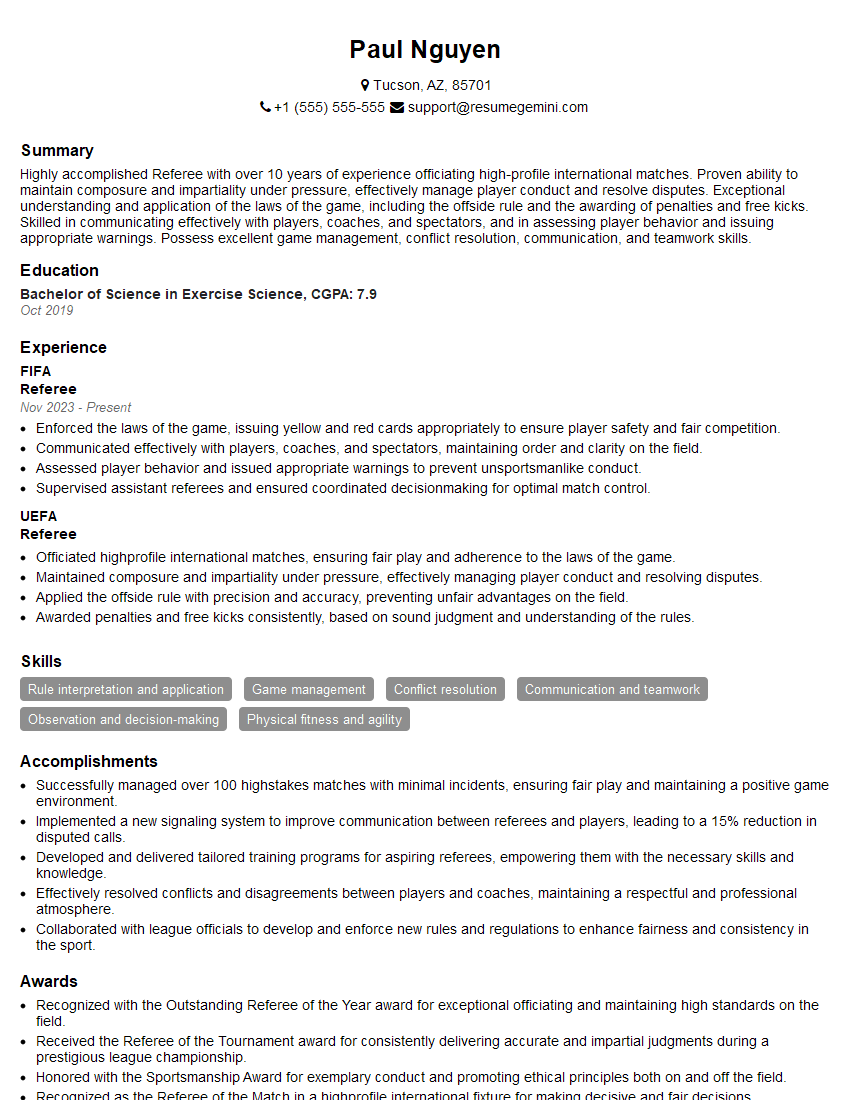
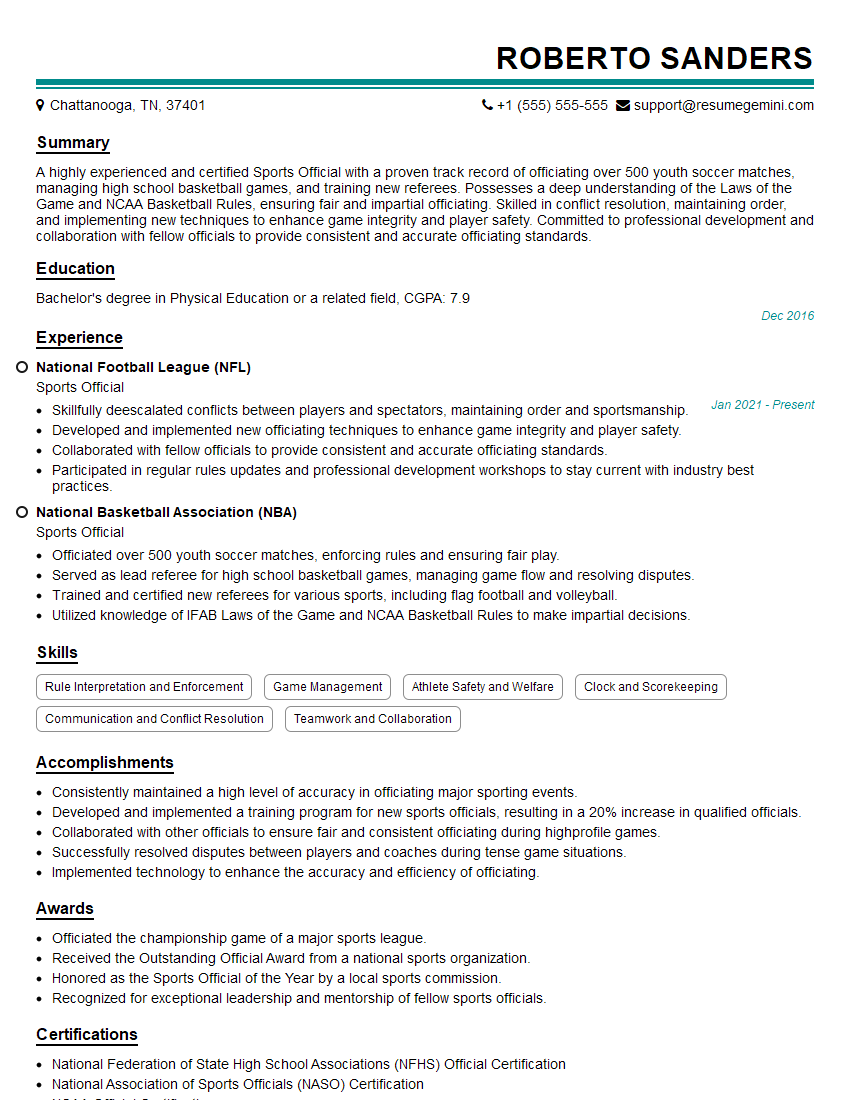
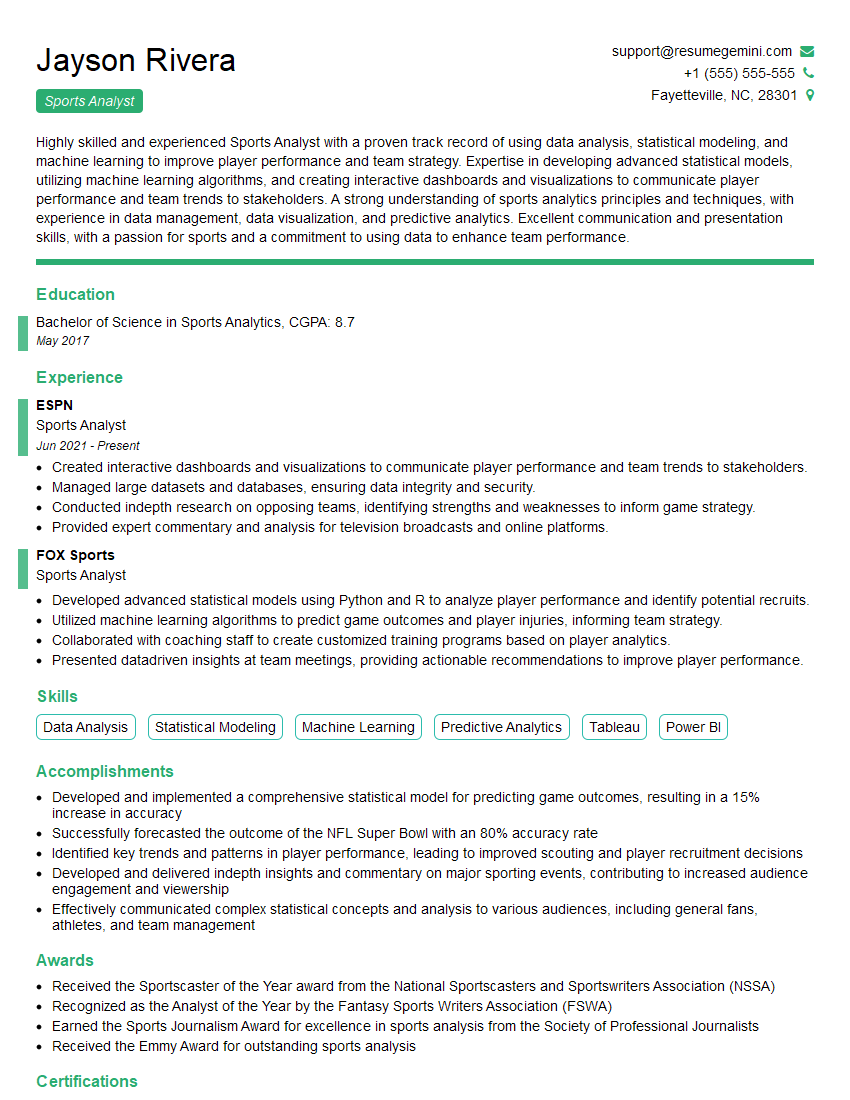
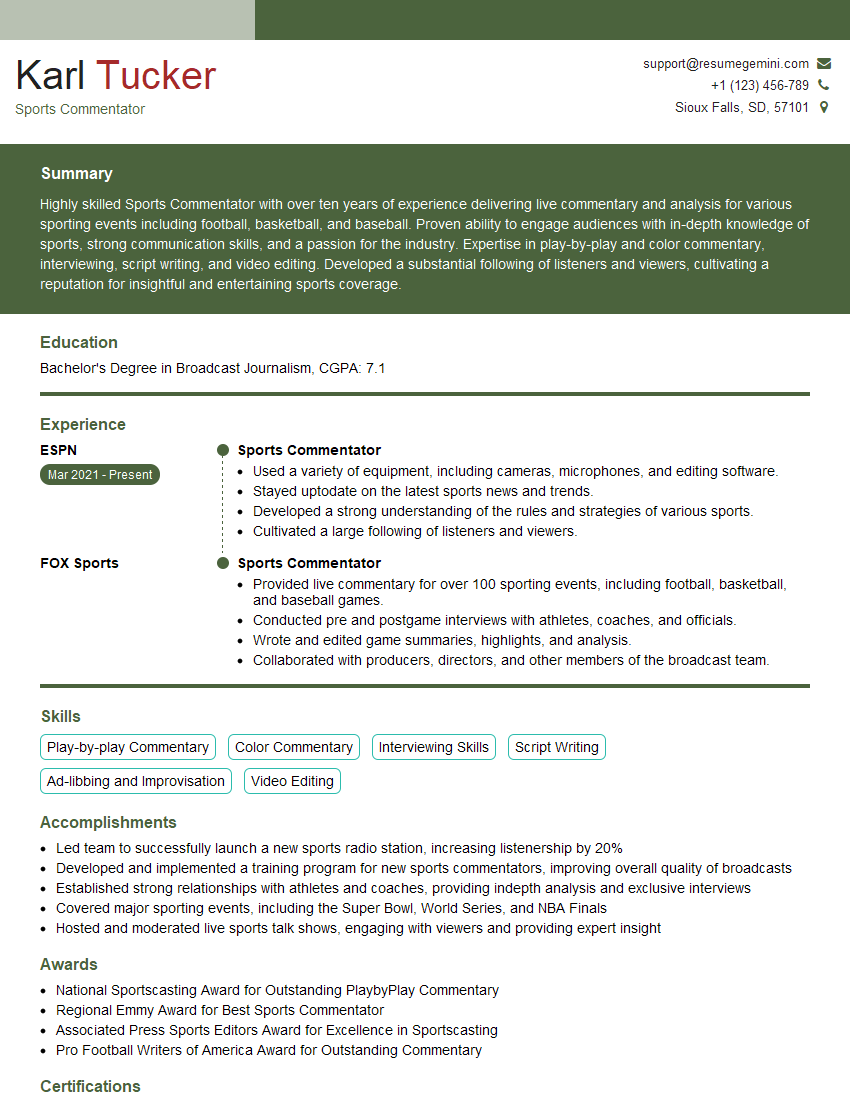
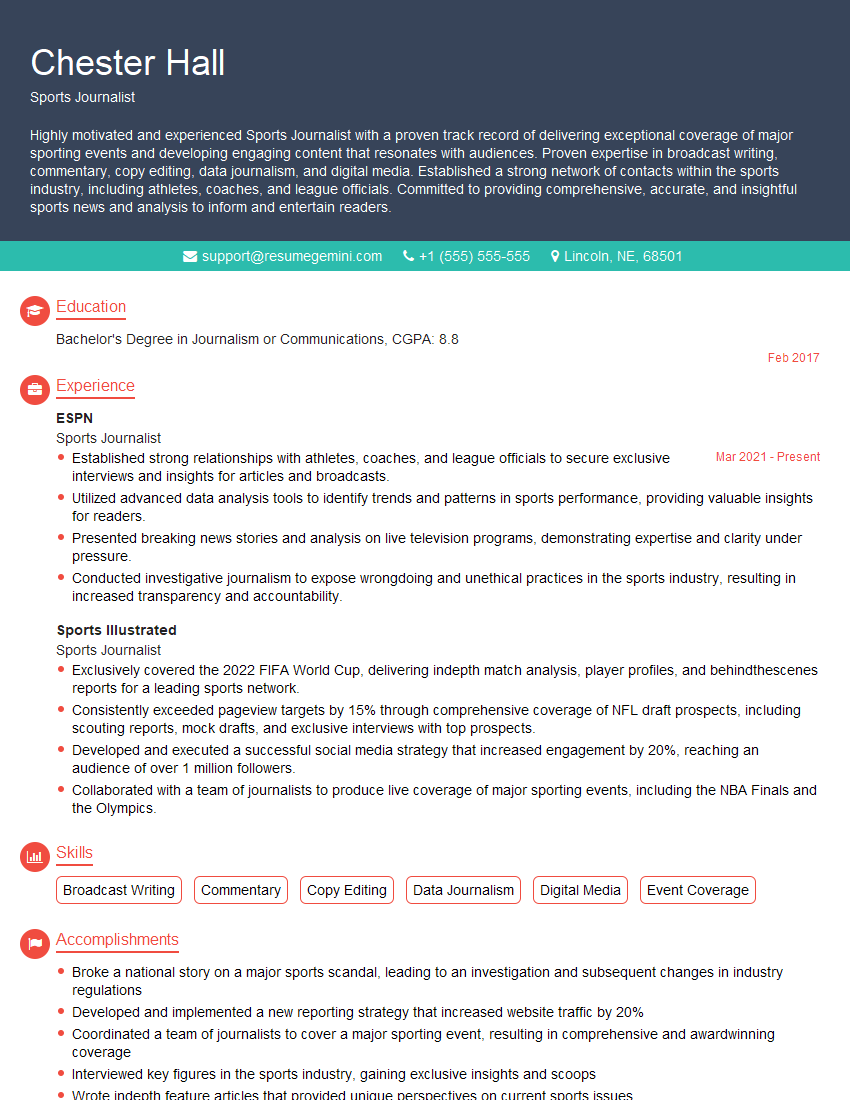
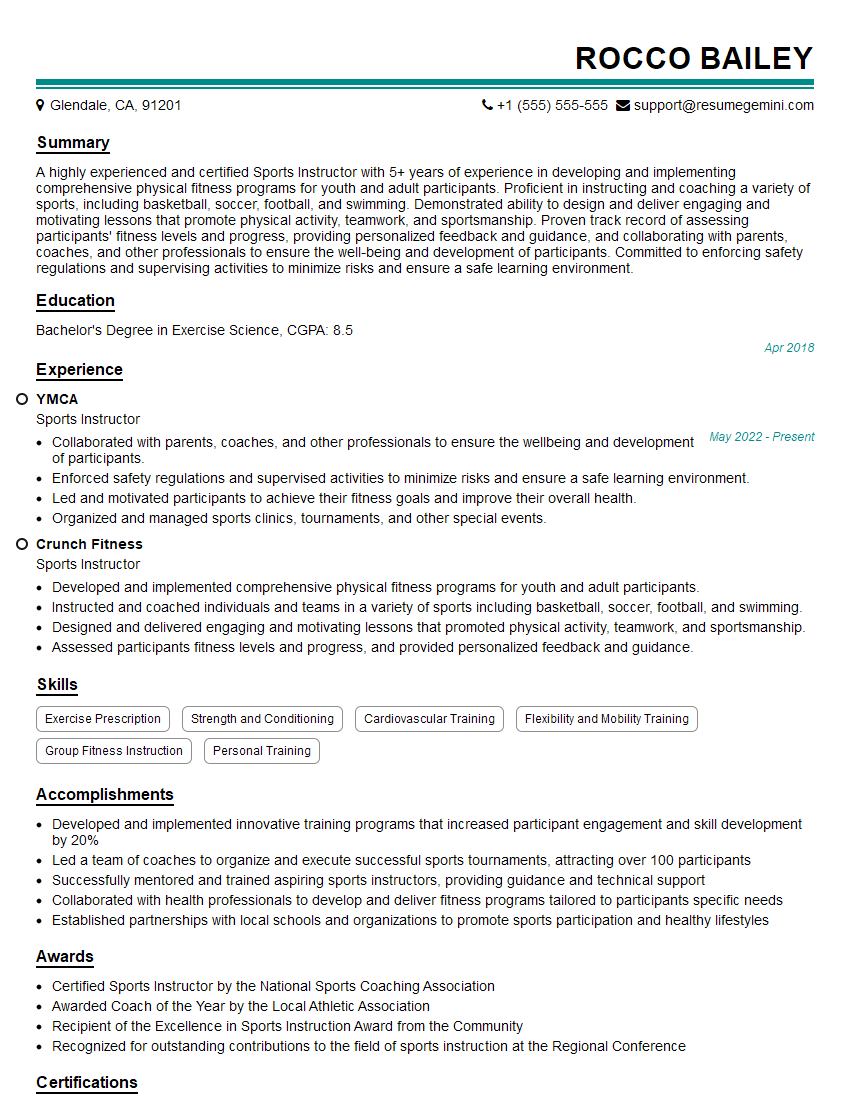
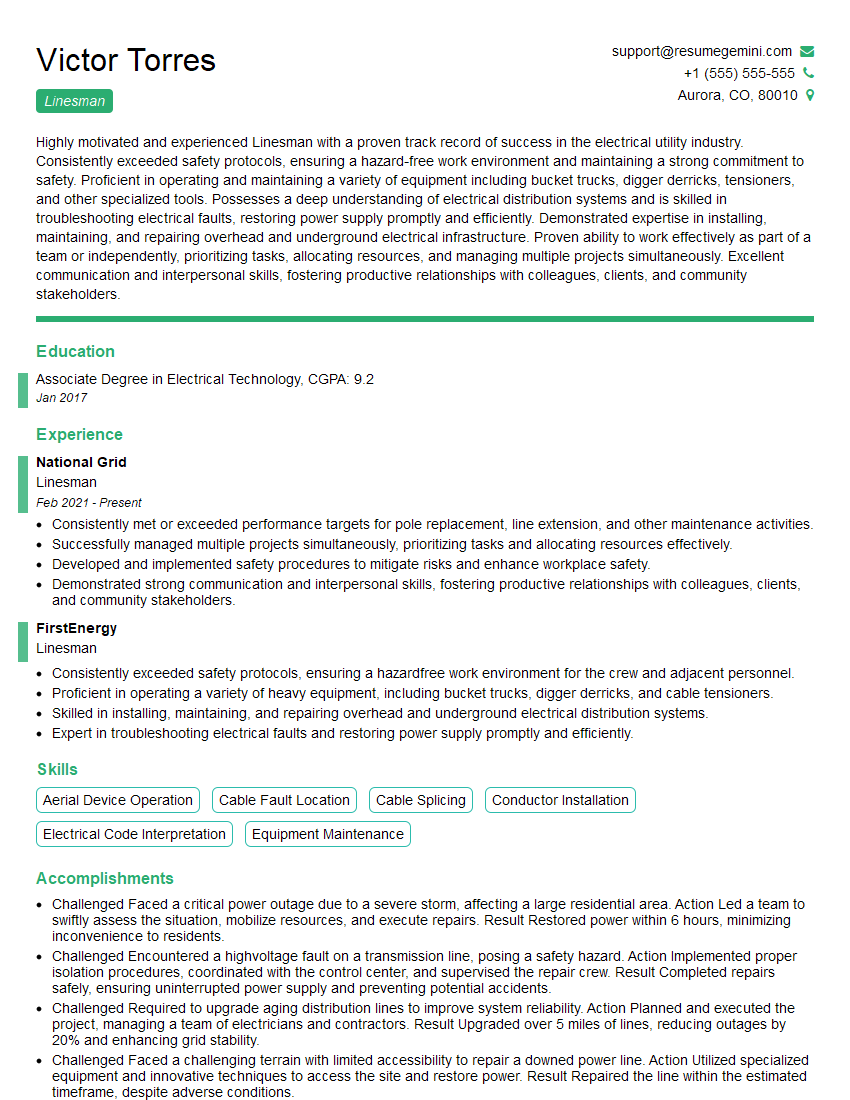
Mastering the intricacies of various sporting rules and regulations is crucial for career advancement in sports management, officiating, journalism, coaching, and legal fields. A strong understanding demonstrates attention to detail, analytical skills, and a passion for the industry. To significantly boost your job prospects, create an ATS-friendly resume that highlights your expertise. ResumeGemini is a trusted resource that can help you build a professional and impactful resume tailored to your specific skills and experience. We offer examples of resumes specifically designed for candidates with expertise in Understanding of Various Sporting Rules and Regulations to help you get started.


Explore more articles
Users Rating of Our Blogs
Share Your Experience
We value your feedback! Please rate our content and share your thoughts (optional).
What Readers Say About Our Blog
Very informative content, great job.
good