Cracking a skill-specific interview, like one for Strong understanding of lean manufacturing principles, requires understanding the nuances of the role. In this blog, we present the questions you’re most likely to encounter, along with insights into how to answer them effectively. Let’s ensure you’re ready to make a strong impression.
Questions Asked in Strong understanding of lean manufacturing principles Interview
Q 1. Explain the five principles of lean manufacturing.
Lean manufacturing’s five core principles are all interconnected and aim to maximize value for the customer while minimizing waste. Think of it like building a perfectly efficient machine, where every part contributes directly to the final product.
- Specify Value: Define value strictly from the customer’s perspective. What are they willing to pay for? Everything else is waste. For example, if a customer wants a red car, painting it blue is waste.
- Map the Value Stream: Identify all the steps involved in bringing a product from inception to delivery, including those that add value and those that don’t. Imagine tracing every step a car part takes – from raw material to final assembly – to highlight inefficiencies.
- Create Flow: Optimize the flow of materials and information to reduce bottlenecks and delays. Think of a smoothly flowing river, versus a river with many rocks causing interruptions. Streamlining this process minimizes wasted time and resources.
- Establish Pull: Produce only what is needed, when it is needed, based on actual customer demand (pull system). This prevents overproduction – a significant form of waste. Imagine a supermarket – they only stock what customers are buying, avoiding large quantities of unsold goods.
- Pursue Perfection: Continuously strive to improve all processes to eliminate waste and enhance value. This is an ongoing journey, not a destination. Think of it as constantly fine-tuning your machine for optimal performance.
Q 2. What is Value Stream Mapping, and how is it used in lean manufacturing?
Value Stream Mapping (VSM) is a lean manufacturing tool used to visually represent the flow of materials and information in a process. It’s like creating a roadmap of your production, highlighting all steps and identifying areas for improvement. The map pinpoints where value is added and where waste occurs, enabling targeted improvements.
In practice, a team would create a current-state map, documenting the entire process. This would show all steps, inventory levels, lead times, and potential bottlenecks. They then create a future-state map, showcasing the improvements they envision. This visualization clarifies the ‘before’ and ‘after’, demonstrating potential gains in efficiency and cost reduction.
For example, a VSM for assembling a bicycle might reveal that the wheel assembly takes unnecessarily long, creating a bottleneck. The future-state map could then propose changes, like optimizing the workflow, adding more tools, or better training for the workers to solve the bottleneck.
Q 3. Describe the 5S methodology and its application in a manufacturing setting.
5S is a workplace organization method that creates a clean, orderly, and efficient work environment. It’s not just about tidiness; it’s about a standardized approach that minimizes waste and improves safety. The five S’s are Japanese words, but their English translations make their meaning clear:
- Seiri (Sort): Eliminate unnecessary items from the workspace. Think of decluttering your desk – removing items you don’t need for daily work.
- Seiton (Set in Order): Arrange necessary items in an easily accessible and logical manner. Imagine organizing your tools so the ones you use most frequently are within easy reach.
- Seiso (Shine): Clean the workspace thoroughly and regularly. This ensures a safe and hygienic environment and helps identify potential problems early.
- Seiketsu (Standardize): Maintain the cleanliness and orderliness through standardized procedures. Develop a checklist or schedule to ensure the workplace remains organized.
- Shitsuke (Sustain): Make 5S a habit and part of the company culture. Consistent implementation through training and continuous improvement is key.
In a manufacturing setting, 5S ensures that workers can find tools quickly, reduces the risk of accidents, and makes it easier to identify and address problems. A clean and organized factory floor also improves morale and productivity.
Q 4. What are the key differences between Kaizen and Kanban?
Both Kaizen and Kanban are lean manufacturing tools, but they focus on different aspects of improvement.
Kaizen focuses on continuous small improvements. It’s a philosophy of incremental change, involving everyone in the process of identifying and addressing problems. It’s like constantly polishing a gem – making small, consistent improvements leads to significant, long-term results. Think of a team suggesting and implementing minor modifications in their daily tasks, resulting in improved efficiency.
Kanban is a visual system for managing workflow. It focuses on limiting work in progress and pulling items through the production system based on customer demand. It’s like a traffic controller, ensuring a steady flow without congestion. Think of a Kanban board displaying the stages of production, helping teams visualize workflow and prevent bottlenecks.
In essence, Kaizen is about *what* improvements to make, while Kanban is about *how* to manage the workflow to implement those improvements smoothly and efficiently.
Q 5. How do you identify and eliminate waste in a manufacturing process?
Identifying and eliminating waste is central to lean manufacturing. Waste, also known as ‘muda’ in Japanese, takes many forms. The most common are:
- Overproduction: Producing more than needed.
- Waiting: Idle time for materials or workers.
- Transportation: Unnecessary movement of materials.
- Inventory: Excessive stock of raw materials or finished goods.
- Motion: Unnecessary movements by workers.
- Over-processing: Performing unnecessary steps.
- Defects: Products that don’t meet quality standards.
- Unused Talent: Failing to utilize employee skills and knowledge.
To eliminate waste, you need a systematic approach. This involves using tools like VSM to visualize the process, analyzing each step to identify where waste occurs, and implementing solutions such as redesigning workflows, improving layout, implementing better quality control, and employee empowerment.
For example, analyzing a production line might reveal significant waiting time while materials are transported. Solutions could involve relocating the storage area closer to the assembly line or using automated guided vehicles.
Q 6. Explain the concept of ‘takt time’ and its importance in lean manufacturing.
Takt time is the rate at which a finished product needs to be produced to meet customer demand. It’s calculated by dividing the available production time by the customer demand. For example, if you have 8 hours of production time per day and need to produce 200 units, your takt time is 8 hours * 60 minutes/hour / 200 units = 2.4 minutes/unit.
Takt time is crucial because it sets the pace for the entire production process. By aligning all processes to the takt time, you ensure that production matches customer demand, avoiding overproduction and inventory buildup. Think of it as the heartbeat of your production line; it dictates the rhythm that every part of the operation must follow.
If your current process doesn’t meet the takt time, you need to identify bottlenecks and implement solutions to increase efficiency. This could involve improving processes, adding resources, or changing the layout to ensure a smoother workflow.
Q 7. What is the role of Poka-Yoke in preventing defects?
Poka-Yoke, meaning ‘mistake-proofing’ in Japanese, involves designing processes and equipment to prevent defects from occurring in the first place. It’s a proactive approach to quality control, aiming to eliminate human error.
There are several methods for implementing Poka-Yoke. One common technique is using jigs and fixtures that guide workers and prevent them from making mistakes. Another is using sensors and automated systems to detect errors as they occur. For instance, a car assembly line might have sensors that detect if a bolt hasn’t been properly tightened, stopping the line until the issue is resolved.
Other methods include using visual cues like color-coding to distinguish different parts, or implementing checklists and standardized procedures to reduce the chance of human error. Essentially, Poka-Yoke anticipates common errors and builds safeguards to prevent them, creating a more reliable and consistent production process.
Q 8. Describe your experience implementing lean principles in a previous role.
In my previous role at a medium-sized automotive parts manufacturer, we implemented Lean principles to streamline our production process and reduce waste. We started by mapping the entire value stream, identifying bottlenecks and areas of inefficiency using value stream mapping. This involved observing the flow of materials and information, from raw materials to finished goods. We discovered significant delays in the assembly line due to inconsistent parts delivery. To address this, we implemented Kanban systems to manage inventory flow and signal production needs based on actual demand. This reduced lead times significantly and minimized wasted inventory. We also implemented 5S methodology to improve workplace organization, resulting in a safer and more efficient work environment. The entire initiative led to a 15% reduction in lead time and a 10% decrease in inventory holding costs within six months.
Q 9. How would you measure the success of a lean initiative?
Measuring the success of a lean initiative requires a multifaceted approach. We shouldn’t rely solely on one metric. Instead, a balanced scorecard is necessary, tracking improvements across several key performance indicators (KPIs). Key metrics include:
- Lead time reduction: How much faster are we producing goods or services?
- Inventory reduction: How much less inventory are we holding?
- Defect rate reduction: How much has product quality improved?
- Production efficiency increase: How much has overall output improved?
- Employee satisfaction: How engaged and satisfied are the employees with the new processes?
- Cost reduction: How much have we reduced operational costs?
Regular monitoring of these KPIs, coupled with feedback from employees, provides a holistic view of the lean initiative’s success. For example, if lead time is reduced but employee satisfaction drops, we need to investigate and adjust the implementation.
Q 10. Explain the concept of pull systems versus push systems.
Think of a push system like a river constantly flowing downstream, regardless of whether there’s a need for water at the end. In manufacturing, this means producing goods based on forecasts or production schedules, regardless of actual customer demand. This often leads to excess inventory, wasted resources, and increased risk of obsolescence.
A pull system, on the other hand, is like a water faucet. Water only flows when the tap is turned on, signifying a demand. In manufacturing, this means producing goods only when there’s a confirmed customer order or demand signal. This significantly reduces waste, improves responsiveness to customer needs, and helps to maintain optimal inventory levels.
Example: A push system might produce 100 widgets daily based on a sales forecast, even if only 70 are sold. A pull system would produce only 70 widgets after receiving orders for that quantity. Kanban is a classic example of a pull system.
Q 11. What is the role of visual management in a lean manufacturing environment?
Visual management is crucial in a lean environment because it makes information readily available and easily understandable to everyone on the shop floor. It’s about using visual cues to monitor performance, identify problems, and track progress. This eliminates the need for extensive reports and meetings, allowing for faster problem-solving and improved communication.
Examples of visual management tools include:
- Andon boards: Display real-time production status and alerts.
- Kanban boards: Show the flow of materials and work-in-progress.
- 5S work areas: Visually organized and clean workspaces.
- Shadow boards: Show where tools should be stored.
- Charts and graphs: Track key performance indicators visually.
By making information visible, everyone can see the status of production, identify potential problems proactively, and participate in continuous improvement. Visual management empowers employees and fosters a culture of transparency and accountability.
Q 12. How do you handle resistance to change when implementing lean principles?
Resistance to change is a common hurdle in lean implementation. It often stems from fear of the unknown, job insecurity, or lack of understanding. To overcome this, it’s crucial to involve employees from the start. This includes:
- Communication and Education: Clearly explain the benefits of lean and how it will affect individual roles. Address concerns and misconceptions openly.
- Training and Development: Provide comprehensive training on new processes and tools, empowering employees with the skills they need.
- Involve Employees in the Process: Engage employees in identifying problems and developing solutions. Make them active participants, not just recipients of change.
- Celebrate Small Wins: Acknowledge and reward progress, building momentum and demonstrating success.
- Address Concerns: Listen to and address employees’ concerns about job security or workload changes. Show empathy and understanding.
Change management is a crucial aspect of a successful lean implementation. Creating a culture of trust and collaboration is essential.
Q 13. What are some common challenges encountered during lean implementation?
Implementing lean principles often encounters several challenges:
- Resistance to change: As discussed earlier, overcoming resistance from employees is crucial.
- Lack of management support: Lean implementation requires strong commitment from top management to provide resources and drive the initiative.
- Insufficient training: Employees need adequate training to effectively use lean tools and processes.
- Inconsistent implementation: Lean principles should be implemented consistently across the entire organization.
- Measuring results: Defining and tracking appropriate KPIs is vital to demonstrate the success of the initiative.
- Lack of standardization: Standardization of processes is key to efficiency and consistency.
Addressing these challenges proactively, through careful planning, communication, and consistent monitoring, is key to successful lean transformation.
Q 14. Explain the concept of Andon and its use in lean manufacturing.
An Andon is a visual signaling system used to alert management to problems on the production line. Imagine it as a visual alarm system, typically displayed on a central board. When a problem occurs – whether it’s a machine malfunction, a quality issue, or a safety hazard – an employee can trigger the Andon, immediately halting production at that station or even the entire line.
This immediate visual alert ensures that problems are addressed quickly, minimizing downtime and preventing defects from propagating down the line. The Andon system promotes a culture of proactive problem-solving and immediate attention to quality and safety. It’s an integral part of a lean manufacturing system that aims for continuous improvement and waste reduction.
Q 15. How would you use data analysis to support lean initiatives?
Data analysis is the bedrock of effective lean implementation. It allows us to move beyond gut feelings and subjective opinions to objective, fact-based decision-making. We use data to identify areas for improvement, track progress, and measure the impact of our lean initiatives.
For example, in a previous role, we analyzed production line data – cycle times, defect rates, downtime – to pinpoint bottlenecks. We used control charts to monitor process stability and identify special cause variations requiring immediate attention. This data-driven approach led to a 15% reduction in production lead times and a 10% decrease in defects.
Specific data analysis techniques we leverage include:
- Statistical Process Control (SPC): To monitor process variation and identify areas needing adjustment.
- Value Stream Mapping (VSM): To visually represent the flow of materials and information, revealing waste and inefficiencies.
- Root Cause Analysis (RCA): Techniques like the 5 Whys or Fishbone diagrams help us understand the underlying causes of problems.
- Six Sigma methodologies: Employing tools like DMAIC (Define, Measure, Analyze, Improve, Control) for structured problem-solving.
By systematically collecting, analyzing, and interpreting data, we ensure our lean initiatives are targeted, effective, and demonstrably successful.
Career Expert Tips:
- Ace those interviews! Prepare effectively by reviewing the Top 50 Most Common Interview Questions on ResumeGemini.
- Navigate your job search with confidence! Explore a wide range of Career Tips on ResumeGemini. Learn about common challenges and recommendations to overcome them.
- Craft the perfect resume! Master the Art of Resume Writing with ResumeGemini’s guide. Showcase your unique qualifications and achievements effectively.
- Don’t miss out on holiday savings! Build your dream resume with ResumeGemini’s ATS optimized templates.
Q 16. What is the role of continuous improvement in lean manufacturing?
Continuous improvement (Kaizen) is the lifeblood of lean manufacturing. It’s the philosophy that drives ongoing refinement and optimization of processes, aiming for incremental, sustainable improvements rather than radical, disruptive changes. It’s about fostering a culture where everyone is empowered to identify and eliminate waste.
Imagine a river constantly eroding its banks. Kaizen is like that slow, persistent erosion, gradually shaping a more efficient, effective channel. It’s not about a single, massive dam-building project, but a continuous process of refinement.
In practice, continuous improvement involves:
- Regular Gemba walks: Going to the actual workplace to observe processes firsthand.
- Kaizen events: Focused workshops where teams collaborate to solve specific problems.
- Standardized work: Documenting best practices to ensure consistency and reduce variation.
- Feedback loops: Establishing systems for collecting and acting on feedback from employees and customers.
Without continuous improvement, any initial gains from lean implementation will eventually be eroded. It’s an ongoing commitment to excellence.
Q 17. Describe your experience with different lean tools and techniques.
My experience spans a wide range of lean tools and techniques. I’ve successfully implemented Value Stream Mapping to identify bottlenecks in complex manufacturing processes, leading to significant reductions in lead times and inventory. I’ve also extensively used 5S methodologies to create organized and efficient workspaces, boosting productivity and safety.
Furthermore, I’m proficient in:
- Kanban: For visualizing workflow and managing inventory in a just-in-time manner.
- Poka-Yoke (error-proofing): Designing processes to prevent defects from occurring in the first place.
- Andon: A system for quickly alerting supervisors to problems on the production line.
- Heijunka (level scheduling): To smooth out production by reducing variability in demand.
I’ve also facilitated numerous Kaizen events, guiding cross-functional teams through problem-solving and improvement projects. My experience extends to implementing lean principles in both manufacturing and administrative settings, demonstrating adaptability and a comprehensive understanding of lean methodology. I’m always eager to learn and apply new techniques to achieve optimal results.
Q 18. How do you ensure that lean principles are integrated into all aspects of an organization?
Integrating lean principles across an entire organization requires a holistic approach, going beyond just the manufacturing floor. It’s about embedding lean thinking into the company’s DNA. This involves a multifaceted strategy:
- Leadership commitment: Top-down support and active participation are crucial. Leaders need to champion the initiative and visibly demonstrate their commitment.
- Training and education: Employees at all levels must understand lean principles and how they apply to their roles. This ensures buy-in and effective implementation.
- Cross-functional teams: Lean improvement projects should involve members from different departments to foster collaboration and break down silos.
- Clear communication: Regular updates, progress reports, and open dialogue are essential to maintain momentum and address challenges.
- Measurement and recognition: Tracking key performance indicators (KPIs) and celebrating successes reinforce positive behaviors and encourage continuous improvement.
- Continuous improvement culture: Foster an environment where identifying and solving problems is valued and rewarded.
For example, in a previous role, we successfully integrated lean principles into our administrative processes, reducing paperwork, improving information flow, and streamlining approval processes. This demonstrated that lean thinking can benefit all aspects of a business, not just manufacturing.
Q 19. What are the benefits of implementing lean manufacturing?
Implementing lean manufacturing offers numerous benefits, leading to substantial improvements in efficiency, profitability, and customer satisfaction. The advantages extend across various aspects of the business:
- Reduced costs: Eliminating waste reduces material, labor, and overhead expenses.
- Improved quality: Error-proofing and process standardization minimize defects and improve product quality.
- Increased efficiency: Streamlined processes and optimized workflows improve productivity and throughput.
- Shorter lead times: Faster production and delivery cycles enhance customer responsiveness.
- Reduced inventory: Just-in-time inventory management minimizes storage costs and reduces waste.
- Improved employee morale: Empowerment, problem-solving opportunities, and a focus on continuous improvement contribute to a more engaged and satisfied workforce.
- Enhanced customer satisfaction: Faster delivery, higher quality, and greater responsiveness improve customer experience.
In essence, lean manufacturing empowers businesses to become more competitive, adaptable, and resilient in today’s dynamic market.
Q 20. How would you prioritize improvement projects in a lean environment?
Prioritizing improvement projects in a lean environment requires a systematic approach that considers both the potential impact and the feasibility of implementation. We typically use a combination of methods:
- Value stream mapping: Identify the highest-value streams and prioritize projects that will have the greatest impact on those streams.
- Cost-benefit analysis: Assess the potential return on investment (ROI) for each project to ensure resources are allocated effectively.
- Urgency and impact matrix: Categorize projects based on their urgency and potential impact. High-impact, high-urgency projects should be prioritized.
- Data-driven decision making: Use data on defects, cycle times, and other key performance indicators to identify the most critical areas for improvement.
- Stakeholder input: Involve key stakeholders in the prioritization process to ensure alignment and buy-in.
We employ a balanced scorecard approach, considering financial, customer, internal process, and learning & growth perspectives. This ensures we’re not solely focused on short-term gains but also building a sustainable system for continuous improvement.
Q 21. Explain the concept of Gemba walks.
Gemba walks are structured observations of the actual work process at the place where the work is done (Gemba means “the real place” in Japanese). It’s not just a casual stroll through the factory; it’s a purposeful, systematic approach to understanding how work is performed and identifying areas for improvement.
Think of it as a doctor conducting a physical examination. They don’t just ask the patient how they feel; they perform tests, examine symptoms, and make observations to diagnose the problem accurately. Similarly, a Gemba walk is about directly observing the process to gain first-hand insights rather than relying on secondhand information.
Effective Gemba walks involve:
- Preparation: Defining the purpose of the walk and identifying key areas to focus on.
- Observation: Carefully observing the process, paying attention to details like workflow, material flow, and equipment usage.
- Data collection: Gathering data on cycle times, defect rates, and other relevant metrics.
- Asking questions: Engaging with the workers to understand their perspectives and identify challenges.
- Follow-up: Developing action plans to address the identified issues and tracking progress.
Gemba walks are crucial for gaining a deep understanding of the process, fostering collaboration, and driving continuous improvement. They are a powerful tool for lean implementation, bringing leaders and workers together to solve problems and create a more efficient and effective workplace.
Q 22. How do you involve employees in lean implementation?
Lean implementation thrives on employee involvement; it’s not a top-down initiative. Think of it as a journey, not a destination, and employees are your trusted guides. I’d start by building a culture of continuous improvement. This involves:
Training and Education: Providing thorough training on lean principles, tools (like 5S, Kaizen, Value Stream Mapping), and the overall goals. This ensures everyone understands their role in the process.
Empowerment and Ownership: Giving employees the authority to identify and solve problems directly affecting their work. This fosters a sense of ownership and commitment.
Suggestion Systems and Kaizen Events: Implementing formal systems for employees to suggest improvements and actively participate in Kaizen events (short, focused improvement projects). This provides a structured way to capture their valuable insights.
Cross-functional Teams: Forming teams that include employees from different departments to tackle problems holistically. This breaks down silos and fosters collaboration.
Recognition and Rewards: Acknowledging and rewarding contributions, big or small. This reinforces positive behavior and sustains employee motivation.
For example, in a previous role, we held regular ‘Gemba Walks’ (going to the actual workplace to observe the process) with frontline workers, allowing them to highlight bottlenecks and inefficiencies they experienced firsthand. This led to several significant improvements in our production process.
Q 23. How do you measure the ROI of lean initiatives?
Measuring the ROI of lean initiatives requires a multifaceted approach. It’s not just about immediate cost savings; it’s about long-term sustainable improvements. I’d focus on:
Reduced Costs: Tracking reductions in inventory, waste (materials, time, motion), and production costs. This can be quantified through direct comparisons before and after lean implementation.
Improved Efficiency: Measuring metrics like lead time reduction, cycle time improvement, and overall equipment effectiveness (OEE). These metrics illustrate how lean has streamlined processes.
Increased Quality: Tracking improvements in defect rates, customer satisfaction scores, and on-time delivery. Lean aims for zero defects and improved product quality.
Enhanced Productivity: Assessing increases in output per employee or machine hour. Lean reduces non-value-added activities, freeing up capacity for more productive tasks.
Improved Safety: Measuring reductions in workplace accidents. A lean workplace prioritizes safety as a key element of efficiency.
Ideally, you’d use a combination of quantitative (numerical) and qualitative (descriptive) data to build a comprehensive picture. I frequently use dashboards and regular reporting to track key metrics and communicate progress visually.
Q 24. Describe your understanding of the Toyota Production System (TPS).
The Toyota Production System (TPS) is the foundation of lean manufacturing. It’s built on two pillars:
Just-in-Time (JIT): Producing goods only when needed, minimizing inventory and waste. This requires precise coordination and efficient processes.
Jidoka (Autonomation): Building quality into the process itself. This involves empowering workers to stop the production line when a problem is detected, preventing defects from progressing further down the line.
TPS also emphasizes continuous improvement (Kaizen), waste reduction (Muda), and respect for people. It’s not just about optimizing individual processes; it’s about creating a system-wide culture of efficiency and continuous improvement. Think of it as an orchestra – each instrument (process) needs to play its part perfectly in harmony to create a beautiful symphony (high-quality product delivered efficiently).
Q 25. How do you balance efficiency and quality in a lean manufacturing setting?
Balancing efficiency and quality in lean manufacturing isn’t a trade-off; it’s a synergistic relationship. Improving efficiency often leads to improved quality, and vice versa. Here’s how I approach it:
Focus on Value-Added Activities: Identifying and eliminating non-value-added activities (waste) directly increases efficiency and frees resources to focus on improving quality.
Process Standardization: Developing standardized work instructions reduces variability and minimizes errors, leading to higher quality and consistent production.
Quality at the Source (Jidoka): Empowering workers to identify and correct defects immediately eliminates the need for downstream rework and inspection, improving both efficiency and quality.
Continuous Improvement (Kaizen): Regularly evaluating processes for improvements, both in efficiency and quality, prevents complacency and promotes a culture of continuous learning.
Use of Metrics: Tracking key quality metrics (defect rates, customer complaints) alongside efficiency metrics (cycle time, OEE) provides a clear picture of the overall performance and reveals areas for improvement.
For example, implementing a Poka-Yoke (error-proofing) system on an assembly line can prevent defects from occurring in the first place, boosting both efficiency and quality simultaneously.
Q 26. What is your experience with implementing lean in a specific industry (e.g., automotive, food processing)?
I have extensive experience implementing lean principles in the food processing industry. In my previous role at a large bakery, we focused on reducing waste in the production of bread rolls. We used value stream mapping to visualize the entire process, from raw material delivery to finished product packaging. This revealed significant bottlenecks and non-value-added activities such as unnecessary transportation, excessive waiting time for ovens, and inefficient packaging processes. We implemented several improvements based on lean principles, including:
Improved oven scheduling: Optimizing oven usage to minimize idle time and reduce energy consumption.
Redesigned material flow: Creating a more efficient layout to reduce the distance materials needed to travel.
Standardized work instructions: Clear, consistent instructions for each step in the process ensured consistent quality and reduced errors.
Kaizen events: Engaging employees in identifying and solving smaller problems throughout the process.
These improvements resulted in a 15% reduction in production time, a 10% decrease in waste, and a significant improvement in overall product quality. The key was involving employees at every step and creating a culture of continuous improvement.
Q 27. Explain how you would address a bottleneck in a manufacturing process using lean principles.
Addressing a bottleneck using lean principles involves a structured approach:
Identify the Bottleneck: Use tools like value stream mapping to pinpoint the stage in the process where work is piling up or causing delays. This often involves analyzing cycle times, inventory levels, and employee workload.
Analyze the Root Cause: Investigate *why* the bottleneck exists. Is it due to insufficient equipment capacity, poor process design, skill gaps among employees, or inadequate materials supply?
Develop Solutions: Brainstorm potential solutions using lean tools such as 5 Whys, fishbone diagrams, and Kaizen events. This involves exploring various options including increasing capacity, improving process flow, enhancing employee skills, or improving material handling.
Implement and Test: Implement the chosen solution(s) on a small scale (pilot project) to test its effectiveness. This allows for quick adjustments if necessary.
Monitor and Evaluate: Track key metrics to measure the impact of the implemented solution. This involves monitoring cycle times, inventory levels, and overall throughput to ensure the bottleneck has been effectively addressed.
Standardize and Document: Once a successful solution is identified, standardize the improved process and document the changes. This ensures that the improvements are sustained over time.
For example, a bottleneck in packaging could be addressed by improving the packaging machine’s efficiency (increasing capacity), using a different packaging material (reducing processing time), or rearranging the packaging line to reduce movement.
Q 28. Describe a time you successfully identified and resolved a waste in a production process.
In a previous role at a manufacturing plant, we identified significant waste in the material handling process. We observed that materials were being transported across the factory floor using manual hand trucks, which was inefficient, time-consuming, and prone to errors. We analyzed the process and found that:
Unnecessary Movement: Materials were being moved multiple times before reaching their destination.
Long Transport Times: The distance between work centers was excessive.
High Risk of Damage: Manual handling increased the likelihood of materials being damaged.
We implemented a Kanban system for materials flow and invested in a conveyor belt system to automate the movement of materials between work centers. This minimized unnecessary movement, reduced transport times, and decreased the risk of damage. The result was a 20% reduction in material handling time, a 10% decrease in damaged materials, and an overall improvement in factory efficiency. The Kanban system also enhanced the just-in-time delivery of materials, leading to reduced inventory costs. This demonstrated the power of applying lean principles to a seemingly minor aspect of production, resulting in substantial benefits.
Key Topics to Learn for Strong Understanding of Lean Manufacturing Principles Interview
- Value Stream Mapping: Understand how to identify and eliminate waste in your processes. Be prepared to discuss practical applications like analyzing current state maps and designing future state maps for improved efficiency.
- Kaizen and Continuous Improvement: Explain the philosophy behind Kaizen and provide examples of how small, incremental changes can lead to significant improvements. Discuss your experience with implementing Kaizen events or projects.
- 5S Methodology: Describe the five principles (Sort, Set in Order, Shine, Standardize, Sustain) and how they contribute to a more organized and efficient workplace. Be ready to share examples of successful 5S implementations.
- Lean Tools & Techniques: Familiarize yourself with common lean tools such as Kanban, Poka-Yoke (error-proofing), and Total Productive Maintenance (TPM). Be prepared to discuss how these tools can be used to solve real-world problems.
- Waste Reduction (Muda): Demonstrate a comprehensive understanding of the seven types of waste (Transportation, Inventory, Motion, Waiting, Overproduction, Over-processing, Defects) and how to identify and eliminate them. Provide specific examples from your experience.
- Pull Systems (Just-in-Time): Explain the principles of Just-in-Time manufacturing and its benefits. Be ready to discuss its implementation and potential challenges.
- Problem-Solving Methodologies (e.g., A3 Reporting, Root Cause Analysis): Showcase your ability to systematically identify and solve problems using structured methodologies. Be ready to discuss a challenging problem you solved using a lean approach.
Next Steps
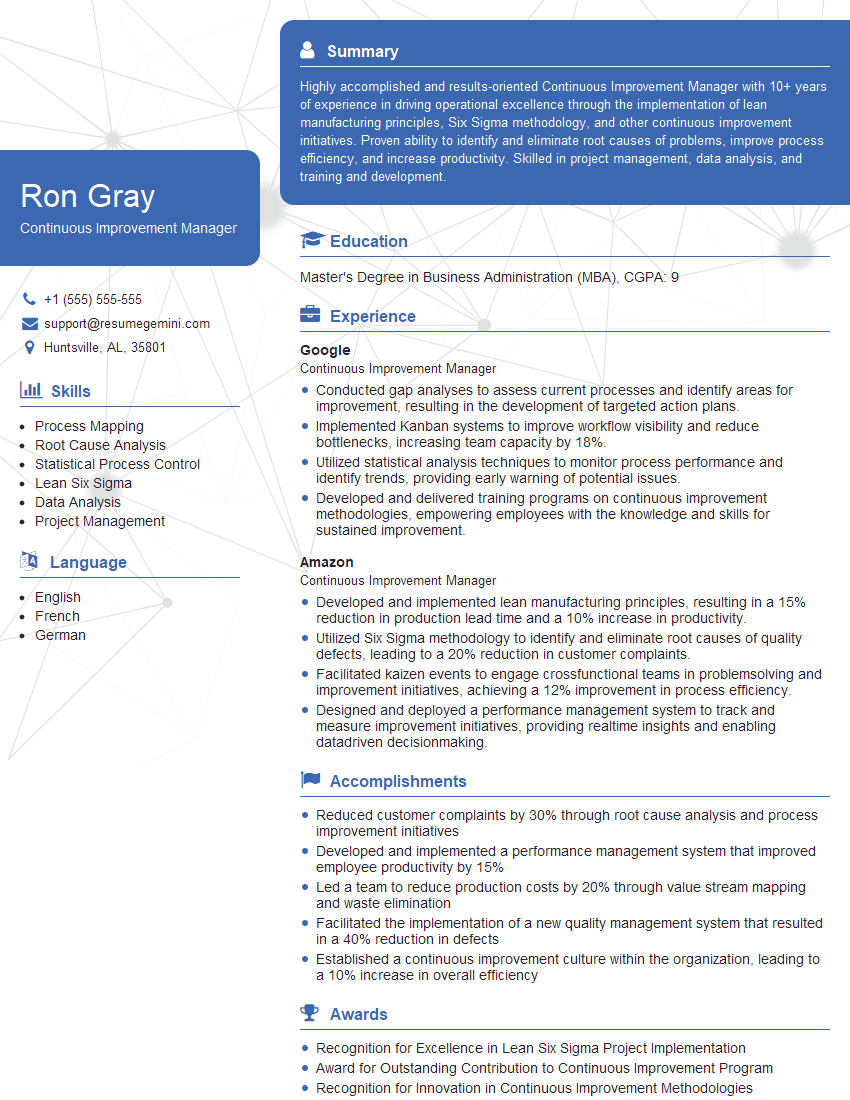
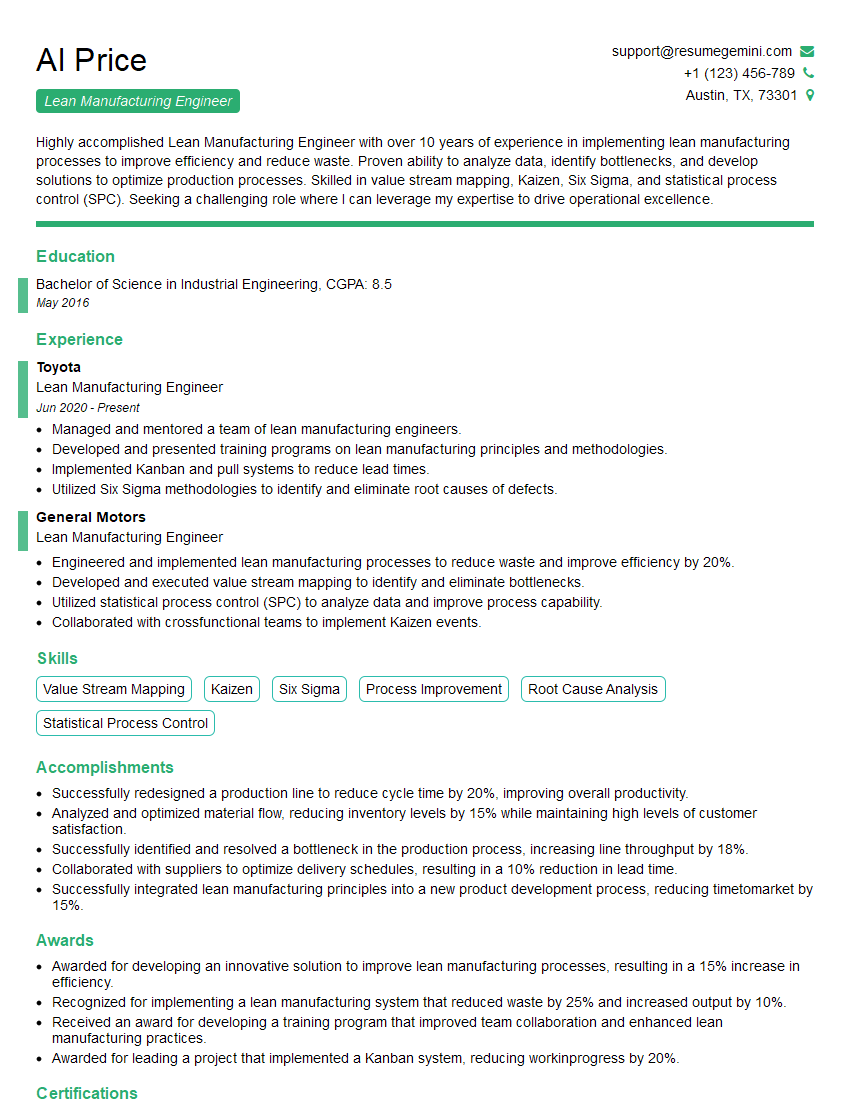
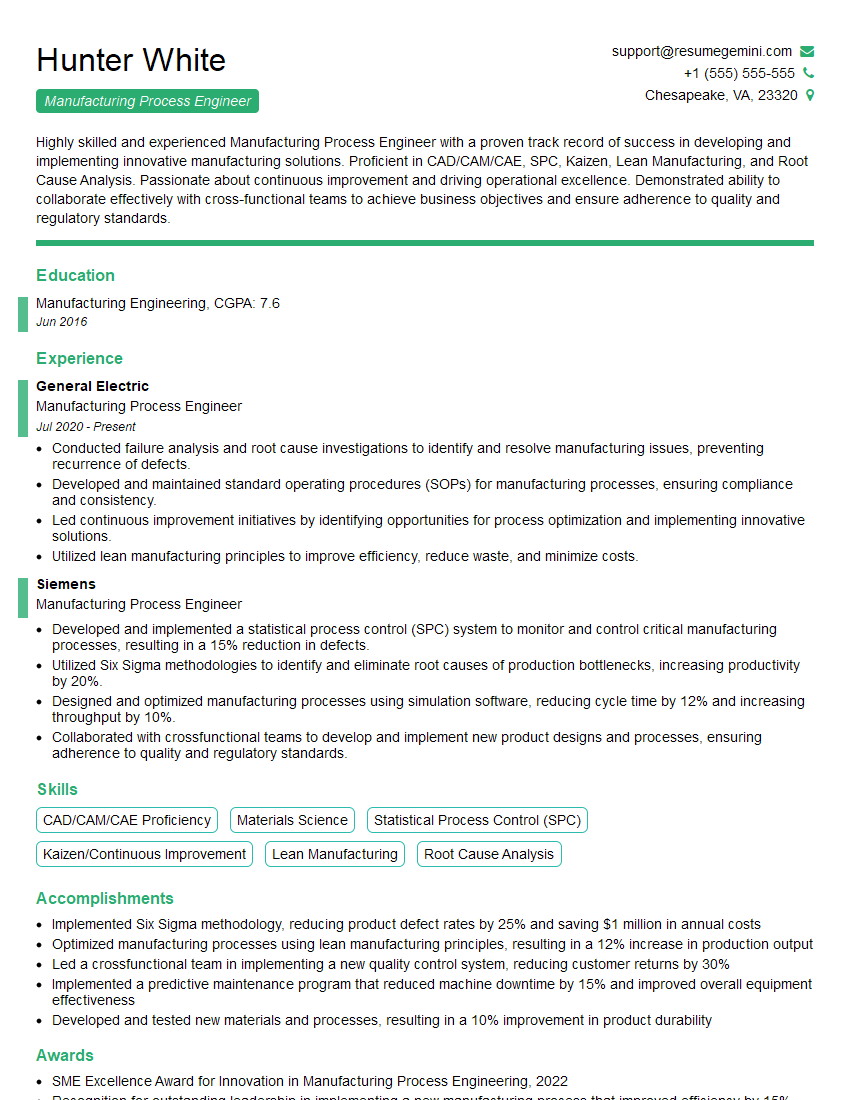
Mastering lean manufacturing principles significantly enhances your career prospects, opening doors to leadership roles and higher earning potential. A well-crafted, ATS-friendly resume is crucial for showcasing your skills effectively and landing those interviews. ResumeGemini is a trusted resource to help you build a professional resume that highlights your lean manufacturing expertise. Examples of resumes tailored to lean manufacturing principles are available within ResumeGemini to guide your creation, ensuring your skills and experience are presented in the best possible light. Take the next step towards your dream career today!
Explore more articles
Users Rating of Our Blogs
Share Your Experience
We value your feedback! Please rate our content and share your thoughts (optional).
What Readers Say About Our Blog
Very informative content, great job.
good