Cracking a skill-specific interview, like one for Drapery Measuring and Installation, requires understanding the nuances of the role. In this blog, we present the questions you’re most likely to encounter, along with insights into how to answer them effectively. Let’s ensure you’re ready to make a strong impression.
Questions Asked in Drapery Measuring and Installation Interview
Q 1. What are the common types of drapery hardware you’ve worked with?
Over the years, I’ve worked extensively with a wide variety of drapery hardware. My experience encompasses everything from basic rod sets to more complex systems. This includes:
- Standard curtain rods: These are the most common, available in various materials (wood, metal, etc.), finishes, and diameters. The choice depends largely on the weight of the drapery fabric and the overall style.
- Traverse rods: These are more sophisticated, allowing for the opening and closing of drapes in sections using a cord mechanism. They are excellent for large windows or those requiring more control.
- Café rods: These are shorter rods, typically mounted midway down a window, perfect for creating a charming café-style look while maintaining privacy.
- Track systems: These often incorporate pulleys and carriers for smooth operation and are particularly useful for heavier drapes or bay windows with multiple panels. They allow for a sophisticated stacking and opening mechanism.
- Finials: These decorative end pieces add a touch of elegance and complete the overall aesthetic. I have experience matching finials to the style and material of the rods and the surrounding décor.
Understanding the nuances of each hardware type is crucial for ensuring proper installation and smooth operation of the drapes.
Q 2. Describe your experience measuring for various window treatments (e.g., curtains, drapes, blinds).
Accurate measuring is the cornerstone of successful drapery projects. My experience spans various window treatments, encompassing:
- Curtains: I meticulously measure the width and length of the window, accounting for fabric fullness and desired draping style (e.g., gathered or pleated). I also consider the desired length – whether it’s hitting the sill, the floor, or pooling on the floor.
- Drapes: Similar to curtains, but often more involved, requiring precise measurements to ensure the elegant fall of heavier fabrics. I always account for the header type (e.g., grommets, pleats) and the weight of the fabric to avoid sagging or bunching.
- Blinds: While not strictly drapery, I also have experience measuring for blinds, ensuring a perfect fit within the window frame or casing. This includes precise measurements of the width and height, considering the installation type (inside or outside mount).
For each project, I create detailed sketches with measurements, meticulously noting any obstructions, like unusual window shapes or architectural features. This level of detail minimizes errors and ensures a perfect fit.
Q 3. How do you handle unexpected challenges during installation?
Unexpected challenges are part and parcel of this profession. My approach involves a combination of preparedness, problem-solving, and communication. For instance:
- Uneven walls: If I encounter uneven walls, I carefully adjust my measurements to account for these irregularities. This might involve shimming the hardware or using flexible track systems to ensure a straight hang.
- Faulty hardware: If I discover faulty hardware during installation, I immediately contact the supplier or utilize my backup inventory to ensure the project isn’t delayed. I always carry a variety of common replacement parts.
- Unforeseen obstructions: Discovering hidden obstructions (electrical wiring, pipes) requires careful planning and potential adjustments to the installation strategy. I always do a thorough inspection before beginning the installation.
Open communication with the client is crucial. I keep them informed of any issues and collaboratively find solutions. My experience has taught me to be resourceful and adaptable, ensuring a positive outcome even in unforeseen circumstances.
Q 4. Explain your process for calculating fabric requirements for drapery projects.
Calculating fabric requirements is a precise process that involves more than just measuring the window. I consider several factors:
- Window width: This is the starting point, but I typically add extra fabric for fullness (often 1.5 to 3 times the width). This creates the desired drape and luxurious look.
- Header and hem allowances: I add extra fabric for the top (header) and bottom (hem) to account for the finishing. This allowance depends on the type of heading (pleats, grommets, etc.) and the desired hem length.
- Fabric repeat: For patterned fabrics, it’s crucial to consider the pattern repeat to ensure a continuous pattern across panels. This sometimes requires purchasing extra fabric to match the pattern.
- Drape length: This includes the length from the top of the rod to the desired finishing point (floor, sill, etc.). I add extra for the desired pooling or break.
I usually create a detailed calculation sheet for each project, outlining all these factors to ensure accurate fabric ordering and minimize waste. This systematic approach helps ensure a smooth project and avoids costly mistakes.
Q 5. What safety precautions do you take during drapery installation?
Safety is paramount. My installation process includes:
- Proper use of ladders: I always use sturdy ladders in good condition, ensuring they are placed on a stable surface. I never overextend myself and always follow safety guidelines.
- Protective gear: I wear safety glasses and gloves to protect against potential hazards, like sharp fabrics or falling debris.
- Electrical safety: I always check for and avoid contact with electrical wires. I carefully locate any electrical fixtures before drilling or making any modifications.
- Secure mounting: I use appropriate wall anchors and screws for the specific wall type to ensure secure and stable mounting of the hardware.
I brief clients on any potential safety concerns and encourage their involvement in the process if appropriate. This shared responsibility creates a safe environment for all involved.
Q 6. How do you ensure precise measurements to avoid fabric waste?
Precise measurements are key to minimizing fabric waste. My strategy involves:
- Multiple measurements: I take multiple measurements of each window at different points to account for any irregularities. I record all measurements meticulously, documenting any discrepancies.
- Detailed sketches: I always draw a detailed sketch of each window, including all measurements and relevant features. This serves as a visual guide during the cutting and installation phases.
- Precise cutting techniques: I use precision cutting tools to ensure straight cuts and minimize waste. This includes using a rotary cutter or sharp shears.
- Pre-fabrication layout: Before cutting, I lay out the fabric panels to visualize the placement of the pattern and ensure efficient usage. This minimizes waste and optimizes fabric usage.
Experience allows me to estimate fabric needs accurately, and my detailed approach allows for creating a custom cut plan that minimizes waste while preserving a high-quality finish. I view this careful planning as cost-saving and a testament to professionalism.
Q 7. Describe your experience with different types of drapery fabrics.
My experience with drapery fabrics is extensive. I’ve worked with a wide range of materials, each with its own properties and characteristics:
- Velvet: Luxurious and heavy, requiring robust hardware and careful handling during installation. The weight and texture must be considered when determining appropriate fullness.
- Linen: A natural fiber with a relaxed drape. It’s often more prone to wrinkling, and its inherent texture needs to be factored into the design and fullness.
- Silk: Delicate and elegant, needing gentle handling and specialized care. This fabric requires special attention during both measurement and installation.
- Polyester blends: More durable and easy to maintain, often chosen for their practicality and cost-effectiveness. They still need proper measurements for appropriate fullness and drape.
Understanding the drape, weight, and maintenance requirements of each fabric is essential for selecting the correct hardware and advising clients on appropriate care instructions. I always discuss fabric choices with clients, considering their lifestyle and desired aesthetic.
Q 8. How do you deal with difficult window shapes or sizes?
Dealing with unusual window shapes and sizes requires a creative and meticulous approach. It’s not simply about hanging fabric; it’s about understanding the architecture and designing a solution that complements the space. I start by carefully measuring every dimension, including angles, curves, and any obstructions. For example, a bay window requires separate measurements for each section to ensure a perfect fit. I then create a detailed sketch, often using a CAD program, to visualize the best drapery configuration and determine the required fabric yardage. This detailed plan accounts for the appropriate fullness, pleat styles, and potential need for custom-made panels or linings. For arched windows, I might use a combination of straight and curved panels, or even consider a custom-shaped lining to create a flawless drape. The key is precision measurement and creative problem-solving to achieve a seamless, elegant result that enhances, rather than detracts, from the window’s unique character.
Q 9. What tools and equipment are essential for drapery installation?
Essential tools for drapery installation go beyond just a hammer and nails. Precision is paramount. My toolkit includes a measuring tape (both metal and flexible), a level, a stud finder, a cordless drill with various drill bits, a screwdriver set, scissors, seam ripper, safety pins, weights (for hemming), and a variety of hooks and brackets tailored to different drapery hardware. For motorized systems, specific tools are needed which I will discuss later. Additionally, I always carry a ladder that is properly secured and appropriate for the height of the windows being worked on. It’s also essential to have the right hardware for the specific drapery style; this often includes rings, carriers, rods, and finials, the selection of which is determined during the consultation and measuring stage.
Q 10. Explain your experience with different drapery heading styles.
My experience encompasses a wide range of drapery heading styles, each contributing to the overall aesthetic. I’m proficient with classic styles like pinch pleats, goblet pleats, grommets, and tab-top headings. Each presents unique challenges and requires a different installation method. For example, pinch pleats necessitate precise stitching and careful placement of the pleats to achieve a uniform and elegant look. Grommet-top drapes are simpler to install but require careful attention to fabric weight and rod diameter to ensure the grommets slide smoothly. I also have extensive experience with more contemporary styles such as ripplefold headings, which are perfect for creating a softer, more modern feel. When selecting a heading, I consider not only the client’s aesthetic preferences but also the fabric weight and drape to ensure the chosen style complements the fabric and overall design. I work closely with the client throughout the process to ensure they are happy with the final choice and its visual effect.
Q 11. How do you maintain quality control throughout the installation process?
Quality control is integral to my work, starting with the initial consultation. Precise measurements are fundamental. I double-check all measurements and create detailed drawings to minimize errors. During installation, I constantly verify plumb lines and levelness, ensuring every panel hangs evenly and straight. I pay close attention to detail, meticulously checking for consistent pleat spacing, proper hook placement, and even fabric alignment. Any inconsistencies, no matter how minor, are addressed immediately. I have a rigorous checklist which I follow to ensure I have inspected every aspect of the project before considering it complete and I always take a final photo to document that the client is satisfied with the result. My goal is to deliver flawlessly executed work every time.
Q 12. How do you handle customer concerns or complaints?
Handling customer concerns is a crucial aspect of providing excellent service. I approach each concern with empathy and professionalism. Active listening is key – understanding the customer’s perspective is paramount before offering solutions. I calmly address their concerns, explaining my process and providing possible solutions. If there is a legitimate issue, I take immediate action to rectify it, whether it involves adjusting the drapery, re-measuring, or even replacing a panel if necessary. My focus is on finding a mutually acceptable solution to ensure customer satisfaction and to maintain a positive professional relationship. Sometimes, a simple explanation of the process and reassurances can ease concerns. I document every conversation and resolution to keep a clear record. Transparent communication is crucial in building trust and resolving any disagreements.
Q 13. What is your experience with installing motorized drapery systems?
I have significant experience installing motorized drapery systems, primarily using Lutron and Somfy systems. These systems add a level of sophistication and convenience, and my expertise extends to both the installation of the motor itself and its integration with home automation systems. This includes the wiring, programming of the motors (which often involves specific software and applications) and testing of the system to ensure smooth and reliable operation. I’m familiar with troubleshooting common issues, such as power outages and software glitches. Safety is paramount, so I always ensure the motor is properly grounded and follows all relevant electrical codes before integrating it into the client’s existing system. A successful motorized drapery installation requires knowledge not just of drapery but also of electrical systems and home automation technologies. The additional complexity brings extra challenges but also a higher degree of satisfaction for the client, as it significantly enhances the comfort and control over their living space.
Q 14. Describe your method for hanging various weights of drapery fabric.
Hanging various weights of drapery fabric necessitates careful consideration of the hardware and installation technique. Lighter fabrics, such as sheer linen or voile, can be hung using lighter rods and simpler hardware. Heavier fabrics, such as velvet or brocade, require sturdier rods and appropriate carriers that can support the weight without sagging or stretching. I select the appropriate rod diameter based on fabric weight and width. For heavier fabrics, I might use multiple rods or additional support brackets to ensure stability. For very heavy fabrics, I might recommend lining to provide additional support and prevent stretching. The installation process itself involves strategically placing carriers to distribute weight evenly along the rod. Precise measurements are critical here to prevent any uneven hanging or sagging. Each project is assessed individually, and I advise clients on the best hardware choice to ensure the drapes hang gracefully and beautifully for years to come.
Q 15. How do you manage multiple installation projects simultaneously?
Managing multiple drapery installation projects simultaneously requires meticulous organization and planning. Think of it like conducting an orchestra – each project is a different instrument, requiring careful attention to its unique needs and timing. My approach involves a three-pronged strategy:
- Detailed Scheduling: I utilize project management software to meticulously schedule each project, factoring in travel time, installation time, and potential unforeseen delays. This ensures I allocate sufficient time for each installation without overlapping crucial tasks.
- Prioritization & Communication: I clearly prioritize tasks based on deadlines and client needs, constantly communicating with clients to manage expectations and address any concerns proactively. This prevents miscommunications and ensures smooth project progression.
- Teamwork (if applicable): If working with a team, clear roles and responsibilities are crucial. I ensure that every team member understands their specific tasks and the overall project goals, fostering efficient collaboration.
For example, I might schedule three installations in a week: two smaller residential jobs on Monday and Wednesday, and a larger commercial project on Friday. This allows me to strategically allocate my time and resources effectively. Clear communication with clients about potential delays due to unexpected circumstances is also key.
Career Expert Tips:
- Ace those interviews! Prepare effectively by reviewing the Top 50 Most Common Interview Questions on ResumeGemini.
- Navigate your job search with confidence! Explore a wide range of Career Tips on ResumeGemini. Learn about common challenges and recommendations to overcome them.
- Craft the perfect resume! Master the Art of Resume Writing with ResumeGemini’s guide. Showcase your unique qualifications and achievements effectively.
- Don’t miss out on holiday savings! Build your dream resume with ResumeGemini’s ATS optimized templates.
Q 16. What is your experience with different types of drapery linings?
My experience with drapery linings is extensive. Linings are crucial not only for aesthetics but also for the longevity and functionality of the drapes. I’m familiar with a wide variety of linings, each serving a specific purpose:
- Standard Lining: This provides a clean finish and adds body to the drape. It’s cost-effective and suitable for many applications.
- Blackout Lining: Essential for light control and privacy, this is a popular choice for bedrooms or media rooms. It effectively blocks out sunlight and ambient light.
- Interlining: Used for added insulation and improved drape. This is great for rooms where temperature control is important or for heavier fabrics that need more structure.
- Dimout Lining: Offers a balance between light control and breathability, softening harsh sunlight without total blackout.
Choosing the right lining depends on the fabric, the room’s purpose, and the client’s preferences. For instance, I’d recommend blackout lining for a bedroom, while a standard lining might suffice for a living room with sheer curtains.
Q 17. How do you assess the structural integrity of the walls/windows before installation?
Assessing the structural integrity of walls and windows before drapery installation is paramount to ensure a safe and successful installation. I approach this assessment methodically:
- Wall Inspection: I carefully examine the wall for stability, looking for cracks, weak points, or uneven surfaces. I check the wall’s ability to support the weight of the drapery hardware.
- Window Frame Assessment: I thoroughly inspect the window frame for soundness, ensuring it’s securely mounted and doesn’t show signs of rot or damage. I also measure the window frame’s dimensions accurately.
- Hardware Considerations: I consider the type of hardware needed based on the wall and window structure. For instance, using appropriate anchors for different wall materials (drywall, brick, etc.) is crucial.
If I find any issues, such as weak drywall or a damaged window frame, I discuss them with the client immediately, outlining necessary repairs before proceeding with the installation. Safety is my top priority.
Q 18. What is your experience with installing custom-made draperies?
I have extensive experience installing custom-made draperies. This requires precision and attention to detail. It’s a rewarding aspect of the job because each project is unique and allows for creative problem-solving. My process involves:
- Careful Measurement Verification: Before installation, I meticulously double-check the measurements against the custom-made drapery panels to ensure a perfect fit.
- Precise Hanging: I pay close attention to achieving perfectly aligned pleats and even fullness. This ensures the draperies look polished and professional.
- Hardware Selection & Installation: I select and install the appropriate hardware, ensuring it complements the draperies and the room’s décor.
- Client Consultation: I work closely with clients throughout the process, addressing any concerns or questions they might have.
For example, I recently installed a set of custom velvet draperies with intricate detailing. The exact placement of each panel was crucial to showcase the handcrafted embroidery. The client was thrilled with the final result, demonstrating the importance of precision and attention to detail in custom installations.
Q 19. How do you resolve issues with uneven walls or window frames?
Uneven walls and window frames present challenges, but with experience, these issues are manageable. My approach is to compensate for the imperfections while maintaining the aesthetic appeal of the draperies.
- Shimming: For minor inconsistencies, shimming (using thin wood or plastic pieces) can level the hardware and ensure straight hanging.
- Custom Hardware: In some cases, custom hardware might be needed to adapt to the irregularities of the window or wall.
- Fabric Manipulation: Careful manipulation of the fabric can help mask minor imperfections, but it’s crucial to ensure the functionality and aesthetics are not compromised.
- Strategic Drapery Placement: Sometimes, strategic placement of the drapes can minimize the visibility of unevenness.
For instance, if a window frame is slightly out of square, I might use adjustable brackets to align the drapery rod perfectly, creating the illusion of a straight, even hang. This takes careful measurement and precise installation techniques.
Q 20. Describe your knowledge of different drapery pleat styles.
I’m well-versed in various drapery pleat styles, each contributing a different aesthetic to the overall design. Understanding the nuances of each style is crucial for achieving the desired look.
- Pinch Pleats: These are classic and formal, creating a crisp, tailored look. They’re easily recognizable by their neatly folded pleats.
- Goblet Pleats: More elaborate than pinch pleats, they add a sense of elegance and luxury. The pleats are deeper and more rounded.
- Box Pleats: These create a clean, structured look with sharp, defined pleats that are sewn in place for a permanently crisp appearance.
- French Pleats: These are softer and more flowing, creating a romantic and less structured appearance.
- Ripplefold Pleats: These give a soft, elegant wave-like drape that is particularly suited to lighter fabrics.
Choosing the right pleat style depends on the fabric, the room’s style, and the client’s preferences. For example, goblet pleats would be suitable for a formal dining room, while ripplefold pleats might be better suited for a more relaxed, contemporary living space.
Q 21. Explain your experience with working from detailed installation drawings.
Working from detailed installation drawings is fundamental to successful drapery installation. These drawings act as blueprints, guiding the process and ensuring accuracy. My experience with these drawings is comprehensive.
- Understanding Specifications: I can interpret technical details, such as measurements, pleat styles, hardware specifications, and fabric types, from the drawings.
- Accurate Measurements: I verify the measurements in the drawings against the actual space to account for any potential discrepancies.
- Hardware Selection: The drawings usually specify the type and quantity of hardware needed; I ensure I have the correct supplies ready.
- Troubleshooting: If I encounter any discrepancies or unclear information, I’m adept at resolving them, either by clarifying with the designer or by utilizing my experience to find suitable solutions.
A recent project involved intricate installation drawings for a multi-layered drapery system. By carefully following the drawings, I successfully installed the complex system, precisely matching the designer’s vision and ensuring a seamless and functional outcome. This highlighted the importance of detailed drawings in high-end installations.
Q 22. How do you ensure the proper functioning of drapery hardware after installation?
Ensuring proper drapery hardware functioning after installation is crucial for both aesthetics and longevity. It involves a multi-step process focusing on both the mechanical aspects and the visual appeal. First, I meticulously check that all brackets are securely fastened to the wall or ceiling, using appropriate anchors for the surface type. This prevents sagging or uneven hanging. Next, I carefully inspect the rods or tracks to ensure they’re smoothly gliding, free from obstructions, and properly aligned. Any sticking or binding is addressed by lubricating moving parts with a suitable lubricant – never anything that could stain the fabric. Finally, I test the functionality of the carriers and rings, ensuring the drapes move effortlessly and evenly along the track. This includes verifying that the opening and closing mechanisms work as intended, with no snagging or jamming. For example, if a customer has chosen a traverse rod system, I’ll test the cords to ensure they operate smoothly and the drapes draw open and closed without any pulling or resistance. A final visual check confirms the drapes hang evenly and the hardware is not visible or distracting.
Q 23. What is your experience with installing Roman shades or other window treatments?
I have extensive experience installing a wide variety of window treatments, including Roman shades, cellular shades, roller shades, and woven wood shades. My experience encompasses various styles, fabrics, and operating mechanisms. With Roman shades, for instance, I’m adept at ensuring the evenness of the folds and the proper functioning of the lift mechanism. I understand the nuances of different lift cords and their installation, as well as the critical alignment required for a smooth, aesthetically pleasing operation. I’ve worked with both standard and custom-sized shades, understanding the specific challenges and solutions each presents. In one recent project, a customer chose bamboo Roman shades for a sunroom. To ensure longevity and prevent warping, I pre-treated the shades against humidity. This level of detail demonstrates my commitment to delivering high-quality installations that stand the test of time.
Q 24. How do you prepare the work area before beginning an installation?
Preparing the work area is paramount for a smooth and efficient installation. This includes a thorough assessment of the window, wall, or ceiling, ensuring there are no obstacles hindering the installation process. I remove any obstructions like pictures, shelves, or plants. I then protect the surrounding area from potential damage using drop cloths or masking tape to safeguard walls and floors from scratches or dust. For delicate surfaces, I might also use protective padding. Before drilling, I meticulously locate and mark the exact points for bracket placement, using a level to ensure absolute precision. This avoids costly mistakes and ensures perfectly aligned window treatments. I always communicate with the customer regarding any potential issues or concerns before starting the installation process. For example, if I notice a weak wall, I will advise the customer on the best course of action to prevent any problems after the installation. Preparation is key for achieving high-quality results.
Q 25. How do you clean up after completing an installation job?
Thorough cleanup is as important as the installation itself. After completing a job, I meticulously remove all tools, debris, and packaging materials from the work area. I carefully vacuum or sweep the floor to remove any dust or small fragments. For delicate surfaces, I use a soft cloth to wipe away any residual dust. I inspect the area for any signs of damage or accidental marks and address them if needed. Finally, I always leave the installation area cleaner than I found it. This demonstrates professionalism and respect for the customer’s property. A satisfied customer is a returning customer, and clean work demonstrates quality service. For instance, after installing heavy drapes in a client’s living room, I not only cleaned up the usual debris but also vacuumed and straightened the carpet which added to the client’s appreciation.
Q 26. How familiar are you with relevant building codes and safety regulations?
I am very familiar with relevant building codes and safety regulations pertaining to drapery installation. This includes understanding weight limitations for different wall types, appropriate anchoring techniques, and fire safety standards regarding fabric selection and installation methods. I am aware of the importance of using appropriate safety equipment, such as safety glasses and gloves when necessary. For example, I’m knowledgeable about the load-bearing capacities of drywall versus concrete and how this impacts the choice of hardware and mounting techniques. Staying updated on these regulations is a continuous process and a vital part of ensuring the safety and structural integrity of the installations I perform. I am also conscious of the need to comply with any local ordinances that may impact drapery installation practices. This awareness helps me deliver safe and compliant installations every time.
Q 27. What is your experience working with different types of tracks and rods?
My experience with different types of tracks and rods is extensive. I’ve worked with various materials, including wood, metal, and plastic, in a wide range of styles and finishes. I am proficient in installing and adjusting traverse rods, stationary rods, decorative rods, and various track systems. I understand the differences in their functionality, weight capacity, and installation requirements. This includes understanding how to properly install and tension different types of cord mechanisms for traverse rods and the correct techniques for mounting different types of tracks to various ceiling and wall types. For example, I know that installing a heavy drapery on a lightweight track could lead to sagging or failure. I’ll always choose the appropriate hardware to match the weight and style of the drapery. Knowing which type of rod or track is best suited to a customer’s needs and the specific requirements of their space allows me to offer the best possible solutions.
Q 28. How would you handle a situation where the customer wants a change during installation?
Handling customer requests for changes during installation requires professionalism, flexibility, and clear communication. My first step is to listen attentively to the customer’s request, understanding their reasoning and concerns. Then I assess the feasibility of the change. If the change is straightforward and doesn’t significantly alter the project scope, I’ll accommodate it to the best of my ability. If the change requires additional materials or time, I’ll transparently discuss this with the customer, explaining the implications on the schedule and cost. For instance, if a customer wants to shift the position of the rod slightly, I’ll carefully make the adjustment after explaining the implication, and adjust the bracket positioning. However, if they want to switch to a completely different type of hardware, I’ll offer a clear explanation of what that would mean in terms of additional costs and completion time. Ultimately, the goal is to find a solution that satisfies the customer while maintaining the quality and integrity of the work.
Key Topics to Learn for Drapery Measuring and Installation Interview
- Accurate Measuring Techniques: Mastering various measuring tools and methods for precise window and drapery dimensions, including understanding and accounting for window treatments, wall construction, and headrail considerations.
- Fabric Calculations and Material Selection: Calculating the correct fabric yardage needed for different drapery styles, considering factors like fullness, lining, and heading types. Understanding different fabric types, their properties, and suitability for various applications.
- Installation Methods and Techniques: Familiarity with different drapery hardware, including rods, tracks, and carriers. Proficiency in installing various drapery styles, such as grommets, pleats, and pinch pleats, ensuring proper hanging and functionality.
- Problem-Solving and Troubleshooting: Identifying and resolving common installation challenges, such as uneven hanging, fabric wrinkles, and hardware malfunctions. Demonstrating adaptability and resourcefulness in unexpected situations.
- Safety Procedures and Best Practices: Understanding and adhering to safety protocols during measuring and installation, including proper use of tools and equipment, and maintaining a safe work environment.
- Client Communication and Professionalism: Effectively communicating with clients, addressing concerns, and providing exceptional customer service throughout the measuring and installation process. Maintaining a professional demeanor and representing your company positively.
- Understanding Drapery Styles and Terminology: Familiarity with various drapery styles (e.g., Austrian, Roman, French pleat), their construction, and appropriate terminology to effectively communicate with clients and colleagues.
Next Steps
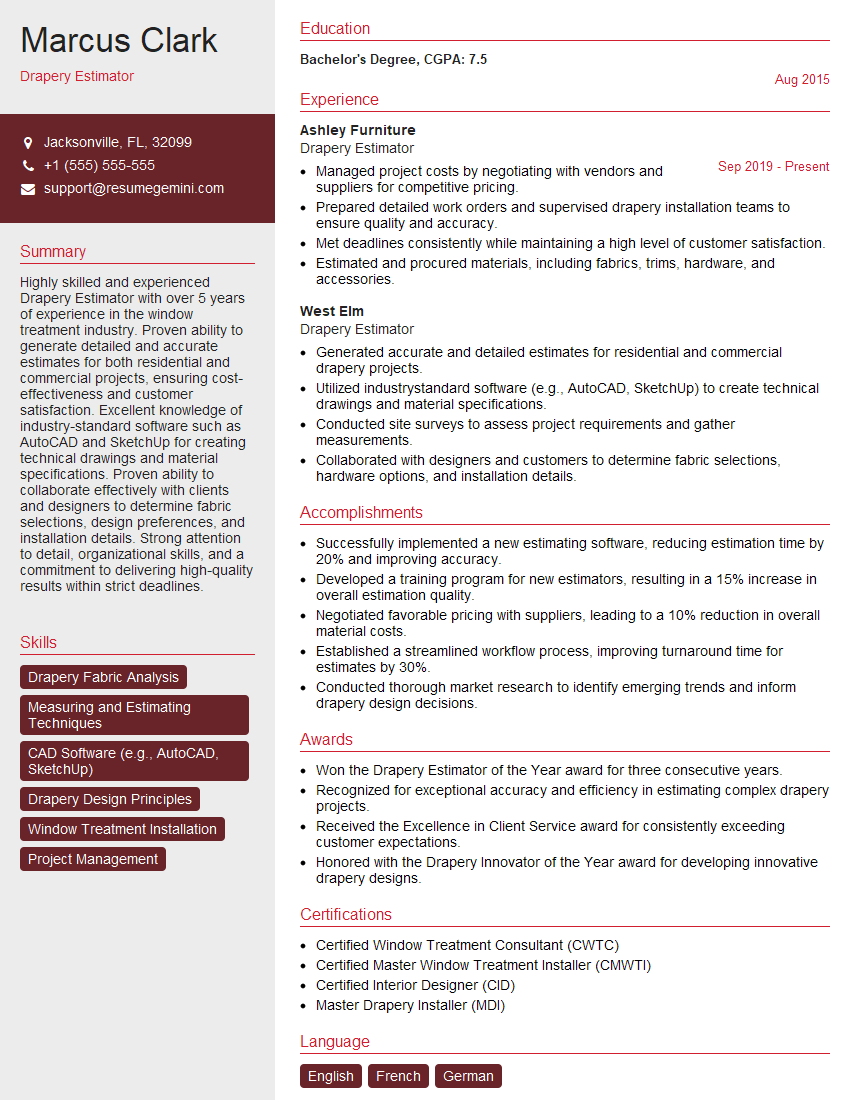
Mastering drapery measuring and installation opens doors to a fulfilling career with excellent growth potential. Whether you’re aiming for a lead installer role or seeking advancement into design or project management, a strong foundation in these skills is invaluable. To maximize your job prospects, create a compelling and ATS-friendly resume that highlights your abilities. ResumeGemini is a trusted resource for building professional resumes, and we provide examples of resumes tailored to Drapery Measuring and Installation to help you get started. Invest the time to craft a resume that accurately reflects your skills and experience – it’s your first impression with potential employers!

Explore more articles
Users Rating of Our Blogs
Share Your Experience
We value your feedback! Please rate our content and share your thoughts (optional).
What Readers Say About Our Blog
Very informative content, great job.
good