Are you ready to stand out in your next interview? Understanding and preparing for Experience with finite element analysis (FEA) interview questions is a game-changer. In this blog, we’ve compiled key questions and expert advice to help you showcase your skills with confidence and precision. Let’s get started on your journey to acing the interview.
Questions Asked in Experience with finite element analysis (FEA) Interview
Q 1. Explain the fundamental principles of the finite element method.
The Finite Element Method (FEM) is a powerful numerical technique used to solve complex engineering and physics problems. At its core, FEM works by breaking down a complex structure or system into smaller, simpler parts called finite elements. These elements are interconnected at points called nodes. We then approximate the behavior of each element using simple mathematical equations, and assemble these individual element behaviors to predict the overall behavior of the entire system.
Imagine trying to find the weight of a weirdly shaped rock. You could try to find the exact volume and then use density, but that’s hard. Instead, you could break the rock into smaller, simpler shapes (cubes, for example), estimate each cube’s weight easily and add them up. FEM does something similar but with much more sophisticated equations for things like stress, strain, temperature, and fluid flow. The accuracy depends on how small you break the rock (the mesh density).
The process involves defining the geometry, material properties, boundary conditions (forces and constraints applied to the structure), and solving a system of equations to find the unknown variables like displacement, stress, and strain at each node.
Q 2. Describe different element types used in FEA and their applications.
Many element types exist, each suited to different applications. The choice depends on the geometry, expected stress distribution, and accuracy requirements.
- Linear elements (e.g., 2D triangles, 3D tetrahedra): Simplest elements, good for initial analysis or problems with relatively simple geometry. Easy to mesh but may need finer meshing for high accuracy.
- Quadrilateral and hexahedral elements: Better accuracy than triangles and tetrahedra for the same mesh density, particularly for problems with smooth variations in stress. Suitable for structural analysis, fluid dynamics, and heat transfer.
- Higher-order elements (e.g., quadratic, cubic): Employ curved sides and allow for more accurate representation of geometry and stress distribution with fewer elements. Useful for curved structures and problems where high accuracy is crucial but come with increased computational cost.
- Beam and shell elements: Specialized elements designed for structures with dominant one or two-dimensional behavior. These significantly reduce computational cost compared to using 3D solid elements for beams and thin plates.
Example: A structural analysis of a car chassis might use shell elements for the thin metal panels and beam elements for the longitudinal supports. A stress analysis of a complex turbine blade might employ higher-order elements for accurate stress concentration prediction.
Q 3. What are the advantages and disadvantages of using FEA?
Advantages:
- Handles complex geometries: FEA excels at analyzing complex shapes that would be impossible to solve analytically.
- Predicts failure modes: Helps identify potential failure points, optimizing designs for safety and durability.
- Reduces prototyping costs: Allows virtual testing and iterative design improvements, reducing the need for extensive physical prototyping.
- Detailed analysis: Provides comprehensive data on stress, strain, displacement, temperature, and other parameters throughout the structure.
Disadvantages:
- Computational cost: Complex models can require significant computational resources and time.
- Mesh dependency: Results depend on the quality and density of the finite element mesh. Poor meshing leads to inaccurate results.
- Requires specialized software: FEA software packages are expensive and require expertise to use effectively.
- Simplifications and assumptions: The model is always an approximation of reality; Material properties and boundary conditions might require simplification.
Q 4. How do you choose the appropriate mesh density for an FEA model?
Mesh density is crucial. Too coarse a mesh leads to inaccurate results while an overly fine mesh increases computational cost without significant gains in accuracy. The optimal mesh density depends on several factors:
- Geometry complexity: Areas with sharp corners or rapid geometry changes require finer meshing.
- Expected stress gradients: Regions where stress is expected to change rapidly require finer meshing to capture these variations accurately.
- Accuracy requirements: Higher accuracy demands finer meshing.
- Computational resources: Available resources limit the maximum mesh density.
Adaptive mesh refinement is a technique where the mesh is automatically refined in areas where the solution is changing rapidly, allowing for efficient use of computational resources. A common approach is to start with a relatively coarse mesh, check the solution for convergence and accuracy, and refine the mesh iteratively in critical regions.
Q 5. Explain the concept of convergence in FEA.
Convergence in FEA means that as the mesh density increases (the elements get smaller), the solution approaches a stable, accurate value. In other words, the solution doesn’t change significantly with further mesh refinement. Non-convergence suggests issues such as a poorly formulated model, inappropriate element types, or numerical instabilities. Monitoring convergence is essential to ensure the reliability of FEA results. It’s often assessed by performing a mesh refinement study, where the results are compared for different mesh densities. If the results change significantly as the mesh is refined, it indicates lack of convergence and points to needing a refinement in the mesh or model review.
Q 6. What are boundary conditions and how do they affect FEA results?
Boundary conditions define how the structure interacts with its surroundings. They specify the forces, displacements, temperatures, or other parameters imposed on the boundaries of the model. The boundary conditions significantly influence FEA results. Incorrectly defined boundary conditions can lead to inaccurate or even meaningless results. For example, incorrectly applying a fixed constraint might lead to an unrealistic stress concentration, while failing to apply a load can create a scenario with no stress at all.
Q 7. Describe different types of boundary conditions used in FEA.
Several types of boundary conditions are used in FEA:
- Fixed Support (Fixed Boundary Condition): Restrains all degrees of freedom (displacement in x, y, and z directions, and rotations about x, y, and z axes) at a specified node or surface.
- Simply Supported: Allows rotation but restricts translation in specific directions (e.g., restricting vertical displacement but allowing rotation).
- Prescribed Displacement: Imposes a specific displacement at a node or surface.
- Applied Force: Applies a force (point load or pressure) to a node or surface.
- Applied Moment: Applies a moment (torque) to a node.
- Thermal Boundary Conditions: Specify temperature or heat flux at boundaries. Useful for thermal stress analysis.
- Symmetry Boundary Conditions: Used to reduce model size for structures with symmetric geometry and loading. Reduces computation time, imposing conditions that enforce symmetry.
Q 8. How do you handle non-linearity in FEA?
Non-linearity in FEA arises when the relationship between loads and displacements isn’t linear. This means the stiffness of the structure changes as it deforms. We can’t use simple linear algebra to solve these problems; instead, we use iterative solution techniques. Imagine stretching a rubber band: the further you stretch it, the harder it becomes to stretch further—that’s non-linear behavior. Handling it involves choosing the appropriate non-linear solver (e.g., Newton-Raphson) within the FEA software. This solver iteratively adjusts the stiffness matrix based on the current displacement state until convergence is achieved (i.e., the solution stabilizes). Each iteration refines the solution by incorporating the changes in stiffness caused by the deformation.
The process usually involves applying the load in increments (incremental loading) to better capture the non-linear response. The choice of increment size is crucial; too large an increment may skip over important behavior, and too small an increment increases computational cost. Convergence criteria, such as tolerance limits on displacement and force residuals, ensure accuracy and efficiency.
Q 9. What are different types of non-linearity encountered in FEA?
FEA encounters several types of non-linearity:
- Material Non-linearity: This occurs when the material’s stress-strain relationship isn’t linear (e.g., plasticity in metals, hyperelasticity in rubber). Think of bending a paperclip – it bends easily at first, then becomes stiffer.
- Geometric Non-linearity: This arises when large displacements or rotations significantly alter the structure’s geometry and, consequently, its stiffness. Imagine a long, slender beam bending under its own weight; the change in geometry affects the subsequent bending.
- Boundary Non-linearity: This happens when boundary conditions change during the analysis, such as contact between parts where the contact area evolves as the load increases. Consider two blocks pressing against each other; the contact area and forces will adjust as the load grows.
Often, we have a combination of these types of non-linearity in a single analysis, making the simulation complex and computationally intensive.
Q 10. Explain the concept of element stiffness matrix.
The element stiffness matrix (Ke) represents the relationship between forces and displacements at the nodes of a single finite element. It’s a matrix that describes how the element resists deformation. Each element in the matrix represents the force required at one node to produce a unit displacement at another node, holding all other nodes fixed. It is derived from the element’s material properties, geometry, and the chosen interpolation functions (shape functions). For a simple linear elastic element, this relationship is governed by Hooke’s Law.
For example, a simple 2D truss element would have a 2×2 stiffness matrix relating the axial forces at its two nodes to the axial displacements at these nodes. The stiffness matrix is essential because it’s the fundamental building block for assembling the global stiffness matrix of the entire structure.
Q 11. How is the global stiffness matrix assembled?
The global stiffness matrix (K) represents the stiffness of the entire structure. It’s assembled by combining the individual element stiffness matrices (Ke) of all the elements in the finite element model. The assembly process involves mapping the element’s local node numbers to the global node numbers of the structure. This is often done using a connectivity array which defines how the elements are connected in the mesh.
Think of it like building with LEGOs: each LEGO brick is an element with its own stiffness (Ke). The global stiffness matrix (K) is the entire structure built from those individual bricks, where the connections between them determine how the forces are transmitted.
The process involves summing the contributions of each element stiffness matrix into the corresponding locations in the global stiffness matrix according to the element connectivity.
Q 12. Explain different solution techniques used in FEA.
Different solution techniques are employed in FEA depending on the problem’s linearity and complexity:
- Direct Methods: These methods solve the system of equations (
Kx = F, whereKis the global stiffness matrix,xis the displacement vector, andFis the force vector) directly. Gaussian elimination and Cholesky decomposition are common examples. They are efficient for smaller problems and linear analyses. - Iterative Methods: These methods solve the system of equations iteratively, producing a sequence of approximate solutions that converge to the true solution. Examples include Conjugate Gradient, GMRES, and BiCGSTAB methods. These are well-suited for large, sparse matrices often encountered in non-linear analysis or complex models. They are more memory-efficient than direct methods.
- Newton-Raphson Method (and variations): For non-linear problems, this iterative method is extensively used. It linearizes the non-linear equations at each iteration, solving a linear system using direct or iterative techniques to find the incremental displacement. It repeats the process until convergence criteria are met.
The choice of the solution technique depends on factors like problem size, non-linearity, accuracy requirements, and available computational resources.
Q 13. How do you verify and validate FEA results?
Verification and validation are crucial steps to ensure the reliability of FEA results. Verification confirms that the FEA model and solution process are implemented correctly, while validation confirms that the model accurately represents the real-world behavior of the structure.
- Verification: This involves checking the FEA model’s accuracy through various methods, such as mesh convergence studies (refining the mesh to see if the solution changes significantly), comparing results with analytical solutions (if available), and using code verification techniques. It assures you’re solving the equations correctly.
- Validation: This compares the FEA results with experimental data from physical testing. This is critical to ensure the model represents the real-world behavior. If discrepancies exist, it signifies the need to refine the model (e.g., material properties, boundary conditions, or element type).
Both verification and validation are essential to build confidence in the FEA results and make informed engineering decisions.
Q 14. What are some common sources of error in FEA?
Common sources of error in FEA include:
- Meshing Errors: Poorly refined or distorted elements can significantly affect accuracy. Elements should be appropriately sized and shaped, especially in areas with high stress gradients.
- Modeling Errors: Incorrect material properties, boundary conditions, or simplified geometry can lead to inaccurate results. The model should accurately represent the real-world system.
- Numerical Errors: These arise from the numerical methods used in the solution process. These can be mitigated by selecting appropriate solution techniques and convergence criteria.
- Software Errors: Bugs in the FEA software itself can lead to errors. It is crucial to use well-validated software and perform checks to detect any potential issues.
- Human Errors: Mistakes in model creation, data entry, or interpretation of results are also common sources of errors. Careful attention to detail and thorough review processes can reduce these errors.
It is essential to perform sensitivity studies, mesh convergence studies, and thorough validation to minimize the impact of these error sources.
Q 15. How do you address mesh dependency in FEA?
Mesh dependency in FEA refers to the situation where the results of your simulation change significantly depending on the fineness of your mesh. A finer mesh (more elements) generally leads to more accurate results, but at a greater computational cost. Addressing this requires a systematic approach.
- Mesh Refinement Studies: The most common method. You progressively refine your mesh in critical areas (e.g., areas of high stress concentration) and compare the results. If the change in key results (stress, displacement, etc.) is negligible between successive refinements, you’ve likely achieved mesh independence. This is often done by halving element size in critical regions.
- Adaptive Meshing: Sophisticated FEA software often offers adaptive meshing techniques. These methods automatically refine the mesh in regions where the solution error is high, focusing computational resources where they are most needed. This significantly reduces the manual effort involved in mesh refinement studies.
- Error Estimation: Some advanced solvers provide error estimates, giving an indication of the accuracy of the solution. This helps you decide whether further mesh refinement is necessary and where to focus your efforts.
- Mesh Quality: Poor mesh quality (e.g., highly skewed elements, excessively long or thin elements) can also lead to inaccurate results and mesh dependency. Ensure your mesh is of high quality using appropriate meshing tools and techniques. This includes checking aspect ratios and avoiding distorted elements.
Example: Imagine analyzing a cracked component. A coarse mesh might underestimate the stress concentration around the crack tip. A series of progressively finer meshes would show the stress converging towards a more accurate value. Once the change in stress is minimal between refinements, you’ve likely reached mesh independence.
Career Expert Tips:
- Ace those interviews! Prepare effectively by reviewing the Top 50 Most Common Interview Questions on ResumeGemini.
- Navigate your job search with confidence! Explore a wide range of Career Tips on ResumeGemini. Learn about common challenges and recommendations to overcome them.
- Craft the perfect resume! Master the Art of Resume Writing with ResumeGemini’s guide. Showcase your unique qualifications and achievements effectively.
- Don’t miss out on holiday savings! Build your dream resume with ResumeGemini’s ATS optimized templates.
Q 16. Explain different types of loads used in FEA.
Loads in FEA represent the external forces and constraints acting on a structure. They determine the response of the structure (stress, strain, displacement).
- Point Loads: A force applied at a single point. Imagine a weight resting on a beam.
- Distributed Loads: A force spread over a surface or length. Think of the weight of a fluid in a tank acting on the tank walls.
- Pressure Loads: A force distributed per unit area. Examples include internal pressure in a pipe or wind pressure on a building.
- Gravity Loads: The effect of gravity on the structure’s mass. Essential for modeling tall buildings or hanging objects.
- Thermal Loads: Resulting from temperature changes causing thermal expansion or contraction. This is crucial for analyzing components in extreme temperature environments.
- Centrifugal Loads: Arising from rotational motion. Important in the analysis of rotating machinery.
- Inertial Loads: Forces arising from acceleration or deceleration. These are considered in dynamic simulations, such as impact analysis.
Practical Application: In designing a bridge, you would consider the weight of the bridge itself (gravity), the load from vehicles (distributed load), and wind load (pressure). Accurate modeling of these loads is crucial for structural integrity.
Q 17. How do you model contact in FEA?
Modeling contact in FEA involves defining how different parts of a model interact when they come into physical contact. It’s crucial for accurate simulation of assemblies, joints, and impact scenarios. It’s far more complex than simply applying forces; the contact area changes over time and requires special algorithms.
- Contact Definition: Identify the contacting surfaces. These are defined as sets of elements or nodes.
- Contact Type: Choose the type of contact, such as bonded, no separation, frictionless, or frictional contact. Bonded assumes perfect adherence. No separation allows penetration but prevents separation. Frictional contact considers the effect of friction during interaction.
- Contact Algorithm: Select an appropriate contact algorithm (discussed in the next question). This algorithm determines how the contact forces are calculated.
- Contact Parameters: Set parameters such as friction coefficient (for frictional contact), contact stiffness, and tolerance. These parameters significantly influence simulation accuracy.
Example: Simulating a bolted joint requires defining contact between the bolt head and the connected parts, considering friction to prevent slipping.
Q 18. What are different contact algorithms used in FEA?
Several contact algorithms exist, each with strengths and weaknesses:
- Penalty Method: The simplest method. It approximates contact by adding a spring-like force between the contacting surfaces. Penetration is allowed, but penalized by a spring stiffness. Easy to implement but can be sensitive to the choice of penalty stiffness.
- Lagrange Multiplier Method: Enforces contact constraints exactly, preventing any penetration. Computationally more expensive than the penalty method, but generally provides more accurate results.
- Augmented Lagrange Method: A combination of the penalty and Lagrange multiplier methods. It combines the efficiency of the penalty method with the accuracy of the Lagrange multiplier method.
The choice of algorithm depends on the problem’s complexity, accuracy requirements, and computational resources. For simple problems, the penalty method may suffice. Complex problems requiring high accuracy often benefit from the augmented Lagrange or Lagrange multiplier methods.
Q 19. Explain the concept of modal analysis.
Modal analysis determines the natural frequencies and mode shapes of a structure. A natural frequency is the frequency at which the structure will vibrate freely without any external force, while a mode shape shows the displacement pattern of the structure at that frequency. Think of it like the different ways a guitar string can vibrate.
- Eigenvalue Problem: Modal analysis solves an eigenvalue problem, finding the eigenvalues (natural frequencies) and eigenvectors (mode shapes) of the system’s stiffness and mass matrices.
- Applications: Crucial for understanding a structure’s dynamic behavior, predicting resonance, and designing for vibration damping. It’s used to avoid resonance, which can lead to catastrophic failure.
- Example: Designing a tall building requires modal analysis to ensure it can withstand wind-induced vibrations. The analysis would identify the natural frequencies, and the design would be modified to avoid any excitation frequencies close to those natural frequencies.
Q 20. Explain the concept of harmonic analysis.
Harmonic analysis simulates the response of a structure to a sinusoidal load at a specific frequency or a range of frequencies. This is valuable for understanding how a structure behaves under cyclic loading, such as a rotating machine or a structure subjected to vibrations.
- Steady-State Response: Harmonic analysis typically determines the steady-state response of the structure after the initial transient effects have decayed. This means the vibration pattern will become stable after enough time.
- Frequency Sweep: Often, a frequency sweep is performed, analyzing the response over a range of frequencies to identify resonant frequencies.
- Applications: Widely used in the design of rotating machinery, aircraft components, and musical instruments. It allows engineers to ensure that operating frequencies are far from the structure’s natural frequencies to prevent resonance and failure.
- Example: Analyzing a turbine blade subjected to periodic forces from the rotating shaft. This analysis would determine the blade’s response at each frequency, identifying potential resonance issues.
Q 21. Explain the concept of transient analysis.
Transient analysis simulates the response of a structure to time-dependent loads. This is necessary when the loads change significantly over time, such as an impact load or a sudden change in temperature.
- Time-Stepping: The solution is obtained through a series of time steps. The loads and the structure’s response are calculated at each time step.
- Explicit vs. Implicit: Two main approaches exist: explicit and implicit. Explicit methods are computationally efficient for short-duration, highly dynamic events, like impact or explosions. Implicit methods are better suited for longer-duration events with more complex material models.
- Applications: Impact analysis (crashworthiness), blast loading, earthquake response, and thermal shock analysis all require transient analysis.
- Example: Simulating a car crash to analyze the deformation of the car body and the forces experienced by the occupants requires transient analysis.
Q 22. How do you perform a buckling analysis using FEA?
Buckling analysis in FEA determines the critical load at which a structural component will transition from a stable to an unstable equilibrium, essentially collapsing or deforming significantly. It’s crucial for designing structures like columns, beams, and aircraft wings that are susceptible to buckling under compressive loads.
The process typically involves:
- Model Creation: Building a 3D finite element model of the structure, accurately representing geometry, material properties (like Young’s modulus and Poisson’s ratio), and boundary conditions (constraints).
- Eigenvalue Buckling Analysis: This method solves for the eigenvalues and eigenvectors of the stiffness matrix, identifying the critical buckling load and corresponding mode shape. The lowest eigenvalue corresponds to the lowest critical buckling load, indicating the most vulnerable buckling mode.
- Nonlinear Buckling Analysis: For more complex scenarios, a nonlinear analysis accounts for geometric nonlinearities (large deformations) which become significant as the structure approaches buckling. This involves iterative solutions tracking the structure’s behavior beyond the linear elastic range.
- Result Interpretation: Analyzing the results includes examining the critical buckling load, the corresponding mode shape (which shows the deformation pattern at buckling), and stress distributions. This helps understand where and how the structure is most likely to buckle.
Example: Designing a slender column supporting a heavy load. A buckling analysis will predict the maximum load the column can support before buckling occurs, enabling engineers to choose appropriate column dimensions or materials.
Q 23. Explain the concept of fatigue analysis.
Fatigue analysis examines the structural integrity of a component under cyclic loading. It assesses a material’s ability to withstand repeated stress fluctuations, as repeated loading, even below the yield strength, can eventually lead to crack initiation and propagation, causing failure. Think of bending a paperclip back and forth repeatedly – it eventually breaks, even though the force at each bend is less than the force needed to break it in one go.
Key aspects of fatigue analysis include:
- Stress-Life Approach: This method relates the cyclic stress amplitude to the number of cycles to failure (fatigue life). S-N curves (Stress vs. Number of cycles) provide a basis for these predictions.
- Strain-Life Approach: This approach focuses on the cyclic plastic strain and is more suitable for high-cycle fatigue (many cycles to failure) or low-cycle fatigue (few cycles to failure).
- Crack Propagation Analysis: This assesses the growth of cracks from initial imperfections or fatigue initiation sites. It uses fracture mechanics concepts like stress intensity factors.
Real-world Application: Designing an aircraft wing. Fatigue analysis is critical because the wing experiences repeated stress cycles from gusts and maneuvers during its service life. The analysis ensures the wing’s structural integrity even after countless cycles of flight.
Q 24. What is the role of pre- and post-processing in FEA?
Pre- and post-processing are crucial stages in the FEA workflow, framing the analysis and interpreting its results. They aren’t directly part of the solver’s calculations but ensure the model’s accuracy and the effective use of the data obtained.
Pre-processing: This stage involves creating the FEA model. It includes:
- Geometry Creation: Defining the component’s geometry using CAD software or built-in meshing tools.
- Mesh Generation: Dividing the geometry into numerous small elements. Mesh density influences accuracy; finer meshes increase accuracy but also computational cost.
- Material Property Definition: Assigning appropriate material properties (Young’s modulus, Poisson’s ratio, density, etc.) to each element.
- Boundary Condition Application: Defining constraints (fixed supports, prescribed displacements) and loads (forces, pressures).
Post-processing: This involves interpreting the results obtained from the FEA solver:
- Stress and Strain Visualization: Examining stress and strain distributions across the model to identify high-stress areas or regions of deformation.
- Displacement Analysis: Visualizing the component’s deformation under load.
- Result Extraction: Extracting specific numerical results (e.g., maximum stress, displacement, etc.) from the analysis for design verification.
Analogy: Pre-processing is like preparing the ingredients and setting up the kitchen for cooking (FEA), and post-processing is like tasting and analyzing the dish to see if it’s well-cooked.
Q 25. What FEA software are you proficient in?
I’m proficient in several FEA software packages, including ANSYS, Abaqus, and Nastran. My experience encompasses various modules within these platforms, such as structural, thermal, and fluid-structure interaction analyses. I also have experience with scripting and automation within these platforms to optimize workflows and improve efficiency.
Q 26. Describe a challenging FEA project you worked on and how you overcame its challenges.
One challenging project involved analyzing the fatigue life of a complex turbine blade under high-cycle loading conditions. The blade’s geometry was intricate, with numerous internal cooling passages, making mesh generation extremely difficult and computationally expensive. The challenge was to achieve accurate results within reasonable computation time.
To overcome this, I employed adaptive mesh refinement techniques, concentrating finer meshes in critical stress regions. I also used sub-modeling, where a smaller, highly refined model focused on the highest-stress areas. This dramatically reduced the overall model size while maintaining accuracy. Furthermore, I employed parallel processing capabilities of the FEA software to significantly decrease the computation time. This project highlighted the importance of thoughtful meshing strategies, efficient computational techniques, and the careful selection of analysis methods for complex components.
Q 27. How do you ensure the accuracy of your FEA models?
Ensuring FEA model accuracy is paramount. My strategies include:
- Mesh Convergence Study: Refining the mesh progressively and observing the convergence of results. If the results stabilize with mesh refinement, it indicates that the solution is accurate.
- Model Validation: Comparing FEA predictions with experimental data (e.g., strain gauge measurements) or results from analytical solutions. Discrepancies may indicate errors in the model or analysis setup.
- Material Property Verification: Ensuring the accuracy of material properties used in the analysis. Using experimentally determined or well-established material data is crucial.
- Boundary Condition Check: Carefully reviewing and verifying the boundary conditions imposed on the model. Incorrect boundary conditions can significantly affect the accuracy of the results.
- Solution Verification: Comparing results from different solvers or solution methods to confirm consistency and accuracy.
Employing these techniques helps build confidence in the validity and reliability of the FEA results. A meticulous approach to modeling and verification is key to avoiding costly design errors.
Q 28. What are your strategies for improving efficiency in FEA simulations?
Improving efficiency in FEA simulations requires a multi-pronged approach:
- Optimal Meshing Strategies: Using appropriate element types and mesh densities, employing adaptive mesh refinement techniques, and exploring mesh smoothing algorithms to improve computational efficiency without sacrificing accuracy.
- Model Simplification: Using symmetry or other geometric simplifications to reduce the model size and complexity where appropriate. This often significantly reduces computation time.
- Parallel Processing: Leveraging parallel computing capabilities of the FEA software to distribute the computational load across multiple processors, resulting in substantially faster solutions.
- Solver Optimization: Selecting the most appropriate solver for the specific problem and adjusting solver settings for optimal performance.
- Automation: Developing scripts or using built-in automation features to streamline repetitive tasks in pre- and post-processing, minimizing manual effort and error.
By implementing these strategies, you can dramatically reduce simulation times while still achieving highly accurate results. This is crucial in real-world engineering applications where timely results are often critical for meeting deadlines.
Key Topics to Learn for Finite Element Analysis (FEA) Interviews
- Fundamental Concepts: Understand the underlying mathematical principles of FEA, including discretization, element types (e.g., linear, quadratic), and interpolation functions. Be prepared to discuss the differences between various element formulations.
- Software Proficiency: Demonstrate familiarity with at least one major FEA software package (e.g., ANSYS, Abaqus, Nastran). Highlight your experience with meshing techniques, boundary condition application, and result interpretation.
- Material Models: Show a strong grasp of constitutive relationships and material properties relevant to FEA simulations. Be ready to discuss linear elastic, plastic, and viscoelastic models, and their appropriate applications.
- Stress and Strain Analysis: Be able to explain stress tensors, strain tensors, and their relationships. Understand principal stresses and strains, and be prepared to interpret stress concentration factors.
- Practical Applications: Showcase your experience in applying FEA to real-world engineering problems. Examples include structural analysis, thermal analysis, fluid dynamics, or other relevant fields. Be ready to describe your workflow and the challenges you overcame.
- Error Analysis and Validation: Discuss methods for verifying the accuracy of FEA simulations, such as mesh convergence studies and comparison with experimental data. Understand the limitations of FEA and how to mitigate potential errors.
- Advanced Topics (depending on experience level): Consider reviewing topics like non-linear analysis, contact mechanics, dynamic analysis, and optimization techniques.
Next Steps
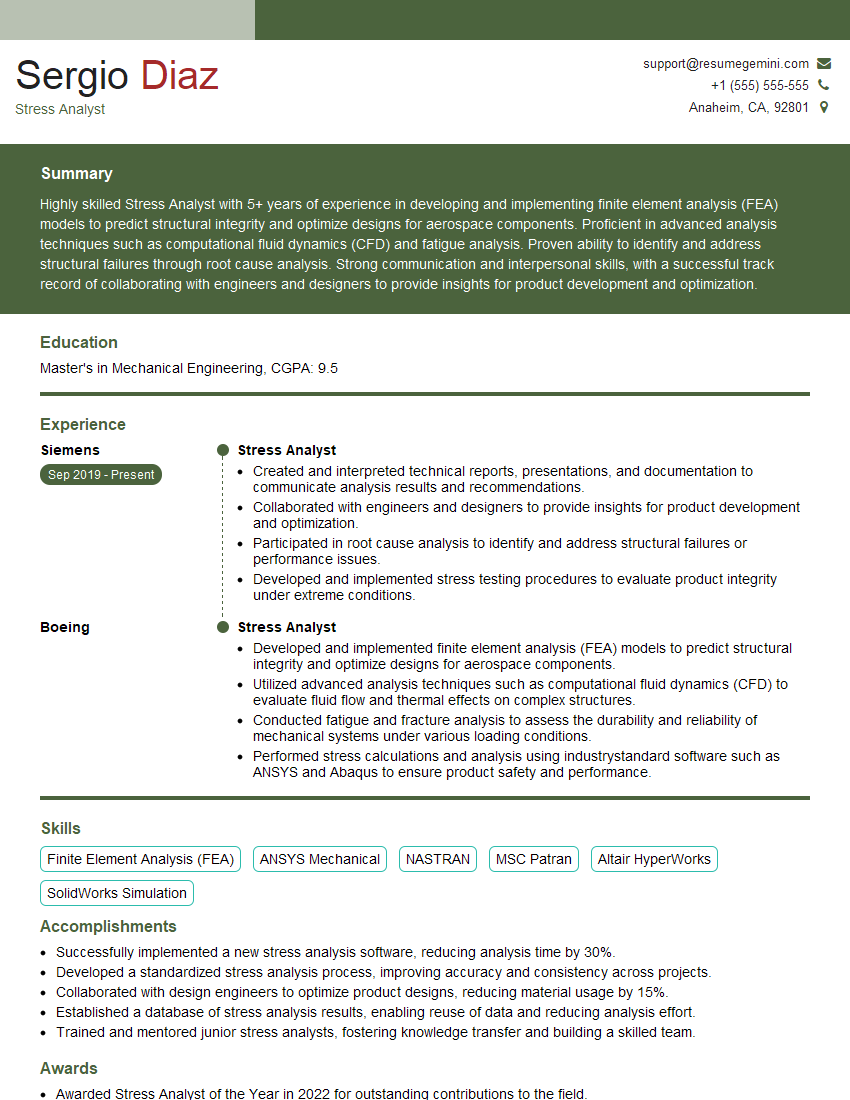
Mastering FEA is crucial for career advancement in numerous engineering disciplines. A strong understanding of these principles opens doors to exciting and challenging roles with significant growth potential. To maximize your job prospects, create an ATS-friendly resume that effectively showcases your FEA skills and experience. ResumeGemini is a trusted resource to help you build a professional and impactful resume that stands out. We provide examples of resumes tailored to FEA experience to guide you in creating your own compelling application materials.
Explore more articles
Users Rating of Our Blogs
Share Your Experience
We value your feedback! Please rate our content and share your thoughts (optional).
What Readers Say About Our Blog
Very informative content, great job.
good