Are you ready to stand out in your next interview? Understanding and preparing for Sound Effects and Musicality interview questions is a game-changer. In this blog, we’ve compiled key questions and expert advice to help you showcase your skills with confidence and precision. Let’s get started on your journey to acing the interview.
Questions Asked in Sound Effects and Musicality Interview
Q 1. Explain the difference between sound design and sound effects.
Sound design is the broader concept encompassing the creation and manipulation of all audio elements within a project, including music, sound effects, and dialogue. Think of it as the overall sonic architecture. Sound effects, on the other hand, are a specific subset of sound design. They are individual audio elements used to enhance realism, create atmosphere, or emphasize action. For instance, a whooshing sound effect is a single element; the complete sound design of a spaceship scene involves many sound effects, music, and dialogue, all carefully integrated.
Imagine building a house: sound design is the entire blueprint and construction, while sound effects are specific elements like the creaking of floorboards or the ticking of a clock.
Q 2. Describe your experience with various sound editing software (e.g., Pro Tools, Audacity, Reaper).
I’m proficient in several Digital Audio Workstations (DAWs). Pro Tools is my go-to for large-scale projects, particularly film and television work, because of its robust features and industry standard compatibility. Its extensive automation capabilities and advanced mixing tools are invaluable. Audacity is fantastic for quick edits, smaller projects, and educational purposes due to its user-friendly interface and free accessibility. Reaper, with its highly customizable workflow and efficient resource management, is a great alternative that offers a powerful feature set at a competitive price point. I’ve used each DAW extensively, adapting my workflow to leverage the specific strengths of each based on the project demands.
Q 3. How do you approach creating realistic sound effects?
Creating realistic sound effects involves a multi-step process. It starts with meticulous sound recording, often involving field recording of real-world sounds. I always aim for capturing sounds in their purest form, so I often use high-quality microphones and preamps. Then, I carefully edit and manipulate the recorded audio, using techniques like layering, equalization, compression, and reverb to enhance and shape the sounds. For example, the sound of a sword clash might involve layering metallic impacts with a whooshing sound and carefully adjusting EQ to match the frequency response of real metal. I might even blend in some subtle recordings of wood or concrete impacting to add realism. Synthesis and manipulation of existing sounds are frequently used when sourcing authentic recordings isn’t feasible, maintaining realism through careful attention to detail.
Q 4. Discuss your process for composing music for different media (e.g., film, games, advertising).
My approach to composing music for different media is highly contextual. Film music, for example, often requires a strong narrative focus, mirroring the emotions and action on screen. Game music often needs to be more modular and dynamic, adapting to gameplay changes. Advertising music prioritizes memorability and brand identity, frequently utilizing catchy melodies and concise arrangements. In each case, I begin with a detailed analysis of the project brief, including the target audience, overall tone and style, and specific musical requirements. I then develop a compositional strategy, sketching out melodies, harmonies, rhythms, and instrumentation that align with these parameters. Collaboration with directors, producers, and game designers is crucial to ensure the music effectively complements the visual and narrative elements.
Q 5. Explain the concept of Foley and your experience with it.
Foley is the art of creating sound effects in synchronization with picture. Think of it as live sound effects recording to match a film or video. It’s a very hands-on process. My experience with Foley involves working closely with Foley artists to recreate everyday sounds, from footsteps and clothing rustling to more dramatic sounds like breaking glass or punches. We use a variety of materials and techniques to create the desired sounds, such as walking on different surfaces to create different footsteps, or hitting different materials to replicate the sound of impacts. The key is precise timing and synchronization with the picture to create realistic and immersive sound. It’s a surprisingly physical and creative process!
Q 6. How do you handle sound mixing in a complex scene with multiple audio tracks?
Mixing a complex scene with multiple audio tracks requires meticulous organization and careful attention to detail. I typically start by organizing tracks into logical groups (e.g., dialogue, sound effects, music). Then, I address each group individually, utilizing equalization and compression to balance levels and clarity. Automation and panning are extensively used to create depth and movement. I pay close attention to frequency balance, ensuring no element masks another. Careful use of reverb and delay can create a sense of space and atmosphere. Ultimately, a successful mix is about balance, clarity, and creating a cohesive and engaging soundscape. The goal is to create a soundscape that is both immersive and emotionally resonant.
Q 7. Describe your experience with spatial audio and 3D sound design.
Spatial audio and 3D sound design allow for a more immersive and realistic audio experience by taking advantage of multiple audio channels and manipulating the perceived location of sounds within a 3D soundscape. My experience with this involves creating sounds that appear to come from specific points in space, moving around the listener as the scene progresses. This is frequently achieved using techniques like binaural recording, Ambisonics, and object-based audio. I’ve worked on projects that leverage headphones or multiple speakers to place sounds accurately in the virtual environment. This enhances realism, especially in virtual reality and interactive media, giving the audience a more engaging and believable experience. Understanding the psychoacoustics involved is critical to creating effective 3D sound design.
Q 8. How do you ensure your sound design enhances the storytelling or emotional impact of a project?
Sound design isn’t just about adding noises; it’s about crafting an auditory narrative that complements and elevates the visual story. I approach this by meticulously analyzing the script and visuals, identifying key emotional moments and plot points. For each scene, I ask myself: What feeling should the audience experience? What sounds best communicate that feeling? For example, in a tense scene, I might use subtle creaks and whispers to build suspense, rather than relying on loud, obvious sound effects. Conversely, a joyful scene might employ bright, playful sounds. The goal is to create a synergy between the sound and the image, enhancing the emotional impact rather than competing with it. I often use techniques like sound layering and spatialization to create a richer and more immersive soundscape, allowing subtle sounds to build to dramatic climaxes.
In a recent project, a quiet moment of reflection was amplified by using the subtle sound of a distant waterfall, layered with the character’s shallow breathing. This created a profound sense of peace and solitude without being overtly sentimental.
Q 9. What are your preferred methods for creating ambient soundscapes?
Creating believable and immersive ambient soundscapes is crucial for setting the mood and atmosphere of a project. My preferred methods involve a combination of field recording, sound design using synthesis and processing, and careful layering. I frequently record real-world sounds – the rustling of leaves, the distant hum of a city, the crashing of waves – which provides an essential level of authenticity. However, field recordings are often imperfect, so I then process and manipulate them using digital audio workstations (DAWs) to achieve the desired quality and texture. Synthesis plays a crucial role in creating sounds that may not be easily captured in the real world, especially when dealing with fantasy or sci-fi elements.
For example, a recent project required the creation of an otherworldly forest. I started with field recordings of wind through trees, then manipulated those sounds using reverb, delay, and equalization to add a sense of depth and mystery. I then used synthesis to create subtle, ethereal sounds that felt both natural and alien. Finally, the careful layering of these sounds, adjusting volume and panning to create spatial depth, achieved a soundscape that was simultaneously realistic and fantastical.
Q 10. Describe your experience working with music libraries and royalty-free music.
Music libraries and royalty-free music are invaluable resources for sound designers, but require careful consideration. They offer a vast array of pre-composed tracks, saving time and often budget compared to commissioning original music. However, it’s crucial to select music that aligns with the project’s aesthetic and doesn’t sound generic. I prefer to use music libraries as a starting point, often editing or manipulating the chosen tracks – adding effects, altering tempo, or isolating sections – to ensure a seamless fit with the sound design. I always meticulously check the licensing agreements to understand usage rights, ensuring compliance across all platforms and formats.
One project involved a low-budget documentary where I found a piece of royalty-free music that matched the emotional tone perfectly. But the original track was a bit too upbeat. By slowing down the tempo and adding some reverb, I was able to create a more melancholic and reflective atmosphere that perfectly matched the documentary’s themes. Understanding licensing and how to subtly adapt existing tracks is a key skill for efficient and cost-effective post-production.
Q 11. How do you manage sound budgets and timelines for a project?
Managing sound budgets and timelines is a crucial skill for any sound designer. I typically begin by creating a detailed breakdown of all sound-related tasks, estimating the time and resources required for each. This includes not just sound design and mixing, but also elements like sound editing, voice recording, and music licensing. Early collaboration with the production team is vital to establish a realistic budget and timeline from the outset. It’s often helpful to provide different tiers of sound design services, allowing the client to select a level that aligns with their budget.
For example, I might offer a ‘basic’ package focusing on core sound effects, a ‘premium’ package that incorporates advanced sound design techniques, and a ‘luxury’ package that includes original music composition. Regular communication and progress reports are also crucial for keeping the project on track and addressing any potential issues or changes in scope. The use of project management software can greatly improve organization and streamline the entire process.
Q 12. What are some common challenges in audio post-production and how do you overcome them?
Audio post-production presents several challenges. One common issue is dealing with noisy recordings that require extensive cleaning and restoration. This often involves using tools like noise reduction software, spectral editing, and careful manual cleaning. Another challenge is achieving consistency across a project – ensuring the sound levels, EQ, and other parameters remain consistent throughout. This demands meticulous attention to detail and a solid understanding of audio mixing techniques. A third challenge is time constraints – especially with tight deadlines – often necessitating effective workflow optimization and prioritization.
To overcome these challenges, I utilize a systematic approach. I invest in high-quality noise reduction plugins, employ efficient editing strategies, and meticulously document my workflow. For consistency, I create a standardized mix template to ensure consistent levels and sonic character. Prioritizing tasks strategically ensures timely completion, and continuous communication with the team allows for efficient problem-solving.
Q 13. How do you collaborate effectively with other team members (e.g., directors, composers, musicians)?
Effective collaboration is crucial in audio post-production. I believe in establishing clear communication channels from the project’s outset. Regular meetings with the director, composer, and musicians are essential to align everyone’s vision and expectations. Open and honest feedback is vital; I encourage team members to share their ideas and concerns freely. Using shared cloud storage for assets ensures everyone has access to the latest versions of files. Active listening, empathy, and a willingness to compromise are all vital for resolving creative differences and building a strong collaborative working relationship.
A recent project involved a challenging scene where the director had a specific vision for the soundscape that initially clashed with the composer’s music. Through open communication and several collaborative listening sessions, we were able to find a solution that incorporated elements from both visions, resulting in a scene that was even more powerful than initially anticipated. A collaborative spirit, clear expectations, and open communication make for a more seamless and creative process.
Q 14. Describe your process for designing sound effects for specific genres (e.g., horror, action, comedy).
Sound design for different genres demands a distinct approach. In horror, for instance, I focus on creating unsettling soundscapes using low frequencies, distorted sounds, and unexpected noises to build suspense and fear. Action scenes require impactful sound effects, explosions, and powerful whooshes to enhance the dynamic energy. Comedy, on the other hand, calls for more playful and exaggerated sounds, often using cartoonish effects or unexpected sound combinations to create humor.
For a horror film, I might use subtle creaks and whispers to heighten tension, followed by a sudden, jarring sound to create a jump scare. In an action scene, I’d use layered explosions and impactful impacts, alongside weapon sounds and the roar of engines. For comedy, slapstick sounds, exaggerated cartoonish effects, and incongruous sound pairings can generate humor. My process always begins with a deep understanding of the genre’s conventions, but I also strive to add unique elements and find creative ways to push those conventions.
Q 15. Explain your understanding of different audio formats (e.g., WAV, MP3, AIFF).
Audio formats determine how sound is digitally represented. They differ primarily in their compression levels and resulting file sizes. Lossless formats retain all audio data, while lossy formats discard some data to reduce file size.
- WAV (Waveform Audio File Format): A lossless format commonly used for high-fidelity audio. Think of it as the digital equivalent of a high-resolution photograph – it contains all the original audio information. It’s ideal for archiving and mastering but results in larger file sizes.
- MP3 (MPEG Audio Layer III): A lossy format known for its small file sizes and widespread compatibility. It uses compression to reduce file size, but this inevitably results in some loss of audio quality. It’s a great choice for distributing music online or for applications where file size is critical.
- AIFF (Audio Interchange File Format): Another lossless format, similar to WAV, but primarily used on Apple systems. It offers excellent sound quality and is often preferred for professional audio work where preserving the original audio data is crucial. It’s like WAV’s cousin, often favored in specific professional workflows.
The choice of format depends heavily on the project’s needs. For a high-fidelity project like a film soundtrack, WAV or AIFF is preferable. For online music distribution, MP3 is often a practical choice.
Career Expert Tips:
- Ace those interviews! Prepare effectively by reviewing the Top 50 Most Common Interview Questions on ResumeGemini.
- Navigate your job search with confidence! Explore a wide range of Career Tips on ResumeGemini. Learn about common challenges and recommendations to overcome them.
- Craft the perfect resume! Master the Art of Resume Writing with ResumeGemini’s guide. Showcase your unique qualifications and achievements effectively.
- Don’t miss out on holiday savings! Build your dream resume with ResumeGemini’s ATS optimized templates.
Q 16. How do you maintain the consistency and quality of sound throughout a project?
Maintaining consistent sound quality involves meticulous planning and execution. This starts with setting up a consistent workflow and sticking to it. I use a standardized process that includes:
- Defining a sonic palette early on: This involves establishing a set of tonal characteristics, reverb styles, and processing techniques that will guide the project. Think of this as choosing a set of colors for a painting before you start.
- Using reference tracks: Comparing your work against professionally mixed tracks helps to gauge your progress and ensure a consistent level of quality. These act as benchmarks for your sound.
- Version control and meticulous labeling: I meticulously track every change made to audio files and label them clearly. This helps avoid confusion and ensures easy revisiting of previous versions.
- Regular monitoring checks: I frequently check my work on multiple playback systems, such as different speakers and headphones, to identify any inconsistencies. This helps to ensure that the mix sounds good across various playback devices.
By following these steps, I can significantly reduce discrepancies and guarantee a polished and cohesive sound throughout any project.
Q 17. What are your preferred techniques for sound manipulation and processing?
My sound manipulation and processing techniques are diverse and depend on the specific task. I utilize a variety of digital audio workstations (DAWs) such as Pro Tools and Logic Pro X, and am proficient in various plugins. Some of my preferred techniques include:
- Spectral editing: This allows me to precisely manipulate specific frequencies within an audio file, removing unwanted sounds or enhancing specific elements.
- Automation: I use automation extensively to create dynamic changes in volume, effects, and other parameters throughout a piece of audio. This creates a more engaging and dynamic listen.
- Granular synthesis: For creating unique and experimental sounds, granular synthesis is a powerful tool, allowing me to manipulate individual grains of audio to create fascinating textures.
- Sound design using synthesizers (VSTs): Creating original sound effects using synthesizers is a core skill. I use subtractive and additive synthesis, along with various modulation techniques, to generate unique sounds tailored to the project.
I often combine these techniques to achieve the desired effect. For example, I might use spectral editing to clean up a recording, then use granular synthesis to create a unique sound effect, and finally automate parameters to create a dynamic feel.
Q 18. How do you use EQ, compression, and other audio effects to enhance sound quality?
EQ (Equalization), compression, and other audio effects are essential tools for enhancing sound quality. They allow for precise control over various aspects of the audio signal.
- EQ: EQ allows me to boost or cut specific frequencies. For example, I might boost the high frequencies to make a sound clearer or cut the low frequencies to reduce muddiness.
Example: Boosting the 2kHz range can enhance vocal clarity. - Compression: Compression reduces the dynamic range of a signal, making quieter sounds louder and louder sounds quieter. This helps to create a more consistent and punchy sound.
Example: Compressing a drum track can give it more impact and reduce its dynamic variation. - Reverb: Reverb adds a sense of space and ambience to a sound. The choice of reverb type depends on the desired effect – a large hall reverb for a spacious feel, or a short plate reverb for a more intimate sound.
Example: Using a large hall reverb can enhance the sense of space in a vocal recording. - Delay: Delay adds echoes to a sound, creating interesting rhythmic patterns. Different delay times and feedback settings create vastly different effects.
Example: Adding a short delay to a guitar can create a rhythmic slapback effect.
I carefully consider the interplay of these effects to create a balanced and polished sound. Overuse of any of these can be detrimental, so careful application is key. It is like seasoning a dish – you want enough to enhance, but not to overwhelm.
Q 19. How do you deal with noisy audio recordings and background noise removal?
Dealing with noisy recordings is a common challenge. My approach involves a combination of preventative measures and post-processing techniques.
- Preventative measures: This involves using appropriate recording techniques, such as choosing a quiet location, using directional microphones, and employing isolation techniques.
- Noise reduction plugins: These plugins analyze the noise in a recording and then attempt to remove it. It’s crucial to carefully adjust the settings to avoid artifacts.
- Spectral editing: I also use spectral editing to manually remove noise from specific frequencies. This allows for more precise control than automated noise reduction plugins.
- Gate: A gate will automatically reduce or remove audio below a certain threshold. This works well to remove background hiss or rumble.
Sometimes, a combination of techniques is necessary. For instance, I might use a noise gate to reduce background hum, followed by a noise reduction plugin to target the remaining noise, and finally, spectral editing for any remaining imperfections.
Q 20. Explain your familiarity with different microphone types and their applications.
My experience encompasses a range of microphone types, each suited to different applications.
- Condenser microphones: These microphones are known for their high sensitivity and detailed sound reproduction. They’re ideal for capturing delicate sounds such as vocals, acoustic instruments, and ambient recordings. The classic Neumann U87 is an example of a highly versatile condenser microphone.
- Dynamic microphones: These microphones are more rugged and less sensitive than condenser mics. They handle high sound pressure levels well and are commonly used for live performances, loud instruments (drums, amplified guitar), and broadcast applications. The Shure SM57 is a workhorse dynamic microphone known for its versatility.
- Ribbon microphones: Known for their warm, smooth sound and sensitivity to subtle nuances, ribbon mics are often used for recording instruments like guitars and vocals where a vintage-style sound is desired. They require careful handling due to their fragility.
- Boundary microphones: Also known as surface-mount microphones, they are designed for mounting on tables or floors and are frequently used in conferencing or recording situations where a less intrusive microphone setup is needed.
The choice of microphone depends heavily on the specific sound source and recording environment. For instance, I would use a condenser microphone to capture a singer’s delicate vocals, but a dynamic microphone to record a loud drum kit.
Q 21. Describe your experience with different audio signal flow setups.
I have extensive experience with various audio signal flow setups, from simple recording setups to complex multi-track recordings and virtual instrument setups.
- Basic recording setup: This involves a microphone, preamplifier, analog-to-digital converter (ADC), and DAW.
- Multi-track recording: This is a more complex setup involving multiple microphones, preamps, mixers, and other signal processing units. Each audio signal is recorded separately to allow for greater flexibility during mixing.
- In-the-box recording (using plugins): Modern DAWs allow for a fully virtual workflow, where instruments and effects are all processed within the computer. This offers great flexibility and control.
- Hybrid setups: Many modern projects involve a combination of both analog and digital components. This might include using analog equipment for recording, followed by digital processing in the DAW.
The specific setup used depends on the project’s demands and the available resources. A simple recording might only require a basic setup, while a complex orchestral recording would necessitate a more extensive and sophisticated signal flow.
Q 22. How do you approach creating unique and memorable musical scores?
Creating unique and memorable musical scores starts with a deep understanding of the project’s narrative and emotional landscape. It’s not just about writing pretty melodies; it’s about crafting a sonic experience that complements and enhances the story. I begin by thoroughly analyzing the script or visuals, identifying key emotional moments and thematic elements. Then, I experiment with diverse musical styles, instruments, and textures to find the perfect sonic palette. For example, for a tense thriller, I might incorporate dissonant chords and atonal melodies played on dark-sounding instruments like cellos and distorted guitars. Conversely, a heartwarming scene might call for bright major chords, light strings, and woodwinds. The key is to be creative and bold, to push boundaries, and to not be afraid to experiment until you find that perfect unique sound that captures the essence of the project.
Beyond instrumentation and harmony, I focus on thematic development, creating recurring musical motifs that represent key characters or plot points. This gives the score coherence and helps the audience connect emotionally with the story. Imagine a particular melody representing a protagonist’s journey – hearing that motif subtly adapted and developed throughout the narrative underscores his emotional arc and keeps the audience invested. Finally, I carefully consider the pacing and dynamics of the score, ensuring it builds tension, releases emotion, and guides the viewer’s experience.
Q 23. How do you adapt your musical style to fit different projects and briefs?
Adapting my musical style to different projects demands flexibility and a deep understanding of various genres and aesthetics. Each project comes with its own unique set of requirements and expectations. For a period drama, my style might lean towards classical or baroque influences, employing period-appropriate instruments and compositional techniques. In contrast, a contemporary science fiction film could demand a more electronic or experimental approach, utilizing synthesizers, drum machines, and sound design techniques. I approach each project as a unique puzzle, analyzing the brief to understand the desired mood, tone, and target audience. I then research and familiarize myself with the project’s thematic elements, including the setting, characters, and overall narrative to ensure a cohesive and fitting score. I might even engage with the director and other creative team members for early feedback and to refine my understanding of the project’s vision.
For instance, if I’m working on a children’s cartoon, my music will need to be bright, cheerful, and engaging for a young audience. The melody will be simple and memorable, and the instrumentation might focus on playful instruments like xylophones and glockenspiels. Conversely, a horror film requires a different approach. I would utilize dissonant chords, low frequencies, and unusual sound effects to create a sense of unease and fear.
Q 24. Explain your understanding of music theory and its relevance to composition.
Music theory is the foundation of my compositional process. It provides the framework for creating well-structured and emotionally resonant music. My understanding of harmony, melody, rhythm, and form allows me to manipulate musical elements effectively to evoke specific emotions and drive the narrative. For example, a major key generally conveys happiness or optimism, while a minor key can suggest sadness or tension. The use of dissonance creates a sense of unease or conflict, while consonance provides a sense of resolution or stability. Understanding rhythmic patterns is crucial in creating a sense of movement and energy within the piece.
Beyond the basics, understanding counterpoint, orchestration, and advanced harmonic techniques allows for more sophisticated and nuanced musical expressions. Knowing how to layer instruments and create complex textures can drastically enhance the emotional impact of a score. For example, understanding the timbral qualities of different instruments enables me to choose the perfect sound for a given emotional moment. A solo cello might create a feeling of melancholy, whereas a full string orchestra could depict grandeur and power.
Q 25. How do you use music to enhance specific emotions or scenes in a project?
Music acts as a powerful tool for enhancing emotions and scenes. I carefully select musical elements to support and amplify the visual narrative. For instance, a quiet, melancholic melody with sparse instrumentation might underscore a scene of profound loss or reflection. Conversely, a fast-paced, high-energy score with driving rhythms might heighten the intensity of an action sequence. By manipulating tempo, dynamics, harmony, and instrumentation, I can precisely shape the emotional response of the audience.
Consider a scene showing a character facing a moral dilemma. The music might start with ambiguous harmonies, creating a sense of uncertainty. As the character wrestles with their decision, the music could gradually intensify, mirroring the internal conflict. The final resolution of the scene could be reflected in a musical shift – a major chord resolving the tension, or a sudden silence highlighting the weight of the decision. This carefully orchestrated interplay between visuals and music creates a powerful and unforgettable experience.
Q 26. Describe your workflow for composing and producing music from initial ideas to final product.
My workflow begins with inspiration. I might start with a melody, a rhythmic idea, or even a specific emotional concept I want to explore. I typically use a Digital Audio Workstation (DAW) like Logic Pro X or Ableton Live. I sketch out my ideas initially, focusing on melody, harmony, and rhythm. This is a very iterative process, where I experiment with different instrumentation, arrangements and harmonies. After sketching, I refine the composition, paying close attention to detail and ensuring that the music seamlessly integrates with the project’s visuals or narrative. This might involve multiple rounds of revision and refinement. Once the composition is finalized, I move to the production phase. This stage involves recording instruments, using virtual instruments, and applying various effects to shape the sound of the score.
In the production phase, I meticulously mix and master the music, paying close attention to the balance of different instruments and ensuring a polished, professional sound. Throughout the entire process, I collaborate closely with the director or other creative team members to ensure the music aligns perfectly with the project’s vision. The final product is a fully realized sonic landscape that complements and enhances the overall experience of the project. Testing the score with different mixes and sound systems is also vital at this stage.
Q 27. How do you handle revisions and feedback on your sound design and music composition work?
Handling revisions and feedback is a crucial aspect of my workflow. I see feedback as an opportunity to improve my work and ensure it meets the project’s needs. I always approach feedback constructively, listening carefully and considering the suggestions made. I maintain open communication with the client or director, asking clarifying questions if needed to ensure I fully understand their vision. I typically create multiple versions based on feedback, allowing for easy A/B comparisons. I always try to explain my creative decisions, providing context for my choices and justifying them based on musical theory or the project’s narrative.
For example, if a director feels a particular section is too intense, I might adjust the dynamics, tempo, or instrumentation to make it softer and less dramatic. If feedback involves specific notes or sections, I carefully revise these, focusing on the specific issues raised. My goal is always to incorporate feedback in a way that improves the final product while preserving the integrity of the creative vision. The process involves patience, clear communication, and a willingness to adapt and refine the work until it meets the client’s approval and fulfills the project’s needs.
Key Topics to Learn for Sound Effects and Musicality Interview
- Sound Design Principles: Understanding the elements of sound, including timbre, pitch, rhythm, and dynamics, and how they contribute to the overall emotional impact and narrative.
- Practical Application: Analyzing how sound effects and music enhance storytelling in various media (film, games, animation, etc.) and explaining your creative process in crafting specific soundscapes.
- Microphone Techniques and Recording: Demonstrating knowledge of different microphone types and techniques for capturing high-quality sound effects and musical instruments.
- Audio Editing and Mixing: Understanding the workflow and techniques for editing, cleaning, processing, and mixing audio to achieve a polished and professional result. This includes familiarity with relevant software (mentioning specific software is optional but might be beneficial).
- Music Theory Fundamentals: Possessing a foundational understanding of music theory (scales, chords, harmony) to better understand the musical elements and their role in emotional storytelling.
- Software Proficiency: Demonstrating familiarity with industry-standard audio software (DAWs) and sound design tools, showcasing your proficiency in using them for both sound effects and music creation.
- Workflow and Collaboration: Explaining your experience working collaboratively within a team, highlighting your ability to communicate effectively and integrate your work with others’ contributions.
- Problem-Solving and Creative Thinking: Showcasing your ability to solve complex audio challenges creatively and efficiently, including scenarios involving limited resources or tight deadlines.
- Portfolio Presentation: Preparing a strong portfolio showcasing your best work, demonstrating your capabilities in sound design and musicality and highlighting your unique style.
Next Steps
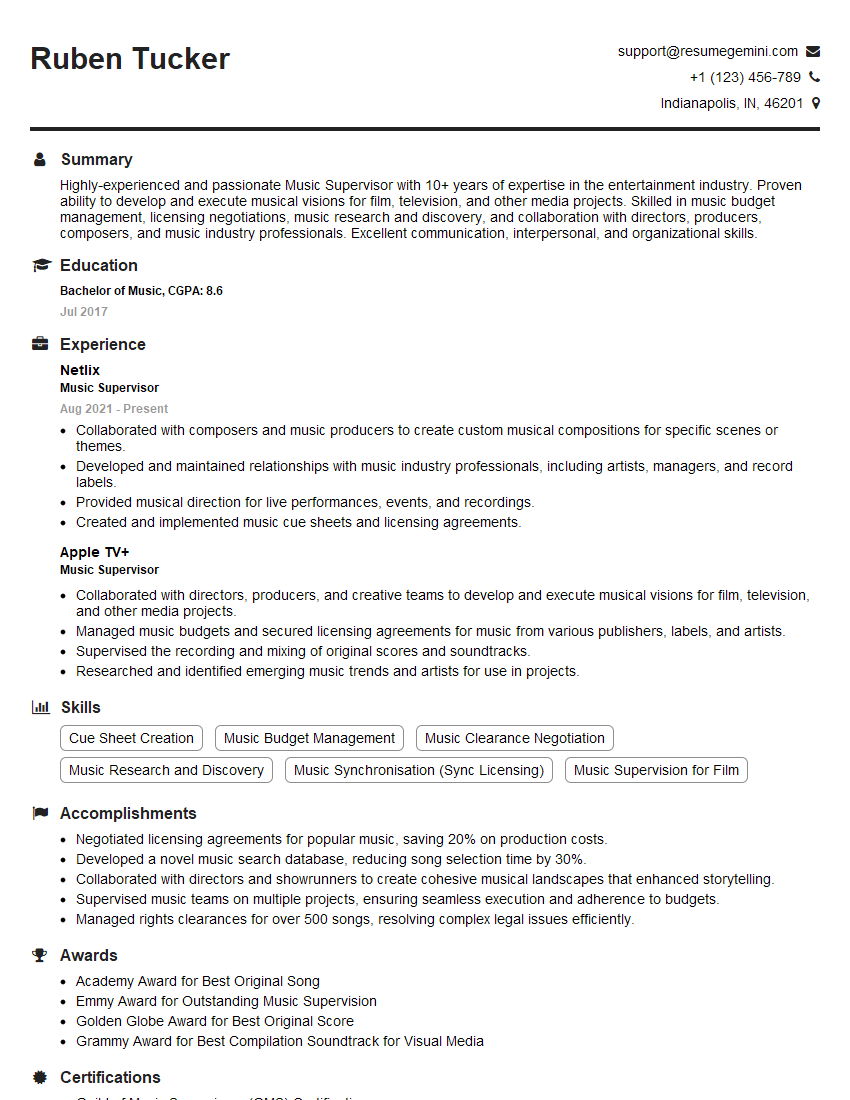
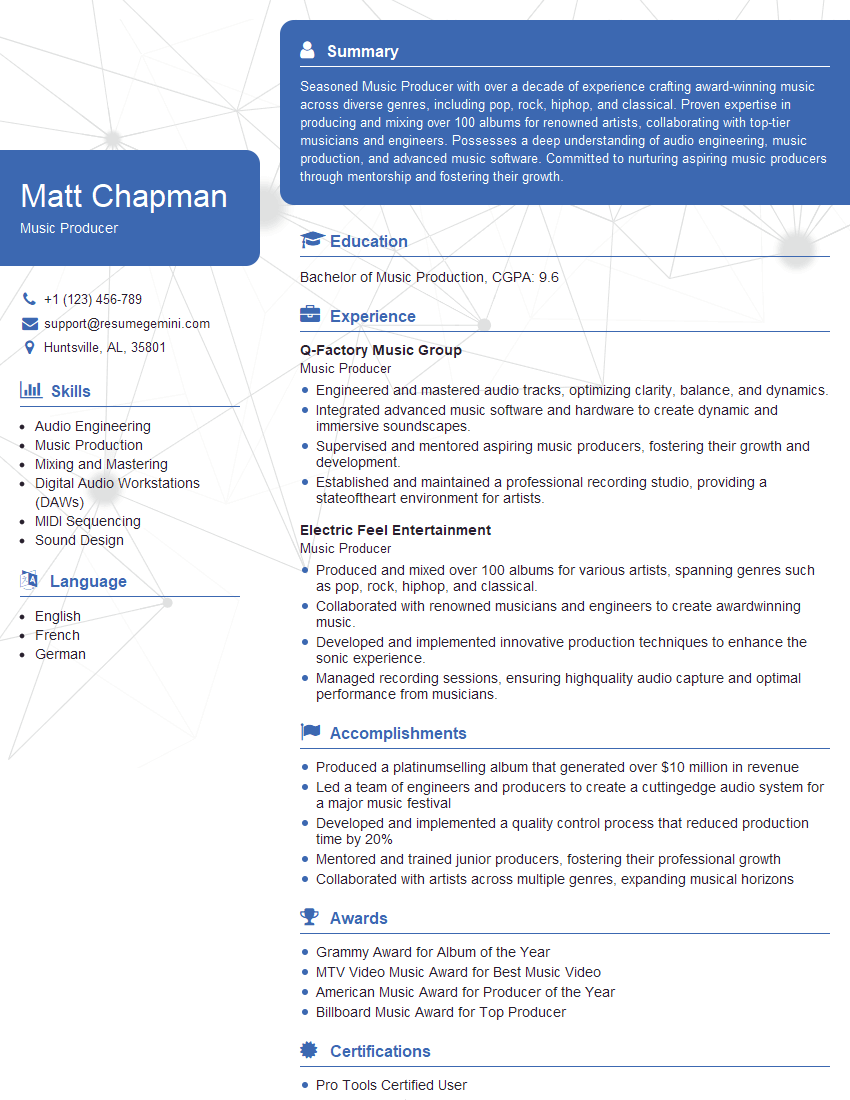
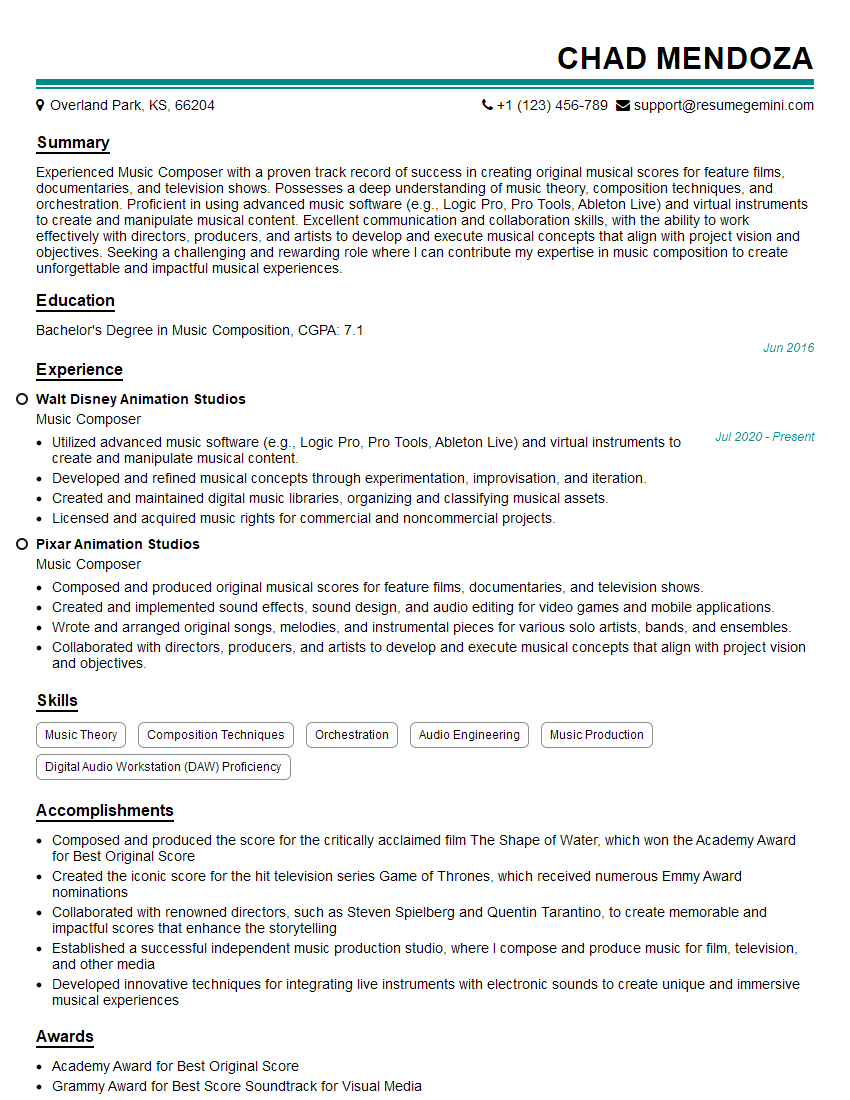
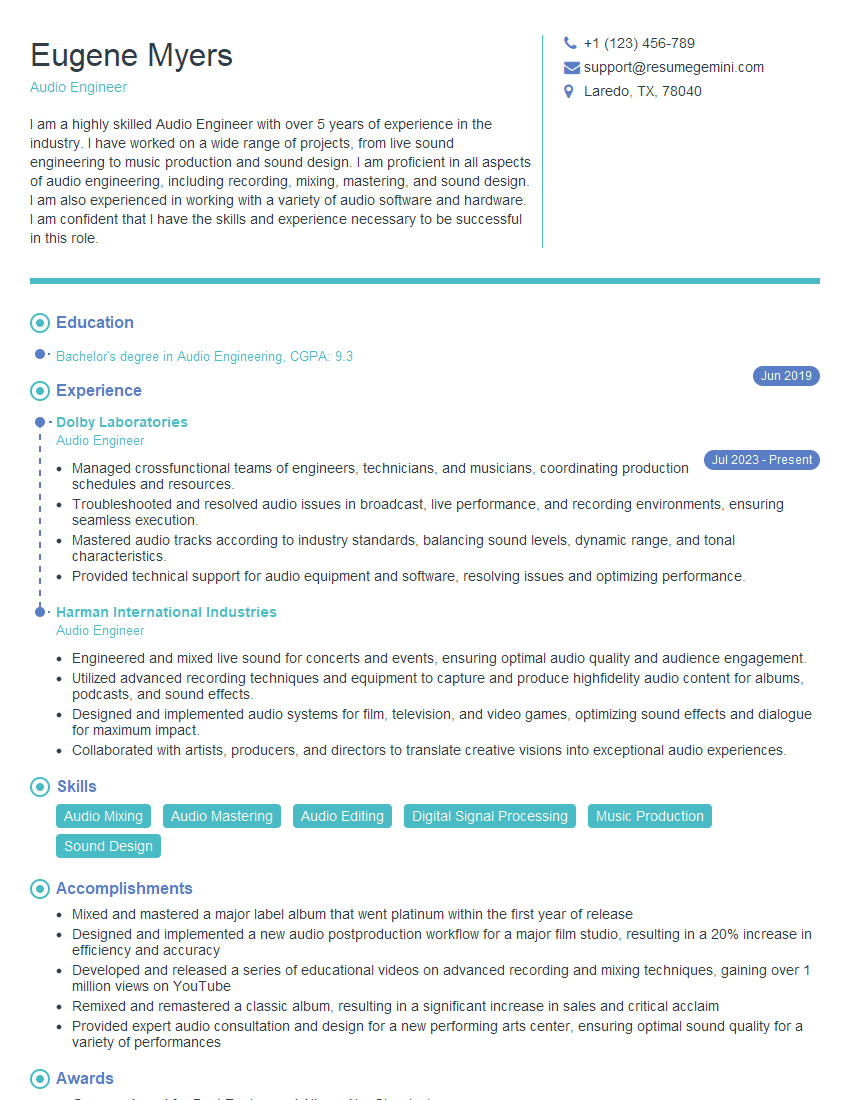
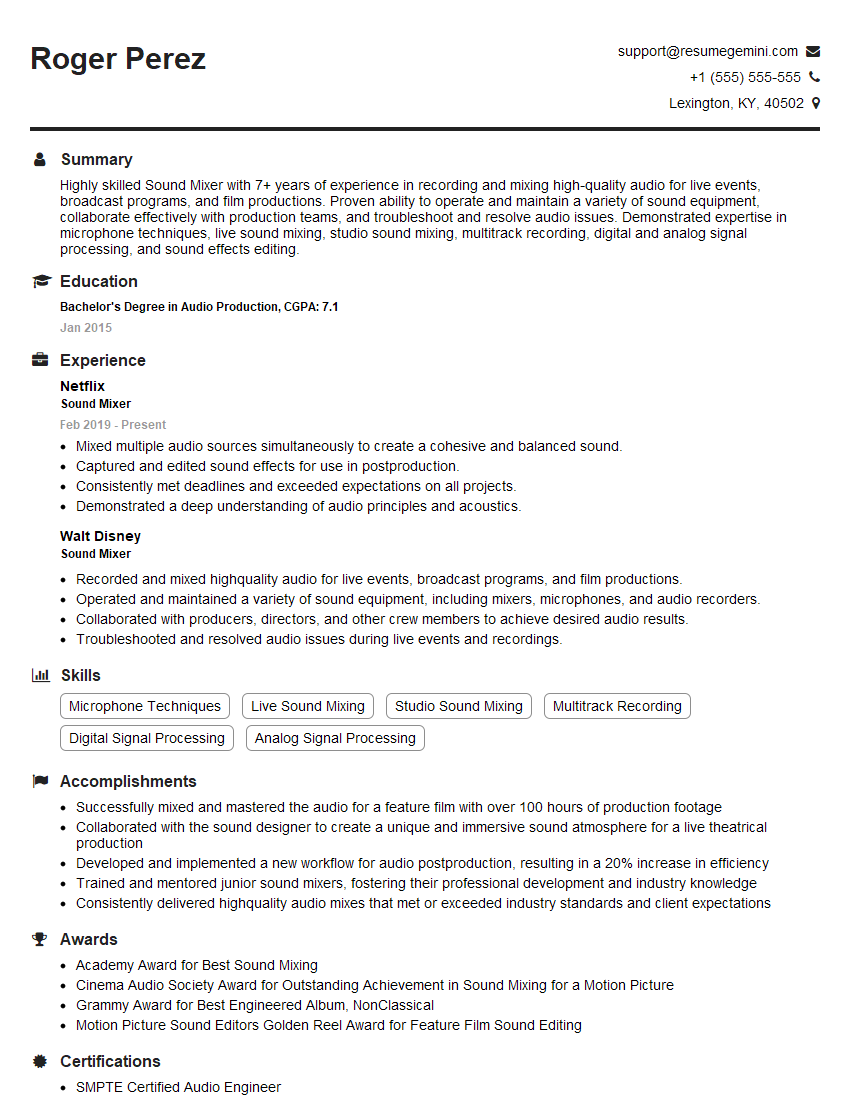
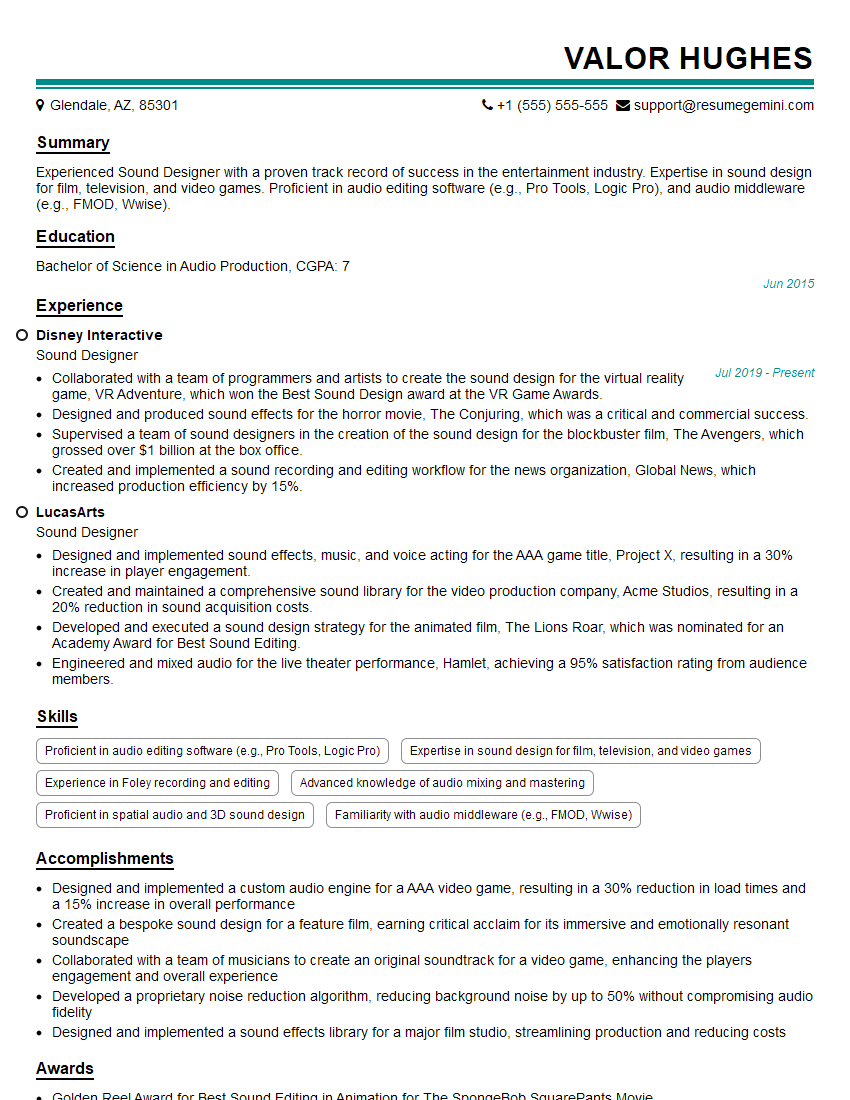
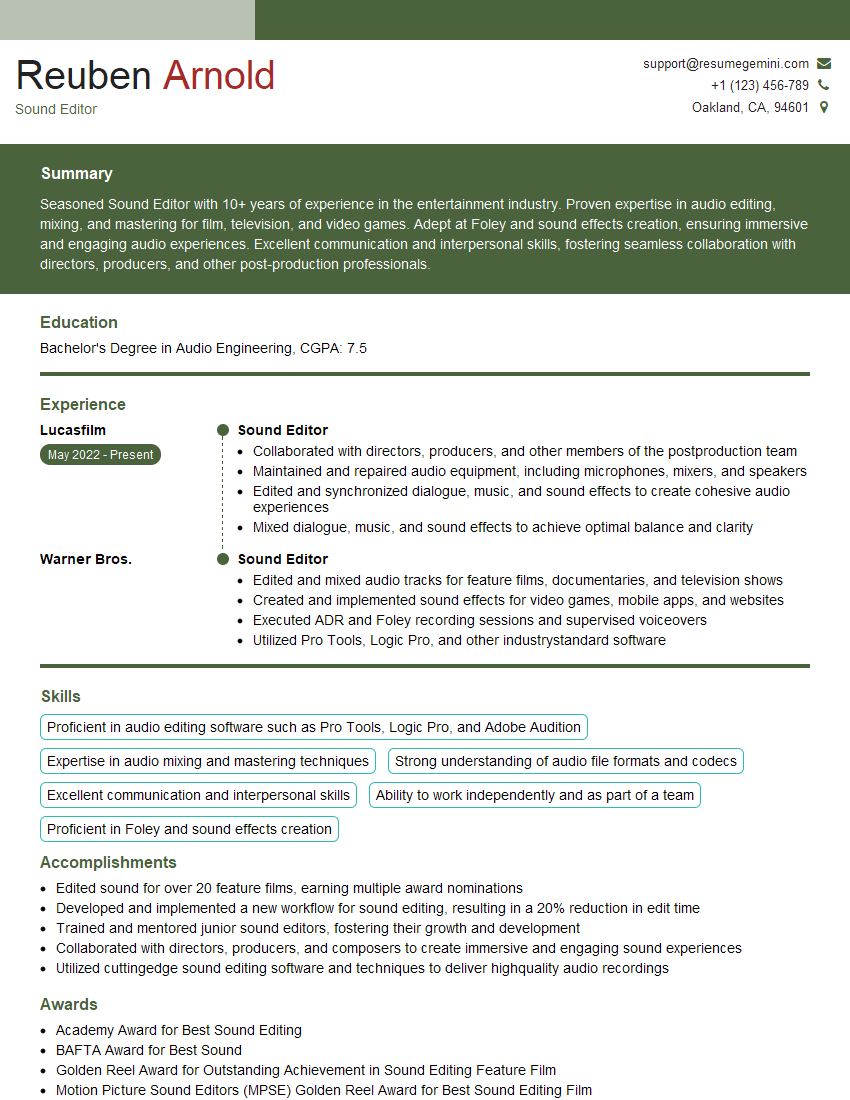
Mastering sound effects and musicality is crucial for career advancement in many creative fields. A strong understanding of these areas allows you to contribute significantly to compelling narratives and impactful experiences. To maximize your job prospects, crafting an ATS-friendly resume is essential. This ensures your application gets noticed by recruiters and hiring managers. ResumeGemini is a trusted resource to help you build a professional and effective resume. They provide examples of resumes tailored specifically to Sound Effects and Musicality roles, giving you a head start in creating a compelling application that truly reflects your skills and experience.
Explore more articles
Users Rating of Our Blogs
Share Your Experience
We value your feedback! Please rate our content and share your thoughts (optional).
What Readers Say About Our Blog
Very informative content, great job.
good