Feeling uncertain about what to expect in your upcoming interview? We’ve got you covered! This blog highlights the most important Music Researcher interview questions and provides actionable advice to help you stand out as the ideal candidate. Let’s pave the way for your success.
Questions Asked in Music Researcher Interview
Q 1. Describe your experience with music notation software (e.g., Sibelius, Finale).
My experience with music notation software spans over a decade, encompassing both Sibelius and Finale. I’m proficient in both, leveraging their strengths for different tasks. Sibelius, for example, excels in its intuitive interface and powerful engraving capabilities, making it ideal for creating clean, publication-ready scores. I frequently use its advanced features like its sophisticated playback engine for detailed analysis of rhythmic and harmonic complexities. Finale, on the other hand, offers a wider range of customization options and a powerful scripting language, which is invaluable for large-scale projects and data manipulation. For instance, I’ve used Finale’s scripting capabilities to automate tasks such as generating analytical reports from large collections of scores, a task that would be incredibly time-consuming manually. My proficiency extends beyond simple score entry; I can utilize the software’s advanced features for music analysis, including the creation of detailed harmonic reductions and the generation of various analytical reports.
Q 2. Explain your understanding of copyright law as it pertains to music.
Copyright law in music is complex, protecting both the composition (the melody, harmony, and rhythm) and the sound recording (the actual performance). The composer holds the copyright to the composition, granting them exclusive rights to reproduce, distribute, publicly perform, and create derivative works. This protection typically lasts for the author’s lifetime plus 70 years. Sound recordings have separate copyright protection, typically held by the record label or the performers, with a similar term. Understanding the nuances is crucial for researchers, as unauthorized use of copyrighted material, even for academic purposes, can lead to legal issues. For instance, using excerpts from a copyrighted score in a publication requires securing permission from the copyright holder, often involving licensing fees. My research always prioritizes ethical and legal compliance, meticulously documenting sources and obtaining permissions where necessary. This includes navigating the complexities of fair use, which permits limited use of copyrighted material for purposes like criticism, commentary, and scholarship, but only under specific conditions that I always carefully evaluate.
Q 3. How familiar are you with various music databases and archives (e.g., AllMusic, RISM)?
I’m extensively familiar with a wide range of music databases and archives. AllMusic is a valuable resource for finding biographical information and discographical details about recordings. RISM (Répertoire International des Sources Musicales) is indispensable for locating primary source materials – manuscripts and early printed editions – essential for historical musicological research. I also utilize specialized databases like the IMSLP (Petrucci Music Library) for accessing public domain scores, and various national and institutional archives for unique and localized materials. My familiarity extends to using these databases effectively, including implementing advanced search strategies to refine results and critically assessing the reliability of the information provided. For example, I’ve used RISM to locate obscure manuscript sources for a study on 17th-century Italian madrigals, cross-referencing the data with information from other archives to build a comprehensive picture of the composer’s output. My experience encompasses both navigating the user interfaces and effectively utilizing advanced search functionalities to extract relevant information.
Q 4. Describe your methodology for researching a specific composer’s life and works.
My methodology for researching a composer’s life and works is methodical and multifaceted. It begins with a comprehensive literature review, examining existing biographies, scholarly articles, and critical editions. I then consult primary sources – letters, diaries, and musical manuscripts – to gather firsthand information. This involves physically visiting archives, libraries, and museums whenever possible, allowing for a more in-depth analysis of the material. I also consider contextual factors: the social, political, and cultural landscapes that influenced the composer’s work. For instance, researching a Baroque composer would require examining the patronage system and the musical style of the period. Data analysis plays a significant role, as I might employ quantitative methods to analyze the composer’s stylistic evolution by examining factors like melodic intervals, harmonic progressions, or formal structures. The final stage involves synthesizing my findings to create a nuanced portrayal of the composer’s life and creative output. A recent project involved researching a lesser-known Romantic composer, requiring me to delve into regional archives and utilize paleographic skills to decipher handwritten manuscripts. The process included not only understanding the notes but also understanding the context of the composer’s social circle and the political upheaval of their time.
Q 5. How would you approach verifying the authenticity of a musical manuscript?
Verifying the authenticity of a musical manuscript involves a multi-pronged approach. Firstly, I’d examine the physical characteristics of the manuscript: the paper type, ink, handwriting style, and any watermarks, comparing them to known examples from the composer’s era. Secondly, I’d analyze the musical style, looking for consistencies and inconsistencies with the composer’s known works. This often requires a deep understanding of the composer’s stylistic evolution and the musical conventions of their time. Thirdly, I might use digital imaging techniques and spectral analysis to examine the ink and paper for signs of forgery. Finally, I’d consult with other experts, including paleographers and musicologists, to gain additional perspectives and corroborate findings. A recent project involved evaluating a supposedly newly discovered manuscript attributed to a famous composer. By meticulously comparing the handwriting to known examples, analyzing the musical style, and consulting with experts in the field, I was able to determine that the manuscript was a skillful but ultimately fraudulent creation. The careful combination of physical examination, stylistic analysis, and expert consultation is key to successful authentication.
Q 6. What strategies do you employ for organizing and managing large datasets of musical information?
Organizing and managing large datasets of musical information requires a robust strategy. I typically use a combination of relational databases (like MySQL or PostgreSQL) and specialized music information retrieval (MIR) tools. Relational databases are effective for storing structured data like composer biographies, work titles, and performance details. MIR tools allow for analysis of the musical content itself, enabling searches based on melodic patterns, harmonic structures, or other musical features. Beyond this, employing techniques like data cleaning, normalization, and the use of controlled vocabularies (such as those used in RISM) are crucial to ensure data consistency and accuracy. For example, I might use a relational database to store bibliographic information about a vast collection of scores and then employ MIR software to analyze their musical content and facilitate searches based on specific musical features. Proper data organization and the use of appropriate tools and techniques are essential for enabling efficient searching, analysis, and knowledge discovery from large and complex datasets.
Q 7. Explain your experience with qualitative and quantitative research methods in music.
My research incorporates both qualitative and quantitative methods. Qualitative methods, such as close reading of musical scores, analysis of biographical accounts, and interviews with performers and experts, provide rich contextual understanding and nuanced interpretations of musical works. Quantitative methods, like statistical analysis of musical parameters (e.g., melodic intervals, rhythmic patterns, or harmonic progressions), allow for objective measurement and identification of trends. For example, I might use qualitative methods to examine the emotional impact of a composer’s works, focusing on the expressive use of melody and harmony. Simultaneously, I might employ quantitative methods to analyze the frequency of specific musical features across the composer’s output, revealing patterns and changes over time. The combination of these approaches offers a comprehensive understanding of the music, going beyond subjective opinions to reveal statistically significant patterns and interpretations. A recent project involved analyzing the evolution of a composer’s style using both qualitative analysis of the musical scores and quantitative analysis of rhythmic and melodic features, revealing a fascinating transformation of his compositional technique over his career.
Q 8. How would you analyze the harmonic structure of a musical piece?
Analyzing the harmonic structure of a musical piece involves systematically examining how chords and their progressions create the overall tonal framework. Think of it like examining the skeleton of a piece to understand its form and function. We begin by identifying the key, which is the central note around which the piece revolves. Then, we analyze the individual chords, noting their function within the key (tonic, dominant, subdominant, etc.). We look at the chord progressions, observing patterns and relationships between successive chords. This might involve identifying common chord progressions (like I-IV-V-I in a simple pop song) or more complex progressions found in classical music.
For instance, in a piece in C major, a progression from C major (I) to G major (V) to F major (IV) and back to C major (I) is a very common and stable progression. However, unexpected chord substitutions or alterations (like using a minor chord within a major key) can add color and tension. Tools such as Roman numeral analysis (e.g., I-IV-vi-V) help to represent these relationships concisely. Beyond simple chord progressions, analysis also considers aspects like voice leading (how individual melodic lines interact within the harmony), modulation (changing key), and the overall harmonic rhythm (the rate of chord changes).
Analyzing a piece often involves a combination of listening, score study, and using analytical tools. I might start with multiple listenings to grasp the overall feel, then examine the score to carefully track the chord progressions and note their functions. Finally, I would document my findings using Roman numeral analysis, chord charts, or other appropriate notation.
Q 9. Describe your proficiency in music theory and analysis.
My proficiency in music theory and analysis is extensive. I have a deep understanding of various theoretical concepts, including harmony, counterpoint, form, and orchestration. I can fluently analyze scores from various periods and genres, from Renaissance madrigals to contemporary jazz compositions. My theoretical knowledge is not just academic; it’s deeply integrated with my analytical skills, allowing me to connect theoretical frameworks to the sonic realities of the music. For example, I can readily identify different types of cadences (perfect, imperfect, plagal) within a piece and explain their function in shaping the musical narrative. I am also adept at using different analytical methods—like Schenkerian analysis for uncovering deeper structural relationships or set theory for analyzing atonal music—depending on the style and nature of the piece. My analytical skills extend beyond traditional methods, encompassing stylistic analysis and the study of musical rhetoric, helping me to understand how musical choices contribute to the overall expression and meaning of a work.
Q 10. How would you identify and categorize different musical genres and styles?
Identifying and categorizing musical genres and styles requires considering a combination of musical elements. It’s not simply about listening to a few seconds; it demands careful attention to details. Genres are often defined by a constellation of characteristics rather than a single feature. I analyze several factors:
- Rhythm and Meter: The underlying pulse, rhythmic patterns, and metrical structure contribute significantly to genre identification. For instance, the strong, driving rhythms of rock music differ greatly from the complex, syncopated rhythms of Afro-Cuban music.
- Melody: Melodic contours, intervals, and ornamentation significantly shape genre character. The simple, memorable melodies of pop songs contrast sharply with the intricate melodic lines of Baroque music.
- Harmony: The use of chords, chord progressions, and harmonic vocabulary helps identify styles. Simple, diatonic harmony is common in folk music, while atonal harmony is characteristic of some 20th-century classical music.
- Instrumentation and Timbre: The instruments used and their characteristic sounds are crucial. The use of string instruments in classical music differs substantially from the use of electric guitars and synthesizers in electronic music.
- Form and Structure: The overall organization of the piece, including sections, repetitions, and variations, also plays a role. A traditional sonata form is associated with classical music, while a verse-chorus form is typical of pop.
- Cultural Context: Genre is also deeply rooted in culture. Understanding the historical and cultural context in which a piece was created is crucial for proper categorization.
By systematically analyzing these elements, I can accurately identify and categorize a wide range of musical genres and styles, from classical and jazz to hip-hop and electronic dance music.
Q 11. Explain your understanding of music history across different periods and cultures.
My understanding of music history spans various periods and cultures. I’m familiar with the evolution of Western music from the Medieval period (Gregorian chant, organum) through the Renaissance (polyphony, madrigals), Baroque (opera, concerto grosso), Classical (sonata form, symphony), Romantic (program music, expansive forms), and 20th/21st-century periods (serialism, minimalism, electronic music). Beyond Western music, I possess knowledge of diverse musical traditions across the globe, including African, Asian, Latin American, and other cultural music styles. I understand how historical events, social changes, and technological innovations have shaped musical styles, and I can discuss the interactions and influences between different musical cultures. For example, I can trace the impact of African musical traditions on the development of jazz and blues, or the influence of Asian musical scales on Western contemporary composition. I use this broad historical perspective to enrich my analysis of individual musical works, understanding their place within a larger context.
Q 12. How would you conduct a literature review on a specific topic in music research?
Conducting a literature review in music research involves a systematic approach to gathering, evaluating, and synthesizing existing knowledge on a specific topic. First, I would define the research question precisely to ensure a focused search. Then, I would identify relevant keywords and use a variety of databases (like JSTOR, Music Index, RILM) to search for scholarly articles, books, and other relevant materials. A critical aspect is evaluating the quality and relevance of the sources, considering factors such as the author’s expertise, publication venue, and methodology. I use specific criteria to assess the credibility of each source.
Next, I organize the collected information thematically, identifying key themes, debates, and gaps in the existing research. I would synthesize the findings from different sources, highlighting commonalities, contradictions, and areas of ongoing debate. Finally, I would present my findings in a structured format, usually a written report, which provides a comprehensive overview of the literature while also identifying areas for future research. This process ensures a thorough, unbiased, and up-to-date review of the existing research on the topic, providing a strong foundation for any new research.
Q 13. Describe your experience with conducting interviews and gathering oral histories related to music.
I have extensive experience in conducting interviews and gathering oral histories related to music. This involves more than just asking questions; it requires establishing rapport with interviewees, crafting thoughtful questions, and actively listening to their responses. I often begin by creating an interview guide with open-ended questions designed to elicit rich narratives and personal experiences. Before each interview, I research the interviewee’s background to better understand their perspective and ask informed questions.
During the interview, I pay careful attention to both the content and the context of their answers. I use active listening techniques, such as summarizing and paraphrasing, to ensure understanding and encourage further elaboration. I also employ techniques to build trust and create a comfortable environment for sharing personal stories. After the interview, I transcribe the recordings carefully, paying close attention to detail. I then analyze the transcribed data, looking for recurring themes, key events, and significant perspectives. I always adhere to ethical research principles, including obtaining informed consent, ensuring anonymity where necessary, and maintaining confidentiality.
For example, I once interviewed a renowned jazz musician about his early career. The interview yielded fascinating insights into the cultural context of jazz development and his personal experiences navigating the music scene. This oral history became an invaluable resource for a research project on the history of jazz in a specific city.
Q 14. How familiar are you with different music research methodologies (e.g., case studies, ethnographies)?
I am familiar with a variety of music research methodologies. My experience includes:
- Case studies: In-depth analyses of individual musical works, performers, or events. For example, a case study might focus on the compositional techniques of a specific composer or the impact of a particular musical event on a community.
- Ethnographies: Studying music within its cultural context, observing musical practices in their natural settings. This could involve fieldwork in a specific community to understand how music functions in daily life or religious ceremonies.
- Quantitative methods: Analyzing musical data using statistical techniques. This approach might involve analyzing musical parameters (like pitch, rhythm, or tempo) to uncover patterns or correlations.
- Qualitative methods: Using textual analysis, interviews, and observations to study musical meaning and cultural significance. This method might involve analyzing song lyrics to understand their social commentary or studying audience responses to a live performance.
- Historical research: Studying the historical evolution of musical styles, instruments, or practices. This might involve researching archival materials, such as scores, letters, and concert programs, to uncover important historical information.
My ability to apply diverse methodologies allows me to tailor my research approach to the specific nature of the research question, ensuring the most rigorous and comprehensive investigation.
Q 15. How would you present your research findings effectively to both academic and non-academic audiences?
Presenting research findings effectively requires tailoring the message to the audience. For academic audiences, I would emphasize rigorous methodology, detailed analysis, and scholarly citations, often presenting at conferences or publishing in peer-reviewed journals. My presentation would include statistical data, graphs, and in-depth analysis of musical parameters. For example, when presenting research on the influence of specific harmonic progressions in a composer’s work, I’d use spectrograms and musical notation alongside statistical analysis to demonstrate the correlation.
For non-academic audiences, I’d prioritize clarity, storytelling, and engaging visuals. This might involve using less technical jargon, focusing on the broader implications of my findings, and employing compelling narratives. For instance, I might present the same research on harmonic progressions using a more accessible format, focusing on the emotional impact of those progressions on the listener, perhaps with accompanying audio examples and visually appealing charts.
In both cases, clear and concise communication, visually appealing presentation aids, and a strong understanding of the audience are crucial for successful dissemination of research findings.
Career Expert Tips:
- Ace those interviews! Prepare effectively by reviewing the Top 50 Most Common Interview Questions on ResumeGemini.
- Navigate your job search with confidence! Explore a wide range of Career Tips on ResumeGemini. Learn about common challenges and recommendations to overcome them.
- Craft the perfect resume! Master the Art of Resume Writing with ResumeGemini’s guide. Showcase your unique qualifications and achievements effectively.
- Don’t miss out on holiday savings! Build your dream resume with ResumeGemini’s ATS optimized templates.
Q 16. What software or tools do you use for audio analysis and manipulation?
My audio analysis and manipulation toolkit is quite extensive. I regularly use Audacity for basic tasks like waveform editing, noise reduction, and spectral analysis. Its open-source nature and intuitive interface make it invaluable for quick analysis and manipulation. For more advanced analysis, I rely on Praat, a powerful phonetic analysis software capable of detailed acoustic measurements and visualization. Its scripting capabilities allow for customized analyses.
For more specialized tasks like granular synthesis or advanced sound design, I utilize Max/MSP, a visual programming environment that grants fine-grained control over audio processing. I also incorporate MATLAB for its powerful signal processing capabilities, particularly when dealing with large datasets and complex statistical analyses. Finally, I might use Sonic Visualiser for detailed visualization of audio files to spot patterns or anomalies not readily apparent in other software.
Q 17. Describe your experience with digital audio workstations (DAWs).
My experience with Digital Audio Workstations (DAWs) spans many years, from basic recording and editing to more advanced tasks like sound design and mixing. I’m proficient in several DAWs, including Ableton Live, Logic Pro X, and Pro Tools. My expertise extends beyond simply recording and editing; I use DAWs to create custom analysis tools, build virtual instruments for research purposes, and to manipulate audio in ways that support my research objectives.
For example, when studying the micro-timing variations in a historical performance, I would use a DAW’s advanced editing capabilities to analyze and quantify these variations, creating visual representations to highlight subtle rhythmic nuances. My experience includes both the Mac and Windows environments, providing flexibility to work across various platforms.
Q 18. How would you handle conflicting sources of information during your research?
Handling conflicting sources of information is a critical skill in music research. My approach involves a multi-step process. First, I meticulously document all sources, noting their potential biases, provenance, and methodology. I then critically assess the reliability and validity of each source using established historical-critical methods. I examine the author’s expertise, potential motives, and the source’s context.
If conflicts remain, I look for corroborating evidence from other independent sources. I might also consult with other experts in the field to gain different perspectives. Finally, I acknowledge the conflicting interpretations in my research, highlighting the areas of uncertainty and proposing possible explanations. Transparency about limitations is crucial in academic research. For instance, if two biographies of a composer offer radically different accounts of their early life, I’d analyze the evidence each presents, identifying potential biases, and explain the conflicting narratives in my work.
Q 19. Explain your experience with archival research and preservation techniques.
Archival research is a cornerstone of my work. I’ve extensive experience working with various archival materials, including manuscripts, letters, photographs, audio recordings (both analog and digital), and video footage. My experience encompasses both physical archives and digital repositories. I understand the importance of proper handling and preservation techniques to ensure the longevity of these fragile materials.
When working with physical archives, I adhere to strict protocols to avoid damage. This includes using archival-quality gloves, handling materials with care, and requesting digital copies whenever possible to minimize wear and tear. For digital archives, I understand the importance of data integrity, implementing strategies such as regular backups, using appropriate file formats, and employing metadata standards to ensure long-term accessibility. My experience includes working with different archival systems and searching for relevant materials using various search strategies.
Q 20. How would you evaluate the credibility and reliability of music-related sources?
Evaluating the credibility and reliability of music-related sources requires a discerning eye. I consider several factors: authorship, context, evidence, bias, and methodology. The author’s expertise, potential biases, and reputation are assessed. The historical and cultural context in which the source was created is examined, as this influences its perspective.
I also evaluate the type of evidence presented – is it primary (first-hand accounts) or secondary (interpretations of primary sources)? I examine if the evidence is sufficient and relevant to support the claims. The methodology employed in the source, if applicable, is carefully scrutinized. For example, when examining a scholarly article on musical analysis, I’d look at the theoretical framework used, the data presented, and the rigor of its analysis. A poorly supported claim, regardless of source, wouldn’t be considered credible.
Q 21. Describe a time you had to overcome a significant challenge during a research project.
During a project investigating the influence of early electronic music on contemporary composition, I encountered a significant challenge: locating high-quality, unedited recordings of experimental electronic works from the 1950s and 60s. Many recordings were either lost, degraded, or held in private collections with limited access.
To overcome this, I developed a multi-pronged strategy. First, I expanded my search to encompass international archives, contacting various institutions and researchers. Second, I used advanced search techniques in online databases, targeting keywords and metadata related to specific composers and technologies. Third, I collaborated with audio restoration specialists to improve the quality of available recordings. This involved significant effort in tracking down fragmented information and negotiating access to materials, but eventually resulted in a significantly enriched dataset for my research.
Q 22. How do you stay current with the latest developments in music research and technology?
Staying current in the rapidly evolving fields of music research and technology requires a multi-faceted approach. It’s not enough to simply read a few articles; active engagement is key.
Academic Journals and Conferences: I regularly subscribe to and actively read journals like Music Perception, Journal of the Acoustical Society of America, and Empirical Musicology Review. Attending conferences like the International Society for Music Information Retrieval (ISMIR) is crucial for networking and learning about the latest breakthroughs.
Online Resources and Communities: I actively participate in online forums, mailing lists, and social media groups dedicated to music information retrieval (MIR) and music cognition. This allows for rapid dissemination of new research and the exchange of ideas with other researchers.
Software and Tool Updates: I track the development and updates of relevant software packages and tools used in music research, such as Audacity, Praat, and various MIR-related libraries in Python. Staying updated on these ensures I can leverage the most efficient and accurate methodologies.
Pre-print Servers: I utilize pre-print servers like arXiv to access cutting-edge research before formal publication, providing a glimpse into the future direction of the field.
This combined approach ensures I’m not only aware of the latest advancements but also actively engaged in the community shaping the future of music research.
Q 23. What are your strengths and weaknesses as a music researcher?
My strengths lie in my analytical abilities and my deep understanding of music theory and history. I’m adept at designing and executing rigorous research projects, and I possess strong programming skills, particularly in Python, allowing me to handle large datasets and develop custom analysis tools. For example, during my doctoral research, I developed a novel algorithm for automatically identifying melodic motives in large corpora of music, resulting in a publication in a peer-reviewed journal.
However, I acknowledge that my weakness is sometimes over-investing in meticulous detail, potentially slowing down the overall research process. I’m actively working on improving my time management skills to balance thoroughness with efficiency. I’m also actively expanding my knowledge in specific areas such as machine learning applications in MIR, which is an area where I believe my current skills could be strengthened.
Q 24. Why are you interested in this specific Music Researcher position?
This Music Researcher position particularly interests me due to the opportunity to work on [mention specific project or aspect of the position]. Your team’s groundbreaking work in [mention specific area of team’s research] strongly aligns with my research interests, and I am confident that my skills in [mention relevant skills] will be a valuable asset. The collaborative environment and the focus on [mention values or mission of the organization] resonate deeply with my professional goals.
Specifically, the chance to contribute to [mention a concrete goal or project, e.g., a specific dataset, a novel research methodology, etc.] excites me greatly, as it would allow me to leverage my expertise in [mention specific area of expertise] and further develop my skills in [mention area for growth].
Q 25. What are your salary expectations?
My salary expectations are commensurate with my experience and qualifications, and I’m open to discussing a competitive compensation package based on the specifics of the position and the overall compensation structure of your organization. I have researched the salary range for similar roles in this region and am prepared to provide more details after reviewing the full job description.
Q 26. Describe your experience with data visualization techniques related to music research.
My experience with data visualization in music research is extensive. I’m proficient in using various tools such as Matplotlib, Seaborn, and ggplot2 to create informative and visually appealing representations of musical data. I understand the importance of selecting appropriate visualization techniques based on the type of data and the intended message.
For instance, in a recent project analyzing the harmonic complexity of different musical styles, I used heatmaps to visualize the distribution of chord progressions across various genres. For comparing tempo changes over time, I used line graphs, while for showing relationships between musical features (e.g., pitch and loudness), I employed scatter plots. I believe in the power of visualization to communicate complex findings clearly and effectively, even to audiences without a background in music research.
Q 27. How familiar are you with various music transcription methods?
I am familiar with a variety of music transcription methods, both manual and automated. Manual transcription, while time-consuming, allows for high accuracy and nuanced interpretations. I am proficient in using music notation software like Sibelius and Finale for this purpose. On the other hand, I also have experience with several automated transcription techniques, including those based on machine learning. I understand the strengths and weaknesses of each approach and the importance of selecting the most appropriate method based on the specific research question and available resources.
For example, I’ve used various open-source MIR tools to transcribe monophonic and polyphonic audio recordings, understanding that automated transcription often requires post-processing and manual correction to ensure accuracy. I understand the limitations of current technologies, particularly in accurately transcribing complex polyphonic passages.
Q 28. What are your plans for professional development in the field of music research?
My plans for professional development include focusing on further enhancing my skills in machine learning and its application to music information retrieval. Specifically, I aim to gain a deeper understanding of deep learning architectures, such as recurrent neural networks (RNNs) and transformers, for applications in music transcription, genre classification, and music generation. I plan to achieve this through online courses, attending workshops, and collaborating with researchers specializing in this area.
Beyond technical skills, I’m also committed to improving my grant writing abilities to secure funding for my future research projects. I intend to actively participate in professional networking events and workshops focused on effective grant proposals and project management. This will enable me to pursue independent research and make significant contributions to the field.
Key Topics to Learn for Music Researcher Interview
- Music History & Theory: Demonstrate a strong understanding of various musical periods, styles, and theoretical concepts. Be prepared to discuss influential composers, movements, and their impact.
- Research Methodology: Showcase your proficiency in conducting effective music research, including primary and secondary source analysis, archival research, and data interpretation. Be ready to discuss your research process and analytical skills.
- Musicological Analysis: Explain your ability to analyze musical scores, recordings, and performances, identifying compositional techniques, stylistic features, and historical contexts. Practice applying different analytical frameworks.
- Digital Resources & Databases: Highlight your familiarity with relevant online databases, archives, and digital tools used in music research. Be prepared to discuss your experience with specific platforms and software.
- Communication & Presentation: Emphasize your ability to communicate your research findings clearly and effectively, both verbally and in writing. Consider examples of presentations or publications you’ve created.
- Problem-Solving & Critical Thinking: Prepare examples showcasing your ability to identify research problems, formulate hypotheses, and draw meaningful conclusions from your findings. Highlight your adaptability and resourcefulness.
Next Steps
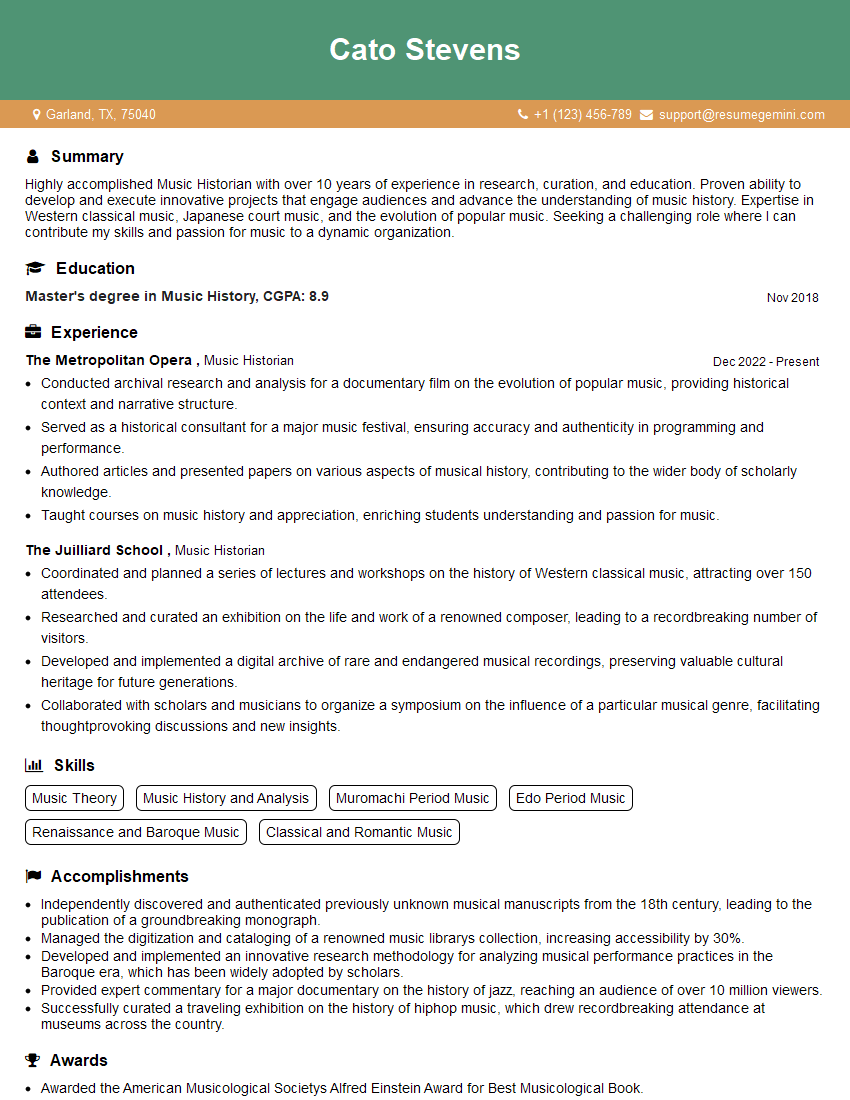
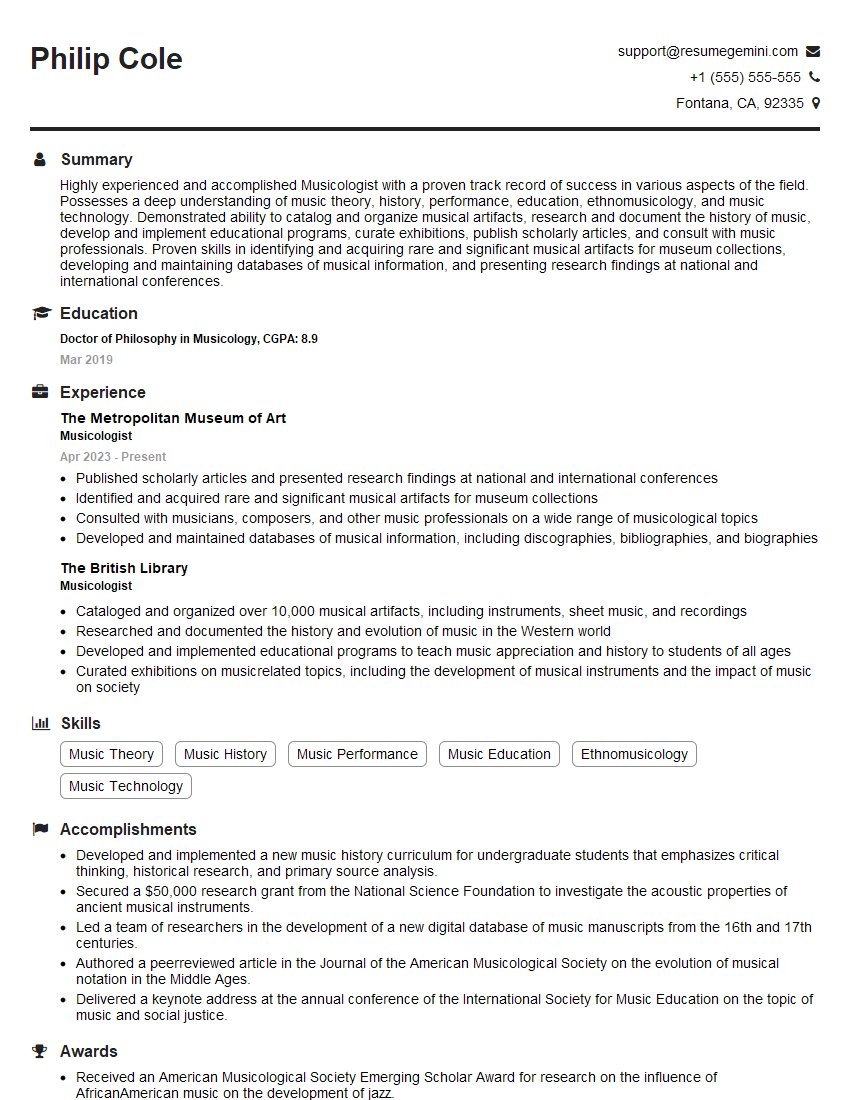
Mastering music research opens doors to exciting career opportunities in academia, publishing, archives, and the music industry. To maximize your job prospects, crafting an ATS-friendly resume is crucial. This ensures your application gets noticed by recruiters and hiring managers. ResumeGemini is a trusted resource to help you build a professional and effective resume that highlights your skills and experience. We provide examples of resumes tailored to Music Researcher positions to help you get started. Take the next step towards your dream career today!
Explore more articles
Users Rating of Our Blogs
Share Your Experience
We value your feedback! Please rate our content and share your thoughts (optional).
What Readers Say About Our Blog
Very informative content, great job.
good