The thought of an interview can be nerve-wracking, but the right preparation can make all the difference. Explore this comprehensive guide to ArchGIS interview questions and gain the confidence you need to showcase your abilities and secure the role.
Questions Asked in ArchGIS Interview
Q 1. Explain the difference between vector and raster data.
Vector and raster data are two fundamental ways to represent geographic information in GIS. Think of it like drawing a map: vector uses points, lines, and polygons to represent features, while raster uses a grid of cells (pixels) to represent continuous surfaces.
- Vector Data: This data type stores geographic features as individual objects with defined coordinates. Points represent locations (e.g., a well), lines represent linear features (e.g., a road), and polygons represent areas (e.g., a building). Vector data is precise and scalable, making it ideal for representing discrete features. For example, a detailed map of city blocks would use polygons to represent each block.
- Raster Data: This data type stores geographic information as a grid of cells, or pixels, each with a value representing a specific attribute. This is commonly used for satellite imagery, aerial photographs, and elevation models. Each pixel represents a specific area on the ground, with the value representing the attribute, such as elevation or land cover. Think of it like a digital photograph. For example, a digital elevation model (DEM) is a raster dataset showing elevation at each pixel location.
The key difference lies in how they store information: vector is precise and object-based, while raster is continuous and cell-based. The best choice depends on the specific application and type of data.
Q 2. Describe your experience with ArcGIS Pro and its various extensions.
I have extensive experience with ArcGIS Pro, utilizing its core functionalities and several extensions. My workflow regularly involves creating and editing feature classes, managing geodatabases, performing spatial analysis, and creating professional-quality maps and layouts. I am proficient in using extensions such as:
- Spatial Analyst: For performing raster-based analyses such as surface analysis, overlay, and modeling. I have used this extensively for tasks such as calculating slope and aspect from DEMs, creating suitability maps, and hydrological modeling.
- 3D Analyst: For creating and visualizing 3D models, including terrain surfaces and building models. I have used this for urban planning projects to visualize proposed developments within their context.
- Geostatistical Analyst: For performing interpolation and spatial statistical analysis on point data. This has been crucial for projects involving environmental monitoring and prediction.
- Network Analyst: For solving network-related problems, such as finding optimal routes and service areas. For example, I’ve optimized delivery routes for a logistics company.
Beyond the extensions, I’m comfortable using Python scripting within ArcGIS Pro to automate repetitive tasks and build custom geoprocessing tools, significantly improving efficiency and reproducibility.
Q 3. How do you perform geoprocessing tasks in ArcGIS?
Geoprocessing in ArcGIS involves using tools to manipulate and analyze geographic data. This is accomplished primarily through the geoprocessing pane in ArcGIS Pro, the ModelBuilder, and Python scripting. The geoprocessing pane provides a library of ready-to-use tools, while ModelBuilder allows users to create visual workflows, and Python scripting offers unparalleled flexibility and automation.
Example: Let’s say we need to buffer a point dataset representing wells by a distance of 500 meters. In ArcGIS Pro, we would open the geoprocessing pane, search for the ‘Buffer’ tool, select our point feature class as input, set the buffer distance to 500 meters, choose an output location and name, and execute the tool. The output would be a new polygon feature class showing a 500-meter buffer around each well. This provides a visual representation of the area potentially affected by each well.
This is a simple example, but geoprocessing can involve complex chains of tools, often automated with ModelBuilder or Python scripts to streamline workflows and increase repeatability. For instance, a model might automate clipping, projecting, and overlaying multiple layers for a particular analysis.
Q 4. What are the different types of map projections and when would you use each?
Map projections are mathematical methods used to represent the three-dimensional Earth on a two-dimensional map. Since the Earth is a sphere (or more accurately, an oblate spheroid), any projection will introduce some distortion. Different projections minimize different types of distortion.
- Equidistant Projections: Preserve distance accurately from a central point or along specific lines. Used when accurate distance measurement from a specific location is critical (e.g., navigation charts).
- Conformal Projections: Preserve angles and shapes accurately, but distort area. Ideal for navigation and mapping small areas where shape is paramount (e.g., nautical charts).
- Equal-Area Projections: Preserve area accurately but distort shape and angles. Best for showing the relative sizes of countries or regions (e.g., world maps emphasizing land area).
- Compromise Projections: Balance distortion across different properties, not perfectly preserving any single property. Often used for general-purpose maps (e.g., Robinson projection).
The choice of projection depends on the purpose of the map and the geographic area. For a world map showcasing land areas, an equal-area projection is preferable. For a navigational map, a conformal projection might be best. For a map of a small region, a compromise projection might suffice.
Q 5. Explain your experience with spatial analysis techniques such as overlay analysis, buffering, and proximity analysis.
I’ve extensive experience applying various spatial analysis techniques, including overlay, buffering, and proximity analysis. These are powerful tools for deriving information from spatial data.
- Overlay Analysis: This involves combining two or more layers to create a new layer containing information from both. I’ve used this for land suitability analysis, combining soil type, slope, and proximity to water sources to identify suitable locations for development. There are several types, including intersect, union, and erase.
- Buffering: This creates zones around features within a specified distance. I’ve used this to determine areas potentially affected by a pollution source or to identify properties within a certain distance of a school.
- Proximity Analysis: This calculates distances and identifies nearest neighbors. I have used this to find the nearest hospital to accident locations or to analyze the spatial distribution of trees in a forest.
These techniques are not isolated; they’re often combined in complex workflows to solve intricate spatial problems. For instance, I once combined buffering and overlay analysis to identify areas within 1 km of a river that also meet specific soil suitability criteria for a riparian restoration project.
Q 6. How do you manage and maintain geodatabases?
Geodatabase management is crucial for maintaining data integrity and ensuring efficient access to spatial information. My experience encompasses various aspects of geodatabase administration, including:
- Data Modeling: Designing effective geodatabase schemas to efficiently organize and manage spatial data. This includes defining feature classes, attributes, and relationships between them.
- Data Editing and Validation: Implementing data quality control measures to ensure accuracy and consistency, employing topology rules and attribute domains.
- Versioning and Replication: Using geodatabase versioning to allow multiple users to edit data concurrently without conflicts. I have also used replication to synchronize data across different locations or users.
- Data Backup and Recovery: Implementing regular backup and recovery strategies to protect against data loss. This is critical for disaster recovery planning.
- Data Compression and Archiving: Employing appropriate strategies to minimize storage space and improve data access efficiency.
Proper geodatabase management is essential for long-term data sustainability and the reliability of spatial analyses. A well-structured geodatabase ensures data integrity, usability, and efficient use of resources.
Q 7. Describe your experience with data import/export in ArcGIS.
Data import and export are fundamental tasks in any GIS project. My experience with ArcGIS involves a wide range of import/export methods for different data formats.
- Shapefiles: Commonly used for simple vector data exchange. ArcGIS handles shapefile import and export seamlessly.
- Geodatabases (file and enterprise): The preferred format for storing and managing complex spatial data within ArcGIS. Data migration between different geodatabase types is frequently part of my workflow.
- Raster formats (TIFF, GeoTIFF, IMG): I routinely handle raster data, including satellite imagery and DEMs, using ArcGIS’s capabilities for importing and exporting these formats.
- CAD formats (DWG, DXF): I’ve worked with importing CAD data to integrate infrastructure information into GIS projects, often requiring some pre-processing or cleaning.
- CSV and other tabular data: I frequently import tabular attribute data to join with spatial data, enriching GIS layers with additional contextual information.
- GPKG (Geopackage): A newer format increasingly preferred for its multi-format and efficiency, supporting both raster and vector data.
For complex data transformations or large datasets, I use scripting and automation tools to streamline import/export processes, ensuring data accuracy and reducing manual effort. The specific approach depends on the data type, format, and the project requirements.
Q 8. How do you handle spatial data errors and inconsistencies?
Handling spatial data errors and inconsistencies is crucial for accurate geospatial analysis. It involves a multi-step process starting with data validation and progressing to data cleaning and error correction. Think of it like editing a photograph – you wouldn’t publish an image with blurry spots or misaligned elements. Similarly, inaccurate spatial data can lead to flawed conclusions.
- Data Validation: This initial step involves checking for various errors, such as duplicate features, invalid geometries (e.g., self-intersecting polygons), topological errors (e.g., gaps or overlaps between adjacent polygons), and attribute errors (e.g., inconsistencies or missing data). ArcGIS Pro offers tools like the ‘Check Geometry’ and ‘Topology’ tools for this purpose. For example, the ‘Check Geometry’ tool identifies and flags polygons with self-intersections, allowing for their subsequent correction.
- Data Cleaning: Once errors are identified, the next stage involves cleaning the data. This can involve using ArcGIS tools to repair invalid geometries (e.g., using the ‘Repair Geometry’ tool), removing duplicates, and resolving topological errors. For attribute errors, you might use tools like field calculators to correct data, identify and replace inconsistencies.
- Error Correction: Sometimes, errors require manual intervention. This may involve visual inspection using ArcMap or ArcGIS Pro, comparing the data to a higher-accuracy source, or contacting the data provider for clarification. For example, if address points are off by a few meters, manual adjustment using editing tools is often necessary.
- Data Transformation: Data might need transformation (projection or coordinate system conversion) to ensure consistency. Different datasets often use different coordinate systems. Failure to transform them before analysis can result in inaccurate spatial relationships. ArcGIS’s ‘Project’ tool is crucial here.
A real-world example: I worked on a project mapping agricultural lands where inconsistent polygon boundaries between different datasets led to inaccuracies in area calculations. By employing these data validation and cleaning techniques, we corrected the errors, leading to a more reliable assessment of agricultural productivity.
Q 9. Explain your experience with scripting or automation in ArcGIS (Python, ModelBuilder).
I have extensive experience with both Python scripting and ModelBuilder in ArcGIS. Python offers more flexibility and power for complex tasks, while ModelBuilder provides a visual, drag-and-drop interface suitable for simpler, repeatable workflows. Imagine Python as a powerful chef’s knife and ModelBuilder as a reliable, multi-tool.
- Python Scripting: I’ve used Python extensively for tasks such as automating geoprocessing workflows (e.g., batch processing of rasters, creating custom spatial analysis tools), data manipulation (e.g., extracting attributes, creating new fields), and map automation (e.g., dynamically generating maps based on user input). For example, I created a script using the
arcpylibrary to automatically process hundreds of aerial photographs, orthorectify them, and generate mosaics. - ModelBuilder: ModelBuilder is ideal for creating reusable workflows that can be easily shared with others. I’ve used it to streamline tasks like creating buffers, performing spatial joins, and generating reports. A practical example is creating a model that automatically buffers points representing wells, intersects the buffers with a land-use layer, and then creates a summary table of the land-use type within each buffer.
# Example Python code snippet for creating buffers:
import arcpy
arcpy.Buffer_analysis("input_points", "output_buffers", "100 Meters")
My experience allows me to choose the best approach for each project. For highly repetitive tasks or when working with non-programmers, ModelBuilder is preferable. For complex or customized solutions, Python provides the necessary flexibility.
Q 10. How do you create and manage map layouts in ArcGIS?
Creating and managing map layouts in ArcGIS involves selecting appropriate map elements, arranging them aesthetically, and ensuring clarity and readability. It’s like designing a poster – you need to choose the right elements, position them effectively, and ensure the overall design is compelling and easy to understand.
- Map Elements: A map layout includes the map frame itself, a title, a legend, a scale bar, north arrow, and potentially other elements like insets, data tables, or text boxes. The choice of elements depends on the purpose of the map and the target audience.
- Arrangement and Aesthetics: Elements should be arranged logically and aesthetically. Consider using white space effectively, choosing appropriate fonts and colors, and aligning elements consistently. The goal is to create a map that is visually appealing and easy to read.
- Exporting and Sharing: Once the layout is complete, it can be exported in various formats (PDF, PNG, JPG) for printing or sharing. ArcGIS Pro provides excellent control over resolution and output quality.
For instance, while creating a map displaying population density, I carefully chose a color ramp that clearly visualized density variations, placed the legend in a prominent position, and added a title to provide context. I also ensured that the scale bar allowed readers to easily interpret distances.
Q 11. Describe your experience with cartographic design principles.
Cartographic design principles are fundamental to creating effective and communicative maps. These principles guide the visual representation of spatial data, ensuring clarity, accuracy, and aesthetic appeal. Think of them as the grammar and style guide for mapmaking.
- Visual Hierarchy: Elements should be arranged to guide the viewer’s eye, emphasizing important information. This can be achieved using size, color, and placement.
- Color Selection: Colors should be chosen carefully, considering color blindness and the need to distinguish different features clearly. Color ramps should be perceptually uniform to avoid misinterpretations.
- Typography: Fonts should be legible and appropriate for the map scale. Consistent font usage improves readability.
- Symbol Selection: Symbols should be easily identifiable and consistent with cartographic conventions. The choice of symbol depends on the type of feature being represented.
- Map Scale and Projection: The scale should be appropriate for the detail needed, and the map projection should be selected based on the area being mapped and the type of analysis being performed.
For example, when designing a thematic map, I would choose a color scheme that is both visually appealing and effectively communicates the data variation. I would also carefully select symbols that are instantly recognizable and consistently sized to avoid ambiguity.
Q 12. How familiar are you with different data formats (shapefiles, GeoJSON, GeoTIFF)?
I’m very familiar with various data formats used in GIS, including shapefiles, GeoJSON, and GeoTIFF. Each has its strengths and weaknesses, making them suitable for different purposes.
- Shapefiles: A classic format, shapefiles are widely used and supported by most GIS software. However, they are composed of multiple files (.shp, .shx, .dbf, etc.), which can be cumbersome to manage. They’re best suited for vector data such as points, lines, and polygons.
- GeoJSON: A lightweight, text-based format that’s increasingly popular due to its ease of use and compatibility with web mapping applications. It’s excellent for data exchange and integration with web services. GeoJSON handles both vector and some raster data, representing it as a JSON object.
- GeoTIFF: A popular georeferenced raster format, GeoTIFF stores raster data along with geospatial metadata, making it easy to work with in GIS software. They’re perfect for satellite imagery, elevation models, and other raster datasets.
I regularly convert between these formats depending on the needs of the project. For example, I might download GeoJSON data from an open-source database, convert it to a shapefile for analysis in ArcGIS Pro, and then export it as a GeoTIFF to incorporate into a web map.
Q 13. Explain your experience with online mapping services (ArcGIS Online, ArcGIS Enterprise).
I have considerable experience with both ArcGIS Online and ArcGIS Enterprise. They provide different levels of functionality and control for managing and sharing geospatial data and applications.
- ArcGIS Online: A cloud-based GIS platform, ideal for sharing maps and data with a wider audience. I’ve used it to publish maps, create web apps, and collaborate with others on geospatial projects. Its ease of use makes it perfect for sharing data with non-GIS experts.
- ArcGIS Enterprise: A more robust, on-premise platform that provides greater control and customization options. I’ve used it to deploy enterprise-level GIS applications, manage large datasets, and implement complex geoprocessing workflows within a secure environment. This is best for organizations requiring high levels of control and customization.
In a recent project, we used ArcGIS Online to share a public-facing map displaying real-time traffic conditions. For internal use, however, we utilized ArcGIS Enterprise to manage sensitive spatial data within a secure organizational environment.
Q 14. How do you perform spatial joins and relate tables in ArcGIS?
Spatial joins and relates are powerful tools for combining data from different sources based on spatial relationships. Think of them as sophisticated ways to ‘link’ information based on location.
- Spatial Joins: A spatial join merges attributes from one feature class (the ‘join features’) into another (the ‘target features’) based on their spatial relationship. For example, you might spatially join points representing crime incidents to polygons representing neighborhoods to determine the number of crimes in each neighborhood. ArcGIS Pro’s ‘Spatial Join’ tool provides this functionality.
- Relates: A relate creates a link between two tables based on a common attribute field without merging attributes into a single table. This maintains the integrity of both tables while allowing you to access and query related information. Imagine a table of roads and another of traffic sensors; you would relate them using a common road ID to see traffic flow on specific roads.
In a real-world example, I used a spatial join to overlay census data (polygons) with points representing store locations to determine the population within a certain radius of each store. This information was used to support decisions on new store placement.
Q 15. Describe your experience with using GPS data in ArcGIS.
My experience with GPS data in ArcGIS is extensive. I’ve worked with various GPS data formats, including shapefiles, geodatabases, and GPX files, incorporating them into diverse GIS projects. I’m proficient in importing, cleaning, and analyzing GPS data. This includes handling issues like positional inaccuracies (noise) and temporal discrepancies. For instance, I once used GPS track logs to analyze the movement patterns of wildlife in a conservation study, identifying key habitats and migration routes. Cleaning the data involved removing outliers due to GPS signal loss and smoothing trajectories to represent the actual animal movement more accurately. The analysis involved calculating distances, speeds, and durations, then creating maps to visualize these findings. I’m also familiar with using GPS data alongside other spatial data layers, such as elevation data, to create more comprehensive spatial analyses.
Furthermore, I understand the importance of metadata associated with GPS data, including the datum and coordinate system, ensuring data accuracy and integration with other datasets.
Career Expert Tips:
- Ace those interviews! Prepare effectively by reviewing the Top 50 Most Common Interview Questions on ResumeGemini.
- Navigate your job search with confidence! Explore a wide range of Career Tips on ResumeGemini. Learn about common challenges and recommendations to overcome them.
- Craft the perfect resume! Master the Art of Resume Writing with ResumeGemini’s guide. Showcase your unique qualifications and achievements effectively.
- Don’t miss out on holiday savings! Build your dream resume with ResumeGemini’s ATS optimized templates.
Q 16. How would you approach a project involving large datasets in ArcGIS?
Working with large datasets in ArcGIS requires a strategic approach that leverages ArcGIS’s capabilities efficiently. My strategy typically involves these steps:
- Data Preprocessing: Before loading the entire dataset, I perform initial data assessment and cleaning using tools like ArcPy. This can include identifying and handling errors, inconsistencies, or missing data. I may also use sampling techniques to evaluate data quality before processing the entire dataset.
- Data Management: For very large datasets, I would utilize geodatabases and file geodatabases for superior data organization and management, rather than relying solely on shapefiles. I would partition the data into smaller, manageable sections if necessary. This approach enhances performance and facilitates efficient querying and analysis.
- Spatial Indexing: Implementing spatial indexing using techniques like building spatial indexes within the geodatabase significantly speeds up spatial queries and analyses on large datasets.
- Data Visualization and Analysis: Instead of using the full dataset for visualizations, I strategically select data subsets or aggregate data to improve performance when creating maps and performing complex analysis.
- Cloud Computing: For exceptionally large datasets that exceed local machine processing capabilities, I can utilize cloud-based GIS platforms (like ArcGIS Online or ArcGIS Enterprise) to leverage distributed computing resources for efficient processing and visualization.
For example, in a project involving analyzing millions of points representing urban tree canopy, I utilized a combination of these strategies to manage and analyze the data effectively, producing a high-resolution map of tree density.
Q 17. What is your experience with georeferencing and rectification?
Georeferencing and rectification are crucial aspects of my GIS workflow. Georeferencing is the process of assigning geographic coordinates to an image or map that lacks them. Rectification involves correcting geometric distortions in an image or map.
My experience includes georeferencing scanned maps and aerial photographs using ground control points (GCPs), which are points with known coordinates in both the image and a reference dataset (e.g., a high-accuracy basemap). I utilize ArcGIS tools to define these GCPs and transform the image to align with the reference data, employing various transformation methods (e.g., polynomial transformations) depending on the image distortion. I understand the importance of selecting sufficient GCPs that are evenly distributed across the image, accurately representing the transformation throughout the image. In rectification, I deal with both systematic and random errors that are frequently observed in scanned maps and aerial photographs.
Rectification accuracy is directly related to the quality of the GCPs. Improperly chosen or incorrectly identified GCPs lead to inaccurate transformations, so careful consideration of data accuracy is paramount in my process.
Q 18. Explain your understanding of coordinate systems and datums.
Coordinate systems and datums are fundamental concepts in GIS. A coordinate system is a reference system used to define the location of points on the Earth’s surface. A datum is a reference model of the Earth’s shape and orientation used in defining a coordinate system. Understanding them is crucial for accurate spatial analysis and data integration.
I am familiar with various coordinate systems, including geographic coordinate systems (latitude and longitude) and projected coordinate systems (e.g., UTM, State Plane). I understand the differences between datums, such as NAD83 and WGS84, and their impact on positional accuracy. Incorrect use of coordinate systems and datums can lead to significant positional errors in GIS analysis. Choosing the appropriate coordinate system for a particular project is essential for its success, and I always take time to ensure data from different sources shares a common datum and coordinate system before integrating them into analysis.
For example, while working on a project involving both GPS data (WGS84 datum) and a local cadastral map (NAD83 datum), I meticulously transformed one dataset to match the coordinate system of the other, ensuring accuracy during overlay and analysis operations.
Q 19. Describe your experience with creating and using custom symbology in ArcGIS.
Creating and using custom symbology is a vital skill for effective data visualization in ArcGIS. I am proficient in designing custom symbols to represent features in a way that enhances map readability and conveys information clearly. I’ve designed symbols ranging from simple markers to complex graduated symbols and charts for various applications.
For instance, in a project analyzing crime statistics, I developed custom symbols that varied in size and color according to the severity and type of crime, making it easy to discern crime hotspots and patterns. In addition to using the standard ArcGIS symbology editor, I have created custom symbols using external graphics editing software and integrated them into my ArcGIS projects. This allows for a level of customization that adds significant value in projects requiring highly specific and visually engaging representations. I understand the importance of leveraging both visual and thematic variations in symbology to create clear, effective maps for diverse audiences.
Q 20. How do you perform spatial queries in ArcGIS?
Spatial queries in ArcGIS are fundamental for extracting information based on spatial relationships between features. I use a variety of methods to perform these queries, including:
- Select By Location: This allows me to select features in one layer based on their spatial relationship (e.g., intersection, containment, proximity) with features in another layer. For example, I might select all buildings within a specific flood zone.
- Select By Attributes: This involves selecting features based on attribute values. I can combine this with Select By Location to filter results based on both spatial and attribute characteristics.
- Spatial Analyst Tools: Tools like ‘Clip’, ‘Intersect’, ‘Erase’, and ‘Buffer’ are used for more complex spatial analysis. For example, I might use the buffer tool to find all points within a 1-kilometer radius of a specific road. This is helpful for creating service area maps or identifying features in proximity.
- Geoprocessing Tools: More advanced spatial queries can be achieved using geoprocessing scripts using ArcPy or ModelBuilder. This allows for automation of complex queries and data manipulations, improving efficiency and accuracy.
Understanding the strengths and limitations of each of these tools allows me to select the most appropriate method for each particular spatial query I need to conduct.
Q 21. How familiar are you with the ArcGIS API for JavaScript or Python?
I possess a strong working knowledge of both the ArcGIS API for JavaScript and the ArcGIS API for Python. While not a coding expert, I am adept at developing customized scripts and applications using these APIs to automate tasks and extend ArcGIS functionality.
Using the JavaScript API, I’ve created web maps and applications that integrate with other web services, enabling interactive data exploration and visualization. My experience includes using JavaScript to generate dynamic charts, perform real-time map updates, and implement custom interactions within web map applications.
With the Python API (ArcPy), I’ve automated various geoprocessing tasks, including data conversion, analysis, and map production, creating efficient workflows that can handle large datasets and repetitive operations. This greatly improves productivity and ensures consistency across large projects. I frequently use ArcPy to write scripts to process large amounts of data, automate map generation and export, and perform custom spatial analyses that are not readily available in the standard ArcGIS interface.
Q 22. Explain your experience with 3D GIS capabilities in ArcGIS Pro.
My experience with ArcGIS Pro’s 3D GIS capabilities is extensive. I’ve leveraged its tools to create and analyze 3D scenes for various applications, from urban planning and environmental impact assessments to visualizing subsurface utilities and geological formations. I’m proficient in creating and manipulating 3D features, including extruding polygons to create buildings, draping imagery over terrain surfaces, and incorporating point clouds for highly detailed representations.
For example, in a recent project involving a proposed wind farm, I used ArcGIS Pro to create a 3D model of the terrain, incorporating wind turbine models and visualizing potential shadow impacts on nearby communities. This allowed stakeholders to better understand the project’s potential environmental effects and facilitated informed decision-making. I also regularly employ the scene layer package functionality for collaborative work and efficient data sharing. Furthermore, I’m experienced in utilizing various 3D analysis tools, such as line of sight and viewshed analysis, to identify optimal locations for infrastructure or assess visibility constraints.
Beyond basic visualization, I understand the complexities of managing large 3D datasets and optimizing performance within ArcGIS Pro. This includes techniques such as level of detail management and the application of appropriate symbology to prevent performance bottlenecks when working with massive datasets.
Q 23. How do you ensure data quality and accuracy in your GIS work?
Data quality and accuracy are paramount in GIS. My approach involves a multi-stage process beginning with careful data sourcing. I prioritize using authoritative and well-documented datasets from reputable sources like government agencies or established research institutions. Then, I conduct rigorous data validation checks throughout the project lifecycle. This involves using ArcGIS Pro’s geoprocessing tools to identify and address spatial inconsistencies, such as topology errors or attribute discrepancies.
For example, I routinely employ the ‘Check Geometry’ tool to identify self-intersections or invalid geometries in polygon features. I also utilize attribute queries to detect illogical or missing data, ensuring consistency in data values. Data editing and cleansing are conducted carefully, often involving a combination of automated and manual processes. Finally, I implement rigorous quality control checks, often involving peer review and independent verification to ensure the accuracy and reliability of the final product.
Documentation is also key. I meticulously document data sources, processing steps, and any identified limitations, ensuring transparency and reproducibility of my work. This comprehensive approach guarantees the delivery of high-quality, reliable GIS data that supports accurate spatial analysis and decision-making.
Q 24. Describe your experience with creating interactive maps and web applications using ArcGIS.
I possess significant experience in developing interactive maps and web applications using ArcGIS Online and ArcGIS Enterprise. I’m proficient in creating engaging web maps with custom symbology, pop-ups, and interactive elements that enhance user experience. I’ve developed web applications using ArcGIS Web AppBuilder and ArcGIS API for JavaScript, tailoring the interfaces to meet specific user needs and project requirements.
For instance, I recently created a web application for a local government that allowed citizens to easily locate nearby parks and recreation facilities, including information on amenities and accessibility features. The application also incorporated real-time data feeds for things like weather conditions and park occupancy levels. I leveraged the power of web mapping to create a user-friendly and informative tool accessible through various devices. My expertise includes integrating data from multiple sources, creating custom visualizations, and implementing user authentication and authorization features to control data access. I understand the importance of responsive design to ensure seamless operation across different devices.
Q 25. What are some common challenges you have faced working with GIS data and how did you overcome them?
One common challenge is working with inconsistent data formats and projections. I’ve encountered situations where datasets from various sources had different coordinate systems or attribute structures. To overcome this, I utilize ArcGIS Pro’s projection and data conversion tools to ensure all data is in a consistent format before analysis. For example, I’ve frequently used the ‘Project’ and ‘Feature Class to Feature Class’ geoprocessing tools to handle these conversions.
Another challenge is managing large datasets. Working with high-resolution imagery or extensive point cloud data can create performance bottlenecks. To address this, I employ techniques such as data tiling, utilizing appropriate data formats, and optimizing symbology within ArcGIS Pro. I also leverage the capabilities of cloud-based GIS platforms to manage and process large datasets more efficiently.
Furthermore, dealing with incomplete or inaccurate data is a frequent challenge. I use a combination of data validation, error detection tools, and imputation techniques to mitigate these issues. These strategies ensure that the data used for analysis is as accurate and complete as possible.
Q 26. How do you stay current with advancements in GIS technology?
Staying current with GIS technology is crucial. I actively participate in online courses and webinars offered by Esri. I regularly read industry publications and blogs, including Esri’s own resources, to keep abreast of new software updates, functionalities, and best practices. I also attend industry conferences and workshops, which provide opportunities for networking and learning from other GIS professionals.
Furthermore, I actively engage in online communities and forums dedicated to GIS, participating in discussions and sharing knowledge with other practitioners. This constant learning ensures I’m familiar with the latest advancements and can adapt my skills accordingly to leverage the most effective tools and techniques available.
Q 27. Describe a time you had to troubleshoot a complex GIS issue. What was the solution?
In one project involving the analysis of a large-scale transportation network, I encountered a significant performance bottleneck when attempting to perform network analysis on a massive dataset of street segments. The analysis took an unreasonably long time to complete.
My troubleshooting process involved systematically investigating potential causes. Initially, I optimized the network dataset by simplifying the geometry of street segments and removing redundant features. This improved performance slightly, but the analysis remained slow. I then suspected issues with the database used to store the network data. Upon closer examination, I discovered that the database was not adequately indexed, resulting in slow query performance.
The solution involved creating spatial indexes on the relevant tables within the database. This dramatically reduced the processing time for network analysis, making the project feasible. This experience highlighted the importance of database optimization and its crucial impact on the efficiency of spatial analysis tasks within a GIS environment.
Key Topics to Learn for ArchGIS Interview
- Spatial Data Management: Understanding data models (vector, raster), data structures, and database management systems (DBMS) used with ArcGIS. Practical application: Explain how you would manage and organize a large geospatial dataset for efficient analysis.
- Geoprocessing and Analysis: Mastering tools for spatial analysis, such as overlay analysis, proximity analysis, and spatial statistics. Practical application: Describe a project where you used geoprocessing to solve a real-world problem, highlighting the techniques employed and the results achieved.
- Cartography and Visualization: Creating effective and informative maps using ArcGIS Pro. Practical application: Explain your approach to designing a map for a specific audience and purpose, considering map elements like symbology, labeling, and layout.
- ArcGIS Pro Interface and Functionality: Demonstrate proficiency in navigating the ArcGIS Pro environment, utilizing its various tools and extensions. Practical application: Discuss your experience with customizing toolbars, creating geoprocessing models, or utilizing specific extensions for specialized tasks.
- Scripting and Automation (Python): Understanding how to automate geoprocessing tasks using Python scripting within ArcGIS. Practical application: Explain how you’ve used Python to improve efficiency in your workflow or to create custom geoprocessing tools.
- GIS Project Management: Demonstrate understanding of project planning, execution, and delivery within a GIS context. Practical application: Discuss your approach to managing a complex GIS project, including data acquisition, analysis, and presentation.
- Data Sources and Formats: Familiarity with various spatial data formats (shapefiles, geodatabases, rasters, etc.) and their applications. Practical application: Discuss your experience working with different data sources and formats and how you addressed potential data inconsistencies or challenges.
Next Steps
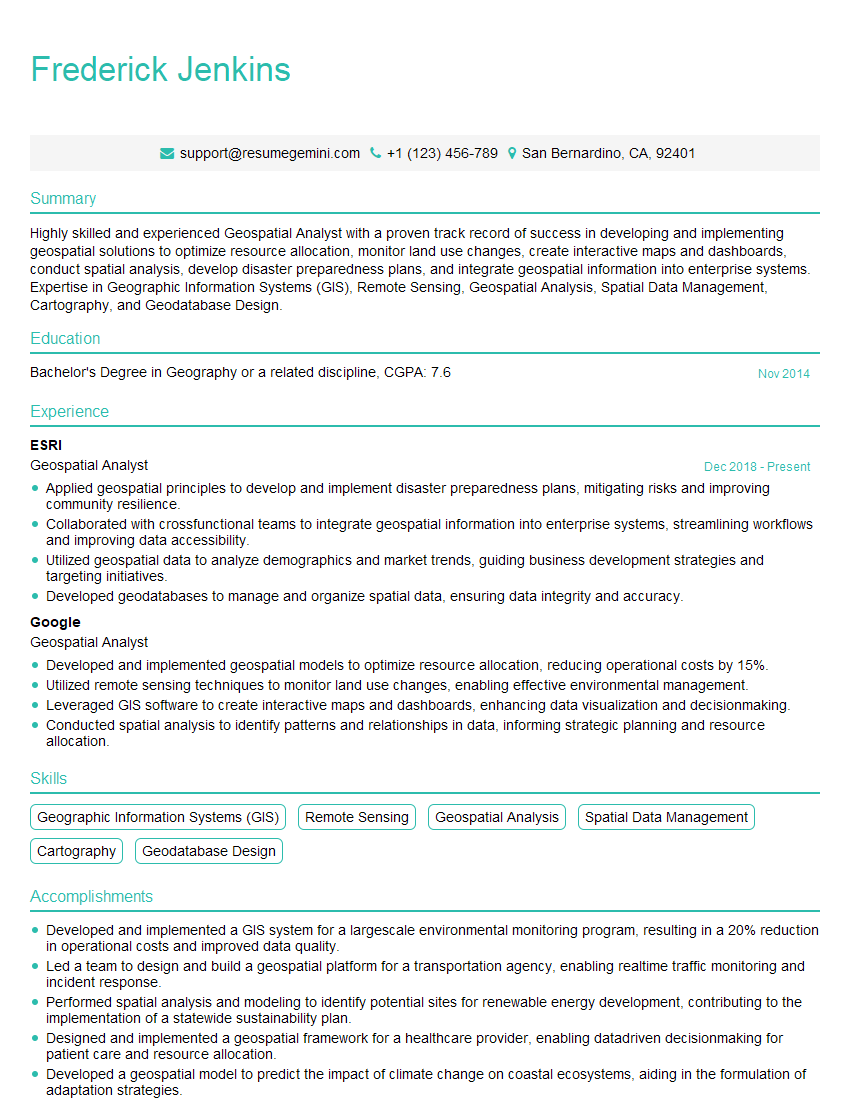
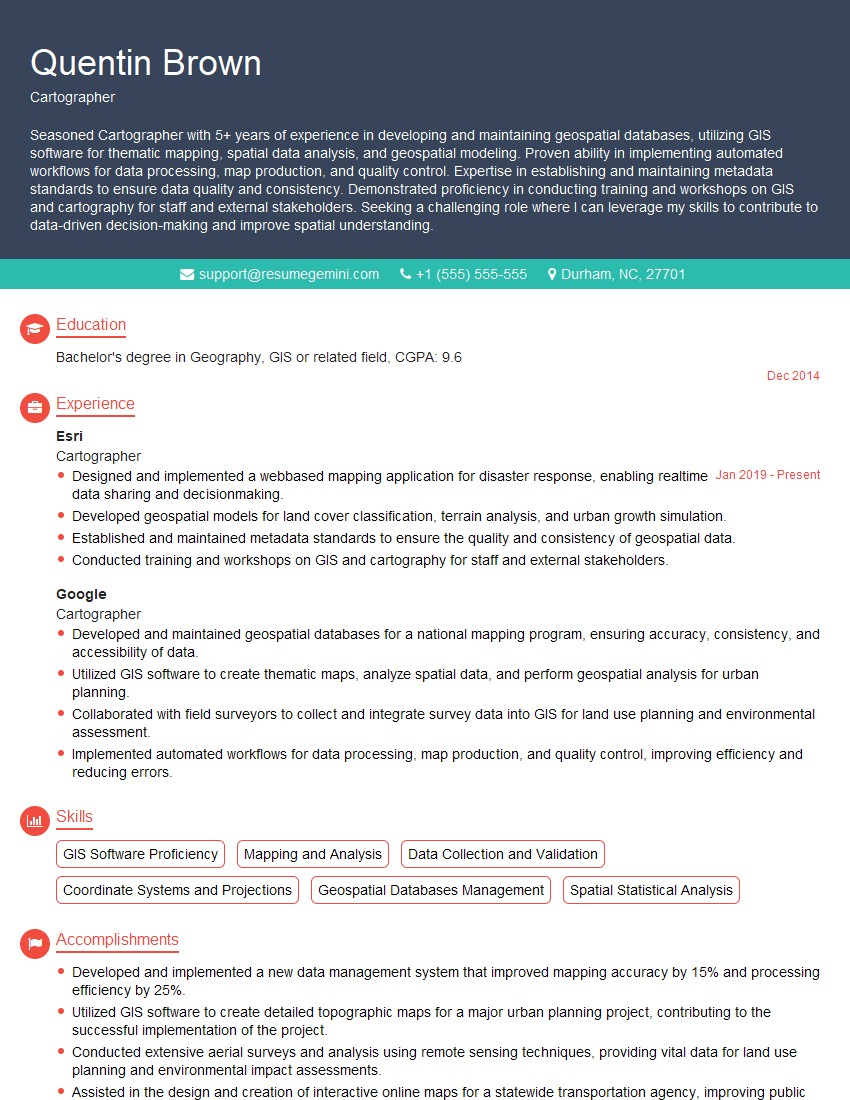
Mastering ArcGIS opens doors to exciting career opportunities in fields like environmental science, urban planning, transportation, and many more. A strong understanding of ArcGIS is highly sought after, significantly enhancing your job prospects. To make the most of your skills, creating an ATS-friendly resume is crucial. ResumeGemini is a trusted resource to help you build a professional and impactful resume that highlights your ArchGIS expertise. Examples of resumes tailored to ArchGIS positions are available to guide you through this process.
Explore more articles
Users Rating of Our Blogs
Share Your Experience
We value your feedback! Please rate our content and share your thoughts (optional).
What Readers Say About Our Blog
Very informative content, great job.
good