Preparation is the key to success in any interview. In this post, we’ll explore crucial Ability to Work with Large Ensembles and Conductors interview questions and equip you with strategies to craft impactful answers. Whether you’re a beginner or a pro, these tips will elevate your preparation.
Questions Asked in Ability to Work with Large Ensembles and Conductors Interview
Q 1. Describe your experience conducting large ensembles (size and type).
My experience encompasses conducting ensembles ranging in size from 40-piece orchestras to 100+ member symphonic bands and choirs. I’ve worked with diverse musical styles, including classical, romantic, contemporary, and jazz. For example, I led a 75-piece community orchestra in a performance of Mahler’s Symphony No. 5, requiring meticulous preparation and attention to detail given the complexity of the score and the wide range of instrumental skills involved. Another project included conducting a 120-voice choir in a challenging contemporary work demanding precise vocal technique and ensemble cohesion.
Q 2. How do you manage rehearsals with diverse skill levels within a large ensemble?
Managing diverse skill levels requires a multifaceted approach. I begin by assessing the individual strengths and weaknesses of each musician through auditions and early rehearsals. I then tailor rehearsals to address specific needs. This might involve providing individual coaching for advanced techniques to weaker players, while simultaneously offering challenging exercises for more proficient members. I also create a supportive environment where musicians feel comfortable asking questions and seeking clarification, fostering a sense of collaboration rather than competition. Sectionals (separate rehearsals for individual instrument or vocal sections) are crucial for addressing specific challenges within smaller groups before integrating them into the full ensemble sound.
Q 3. Explain your approach to balancing artistic vision with the technical capabilities of the ensemble.
Balancing artistic vision with technical capabilities is a constant juggling act. My approach involves open communication with the ensemble. I clearly articulate my artistic interpretation of the piece, explaining the emotional nuances and stylistic choices. Then, I collaboratively work with musicians to ensure that the technical demands of the piece are met without compromising the artistic integrity. This might involve simplifying certain passages, suggesting alternative fingerings or bowings, or exploring different phrasing options to suit the ensemble’s strengths. For instance, when conducting a challenging piece with a less experienced ensemble, I might focus initially on achieving a solid foundation in rhythm and intonation before working on expressive aspects.
Q 4. How do you handle conflicts or disagreements among ensemble members?
Conflicts are inevitable in any large ensemble. My approach prioritizes open communication and mediation. I encourage ensemble members to express their concerns respectfully and create a safe space for dialogue. I facilitate discussions, helping conflicting parties understand each other’s perspectives. I focus on identifying the root cause of the conflict – is it musical differences, personality clashes, or logistical issues? The solution will depend on the specific cause, but always emphasizes mutual respect and finding a compromise that works for the entire ensemble.
Q 5. Detail your strategies for effective communication with musicians in a large ensemble.
Effective communication is paramount. In large ensembles, I utilize a combination of techniques: clear and concise verbal instructions during rehearsals, utilizing non-verbal cues such as gestures and facial expressions, written materials providing detailed notes and practice assignments, and individual check-ins to address specific concerns. I also encourage feedback from the ensemble, fostering an atmosphere of mutual respect and understanding. Regular ensemble meetings to discuss logistical and artistic aspects of performances can significantly improve communication and teamwork.
Q 6. Describe your methods for providing constructive feedback to individual musicians and the ensemble as a whole.
Providing constructive feedback requires tact and sensitivity. I aim to be specific and positive, focusing on what the musician is doing well before addressing areas for improvement. I often frame feedback as suggestions rather than criticisms, using phrases like “Have you considered trying…” or “Perhaps we can explore…” For the ensemble as a whole, I use collective feedback sessions focusing on specific passages or aspects of the performance, utilizing recordings or live demonstrations to illustrate points. I encourage self-assessment and peer feedback, promoting a culture of learning and improvement.
Q 7. How do you incorporate new or challenging musical pieces into the ensemble’s repertoire?
Introducing new pieces requires a gradual and systematic approach. I start by selecting pieces that are appropriate for the ensemble’s skill level and musical style. Then, I break down the music into manageable sections, gradually building up the complexity. I provide ample opportunities for individual and sectional practice, offering detailed explanations, and using various rehearsal techniques like note-splitting, and rhythmic subdivision exercises to make challenging passages more accessible. A phased approach — first working on technical proficiency, then dynamics and phrasing, then integrating sections — allows everyone to gain confidence and feel successful in mastering the new material.
Q 8. How do you maintain ensemble cohesion and morale during long rehearsals or demanding performances?
Maintaining ensemble cohesion and morale, especially during lengthy rehearsals or demanding performances, is paramount. It’s akin to being a team coach, fostering a supportive and collaborative environment. My approach is multifaceted:
- Open Communication: Regular check-ins with individual musicians and section leaders to address concerns, both musical and personal. This helps identify potential issues early on.
- Positive Reinforcement: Focusing on achievements and progress, celebrating small victories to build confidence and motivation. Even during challenging sections, I highlight successful moments.
- Building Camaraderie: Encouraging social interaction among ensemble members – perhaps informal gatherings or team-building exercises – to foster a strong sense of community beyond the rehearsal room.
- Flexibility and Empathy: Recognizing that musicians are individuals with diverse needs and experiences. Adjusting rehearsal schedules or providing breaks when necessary can make a huge difference.
- Clear Expectations: Setting clear goals and expectations from the outset, ensuring everyone understands their roles and responsibilities within the larger context of the performance.
For example, during a particularly challenging production of Mahler’s Symphony No. 8, I noticed fatigue affecting the chorus’s intonation. We incorporated short, regular breaks with vocal exercises focused on breath control and relaxation, which significantly improved their performance and morale.
Q 9. Explain your experience in selecting repertoire suitable for a large ensemble.
Selecting repertoire for a large ensemble requires careful consideration of several factors. It’s not just about musical quality but also the practical needs and capabilities of the ensemble. My process typically involves:
- Assessing Ensemble Strengths and Weaknesses: Honestly evaluating the ensemble’s technical skills, stylistic expertise, and overall experience. A piece requiring advanced virtuosity wouldn’t be suitable for a less experienced group.
- Considering Audience and Context: The chosen repertoire should align with the target audience and the performance setting. A contemporary piece might be more appropriate for a modern art festival than a traditional concert hall.
- Balancing Programmatic Variety: Creating a balanced program that offers a range of styles, emotions, and textures to keep the audience engaged. Mixing energetic pieces with more reflective ones can enhance the overall listening experience.
- Logistical Considerations: Assessing the practical aspects, including the length of the pieces, the number of instrumentalists required, and the availability of scores and parts.
- Consultation and Collaboration: Seeking input from ensemble members and other relevant stakeholders, such as artistic directors or conductors.
For instance, when programming for a youth orchestra, I favored works with strong melodic lines and engaging rhythms, selecting pieces that were challenging yet achievable, building confidence and skills.
Q 10. Describe your approach to preparing for a major concert or performance with a large ensemble.
Preparing for a major concert with a large ensemble is a meticulous process that requires thorough planning and organization. My approach is structured:
- Detailed Rehearsal Schedule: Creating a detailed rehearsal schedule that allocates sufficient time for individual sections, full ensemble rehearsals, and sectional work, ensuring sufficient time for refinement.
- Incremental Development: Working systematically through the repertoire, focusing on individual sections before bringing everything together. This approach allows for focused problem-solving.
- Individual Coaching: Providing individual coaching and feedback to musicians, addressing specific technical challenges or interpretive issues.
- Technical Rehearsals: Dedicated technical rehearsals addressing specific challenges like stagecraft, transitions, and entrances/exits for seamless performance.
- Dress Rehearsals: Conducting full dress rehearsals under performance conditions, including lighting, costumes, and stage management, to iron out any remaining issues.
- Collaboration with Artistic Staff: Working closely with stage managers, lighting designers, and other artistic staff to ensure a cohesive and visually compelling performance.
For example, before a large-scale opera production, I created a comprehensive rehearsal schedule that spanned several weeks, incorporating staged rehearsals from an early point in the process allowing for the integration of all aspects of the performance.
Q 11. How do you address technical challenges such as intonation or rhythmic accuracy in a large ensemble?
Addressing technical challenges like intonation and rhythmic accuracy in a large ensemble requires a systematic approach. It’s like fine-tuning a complex machine.
- Targeted Sectionals: Identifying specific sections or instruments struggling with intonation or rhythm and working with them individually to address the issues. This allows for more focused attention.
- Aural Training Exercises: Incorporating aural training exercises to improve musicians’ listening skills and their ability to identify and correct pitch and rhythmic inaccuracies.
- Use of Technology: Employing recording technology to analyze performances, identifying areas needing improvement. Visual aids such as spectrograms can be very helpful.
- Conducting Techniques: Using precise and clear conducting techniques to provide rhythmic and pitch cues to the ensemble. Clear visual cues are crucial.
- Positive Feedback and Encouragement: Focusing on the positive aspects of the performance while gently guiding musicians toward improvement. A positive atmosphere is vital for learning.
In one instance, a brass section struggled with intonation in a particularly challenging passage. By utilizing recordings and spectrograms, we pinpointed the problematic frequencies and implemented targeted exercises to correct the issue.
Q 12. Explain your use of technology (e.g., software, recording) in managing and improving ensemble performance.
Technology plays a crucial role in managing and improving ensemble performance. I leverage it in several ways:
- Recording and Playback: Using high-quality recording equipment to capture rehearsals and performances, allowing for detailed analysis of musical details and identification of areas needing improvement. Playback allows for objective self-assessment.
- Music Notation Software: Utilizing notation software such as Sibelius or Finale to create and edit scores, parts, and cue sheets, facilitating efficient score preparation and distribution.
- Audio Editing Software: Employing audio editing software to isolate sections, create practice loops, and adjust tempo or pitch for more efficient practicing and learning.
- Video Analysis: Analyzing video recordings to evaluate ensemble dynamics, stage presence, and visual coordination. This provides feedback on non-audio aspects of the performance.
- Digital Score Sharing: Utilizing cloud-based platforms for secure score distribution and version control to ensure all musicians have access to the most current materials.
For instance, I used audio editing software to create slow-tempo practice loops of challenging passages for our string section, which greatly improved their accuracy and confidence before the final performance.
Q 13. How do you collaborate effectively with other artistic staff (e.g., stage managers, lighting designers)?
Effective collaboration with other artistic staff is essential for a successful performance. It requires open communication and mutual respect. My approach emphasizes:
- Early and Frequent Communication: Establishing open lines of communication from the initial stages of planning through to the final performance. Regular meetings are key.
- Shared Vision: Working collaboratively to create a shared artistic vision that aligns with the goals of the production. Everyone needs to be on the same page.
- Respect for Expertise: Respecting the expertise and contributions of each member of the artistic team, recognizing that each role is crucial for success.
- Problem-Solving: Working together to address any challenges or conflicts that may arise during the production process. A collaborative problem-solving approach is essential.
- Clear Roles and Responsibilities: Clearly defining the roles and responsibilities of each member of the artistic team to ensure efficient workflow and avoid misunderstandings.
For example, during a recent opera, I worked closely with the lighting designer to synchronize lighting cues with musical moments, creating a dynamic and visually stunning performance.
Q 14. Describe your experience working with different musical styles and genres within a large ensemble.
Working with diverse musical styles and genres within a large ensemble requires adaptability and a deep understanding of musical traditions. I approach this by:
- Thorough Research: Conducting thorough research into the specific stylistic characteristics of each genre, understanding the historical context and the nuances of the music.
- Adapting Conducting Techniques: Adapting my conducting techniques to reflect the style and character of the music. For example, a Baroque piece might require a lighter touch than a Romantic symphony.
- Communicating Style Effectively: Clearly communicating the stylistic requirements to the musicians, providing examples and explanations to help them understand the nuances of each piece.
- Encouraging Musical Exploration: Encouraging musicians to explore the music and find their own interpretations within the stylistic constraints of the genre.
- Learning from Musicians: Valuing and learning from the expertise of musicians who possess strong backgrounds in different styles and genres.
I once led a large ensemble through a program that included pieces from the Renaissance, Baroque, Classical, and Romantic periods. This required careful attention to period-specific performance practices and stylistic nuances, resulting in a varied and engaging concert experience.
Q 15. How do you manage the emotional dynamics of a large group of musicians?
Managing the emotional dynamics of a large ensemble requires a nuanced approach, understanding that musicians are highly sensitive individuals expressing themselves through their art. It’s about fostering a supportive and respectful environment where vulnerability is welcomed, not feared.
Open Communication: I create space for open dialogue. Regular check-ins, both individually and as a group, allow musicians to voice concerns, share frustrations, and celebrate successes. This prevents small issues from escalating into larger conflicts.
Empathy and Understanding: I strive to understand each musician’s perspective, recognizing that their performance can be impacted by personal challenges outside the rehearsal room. This involves active listening and a genuine interest in their well-being.
Positive Reinforcement: I focus on positive feedback, emphasizing what is working well. Constructive criticism is delivered privately and with sensitivity, focusing on specific actions rather than general characterizations. Celebrating accomplishments, big and small, reinforces a collaborative spirit.
Conflict Resolution: When conflicts arise, I facilitate a respectful dialogue between the involved parties, helping them find common ground and solutions that work for everyone. Mediation skills are critical here.
For example, during a particularly challenging rehearsal of a complex piece, I noticed a cellist seemed withdrawn and played with less energy. A private conversation revealed personal anxieties unrelated to music. Addressing this concern, allowing a brief break, and offering words of encouragement significantly improved their performance and overall mood.
Career Expert Tips:
- Ace those interviews! Prepare effectively by reviewing the Top 50 Most Common Interview Questions on ResumeGemini.
- Navigate your job search with confidence! Explore a wide range of Career Tips on ResumeGemini. Learn about common challenges and recommendations to overcome them.
- Craft the perfect resume! Master the Art of Resume Writing with ResumeGemini’s guide. Showcase your unique qualifications and achievements effectively.
- Don’t miss out on holiday savings! Build your dream resume with ResumeGemini’s ATS optimized templates.
Q 16. How do you adapt your conducting techniques based on the size and acoustic properties of the performance venue?
Adapting conducting techniques to different venues is essential for achieving optimal sound. The size and acoustic properties of a space directly influence how sound travels and how the ensemble projects.
Large Venues: In large halls with significant reverberation, my movements become broader and more expansive to ensure all sections hear my cues clearly. I might adjust dynamics and articulation to compensate for the acoustic space, emphasizing clarity and precision.
Small Venues: In smaller, more intimate spaces with less reverberation, my conducting style becomes more subtle and nuanced. I may use smaller gestures to avoid overwhelming the performers and the audience with overly large movements.
Acoustic Considerations: I spend time listening to the acoustics of the space before the first rehearsal, noting how sound reflects and dissipates. This informs my decisions about balance, phrasing, and dynamics.
Mic Placement: I collaborate with sound engineers to optimize microphone placement to ensure a balanced and clear sound for both the live audience and any recordings.
For instance, when conducting a symphony orchestra in a large cathedral, I used amplified cues to ensure the back rows of musicians could hear my directions despite the acoustic challenges. In a smaller chamber music hall, my focus shifted towards subtle interpretive cues, relying on eye contact and minimal gestures to maintain intimacy and clarity.
Q 17. Explain your strategies for ensuring accuracy in score reading and interpretation among ensemble members.
Ensuring accuracy in score reading and interpretation involves a multi-faceted approach focused on building a strong foundation in musicianship and clear communication.
Thorough Score Study: I encourage musicians to thoroughly analyze the score before rehearsals. This includes identifying harmonic progressions, melodic lines, rhythmic complexities, and dynamic contrasts. I might suggest annotating scores with personal markers to highlight crucial aspects.
Detailed Rehearsal Strategies: Rehearsals are planned systematically, starting with individual sections and gradually working toward full ensemble performances. I pay close attention to detail, addressing rhythmic and intonation issues promptly.
Clear Articulation of Interpretation: I articulate my vision for the piece clearly, discussing stylistic choices, phrasing, and emotional expression. I encourage questions and open discussion to ensure everyone understands the musical intentions.
Sectionals and Focused Practice: I use sectionals to address specific challenges within individual sections, allowing for focused attention and problem-solving before combining sections. I might demonstrate passages, offer tailored suggestions, and ensure balance across sections.
Performance-based learning: The focus isn’t just on notes; it’s about conveying meaning and connecting with the audience. Rehearsals often incorporate performance scenarios to develop the musicians’ ability to handle unpredictable elements.
For example, while preparing a piece with challenging contrapuntal sections, I facilitated a detailed analysis session, marking key points in the score and providing individual attention to the musicians, ensuring a shared understanding of the intricate interplay between the lines.
Q 18. Describe your method for building a positive and collaborative working environment within the ensemble.
Building a positive and collaborative environment is paramount. It’s about cultivating mutual respect, trust, and a shared commitment to musical excellence.
Respectful Communication: I encourage open, respectful dialogue among ensemble members. This involves active listening, valuing diverse opinions, and addressing conflicts constructively.
Team Building Activities: I incorporate team-building exercises outside of formal rehearsals to foster camaraderie and strengthen interpersonal relationships. These might include informal social gatherings or collaborative projects.
Shared Goals and Vision: I work collaboratively with the ensemble to establish shared goals and a common vision for each performance. This creates a sense of shared purpose and collective responsibility.
Recognition and Appreciation: I frequently express appreciation for each musician’s contribution, recognizing both individual strengths and collective achievements.
Flexible and Adaptable Leadership: Effective leadership involves adapting to the group’s dynamics and needs. This includes recognizing when a more collaborative or directive approach is needed.
For example, prior to a major concert, we held a team dinner where musicians could share their experiences and expectations, helping to build a stronger sense of community and shared purpose.
Q 19. How do you handle unexpected challenges or disruptions during a rehearsal or performance?
Handling unexpected challenges during rehearsals or performances requires adaptability, quick thinking, and a calm demeanor. My approach is centered on problem-solving and maintaining the performance’s momentum.
Preparedness: I always have contingency plans in place. This includes having backup musicians available, familiarizing myself with the technical aspects of the venue, and ensuring instruments are properly maintained.
Calm and Clear Communication: In case of an unexpected disruption, I maintain composure, offering clear and concise instructions to the ensemble. This helps prevent panic and maintains focus.
Problem-Solving: I assess the situation quickly and determine the most effective solution. This might involve adapting the performance, skipping a section, or improvising a suitable alternative.
Improvisation and Adaptation: I am prepared to improvise and adapt if necessary. This requires flexibility and a deep understanding of the music.
Post-Performance Debrief: Following an event with an unexpected challenge, I conduct a debriefing session to discuss what happened, what went well, and how we can improve our preparedness for the future.
During a performance, a musician experienced a sudden instrument malfunction. I calmly signaled for a brief pause, conferred with the affected musician, and instructed the ensemble to shift focus to a different section of the piece, maintaining the narrative flow while the instrument was repaired.
Q 20. How do you ensure that individual musicians feel heard and valued within the ensemble?
Making each musician feel heard and valued is fundamental to a successful ensemble. It’s about creating a space where everyone’s contribution is appreciated and their voice is respected.
Individual Attention: I take the time to speak with each musician individually, addressing their specific concerns, providing personalized feedback, and acknowledging their efforts.
Open Door Policy: I maintain an open-door policy, encouraging musicians to come to me with any questions, concerns, or suggestions at any time.
Active Listening: I actively listen to each musician’s perspective, demonstrating empathy and understanding, even when I don’t fully agree with their point of view.
Fairness and Equity: I strive to ensure that all musicians are treated fairly and equitably, regardless of their experience level or seniority.
Delegation and Responsibility: I delegate responsibilities within the group, offering opportunities for leadership and collaborative decision-making.
For instance, I regularly ask for individual musicians’ opinions on repertoire choices and performance strategies. This demonstrates respect for their perspectives and fosters a sense of ownership and involvement within the ensemble.
Q 21. Describe your approach to mentoring and training younger or less experienced musicians within the ensemble.
Mentoring and training younger or less experienced musicians involves patience, encouragement, and a commitment to their growth and development.
Individualized Instruction: I provide personalized instruction and guidance, tailoring my approach to each musician’s strengths and weaknesses.
Positive Feedback and Encouragement: I focus on positive reinforcement, emphasizing what the musician is doing well, and providing constructive criticism in a supportive manner.
Modeling Good Practice: I model good practice through my own conduct and performance, demonstrating professionalism and a strong work ethic.
Opportunities for Performance: I create opportunities for less experienced musicians to perform, allowing them to gain confidence and experience in a supportive environment.
Collaboration and Peer Learning: I encourage collaboration and peer learning among musicians, facilitating a supportive learning environment.
Resource Provision: I provide access to additional resources such as masterclasses, workshops, and private lessons, to enhance their musical skills.
For example, I paired a less experienced violinist with a more experienced one for a mentoring program, allowing them to learn from each other and develop their skills collaboratively. The progress was outstanding, demonstrating that a supportive learning environment can create rapid growth.
Q 22. How do you develop and maintain relationships with musicians in a large ensemble?
Building and maintaining strong relationships with musicians in a large ensemble is crucial for its success. It’s not just about musical proficiency; it’s about fostering a collaborative and supportive environment. I approach this through a multifaceted strategy:
- Open Communication: Regular, transparent communication is key. This includes individual check-ins, section rehearsals focusing on both musical and personal well-being, and ensemble meetings to discuss upcoming projects and address any concerns. I make myself accessible and encourage feedback.
- Respect and Appreciation: I actively show appreciation for each musician’s contribution, recognizing their individual skills and dedication. Public acknowledgment of achievements, both large and small, boosts morale and fosters a sense of belonging.
- Conflict Resolution: Inevitably, disagreements arise. My approach is to address them directly, with empathy and a focus on finding solutions that benefit the ensemble as a whole. Mediation and active listening are crucial tools in this process.
- Social Events: Informal gatherings, like post-rehearsal dinners or social outings, build camaraderie and strengthen relationships outside of the rehearsal room. This creates a more cohesive and supportive team dynamic.
For example, during my time leading the City Symphony Orchestra, I implemented a mentorship program pairing experienced musicians with newer members. This fostered a sense of community and helped integrate new talent seamlessly into the ensemble.
Q 23. Explain your experience in creating a performance schedule and logistical arrangements for a large ensemble.
Creating a performance schedule and logistical arrangements for a large ensemble requires meticulous planning and organization. It’s a complex process involving multiple stakeholders and moving parts.
- Timeline Creation: I begin by establishing a realistic timeline, considering rehearsal schedules, venue availability, marketing deadlines, and potential conflicts. This usually involves creating a detailed Gantt chart or project management software to track progress.
- Venue Booking and Contract Negotiation: Securing suitable performance venues involves researching options, negotiating contracts, and coordinating technical requirements (lighting, sound, stage setup).
- Transportation and Accommodation: If the ensemble travels, arranging transportation (buses, flights) and accommodation (hotels) is vital. This includes managing budgets and ensuring everyone’s needs are met.
- Personnel Management: This includes tracking musician availability, managing contracts, and ensuring all necessary paperwork (permits, insurance) is in order.
- Budgeting and Financial Planning: Creating a detailed budget that accounts for all expenses (venue rental, transportation, musician fees, marketing) is critical. This also involves seeking funding and managing financial resources effectively.
For instance, while preparing for a European tour with the orchestra, I used specialized project management software to map out the entire itinerary, from flight bookings and hotel reservations to daily rehearsal schedules and stage plot diagrams. This ensured a smooth and well-organized tour.
Q 24. How do you maintain the ensemble’s artistic quality and standards over an extended period?
Maintaining artistic quality and standards in a large ensemble over the long term requires a consistent and proactive approach. It’s a continuous process of refinement and improvement.
- Regular Rehearsals and Feedback: Frequent, well-structured rehearsals are essential. Constructive criticism and feedback, delivered respectfully and professionally, are crucial for improvement.
- High Standards of Selection: Maintaining a high standard of musicianship requires rigorous audition processes and continuous evaluation. This ensures that the ensemble maintains a consistently high level of performance.
- Professional Development: Investing in professional development for musicians, such as masterclasses, workshops, or coaching sessions, keeps their skills sharp and helps them grow as musicians.
- Repertoire Selection: Choosing a diverse and challenging repertoire keeps musicians engaged and challenges them to improve their abilities. Balancing audience appeal with artistic ambition is key.
- Leadership and Mentorship: Strong leadership that fosters a collaborative environment, provides clear direction, and offers guidance and support is essential for maintaining high standards.
I recall a situation where the orchestra’s intonation had become inconsistent. To address this, I implemented targeted intonation exercises in rehearsals and incorporated regular sectionals focusing on precise tuning. This focused effort significantly improved the orchestra’s overall sound quality.
Q 25. Describe your experience in securing funding or support for a large ensemble.
Securing funding for a large ensemble requires a strategic approach that combines grant writing, fundraising initiatives, and cultivating relationships with potential sponsors.
- Grant Writing: Crafting compelling grant proposals that articulate the ensemble’s artistic vision, impact, and financial needs is crucial. This requires researching potential funding sources and tailoring proposals to each organization’s specific requirements.
- Fundraising Events: Organizing fundraising events, such as concerts, galas, or auctions, can generate significant revenue. These events need careful planning, marketing, and execution to maximize their effectiveness.
- Corporate Sponsorships: Cultivating relationships with potential corporate sponsors, highlighting mutual benefits and brand alignment, can lead to significant financial support. This requires presenting a strong case for sponsorship and offering appropriate return on investment.
- Individual Donations: Building a strong base of individual donors who believe in the ensemble’s mission through regular communication and engaging them with the orchestra’s activities is important.
- Crowdfunding: Utilizing online crowdfunding platforms can reach a wider audience and generate diverse streams of funding.
For example, I successfully secured a substantial grant from the National Endowment for the Arts by presenting a detailed proposal that highlighted the orchestra’s commitment to community engagement and its impact on youth music education.
Q 26. How do you manage audience interaction and expectations for a large ensemble performance?
Managing audience interaction and expectations for a large ensemble performance involves careful consideration of pre-performance communication, the performance itself, and post-performance engagement.
- Pre-Performance Communication: Providing clear information about the program, performers, and venue through program notes, website updates, and social media engagement helps set expectations and build anticipation.
- Performance Presentation: The performance itself needs to be well-paced, engaging, and easily understood by the audience. Clear introductions of pieces and performers are crucial.
- Audience Etiquette: Addressing audience etiquette (e.g., when to applaud) and providing context for the music enhances the audience experience.
- Post-Performance Engagement: Offering opportunities for post-performance interaction, like meet-and-greets or Q&A sessions, strengthens audience connection and fosters a sense of community.
- Feedback Mechanisms: Gathering audience feedback through surveys or comment cards allows for continuous improvement and adjustments to future performances.
In one instance, we introduced pre-concert talks led by musicians to provide context and insights into the music, which enhanced audience understanding and engagement considerably.
Q 27. How would you resolve a significant artistic disagreement with a key section leader in your ensemble?
Resolving a significant artistic disagreement with a key section leader requires a diplomatic and collaborative approach. It’s about finding a solution that preserves the ensemble’s artistic integrity and maintains respectful working relationships.
- Private Meeting: I would schedule a private meeting with the section leader to discuss the disagreement openly and respectfully. The goal is to understand their perspective and concerns.
- Active Listening: I would actively listen to their concerns, without interrupting or becoming defensive. Empathy is crucial in this process.
- Collaborative Problem-Solving: We would work together to identify potential solutions that address both their concerns and the overall artistic vision of the ensemble.
- Compromise and Negotiation: Finding a compromise often involves negotiation and a willingness to adjust approaches or interpretations. This requires flexibility and a collaborative spirit.
- Documentation: In case the disagreement persists, documenting the discussion, agreed-upon solutions, and any outstanding issues can be helpful.
If the disagreement persists, involving a neutral third party (e.g., a respected musician or music director) for mediation might be necessary. The goal is always to find a resolution that respects both artistic viewpoints while upholding the ensemble’s overall artistic standard.
Q 28. Describe your experience working with a diverse group of musicians across various cultural and linguistic backgrounds.
Working with a diverse group of musicians from various cultural and linguistic backgrounds enriches the musical experience and fosters a vibrant ensemble. My approach involves building a culturally sensitive and inclusive environment.
- Cultural Sensitivity Training: Providing cultural sensitivity training to all ensemble members helps foster understanding and respect among diverse individuals.
- Multilingual Communication: Using clear, concise language, and employing translators or interpreters when necessary, ensures that all musicians understand instructions and information.
- Inclusive Repertoire Selection: Choosing repertoire that reflects the diverse cultural backgrounds of the musicians broadens the ensemble’s artistic expression and allows each musician to contribute meaningfully.
- Respectful Communication Styles: Understanding and adapting to different communication styles is vital. This involves recognizing different non-verbal cues and communication preferences.
- Conflict Resolution Strategies: Utilizing effective conflict resolution strategies that respect cultural differences and address misunderstandings promptly prevents potential conflicts.
During my tenure with the International Orchestra, I facilitated workshops on cross-cultural communication, which significantly improved the ensemble’s cohesion and collaborative spirit. This fostered an inclusive environment where musicians from diverse backgrounds felt valued and respected.
Key Topics to Learn for Ability to Work with Large Ensembles and Conductors Interview
- Understanding Ensemble Dynamics: Explore the complexities of group performance, including communication styles, individual roles within the ensemble, and the impact of group cohesion on overall success.
- Responding to Conductor’s Instructions: Discuss practical approaches to interpreting and executing a conductor’s cues, considering variations in style and communication techniques. Analyze how to adapt quickly to different conducting styles and maintain musical accuracy.
- Collaborative Problem-Solving: Detail your experience in identifying and resolving musical discrepancies within the ensemble. Consider examples of effective conflict resolution and collaborative decision-making processes.
- Maintaining Professionalism: Explain the importance of punctuality, preparation, and respectful communication within a large ensemble setting. Highlight your ability to contribute positively to a professional and productive rehearsal environment.
- Technical Proficiency and Musicality: Discuss how your individual technical skills contribute to the overall performance quality of the ensemble. Demonstrate an understanding of the balance between individual contribution and collective musical expression.
- Adaptability and Flexibility: Explain how you adapt to unexpected changes in rehearsal or performance settings, including last-minute adjustments in musical interpretation or personnel changes.
Next Steps
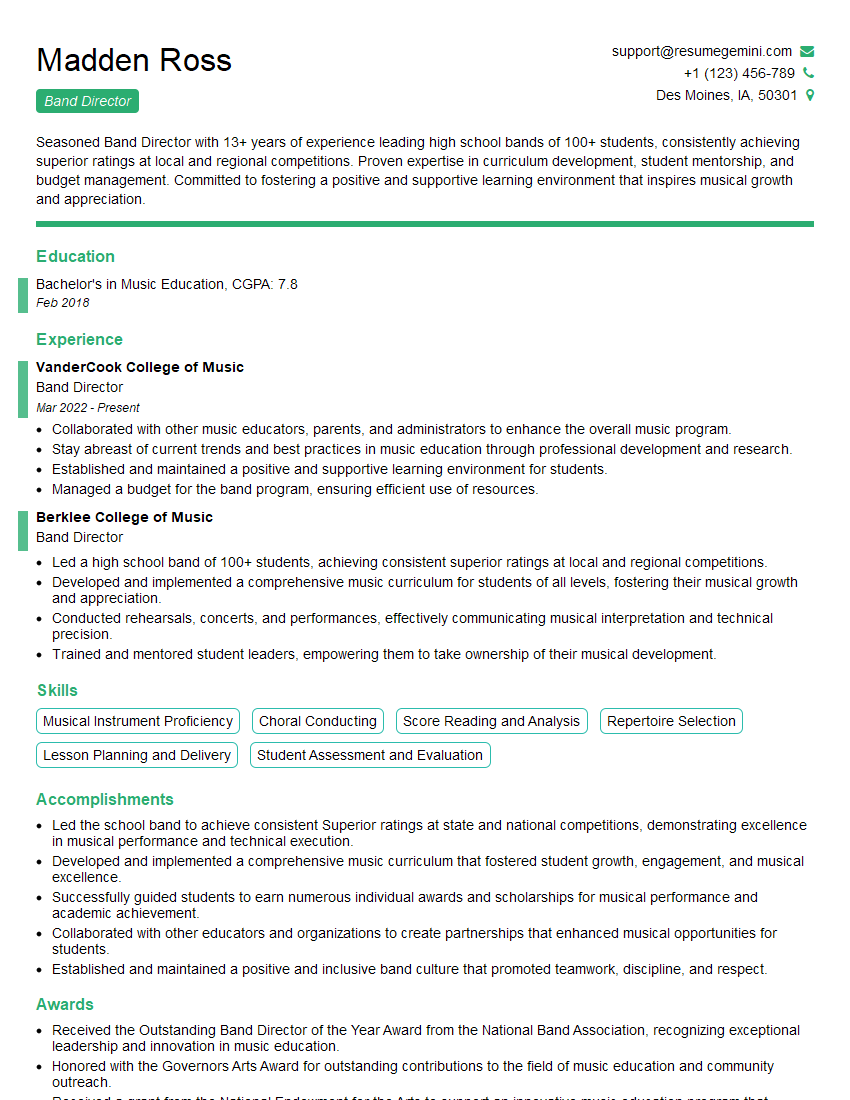
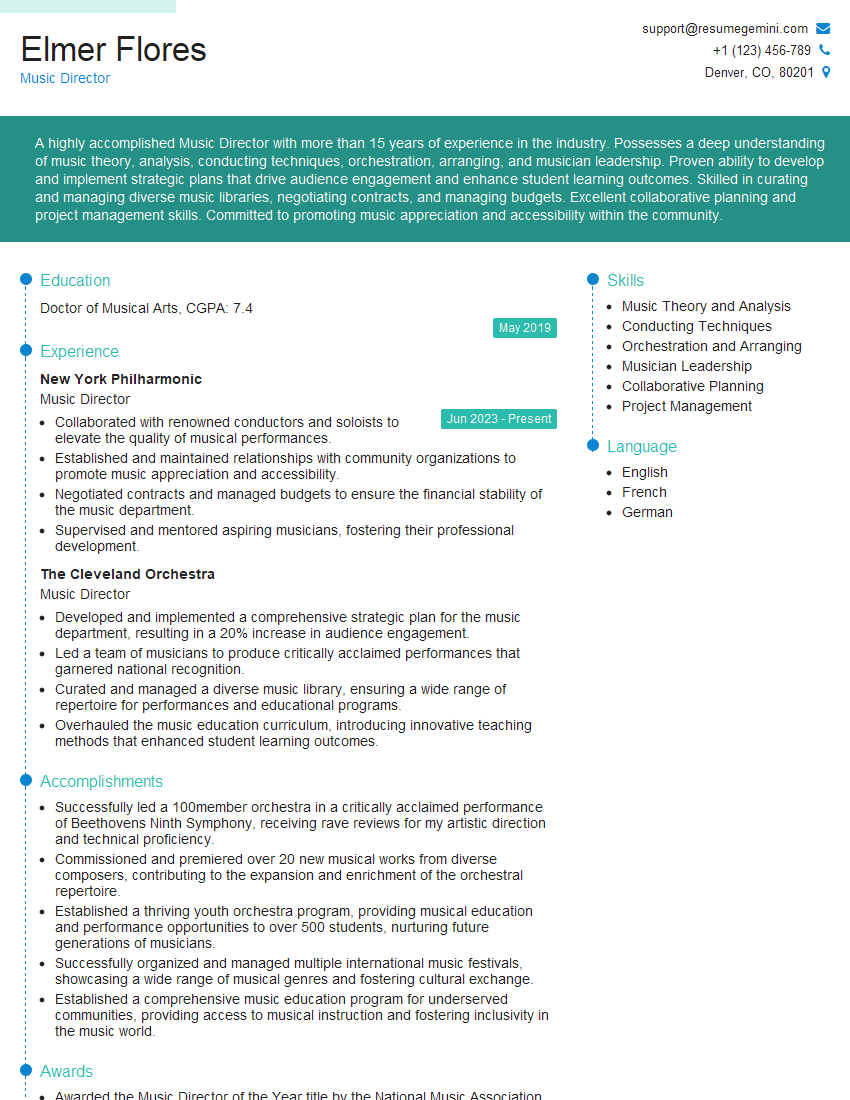
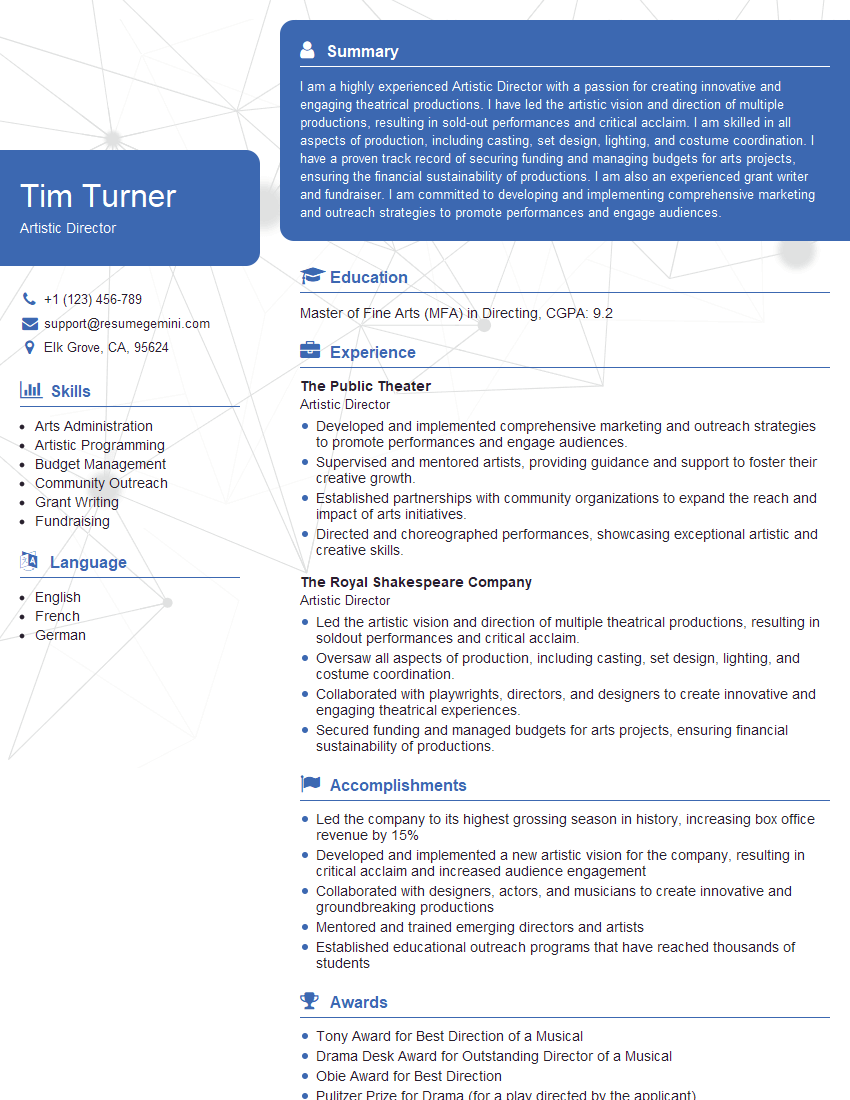
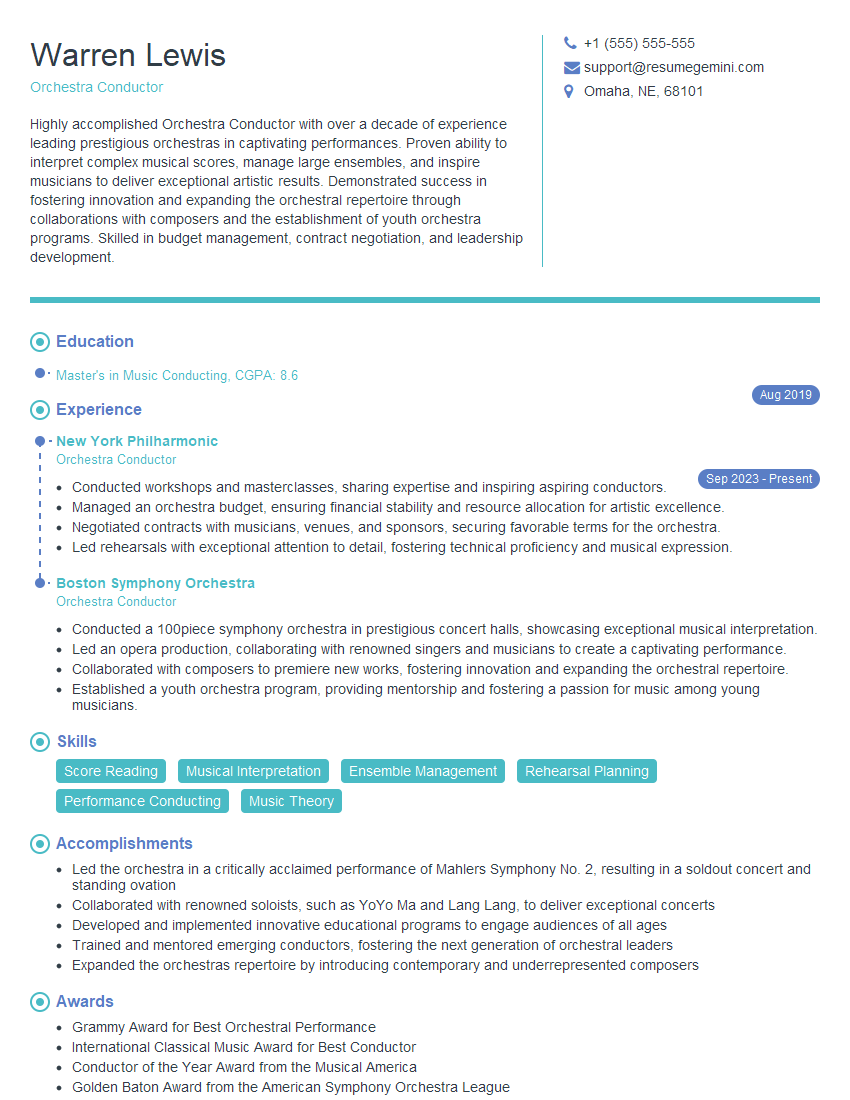
Mastering the ability to work effectively with large ensembles and conductors is crucial for career advancement in the performing arts. A strong resume showcasing your relevant skills and experience is your first step toward securing your dream role. To significantly boost your job prospects, create an ATS-friendly resume that highlights your key accomplishments and skills. ResumeGemini can help you craft a compelling and effective resume, tailored to showcase your abilities in this specific area. We provide examples of resumes tailored to highlight “Ability to Work with Large Ensembles and Conductors,” allowing you to see how best to present your qualifications. Take the next step towards a successful career today!
Explore more articles
Users Rating of Our Blogs
Share Your Experience
We value your feedback! Please rate our content and share your thoughts (optional).
What Readers Say About Our Blog
Very informative content, great job.
good