The right preparation can turn an interview into an opportunity to showcase your expertise. This guide to Experience in formatting music for specific publishers and ensembles interview questions is your ultimate resource, providing key insights and tips to help you ace your responses and stand out as a top candidate.
Questions Asked in Experience in formatting music for specific publishers and ensembles Interview
Q 1. What music notation software are you proficient in (Sibelius, Finale, Dorico, etc.)?
I’m highly proficient in Sibelius, Finale, and Dorico. My choice of software often depends on the specific project and the publisher’s preferences. Sibelius, for example, excels in its intuitive interface and powerful scripting capabilities, making it ideal for large-scale orchestral scores. Finale’s extensive library of templates and fonts is invaluable when working with publishers who have stringent style guides. Dorico’s streamlined workflow and advanced features like its powerful playback engine are perfect for projects requiring efficient and accurate results. I’m comfortable switching between these programs seamlessly, leveraging each one’s strengths as needed.
Q 2. Describe your experience with music engraving conventions for different publishers.
My experience with music engraving conventions varies widely depending on the publisher. Some publishers have extremely detailed style guides, specifying everything from font sizes and spacing to the style of slurs and articulation markings. For example, one publisher might prefer a specific type of repeat sign, while another might have a unique approach to handling hairpins or dynamics. I’m adept at navigating these differing conventions, carefully reviewing each publisher’s style guide before beginning a project. I meticulously follow these specifications to ensure the final product meets their exact requirements and maintain consistency across all their publications.
Q 3. How do you handle inconsistencies in a composer’s manuscript?
Handling inconsistencies in a composer’s manuscript is a crucial part of my workflow. I approach this systematically. First, I carefully review the entire manuscript to identify all inconsistencies – this could range from inconsistent rhythmic notation to differing phrasing markings or accidental usage. Then, I carefully analyze each inconsistency to determine the composer’s likely intention. If the inconsistency seems unintentional, I will make the necessary corrections to ensure consistency. If the inconsistency might reflect a conscious artistic choice, I’ll consult with the composer or their representative to clarify their intent before making any changes. Documentation of all decisions is essential for transparency and accountability.
Q 4. Explain your process for creating a clean, publication-ready score.
Creating a clean, publication-ready score is a multi-step process. It begins with careful data entry, ensuring accurate note input, rhythms, and articulation markings. Next, I systematically apply the publisher’s style guide, ensuring that all aspects of the score (spacing, font, layout, etc.) conform to their standards. This stage frequently involves fine-tuning details like system breaks and page layouts for optimal readability. Proofreading is an iterative process; I typically review the score multiple times, paying close attention to details like accidentals, rests, and dynamics. Finally, I conduct a comprehensive final check before delivering the score. Imagine it like polishing a precious gem; it’s the attention to the small details that makes all the difference.
Q 5. What are the key differences between preparing scores for orchestras versus chamber ensembles?
Preparing scores for orchestras versus chamber ensembles requires distinct approaches. Orchestral scores necessitate a high level of organization and clarity, with individual parts clearly separated and labeled for each instrument. Staff arrangements, layout and spacing need to be optimized for readability across multiple parts. Chamber ensemble scores, on the other hand, are often more compact, focusing on clear presentation across fewer parts, often with more emphasis on overall visual balance and aesthetic appeal. The size and complexity of the score drastically influence the formatting decisions, ensuring the musicians can easily read and play the music.
Q 6. How do you ensure accuracy in music formatting, particularly regarding accidentals and rhythmic notation?
Ensuring accuracy, especially with accidentals and rhythmic notation, is paramount. I employ several strategies: careful double-checking of every detail, utilizing software’s built-in spell-checking and verification tools, and sometimes even employing manual verification techniques where appropriate. For example, I might use a separate software program to independently verify complex rhythmic patterns to avoid human error. The goal is zero tolerance for mistakes; a single misplaced accidental or incorrect note can significantly impact the performance.
Q 7. Describe your experience with music proofreading and error correction.
Music proofreading is a critical stage, requiring a keen eye for detail and a deep understanding of musical notation. I typically use a multi-stage approach: initial self-proofreading, followed by a second independent proofreading by a colleague. This process involves meticulous checking of every note, accidental, dynamic marking, articulation, and other details. We work collaboratively, comparing our findings and resolving any discrepancies. It’s a bit like a quality control system, ensuring the final product is flawless. The accuracy of the score is not only important for the musicians but also upholds the integrity and reputation of both the composer and the publisher.
Q 8. How do you manage multiple projects with varying deadlines?
Managing multiple projects with diverse deadlines requires a structured approach. I utilize project management tools like Trello or Asana to create individual boards for each project, breaking down large tasks into smaller, manageable components. Each card represents a specific task, assigned a due date, and categorized by priority. This visual overview allows me to quickly assess progress across all projects and adjust my workflow accordingly. For instance, if one project experiences a delay, I can reallocate time from a less urgent task in another project. I also leverage time-blocking techniques, dedicating specific time slots for particular projects, ensuring consistent progress and preventing burnout.
Regular review and reassessment are crucial. I set aside time each week to analyze my progress, adjust timelines if necessary, and communicate any potential issues to clients proactively. This proactive communication builds trust and ensures everyone is on the same page.
Q 9. How familiar are you with different music publishing styles and formatting guidelines?
My familiarity with music publishing styles and formatting guidelines is extensive. I’ve worked with numerous publishers, each possessing unique style guides. These range from classical publishers adhering to strict engraving conventions, to contemporary publishers favoring more flexible layouts. I’m proficient in various notation software like Sibelius and Finale, capable of adapting my workflow to meet the specific requirements of each publisher. For example, some publishers prefer a specific font size for the title, a particular style for dynamic markings, or a unique system for page numbering. I carefully study each publisher’s guidelines before beginning a project, guaranteeing consistent formatting throughout the score.
My experience encompasses different genres – orchestral, chamber, vocal, and solo works – each with its own conventions. I understand the differences in formatting between a full orchestral score, a piano reduction, or individual instrumental parts. This knowledge allows me to efficiently and accurately prepare the music for its intended use.
Q 10. What is your experience with preparing music for digital publishing platforms?
Preparing music for digital publishing platforms involves more than just creating a PDF. It requires understanding the technical specifications and file formats required by each platform. My experience includes preparing scores and parts in various formats like MusicXML, PDF, and even audio files. I’m familiar with platforms such as Sheet Music Plus, Musicnotes.com, and others. This includes optimizing files for efficient download size and ensuring compatibility across different devices and operating systems. For example, I ensure that the PDF files are optimized for readability on tablets and phones and that the MusicXML files are correctly tagged for metadata and searchability.
Furthermore, I’m aware of the importance of metadata accuracy when uploading scores, including accurate composer information, instrumentations, and copyright details. This is crucial for the searchability and discoverability of the music online.
Q 11. How do you handle complex musical passages requiring specialized formatting techniques?
Handling complex musical passages requires a combination of technical skill and creative problem-solving. For instance, densely layered textures or intricate rhythmic patterns might necessitate the use of techniques like system breaks, ossia staves, or the strategic use of smaller note sizes to maintain readability. I might employ special formatting techniques such as using different colors for different instrument groups to help visually separate the layers. I can also employ techniques like beam breaking and selective note stem direction to avoid clutter.
One example I recall was a piece with a complex section involving rapid arpeggios across multiple instruments. To enhance clarity, I adjusted the spacing of the notes and used smaller note heads in sections where notes were very close together, while maintaining visual balance. Careful attention to detail is paramount to ensure that the score is not only accurate but also easily read and played.
Q 12. Describe your experience with creating parts for individual instrumentalists or vocalists.
Creating parts for individual instrumentalists or vocalists is a key aspect of my work, requiring a thorough understanding of the instrumental or vocal ranges and techniques. I meticulously extract relevant sections from the full score, ensuring each part is complete, accurate, and clearly laid out for the performer. This includes carefully considering page turns, adjusting dynamics and articulations as needed for the individual instrument, and adding any specific performance instructions or markings that might be relevant.
For example, when preparing parts for a string quartet, I ensure that the ranges are appropriate for each instrument and that the bowing indications are clearly marked. I pay particular attention to any potentially problematic passages, perhaps adjusting the layout to make them easier to read. I always aim to create parts that are both accurate and performer-friendly.
Q 13. How do you deal with formatting challenges related to unusual time signatures or key changes?
Unusual time signatures and key changes present unique formatting challenges, requiring careful planning and execution. I use the features of my notation software effectively to handle these complexities. For time signatures, I ensure that the beaming and note placement accurately reflect the rhythmic structure. I might employ techniques like using different beam styles or adjusting the spacing between notes to emphasize the changes in meter.
Similarly, key changes require clear indication. I ensure that key signatures are changed correctly at the appropriate moment and that any necessary accidentals are added to maintain clarity. Sometimes, I might also add a clear textual indication of the key change, especially in more abrupt or unexpected changes. The goal is to create a score that is not only visually accurate but also musically clear and easy for the performer to understand.
Q 14. What is your experience with incorporating lyrics and other textual elements into a score?
Incorporating lyrics and textual elements into a score demands accuracy and attention to detail. I use my notation software to align lyrics precisely with the music, ensuring proper syllable placement and phrasing. This often involves adjusting the spacing and line breaks to optimize the overall presentation, making sure the text is easily legible and doesn’t clash with the musical notation. I’m also familiar with different typesetting techniques for various languages and styles to ensure appropriate presentation.
I frequently deal with different languages, which requires careful attention to diacritics and appropriate fonts. For instance, preparing a vocal score in Italian requires accurate representation of accents and special characters, ensuring the textual elements are both accurate and visually appealing. I always ensure the text is clearly visible and doesn’t obstruct the musical notation.
Q 15. How do you maintain the integrity of the composer’s intent during the formatting process?
Maintaining a composer’s intent is paramount. It’s like translating a novel – you need to convey not just the words, but the emotion, the style, and the overall message. I approach this by meticulously studying the score. This includes understanding the composer’s style, analyzing any annotations or markings, and carefully interpreting any ambiguities. For example, if a composer uses a specific type of articulation repeatedly, I ensure that this is consistently reflected in the formatted score. I also consult with the composer or their representatives whenever there’s any uncertainty to ensure I’m preserving their artistic vision. I treat each score with the respect it deserves, always prioritizing accuracy and faithfulness to the original work.
My process involves actively looking for nuances in the music—subtle dynamic changes, specific phrasing indications, or particular rhythmic choices. These details might seem insignificant individually but collectively, they contribute significantly to the overall emotional impact of the piece. My attention to these subtleties is what ensures the integrity of the composer’s intent is maintained throughout the formatting process.
Career Expert Tips:
- Ace those interviews! Prepare effectively by reviewing the Top 50 Most Common Interview Questions on ResumeGemini.
- Navigate your job search with confidence! Explore a wide range of Career Tips on ResumeGemini. Learn about common challenges and recommendations to overcome them.
- Craft the perfect resume! Master the Art of Resume Writing with ResumeGemini’s guide. Showcase your unique qualifications and achievements effectively.
- Don’t miss out on holiday savings! Build your dream resume with ResumeGemini’s ATS optimized templates.
Q 16. Describe your experience with creating full scores and individual parts.
I have extensive experience in creating both full scores and individual parts. Creating a full score requires a holistic understanding of the music, ensuring all instrument parts are clearly laid out and interact seamlessly. This involves careful consideration of spacing, system breaks, and overall layout to ensure readability and aesthetic appeal. Think of it like designing a blueprint for an orchestra—everything needs to be in its place, clearly labelled, and easy to understand. For individual parts, I focus on extracting relevant information from the full score and presenting it in a clear, concise format, tailored to the specific instrument. This often involves simplifying complex passages for easier reading, ensuring the performer has everything they need to execute the music perfectly.
Recently, I prepared a full score and parts for a chamber orchestra piece. The full score involved meticulous organization across multiple staves to display the interplay between the instruments. The individual parts were then carefully extracted, removing unnecessary information and adding any performer-specific markings required. The final product not only was accurate but was easy for both the conductor and performers to use.
Q 17. How do you address inconsistencies in the original manuscript?
Inconsistencies in original manuscripts are common. It’s akin to editing a handwritten document – there might be spelling errors, inconsistencies in formatting, and even missing notes. My approach involves careful analysis to determine the most likely intended notation. I might use contextual clues from surrounding passages or consult with relevant experts like musicologists if necessary. I always document any changes made, providing clear rationale in the notes of the score to maintain transparency and allow for easy revision if needed. For instance, if there are conflicting dynamic markings, I might carefully analyze the surrounding context or consult recordings of the piece to decide which marking is most appropriate.
I never arbitrarily change something. My process is to investigate inconsistencies thoroughly, ensuring each decision is informed and justifiable. Sometimes it’s even necessary to contact the composer or their estate for clarification to maintain accuracy and respect their artistic vision.
Q 18. What methods do you use to ensure the legibility and clarity of your formatted scores?
Legibility and clarity are paramount. I utilize several methods to ensure this. First, I carefully select appropriate fonts and sizes for optimal readability. This is particularly crucial for complex scores with dense notation. I also use clear and consistent spacing between staves, systems, and measures. This allows for a cleaner visual presentation, preventing any possible confusion that can easily arise from cramped scores. I utilize appropriate engraving software, making use of its features to create professional-looking scores with clear articulation of musical symbols, dynamic markings, and expression markings.
Furthermore, I often use color coding in specific instances to highlight certain elements, such as cuing or other important information for the performers. This improves readability and reduces the cognitive load on the performer, preventing any interpretation issues and allowing for a smooth performance. Regular proofreading, both visually and aurally, helps identify and rectify any unintended errors, ensuring the final product is highly polished and easy to read.
Q 19. What are your strategies for efficient workflow and time management when formatting music?
Efficient workflow is key. I use project management techniques, breaking down large projects into smaller, manageable tasks. This involves prioritizing tasks based on urgency and complexity, creating a realistic timeline, and consistently monitoring progress. I utilize specialized music notation software that offers features like automated part extraction and template creation to expedite certain processes. Regular breaks and effective time management strategies help maintain focus and prevent burnout.
For example, I often begin by creating templates for common tasks to save time on repetitive actions, and I prioritize creating the full score first to establish a foundation for the individual parts. By adhering to a well-structured workflow, I’m able to deliver high-quality work efficiently and within agreed-upon deadlines.
Q 20. Explain your understanding of copyright and licensing in music publishing.
Copyright and licensing are crucial aspects of music publishing. Copyright protects the composer’s ownership of their musical work, granting them exclusive rights to reproduce, distribute, and perform their compositions. Licensing allows others to use the copyrighted work under specific terms and conditions, often involving payment of royalties. My understanding encompasses different types of licenses, including mechanical licenses (for recordings), print licenses (for printed scores), and synchronization licenses (for use in film or media). I’m familiar with the legal implications of copyright infringement and the importance of obtaining proper permissions before using copyrighted material.
In my work, I always ensure that the appropriate copyright notices are included in the formatted scores and that licensing agreements are respected throughout the publishing process. It’s essential to understand these aspects to avoid legal issues and protect both the composer and the publisher.
Q 21. How familiar are you with different file formats used in music publishing (PDF, MusicXML, etc.)?
I’m highly proficient in various file formats used in music publishing. PDF is widely used for its print-ready capabilities and cross-platform compatibility. MusicXML is a crucial format for its ability to store and exchange musical data in a structured, editable format, allowing for easy modifications and adaptation to different systems. I also have experience with other formats, such as Sibelius (.sib) or Finale (.musx) native files, and am adaptable to new formats as they emerge in the industry. Understanding these formats allows me to work effectively with diverse clients and technologies, ensuring seamless transfer of data and efficient workflow.
The choice of format often depends on the client’s needs and the intended use of the score. For example, PDF is ideal for print publication, while MusicXML is preferable for collaborative work and editing across different platforms. My versatility in handling multiple file formats is a key asset in my profession.
Q 22. Describe your experience with preparing scores for printing or digital distribution.
Preparing scores for printing or digital distribution involves a meticulous process that goes beyond simply typesetting notes. It requires a deep understanding of music notation, typography, and the specific requirements of different publishers and output mediums. I’m proficient in using professional music notation software like Sibelius and Finale, ensuring that the final product is both visually appealing and technically accurate.
My workflow typically involves:
- Importing the score: I carefully import the composer’s manuscript or digital file, verifying its accuracy and completeness.
- Systematization and Cleanup: This step involves ensuring consistent notation, correcting any inconsistencies, and organizing the score for optimal readability. For example, I might standardize spacing between systems, ensure proper beaming and articulation, and correct any accidental inconsistencies.
- Formatting for the chosen medium: This stage depends heavily on the intended platform. A printed score may require different spacing and page breaks compared to a digital score for tablets. I carefully consider factors like page size, margins, and font choices to ensure optimal readability and visual appeal.
- Proofreading and Quality Control: Multiple rounds of proofreading are essential, both visually and musically, to catch any errors. I often use playback software to verify the accuracy of the notation.
- Export and Packaging: Finally, the score is exported in the appropriate format (PDF, MusicXML, etc.) and packaged for submission or distribution, following the publisher’s guidelines.
For example, I recently prepared a symphony score for a major orchestra. This involved meticulously adjusting spacing and page breaks to ensure that all the instrumental parts were clearly visible and easily playable on the stand. This task required understanding the physical limitations of the players’ music stands.
Q 23. How do you adapt your formatting style to meet the specific requirements of a particular publisher?
Adapting my formatting style to meet a publisher’s specifications is crucial. Each publisher has its own style guide, often with unique requirements for things like font choices, spacing, page layouts, and even the use of specific symbols.
My approach involves:
- Thorough Review of Style Guide: I begin by carefully reviewing the publisher’s style guide, paying close attention to every detail, from font sizes and spacing to the placement of slurs and articulation markings. Many publishers provide style sheets that can be directly imported into the notation software.
- Customization and Implementation: I then customize my template and workflow in my notation software to match the publisher’s specifications. This might involve creating custom styles, adjusting template settings, or creating macros to automate repetitive tasks.
- Consistent Application: Maintaining consistency throughout the score is vital. I use tools within the software to ensure consistent spacing, font sizes, and other formatting elements.
- Testing and Refinement: I always test the formatting throughout the piece and make necessary refinements as I progress to ensure accuracy and conformity to the style guide.
For instance, one publisher might prefer a specific serif font for the body text, while another might require a sans-serif font. I meticulously implement these preferences to ensure that the final score perfectly aligns with their branding and aesthetic.
Q 24. What are some common challenges you’ve encountered during music formatting, and how did you overcome them?
One common challenge is dealing with complex scores with intricate rhythms or unusual notations. Another challenge is managing scores with numerous parts and instruments. Occasionally, I encounter inconsistencies or errors in the composer’s original manuscript which require careful interpretation and communication.
To overcome these challenges, I employ the following strategies:
- Careful Examination and Planning: Before starting, I carefully analyze the complexity of the score to plan my approach and allocate sufficient time.
- Systematic Approach: A systematic workflow helps to prevent errors and maintain consistency. I work section by section, carefully reviewing each before proceeding to the next.
- Communication with the Composer: When facing ambiguous or conflicting notations, I reach out to the composer for clarification. Clear communication is crucial to ensure accuracy and meet the composer’s artistic intent.
- Utilizing Software Tools: Using the advanced features of notation software, such as automated spacing, automatic beaming, and score checking functions, helps in avoiding manual errors and inconsistencies.
- Testing and Review: I use multiple methods of testing and review—visual inspection, playback, and even having colleagues review the score—to ensure accuracy.
For example, a complex score with many interwoven melodic lines might require careful consideration of spacing to prevent visual clutter. I might use techniques like adjusting system breaks or employing different types of dynamic markings to create clarity without sacrificing musical expression.
Q 25. Describe your experience with working collaboratively with composers or other music professionals.
Collaboration is integral to my work. I regularly work closely with composers and other music professionals to ensure their vision is accurately and effectively translated into a well-formatted score.
My collaborative process usually involves:
- Initial Consultation: I begin by discussing the project requirements with the composer, understanding their vision and preferences for formatting and style.
- Regular Feedback and Updates: I provide regular updates and solicit feedback throughout the process. This iterative process ensures that the final product reflects the composer’s intent.
- Clear Communication: Open and transparent communication is paramount. I use email, video conferencing, and project management software to ensure smooth communication and efficient problem-solving.
- Respect for Artistic Vision: I always strive to respect the composer’s artistic vision, translating their creative ideas into a readable and visually appealing score.
In one instance, I collaborated with a composer who had a very specific vision for the visual presentation of their piece. Through regular communication and iterative feedback, we refined the score until it perfectly matched their vision. The final product was highly successful and well-received.
Q 26. How do you ensure that your formatted scores are accessible to musicians with different levels of experience?
Making formatted scores accessible to musicians of all levels involves a layered approach to clarity and readability. This goes beyond basic notation accuracy.
I use these methods:
- Clear and Concise Notation: I ensure that the notation is clear, concise, and unambiguous. I avoid unnecessary clutter or overly complex notation choices.
- Strategic Spacing and Layout: I carefully arrange the score, using ample spacing to prevent clutter and making sure that different parts or systems are easily discernible.
- Consistent Formatting: Consistency in notation and formatting is key. I maintain a consistent style throughout the piece to facilitate easier reading.
- Appropriate Level of Detail: I tailor the level of detail in the score to the musicians’ level of experience. For instance, I might use simplified notation for less experienced musicians while providing more detailed information for advanced players.
- Multiple Score Versions: If necessary, I will prepare multiple versions of the score—for example, a full score, individual parts, and a reduced score for conductors—tailored to the needs of various musicians.
For example, when preparing a score for a community orchestra, I would focus on clarity and ease of reading. I might use larger note sizes, increase the spacing between staves and systems, and utilize clear articulation markings to assist less experienced players.
Q 27. What are your skills in using music playback software for verification of accuracy?
I’m proficient in using music playback software, such as Sibelius, Finale, and Dorico, for verification of accuracy. This is an essential step in ensuring that the formatted score aligns precisely with the composer’s intentions.
My approach:
- Systematic Playback: I play back the entire score systematically, section by section, carefully listening for any discrepancies between the visual notation and the playback sound.
- Comparison with Original Material: I often compare the playback with the original manuscript or digital file to catch any errors that might have been introduced during the formatting process.
- Focus on Specific Areas: I focus on areas of the score where there is more complexity, such as intricate rhythms, difficult harmonies, or unusual notations.
- Multiple Playback Checks: I usually conduct several playback checks at different stages of the formatting process to ensure that any errors are caught early.
Playback isn’t foolproof; however, it’s a valuable tool to ensure that the score accurately represents the intended music. It’s analogous to proofreading a written document; even with careful manual editing, a second check (like using read-aloud software) helps catch errors.
Q 28. What is your approach to maintaining organization and managing a large volume of musical files?
Maintaining organization and managing a large volume of musical files requires a systematic approach. I use a combination of file naming conventions, folder structures, and software tools to keep my workflow organized and efficient.
My strategy involves:
- Consistent File Naming: I use a consistent and descriptive file naming convention, including composer’s name, title, and version number (e.g., ‘Beethoven_Symphony5_v3.sib’).
- Logical Folder Structure: I organize files into a logical folder structure, separating projects, versions, and individual instrument parts. I might use a hierarchical system where projects are grouped by composer, then by title, and then by version.
- Cloud Storage and Backup: I regularly back up all my files to cloud storage services to prevent data loss. This is crucial for ensuring the security of important musical assets.
- Version Control: I maintain different versions of scores, clearly documenting changes and revisions using version control within the software or by saving multiple versions with distinct file names.
- Database or Spreadsheet: For larger projects or managing many scores, I maintain a database or spreadsheet to track projects, deadlines, and publisher requirements.
This system allows me to quickly locate specific files, manage different versions of projects, and maintain an orderly workflow, even when handling numerous musical files simultaneously.
Key Topics to Learn for Experience in formatting music for specific publishers and ensembles Interview
- Publisher-Specific Style Guides: Understanding and applying the formatting rules of major music publishers (e.g., engraving style, notation conventions, page layout).
- Software Proficiency: Demonstrating expertise in music notation software (Sibelius, Finale, Dorico) and their application in creating publication-ready scores.
- Ensemble-Specific Considerations: Adapting formatting to the needs of various ensembles (e.g., orchestra, choir, chamber group), including instrument-specific requirements and layout choices.
- Copyright and Licensing: Knowledge of copyright law and licensing agreements related to music publishing and distribution.
- Proofreading and Quality Control: Developing meticulous attention to detail in identifying and correcting errors in notation and formatting.
- File Management and Organization: Implementing efficient workflows for managing large projects and multiple file versions.
- Collaboration and Communication: Effectively communicating with composers, editors, and other stakeholders throughout the publishing process.
- Troubleshooting and Problem-Solving: Demonstrating the ability to diagnose and resolve technical issues related to formatting and software.
- Workflow Optimization: Exploring methods for streamlining processes and maximizing efficiency in music formatting.
Next Steps
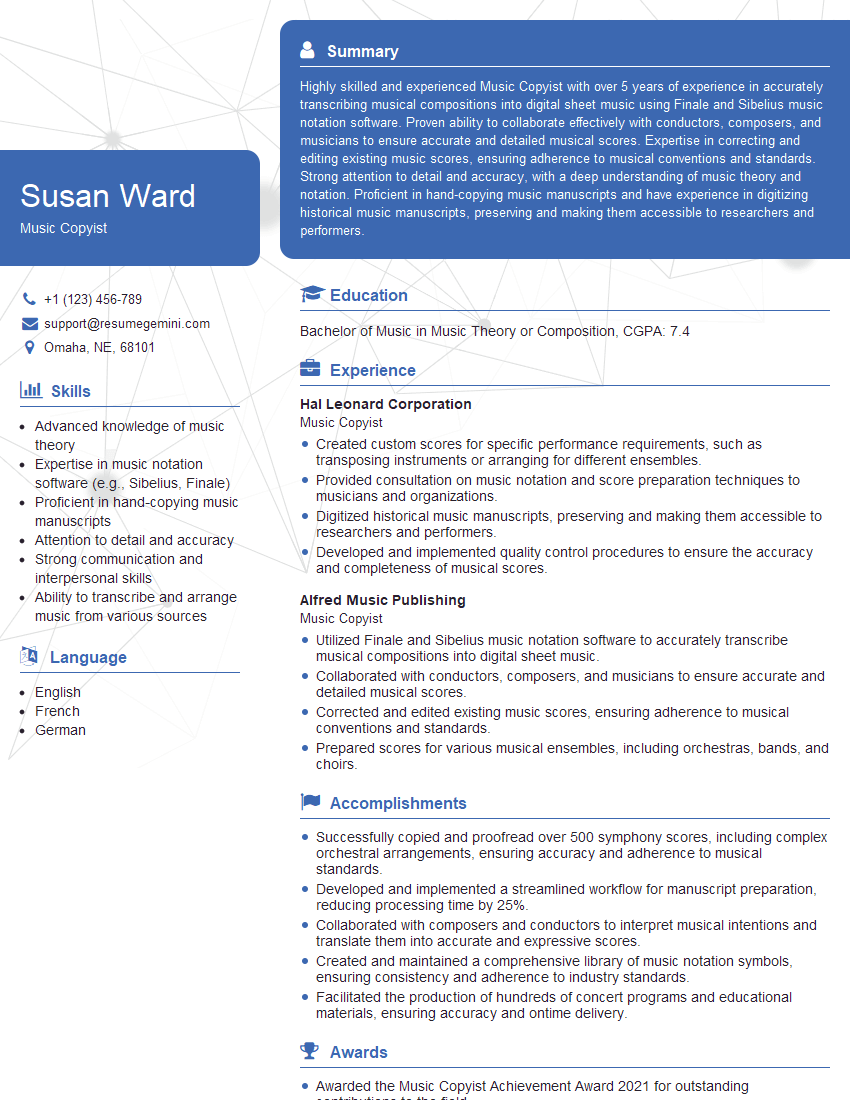
Mastering music formatting for specific publishers and ensembles is crucial for career advancement in the music industry. It demonstrates a high level of professionalism, technical skill, and attention to detail – all highly sought-after qualities. To significantly boost your job prospects, creating an ATS-friendly resume is essential. ResumeGemini is a trusted resource that can help you build a compelling and effective resume tailored to highlight your unique skills and experiences. Examples of resumes tailored to showcasing experience in music formatting for publishers and ensembles are available through ResumeGemini, allowing you to learn from best practices and create a winning application.
Explore more articles
Users Rating of Our Blogs
Share Your Experience
We value your feedback! Please rate our content and share your thoughts (optional).
What Readers Say About Our Blog
Very informative content, great job.
good