Are you ready to stand out in your next interview? Understanding and preparing for Leatherwork interview questions is a game-changer. In this blog, we’ve compiled key questions and expert advice to help you showcase your skills with confidence and precision. Let’s get started on your journey to acing the interview.
Questions Asked in Leatherwork Interview
Q 1. What types of leather are best suited for handbags versus saddles?
Choosing the right leather depends heavily on the intended use. Handbags prioritize suppleness, beauty, and potentially lighter weight, while saddles demand durability, strength, and resistance to wear and tear.
- Handbags: Softer leathers like calfskin, lambskin, goatskin, or even certain types of suede are popular choices. These offer a luxurious feel and drape well. Full-grain leather is also suitable, offering a balance of durability and softness. Consider the handbag’s style; a structured tote might benefit from a firmer leather like a well-tanned full-grain, while a slouchy hobo would be better suited to a supple leather like calfskin.
- Saddles: For saddles, you need exceptionally strong and durable leathers. Heavyweight harness leather, often made from thick cowhide, is a classic choice. The tanning process is crucial; vegetable-tanned leather is preferred for its strength and resistance to water and abrasion. These leathers require a firm structure to withstand the constant pressure and movement during riding. The thickness is a significant consideration; a thin leather would quickly wear out under such stress.
Q 2. Explain the different types of leather finishes and their applications.
Leather finishes significantly impact the leather’s appearance, feel, and durability. They range from very natural to highly processed.
- Full-grain: This is the top layer of the hide, retaining its natural grain and imperfections. It’s the strongest and most durable, developing a beautiful patina over time. It’s often used for high-end goods like saddles and luxury bags.
- Top-grain: The top layer after the imperfections are sanded off, resulting in a smoother surface. It is still durable, but less so than full-grain. It’s treated with a finish, often sprayed, to improve its appearance and water resistance.
- Corrected-grain: This leather has undergone significant sanding and then been embossed with a simulated grain pattern. It’s less durable and may lack character but provides a consistent, uniform appearance. It’s often seen in more affordable leather goods.
- Nubuck/Suede: These are produced by sanding the grain side of the leather, resulting in a velvety texture. They are softer but more delicate and require more care. They offer a softer, more luxurious look and feel.
- Patent: This leather is coated with a high-gloss lacquer, creating a shiny surface. It’s fashionable but less durable and can crack easily if not treated properly.
Q 3. Describe your experience with leather tooling techniques.
My experience in leather tooling spans over 15 years, encompassing a wide range of techniques. I’ve mastered both traditional and modern approaches.
I’m proficient in using various tools, including stamps, mallets, bevelers, and cutters to create intricate designs. I particularly enjoy the challenge of carving intricate designs, achieving both shallow and deep relief. My work ranges from simple geometric patterns to highly detailed floral motifs and even realistic portrayals of animals. I’ve worked with both vegetable-tanned and chrome-tanned leathers, understanding the nuances of each in responding to tooling. One project I’m particularly proud of involved creating a custom tooled belt with a highly detailed Celtic knotwork pattern for a client.
Q 4. How do you select the appropriate stitching for a particular leather project?
Stitching selection is critical; it must complement both the leather and the project’s intended function.
- Hand-stitching: This offers superior strength and a more aesthetically pleasing result, especially for high-end items and smaller projects. Saddle stitch, for example, is known for its durability and is ideal for items that will experience significant stress.
- Machine stitching: Offers greater speed for larger projects but might not be as strong or aesthetically refined as hand-stitching. The stitch type chosen depends on the leather thickness and desired aesthetic; a heavier-duty stitch is needed for thicker leathers. Examples include lock stitch, chain stitch.
- Thread choice: The thread must be appropriate for the leather type and thickness, using nylon or waxed linen threads are common choices depending on project and aesthetics.
For example, a delicate handbag might use fine hand-stitching with a subtle thread color to complement the leather. In contrast, a heavy-duty work belt would benefit from strong machine stitching with thick, durable thread.
Q 5. What are the common challenges encountered when working with different leather thicknesses?
Different leather thicknesses present unique challenges. Thicker leathers are more robust but require more powerful tools and techniques for cutting, stitching, and tooling. Thinner leathers are easier to work with but are more prone to damage and require more delicate handling.
- Stitching: Thicker leathers need stronger needles and thicker thread to prevent breakage. Multiple layers of thinner leathers might require special techniques to avoid puckering.
- Tooling: Thicker leathers require more force when tooling, and the tools need to be appropriately sized. Thin leathers can be easily damaged by aggressive tooling.
- Cutting: Sharp tools are essential for precise cuts regardless of thickness, but thicker leather might require more powerful tools to prevent tearing or uneven cuts.
For instance, while stitching thin suede requires fine needles and a light touch, thick harness leather demands heavy-duty needles and a strong stitch. Similarly, delicate tooling is suitable for thin leather, whereas aggressive carving is needed for thicker hides.
Q 6. Explain your experience with leather dyeing and finishing processes.
Dyeing and finishing are crucial steps in enhancing leather’s appearance and durability. My experience covers a range of techniques, including:
- Dye application: This can be done through various methods, such as hand-painting for intricate designs, dipping for even coloration, or spraying for large surfaces. The choice depends on the desired effect and leather type.
- Finishing: This process seals the leather, protecting it from water and wear. Finishes range from simple waxes and oils to more complex polymer coatings. The type of finish affects the final look and feel – from a matte, rustic look to a high-gloss shine.
- Edge finishing: This step involves smoothing, shaping, and often coloring the edges of the leather. It is crucial for both aesthetics and durability, and techniques include sanding, burnishing, and painting.
I once worked on a project where I hand-painted a complex design onto a full-grain leather briefcase, followed by a meticulous edge-finishing process which perfectly complemented the design. Achieving a consistently high-quality dye and finish requires both technical skill and artistic sensibility.
Q 7. How do you maintain the quality and durability of your leatherwork?
Maintaining the quality and durability of leatherwork requires proper care and attention.
- Regular cleaning: Gentle cleaning with a soft cloth and a leather cleaner removes dirt and grime, preventing damage. Avoid harsh chemicals.
- Conditioning: Regular conditioning with a suitable leather conditioner keeps the leather supple and prevents cracking, especially in dry climates. This replenishes oils lost during the tanning and use.
- Storage: Proper storage is essential; store leather goods in a cool, dry place away from direct sunlight and excessive heat. Avoid contact with moisture. Stuffing bags with acid-free tissue paper helps maintain their shape.
- Protection: Protecting your leather goods from excessive moisture and scratches is vital. A water-repellent spray can help provide protection from rain and spills.
Think of caring for leather like caring for your skin; regular cleaning, moisturizing, and protection all contribute to its long-term health and beauty.
Q 8. What are your preferred leather care and maintenance recommendations?
Leather care is paramount to extending the lifespan and beauty of your leather goods. My preferred methods focus on prevention and gentle cleaning. I recommend regular dusting with a soft cloth to remove surface dirt. For deeper cleaning, I use a specialized leather cleaner, always testing it in an inconspicuous area first. Avoid harsh chemicals, soaps, and excessive moisture.
Conditioning is crucial, especially for full-grain leathers. I use a high-quality leather conditioner every few months, or more frequently depending on use and climate. This replenishes the leather’s natural oils, keeping it supple and preventing cracking. Think of it like moisturizing your skin – it keeps it healthy and prevents premature aging. Finally, storing leather goods in a cool, dry place away from direct sunlight and heat is essential to prevent fading and damage.
- Regular dusting with a soft cloth
- Specialized leather cleaner (tested in an inconspicuous area)
- High-quality leather conditioner applied every few months
- Cool, dry storage away from sunlight and heat
Q 9. Describe your experience with pattern making and cutting leather.
Pattern making and cutting leather are fundamental skills in leatherwork. My experience spans decades, working with various leather types and projects, from simple wallets to complex equestrian saddles. I begin with a detailed sketch or digital design, translating it into a precise pattern using paper or CAD software. The key is accuracy; even a slight error can ruin the final product.
Cutting leather requires sharp tools and a steady hand. I use a variety of cutting tools, selecting the appropriate one depending on the leather thickness and pattern complexity. For instance, a rotary cutter is ideal for straight lines on thinner leathers, while a swivel knife offers greater control for intricate curves on thicker hides. I always ensure the cutting surface is clean and stable, using a self-healing cutting mat to protect both the tools and the work surface. Careful cutting minimizes waste and ensures clean edges, essential for a professional finish.
Q 10. Explain your process for repairing damaged leather goods.
Repairing damaged leather goods requires careful assessment and a methodical approach. My process starts with a thorough examination of the damage. I determine the extent of the damage, identifying tears, scratches, scuffs, and stitching issues. The repair technique depends on the type and severity of the damage. For minor scratches, I might use a leather dye to blend the blemish, followed by a conditioner to restore suppleness.
More significant tears or holes may necessitate patching. I carefully select a matching piece of leather and use appropriate stitching techniques to seamlessly integrate the patch. For broken stitching, I carefully remove the damaged section before restitching with strong, durable thread. I always prioritize preserving the original craftsmanship and aesthetics of the item. Once completed, I apply a protective finish to enhance longevity and water resistance.
Q 11. What safety precautions do you observe when working with leather and its tools?
Safety is paramount in leatherwork. Sharp tools like knives, chisels, and rotary cutters demand respect. I always use appropriate safety precautions including wearing protective eyewear to guard against flying debris and sharp fragments, and using cut-resistant gloves to minimize the risk of cuts and abrasions.
Working in a well-ventilated area is essential, particularly when using chemical finishes or dyes, as many release fumes. I maintain a clean and organized workspace to prevent accidents. Sharp tools are stored safely when not in use, minimizing the risk of accidental injury. Proper tool maintenance is equally important. Sharp tools are less prone to slippage and accidents, so regular sharpening and maintenance are key to my safety practices.
Q 12. How do you determine the appropriate amount of leather for a given project?
Determining the appropriate amount of leather is crucial for minimizing waste and ensuring sufficient material for a project. I start by creating a precise pattern based on the design specifications, ensuring accurate measurements. I then add seam allowances and consider any additional material needed for matching grain direction or complex shaping.
My experience allows me to estimate leather requirements accurately. However, I always factor in a margin of error – typically 10-15% extra – to account for potential cutting errors or unexpected adjustments during the project. This extra material ensures I have enough to complete the project without compromising quality. For larger projects, I often create full-scale mock-ups to refine the pattern and finalize leather requirements before cutting the final pieces.
Q 13. Describe your experience with using different leatherworking tools.
My experience encompasses a wide range of leatherworking tools. I’m proficient with hand tools such as various types of knives (swivel knives, stitching groovers), mallets, stitching pony, punches, and chisels. I also utilize power tools like rotary cutters, edge bevelers, and stitching machines for specific tasks.
The selection of tools depends on the project. For intricate details, I prefer the precision of hand tools. Power tools are efficient for repetitive tasks or large projects, but they require more care and skill to use correctly. I regularly maintain my tools, sharpening blades, and keeping them clean and oiled to ensure optimal performance and longevity. Regular maintenance not only extends the life of the tools but also increases safety and precision during use.
Q 14. What are the advantages and disadvantages of using different types of adhesives for leather?
Several adhesives are suitable for leather, each with its own advantages and disadvantages. Contact cement is a popular choice, offering a strong, permanent bond. However, it requires precise application and a short open time, leaving little room for error. It also creates a rigid bond that might not be suitable for all applications.
Water-based adhesives offer greater flexibility and are easier to clean up. They are ideal for projects requiring flexibility and easy repositioning of pieces during assembly. However, they generally offer a weaker bond than contact cement and require longer drying times. The best adhesive depends on the project’s specific needs – the type of leather, the intended application, and the level of flexibility required. I always test adhesives in inconspicuous areas before applying them to the main project to assess their compatibility with the specific leather type and ensure adhesion is strong and does not affect the leather’s look or feel.
Q 15. How do you ensure the consistent quality of your leather products?
Maintaining consistent quality in leather goods is paramount. It’s a multi-step process that begins long before the leather even touches my tools. It starts with sourcing high-quality hides from reputable suppliers. I meticulously inspect each hide for imperfections, ensuring consistent thickness and evenness of the grain.
During the production process, I employ standardized procedures. For example, my stitching is always done with the same tension and stitch length, using high-quality thread. I also regularly calibrate my tooling and machinery to maintain precision. Finally, I implement a rigorous quality control check at each stage, rejecting any piece that doesn’t meet my standards. Think of it like baking a cake – precise measurements and consistent techniques are key to a perfect outcome.
This commitment to consistency extends to after-sales service; addressing any issues promptly and professionally to maintain customer trust.
Career Expert Tips:
- Ace those interviews! Prepare effectively by reviewing the Top 50 Most Common Interview Questions on ResumeGemini.
- Navigate your job search with confidence! Explore a wide range of Career Tips on ResumeGemini. Learn about common challenges and recommendations to overcome them.
- Craft the perfect resume! Master the Art of Resume Writing with ResumeGemini’s guide. Showcase your unique qualifications and achievements effectively.
- Don’t miss out on holiday savings! Build your dream resume with ResumeGemini’s ATS optimized templates.
Q 16. Describe your experience with working with different leather types (e.g., full-grain, top-grain).
My experience spans a wide range of leathers. Full-grain leather, the highest quality, boasts the natural grain intact, offering durability and a unique character that develops a beautiful patina over time. I love working with full-grain because of its potential for unique and lasting pieces. I’ve used it for everything from bespoke briefcases to rugged motorcycle jackets.
Top-grain leather, while slightly less expensive, is still a strong choice. The top layer of the hide is sanded to create a more uniform surface. While it may lack the unique texture of full-grain, it’s still durable and versatile, ideal for items that require a smoother finish, like wallets or belts. I’ve frequently used top-grain for projects where a client prioritizes a uniform look and feel. Other leathers like suede, nubuck, and exotic skins (like alligator or ostrich) each demand specific techniques and knowledge to handle effectively and beautifully. Each leather presents unique challenges and rewards, requiring careful consideration of the project’s needs.
Q 17. How do you handle customer requests or specifications for custom leather projects?
Custom projects are the heart of my work! Handling customer requests involves a collaborative process. I begin by having a detailed consultation with the client to understand their vision, needs, and any specific requirements. We discuss leather type, design elements, size, and functionality. I then create sketches and renderings, often incorporating client feedback at each stage.
For instance, a client recently commissioned a custom saddlebag. We discussed the desired size, style, leather type (he preferred a robust full-grain), and the placement of additional pockets. I presented several design options, incorporating his feedback before starting the project. The end result was a unique, perfectly tailored saddlebag that exceeded his expectations. Detailed communication and a willingness to adjust the design based on client input are vital for successful custom projects.
Q 18. What software or design tools are you proficient in for leatherwork design?
While leatherwork is largely a hands-on craft, I leverage digital tools to enhance efficiency and design precision. I’m proficient in Adobe Illustrator and Photoshop for creating detailed patterns and visualizing design elements. Illustrator allows me to precisely draft patterns and manipulate vector images, ensuring accurate cutting and construction. Photoshop helps in visualizing color combinations and textures before committing to the leather. I also utilize CAD software for more complex, three-dimensional projects.
For example, when designing a complex saddle, CAD software allows me to create a 3D model, ensuring all components fit perfectly before I start cutting and assembling the leather. Although technology is a valuable tool, I believe the true art of leatherworking lies in the hands-on craftsmanship.
Q 19. What is your understanding of different leather tanning methods?
Leather tanning is a crucial process that transforms raw hides into durable and usable leather. I have a strong understanding of various methods. Vegetable tanning uses plant-based tannins, resulting in a leather that is environmentally friendly, strong, and develops a rich patina over time. It’s my preferred method for many projects.
Chrome tanning, a faster and cheaper method, uses chromium salts. This produces a more consistent and uniform leather but can have environmental implications. Other methods include alum tanning and brain tanning (using animal brains!), each yielding unique characteristics in the final leather. My understanding of these methods allows me to select the appropriate leather for a project based on its intended use and desired aesthetic.
Q 20. How do you ensure your leather products meet industry standards?
Meeting industry standards is a non-negotiable aspect of my work. I adhere to guidelines established by organizations like the Leather Manufacturers Association. This includes using safe and approved chemicals and dyes, ensuring the durability and longevity of my products. Regular inspections and testing are carried out to meet quality control requirements.
I also prioritize ethical sourcing, choosing suppliers who adhere to fair labor practices and environmental sustainability. This commitment ensures that my products meet not only technical standards but also ethical considerations that are increasingly important to consumers.
Q 21. How do you manage time and prioritize tasks in a fast-paced production environment?
In a fast-paced environment, effective time management is essential. I utilize project management techniques, breaking down large projects into smaller, manageable tasks. I prioritize tasks based on deadlines and client needs. I employ tools like project management software to track progress and deadlines.
For example, if I have multiple projects underway, I might schedule specific days for cutting, stitching, and finishing for each project, ensuring efficient use of my time and resources. Proactive planning and flexible adaptation to unexpected delays are critical for navigating a busy production schedule. It’s a balance of meticulous planning and responsive adaptability.
Q 22. Explain your experience with quality control and inspection processes for leather goods.
Quality control in leatherwork is paramount. It’s not just about the final product looking good; it’s about ensuring durability, consistency, and adherence to the highest standards. My process begins with the raw materials – I meticulously inspect each hide for imperfections like scars, insect bites, or inconsistencies in thickness. This initial inspection helps me select the best hides for specific projects, minimizing waste and maximizing the quality of the final product. During the production process, I regularly check for flaws in cutting, stitching, finishing, and any other relevant steps. I employ various tools, including calipers for precise measurements and magnifying glasses for detailed examination of stitching and finishing. For example, if I’m making a high-end handbag, I might use a leather thickness gauge to ensure uniform thickness throughout, preventing inconsistencies and potential weak points. Finally, a thorough final inspection includes examining the overall aesthetics, functionality, and structural integrity of the finished piece. This rigorous approach has resulted in consistently high-quality products and minimized customer complaints.
Q 23. Describe your experience with troubleshooting problems encountered during the leatherworking process.
Troubleshooting in leatherwork requires a blend of experience, problem-solving skills, and a keen eye for detail. One common issue is uneven dyeing or staining. This often stems from inconsistencies in the leather’s preparation or application techniques. To troubleshoot this, I systematically check each step – the leather’s pre-treatment, the dye concentration, the application method, and the drying conditions. I might experiment with different dye dilutions or application techniques to find the solution. Another frequent problem is stitching inconsistencies, possibly due to faulty needles, incorrect tension settings on the sewing machine, or improper thread selection. In this case, I’d inspect the machine, change needles if necessary, adjust tension, and perhaps try different threads until the desired result is achieved. I approach troubleshooting like solving a puzzle; I start by identifying the symptom, then carefully examine each stage of the process to pinpoint the root cause, and finally implement the appropriate corrective measure. Documenting these solutions helps me avoid repeating the same mistakes.
Q 24. What are your strategies for minimizing waste and maximizing efficiency in your leatherwork?
Minimizing waste and maximizing efficiency are crucial for both environmental and economic reasons. My strategies begin with careful planning and precise cutting. I use computer-aided design (CAD) software to create efficient cutting patterns, minimizing material waste. For smaller projects, I meticulously plan my cuts to maximize the utilization of each hide. I also carefully store leather scraps, repurposing them for smaller projects or embellishments. For instance, I might use smaller scraps to create keychains or patches. Beyond cutting, I ensure efficient tool use. Regular maintenance of my tools prevents delays and improves the quality of my work. I also streamline my workflow by optimizing the sequence of operations. I prioritize training and skill enhancement to improve efficiency, enabling me to complete projects faster without compromising quality. This holistic approach not only reduces waste but also increases profitability and contributes to a sustainable practice.
Q 25. How do you stay updated on the latest trends and innovations in the leather industry?
Staying current in the leather industry requires a multifaceted approach. I regularly attend trade shows and workshops, networking with other professionals and learning about new techniques and materials. Subscribing to relevant industry magazines and online publications keeps me informed about the latest trends and innovations. I also actively engage with online communities and forums dedicated to leatherwork, exchanging ideas and learning from other artisans. Following influential leatherworkers and designers on social media exposes me to diverse perspectives and creative applications. Finally, continuous experimentation with new techniques and materials is essential to refine my craft and adapt to evolving industry standards. For example, recently I’ve been exploring the use of vegetable-tanned leathers and sustainable dyeing techniques, reflecting the growing demand for eco-friendly products.
Q 26. Describe your experience in maintaining and repairing leatherworking equipment.
Maintaining and repairing leatherworking equipment is essential for productivity and safety. I regularly clean and lubricate my stitching machines, ensuring smooth operation and preventing breakdowns. I inspect needles, replacing them when necessary to maintain stitching quality and avoid damaging the leather. I sharpen my cutting tools frequently, using honing steel and sharpening stones to keep them at peak performance. For more significant repairs, I consult with skilled maintenance technicians or refer to manufacturer manuals. For example, I recently had to replace the bobbin tensioner on my sewing machine; I followed the manufacturer’s instructions to avoid any damage to the machine’s internal mechanisms. This proactive approach ensures that my equipment functions optimally, minimizing downtime and maximizing productivity.
Q 27. How do you handle feedback and criticism regarding your leatherwork?
Feedback is crucial for growth and improvement. I actively seek feedback from clients and colleagues, valuing both praise and criticism. Constructive criticism is especially valuable as it highlights areas for improvement. I view criticism not as a personal attack, but as an opportunity to refine my skills and processes. For example, if a client points out a slight imperfection in the finishing, I analyze the feedback, identifying the root cause and implementing corrective measures to avoid similar issues in the future. I maintain open communication with clients and colleagues, addressing concerns professionally and striving to meet their expectations. Positive feedback reinforces my strengths and motivates me to continue pushing creative boundaries.
Q 28. What are your career goals within the leatherwork industry?
My career goals involve a combination of creative fulfillment and professional growth within the leatherwork industry. I aspire to establish myself as a recognized artisan, specializing in high-end bespoke leather goods. I envision expanding my business, potentially employing other skilled artisans and creating a collaborative workshop. My long-term goal is to blend traditional techniques with contemporary design, creating unique and innovative leather products. This includes exploring opportunities to design and produce limited-edition collections and collaborating on projects with other designers and brands. Continuously learning, improving my skills, and sharing my knowledge with the next generation of leatherworkers are central to my vision for the future.
Key Topics to Learn for Your Leatherwork Interview
- Leather Selection & Properties: Understanding different types of leather (e.g., full-grain, top-grain, split leather), their characteristics, and suitability for various projects. Knowing how to assess leather quality and identify defects is crucial.
- Leatherworking Tools & Techniques: Familiarity with various tools (e.g., stitching groovers, mallets, punches, skiving knives) and their proper use. Demonstrate understanding of stitching techniques (e.g., saddle stitch, hand stitch), finishing methods, and pattern making.
- Design & Pattern Making: Ability to translate design concepts into workable patterns, considering leather’s properties and limitations. Showcasing proficiency in creating accurate and efficient patterns is key.
- Project Planning & Execution: Discuss your approach to project management, including material estimation, time management, and problem-solving during the crafting process. Be prepared to detail your workflow and troubleshooting skills.
- Finishing & Care: Knowledge of various finishing techniques (e.g., dyeing, conditioning, sealing) and their impact on leather’s appearance and longevity. Understanding proper leather care and maintenance is essential.
- Safety Procedures: Demonstrate awareness of safety protocols associated with using sharp tools and working with leather. Highlight your commitment to a safe working environment.
- Industry Trends & Innovations: Staying updated on current trends in leatherwork design, techniques, and materials. Showcasing your passion and continuous learning is highly valued.
Next Steps
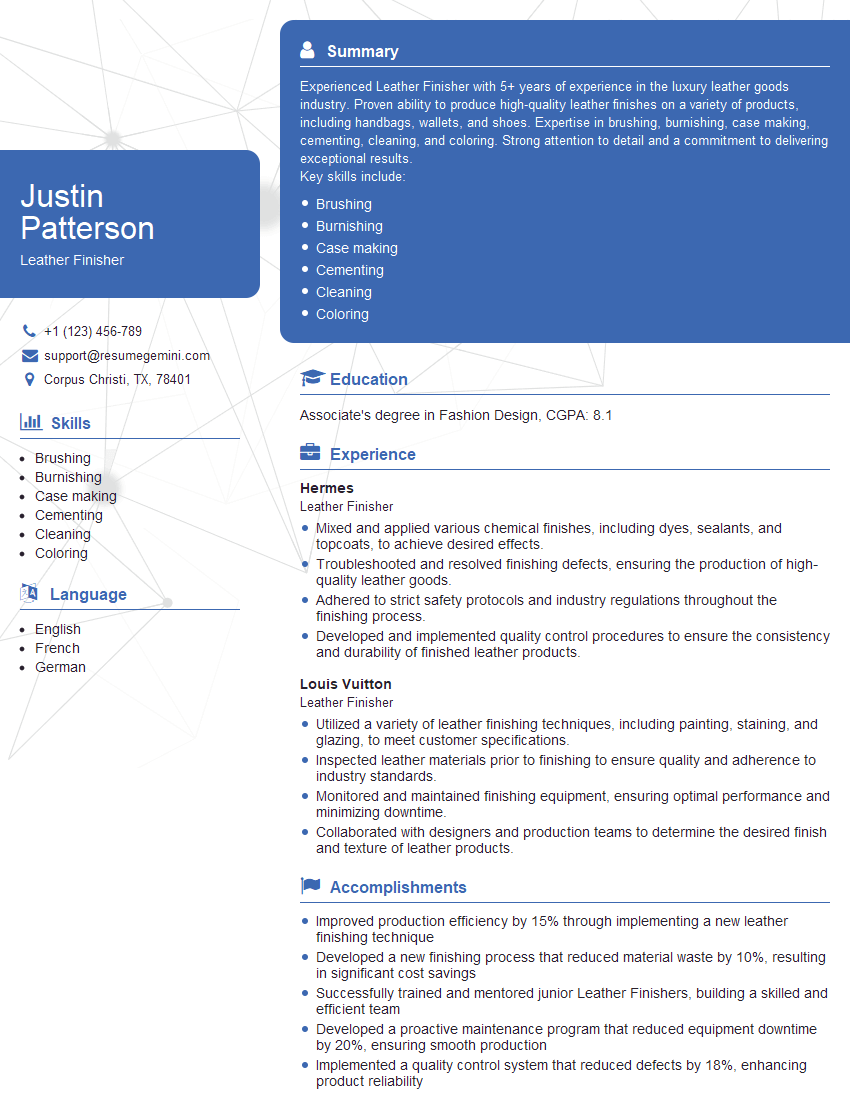
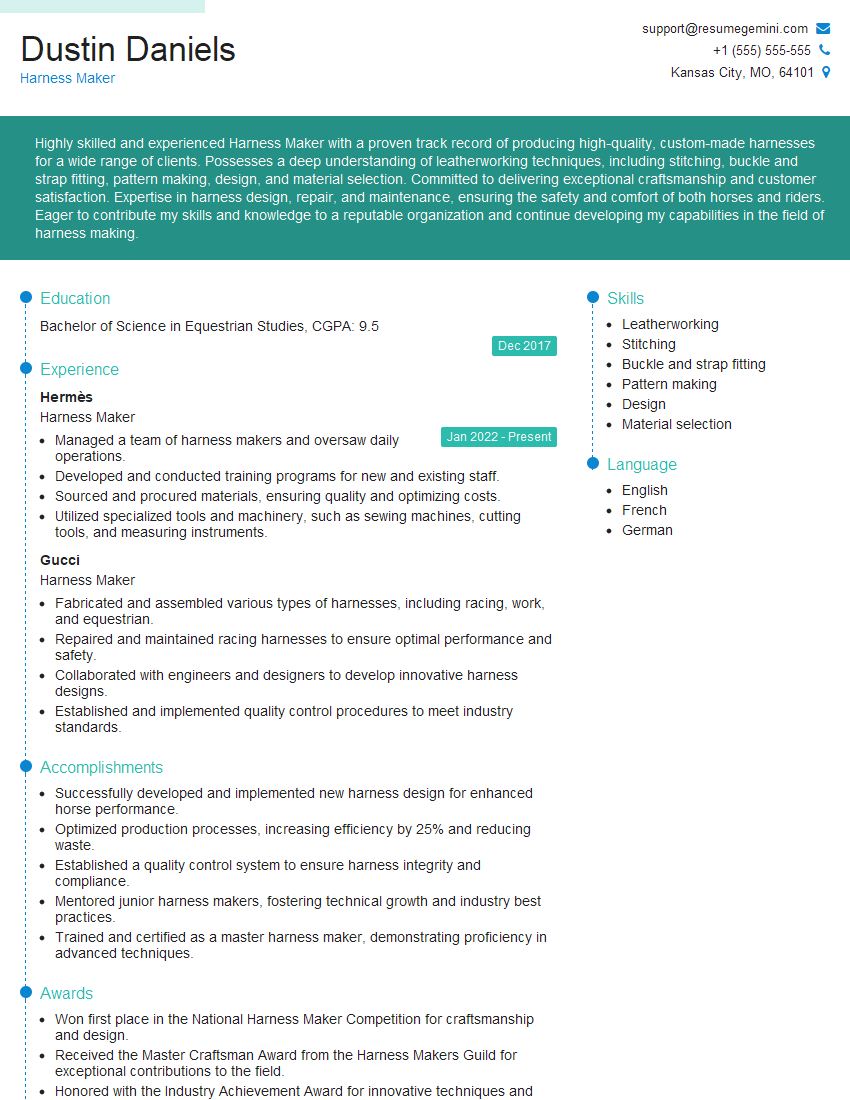
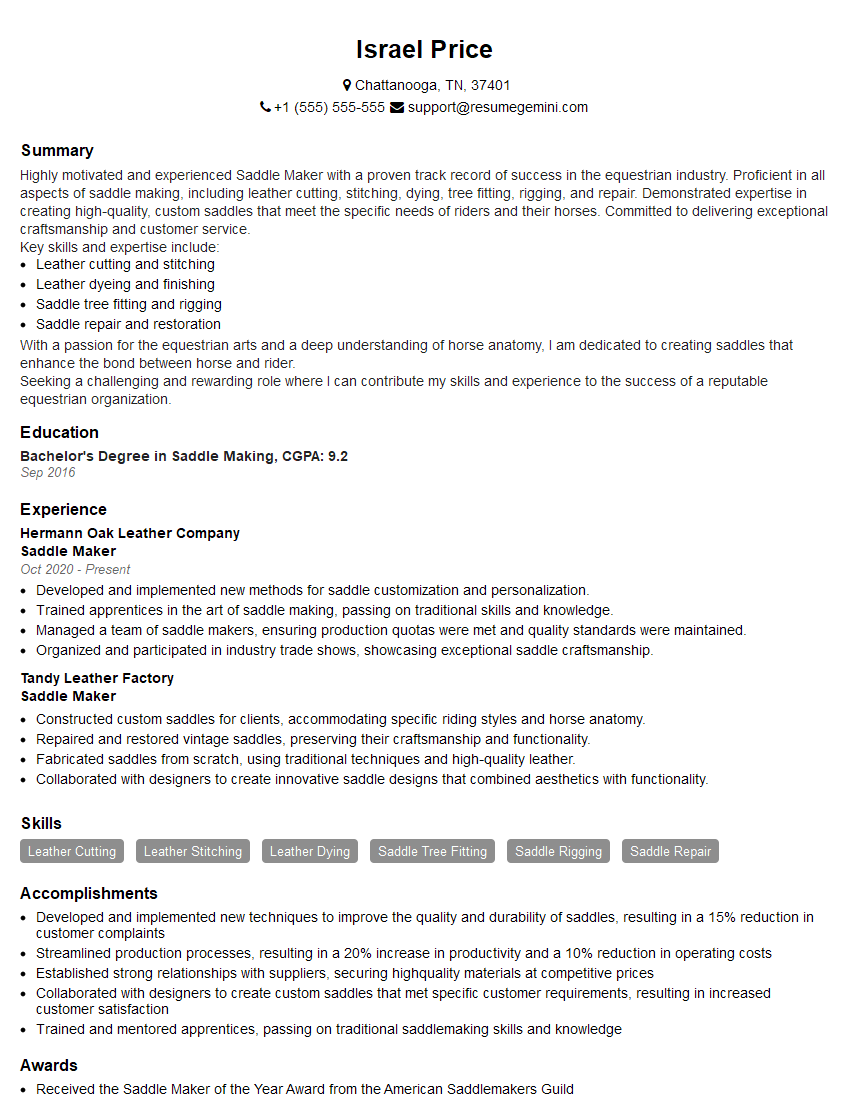
Mastering leatherwork opens doors to a rewarding career with diverse opportunities. To maximize your job prospects, a strong, ATS-friendly resume is essential. ResumeGemini can help you craft a compelling resume that highlights your skills and experience effectively. ResumeGemini provides examples of resumes tailored to the leatherwork industry, ensuring your application stands out. Invest the time to create a professional resume – it’s your first impression on potential employers.
Explore more articles
Users Rating of Our Blogs
Share Your Experience
We value your feedback! Please rate our content and share your thoughts (optional).
What Readers Say About Our Blog
Very informative content, great job.
good