The right preparation can turn an interview into an opportunity to showcase your expertise. This guide to Sample Prototyping interview questions is your ultimate resource, providing key insights and tips to help you ace your responses and stand out as a top candidate.
Questions Asked in Sample Prototyping Interview
Q 1. Explain the different types of sample prototyping methods.
Sample prototyping methods span a wide range, categorized by fidelity (how closely they represent the final product) and the level of interaction they offer. Low-fidelity prototypes focus on the basic concept and functionality, while high-fidelity prototypes are nearly indistinguishable from the final product.
- Low-Fidelity Prototypes: These are quick and inexpensive to create, ideal for early-stage testing and concept validation. Examples include paper prototypes, storyboards, and wireframes. A paper prototype might involve sketching a user interface on paper and acting out user interactions. This allows for rapid iteration and feedback.
- Medium-Fidelity Prototypes: These offer a more refined representation of the final product, incorporating more visual details and functionality. Examples include digital mockups using tools like Adobe XD or Figma, and interactive prototypes using tools like InVision or Axure RP. These let users experience a more realistic representation of the interactions.
- High-Fidelity Prototypes: These prototypes are highly detailed and closely resemble the final product. They often incorporate advanced features and functionalities. Examples include functional prototypes built using 3D printing or CNC machining, or highly interactive digital prototypes with realistic animations and transitions. This can significantly increase the development cost, but it allows for a very accurate representation.
The choice of prototyping method depends heavily on the project’s stage, available resources, and the level of detail needed for testing and user feedback.
Q 2. Describe your experience with 3D printing for prototyping.
I have extensive experience using 3D printing for prototyping, primarily using Fused Deposition Modeling (FDM) and Stereolithography (SLA) printers. FDM is great for creating functional prototypes with complex geometries, while SLA excels in producing prototypes with very fine details and smooth surfaces.
For example, I once used FDM printing to create a prototype for a new ergonomic handle for a power tool. The 3D model allowed us to iterate on the grip design quickly, testing different sizes and contours before committing to manufacturing. Later, we used SLA printing to create a highly detailed prototype for a miniature mechanical part, showcasing the intricate details of its design to potential investors.
Beyond simply creating the physical prototype, my experience extends to post-processing techniques like sanding, painting, and assembly, which are crucial for enhancing the prototype’s visual appeal and functionality. Understanding the limitations of different 3D printing technologies – such as layer lines in FDM prints – is key to selecting the right method and managing expectations.
Q 3. What are the key considerations when selecting materials for a prototype?
Material selection for prototyping is critical as it directly impacts the prototype’s functionality, durability, cost, and overall effectiveness in conveying the final product’s characteristics. Key considerations include:
- Functionality: Will the prototype need to withstand stress, heat, or other environmental factors? For example, a prototype for a high-temperature appliance will require a heat-resistant material.
- Appearance: How important is the visual representation of the final product? If aesthetics are crucial, a material that mimics the final product’s surface finish and color is necessary.
- Cost: Prototyping materials range widely in price. Balancing cost-effectiveness with the desired material properties is crucial, especially in early-stage development.
- Machinability: Can the material be easily cut, shaped, or assembled using available tools and techniques? Certain materials may require specialized equipment, increasing the cost and complexity of the prototyping process.
- Ease of Use: The selected material should be suitable for the chosen prototyping method (e.g., 3D printing, CNC machining).
For instance, I might choose ABS plastic for a robust, functional prototype, or acrylic for a transparent prototype showcasing internal components. For a rapid, low-cost prototype, I might opt for cardboard or foam board.
Q 4. How do you ensure the accuracy and precision of a prototype?
Ensuring accuracy and precision in prototyping requires a multi-faceted approach:
- Precise Design: Using accurate CAD modeling software with appropriate tolerances is crucial. This ensures the design dimensions accurately reflect the intended final product dimensions.
- Calibration and Maintenance: Regular calibration and maintenance of prototyping equipment (3D printers, CNC machines) are essential to guarantee consistent and accurate output.
- Material Selection: Choosing appropriate materials with consistent properties minimizes variations in the final prototype.
- Quality Control: Implementing quality control checks at various stages of the process – from design verification to post-processing inspection – helps identify and correct any deviations early on. This might involve using measuring tools like calipers and micrometers.
- Tolerance Analysis: Understanding the acceptable range of variations in dimensions is key. This involves considering factors like manufacturing tolerances and the impact of these variations on the prototype’s functionality.
For example, I always conduct dimensional measurements at multiple points on a 3D-printed prototype to verify its dimensions against the CAD model. Identifying any discrepancies helps in refining the design or adjusting the printing parameters for subsequent iterations.
Q 5. Describe your process for designing and building a functional prototype.
My process for designing and building a functional prototype follows a structured approach:
- Requirements Gathering: Clearly define the prototype’s purpose, functionality, and key performance indicators (KPIs).
- Conceptual Design: Sketching, brainstorming, and initial design concepts. This often involves exploring multiple design options.
- CAD Modeling: Creating a detailed 3D model using CAD software, incorporating all necessary features and specifications.
- Material Selection: Choosing the appropriate materials based on functionality, aesthetics, and cost.
- Prototype Fabrication: Using appropriate prototyping techniques (3D printing, CNC machining, hand assembly, etc.) to build the prototype.
- Testing and Iteration: Thoroughly testing the prototype to identify flaws and areas for improvement. This often involves user testing and feedback.
- Refinement and Finalization: Iteratively refining the design based on testing results until the prototype meets the required specifications.
For instance, in a recent project involving a new type of smartphone case, we went through several iterations, starting with a simple cardboard mockup, followed by a 3D-printed prototype, and finally, a functional prototype with the intended materials and features. Each iteration incorporated feedback from user testing, leading to a significantly improved final product.
Q 6. Explain your experience with CAD software for prototyping.
My expertise in CAD software for prototyping encompasses several programs, including SolidWorks, Fusion 360, and Autodesk Inventor. I’m proficient in using these tools to create detailed 3D models, generate manufacturing drawings, perform simulations, and conduct design analysis.
I’ve used SolidWorks extensively for complex mechanical designs, leveraging its advanced features for assemblies, simulations, and detailed drawings. Fusion 360’s intuitive interface and cloud-based collaboration capabilities have been invaluable for rapid prototyping and teamwork. Autodesk Inventor’s strong focus on manufacturing processes aids in creating designs that are easier to manufacture.
Beyond simply creating models, my skills include optimizing designs for manufacturing, incorporating tolerances and considering material properties within the CAD environment, which significantly reduces errors and improves the efficiency of the prototyping process.
Q 7. How do you manage time constraints and deadlines during prototype development?
Managing time constraints and deadlines during prototype development requires careful planning and prioritization:
- Detailed Project Schedule: Creating a realistic project timeline that breaks down the process into manageable tasks, assigning deadlines for each stage.
- Prioritization of Tasks: Focusing on the most critical aspects of the prototype first, ensuring that core functionality is implemented before addressing less important details.
- Agile Development: Embracing an iterative approach, allowing for flexibility and adjustments based on testing and feedback.
- Effective Communication: Maintaining clear communication with the team and stakeholders to manage expectations and address any potential delays proactively.
- Risk Management: Identifying potential bottlenecks or delays early on and developing contingency plans to mitigate their impact.
For example, in a situation where a deadline was approaching rapidly, we prioritized the core functionality of the prototype, delaying aesthetic refinements until a later stage. This ensured that we met the critical deadline while still delivering a functional prototype for testing and feedback.
Q 8. Describe a challenging prototype project and how you overcame the obstacles.
One particularly challenging project involved creating a prototype for a complex medical device – a miniature, implantable drug delivery system. The primary obstacle was achieving the necessary precision and biocompatibility within the tight dimensional constraints. We initially attempted 3D printing with a standard resin, but the resulting parts were too brittle and lacked the required surface finish for biocompatibility.
To overcome this, we employed a multi-stage approach. First, we refined the CAD model, focusing on minimizing stress concentrations and optimizing wall thicknesses. Second, we experimented with different 3D printing materials, ultimately settling on a biocompatible polymer with improved flexibility and strength. Finally, we incorporated a post-processing step involving a specialized surface treatment to enhance biocompatibility. This iterative approach, combining design optimization, material selection, and advanced finishing techniques, allowed us to successfully create a functional prototype that met all the critical specifications.
Q 9. How do you handle revisions and feedback on a prototype?
Handling revisions and feedback is a crucial part of the prototyping process. I use a structured approach that emphasizes clear communication and iterative improvements. Initially, I gather feedback through a combination of methods: formal presentations, informal discussions, and usability testing. Feedback is documented meticulously, categorizing suggestions as ‘critical,’ ‘major,’ ‘minor,’ and ‘enhancements.’
Using a version control system (like Git) for design files and a project management tool (such as Jira or Asana) to track changes and assignments ensures traceability and simplifies collaboration. Each feedback item is addressed systematically, and mockups or quick iterations are presented to validate proposed solutions before significant time is invested. Regular check-in meetings with the stakeholders ensure everyone is aligned and informed on the progress.
Q 10. What testing methods do you use to evaluate the performance of a prototype?
Evaluating prototype performance requires a multi-faceted testing strategy tailored to the specific project. Common methods include:
- Functional Testing: Verifying the prototype meets its intended functionality. For example, testing the operational range of a mechanical device or the data accuracy of a sensor.
- Performance Testing: Measuring key performance indicators (KPIs) like speed, efficiency, and power consumption. This might involve running benchmarks or stress tests.
- Usability Testing: Observing how users interact with the prototype to identify areas for improvement in user experience. This often involves user interviews and task completion observations.
- Durability and Reliability Testing: Assessing the prototype’s resilience against wear, tear, and environmental factors. This could involve accelerated life testing or environmental chamber tests.
- Material Testing: Evaluating the mechanical properties (strength, stiffness, fatigue resistance) and chemical properties (corrosion resistance, biocompatibility) of the materials used.
The selection of tests depends on the prototype’s purpose and intended application. A detailed test plan is crucial to ensure comprehensive evaluation.
Q 11. Explain your understanding of tolerance analysis in prototyping.
Tolerance analysis is critical in prototyping, especially for precisely engineered parts. It involves quantifying the acceptable variations in dimensions and other parameters to ensure the final product functions correctly within specified limits. These variations, or tolerances, arise from manufacturing processes, material properties, and assembly variations.
The goal of tolerance analysis is to minimize the impact of these variations on the overall functionality. Common methods include:
- Statistical Tolerance Analysis: This approach uses statistical distributions to model the variations in dimensions and calculates the probability of the final product falling outside the acceptable limits.
- Worst-Case Tolerance Analysis: This conservative method assumes all dimensions are at their extreme limits (maximum or minimum) to determine the most extreme possible variation. This is useful for critical components where failure is unacceptable.
Software tools are often used to perform tolerance analysis, enabling the design engineer to assess the impact of tolerance changes before committing to manufacturing.
Q 12. How do you document your prototyping process?
Comprehensive documentation is essential for successful prototyping. My approach involves maintaining a detailed record throughout the entire process, starting with the initial concept and ending with the final prototype evaluation. This usually includes:
- Design Specifications: Clearly defining the requirements and constraints for the prototype.
- CAD Models and Drawings: Maintaining versions of all design files.
- Material Selection Justification: Documenting reasons for selecting specific materials.
- Manufacturing Process Descriptions: Detailing steps involved in fabrication.
- Test Plans and Results: Recording all tests, including methods, data, and analysis.
- Feedback Reports: Summarizing feedback from stakeholders and the actions taken.
- Final Report: Summarizing the entire process, including successes, challenges, and lessons learned.
This thorough documentation helps in future design iterations, facilitates collaboration, and serves as a valuable reference for troubleshooting and improvements.
Q 13. Describe your experience with different manufacturing processes for prototyping.
I have extensive experience with several manufacturing processes for prototyping, each offering unique advantages and disadvantages. These include:
- 3D Printing (Additive Manufacturing): Ideal for rapid prototyping of complex geometries, offering high design flexibility. However, surface finish and material properties can be limiting.
- CNC Machining (Subtractive Manufacturing): Suitable for creating precise parts from various materials, offering excellent dimensional accuracy. It is less flexible for complex geometries and can be more expensive.
- Injection Molding: Allows for high-volume production of identical parts, but the tooling costs can be substantial, making it less suitable for low-volume prototypes.
- Vacuum Forming: A cost-effective method for creating prototypes from thermoplastic sheets. It’s good for simple shapes but lacks the precision of machining.
The choice of manufacturing process depends on factors such as part complexity, material requirements, budget, and desired lead time.
Q 14. What are the advantages and disadvantages of using rapid prototyping techniques?
Rapid prototyping techniques, like 3D printing and rapid tooling, offer significant advantages:
- Reduced Lead Time: Prototypes can be created quickly, accelerating the design cycle.
- Cost Savings: Eliminates or reduces the need for expensive tooling, lowering upfront costs.
- Increased Design Iteration: Allows for rapid testing and modification of designs.
- Improved Collaboration: Tangible prototypes facilitate clearer communication and feedback.
However, there are also limitations:
- Limited Material Selection: The range of materials available for rapid prototyping may be restricted.
- Surface Finish: Surface quality may not be as high as with traditional manufacturing methods.
- Dimensional Accuracy: Precision can be limited in some rapid prototyping techniques.
- Scalability: Rapid prototyping techniques may not be suitable for mass production.
The decision of whether to utilize rapid prototyping should be based on a careful assessment of these advantages and disadvantages within the context of the specific project.
Q 15. How do you balance cost and functionality when designing a prototype?
Balancing cost and functionality in prototyping is a delicate act, akin to finding the sweet spot in a recipe. You need enough functionality to validate your core concepts, but over-engineering leads to wasted resources. My approach involves prioritizing features based on their Minimum Viable Product (MVP) criteria. This means focusing on the essential functionalities that prove the core value proposition. For example, if I’m prototyping a smart home device, I might initially focus on a basic temperature control feature using a simple microcontroller and basic sensors, rather than incorporating advanced features like voice control or AI integration in the first iteration. This allows me to test the fundamental concept without overspending. Later prototypes can then progressively incorporate more complex features. I also consider the prototyping method itself; low-fidelity methods like paper prototyping or basic 3D printing are significantly cheaper than high-fidelity options like CNC machining or injection molding, especially in the early stages.
Furthermore, I utilize tools for cost estimation early in the process. This helps me to proactively identify potential cost overruns and make informed decisions about feature prioritization or material selection. It’s all about smart resource allocation and strategic decision-making to maximize return on investment.
Career Expert Tips:
- Ace those interviews! Prepare effectively by reviewing the Top 50 Most Common Interview Questions on ResumeGemini.
- Navigate your job search with confidence! Explore a wide range of Career Tips on ResumeGemini. Learn about common challenges and recommendations to overcome them.
- Craft the perfect resume! Master the Art of Resume Writing with ResumeGemini’s guide. Showcase your unique qualifications and achievements effectively.
- Don’t miss out on holiday savings! Build your dream resume with ResumeGemini’s ATS optimized templates.
Q 16. How do you collaborate effectively with design and engineering teams?
Effective collaboration with design and engineering teams is paramount to successful prototyping. I believe in fostering open communication and shared understanding from the outset. This starts with clearly defined roles and responsibilities, coupled with regular meetings and progress updates. I use collaborative platforms like Jira or Confluence to manage tasks and track progress, ensuring transparency for all stakeholders. For instance, when designing a user interface, I might share interactive prototypes with the design team for feedback, while concurrently engaging with the engineering team to assess the feasibility of proposed features. This parallel approach ensures that designs are both aesthetically pleasing and technically viable. I also advocate for iterative feedback loops, constantly seeking input and refining the design based on the insights gained from various team members. Regular demos of the prototype during its development process help maintain alignment between the teams and address any potential issues early on.
Q 17. How do you ensure the prototype meets the specified requirements?
Ensuring the prototype meets requirements is a multi-step process beginning with a detailed requirements specification document. This document serves as our north star, outlining all functional and non-functional requirements. Throughout the prototyping process, I conduct rigorous testing at each stage. This includes unit testing (testing individual components), integration testing (testing the interaction between components), and system testing (testing the entire system). For example, in a software prototype, unit testing ensures that each function performs as expected, while integration testing verifies that different modules communicate seamlessly. System testing evaluates overall system performance and user experience. I also use prototyping tools to simulate real-world conditions. For hardware prototypes, this might involve subjecting them to environmental stress tests. All testing results are documented and any discrepancies from the requirements are addressed through iterative design revisions.
Q 18. Describe your experience with different types of prototyping software.
My experience spans a wide range of prototyping software. For low-fidelity prototyping, I frequently use tools like Balsamiq for wireframing and Figma for interactive mockups. These tools are excellent for rapid iteration and exploring various design options without significant time investment. For high-fidelity prototyping, I’m proficient in tools like Adobe XD, which allows for detailed UI design and interaction simulations, and Fusion 360 for 3D modeling and rapid prototyping. This software allows me to create realistic and functional prototypes, facilitating detailed simulations of the final product. In the context of embedded systems, I’ve utilized Arduino IDE and other similar platforms for creating functional electronic prototypes. The choice of software depends heavily on the project scope, budget, and desired level of fidelity.
Q 19. How do you handle unexpected challenges during the prototyping process?
Unexpected challenges are inevitable in prototyping. My approach is to remain flexible and adaptable. When encountering a challenge, I start by clearly defining the problem and analyzing its root cause. Then I brainstorm potential solutions, considering the impact on cost, timeline, and overall design. This might involve exploring alternative materials, redesigning certain components, or even simplifying certain aspects to overcome limitations. For example, during the prototyping of a mechanical device, I once faced an unexpected issue with component alignment. Instead of scrapping the entire prototype, I utilized a 3D printing technique to create custom adapters, thus resolving the alignment issue without significantly impacting the project timeline or budget. Detailed documentation of these challenges and their solutions allows for informed decision-making in future projects and improves the overall robustness of the design.
Q 20. What is your experience with selecting appropriate manufacturing techniques for mass production after prototyping?
Selecting appropriate manufacturing techniques for mass production after prototyping requires careful consideration of several factors, including volume, material properties, cost, and required tolerances. My experience involves collaborating closely with manufacturing engineers to assess the feasibility and cost-effectiveness of different methods like injection molding, die-casting, or 3D printing at scale. The prototype itself serves as a valuable tool to evaluate different manufacturing processes, allowing for early identification of potential issues. For instance, a prototype might reveal material limitations or design flaws that only become apparent during manufacturing. I also consider factors like surface finish, dimensional accuracy, and overall cost during this selection phase. Ultimately, the goal is to select a process that optimizes quality, cost, and scalability.
Q 21. Explain the importance of iterative design in prototyping.
Iterative design is the cornerstone of successful prototyping. It’s a cyclical process of design, prototyping, testing, and refinement. Think of it like sculpting – you don’t create a masterpiece in a single stroke. Instead, you iteratively refine your design based on feedback and testing. Each iteration incorporates improvements and addresses identified shortcomings. For example, in a user interface prototype, the first iteration might be a simple wireframe. Testing this wireframe with users might reveal usability issues that are then addressed in the next iteration, which might involve creating a higher-fidelity interactive prototype. This iterative process continues until the prototype meets the defined requirements and user expectations. This approach minimizes risks, reduces development costs, and significantly improves the final product’s quality and user experience.
Q 22. How do you prioritize tasks when working on multiple prototypes simultaneously?
Prioritizing tasks across multiple prototypes requires a strategic approach. I typically employ a combination of methods, starting with a clear understanding of project goals and deadlines. I use a prioritization matrix, often a MoSCoW method (Must have, Should have, Could have, Won’t have), to categorize features and tasks based on their importance and urgency. This allows me to focus on the critical path for each prototype. For example, if I’m working on a low-fidelity prototype for user testing alongside a high-fidelity prototype for a client presentation, I’d prioritize tasks that directly impact the user testing prototype first, to gather crucial early feedback. Then, I’d allocate time to the high-fidelity prototype, ensuring its timely completion for the presentation. Regular review and adjustment of this matrix is vital as priorities shift throughout the project lifecycle.
Visual tools like Kanban boards can also be incredibly helpful to visualize workflow and identify potential bottlenecks. This provides a flexible approach to managing fluctuating deadlines and emergent issues.
Q 23. Describe your experience with different types of materials suitable for prototyping.
My experience spans a wide range of prototyping materials, each chosen based on the specific needs of the project. For quick, low-fidelity prototypes, I frequently utilize readily available materials like cardboard, foam board, and craft paper. These are inexpensive and allow for rapid iteration. For higher-fidelity prototypes, I’ll often use materials like 3D-printed plastics (ABS, PLA), wood, acrylic, and various metals depending on the required durability, aesthetic, and functionality. For electronics prototyping, I’m adept at working with breadboards, perfboards, and various types of wires and components. The selection process always considers factors like cost-effectiveness, manufacturing feasibility, and the desired level of realism for the final prototype.
For example, when prototyping a complex mechanical assembly, I might initially use wood or cardboard to create a functional model to test the kinematic design, then transition to 3D-printed plastics for a more durable and refined prototype before finalizing the design in metal.
Q 24. How do you ensure the scalability of a prototype design?
Ensuring scalability in prototype design is crucial for successful transition to mass production. This involves considering several key factors during the prototyping stage. First, I focus on designing with modularity in mind. This means breaking down complex components into smaller, easily repeatable units. This simplifies manufacturing and allows for easier scaling up or down of production volume. Second, I carefully select materials that are readily available and cost-effective at scale. Third, I employ standard manufacturing processes where possible, avoiding highly specialized or custom techniques that may be difficult or expensive to replicate on a larger scale. Lastly, throughout the design process, I continuously evaluate manufacturing tolerances and ensure that the design remains functional within these tolerances.
For instance, if I were designing a modular shelving system, I would design individual shelves and connectors as separate components that can be easily assembled and replicated. The materials selection would prioritize readily available, mass-produced materials. This allows for easy scaling up or down of the production run depending on demand.
Q 25. What is your experience with using Finite Element Analysis (FEA) for prototype design?
I have extensive experience using Finite Element Analysis (FEA) software, primarily ANSYS and Abaqus, for prototype design. FEA allows me to simulate the behavior of a design under various loading conditions, stress analysis, predicting failure points, and optimizing designs for strength and durability before committing to expensive physical prototyping. I use FEA to analyze stress concentrations, predict fatigue life, and assess thermal performance. This prevents costly redesigns later in the development process. For instance, in a previous project involving a complex robotic arm, FEA helped identify areas of high stress that were prone to failure. By modifying the design based on the FEA results, we were able to improve the structural integrity of the arm and avoid potential problems during testing.
Example code (Conceptual): While the actual FEA code is complex and depends on the software, the overall process involves defining the geometry, material properties, boundary conditions (loads and constraints), and then running the simulation to obtain results such as stress and displacement fields.
Q 26. How do you manage risks associated with prototyping?
Risk management in prototyping is a continuous process. I start by identifying potential risks early on, such as material availability, manufacturing constraints, and design limitations. I then use a risk assessment matrix to evaluate the likelihood and impact of each risk. This matrix guides the development of mitigation strategies, such as selecting alternative materials, developing contingency plans, and incorporating design features to address potential failures. Regular testing and iteration throughout the prototyping phase help uncover and address unforeseen risks. Proper documentation and communication are vital to transparently tracking risks and their mitigation strategies. Documenting lessons learned from each iteration is crucial to improve future projects.
A simple example is using a risk assessment matrix to prioritize prototyping methods for a new product. The method chosen will depend on how critical the need for accuracy is and how quickly a solution is required.
Q 27. Describe your experience with reverse engineering for prototyping purposes.
Reverse engineering plays a significant role in my prototyping work, particularly when dealing with existing products or components. I use a combination of techniques including 3D scanning, dimensional measurement, and material analysis to understand the design and functionality of a target object. This data is then used to create a digital model, which can be modified and improved upon for new prototypes. For example, I may reverse engineer a competitor’s product to identify areas for improvement or to understand their manufacturing process. This data provides valuable insights for creating a more efficient or cost-effective design.
Ethical considerations are paramount. Reverse engineering should only be done on products that are legally permissible to analyze and not violate any intellectual property rights.
Q 28. How do you maintain version control for your prototype designs and documentation?
Version control is essential for managing the evolution of prototype designs and associated documentation. I consistently use a version control system like Git to track changes to CAD models, design specifications, and test results. Each version is clearly labeled with a description of the changes made. This allows me to easily revert to earlier versions if necessary, compare different design iterations, and collaborate effectively with team members. Furthermore, I employ a structured file naming convention to keep the project organized. This ensures that everyone working on the project can easily access and understand the latest version of the design and related documentation.
Using a platform like GitLab or GitHub provides added benefits, such as the ability to manage code, track bugs, and collaborate more effectively within a team environment.
Key Topics to Learn for Sample Prototyping Interview
- Understanding Prototyping Methodologies: Explore different prototyping approaches like low-fidelity, high-fidelity, and rapid prototyping. Understand the strengths and weaknesses of each method and when to apply them.
- User-Centered Design Principles: Learn how to apply user research findings to inform your prototype design. Focus on user needs, pain points, and desired outcomes.
- Wireframing and Mockup Creation: Master the skills of creating effective wireframes and mockups to visually represent the user interface and user experience.
- Interactive Prototyping Tools: Gain proficiency in using popular prototyping tools such as Figma, Adobe XD, or Axure. Understand their features and capabilities for creating interactive prototypes.
- Testing and Iteration: Learn how to effectively test prototypes with users, gather feedback, and iterate on the design based on user insights. This includes understanding usability testing methodologies.
- Prototyping for Different Platforms: Explore the nuances of prototyping for web, mobile, and other platforms, understanding the specific considerations for each.
- Communication and Collaboration: Develop your ability to clearly communicate your design choices and rationale to stakeholders and team members.
- Problem-solving and Design Thinking: Apply design thinking principles to tackle design challenges and create innovative and effective prototypes.
Next Steps
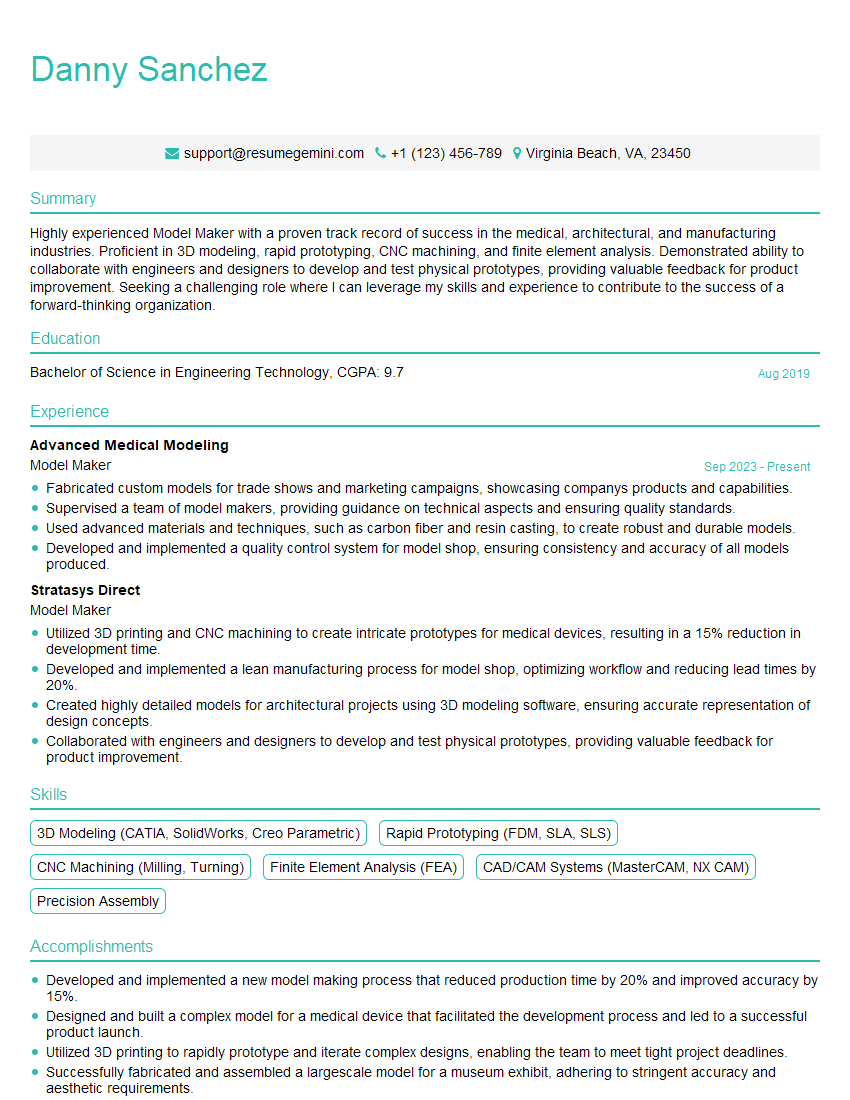
Mastering sample prototyping is crucial for career advancement in the ever-evolving field of UX/UI design and product development. It demonstrates a strong understanding of user-centered design and the ability to translate ideas into tangible solutions. To significantly improve your job prospects, invest time in creating a compelling, ATS-friendly resume that showcases your skills and experience effectively. ResumeGemini is a trusted resource that can help you build a professional and impactful resume. Examples of resumes tailored to Sample Prototyping are available within ResumeGemini to guide you.
Explore more articles
Users Rating of Our Blogs
Share Your Experience
We value your feedback! Please rate our content and share your thoughts (optional).
What Readers Say About Our Blog
Very informative content, great job.
good