Preparation is the key to success in any interview. In this post, we’ll explore crucial Schematic Analysis interview questions and equip you with strategies to craft impactful answers. Whether you’re a beginner or a pro, these tips will elevate your preparation.
Questions Asked in Schematic Analysis Interview
Q 1. Explain the difference between a schematic diagram and a PCB layout.
A schematic diagram is a symbolic representation of an electronic circuit, showing the interconnection of components without regard to their physical layout. Think of it as the blueprint of your circuit. It focuses on functionality and connectivity, using standardized symbols to represent components like resistors, capacitors, and integrated circuits. A PCB (Printed Circuit Board) layout, on the other hand, is the physical arrangement of those components on a printed circuit board. It’s the actual design that dictates how components are placed and routed on the board, taking into account factors like component size, spacing requirements, signal integrity, and manufacturing constraints. The schematic is the *what* and *how* the circuit works, while the PCB layout is the *where* the components go.
For example, a schematic might show a simple voltage divider using two resistors and a power source. The PCB layout would then show the exact placement and routing of those two resistors and the power connection points on the actual board. The schematic doesn’t consider physical size or placement; the PCB layout does.
Q 2. Describe your experience with different schematic capture software (e.g., Altium, Eagle, KiCad).
I have extensive experience with several industry-standard schematic capture software packages. My primary experience is with Altium Designer, where I’ve worked on numerous complex projects, leveraging its advanced features for hierarchical design, library management, and simulation integration. I’m also proficient in Eagle, particularly its ease of use for smaller projects and rapid prototyping. I have experience using KiCad as an open-source alternative, finding its capabilities impressive for a free tool, although it’s learning curve is steeper than Altium or Eagle. In each case, my proficiency extends beyond basic component placement and wiring; I’m comfortable creating and managing custom libraries, utilizing design rules checking (DRC), and integrating with other design automation tools.
For example, in a recent project using Altium, I created a hierarchical schematic to manage the complexity of a motor control system. This allowed me to break down the design into smaller, more manageable sections, improving readability and facilitating collaboration. Each section was carefully documented, ensuring consistency and ease of understanding.
Q 3. How do you ensure the accuracy and consistency of your schematic designs?
Accuracy and consistency in schematic design are paramount. My approach involves a multi-faceted strategy starting with careful planning and utilizing best practices. I begin by establishing a clear and consistent naming convention for components and nets. This simple step significantly improves readability and reduces errors. I make extensive use of design rule checking (DRC) features within the software to automatically identify potential errors, such as incorrect component values, missing connections, and short circuits. Furthermore, I adhere to a rigorous process of peer review (more on that in the next answer), ensuring a fresh set of eyes checks my work for potential oversights. I always ensure that my libraries are well-maintained and up-to-date, reducing the chances of errors originating from outdated components or symbols.
For instance, I might use a naming convention like ‘R123_1k’ for a 1k ohm resistor (R = resistor, 123 = sequential identifier, 1k = value). This clear system prevents confusion and improves traceability across the entire project.
Q 4. Explain the process of schematic review and verification.
Schematic review and verification is a critical step in ensuring design integrity. This process typically involves a formal review by a colleague or team, often utilizing a checklist to ensure all aspects of the design are thoroughly checked. Key areas of focus include verifying component selection, checking for connectivity errors, validating the design against specifications, and assessing for potential manufacturability issues. This review can be formal, including documented procedures and sign-offs, or informal depending on the project and company protocols. Simulation and analysis techniques, such as SPICE simulation, can also be used to verify circuit behavior and performance, ensuring the design meets all functional requirements. This iterative review process greatly reduces the risk of costly errors discovered late in the design cycle.
A typical checklist might include items like: ‘Are all components correctly placed and connected?’, ‘Do component values match the design specifications?’, and ‘Have all necessary safety measures been implemented?’
Q 5. How do you handle design changes and updates in a schematic?
Handling design changes and updates is a routine aspect of schematic design. Version control systems are essential for managing different revisions. This allows for tracking changes, reverting to previous versions if necessary, and collaborating effectively with team members. Changes should always be documented, with clear explanations justifying the modifications. The impact of changes needs careful consideration to avoid unforeseen consequences. The schematic design software usually provides tools for managing revisions, providing a clear history of all alterations. The software also facilitates managing libraries, ensuring changes made to a component symbol are reflected consistently throughout all projects using that component.
For instance, if a component value needs to be changed, I would use the software’s revision control feature, adding a comment explaining the change and its rationale. This ensures traceability and prevents confusion.
Q 6. What are the common symbols and notations used in schematic diagrams?
Schematic diagrams employ a standardized set of symbols and notations to represent electronic components and their interconnections. These symbols vary slightly depending on the standard used (IEEE, IEC, etc.), but the core concepts are universally understood. Common symbols include:
Resistors:A zig-zag lineCapacitors:Two parallel linesInductors:A coilIntegrated Circuits (ICs):A rectangle with pinsTransistors:Symbols vary depending on the type (BJT, FET)Diodes:A triangle with a line
In addition to component symbols, notations are used to indicate values (e.g., ‘1kΩ’ for a 1 kilohm resistor), tolerances, and other relevant parameters. Net labels clearly identify connection points, making it easy to trace signals throughout the circuit.
Q 7. How do you manage complex schematic designs with numerous components?
Managing complex schematic designs requires a structured approach. Hierarchical design is essential – breaking down a large circuit into smaller, more manageable subcircuits. Each subcircuit can then be designed and verified independently. This modular design approach enhances readability, improves maintainability, and facilitates collaboration among team members. Clear sheet organization, logical naming conventions (as mentioned earlier), and the use of sheet symbols to represent subcircuits are crucial for navigating the complexity. Effective use of design tools’ features like bussing and grouping of components further enhances organization and visual clarity. Using effective commenting and annotation within the schematic helps to explain design choices and rationale, crucial for both the designer and those who may maintain the design later. Regular review and verification are also critical, as these catch errors early, preventing issues from cascading as the design grows.
For example, a complex power supply might be broken down into subcircuits for rectification, regulation, and filtering, each designed and documented independently before being integrated into the main schematic. This reduces complexity and increases collaboration effectiveness.
Q 8. Describe your experience with hierarchical schematic design.
Hierarchical schematic design is crucial for managing complexity in large electronic systems. Instead of one massive, unwieldy schematic, we break down the design into smaller, manageable blocks or modules. Each module has its own schematic, representing a specific function or subsystem. These modules are then interconnected at a higher level, forming a hierarchical structure. Think of it like building with LEGOs – you build smaller structures first, and then assemble them into a larger, more complex creation.
Benefits:
- Improved readability and understandability: Smaller schematics are easier to navigate and comprehend than a single, sprawling diagram.
- Easier collaboration: Different team members can work on separate modules concurrently.
- Reusability: A well-designed module can be reused in multiple projects.
- Reduced design errors: Focusing on smaller, self-contained units makes it easier to identify and correct errors.
Example: In designing a complex communication system, we might have separate modules for the RF transceiver, the baseband processor, the power supply, and the user interface. Each module would have its own schematic, and these would be interconnected at a higher level to show the overall system architecture.
Q 9. How do you ensure your schematic design meets specific regulatory standards?
Meeting regulatory standards is paramount. My process involves a multi-stage approach starting right from the initial design phase. First, I thoroughly review the relevant standards (e.g., IEC, UL, FCC) that apply to the specific product and its intended market. This includes understanding requirements for safety, emissions, and immunity. Then, I incorporate these standards directly into the schematic design by selecting components that meet the required certifications and following best practices for layout and routing. This includes proper grounding techniques, the use of appropriate safety components (like fuses and over-current protection), and minimizing potential EMI/EMC issues through careful component placement and shielding. Finally, thorough simulation and testing are crucial. Simulations help verify that the design meets the specified regulatory limits, while physical testing validates the simulation results and ensures compliance. Documentation of this entire process is equally important for traceability and audits.
Q 10. Explain the process of generating a bill of materials (BOM) from a schematic.
Generating a Bill of Materials (BOM) from a schematic is a straightforward but crucial step. Most Electronic Design Automation (EDA) tools provide automated BOM generation. These tools extract component information—part numbers, values, quantities, and other relevant data—directly from the schematic. This eliminates manual data entry and minimizes the risk of errors. I typically use the EDA software’s built-in BOM generation features, verifying the output carefully to ensure accuracy. This includes checking for any missing parts, inconsistencies in part numbers, or discrepancies in quantities. After generating the initial BOM, I usually perform a cross-check against the schematic to ensure all components are correctly identified and listed. Any discrepancies are investigated and resolved before the final BOM is released for procurement.
Q 11. How do you identify and resolve potential design errors in a schematic?
Identifying and resolving design errors in a schematic is an iterative process. I employ several techniques. Firstly, EDA tools have built-in design rule checking (DRC) capabilities. DRC automatically detects potential errors, such as incorrect component placement, shorts, opens, and connectivity issues. I carefully review and address all DRC violations. Secondly, I conduct thorough schematic reviews with my colleagues, utilizing a peer review process to catch any errors that automated checks might miss. This includes checking component values, proper signal routing, and adherence to design guidelines. Finally, simulations, such as Spice simulations, help verify circuit functionality and identify potential problems that wouldn’t be apparent from visual inspection alone. For example, simulations can reveal unexpected voltage drops, noise issues, or stability problems. Each identified error is meticulously documented, addressed, and then verified before proceeding.
Q 12. What are your preferred methods for documenting schematic designs?
My preferred methods for documenting schematic designs emphasize clarity, completeness, and ease of access. I typically use a combination of digital and physical documentation. Digitally, I leverage the EDA software’s features for version control and schematic annotation. This allows for tracking design changes over time and adding clear explanations, notes, and design rationale. We utilize a standardized naming convention for schematic files and use revision control software to track changes. In addition to digital documentation, I often create a concise, high-level overview schematic, showing the major blocks and their interconnections. This acts as a roadmap for understanding the overall system architecture. Finally, detailed design specifications, including parts lists and design calculations, accompany the schematic drawings providing a complete design package.
Q 13. How do you handle schematic designs with multiple power supplies?
Handling multiple power supplies requires careful planning and execution. The key is to clearly define and separate the different power domains within the schematic. Each power supply needs to be properly regulated and isolated to prevent cross-talk and voltage interference. This includes using appropriate decoupling capacitors near each integrated circuit (IC) to filter out noise and ensure stable voltage levels. Careful attention should be given to ground planes and power distribution networks to minimize impedance mismatches and ensure uniform power delivery. Each power rail needs to be clearly identified and labeled in the schematic for better clarity. Using different colors for different power rails can also improve readability and reduce confusion. Furthermore, the design must account for any potential power-related safety concerns, such as over-current protection and short-circuit handling. It’s critical to choose appropriate power components that meet the required specifications and safety standards.
Q 14. Explain your understanding of signal integrity and how it relates to schematic design.
Signal integrity is crucial for the reliable operation of any electronic system. It refers to the quality of a signal as it travels through the circuit, ensuring that the signal arrives at its destination without significant distortion or loss. In schematic design, this consideration starts with selecting the right components and understanding their characteristics. For instance, the choice of trace widths, the use of proper termination resistors, and the careful routing of high-speed signals are critical factors. Using simulation tools to analyze signal integrity, helps anticipate potential issues such as reflections, crosstalk, and jitter. This allows for proactive design modifications, such as optimizing trace routing, incorporating ground planes effectively, and using appropriate shielding techniques. Ignoring signal integrity can lead to malfunctions, data errors, and unexpected system behavior. For high-speed digital designs, signal integrity analysis is often a critical design step, requiring specialized software and expertise to ensure proper function.
Q 15. How do you manage component tolerances and their impact on the circuit’s performance?
Managing component tolerances is crucial for ensuring a circuit performs reliably within its specified parameters. Tolerances represent the variability in a component’s actual value compared to its nominal value (e.g., a 1kΩ resistor might have a ±5% tolerance, meaning its actual resistance could be anywhere between 950Ω and 1050Ω). These variations can significantly impact circuit behavior, leading to unexpected performance or even malfunction.
My approach involves a multi-step process:
- Worst-case analysis: I simulate circuit performance using the extreme values within each component’s tolerance range. For instance, if I have multiple resistors in a voltage divider, I’ll simulate the scenario where all resistors are at their maximum and minimum values, to see the resulting voltage range.
- Monte Carlo analysis: This statistical technique simulates the circuit with many iterations, each using randomly selected values within the tolerance ranges of each component. This generates a distribution of possible outcomes, giving a much clearer picture of the performance variability than a simple worst-case analysis. I use this method to identify potential hot spots or areas of greatest variability.
- Sensitivity analysis: This helps pinpoint the components that most influence the circuit’s performance. By systematically changing the values of each component, we can determine which ones cause the biggest changes to the output. This can guide component selection, focusing on tighter tolerances for the most critical components.
- Component derating: To add a safety margin, I often select components with higher power ratings or voltage ratings than strictly necessary. This reduces the risk of component failure due to thermal stress or voltage spikes.
For example, in a high-precision amplifier design, using tighter tolerance resistors (±1% or even ±0.1%) becomes essential to maintain the desired accuracy. In contrast, a simple LED driver might tolerate wider tolerances without noticeable performance degradation.
Career Expert Tips:
- Ace those interviews! Prepare effectively by reviewing the Top 50 Most Common Interview Questions on ResumeGemini.
- Navigate your job search with confidence! Explore a wide range of Career Tips on ResumeGemini. Learn about common challenges and recommendations to overcome them.
- Craft the perfect resume! Master the Art of Resume Writing with ResumeGemini’s guide. Showcase your unique qualifications and achievements effectively.
- Don’t miss out on holiday savings! Build your dream resume with ResumeGemini’s ATS optimized templates.
Q 16. Describe your experience with simulation tools and their application to schematic analysis.
I have extensive experience using industry-standard simulation tools like LTSpice, Altium Designer, and Cadence Allegro. These tools allow for accurate prediction of circuit behavior before physical prototyping, saving time and resources. My workflow typically involves:
- Schematic Capture: Creating a detailed schematic in the chosen tool, specifying all components and their connections.
- Component Modeling: Selecting appropriate models for each component. Simple components might use ideal models, while more complex components (op-amps, transistors) benefit from detailed behavioral models.
- Simulation Setup: Defining the simulation parameters such as input signals, simulation time, and analysis type (e.g., AC analysis, transient analysis, DC sweep).
- Analysis and Iteration: Running simulations and carefully analyzing the results. This often involves iterating on the design based on the simulation outputs, adjusting component values or topology as needed.
- Verification and Validation: Comparing the simulation results with theoretical calculations or experimental data to ensure accuracy.
For instance, using LTSpice, I recently modeled a switched-mode power supply to optimize its efficiency and stability before constructing a prototype. The simulation revealed some unexpected oscillations that were corrected through adjustments to the feedback loop, preventing potential design failures.
Example LTSpice code snippet: .op; .tran 0 10m 0 1uQ 17. How do you incorporate design for manufacturability (DFM) considerations into your schematics?
Design for Manufacturability (DFM) is a critical aspect of schematic design. It focuses on creating schematics that are easily and cost-effectively manufactured. My approach to incorporating DFM involves:
- Component Selection: Prioritizing widely available components with established manufacturing processes and readily accessible datasheets. Using obsolete or uncommon parts can lead to delays and increased costs.
- Standard Package Sizes: Selecting components in standard package sizes to simplify assembly and reduce manufacturing complexity. Avoid using specialized or unusually sized components unless absolutely necessary.
- Avoiding Sensitive Components: Minimizing the use of highly sensitive components like high-precision or high-temperature components, which can be more challenging and costly to handle during manufacturing.
- Clear Component Identification: Ensuring each component is clearly identified in the schematic with appropriate designators (e.g., R1, C2) and part numbers for easy tracking and ordering.
- Testability Considerations: Incorporating test points into the schematic to allow for easy testing of critical nodes and signals during manufacturing and production testing.
For example, I would avoid using surface mount components that require specialized assembly equipment if the product is meant to be assembled manually. Instead, I might opt for through-hole components that are easier to work with.
Q 18. Explain your approach to troubleshooting issues identified during schematic review.
Troubleshooting during schematic review involves a systematic and logical approach. My strategy involves:
- Visual Inspection: Carefully reviewing the schematic for obvious errors such as incorrect connections, missing components, or unintended loops. I often use a cross-check between the schematic and the requirements document.
- Signal Tracing: Tracing the signal path from the input to the output, carefully analyzing each stage and checking for any potential bottlenecks or sources of error. This helps to isolate the problem area.
- Rule Checking: Utilizing built-in design rule checks (DRC) in the schematic capture tool to identify potential issues with component placement, net naming, or connectivity.
- Simulation: Using simulation to verify circuit behavior under various operating conditions and identifying potential problem areas. Simulation provides quantitative data that assists in confirming suspicions identified during visual inspection.
- Component Datasheet Review: Reviewing the datasheets of the components to verify their suitability for the application and check for any potential limitations or special handling requirements.
Recently, during a review, I noticed an unexpected voltage drop across a capacitor. By carefully tracing the signal path, I discovered a high-impedance node that was causing the issue. Simulation confirmed my suspicions, and adding a buffer solved the problem.
Q 19. What are your strategies for managing large and complex schematic projects?
Managing large and complex schematic projects requires careful organization and planning. My approach involves:
- Hierarchical Design: Breaking down the large schematic into smaller, more manageable sub-schematics or blocks. This improves readability and allows for easier modification and debugging.
- Modular Design: Designing the circuit using reusable modules or components. This reduces design time and improves consistency.
- Schematic Libraries: Creating and utilizing schematic libraries of frequently used components or sub-circuits. This improves design efficiency and consistency.
- Version Control: Employing a version control system to manage different revisions of the schematic and track changes effectively.
- Documentation: Creating clear and comprehensive documentation, including design specifications, simulation results, and test plans.
Think of it like building a house—instead of tackling the whole thing at once, you might build the foundation, walls, and roof as separate modules. Then you combine them into the final product.
Q 20. Describe your experience with version control systems for schematic designs.
Version control is indispensable for managing schematic designs, particularly in collaborative projects. I have extensive experience using Git, along with platforms like GitHub and GitLab, to manage schematic design files. This ensures that:
- Collaboration: Multiple engineers can work on the design simultaneously without overwriting each other’s changes.
- Change Tracking: A complete history of changes to the schematic is maintained, allowing easy rollback to previous versions if necessary.
- Branching: Different versions of the design (e.g., experimental versions, bug fixes) can be developed independently and merged later.
- Backup and Recovery: The designs are safely backed up, protecting against data loss.
For instance, I used Git to manage a complex FPGA design project, where different team members worked on various aspects of the hardware simultaneously. This allowed us to track the progress, merge changes seamlessly, and revert to previous versions when encountering bugs.
Q 21. How do you ensure the correct placement of components for optimal performance?
Correct component placement is crucial for optimal performance, particularly in high-speed or sensitive circuits. My strategy combines several factors:
- Signal Integrity Considerations: Minimizing the length of high-speed signals and using proper routing techniques to avoid signal reflections and crosstalk. This often involves using controlled impedance traces.
- Thermal Management: Placing heat-generating components strategically to optimize airflow and prevent overheating. This is particularly important for power transistors and integrated circuits.
- Grounding and Power Distribution: Establishing a robust ground plane and distributing power effectively to avoid voltage drops and noise. This often involves careful placement of decoupling capacitors.
- Component Sensitivity: Placing sensitive components away from sources of noise or interference, such as high-power components or switching circuits.
- Manufacturing Constraints: Considering the manufacturability of the design. This includes accounting for the size and shape of the components, as well as the available space on the printed circuit board.
For example, in high-speed digital designs, careful component placement and trace routing are critical to maintain signal integrity and avoid timing problems. Placing decoupling capacitors close to the ICs helps to suppress noise and ensure stable operation.
Q 22. How do you handle schematic changes requested after design review?
Handling schematic changes after design review is a crucial aspect of collaborative design. It requires a structured approach to ensure the integrity and functionality of the final design. The process typically begins with a thorough assessment of the requested change. This involves understanding the rationale behind the change, its impact on other parts of the schematic, and its potential implications on the overall system functionality.
Next, I would analyze the proposed modification to determine if it introduces any conflicts with existing components or design rules. This could involve checking for signal integrity issues, power supply constraints, or potential component incompatibility. I would then document all changes made, including the date, author, and a brief description of the modification. This documentation is essential for traceability and version control.
Finally, I would conduct a thorough verification of the modified schematic, potentially using simulation tools to check the performance and functionality of the updated design. Only after a successful verification will the changes be finalized and approved.
For example, a change request might involve adding a capacitor for improved noise filtering. I would assess if this addition requires changes in routing or component placement in the PCB layout stage. Thorough simulation and documentation are crucial before approving the change.
Q 23. Explain your experience with netlist generation and its importance in PCB design.
Netlist generation is a critical step in the transition from schematic design to printed circuit board (PCB) layout. A netlist is essentially a file that describes the connectivity between different components in the schematic. It’s like a blueprint that the PCB design software uses to create the physical layout. My experience involves using various EDA (Electronic Design Automation) software to generate netlists in formats like IPC-2581, which are industry standards ensuring compatibility across different design tools.
The importance of netlist generation cannot be overstated. First, it ensures the accuracy of the PCB layout; errors in the netlist will directly translate to errors in the PCB. Second, it simplifies the PCB design process by automating the task of connecting components, improving efficiency. Third, it enables design rule checking (DRC) and electrical rule checking (ERC) across the entire design, preventing potential layout errors and conflicts. This significantly reduces manufacturing defects and design iterations.
For instance, I’ve worked on projects with thousands of components, and generating an accurate netlist was instrumental in ensuring the final PCB matched the intended functionality. A discrepancy in the netlist could have resulted in hours, or even days, of debugging and rework.
Q 24. How do you ensure your schematic design is compliant with EMC/EMI regulations?
Designing schematics compliant with EMC/EMI (Electromagnetic Compatibility/Electromagnetic Interference) regulations requires proactive measures throughout the design process. Key strategies include minimizing radiated and conducted emissions. This begins with careful component selection. Components with inherent lower EMI emission are preferred. Using shielded cables and strategically placing components to minimize loop areas helps further reduce emissions. Proper grounding techniques are essential, often employing multiple ground planes to minimize noise propagation. The use of ferrite beads and common-mode chokes in critical signal paths further aids in mitigating interference.
Furthermore, incorporating simulations such as differential mode and common-mode simulations at the schematic level allow for early identification and mitigation of potential EMC/EMI issues. These simulations help identify sources of interference and optimize the design before PCB layout begins, saving considerable time and resources. Finally, thorough adherence to industry standards and best practices, such as those outlined in IEC 61000-4 series, is crucial.
For example, in a high-speed digital design, I carefully planned the placement of decoupling capacitors near integrated circuits and used differential signaling to minimize radiated emissions. This proactive approach significantly streamlined the EMC compliance testing phase.
Q 25. How do you incorporate thermal management considerations into your schematic design?
Incorporating thermal management into schematic design is crucial for ensuring the reliability and longevity of electronic systems. This starts with selecting components with appropriate thermal ratings, ensuring they can handle the expected power dissipation without exceeding their maximum operating temperature. The next step involves careful placement of heat-generating components on the PCB, considering airflow and the availability of heat sinks. Additionally, using thermal vias for better heat dissipation can be critical in high-power designs.
Beyond component selection, the schematic design stage is where we specify thermal considerations for the PCB layout. For instance, specifying the thermal relief of a component’s pads informs the layout engineer about heat distribution requirements. In some cases, thermal simulation tools are used to predict component temperatures under various operating conditions. This helps in identifying potential thermal hotspots and adjusting the design accordingly.
For example, in a high-power amplifier design, I used thermal vias strategically to create additional paths for heat dissipation from power transistors. This allowed the amplifier to operate reliably under high-power conditions while preventing overheating.
Q 26. Explain the importance of using standardized design rules in schematic capture.
Using standardized design rules in schematic capture is paramount for several reasons. Firstly, it ensures consistency and readability across the entire project, regardless of the number of team members involved. This dramatically reduces errors and simplifies the design review process. Secondly, standardized design rules facilitate the automation of many tasks, such as netlist generation and design rule checks, further increasing efficiency and reducing the potential for human error. These rules can encompass aspects such as naming conventions, component placement, and annotation standards.
Finally, adhering to standardized rules ensures compatibility with other design tools and facilitates collaboration with external parties. This seamless transition between different software and platforms minimizes the risk of errors stemming from format inconsistencies. A typical example might be defining a naming convention for signals – like using prefixes to indicate signal type (e.g., ‘CLK’ for clock signals) or assigning standardized footprints to components for consistent design.
In one project, we implemented a detailed set of schematic design rules, including a naming convention, component placement guidelines, and annotation standards. This resulted in a highly organized and easy-to-understand schematic, making design verification and PCB layout substantially more efficient.
Q 27. How do you deal with design conflicts or discrepancies between different team members’ schematics?
Design conflicts or discrepancies between different team members’ schematics are usually resolved through a collaborative and iterative process. It starts with a thorough comparison of the different schematics, identifying all areas of discrepancy. This comparison is typically done using version control systems and schematic comparison tools. Once discrepancies are identified, the team needs to assess the root cause. This might involve reviewing design specifications, clarifying requirements, or addressing misunderstandings regarding functionality or component choices.
Next, a discussion is initiated among the involved team members to find a consensus solution. This requires clear communication and a willingness to compromise. Often, the solution involves integrating the best aspects of each design, incorporating feedback, and ensuring alignment with overall system requirements. After arriving at a resolution, the changes are documented, and the updated schematic is re-verified and reviewed to ensure that the modifications haven’t introduced new conflicts.
For example, one project involved two team members designing separate blocks of a larger system. Differences in grounding strategies emerged. Through discussions, we adopted a unified grounding approach, ensuring signal integrity across the entire system.
Q 28. Describe a challenging schematic design project and how you overcame the obstacles.
One challenging project involved designing the schematic for a high-speed, low-power data acquisition system for a harsh environment application. The challenge was to balance high-speed data acquisition with stringent power limitations and environmental robustness. The initial design faced significant challenges regarding signal integrity, especially noise caused by external electromagnetic interference and power supply variations.
To overcome these obstacles, I used a multi-pronged approach. First, I implemented extensive signal integrity analysis using simulation tools to identify potential noise sources and optimize the routing and component placement. This analysis led to changes in component selection, including the use of low-noise amplifiers and specialized high-speed differential signaling techniques. Secondly, I meticulously designed the power supply section to ensure minimal noise and ripple, incorporating sophisticated power filtering techniques, and utilizing multiple regulated voltage rails. Finally, the design incorporated robust grounding and shielding to minimize external interference.
Through this iterative process of simulation, analysis, and redesign, we successfully developed a system that met all requirements while maintaining high reliability in the challenging environment.
Key Topics to Learn for Schematic Analysis Interview
- Circuit Topology Understanding: Mastering the identification and analysis of various circuit configurations (series, parallel, series-parallel, etc.) is fundamental. Practice recognizing common circuit patterns and their behavioral characteristics.
- Component Analysis: Develop a deep understanding of the behavior of individual components (resistors, capacitors, inductors, transistors, operational amplifiers) and their interactions within a circuit. Be prepared to explain their function and impact on overall circuit performance.
- Kirchhoff’s Laws: Demonstrate a thorough understanding of Kirchhoff’s Current Law (KCL) and Kirchhoff’s Voltage Law (KVL) and their application in solving circuit problems. Practice applying these laws to various circuit topologies.
- Network Theorems: Familiarize yourself with essential network theorems such as Thevenin’s theorem, Norton’s theorem, Superposition theorem, and Maximum Power Transfer theorem. Understanding their application simplifies complex circuit analysis.
- AC Circuit Analysis: Gain proficiency in analyzing circuits with AC sources, including concepts like impedance, phasors, and frequency response. Practice calculating impedance and analyzing circuit behavior at different frequencies.
- Boolean Algebra and Logic Gates: For digital schematic analysis, understand Boolean algebra principles and the functionality of various logic gates (AND, OR, NOT, XOR, etc.). Practice simplifying Boolean expressions and analyzing logic circuits.
- Signal Flow and Transfer Functions: Understand how to analyze signal flow within a circuit and determine transfer functions to describe the relationship between input and output signals. This is crucial for understanding system behavior.
- Troubleshooting and Debugging: Develop your ability to identify potential problems and errors within a schematic diagram. Practice identifying inconsistencies and proposing solutions to rectify them.
- Simulation Tools: Familiarity with common schematic capture and simulation tools (mentioning specific tools is optional but showing familiarity is beneficial). Understanding how to use these tools to verify designs and analyze circuit behavior is a significant advantage.
Next Steps
Mastering schematic analysis is crucial for a successful career in engineering and related fields, opening doors to exciting opportunities and advancements. To enhance your job prospects, creating an ATS-friendly resume that highlights your skills and experience is essential. ResumeGemini is a trusted resource to help you build a professional and impactful resume. They provide examples of resumes tailored to Schematic Analysis, giving you a head start in showcasing your expertise effectively. Invest the time to create a strong resume; it’s your first impression on potential employers.
Director of Engineering Resume Sample

Engineering Manager Resume Sample

Systems Architect Resume Sample
Hardware Design Engineer Resume Sample
Circuit Design Engineer Resume Sample
Electronics Design Engineer Resume Sample
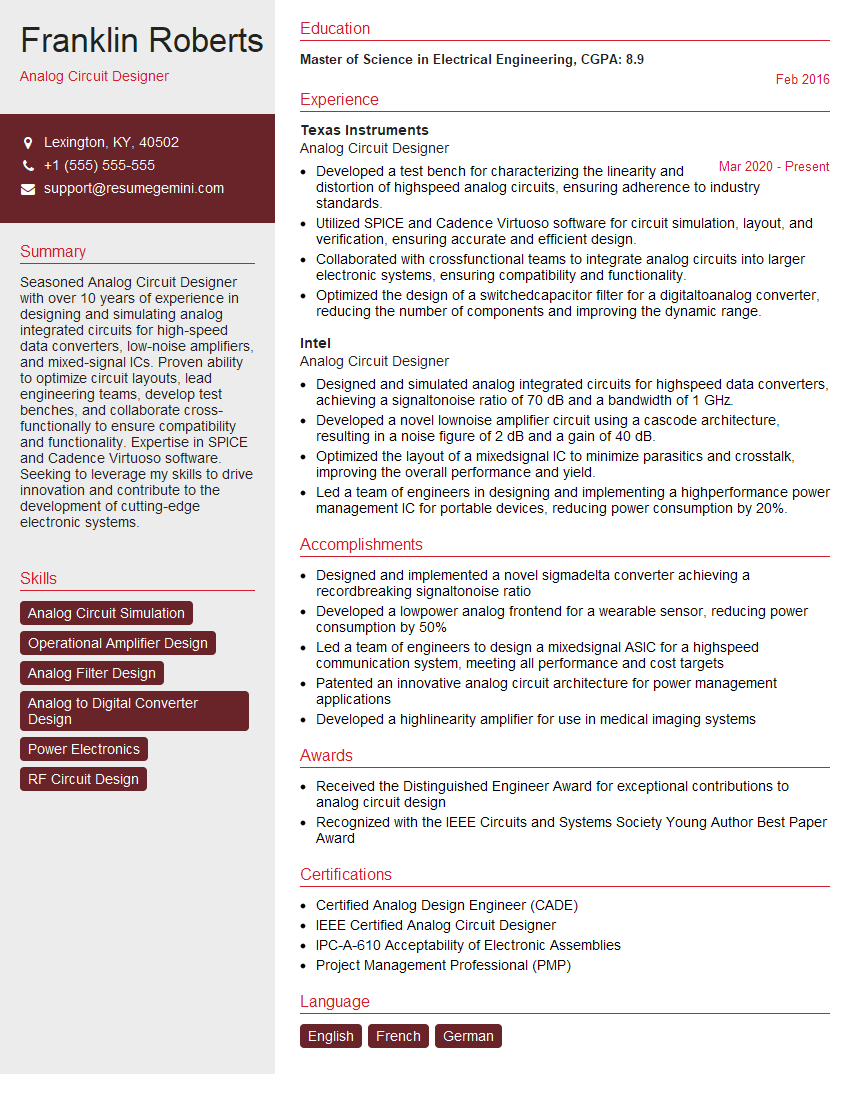
Analog Circuit Designer Resume Sample

Digital Circuit Designer Resume Sample
Explore more articles
Users Rating of Our Blogs
Share Your Experience
We value your feedback! Please rate our content and share your thoughts (optional).
What Readers Say About Our Blog
Very informative content, great job.
good