Cracking a skill-specific interview, like one for Test Process Improvement and Optimization, requires understanding the nuances of the role. In this blog, we present the questions you’re most likely to encounter, along with insights into how to answer them effectively. Let’s ensure you’re ready to make a strong impression.
Questions Asked in Test Process Improvement and Optimization Interview
Q 1. Describe your experience with different test methodologies (Agile, Waterfall, etc.) and their impact on test process improvement.
My experience spans both Waterfall and Agile methodologies, and understanding their impact on test process improvement is crucial. In Waterfall, testing is typically a distinct phase, often late in the cycle. This can lead to significant rework and delays if defects are discovered late. Improving the Waterfall testing process involves focusing on thorough upfront requirements analysis, detailed test planning, and rigorous review processes. We can leverage techniques like static analysis and early testing to catch issues sooner.
Agile, conversely, integrates testing throughout the development lifecycle. This iterative approach allows for early feedback and continuous improvement. Improvements here focus on implementing effective automated testing, incorporating test-driven development (TDD), and ensuring close collaboration between developers and testers. For example, in one project, we transitioned from a purely Waterfall approach to an Agile methodology with continuous integration and continuous delivery (CI/CD). This resulted in a 30% reduction in defect leakage to production and a 20% increase in release velocity.
The key difference in test process improvement between the methodologies lies in the timing and integration of testing. Waterfall demands more structured planning and documentation, while Agile emphasizes adaptability and rapid feedback loops. Successfully optimizing testing under either methodology requires a thorough understanding of its inherent strengths and weaknesses and tailored approaches to address them.
Q 2. Explain your approach to identifying bottlenecks in a testing process.
Identifying bottlenecks in a testing process is a systematic process that often involves a blend of data analysis and collaborative discussions. I begin by collecting data from various sources, including test execution reports, defect tracking systems, and team feedback. This data reveals patterns and potential areas of concern. For instance, consistently high defect density in specific modules might point to problems in the development process or inadequate testing of those modules.
Next, I employ process mapping techniques, visually representing the testing workflow to pinpoint choke points. This might involve identifying excessively long test execution times, slow feedback loops on defect fixes, or cumbersome reporting processes. I’ll often use tools like swim lane diagrams to visualize these flows and make bottlenecks instantly apparent. Then, I conduct interviews with testers, developers, and stakeholders to gather qualitative information and understand the root causes behind the identified bottlenecks. This could unearth issues like lack of resources, insufficient training, or poorly defined processes.
Finally, I analyze the data and feedback to prioritize areas for improvement. This prioritization is critical as resources are often limited. I’ll tackle the bottlenecks with the highest impact first. The end goal is to create a streamlined, efficient, and effective testing process that delivers high-quality software within the given constraints.
Q 3. How do you measure the effectiveness of test process improvements?
Measuring the effectiveness of test process improvements requires a multi-faceted approach that tracks both quantitative and qualitative metrics. Quantitative metrics provide objective evidence of improvement, while qualitative metrics capture subjective perspectives and contextual information. Key quantitative metrics include defect detection rate (the percentage of defects found during testing), defect density (the number of defects per lines of code), and test execution time. A substantial increase in defect detection rate and decrease in defect density after implementing improvements demonstrates their effectiveness.
On the qualitative side, I focus on gathering feedback from testers on the ease of using new tools or processes and from stakeholders on the overall satisfaction with the improved testing process. This is often done through surveys, interviews, or feedback sessions. For example, a reduction in testing time with no significant drop in the defect detection rate highlights a successful optimization. Similarly, positive feedback from testers regarding improved tools or simplified processes indicates a boost in morale and efficiency.
Ultimately, the effectiveness of improvements is judged by whether they lead to a demonstrable improvement in software quality, faster time to market, reduced costs, and increased team satisfaction. A holistic view of both quantitative and qualitative data provides a comprehensive evaluation of the success of the implemented improvements.
Q 4. What are some key metrics you use to track test process efficiency?
Several key metrics track test process efficiency. These include:
- Defect Detection Rate (DDR): Percentage of defects found during testing – a higher rate signifies a more effective testing process.
- Defect Density: Number of defects per 1000 lines of code (KLOC) or functional points – lower density indicates better code quality.
- Test Execution Time: Total time spent executing tests – reductions highlight improvements in efficiency.
- Test Case Coverage: Percentage of requirements or code covered by test cases – higher coverage means more comprehensive testing.
- Test Automation Rate: Percentage of tests automated – higher automation reduces manual effort and speeds up execution.
- Cycle Time: Time it takes to complete a test cycle – shorter cycle times are crucial for faster delivery.
- Escape Rate: Percentage of defects that reach production – lower rates indicate the effectiveness of the testing process in preventing defects.
These metrics are used to track progress, identify areas for improvement, and justify the implementation of test process optimization strategies. Regular monitoring of these metrics is essential to maintain a consistently efficient testing process.
Q 5. Describe your experience with implementing test automation frameworks.
I have extensive experience implementing various test automation frameworks, including keyword-driven, data-driven, and behavior-driven development (BDD) frameworks. The choice of framework depends on the project’s specific needs and complexity. Keyword-driven frameworks, for example, are suitable for projects with a large number of repetitive tests, as they allow for easy test creation and maintenance using keywords to represent actions.
In one project, we implemented a BDD framework using Cucumber and Selenium. This allowed for better communication and collaboration between developers, testers, and business stakeholders. The framework’s human-readable specifications (using Gherkin syntax) made it easier to understand the testing logic and its alignment with business requirements. Feature: User Login
Scenario: Successful login
Given the user is on the login page
When the user enters valid credentials
And the user clicks the login button
Then the user should be redirected to the home page
Data-driven frameworks excel when dealing with large amounts of test data. They automate the execution of the same test with different input values, thus improving test coverage and efficiency. Implementing these frameworks often involves selecting appropriate tools, defining clear coding standards, and establishing a robust maintenance plan. This includes regular reviews, updates, and refactoring to ensure the automation framework remains stable and effective over time.
Q 6. How do you handle conflicting priorities in a testing project?
Handling conflicting priorities is a common challenge in testing projects. My approach involves a structured prioritization process that balances competing demands. I begin by clearly documenting all testing priorities, assigning a weight or score based on their business value, risk, and urgency.
This prioritization usually involves collaboration with stakeholders to gain a shared understanding and agreement on the relative importance of different tasks. We use a prioritization matrix that considers factors like the impact of failure on the business, the likelihood of failure, and the cost of fixing the defect. High-risk, high-impact items naturally take precedence.
Once priorities are established, I communicate them clearly to the entire testing team. Transparency is key to ensuring everyone understands the rationale behind the decisions. If necessary, I’ll use techniques like timeboxing to allocate specific timeframes to high-priority tasks while acknowledging the necessity to potentially defer lower priority items. Regularly reviewing and re-prioritizing tasks is also vital, especially in dynamic project environments. This allows for flexibility and adaptation to evolving project needs.
Q 7. What strategies do you employ to improve test coverage?
Improving test coverage involves a multi-pronged approach focusing on both breadth and depth of testing. Breadth refers to covering a wide range of functionalities, while depth involves rigorous testing of individual components. Techniques for increasing breadth include using requirement traceability matrices to ensure all requirements are tested and employing risk-based testing to focus on high-risk areas first.
To improve the depth of testing, we incorporate various test levels, such as unit, integration, system, and user acceptance testing (UAT). Each level targets different aspects of the software. For example, unit testing focuses on verifying individual code units, while integration testing validates interactions between components. Utilizing techniques like equivalence partitioning and boundary value analysis helps optimize test case design and maximize coverage within a reasonable timeframe. In addition, test automation plays a crucial role in improving test coverage by enabling rapid execution of a large number of test cases.
Regular reviews of test coverage reports are essential to identify gaps and areas needing further attention. These reports should identify untested requirements or code paths, allowing for targeted testing efforts. Continuous improvement in testing strategy and techniques is crucial to enhance test coverage and ultimately improve software quality.
Q 8. How do you balance the need for thorough testing with project deadlines?
Balancing thorough testing with project deadlines requires a strategic approach that prioritizes risk and impact. It’s not about compromising quality but about optimizing testing efforts to achieve the best possible results within the given timeframe. This involves several key strategies:
- Prioritization: Employ risk-based testing techniques to focus on the most critical features and functionalities first. This means identifying areas of the application with the highest potential for impact if a defect is present. We can use techniques like risk matrices, where we weigh the likelihood of failure against its severity.
- Test Case Optimization: Rather than testing every possible scenario, we concentrate on representative test cases that cover the most important aspects of the application’s functionality. This might involve using techniques like equivalence partitioning or boundary value analysis to reduce the number of tests needed while ensuring adequate coverage.
- Test Automation: Automating repetitive tests allows for efficient regression testing and faster feedback loops, freeing up time for more exploratory or manual testing of higher-risk areas. This is particularly beneficial for scenarios where there are frequently updated build releases.
- Agile methodologies: Working within an Agile framework allows for iterative development and testing, enabling early detection of defects and quicker adaptation to changing priorities. Regular sprints allow us to reassess the testing scope and adjust accordingly based on the progress made within each cycle.
- Clear communication: Open communication with stakeholders is crucial. It’s essential to proactively communicate potential risks associated with compressed timelines to ensure everyone is aware and aligned with a potentially adjusted testing approach.
For example, in a project with a tight deadline, we might focus on automating smoke tests and critical path tests to ensure core functionality works correctly. This allows for quicker feedback early on and then we can allocate more time and effort to more detailed exploratory testing of high-risk features only if the core functionality is validated successfully.
Q 9. Explain your approach to risk management in testing.
My approach to risk management in testing is proactive and systematic. It starts with identifying potential risks early in the project lifecycle and developing strategies to mitigate them. I typically follow these steps:
- Risk Identification: This involves brainstorming potential risks related to software quality, testing processes, resources, and external factors. Techniques like Failure Mode and Effects Analysis (FMEA) can be used here.
- Risk Assessment: Each identified risk is analyzed based on its likelihood and potential impact on the project. This creates a risk matrix to prioritize risk mitigation efforts.
- Risk Response Planning: Once risks are assessed, we develop mitigation strategies, including contingency plans to handle risks that do occur. This might include adjusting test plans, adding resources, or developing workarounds.
- Risk Monitoring and Control: Throughout the testing process, we continuously monitor identified risks and assess their evolution. Any changes require updates to the response plans.
- Documentation: All aspects of the risk management process, including identified risks, assessments, and response plans, are meticulously documented.
For example, the risk of a third-party API failing can be mitigated by having alternative test environments that simulate the API’s failure and by thoroughly testing integration points with this API.
Q 10. How do you identify and address testing process risks?
Identifying and addressing testing process risks involves a combination of proactive planning and reactive problem-solving. My approach centers around regularly assessing the testing process itself, looking for potential weaknesses or bottlenecks.
- Process Analysis: Regularly reviewing the testing process using techniques like process mapping helps identify inefficiencies and potential problems.
- Defect Analysis: Analyzing defect reports can reveal patterns indicating weaknesses in the testing process. For instance, a high concentration of defects in a particular module may highlight inadequate testing of that module.
- Team Feedback: Gathering regular feedback from the testing team about challenges, pain points, and suggestions for improvement is invaluable.
- Metrics Tracking: Tracking key metrics such as defect density, test coverage, and testing cycle time helps identify trends and areas for improvement. Significant changes in these metrics may signal underlying problems.
- Root Cause Analysis: Employing root cause analysis techniques (e.g., 5 Whys, Fishbone diagrams) on recurring issues pinpoints the underlying causes of problems and enables targeted improvements.
For example, if we notice a consistent increase in late defect discovery, we might investigate whether the testing process lacks sufficient early feedback loops such as daily builds or more comprehensive reviews of test cases before execution. This approach proactively addresses potential risks before they become major problems.
Q 11. Describe your experience with defect tracking and analysis.
My experience with defect tracking and analysis is extensive. I’ve used various defect tracking systems (e.g., Jira, Bugzilla, Azure DevOps) and have developed a systematic approach to managing and analyzing defects throughout the software development lifecycle. My approach consists of:
- Consistent Reporting: Ensuring all defects are consistently and accurately reported, including detailed descriptions, steps to reproduce, expected vs. actual results, and severity levels.
- Defect Triaging: Reviewing and prioritizing reported defects to determine their severity and urgency. This often involves collaboration with developers and other stakeholders to confirm and classify defects.
- Defect Tracking and Management: Using a defect tracking system to track the lifecycle of each defect, from initial reporting through resolution and verification.
- Defect Analysis: Regularly analyzing defect data to identify trends, patterns, and root causes. This might involve creating reports and dashboards that show defect density by module, severity, or tester.
- Defect Prevention: Using the information gleaned from defect analysis to implement preventative measures, such as improving test cases, updating processes, or enhancing developer training.
For instance, if we find a significant number of defects related to database interactions, we can analyse this to identify the cause, such as insufficient database testing, inadequate documentation, or a flaw in database design and subsequently improve testing strategies to cover these interactions more comprehensively.
Q 12. What tools and techniques do you use for root cause analysis of testing issues?
For root cause analysis of testing issues, I use a variety of tools and techniques, depending on the nature of the problem. Some of my favorites include:
- 5 Whys: A simple yet powerful technique for drilling down to the root cause by repeatedly asking “Why?” until the fundamental cause is uncovered.
- Fishbone Diagram (Ishikawa Diagram): A visual tool that helps brainstorm and organize potential causes of a problem by categorizing them into different contributing factors (e.g., people, process, materials, environment).
- Pareto Chart: A bar graph that helps identify the most significant contributors to a problem by ranking causes based on their frequency or impact.
- Defect Tracking Systems: These systems provide valuable data for trend analysis, helping to identify recurring problems and their potential root causes.
- Code Analysis Tools: Static and dynamic code analysis tools can reveal potential coding errors or vulnerabilities that may be contributing to testing issues.
For example, if a series of performance issues are encountered during testing, a Fishbone diagram could be used to examine potential causes, including hardware limitations, inefficient code, database bottlenecks, or network constraints. This helps to systemically and visually identify the root cause(s) to aid effective mitigation.
Q 13. How do you improve communication and collaboration within a testing team?
Improving communication and collaboration within a testing team is paramount for effective testing. My approach involves several key strategies:
- Regular Team Meetings: Holding regular meetings to discuss progress, challenges, and upcoming tasks fosters open communication and shared understanding.
- Clear Communication Channels: Establishing clear and efficient communication channels (e.g., instant messaging, project management software, email) ensures everyone is informed and can easily access relevant information.
- Shared Test Management Tools: Using shared test management tools allows team members to access test cases, test results, and defect reports, promoting transparency and collaboration.
- Collaborative Test Design: Involving the entire team in the test design process through brainstorming sessions and peer reviews ensures buy-in and shared responsibility.
- Knowledge Sharing: Encouraging knowledge sharing through mentoring, training, and documentation creates a more cohesive and efficient team.
For example, employing a shared testing platform, like TestRail, allows for transparent tracking of all test cases and outcomes. This allows the team to easily collaborate, identify potential bottlenecks, and avoid redundant testing efforts, thus promoting better collaboration and clear lines of communication.
Q 14. How do you prioritize testing activities?
Prioritizing testing activities is crucial for efficient and effective testing, especially in projects with limited time and resources. My approach focuses on risk and impact, using a combination of methods:
- Risk-Based Prioritization: Prioritizing test cases based on the potential risk and impact of failures. This often involves creating a risk matrix that weighs the likelihood of failure against its severity.
- Business Value Prioritization: Prioritizing features based on their business value and importance to the overall project goals. Features that are critical to the business will typically receive higher testing priority.
- Test Coverage Prioritization: Prioritizing areas with lower test coverage or higher defect density. This helps to ensure that the most critical aspects of the application are thoroughly tested.
- Time Constraints: Realistically considering the available time and resources when creating a testing schedule. Prioritization must adjust based on the actual constraints to make sure important items are tested.
- MoSCoW Method: Categorizing requirements as Must have, Should have, Could have, and Won’t have helps prioritize testing efforts based on essential vs. desirable functionalities.
For instance, in an e-commerce application, the checkout process would likely be a top priority due to its direct impact on revenue, while less critical features like the user profile page might receive lower priority, ensuring that the most important aspects of the application are tested first and thoroughly.
Q 15. Describe your experience with performance testing and optimization.
Performance testing and optimization are crucial for ensuring a software application meets its performance goals. My experience encompasses all stages, from planning and scripting to execution and analysis. I’ve worked extensively with tools like JMeter and LoadRunner to simulate realistic user loads and identify bottlenecks. For instance, in a recent project involving an e-commerce platform, we used JMeter to simulate thousands of concurrent users accessing the site. By analyzing the results, we pinpointed a database query that was causing significant slowdowns. We then optimized the query and implemented caching mechanisms, leading to a 70% improvement in response time.
Optimization is an iterative process. After identifying performance issues, we focus on root cause analysis. This might involve profiling code, analyzing database queries, or examining network traffic. Once the root cause is identified, we implement solutions, retest, and monitor performance closely. For example, if we find that a specific API call is slow, we might optimize the code, add caching, or explore alternative architectural solutions. Continuous performance monitoring post-deployment is essential to proactively identify and address degradation.
Career Expert Tips:
- Ace those interviews! Prepare effectively by reviewing the Top 50 Most Common Interview Questions on ResumeGemini.
- Navigate your job search with confidence! Explore a wide range of Career Tips on ResumeGemini. Learn about common challenges and recommendations to overcome them.
- Craft the perfect resume! Master the Art of Resume Writing with ResumeGemini’s guide. Showcase your unique qualifications and achievements effectively.
- Don’t miss out on holiday savings! Build your dream resume with ResumeGemini’s ATS optimized templates.
Q 16. How do you ensure test environment stability and reliability?
Test environment stability and reliability are paramount to accurate and repeatable test results. My approach involves a multi-layered strategy. Firstly, we strive for environment parity – mirroring the production environment as closely as possible in terms of hardware, software, and network configurations. This minimizes discrepancies between testing and production, enhancing the reliability of our findings. We use configuration management tools like Ansible or Puppet to automate the provisioning and configuration of test environments, reducing manual errors and improving consistency.
Secondly, we employ rigorous monitoring tools during testing to detect anomalies promptly. This could involve system-level monitoring (CPU, memory, disk I/O), application-level monitoring (response times, error rates), and even user-level metrics. Any deviation from expected behavior triggers immediate investigation and remediation. For example, a sudden spike in CPU usage might point to a memory leak within the application. Finally, regular maintenance and updates of the test environment are essential. This includes applying security patches, upgrading software components, and regularly cleaning up unused resources to prevent instability.
Q 17. What are your preferred methods for conducting test planning and estimation?
Test planning and estimation require a structured approach. I usually start with a thorough understanding of the project scope and requirements. This involves collaborating with developers, product owners, and other stakeholders to define testing objectives, identify test scope, and prioritize test cases. Once the scope is clearly defined, we can leverage various estimation techniques. For smaller projects, I might use expert judgment or analogy-based estimation, leveraging past project experiences. For larger projects, a more formal approach like Work Breakdown Structure (WBS) and three-point estimation is preferred, accounting for optimistic, pessimistic, and most likely scenarios.
To ensure accuracy, I utilize historical data from similar projects and apply statistical techniques to refine estimates. We also regularly review and update the test plan throughout the project lifecycle, adapting to changing requirements and unexpected issues. Tools like Jira, combined with spreadsheets, help in managing and tracking tasks, progress, and resource allocation, allowing for continuous monitoring and adjustment of the plan.
Q 18. Explain your understanding of different testing types (unit, integration, system, etc.).
Software testing encompasses several types, each focusing on a different aspect of the software. Unit testing verifies the functionality of individual components or modules in isolation. Imagine testing a single function that calculates the area of a circle – this would be a unit test. Integration testing examines how different modules interact with each other, ensuring seamless data flow and communication. For example, verifying data is correctly passed between a user interface and a database. System testing validates the entire system against its requirements, verifying it works as expected. This might involve simulating end-to-end user scenarios.
Other crucial testing types include user acceptance testing (UAT), where end-users validate the system’s suitability; performance testing, assessing response times and scalability; security testing, identifying vulnerabilities; and regression testing, ensuring that new changes haven’t introduced bugs into existing functionality. A well-structured testing strategy typically combines multiple testing types to ensure comprehensive software quality assurance.
Q 19. How do you manage and resolve testing conflicts among team members?
Conflicts among team members are inevitable in any collaborative environment. My approach is proactive and focuses on clear communication and collaboration. I encourage open dialogue and encourage team members to voice their concerns and perspectives. Regular team meetings, facilitated by me, provide a platform for brainstorming solutions, resolving disagreements, and ensuring everyone is on the same page. We use a well-defined escalation path for resolving conflicts that cannot be resolved at the team level. This might involve involving a senior team member or project manager.
Another key strategy is using a collaborative test management tool like Jira or TestRail where test cases, bug reports, and discussions are centrally managed. This provides transparency and allows everyone to see the progress and any ongoing issues. Establishing clear roles and responsibilities helps prevent conflicts by defining individual responsibilities and avoiding overlaps.
Q 20. What strategies do you use to prevent regression testing failures?
Preventing regression testing failures is critical for maintaining software quality. A robust strategy starts with thorough test case design, covering both positive and negative test scenarios, and edge cases. A well-designed test suite is essential. We use a combination of automated and manual testing to ensure complete coverage. Automation of regression tests is prioritized for frequently executed tests to quickly detect any regressions. Tools like Selenium or Cypress allow for efficient automation of repetitive tests.
Furthermore, we implement a rigorous code review process to catch potential issues early in the development cycle. Code reviews ensure that changes meet coding standards and don’t introduce unexpected side effects. Continuous integration and continuous delivery (CI/CD) pipelines also play a vital role. Automated builds and tests are triggered after every code change, giving early feedback and preventing regressions from accumulating. A comprehensive logging and monitoring system helps in tracing and isolating any unexpected behavior during testing.
Q 21. Describe your experience using test management tools (e.g., Jira, TestRail).
I have extensive experience using various test management tools, including Jira and TestRail. Jira is a powerful tool for managing the entire software development lifecycle, including testing. I leverage its features for managing test cases, tracking defects, and collaborating with development teams. TestRail is specifically designed for test case management and provides excellent features for organizing test cases, creating test plans, tracking test execution, and generating reports. In several projects, I’ve used Jira to manage tasks and bug reports, and TestRail to meticulously track our test progress and results.
My expertise extends to integrating these tools with other parts of the CI/CD pipeline. This allows for automated test execution and reporting, providing continuous feedback and improving the overall testing efficiency. The choice of tool often depends on the project’s size, complexity, and the team’s preferences. But regardless of the tool used, my focus remains on optimizing processes for maximum efficiency and transparency. For instance, custom dashboards are created in both Jira and TestRail to provide real-time insights into the testing process, ensuring everyone is aware of the project’s health.
Q 22. How do you ensure test data management and security?
Test data management and security are paramount to ensuring reliable and trustworthy test results. It’s a multi-faceted process involving careful planning, implementation, and ongoing monitoring. We begin by identifying the specific data needed for testing, classifying it based on sensitivity (e.g., Personally Identifiable Information – PII, financial data), and establishing clear data access controls.
To manage this, we utilize a combination of techniques:
- Data Subsetting: Creating smaller, representative subsets of the production data to reduce the volume handled during testing and minimize risk.
- Data Masking: Anonymizing sensitive data by replacing it with realistic but non-sensitive substitutes. For example, replacing real credit card numbers with synthetically generated ones that follow the same format and validation rules.
- Data Encryption: Employing encryption techniques, both at rest and in transit, to protect data confidentiality.
- Data Virtualization: Accessing and querying data directly from the production database without extracting it, reducing data exposure.
Security measures include access control lists (ACLs), regular security audits, and secure storage mechanisms for test data. We also adhere to strict data governance policies and comply with relevant regulations like GDPR or HIPAA, ensuring accountability and traceability of all data usage.
Q 23. Explain your process for creating and maintaining test documentation.
Creating and maintaining comprehensive test documentation is vital for transparency, traceability, and knowledge transfer. My process emphasizes clarity, consistency, and ease of access. We typically use a combination of tools and templates to create a structured document repository.
Key elements include:
- Test Plan: Outlines the testing scope, objectives, approach, resources, and schedule. It serves as a roadmap for the entire testing effort.
- Test Cases: Detailed step-by-step instructions for executing individual test scenarios, including expected results and pass/fail criteria. We use a consistent format and prioritize clear, unambiguous language.
- Test Data Specification: Defines the data required for each test case, including its source, format, and security considerations. This document ensures test data integrity and reusability.
- Test Scripts (Automation): Automated test scripts, when applicable, are well-commented and stored in a version control system for easy tracking and maintenance.
- Test Summary Report: A consolidated report summarizing the test execution, results, defects found, and overall assessment of the system’s quality.
We use a version control system (like Git) to manage changes and ensure everyone works with the most up-to-date documentation. Regular reviews and updates are performed throughout the testing lifecycle.
Q 24. How do you adapt testing processes to changing project requirements?
Adaptability is key in software development. When project requirements change, our testing process needs to be flexible enough to accommodate these alterations without compromising quality or timelines. We employ a risk-based approach, prioritizing the testing of impacted areas based on their criticality and potential risks.
Here’s our strategy:
- Impact Assessment: Quickly analyze the impact of changes on existing test cases and identify areas requiring updates or new test cases.
- Prioritization: Focus on testing critical functionalities that are directly affected by the changes.
- Iterative Testing: Adopt short, iterative testing cycles to incorporate changes rapidly and validate their impact continuously.
- Test Case Modification/Creation: Modify or create new test cases to reflect the changed requirements. This should be a collaborative process with developers and stakeholders.
- Regression Testing: Perform thorough regression testing to verify that changes haven’t introduced unintended side effects. This might involve prioritizing regression test cases based on risk.
Effective communication is critical; we maintain clear channels with stakeholders to understand the reasons for changes, the scope of impact, and potential timelines for testing adaptations.
Q 25. What are some common challenges faced in test process improvement and how did you overcome them?
Test process improvement is never without challenges. Some common ones include:
- Lack of Resources: Insufficient budget, personnel, or tools can hinder effective testing.
- Inadequate Test Environment: Unstable or incomplete test environments can lead to unreliable test results and delays.
- Resistance to Change: Team members may resist adopting new processes or tools, slowing down progress.
- Poor Communication: Communication breakdowns between testers, developers, and stakeholders can create confusion and inefficiencies.
- Measuring Effectiveness: Quantifying the success of test process improvement initiatives can be difficult.
To overcome these, we’ve employed several strategies:
- Prioritization and Planning: Focusing on high-impact improvements with realistic goals.
- Automation: Automating repetitive tasks to improve efficiency and reduce manual effort.
- Training and Education: Providing training and support to team members to ensure they have the necessary skills and knowledge.
- Stakeholder Management: Engaging stakeholders early and often to secure buy-in and address concerns.
- Data-Driven Decision Making: Tracking key metrics to measure the effectiveness of improvements and make data-driven adjustments.
For instance, when faced with a lack of resources for automation, we prioritized automating high-risk, frequently executed test cases first, gradually expanding automation coverage over time.
Q 26. How do you introduce and implement new testing tools and technologies?
Introducing new testing tools and technologies requires a thoughtful and phased approach. It’s not simply about purchasing the latest software; it’s about integrating it effectively into the existing testing workflow. Our process involves:
- Needs Assessment: Identifying specific needs and challenges the new tool aims to address.
- Proof of Concept (POC): Conducting a POC to evaluate the tool’s capabilities and suitability for our environment. This typically involves a small-scale pilot project.
- Training and Skill Development: Providing comprehensive training to the team on using the new tool and its features.
- Gradual Rollout: Implementing the tool gradually, starting with a limited scope and expanding as the team gains proficiency.
- Integration with Existing Systems: Ensuring seamless integration with existing testing tools and infrastructure.
- Monitoring and Evaluation: Continuously monitoring the tool’s performance and effectiveness, making adjustments as needed.
For example, when introducing a new test management tool, we conducted a POC with a small subset of test cases, gathering feedback from the team before a full-scale deployment. We also provided comprehensive training and created a knowledge base to support users.
Q 27. Describe a time you significantly improved a testing process. What were the results?
In a previous project, we were facing significant delays and challenges due to lengthy and manual test execution. Many test cases required complex manual data setup and verification, which was time-consuming and prone to errors. This was impacting our release cycles.
To address this, I proposed and implemented a solution incorporating test data automation and improved test case design. We used a data generation tool to automatically create realistic test data, eliminating the manual data setup process. We also refactored our test cases, focusing on clear, concise steps and incorporating automated verification points. This reduced the reliance on manual data verification and improved test accuracy.
The results were substantial:
- Reduced test execution time by 60%: We significantly reduced the time required to execute our entire test suite.
- Improved test accuracy: Automated verification reduced human errors and improved the reliability of our test results.
- Increased test coverage: We were able to increase our test coverage due to reduced execution time.
- Faster release cycles: This led to a 30% reduction in our overall release cycle times.
This improvement highlighted the significant impact of well-planned automation and streamlined test processes on project timelines and overall product quality.
Q 28. How do you stay current with best practices in test process improvement and optimization?
Staying current with best practices in test process improvement requires continuous learning and engagement with the testing community. I employ several strategies:
- Industry Conferences and Webinars: Attending conferences like STAREAST or Test Automation University and participating in webinars on the latest trends and technologies.
- Professional Organizations: Actively participating in professional organizations like the ISTQB to stay informed about evolving standards and best practices.
- Online Resources and Publications: Regularly reading articles, blogs, and research papers published by leading experts in the field.
- Networking: Connecting with peers and experts through online forums and communities to share knowledge and learn from their experiences.
- Mentorship and Collaboration: Seeking mentorship from experienced professionals and collaborating with colleagues to share insights and best practices.
By constantly seeking new knowledge and exchanging ideas, I ensure my testing practices remain current, effective, and adaptable to the ever-evolving landscape of software development.
Key Topics to Learn for Test Process Improvement and Optimization Interview
- Test Process Maturity Models: Understanding models like CMMI, TMMi, and their application in assessing and improving testing processes. Consider how to identify areas for improvement within a given model.
- Test Automation Frameworks: Practical experience with various frameworks (e.g., Keyword-driven, Data-driven, BDD) and the ability to discuss their strengths, weaknesses, and appropriate application in different contexts. Be prepared to explain how you’ve selected and implemented a framework to solve a specific testing challenge.
- Risk-Based Testing: Demonstrate your understanding of identifying and prioritizing risks, allocating testing resources effectively, and mitigating potential failures. Discuss practical scenarios where you’ve applied risk-based testing strategies.
- Performance Testing and Optimization: Knowledge of performance testing methodologies (load, stress, endurance), tools, and analysis techniques. Be ready to discuss how you’ve identified and resolved performance bottlenecks.
- Defect Prevention and Analysis: Discuss strategies for preventing defects early in the software development lifecycle (SDLC) and techniques for analyzing defect trends to identify root causes and implement preventative measures. Showcase your analytical skills.
- Test Data Management: Understanding the challenges of managing test data, strategies for creating realistic and representative test data, and techniques for ensuring data security and privacy. Discuss your experience with test data generation and management tools.
- Metrics and Reporting: Demonstrate your ability to define and track relevant testing metrics (e.g., defect density, test coverage, test execution time), create insightful reports, and communicate findings effectively to stakeholders.
- Continuous Testing and Integration: Understanding and experience with integrating testing into CI/CD pipelines and the challenges involved in achieving continuous testing. Be prepared to discuss practical implementation examples.
Next Steps
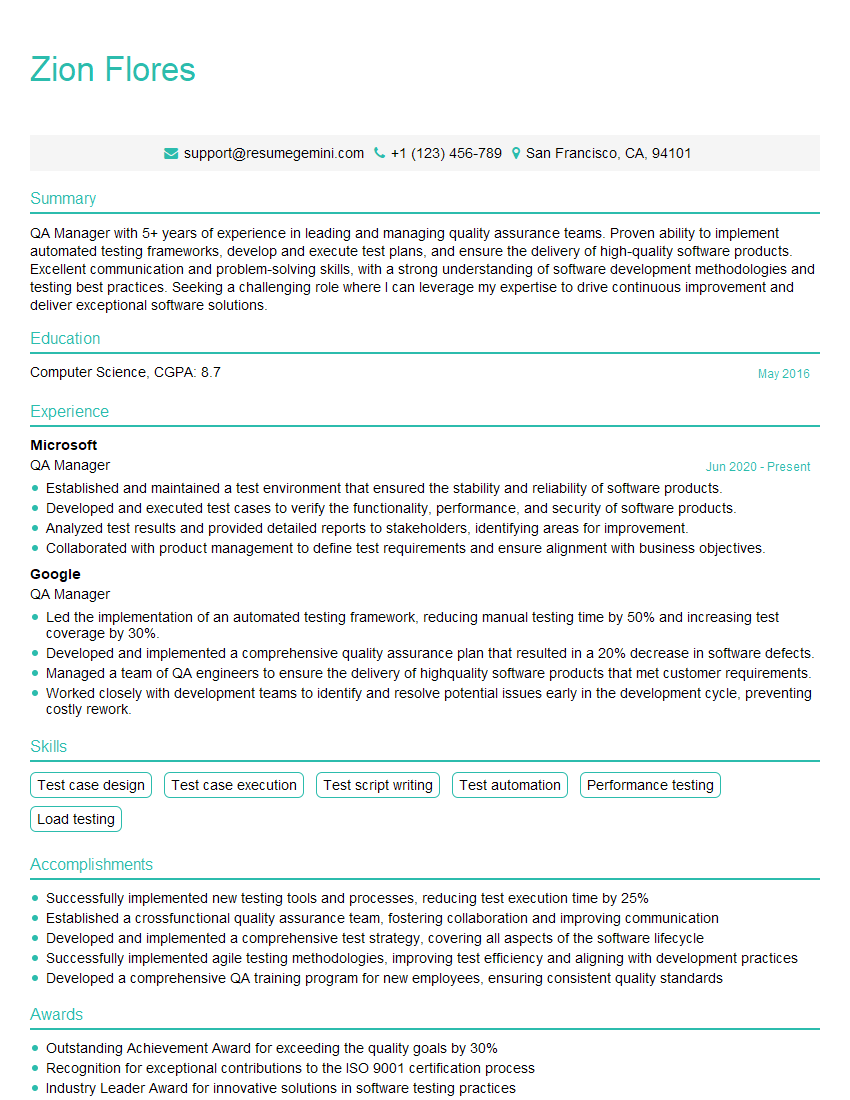
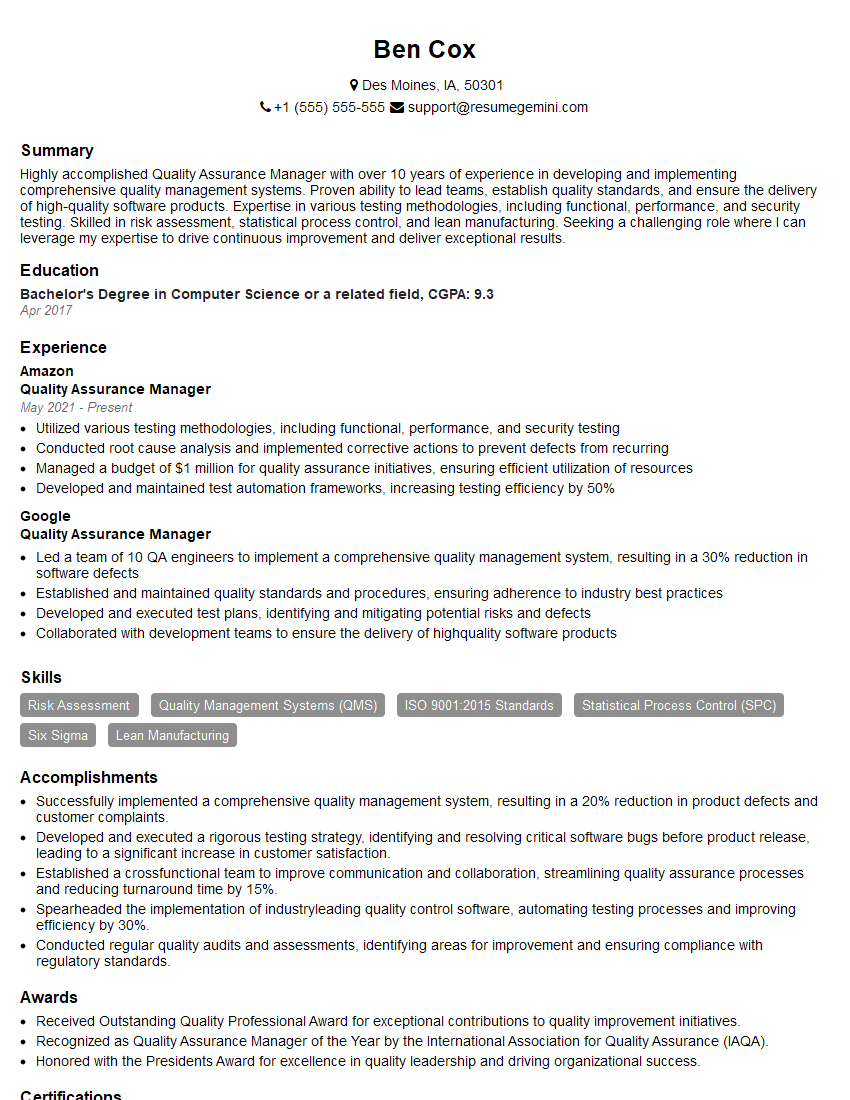
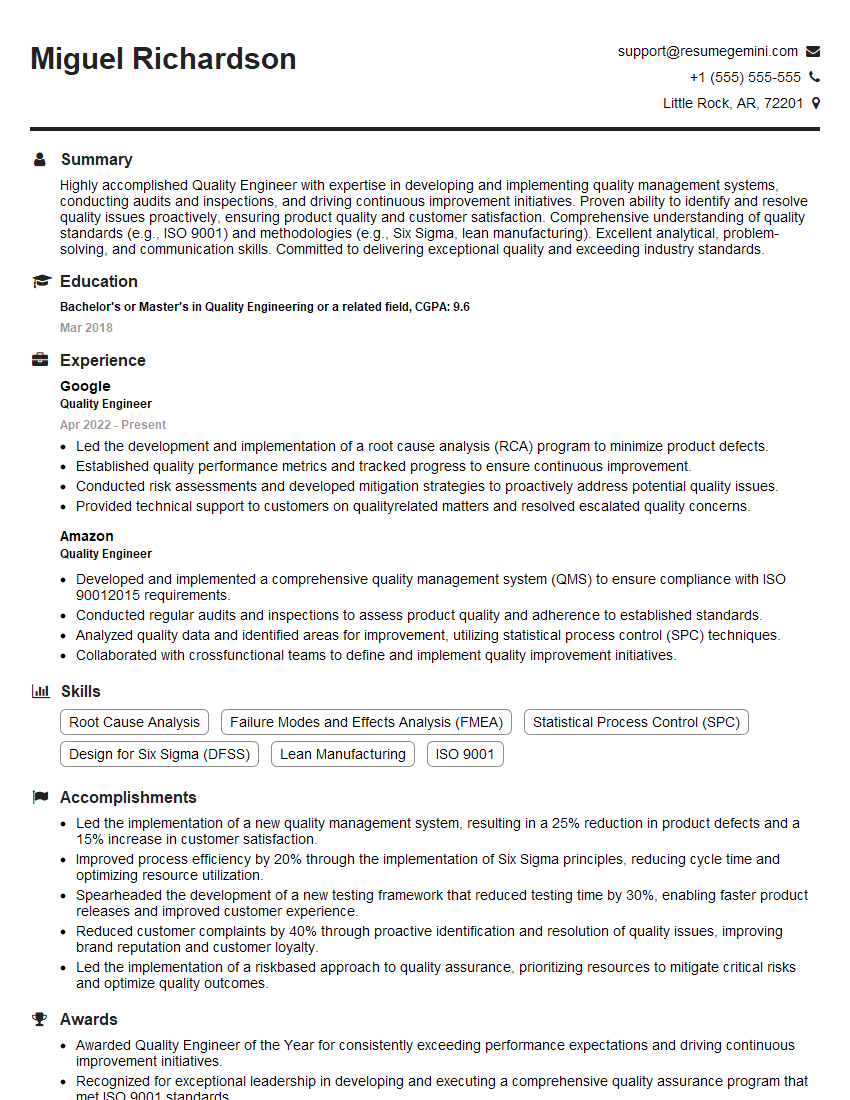
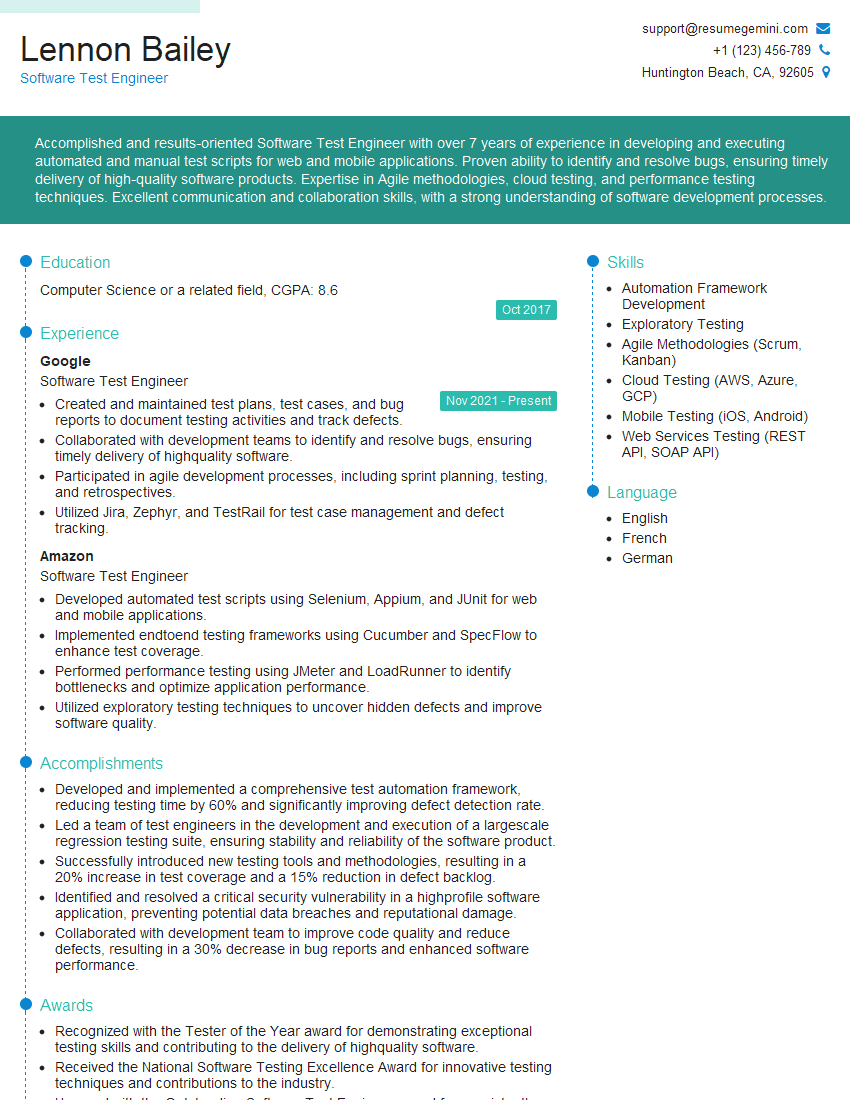
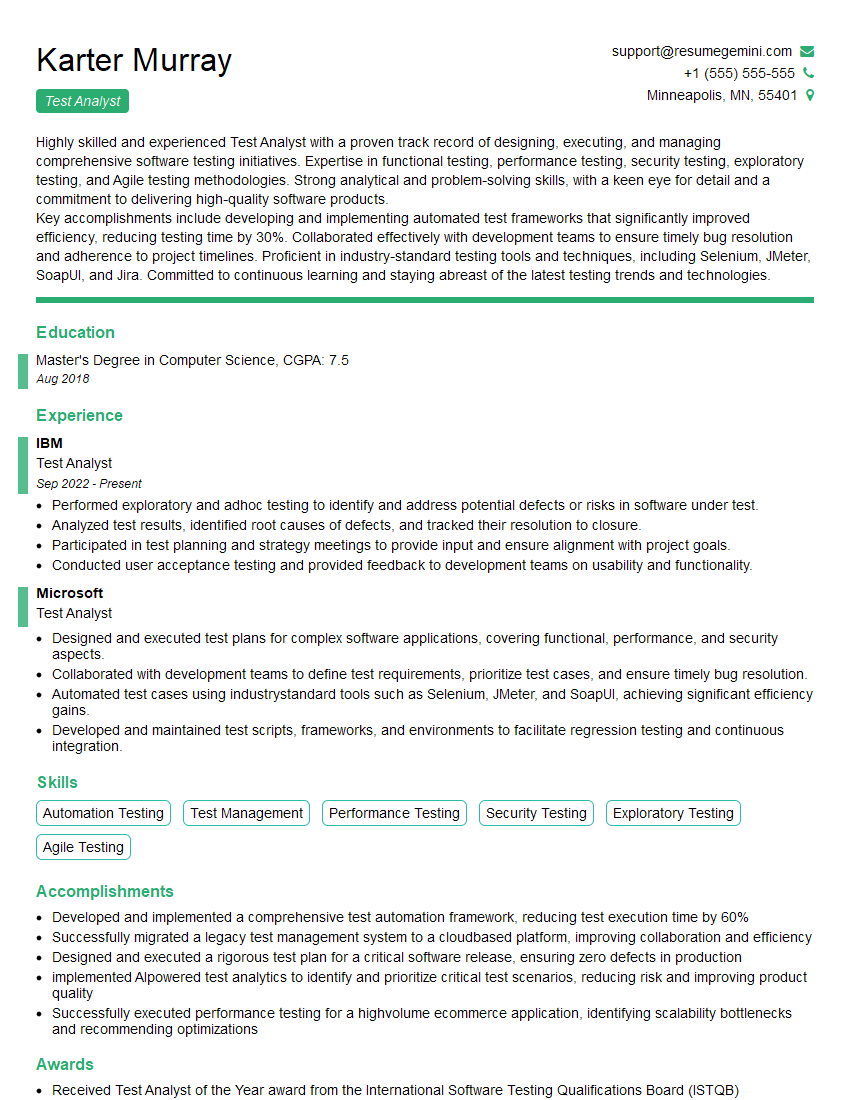
Mastering Test Process Improvement and Optimization is crucial for career advancement in the software testing field. It demonstrates a commitment to efficiency, quality, and continuous improvement – highly valued skills in today’s competitive market. To maximize your job prospects, create a compelling and ATS-friendly resume that highlights your expertise in these areas. ResumeGemini is a trusted resource for building professional resumes, and we provide examples of resumes tailored to Test Process Improvement and Optimization to help you get started.
Explore more articles
Users Rating of Our Blogs
Share Your Experience
We value your feedback! Please rate our content and share your thoughts (optional).
What Readers Say About Our Blog
Very informative content, great job.
good