Interviews are opportunities to demonstrate your expertise, and this guide is here to help you shine. Explore the essential Pattern Drafting and Grading interview questions that employers frequently ask, paired with strategies for crafting responses that set you apart from the competition.
Questions Asked in Pattern Drafting and Grading Interview
Q 1. Explain the difference between sloper and a block pattern.
Both slopers and block patterns are foundational elements in pattern making, serving as the base for creating various garments, but they differ significantly in their level of detail and intended use.
A sloper, also known as a basic block, is a foundational pattern that closely mirrors the body’s shape. It’s a highly individualized, two-dimensional representation of the body’s curves and proportions, typically drafted from a set of body measurements. Think of it as a blank canvas – a simplified, close-fitting garment pattern that captures the essential shape.
A block pattern, on the other hand, is a more developed pattern that includes design elements such as ease (extra fabric for comfort and movement), seam allowances, and sometimes basic styling details like darts or a neckline. It’s based on the sloper but adds design considerations. Imagine adding paint and brushstrokes to your blank canvas to create a more defined image.
In essence, the sloper is the purest form, while the block is an enhanced version, ready for more specific garment creation. You would use a sloper to create a block for various styles; you wouldn’t use a block directly to create a customized garment.
Q 2. Describe your experience with various pattern drafting methods (e.g., draping, flat pattern making).
My experience encompasses both draping and flat pattern making methods. Draping, a three-dimensional approach, involves manipulating fabric directly on a dress form to create the desired shape. This allows for exceptional fit and flexibility in design, particularly for complex or flowing garments. I frequently use draping for creating unique, body-skimming styles, where the fabric’s movement is crucial.
Flat pattern making, conversely, is a two-dimensional process involving creating patterns on paper using mathematical calculations and measurements. It offers greater precision and repeatability, perfect for mass production or when consistent sizing is paramount. I’ve extensively used flat pattern making for creating consistent basic patterns which then undergo grading for various sizes.
The choice between these methods depends heavily on the project; I’m comfortable and proficient in both, using whichever is most appropriate for the design and client needs.
Q 3. How do you ensure accurate grading across various sizes?
Accurate grading is crucial for producing garments in a range of sizes. I employ a combination of techniques to ensure precision.
- Understanding the body’s proportional changes across sizes: Grading isn’t simply scaling up or down; proportions shift as size increases. I factor in these nuances, paying close attention to areas like the bust, waist, and hip.
- Using specialized grading software: Sophisticated software significantly aids in this process, automating much of the calculation and ensuring consistent grading across different areas of the pattern.
- Manual adjustments and checks: Even with software, manual checks are essential. I always review the graded patterns to ensure the proportions are visually correct and make adjustments as needed, keeping in mind the grainlines and design elements.
- Creating and utilizing a grading chart: Developing a detailed grading chart ensures consistent measurements and adjustments across all sizes, facilitating quality control and maintaining pattern integrity.
Accurate grading ensures that a size 10 will fit as intended, just as a size 18 will, maintaining the design integrity across the size range.
Q 4. What software are you proficient in for pattern making and grading?
I’m proficient in several industry-standard software packages, including Pattern Design System (PDS), OptiTex, and Adobe Illustrator. PDS and OptiTex are specifically tailored for pattern making and grading, offering advanced features for automation and precise adjustments. Illustrator is invaluable for creating technical drawings and other design elements.
My expertise extends beyond software proficiency. I understand the underlying principles of pattern design and grading; software is a powerful tool, but mastering it requires a strong grasp of the fundamental principles. My experience using these tools in professional settings ensures efficiency and accuracy in the pattern creation and grading process.
Q 5. Explain the process of creating a basic bodice sloper.
Creating a basic bodice sloper is a foundational skill in pattern drafting. The process typically involves the following steps:
- Taking accurate body measurements: This is the most critical step. Inaccurate measurements will lead to a poorly fitting sloper. I use standard industry measurement techniques.
- Calculating design parameters: Depending on the style and fit desired, additional design parameters such as ease and seam allowance are calculated.
- Drafting the basic pattern: This involves drawing the sloper onto paper using precise measurements and calculations. The process is detailed and requires attention to creating accurate shapes which respect the natural curves of the body.
- Muslin fitting: Once drafted, the sloper is tested using muslin. This crucial step allows for adjustments based on the individual’s body shape.
- Refining the pattern: Adjustments are made based on the muslin fitting. This iterative process ensures the sloper sits smoothly and comfortably against the body.
The result is a customized sloper, accurately mirroring the unique proportions of the individual, providing the base for creating countless garments.
Q 6. How do you handle fit issues during the pattern making process?
Addressing fit issues is an iterative process. My approach involves:
- Identifying the issue: Carefully analyzing the fit on a muslin or first sample to pinpoint areas needing adjustment.
- Determining the cause: Understanding *why* the fit is problematic—is it incorrect measurements, design flaws, or fabric behavior?—is crucial.
- Making adjustments: This might involve adding or removing fullness, adjusting the dart placement or size, altering the neckline or shoulder line, or even re-drafting portions of the pattern.
- Testing the adjustment: The pattern is re-muslined, and the changes are evaluated before moving to final fabric. This is a crucial stage to prevent compounding errors.
Experience plays a significant role in quickly identifying and rectifying fit issues. I’ve encountered and resolved various fit challenges over the years, building a comprehensive understanding of how different adjustments affect the overall fit of a garment.
Q 7. Describe your experience with different types of fabrics and how it impacts pattern adjustments.
Different fabrics exhibit varying draping characteristics and levels of stretch, impacting pattern adjustments. For instance:
- Lightweight fabrics (like chiffon or silk): These fabrics often require less ease than heavier fabrics, as they drape more naturally. The patterns often need adjustments to prevent excessive wrinkling.
- Heavy fabrics (like denim or wool): These fabrics require more ease to allow for comfortable movement. The patterns might require adjustments to accommodate their weight and structure.
- Stretch fabrics (like jersey or lycra): These need pattern adjustments to account for their elasticity. Often, the patterns are drafted smaller to compensate for the stretch, ensuring a good fit without excess fabric.
My experience enables me to anticipate these fabric-related challenges. I account for the fabric’s properties during the design and pattern-making stages, ensuring that the final garment fits and drapes beautifully, regardless of the fabric’s inherent characteristics.
Q 8. How do you incorporate design details into existing patterns?
Incorporating design details into existing patterns is a crucial aspect of pattern drafting. It involves skillfully manipulating the base pattern to accommodate features like pockets, darts, pleats, or yokes without disrupting the overall garment fit. Think of it like sculpting – you’re starting with a basic form and adding intricate details.
My approach involves several steps:
- Identify the Design Detail: Clearly define the design detail and its placement on the garment. For example, a patch pocket on a shirt front requires precise placement points.
- Analyze the Base Pattern: Understand the existing pattern’s construction and grainlines. Adding a detail might require altering existing seams or adding new ones.
- Draft the Detail: Create a separate pattern piece for the detail (e.g., the pocket). This requires accurate measurements and consideration of seam allowances.
- Integrate the Detail: Carefully merge the detail pattern piece with the base pattern. This often requires redrawing sections of the base pattern to accommodate the added feature. Marking the placement of the detail precisely is crucial.
- Test and Refine: A muslin test is essential to check the fit and aesthetic of the integrated design detail. Adjustments may be needed to ensure a smooth, well-fitting garment.
For instance, adding princess seams to a basic bodice pattern requires careful manipulation of the front and back pieces, ensuring the seams run smoothly and maintain the body’s curves. I might use a combination of adding and subtracting pattern pieces to achieve this seamlessly. This is usually easier to accomplish when using a computer aided design program.
Q 9. What are the common challenges faced during pattern grading?
Pattern grading, the process of scaling a pattern to different sizes, presents several common challenges:
- Maintaining Proportions: Scaling up or down must maintain the correct proportions of the body. A simple linear scaling of all measurements can lead to ill-fitting garments, especially in areas like sleeve caps or necklines.
- Complex Design Details: Grading patterns with intricate details like darts, pleats, or curved seams requires precise adjustments to ensure these details remain proportionate and functional across sizes.
- Ease and Grainlines: Ensuring consistent ease (the extra fabric added for comfort and fit) and proper grainline orientation across all sizes is vital for a successful outcome. A poorly graded grainline can distort the garment’s shape significantly.
- Software Limitations: While grading software helps automate the process, it’s crucial to understand its limitations and always double-check the output for accuracy. The software might not accurately handle very complex design details.
- Time Constraints: Grading can be time-consuming, especially for complex garments. Efficient workflows and utilizing appropriate technology are essential for effective time management.
One common example is grading a sleeve cap: simply enlarging the entire sleeve cap proportionally can lead to bagginess or tightness, making the final garment uncomfortable.
Q 10. Explain your approach to correcting a pattern that is too tight or too loose.
Addressing patterns that are too tight or too loose requires a systematic approach. It’s like fine-tuning a musical instrument – small adjustments can make a big difference.
For a pattern that is too tight:
- Identify the Tight Areas: Determine where the pattern restricts movement or creates tension – bust, waist, hips, etc.
- Add Ease: Increase the pattern’s size in the identified areas by adding ease, which should be appropriate for the type of fabric and style of the garment. This is commonly done using a specific mathematical approach based on the body measurements.
- Adjust Seam Lines: Consider adjusting seam lines to distribute the added ease, ensuring a balanced fit.
- Test and Refine: Create a muslin to verify if the adjustments have solved the tightness issue. Further adjustments might be needed based on the muslin fitting.
For a pattern that is too loose:
- Identify the Loose Areas: Determine specific areas where the pattern hangs loosely – bust, waist, armscye, etc.
- Reduce Ease: Reduce ease in those areas, taking into account the necessary ease for the chosen fabric. Some designs need to retain certain amounts of ease for their intended look.
- Adjust Seam Lines: Shifting seam lines can sometimes improve the fit, pulling in the extra fabric.
- Test and Refine: Make a muslin and evaluate the adjustments. Multiple fitting sessions might be necessary to obtain a satisfactory fit.
Remember, the key is to make gradual adjustments and test thoroughly after each step. Rushing the process can easily lead to further fitting problems.
Q 11. How do you maintain accuracy while grading patterns?
Maintaining accuracy in pattern grading hinges on a combination of meticulous techniques and diligent attention to detail. Accuracy is paramount because even small errors can significantly impact the final garment’s fit.
- Consistent Measurement System: Adhere to a consistent system of measurement (metric or imperial) throughout the entire process, avoiding any mixing of units.
- Accurate Grading Rules: Follow precise grading rules and guidelines, typically provided by the pattern company or developed based on industry standards. This includes establishing specific grading increments for different body areas.
- Appropriate Software: Utilizing specialized pattern-grading software can automate the process, reducing the risk of manual errors and ensuring consistency across sizes. However, always double-check the software’s output manually.
- Regular Checks: Conduct regular checks throughout the grading process. This includes verifying measurements at key points and comparing the graded pieces against the original pattern. This approach catches errors early on and is far less time-consuming than fixing mistakes at the end of the process.
- Muslin Testing: Thorough muslin testing is crucial for identifying any remaining fit issues or inconsistencies after grading. It’s a crucial quality assurance step. A second muslin may even be required.
Using a combination of these methods helps to ensure the final garment will fit properly and look professional.
Q 12. How do you use measurements to ensure accurate pattern grading?
Measurements are the foundation of accurate pattern grading. They provide the numerical data needed to scale the pattern effectively while maintaining accurate proportions.
- Body Measurements: Start with accurate body measurements for the target size range. These measurements provide the basis for calculating grading increments.
- Pattern Measurements: Measure the original pattern pieces meticulously to understand the current dimensions before scaling.
- Grading Increments: Apply consistent grading increments based on the difference between the body measurements of adjacent sizes. These increments aren’t always uniform across all body areas—the bust, waist, and hip may require different grading increments.
- Proportionate Scaling: Ensure that the grading proportionally scales all areas of the pattern pieces, especially curves. This prevents distortion and maintains the design’s integrity across sizes.
- Specific Formulas: Using mathematical formulas or industry-standard grading rules can enhance accuracy. These formulas will incorporate the appropriate grading increments and ensure proportional sizing.
For example, if grading a sleeve cap, I would ensure that the increase in the cap height and width is in proportion to the increase in sleeve length and overall body size. If done incorrectly, this can lead to a very poorly fitting sleeve.
Q 13. What are your preferred methods for checking the accuracy of a graded pattern?
Checking the accuracy of a graded pattern requires a multi-pronged approach, combining visual inspection with physical verification.
- Visual Inspection: Carefully examine the graded pattern pieces, comparing them to the original pattern for consistency in shape, curve, and line.
- Measurement Verification: Measure the graded pattern pieces to ensure the measurements accurately reflect the intended size. Key points to measure include bust, waist, hip, sleeve length, etc.
- Grain Line Check: Verify that the grainline remains consistent across all sizes and orientations.
- Muslin Test: Create a muslin using the graded pattern. This is the most important verification step. Muslin testing helps identify fitting issues early on and ensures the overall fit is successful.
- Comparative Analysis: If grading multiple sizes, compare the graded patterns to each other to ensure there are no inconsistencies or sudden, unexpected shifts in shape.
One effective method I use is creating a grading summary sheet where I document all measurements for each size, allowing for quick comparison and error detection.
Q 14. How do you handle grading patterns with complex design details?
Grading patterns with complex design details requires extra care and often a deeper understanding of pattern construction. It’s like assembling a jigsaw puzzle with many small, intricately shaped pieces.
- Break Down the Design: Separate the complex pattern into simpler, manageable sections to simplify the grading process.
- Individual Grading: Grade each section individually, paying close attention to how they interact with one another.
- Grainline Management: Maintain consistent grainline orientation throughout each section and across sizes.
- Digital Tools: Utilize digital pattern-making and grading software. While software can automate some of the process, it’s crucial to double-check each step for accuracy. Specialized programs excel at adjusting curves and complex lines.
- Trial and Error: Be prepared for trial and error. You might need to make adjustments and test the pattern in muslin multiple times to perfect the fit across all sizes.
For instance, grading a yoked bodice with multiple darts and princess seams necessitates a layered approach. Each seam and dart needs to be precisely adjusted, maintaining its relation to the adjacent areas while ensuring consistent proportions across sizes. Grading must be approached piecemeal and thoughtfully to maintain overall proportion and a successful design outcome.
Q 15. Describe your experience with marker making and its relationship to pattern grading.
Marker making is the process of arranging pattern pieces efficiently on fabric to minimize waste and maximize yield. It’s intrinsically linked to pattern grading because the graded patterns – each representing a different size – are the input for marker making. The more sizes you grade, the more complex the marker becomes, requiring strategic placement of pieces to accommodate variations in size and fabric consumption.
For example, imagine grading a simple t-shirt pattern from size small to extra-large. The larger sizes will require more fabric. The marker maker needs to consider this increase in size and plan the layout accordingly to use the fabric efficiently. Inaccurate grading can lead to significant fabric waste or inefficient marker layouts, both impacting the overall profitability of the production run.
My experience encompasses both manual and computerized marker making. I’m proficient in using specialized software to create efficient markers, factoring in factors like fabric grain, nap, and print direction, alongside the graded pattern pieces.
Career Expert Tips:
- Ace those interviews! Prepare effectively by reviewing the Top 50 Most Common Interview Questions on ResumeGemini.
- Navigate your job search with confidence! Explore a wide range of Career Tips on ResumeGemini. Learn about common challenges and recommendations to overcome them.
- Craft the perfect resume! Master the Art of Resume Writing with ResumeGemini’s guide. Showcase your unique qualifications and achievements effectively.
- Don’t miss out on holiday savings! Build your dream resume with ResumeGemini’s ATS optimized templates.
Q 16. How familiar are you with different grading systems (e.g., proportionate vs. non-proportionate)?
I’m very familiar with both proportionate and non-proportionate grading systems. Proportionate grading involves scaling all pattern dimensions by a consistent factor for each size increment. It’s simpler but doesn’t always account for the nuances of human body shape variation. Think of it like enlarging a photograph – everything gets bigger uniformly.
Non-proportionate grading, on the other hand, allows for adjustments to specific areas of the pattern based on body measurements and design considerations. For instance, while the overall sleeve length may increase proportionately, the sleeve width might require a more significant adjustment to maintain proper fit in larger sizes. This offers more control and a better fit across a wider size range, although it’s more complex to execute.
I prefer non-proportionate grading because it allows me to create a more flattering and comfortable garment across different sizes. It’s a critical skill in designing for a variety of body types.
Q 17. Describe your understanding of different body types and how this impacts pattern grading.
Understanding different body types is fundamental to effective pattern grading. We don’t just increase numbers; we adapt to the shape of the body. For instance, a proportionate grading system might lead to a poorly fitting garment for someone with a larger bust or broader shoulders. Non-proportionate grading allows for adjustments to address these variations.
Consider a dress pattern. A proportionate system might simply increase the overall circumference. However, a non-proportionate system would consider the differences in bust, waist, and hip measurements for each size. This requires knowledge of standard body measurements across different sizes and shapes. This understanding is crucial because it ensures the graded pattern is not only bigger but also fits proportionally to different body shapes and avoids common issues like excessive bagginess in some areas and tightness in others.
My experience includes grading for various body types, including standard, plus size, petite, and maternity, requiring careful consideration of proportions and adjustments for the specific requirements of each body type.
Q 18. What is your experience with manual vs. digital pattern making and grading?
I have extensive experience with both manual and digital pattern making and grading. Manual methods, using tools like French curves and rulers, offer a deep understanding of the pattern itself and its construction. It allows for intuitive adjustments and a strong grasp of the design’s subtleties.
Digital pattern making software, on the other hand, significantly streamlines the process, particularly for grading. It allows for precise adjustments, quick iterations, and easy replication. Software also facilitates automation of certain aspects of grading, improving efficiency. For example, I can use software to quickly create a full size range from a base pattern and then fine-tune it based on specific body shape and design requirements.
My proficiency in both methods allows me to choose the most appropriate technique depending on the project’s complexity, time constraints, and client requirements. Often, I will employ a hybrid approach.
Q 19. How do you ensure consistent grading across different size ranges?
Consistency in grading across size ranges is paramount. To achieve this, I rely on a combination of techniques. Firstly, a well-defined grading ruleset is essential. This document clearly outlines the specific adjustments (e.g., increase in chest circumference, back width, sleeve length, etc.) for each size increment. This ensures uniformity across all sizes.
Secondly, the use of digital grading software aids immensely. Software allows for the creation of a grading rule that applies consistently to all the pattern pieces. This reduces errors that can arise from manual calculation and adjustments. Finally, meticulous checking at each stage, including creating and fitting prototypes, helps identify and rectify inconsistencies before the patterns move to production.
Consistent grading leads to consistent fit and reduces potential errors during production. It’s a sign of professionalism and efficiency.
Q 20. Explain your process for checking the accuracy of graded patterns before production.
Checking graded patterns is a crucial step before production. My process involves several layers of verification.
- Visual Inspection: I carefully review the graded patterns, comparing them to the original base pattern and checking for any anomalies or inconsistencies in the shape and proportions.
- Measurement Verification: I meticulously measure each graded pattern piece, verifying that the dimensions match the intended specifications according to my grading rules. I use a tolerance range to account for minimal variations.
- Prototyping: This is the most crucial stage. I create prototypes in muslin (a lightweight cotton fabric) for several key sizes to assess the fit and identify any needed refinements. This is especially critical for non-proportionate grading to ensure the fit is correct and flattering across the body shape.
- Software Verification: When using digital grading tools, I utilize the software’s inbuilt capabilities to check for errors and inconsistencies, ensuring the grading rules were correctly applied across all sizes.
Thorough checking at each stage helps to prevent costly errors down the line. It’s about ensuring a consistently well-fitting garment, which is fundamental to a good reputation and quality product.
Q 21. Describe a time you had to solve a complex pattern grading issue. What was your solution?
I once encountered a complex grading issue with a fitted blazer pattern. The graded larger sizes were developing unwanted wrinkles across the back. Initial proportionate grading led to this problem. It was initially puzzling because the front and sleeves graded perfectly.
My solution involved a thorough analysis of the back pattern piece. I realized the issue stemmed from the way the shoulder and back darts were graded proportionately. The larger sizes needed more shaping and adjustment to the back’s curve. Instead of simply increasing the dart length proportionately, I adjusted the dart placement to better accommodate the different back widths for each size. I also subtly adjusted the seam lines to compensate for changes in shoulder and back widths. I created a new grading rule to address this. Prototyping confirmed the fix, eliminating the wrinkles and ensuring a smooth, flattering fit across all sizes.
This experience underscored the importance of understanding the nuances of garment construction and body shape variations. It reinforced the value of meticulous analysis and iterative testing in pattern grading.
Q 22. How do you manage revisions and feedback during the pattern making process?
Managing revisions and feedback is crucial for successful pattern making. I approach this through a structured system. First, I ensure clear communication channels are established with the design team and any relevant stakeholders. This often involves regular check-in meetings and detailed progress reports.
When feedback is received, I meticulously document it, categorizing it by type (e.g., fit issues, design changes, technical adjustments). This ensures no detail is overlooked. Then, I prioritize the feedback based on its impact on the overall design and functionality. Critical changes are addressed first, while less significant ones may be tackled later or combined for efficiency.
I use digital tools like Adobe Illustrator or dedicated pattern making software to incorporate revisions, making it easier to track changes and revert if necessary. Finally, I always send a revised pattern with a clear summary of the changes made, ensuring everyone is on the same page. For instance, if a sleeve needs to be widened, I would clearly indicate the amount of adjustment and the specific areas modified, using notes or color-coding on the digital pattern.
Q 23. What are the key considerations when grading patterns for different age groups?
Grading patterns for different age groups requires understanding of body proportions and growth patterns. Children’s patterns, for example, require more significant grading adjustments than adult grading, since body proportions change drastically as a child grows. I consider several key aspects:
- Body proportions: The ratio of torso length to limb length varies greatly across age groups. Children have proportionally longer torsos and shorter limbs compared to adults. This necessitates adjustments to lengths and widths in various areas.
- Growth curves: I utilize standardized body measurement charts to accurately predict size variations for each age group. These charts provide data on average body dimensions, allowing for precise grading calculations.
- Ease allowances: The added ease (looseness) for comfort and movement needs to be adjusted based on the age group. Children often need more ease to allow for unrestricted movement, while adults may prefer a more fitted garment.
For instance, when grading a children’s dress, I might focus on adjusting the sleeve length and the bodice circumference more significantly than the hemline. Adult grading, on the other hand, often involves more subtle adjustments focused on the overall shape and fit, taking into account factors like waist circumference and hip width.
Q 24. How do you stay up-to-date with the latest industry trends and software in pattern making and grading?
Staying current in this field involves continuous learning. I regularly attend industry conferences and workshops, where I learn about the newest software and techniques from experts and peers. Trade publications and online forums provide up-to-date information on industry trends and technological advances. I also actively participate in online communities and follow industry influencers on social media platforms, exchanging ideas and knowledge. Finally, I dedicate time to exploring new software and features, experimenting with different techniques to enhance my efficiency and skillset. This could involve learning new functionalities within a software I already use, or exploring entirely new software.
Q 25. How do you manage time effectively during a busy production cycle?
Effective time management is crucial in a busy production cycle. My approach is multi-pronged. I start with detailed planning and prioritization, breaking down large tasks into smaller, manageable steps. This creates a clear workflow and allows for better tracking of progress. I utilize project management software to schedule deadlines and track progress, ensuring tasks are completed on time.
I also focus on eliminating bottlenecks in the workflow. For instance, streamlining the communication process and optimizing the pattern making process using efficient software reduces unnecessary delays. Furthermore, I strive to minimize interruptions by setting specific working blocks dedicated to specific tasks, allowing for focused work. Prioritizing tasks based on their urgency and importance is also key—addressing time-sensitive tasks first before moving on to less urgent ones.
Q 26. Describe your understanding of different ease and fit allowances.
Understanding ease and fit allowances is fundamental to pattern making. Ease refers to the extra fabric added to the garment’s basic measurements to provide comfort and ease of movement. Fit allowances, on the other hand, account for the difference between the body’s measurements and the garment’s final measurements due to fabric stretch or desired fit.
There are several types of ease:
- Fullness ease: Added to create gathers, pleats, or volume.
- Ease for movement: Provides room for ease of movement in the garment.
- Design ease: Added for a specific design effect, such as a loose-fitting silhouette.
The precise amount of ease and fit allowance depends on many factors such as the intended fit, the fabric type and the garment style. A closely fitted garment, for instance, will require less ease than an oversized garment. Mastering these allowances is a key part of creating well-fitting garments.
Q 27. How do you work with other members of the design and production team?
Collaboration is essential in pattern making and I value strong teamwork. I maintain open communication with the design team, sharing regular updates on the progress of the patterns and addressing any questions or concerns promptly. I actively participate in design meetings, offering technical input on the feasibility and functionality of designs. I ensure a smooth workflow by effectively communicating any potential issues or challenges to the production team.
Furthermore, I actively seek feedback from the team, valuing their expertise and perspectives. For instance, if the design team proposes a complex design detail, I’ll discuss the technical implications with them and suggest alternative approaches that might be more practical to produce. This collaborative approach leads to better designs and an efficient production process.
Q 28. What are your salary expectations?
My salary expectations are commensurate with my experience and expertise in pattern making and grading, and are in line with industry standards for a professional with my skillset in this region. I’m open to discussing a competitive compensation package that reflects my contributions to the company’s success.
Key Topics to Learn for Pattern Drafting and Grading Interview
- Fundamental Principles of Pattern Making: Understanding basic body measurements, drafting slopers, and the principles of garment construction.
- Drafting Techniques: Mastering various drafting methods for different garment types (e.g., blouses, skirts, trousers), including flat pattern drafting and draping techniques.
- Grading Methods: Proficiency in both manual and digital grading techniques, understanding grading rules and variations for different size ranges and body types.
- Pattern Alterations and Adjustments: Developing skills in identifying and correcting pattern fitting issues, making necessary adjustments for individual body shapes and preferences.
- Software Proficiency: Familiarity with industry-standard CAD software for pattern making and grading (mention specific software if applicable, e.g., Optitex, Gerber Accumark).
- Fabric Knowledge: Understanding the drape, grain, and behavior of different fabrics and how this impacts pattern design and grading.
- Production Techniques: Knowledge of industrial manufacturing processes, including marker making, cutting, and sewing, and how these processes relate to pattern grading.
- Problem-solving and Troubleshooting: Ability to identify and solve pattern-related problems, adapt to unexpected challenges, and offer creative solutions during the production process.
- Industry Standards and Best Practices: Understanding industry terminology, standards, and best practices related to pattern drafting and grading.
Next Steps
Mastering Pattern Drafting and Grading opens doors to exciting career opportunities in the fashion and apparel industry, offering diverse roles with excellent growth potential. To maximize your job prospects, creating a strong, ATS-friendly resume is crucial. This ensures your skills and experience are effectively communicated to potential employers.
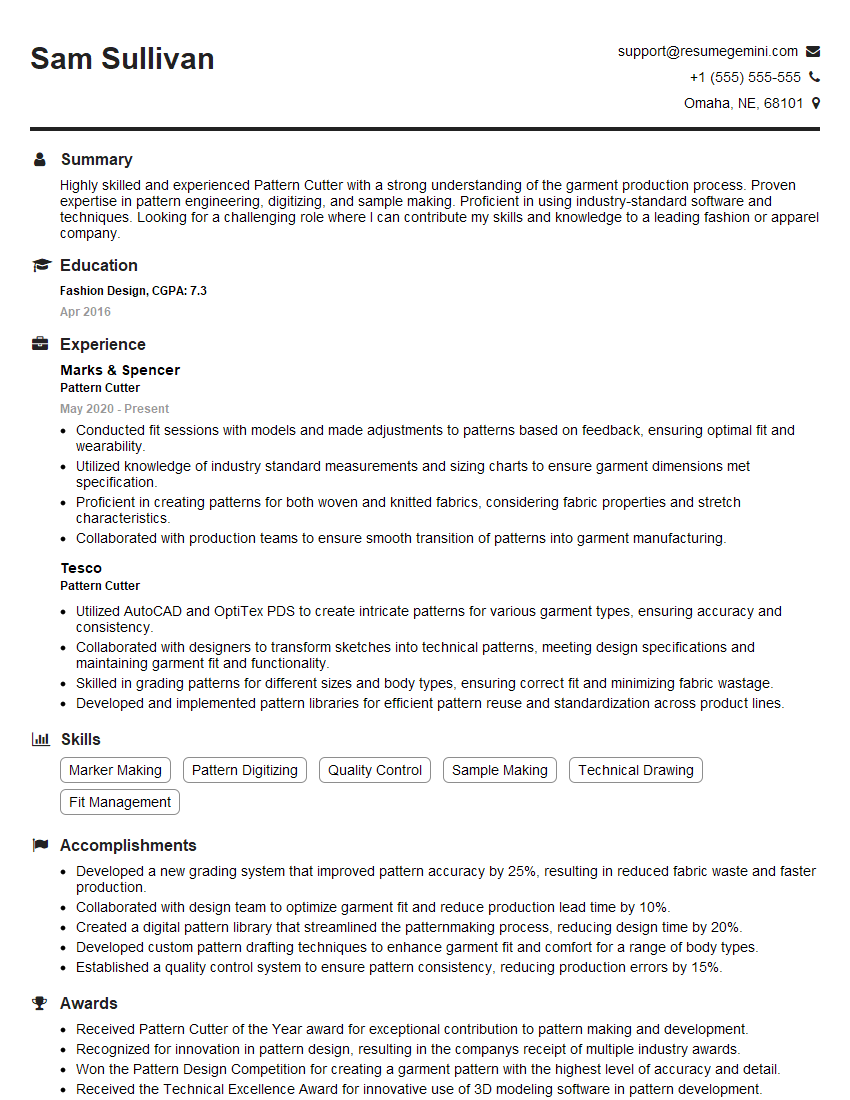
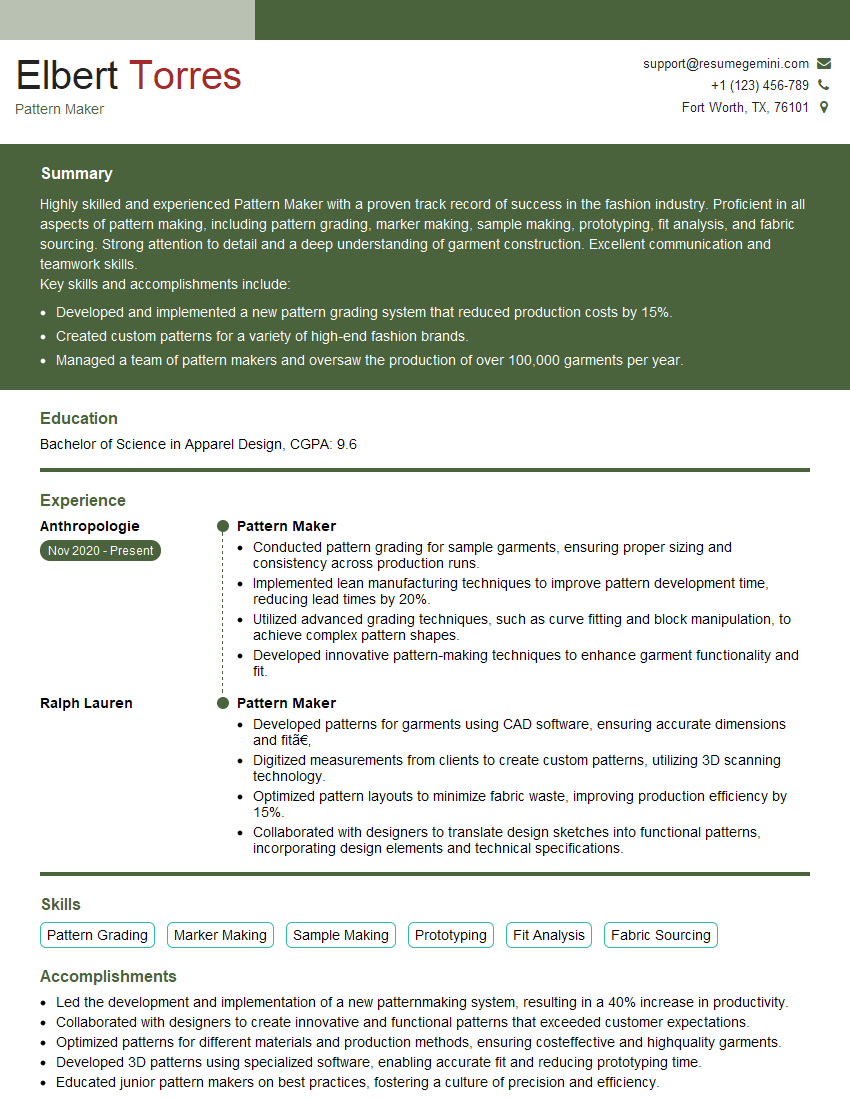
We highly recommend using ResumeGemini to build a professional and impactful resume. ResumeGemini provides a user-friendly platform and offers examples of resumes tailored specifically to Pattern Drafting and Grading, giving you a head start in showcasing your qualifications effectively. Take advantage of this valuable resource to present yourself confidently to prospective employers.





Explore more articles
Users Rating of Our Blogs
Share Your Experience
We value your feedback! Please rate our content and share your thoughts (optional).
What Readers Say About Our Blog
Very informative content, great job.
good