Preparation is the key to success in any interview. In this post, we’ll explore crucial Valve and Pipefitting interview questions and equip you with strategies to craft impactful answers. Whether you’re a beginner or a pro, these tips will elevate your preparation.
Questions Asked in Valve and Pipefitting Interview
Q 1. Explain the different types of valves and their applications.
Valves are essential components in any piping system, controlling the flow of fluids. They come in various types, each suited for specific applications.
- Gate Valves: These valves are primarily used for on/off service. They’re like a gate that either completely opens or closes, allowing for minimal restriction when fully open. Think of them as a simple switch for large diameter pipes carrying water or steam in a power plant.
- Globe Valves: These provide better flow control than gate valves, enabling throttling (reducing flow). Imagine a faucet; the flow is adjusted by a rotating disc within the valve body. They’re excellent for regulating flow rates in processes requiring precise control.
- Ball Valves: These are quarter-turn valves offering quick on/off operation. A rotating ball with a hole controls the flow. Their compact design and ease of use make them common in many applications, from domestic plumbing to industrial systems. I once used a ball valve to quickly isolate a section of pipe during an emergency repair in a chemical processing plant.
- Butterfly Valves: These consist of a disc rotating within the pipe. Like ball valves, they are usually quick-acting on/off valves but can also be used for throttling, especially in larger pipelines for things like sewage or slurry. Their low-cost and compact size makes them suitable for large-scale applications.
- Check Valves: These are self-acting valves that allow fluid flow in only one direction, preventing backflow. Think of a one-way street for fluids! They are crucial in pump systems to protect equipment from reverse flow.
The choice of valve depends critically on the fluid, pressure, temperature, and required flow control. Selecting the wrong valve can lead to inefficiencies, damage, or even safety hazards.
Q 2. Describe the process of pipefitting for high-pressure systems.
Pipefitting for high-pressure systems demands meticulous precision and adherence to strict safety protocols. The process involves careful selection of materials, precise cutting and joining techniques, and rigorous testing.
Firstly, the design must be robust to handle the pressure. We consider factors like pipe wall thickness, material strength (typically higher strength materials like stainless steel or carbon steel are used), and appropriate weld types and specifications. Secondly, the installation process must be flawless; this begins with precise measurements and alignment. For example, improper alignment can concentrate stress at joints, creating failure points. Finally, rigorous pressure testing is crucial; this involves pressurizing the system to well above the operational pressure to verify its integrity. Any leaks are identified and repaired before the system goes live. In one project involving a high-pressure gas pipeline, we employed radiographic testing (RT) to ensure the integrity of every weld in the system, adhering to stringent quality control standards.
Q 3. How do you ensure proper pipe alignment during installation?
Ensuring proper pipe alignment is paramount to prevent stress concentrations and leaks, especially in high-pressure systems. Several techniques are employed:
- Laser Alignment Tools: These provide accurate measurements and visual guides, ensuring pipes are aligned perfectly, even over long distances.
- Alignment Clamps and Guides: These aids keep pipes in place during welding or joining.
- Plumb Bobs and Levels: These tools are used for verification of vertical and horizontal alignment. A simple level can prevent many problems.
- Experienced Pipefitters: Proper training and experience are essential. A skilled pipefitter can intuitively identify and correct alignment issues based on years of experience. I remember a situation where slight misalignment was initially overlooked, only noticed by a very experienced colleague with a keen eye for detail – it potentially prevented a serious issue later on.
Regular checks throughout the installation process are critical; it’s much easier and cheaper to correct minor misalignments early than to remedy the problem after the entire system is built.
Q 4. What safety precautions are crucial when working with valves and pipes?
Safety is paramount when working with valves and pipes, especially in high-pressure systems. Key precautions include:
- Lockout/Tagout (LOTO): This procedure ensures that valves and equipment are isolated before maintenance or repair, preventing unexpected activation. It’s absolutely critical, and we rigorously enforce this on every project.
- Personal Protective Equipment (PPE): This includes safety glasses, gloves, hard hats, and appropriate clothing to protect against potential hazards like pressure releases or chemical spills.
- Confined Space Entry Procedures: If working in confined spaces like tanks or pipelines, proper entry and monitoring procedures are necessary to prevent asphyxiation or exposure to hazardous substances.
- Proper Ventilation: Adequate ventilation is necessary when working with potentially toxic or flammable materials.
- Competent Personnel: Only qualified and trained personnel should work on high-pressure systems. This includes specific training on the type of valves and pipes involved and also on the specific hazards associated with the working medium, such as the flammability and toxicity of the substance.
Regular safety training, thorough risk assessments, and adherence to safety procedures are crucial for a safe working environment.
Q 5. Explain different pipe materials and their suitability for various applications.
Different pipe materials offer varying properties, making them suitable for specific applications.
- Carbon Steel: A widely used material offering a good balance of strength, durability, and cost-effectiveness. It’s suitable for many applications, but susceptible to corrosion, especially in wet environments. Suitable for lower pressure water lines.
- Stainless Steel: Offers excellent corrosion resistance and high strength, making it ideal for harsh environments and high-pressure systems. It’s commonly used in chemical processing, food and beverage, and pharmaceutical industries. Considerably more expensive than carbon steel.
- Copper: Excellent corrosion resistance and ductility make it suitable for plumbing and low-pressure applications. Commonly found in domestic and low-pressure industrial settings.
- PVC (Polyvinyl Chloride): A lightweight and corrosion-resistant plastic pipe. It’s commonly used in water distribution systems, but its temperature and pressure limitations restrict its application.
- Ductile Iron: Extremely strong and durable, even in corrosive environments; used for high-pressure water mains and wastewater applications. A great compromise between corrosion resistance and strength, typically used in underground water pipelines.
The selection of pipe material depends on factors such as pressure rating, temperature range, fluid compatibility, environmental conditions, and cost. A cost-benefit analysis is often done to decide which material to use, often considering the lifetime cost as opposed to just the initial investment cost.
Q 6. How do you identify and address pipe leaks?
Identifying and addressing pipe leaks requires a systematic approach:
- Visual Inspection: A careful visual inspection often reveals obvious leaks, indicated by visible water, steam, or gas escaping.
- Pressure Testing: Pressurizing the system helps pinpoint leaks by observing pressure drops or detecting escaping fluid.
- Leak Detectors: Ultrasonic or acoustic leak detectors can locate leaks that are difficult to detect visually. These instruments use acoustic signals to detect the flow of gas or liquid in a pipe.
- Dye Penetrant Testing: This method involves applying a dye that penetrates cracks or pores and becomes visible after cleaning.
Once a leak is identified, the appropriate repair method is chosen. This may include replacing a section of pipe, applying a patch, or using a specialized sealant. The repair method is dependent on several factors, including the severity of the leak, the material of the pipe, and the operational pressure and temperature of the system. For example, a minor leak in a low-pressure PVC pipe might just require a sealant, while a major leak in a high-pressure steel pipe would require a section to be replaced and possibly reweld.
Q 7. Describe your experience with different welding techniques used in pipefitting.
Welding is a crucial skill in pipefitting, particularly for high-pressure systems. I’m proficient in several techniques:
- Shielded Metal Arc Welding (SMAW): A versatile and widely used technique, suitable for various pipe materials. It’s relatively simple to use, but the welder must be skilled to ensure good quality welds.
- Gas Tungsten Arc Welding (GTAW) or TIG Welding: This technique produces high-quality welds with excellent penetration and minimal distortion. It’s commonly used for stainless steel and other high-alloy materials due to its precision and clean weld appearance. Very expensive and requires significant skill.
- Gas Metal Arc Welding (GMAW) or MIG Welding: A faster and more efficient technique than SMAW or GTAW, often used for high-volume work. It’s commonly used for carbon steel pipelines, producing fairly robust welds.
Choosing the right welding technique depends on factors such as the pipe material, diameter, wall thickness, and required weld quality. It’s crucial to follow appropriate welding codes and procedures (such as ASME Section IX) to ensure the weld integrity meets the required standards and the safety of the system. All my welds are subject to quality assurance inspections, including radiography to ensure the welds are free from defects.
Q 8. Explain the importance of proper pipe insulation.
Proper pipe insulation is crucial for several reasons, primarily energy efficiency and safety. Think of it like wrapping a hot water bottle in a cozy blanket – it keeps the heat in! Insulation minimizes heat loss in hot lines, reducing energy costs and preventing wasted resources. Conversely, for cold lines, insulation prevents condensation and protects against freezing, which can cause significant damage and costly repairs. Furthermore, it enhances worker safety by reducing the risk of burns from hot pipes or frostbite from extremely cold pipes. The type of insulation depends on the application, temperature, and environment. For example, fiberglass is common for moderate temperatures, while calcium silicate is used for higher temperatures and demanding environments.
For instance, imagine a large industrial facility. Without proper insulation on steam lines, the heat loss could translate to thousands of dollars in wasted energy annually. Moreover, exposed hot pipes pose a serious burn risk to workers. A comprehensive insulation program significantly reduces both financial losses and safety hazards.
Q 9. How do you interpret piping and instrumentation diagrams (P&IDs)?
Piping and Instrumentation Diagrams (P&IDs) are the blueprints for process systems. They visually represent the flow of fluids (liquids, gases, or slurries), instruments used for monitoring and control, and the equipment involved. Think of them as highly detailed maps guiding you through a complex network of pipes, valves, and instruments. They are crucial for design, construction, operation, and maintenance.
Interpreting a P&ID involves understanding the symbols used. Each component, like a pump, valve, or heat exchanger, has a specific symbol. Lines represent pipes, arrows show flow direction, and instrument tags identify specific devices. By carefully tracing the lines and analyzing the symbols, one can understand the entire process flow and the function of each component. For example, a globe valve symbol (usually a circle with a stem) indicates a control valve for regulating flow. A specific instrument tag (e.g., PT-101) indicates a pressure transmitter at a specific location. A thorough understanding of these symbols and their arrangement allows engineers and technicians to diagnose problems, make modifications, and maintain the system efficiently.
Q 10. What are the common causes of valve failure?
Valve failure can stem from various issues. Erosion and corrosion are significant culprits, slowly degrading valve components over time, especially in harsh environments. For instance, corrosive chemicals can eat away at valve seats and stems, leading to leaks or complete failure. Similarly, abrasive fluids can erode valve parts, impacting their functionality. Another common cause is cavitation, where pressure fluctuations form bubbles that implode, damaging valve surfaces. Incorrect operation or improper maintenance also contributes significantly. Operator error, like over-tightening, can damage the internal components. Lack of regular maintenance, like lubrication, can lead to seizing or binding. Environmental factors like temperature extremes and vibrations can also negatively affect valve performance and longevity. Finally, material incompatibility, where the valve material reacts with the fluid it handles, should also be considered.
For example, a butterfly valve in a seawater application might experience accelerated corrosion due to the salt content in the water. Similarly, a control valve handling highly abrasive slurries could experience premature erosion of its trim components.
Q 11. How do you troubleshoot a malfunctioning valve?
Troubleshooting a malfunctioning valve is a systematic process. It starts with observation: Is it leaking? Is it stuck open or closed? Is there any unusual noise? Once you’ve identified the symptoms, you can start isolating the cause. This could involve checking the valve’s actuator (if applicable) for proper operation. If it’s a manual valve, check for smooth operation. Examine the valve body for any visible signs of damage like cracks or corrosion. Look for leaks around the stem packing or body seals. Then, use appropriate tools to check for pressure drops across the valve, indicating blockage or other internal issues.
A methodical approach is key. Start with the simplest checks before moving to more involved procedures. For example, if a valve is stuck, try lubricating it before assuming internal damage. If a leak is suspected, carefully inspect the packing gland, valve stem, and body joints for any signs of damage. If the issue persists, a complete valve disassembly might be necessary, potentially involving professional assistance.
Q 12. Explain the principles of hydraulic and pneumatic systems in pipefitting.
Hydraulic and pneumatic systems are utilized extensively in pipefitting for actuating valves and other components. Hydraulic systems use liquids, typically oil, under pressure to generate force. Think of a car’s brake system – pressure applied to the pedal transmits force through hydraulic fluid to the brakes. Pneumatic systems use compressed air or gas to achieve the same. Both have advantages and disadvantages. Hydraulic systems offer greater force and precision but are generally more complex and require more maintenance. Pneumatic systems are simpler, cleaner, and safer but provide less force and are more susceptible to environmental conditions.
In pipefitting, hydraulic actuators are often used for large valves requiring significant force, such as those in power plants or refineries. Pneumatic actuators are more common in smaller applications, like process control valves in chemical plants. The selection depends on factors like the required force, speed, accuracy, safety considerations, and the operating environment.
Q 13. What are the different types of pipe fittings and their applications?
Pipe fittings are connectors used to join pipes, change direction, or adapt to different pipe sizes. Common types include:
- Elbows: Change the direction of a pipe run (45-degree or 90-degree).
- Tees: Create a branch connection in a pipe line.
- Crosses: Allow for four pipe connections.
- Couplings: Join two pipes of the same size.
- Unions: Allow for pipe disassembly without cutting the pipe.
- Reducers: Connect pipes of different sizes.
- Caps: Seal the end of a pipe.
- Bushings: Reduce the size of a pipe connection.
The application of each fitting depends on the specific requirements of the piping system. For example, elbows are used to make turns, while tees are used to create branches. Reducers are used when changing pipe sizes. Unions are invaluable in systems requiring frequent maintenance or repair because they enable easy disassembly without requiring cutting.
Q 14. How do you ensure the proper sizing of pipes and valves for a given application?
Proper sizing of pipes and valves is crucial for ensuring efficient and safe operation of a piping system. It involves balancing factors like flow rate, pressure drop, and velocity. The wrong size can lead to excessive pressure drops (reducing efficiency), high velocities (causing erosion), or inadequate flow (impeding process performance). Several factors are considered, such as the fluid’s properties (viscosity, density), the required flow rate, the pipe material, and the system’s pressure. Calculations based on industry standards and engineering principles are essential. Software tools are often employed for complex systems.
For example, using a pipe that’s too small for a given flow rate results in higher pressure drops, leading to increased energy consumption and potential pump damage. Conversely, using a pipe that’s too large is wasteful and adds unnecessary cost. Valve sizing ensures they can handle the flow rate and pressure without excessive wear or failure.
Q 15. What are your experience with different types of pipe supports?
Pipe supports are crucial for maintaining the structural integrity and operational efficiency of piping systems. They prevent sagging, vibration, and stress, ensuring the system’s longevity and safety. My experience encompasses a wide range of support types, including:
- Rigid supports: These provide fixed points, restricting movement in all directions. Examples include weldments, brackets attached to structural steel, and concrete anchors. I’ve used these extensively in high-pressure applications where minimal movement is critical.
- Flexible supports: These allow for some movement to accommodate thermal expansion and contraction. Examples include spring hangers, constant support hangers, and sway braces. Selecting the appropriate spring stiffness is crucial here, and I have a lot of experience calculating that based on pipe material, temperature fluctuations, and fluid properties. I once had to troubleshoot a system where improperly sized spring hangers were causing excessive stress and potential leaks.
- Seismic restraints: Designed to secure the piping during seismic events, these are essential in earthquake-prone areas. I’ve worked with various types, including hydraulic snubbers and directional restraints, carefully calculating the appropriate restraint force to prevent damage during seismic activity.
- Variable spring hangers: These automatically adjust to compensate for changing loads and pipe weight due to fluid content or temperature changes. I prefer these for systems where fluid levels or temperatures vary significantly.
Proper support selection involves considering factors such as pipe size, material, operating pressure, temperature, and seismic conditions. I always ensure compliance with relevant codes and standards, like ASME B31.1, to guarantee safety and prevent costly failures.
Career Expert Tips:
- Ace those interviews! Prepare effectively by reviewing the Top 50 Most Common Interview Questions on ResumeGemini.
- Navigate your job search with confidence! Explore a wide range of Career Tips on ResumeGemini. Learn about common challenges and recommendations to overcome them.
- Craft the perfect resume! Master the Art of Resume Writing with ResumeGemini’s guide. Showcase your unique qualifications and achievements effectively.
- Don’t miss out on holiday savings! Build your dream resume with ResumeGemini’s ATS optimized templates.
Q 16. Describe your experience with different types of pressure testing.
Pressure testing is vital for verifying the integrity of piping systems before commissioning. My experience includes various methods:
- Hydrostatic testing: This is the most common method, using water pressure to stress the system. I’ve performed countless hydrostatic tests, meticulously documenting pressure readings, hold times, and leak detection procedures. A key aspect is accurately calculating the required test pressure and ensuring the system can safely handle it. I once had to diagnose a slow leak during a hydrostatic test by carefully observing pressure drop rates and strategically using leak detection dye.
- Pneumatic testing: Using air or nitrogen, this is faster than hydrostatic testing but requires greater caution due to the potential for catastrophic failure if a leak occurs. I have experience with pneumatic testing, emphasizing safety measures like pressure limiting valves and leak detection equipment. I find that careful preparation is crucial here, especially the thorough purging of the system of any remaining liquids.
- Leak testing: This is often conducted after the initial pressure test, using specialized equipment to detect even minor leaks. I’m proficient in various leak detection methods, such as soap solution testing and electronic leak detectors. A challenging case involved tracing a very small leak in a buried section of pipeline, which required careful excavation and diligent examination.
Regardless of the method, thorough documentation, adherence to safety protocols, and meticulous data recording are paramount. I always ensure the test procedures comply with relevant industry codes and standards.
Q 17. Explain the importance of proper drainage in pipe systems.
Proper drainage is crucial for several reasons:
- Preventing water hammer: Water hammer occurs when flowing liquid suddenly stops, creating a pressure surge that can damage the system. Proper drainage ensures there’s no trapped liquid to create this effect. I once saw a system suffer significant damage due to neglected drainage, causing a costly repair.
- Preventing corrosion: Stagnant water can cause corrosion in pipes, particularly in systems handling water or other corrosive fluids. Adequate drainage minimizes the time water stays in contact with the pipes, extending their lifespan.
- Maintaining system hygiene: Drainage is vital in systems carrying potable water or those used in hygienic applications, preventing bacterial growth and ensuring safety. Properly designed drainage systems prevent contamination and maintain water quality.
- Facilitating system maintenance: Drainage allows for easier inspection, cleaning, and maintenance of the pipes. I frequently encounter situations where inadequate drainage complicates maintenance tasks, leading to extended downtime and increased costs.
Designing an effective drainage system requires careful consideration of pipe slope, drain location, and the use of appropriate drainage fittings. Understanding the fluid properties and potential for freezing are also critical factors.
Q 18. How do you handle different types of pipe threads?
Handling pipe threads requires precision and the right tools to avoid damage and leaks. Different types of threads exist, each requiring specific tools and techniques:
- National Pipe Taper (NPT): This tapered thread is self-sealing, commonly used in North America. I use pipe wrenches, thread sealant (like Teflon tape or pipe dope), and torque wrenches to ensure a proper, leak-free seal. Over-tightening is a common mistake, potentially damaging the threads.
- National Pipe Straight (NPS): A parallel thread requiring sealing compounds. I’ve worked extensively with NPS threads, knowing that meticulous attention to thread alignment and the proper application of sealant are crucial for a successful joint.
- Metric threads: Used internationally, these require specialized tools and an understanding of the metric system. I have experience using metric dies and taps, and I am careful to follow the correct torque specifications. Mismatched threads can easily lead to leaks or damage.
Proper preparation, using the correct tools, and following best practices are critical to prevent cross-threading, thread damage, and leaks.
Q 19. How do you work safely at heights during pipefitting?
Safety at heights is paramount in pipefitting. I strictly adhere to these practices:
- Proper fall protection: This includes using harnesses, lifelines, and anchor points. I always ensure the equipment is inspected and correctly installed before commencing work. I have received specialized training in fall protection and regularly undergo refresher courses.
- Scaffolding and access equipment: I am skilled in erecting and using scaffolding, ensuring it’s stable and properly secured according to safety regulations. I only utilize certified equipment and thoroughly inspect it before each use.
- Proper training and certification: I hold all necessary certifications for working at heights, including those for specific equipment and procedures. Continuous training keeps me up-to-date on best practices and new technologies.
- Risk assessment: Before any work at heights, I conduct a thorough risk assessment, identifying potential hazards and implementing control measures. This includes planning escape routes and emergency procedures.
My commitment to safety extends beyond personal protection; I actively ensure the safety of my team members by promoting best practices and enforcing safety rules.
Q 20. What are the different types of pipe hangers and supports?
Pipe hangers and supports are critical for the proper functioning and longevity of a piping system. Several types exist:
- Rigid Hangers: These provide fixed points of support, limiting movement. Examples include weld-on brackets or clamps. I utilize these when minimal movement is required.
- Spring Hangers: These accommodate thermal expansion and contraction by using springs to adjust to changes in pipe weight and temperature. Choosing the correct spring stiffness is paramount; an improperly sized spring can cause excessive stress on the system.
- Constant Support Hangers: These maintain a consistent load on the pipe, regardless of temperature changes. I commonly use these for heavier pipes and high-temperature applications.
- Trapeze Hangers: These provide support in two directions, often used for larger pipes where stability is key.
- Snubbers: These limit movement in one direction, often used for seismic protection. They provide resistance to sudden movements but allow for normal thermal expansion.
- Variable Spring Hangers: These automatically adjust to compensate for changes in pipe weight and temperature. They are more costly but reduce stress and strain on the piping system compared to fixed or spring hangers.
The correct hanger type and installation are determined by several factors, including pipe size, weight, material, operating temperature, and seismic activity. Incorrect selection can result in significant problems, such as pipe failure, leaks, and vibration.
Q 21. Describe your experience with using different types of tools and equipment.
My experience with tools and equipment is extensive. I’m proficient in using:
- Hand tools: Pipe wrenches, pipe cutters, threaders, reamers, various types of pliers, screwdrivers, hammers, and measuring tools. I am well-versed in the proper use and maintenance of these tools to ensure safety and efficiency.
- Power tools: Electric and pneumatic impact wrenches, drills, pipe threaders, and cutting tools. I am familiar with safety regulations related to power tools and follow all protocols meticulously.
- Welding equipment: I’m proficient in various welding techniques (MIG, TIG, stick) for joining pipes and fittings. Proper welding technique is vital for ensuring structural integrity and leak prevention.
- Specialized pipefitting equipment: Benders, expansion joints, flanging tools, and various testing equipment (pressure gauges, leak detectors). I have extensive experience in using and maintaining this equipment.
- Lifting and rigging equipment: I am experienced with chains, slings, cranes, and other lifting equipment, adhering to all safety regulations for lifting and moving heavy pipes and equipment.
Proper tool selection and maintenance are critical for safe and efficient pipefitting. I regularly inspect my tools and equipment to ensure they’re in good working order, minimizing the risk of accidents and ensuring the quality of my work.
Q 22. How do you maintain accurate records and documentation of your work?
Maintaining accurate records is crucial for any valve and pipefitting project. Think of it like building a house – you wouldn’t start construction without blueprints! My approach involves a multi-layered system. First, I utilize digital documentation software to meticulously record every aspect of the project, from initial design specifications and material lists to daily progress reports and as-built drawings. This ensures easy access and searchability. Second, I maintain a physical logbook on-site. This logbook acts as a backup and provides a quick reference point for immediate issues. It includes details like valve types used, pipe dimensions, welding specifics, and any challenges encountered. Finally, I regularly back up all digital data to a secure cloud storage, mitigating the risk of data loss. This comprehensive record-keeping not only ensures compliance but also helps with troubleshooting, future maintenance, and efficient project handover.
Q 23. Describe your experience working with different types of flanges.
My experience encompasses a wide range of flanges, including slip-on, weld neck, threaded, blind, and lap-joint flanges. Each type has specific applications and advantages. For instance, slip-on flanges are quick and easy to install but may not be suitable for high-pressure applications. Weld neck flanges offer superior strength and pressure resistance, making them ideal for critical systems. Threaded flanges are practical for smaller pipes and lower pressures, while blind flanges are used for closing off pipe ends. Lap-joint flanges are commonly used with special stub ends for easier maintenance and replacement. I’ve worked with various materials too – carbon steel, stainless steel, and even exotic alloys, each selected based on the service conditions such as temperature, pressure, and corrosiveness of the medium. Selecting the right flange is key to system integrity and safety.
Q 24. Explain your knowledge of relevant codes and standards (e.g., ASME, ANSI).
My understanding of codes and standards like ASME B31.1 (Power Piping), ASME B31.3 (Process Piping), and ANSI B16.5 (Pipe Flanges and Flanged Fittings) is fundamental to my work. These standards provide detailed specifications for materials, design, fabrication, testing, and inspection. For example, ASME B31.1 dictates the requirements for the design and construction of power piping systems, ensuring they can withstand the stresses and pressures they’ll experience. I regularly consult these codes during project planning, material selection, and inspection to guarantee compliance and project safety. Ignoring these standards can lead to catastrophic failures, so adherence is non-negotiable. I also stay updated on the latest revisions and amendments to these standards through professional development courses and industry publications.
Q 25. How do you ensure compliance with safety regulations and environmental standards?
Safety and environmental compliance are paramount. Before starting any project, we conduct a thorough risk assessment, identifying potential hazards and implementing appropriate control measures. This includes providing the team with proper Personal Protective Equipment (PPE), like hard hats, safety glasses, and gloves. We strictly adhere to lockout/tagout procedures when working on live systems, preventing accidental energization. To minimize environmental impact, we manage waste materials responsibly, following regulations for disposal and recycling. We also implement measures to prevent spills and leaks, and conduct regular inspections to ensure the integrity of the pipework and its ability to prevent environmental contamination. Our commitment to safety and environmental protection is an integral part of every project.
Q 26. Describe a time you had to troubleshoot a complex pipefitting problem. What was your approach?
One time, we encountered a persistent leak in a high-pressure steam line. Initially, we suspected a faulty weld, but after thorough inspection, found no visible defects. My approach involved a systematic troubleshooting process. First, we meticulously checked all pressure gauges and isolation valves, ensuring accurate readings and proper operation. Second, we performed a dye penetrant test to detect any microscopic cracks that weren’t visually apparent. Third, we employed ultrasonic testing to assess the integrity of the pipe wall. This revealed a small, internal crack that the initial visual inspection missed. We carefully planned the repair, ensuring minimal downtime, by isolating the affected section and replacing the damaged pipe segment. This systematic approach, based on eliminating possible causes one by one, highlighted the importance of comprehensive testing and thorough investigation when troubleshooting complex issues.
Q 27. How do you plan and execute a large-scale pipefitting project?
Planning and executing a large-scale pipefitting project requires careful organization and meticulous attention to detail. It begins with a thorough review of the project specifications, including piping and instrumentation diagrams (P&IDs), isometric drawings, and material specifications. Next, I develop a detailed project schedule, breaking down the work into manageable tasks, allocating resources (personnel, equipment, materials), and establishing clear timelines. I utilize project management software to track progress, manage resources, and identify potential delays. Regular progress meetings with the team are held to address challenges and maintain communication. Safety is integrated at every stage, and quality control inspections are conducted at various points throughout the project, ensuring compliance with codes and specifications. Finally, comprehensive documentation is maintained, creating a complete record of the entire process.
Q 28. What are your strengths and weaknesses as a valve and pipefitting professional?
My strengths lie in my problem-solving abilities, meticulous attention to detail, and my ability to work effectively both independently and as part of a team. I am highly proficient in reading and interpreting technical drawings and specifications, and I possess a deep understanding of relevant codes and standards. A weakness I’m actively working to improve is delegation. While I have strong technical skills, learning to effectively delegate tasks to others will allow me to manage larger projects even more efficiently, leading to increased productivity and enhanced teamwork. I’m currently enrolled in a project management course to enhance my abilities in this area.
Key Topics to Learn for Valve and Pipefitting Interview
- Valve Types and Operation: Understanding different valve types (gate, globe, ball, check, etc.), their functionalities, and appropriate applications in various piping systems. This includes knowing their limitations and potential failure points.
- Pipefitting Techniques: Mastering practical skills like pipe cutting, threading, bending, welding (different types), and joining techniques. Be prepared to discuss different pipe materials and their suitability for specific applications.
- Pressure and Flow Calculations: Understanding fundamental fluid mechanics principles, including pressure drop calculations, flow rate determination, and the impact of valve selection on system performance. This often involves using industry-standard formulas and tools.
- Safety Procedures and Regulations: Demonstrate a thorough understanding of relevant safety regulations, including lockout/tagout procedures, confined space entry protocols, and hazard identification and mitigation strategies.
- Blueprint Reading and Interpretation: Proficiency in reading and interpreting piping and instrumentation diagrams (P&IDs), isometric drawings, and other technical blueprints to understand system design and layout.
- Troubleshooting and Problem-Solving: Discuss your approach to diagnosing and resolving common pipefitting and valve-related issues. Examples might include leak detection, pressure imbalances, or malfunctioning valves.
- Material Selection and Compatibility: Understanding the properties of different pipe materials (steel, PVC, copper, etc.) and their compatibility with various fluids and operating conditions. This includes corrosion considerations.
- Instrumentation and Control Systems: Familiarity with basic instrumentation used in piping systems (pressure gauges, flow meters, level sensors) and their integration with control systems.
Next Steps
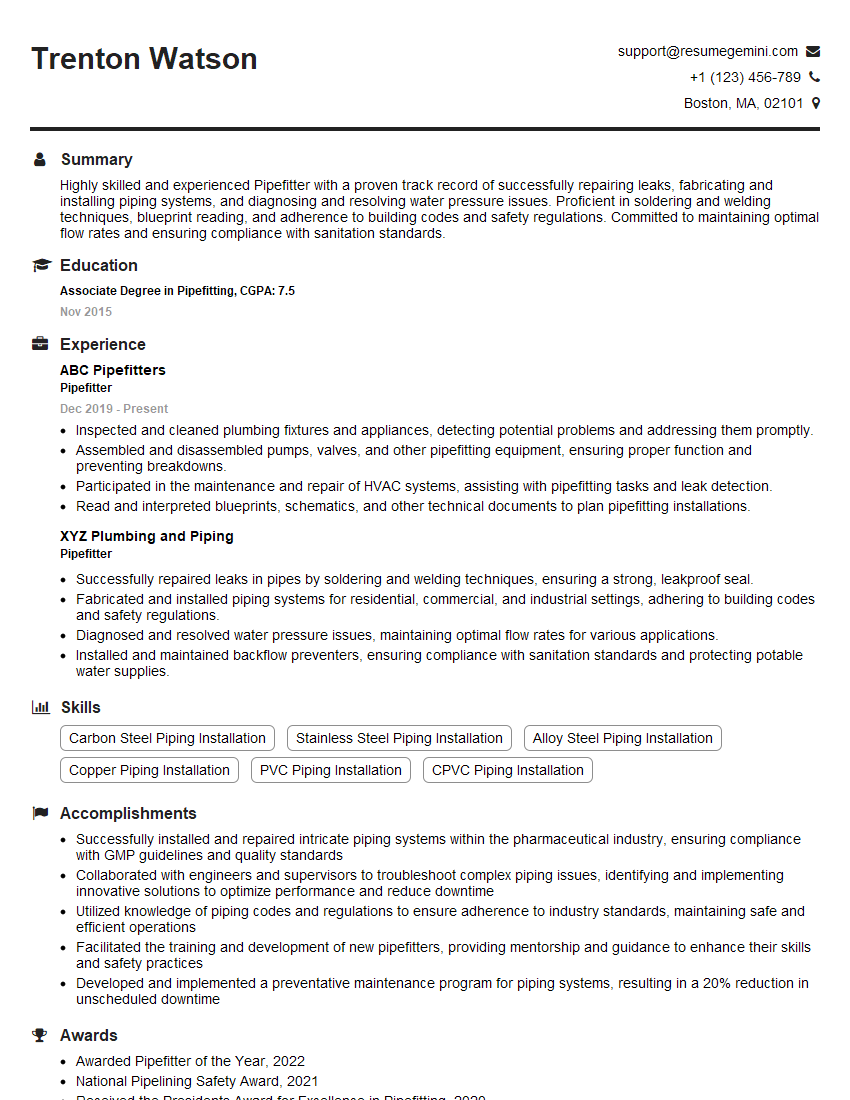
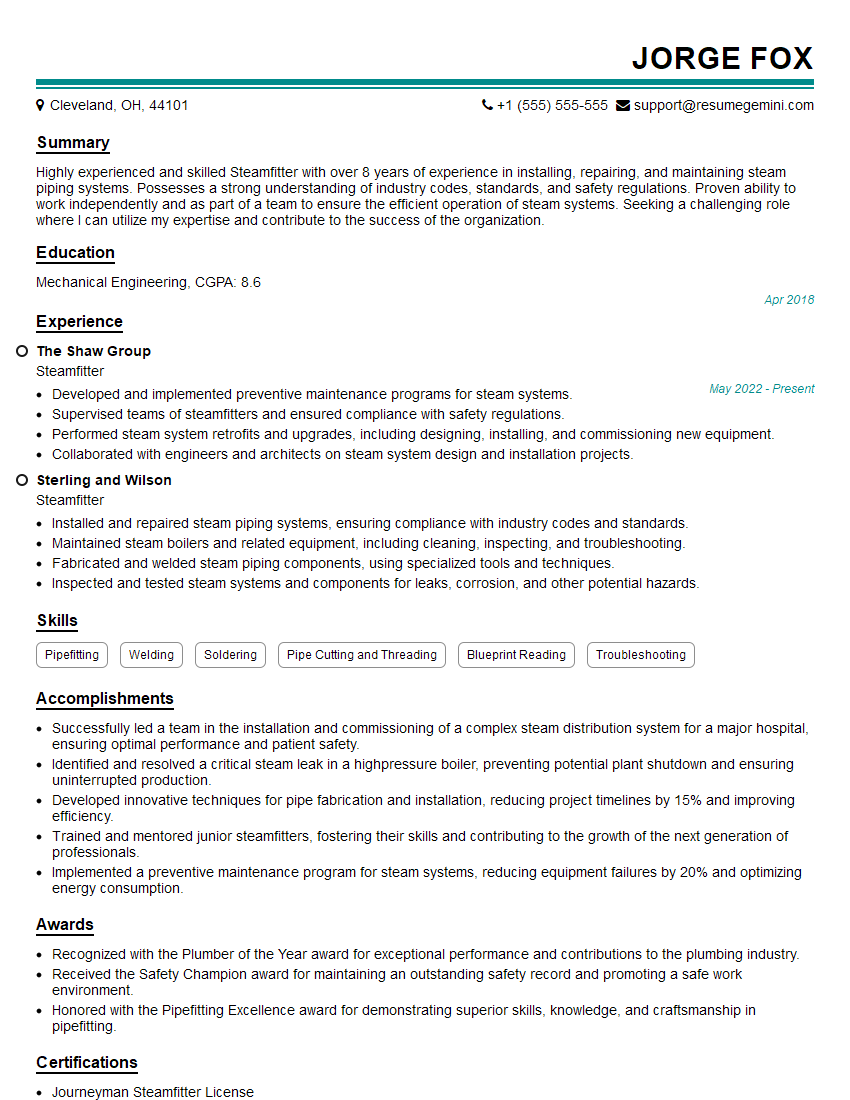
Mastering Valve and Pipefitting is crucial for a successful and rewarding career in a high-demand field. This expertise opens doors to various opportunities with excellent growth potential. To increase your chances of landing your dream job, focus on creating a professional and ATS-friendly resume that highlights your skills and experience effectively. ResumeGemini is a trusted resource that can help you build a compelling resume that showcases your abilities to potential employers. Examples of resumes tailored to the Valve and Pipefitting industry are available to guide you, ensuring your application stands out from the competition.
Explore more articles
Users Rating of Our Blogs
Share Your Experience
We value your feedback! Please rate our content and share your thoughts (optional).
What Readers Say About Our Blog
Very informative content, great job.
good