Interviews are more than just a Q&A session—they’re a chance to prove your worth. This blog dives into essential Expertise in Bridal Couture and Eveningwear interview questions and expert tips to help you align your answers with what hiring managers are looking for. Start preparing to shine!
Questions Asked in Expertise in Bridal Couture and Eveningwear Interview
Q 1. Describe your experience with different bridal fabrics and their suitability for various designs.
Selecting the right fabric is paramount in bridal and evening wear design. It impacts drape, texture, and the overall aesthetic of the garment. My experience encompasses a wide range of fabrics, each with unique properties and suitability for different designs.
- Silk: A luxurious choice, silk offers a beautiful drape and sheen. Different types like charmeuse (smooth, lustrous), crepe de chine (slightly textured), and silk organza (crisp and sheer) allow for diverse design possibilities. A flowing A-line gown would benefit from charmeuse, while a structured ballgown might utilize silk taffeta for its body and hold.
- Lace: From delicate Chantilly to bold Alençon, lace adds intricate detail and romance. Its weight and opacity vary greatly, impacting its suitability. Delicate lace is perfect for overlays or bodice details, while heavier lace can be used for entire gowns, though careful consideration of lining is needed.
- Tulle: A lightweight netting, tulle creates volume and movement. It’s often used for skirts, overlays, and veils. Soft tulle provides a delicate flutter, while stiffer tulle offers more structure.
- Satin: Known for its smooth, glossy surface, satin lends itself to sleek and glamorous designs. Its weight can range from lightweight to heavy, impacting its drape. Heavy satin might be best for a sheath gown, while lightweight satin is perfect for a flowing mermaid style.
- Brocade: A heavier, richly textured fabric, brocade is ideal for statement pieces. Its intricate woven patterns add visual interest and opulence, making it perfect for more formal gowns.
Choosing the right fabric is a collaborative process with the client, taking into account their body type, the design aesthetic, and the overall feel of the garment.
Q 2. Explain your process for creating a bridal gown from initial sketch to final product.
Creating a bridal gown is a meticulous process that begins long before the needle touches the fabric. It’s a journey of collaboration and craftsmanship.
- Initial Consultation & Design Development: I begin by meeting with the bride to understand her vision, style preferences, and body type. We discuss design elements, fabrics, and budget. This initial consultation inspires sketches and mood boards that visualize the gown.
- Sketching and Technical Drawings: I create detailed sketches and technical drawings, outlining the design’s key features, including silhouette, draping, and embellishments. This provides a blueprint for construction.
- Pattern Making: Based on the technical drawings, I create a master pattern, meticulously adjusting it for the client’s measurements. This ensures a perfect fit.
- Fabric Selection & Sourcing: After finalizing the design, we choose the appropriate fabric, considering its drape, texture, and suitability for the design.
- Draping & Muslin Fitting: I use draping techniques to perfect the fit and drape of the gown on a dress form. A muslin fitting on the bride ensures a perfect silhouette.
- Construction: The actual construction of the gown involves meticulous sewing, assembling the different components, and adding details like beading, embroidery, or lace.
- Final Fitting & Alterations: Multiple fittings with the bride ensure the perfect fit and address any necessary alterations.
- Finishing Touches: The final stage involves pressing, steaming, and adding the finishing touches, such as buttons, hooks, and zips.
Each step is crucial to ensuring the final product meets the client’s expectations and reflects the highest standards of craftsmanship.
Q 3. How do you incorporate current fashion trends into bridal and eveningwear designs?
Staying abreast of current fashion trends is essential for creating relevant and desirable bridal and evening wear. I achieve this through a multi-pronged approach.
- Fashion Publications & Shows: I regularly review fashion magazines, attend runway shows (both bridal and ready-to-wear), and follow key designers on social media to stay updated on the latest silhouettes, embellishments, and color palettes.
- Trend Forecasting Services: Utilizing trend forecasting services provides valuable insight into future directions, allowing for proactive design decisions.
- Fabric Market Research: Exploring fabric markets and suppliers reveals new materials and textures, which can inspire innovative design elements.
- Adapting Trends: It’s not just about copying trends, but about thoughtfully incorporating elements that align with my design aesthetic and the client’s personality and preferences. For instance, the current trend towards puffed sleeves might be incorporated into a bridal gown by using delicate fabric and creating a soft, romantic puff rather than a dramatic, structured one.
This careful balance of trend awareness and creative interpretation ensures the designs are fresh, modern, and timeless.
Q 4. Describe your experience with pattern making and grading.
Pattern making and grading are fundamental skills for any bridal or evening wear designer. Pattern making is the art of creating a template for a garment, while grading involves adjusting the pattern to different sizes. My experience in both is extensive.
- Drafting Patterns: I am proficient in drafting patterns from scratch using both flat pattern techniques and draping. This allows me to create unique designs with precise fit.
- Grading Patterns: I can accurately grade patterns up or down in size, ensuring consistent proportions across different sizes. This is crucial for efficient production and consistent sizing.
- Understanding Fabric Behavior: My experience extends to understanding how different fabrics behave during pattern making and grading, allowing me to adjust my patterns for optimal results. A heavy brocade will require different adjustments than a flowing silk chiffon.
- Software Integration: I utilize pattern-making software to assist in the process and ensure precision.
Proficiency in pattern making and grading is crucial to achieve impeccable fit and consistency in production, ensuring every garment created is of the highest quality.
Q 5. What software are you proficient in for design and technical drawing?
Proficiency in design and technical drawing software is essential for efficiency and accuracy. I am proficient in several industry-standard programs.
- Adobe Illustrator: I use Illustrator extensively for creating technical drawings, illustrations, and design presentations. Its vector-based format allows for precise scaling and modification.
- Adobe Photoshop: Photoshop is invaluable for manipulating images, creating textures, and enhancing visual presentations.
- CAD Software (Specific programs vary): I have experience with various CAD software for pattern making and grading, enhancing accuracy and efficiency.
My proficiency in these programs allows me to effectively communicate design ideas, create precise patterns, and manage production efficiently.
Q 6. How do you manage deadlines and work under pressure in a fast-paced environment?
The bridal and evening wear industry is fast-paced, with demanding deadlines. Managing time effectively and working under pressure is crucial. I employ several strategies.
- Detailed Planning & Scheduling: I meticulously plan each project, creating realistic timelines and allocating specific timeframes for each stage of the design and production process. This involves breaking down large projects into smaller, manageable tasks.
- Prioritization: I prioritize tasks based on urgency and importance, ensuring that critical elements receive timely attention. This often involves identifying potential bottlenecks and addressing them proactively.
- Effective Communication: Open and clear communication with clients, seamstresses, and other stakeholders is paramount. Regular updates and proactive problem-solving prevent delays and misunderstandings.
- Flexibility and Adaptability: The ability to adapt to unexpected challenges and remain calm under pressure is crucial. This often involves re-prioritizing tasks and finding creative solutions when faced with unforeseen circumstances.
By combining meticulous planning, effective communication, and adaptability, I consistently deliver high-quality work while meeting demanding deadlines.
Q 7. Describe your experience with draping techniques.
Draping is a crucial skill in bridal and evening wear design, allowing for the creation of unique and exquisitely fitted garments. My experience with draping techniques is extensive.
- Muslin Draping: I frequently use muslin, a lightweight, inexpensive fabric, to drape and manipulate fabric on a dress form. This allows for experimentation and refinement before using the final fabric.
- Understanding Fabric Drape: My understanding extends to how different fabrics drape and react to manipulation, allowing me to create designs that utilize the unique properties of each fabric.
- Creating Unique Silhouettes: Draping allows me to create unique silhouettes and shapes that are difficult, if not impossible, to achieve through flat pattern making alone.
- Advanced Techniques: My expertise includes various advanced draping techniques, like bias draping and tailored draping, to achieve specific effects.
Draping is an integral part of my design process, empowering me to create bespoke, exquisitely fitting garments.
Q 8. How do you handle client feedback and revisions?
Client feedback is crucial for creating a garment that truly reflects their vision. I handle revisions by first actively listening to the client’s concerns, ensuring I understand their perspective completely. This often involves asking clarifying questions and perhaps sketching quick modifications to visualize their requests. Then, I prioritize the feedback based on its impact on the design’s overall aesthetic and structural integrity. Minor adjustments, like a slight alteration in beading placement, are usually implemented immediately. More significant changes, such as modifying the silhouette or adding substantial embellishments, require a more detailed discussion to assess feasibility within the project’s timeline and budget. For instance, a request to add intricate lace appliqué might involve sourcing new fabric, impacting the delivery date. Transparency is key; I always communicate potential timeline or cost implications promptly and collaboratively explore alternative solutions to meet the client’s wishes while maintaining project viability.
Q 9. How do you source fabrics and trims that meet both quality and budget requirements?
Sourcing fabrics and trims that balance quality and budget is a constant challenge, but a vital skill in bridal and evening wear. My approach is multi-faceted. Firstly, I build strong relationships with reputable fabric suppliers, both domestic and international, offering a range of price points and materials. I thoroughly research the market, understanding the current offerings and sourcing new and innovative textiles. For example, I’ve recently discovered a sustainable silk supplier using innovative dying techniques, offering luxury at a more accessible price point. Secondly, I analyze the design itself, identifying areas where cost-saving measures can be implemented without sacrificing quality. Perhaps using a less expensive but equally beautiful lining in areas that are not prominently visible. Thirdly, I work closely with the client to define a realistic budget early in the design process. This allows me to make informed material choices from the outset, preventing costly surprises later on. Finally, I always thoroughly assess fabric quality – drape, durability, and colorfastness – before making a final selection. This meticulous approach ensures a beautiful, high-quality garment that remains within the agreed-upon budget.
Q 10. Explain your knowledge of different stitching techniques relevant to bridal and eveningwear construction.
Stitching techniques are the foundation of high-quality bridal and evening wear construction. My expertise encompasses a wide range, including French seams for clean, professional finishes on delicate fabrics; running stitches for delicate handwork such as beading and appliqué; blind hemming for invisible seams; and various types of seams such as flat-felled seams for durability in areas of stress. For example, French seams are essential for bridal gowns as they create a smooth, elegant finish on the inside, while flat-felled seams are ideal for the side seams of a structured evening gown to ensure durability throughout the garment’s lifetime. I also utilize specialized techniques like ladder stitching for intricate lace work, and pick stitching for attaching linings invisibly. Understanding the properties of different fabrics guides my stitching technique selection. A delicate silk chiffon would require a fine, almost invisible stitch, while a heavier brocade might need a more robust seam to maintain its shape and structure. This deep understanding of stitching techniques allows me to create garments that are both beautiful and exceptionally well-made.
Q 11. How do you ensure quality control throughout the production process?
Quality control is paramount throughout the entire production process. It starts with rigorous fabric inspection upon arrival, ensuring it meets the required standards. Throughout the construction phase, I implement regular checkpoints at key stages: after pattern cutting, after each assembly step (such as attaching sleeves or adding embellishments), and a final pre-fitting inspection. This allows for the prompt identification and correction of any flaws or inconsistencies. For example, we might use a quality control checklist during the beading process, ensuring consistent spacing and secure attachment. I also maintain meticulous documentation of every stage, including fabric type, stitching techniques used and any unique client modifications, ensuring we can easily retrace our steps and address potential issues. The final fitting serves as a critical final quality check, addressing any alterations or adjustments before the garment is completed. This multi-stage approach guarantees a high-quality final product that meets the client’s expectations and reflects my commitment to excellence.
Q 12. Describe your experience with managing a team or working collaboratively on design projects.
My experience working collaboratively on design projects has been extensive. In my previous role, I led a team of five seamstresses and pattern makers, successfully delivering complex bridal collections on time and within budget. My approach involves clear communication, assigning tasks based on individual skills, and fostering a collaborative environment where everyone feels valued and heard. For example, during one particularly challenging project involving intricate embroidery, I worked closely with the embroiderer, providing constant feedback and support to ensure the final product met the design vision. Regular team meetings, where progress is reviewed and challenges are discussed openly, are critical for effective project management. I also believe in mentoring junior team members, sharing my expertise and empowering them to develop their skills. This collaborative approach not only ensures high-quality results but also cultivates a positive and productive work environment.
Q 13. How do you stay up-to-date with the latest bridal and eveningwear trends?
Staying current with bridal and eveningwear trends requires a multifaceted approach. I regularly attend industry trade shows, such as Bridal Fashion Week, to witness firsthand the latest designs and innovations. This direct exposure to the industry’s pulse keeps my creativity sharp and my design process informed. Moreover, I subscribe to leading fashion publications, both print and online, and actively follow key designers and influencers on social media. This keeps me up-to-date on emerging color palettes, fabrics, silhouettes, and design elements. I also analyze runway shows and red-carpet appearances to understand evolving aesthetics and client preferences. Finally, I actively seek inspiration from a wider cultural landscape, exploring art, architecture, and nature for creative stimulation. This comprehensive approach ensures I remain at the forefront of bridal and eveningwear design, consistently incorporating innovative and relevant elements into my creations.
Q 14. What are your strengths and weaknesses as a designer?
My greatest strength as a designer lies in my ability to seamlessly blend creativity and technical skill. I can translate a client’s vision into a stunning reality, paying meticulous attention to detail and ensuring the final garment is structurally sound and impeccably crafted. I excel at problem-solving, adapting quickly to unforeseen challenges and finding creative solutions to ensure project success. For example, when faced with a last-minute fabric shortage, I was able to source a suitable alternative, minimizing the impact on the project timeline. However, I acknowledge that delegating tasks can sometimes be a challenge. I am working on improving my ability to trust others with responsibilities, focusing on fostering a team environment where delegation is effective and comfortable for everyone involved. This continuous self-assessment and improvement ensures I remain a well-rounded and highly effective designer.
Q 15. Describe a time you had to solve a difficult problem related to design or production.
One particularly challenging project involved creating a bespoke bridal gown with intricate beading and a complex silhouette for a client with a very specific vision. The initial design included a cascading, asymmetrical train with layers of delicate lace appliqués, all hand-beaded. The difficulty arose when we realised the weight of the beading was pulling the lace, distorting the drape.
To solve this, we employed a multi-pronged approach. First, we analyzed the weight distribution, identifying the areas of greatest stress. We then experimented with different beading techniques – using lighter beads in strategic locations, and reinforcing the lace with a lightweight interfacing without adding bulk. This involved countless hours of meticulous handwork and several rounds of fittings to adjust the pattern. Finally, we incorporated a subtle internal support structure to hold the train’s shape without compromising its ethereal quality. The final product was stunning, demonstrating our commitment to both artistic vision and structural integrity. It taught me the importance of rigorous pattern-making, meticulous attention to detail, and creative problem-solving, particularly when balancing aesthetic goals with structural limitations.
Career Expert Tips:
- Ace those interviews! Prepare effectively by reviewing the Top 50 Most Common Interview Questions on ResumeGemini.
- Navigate your job search with confidence! Explore a wide range of Career Tips on ResumeGemini. Learn about common challenges and recommendations to overcome them.
- Craft the perfect resume! Master the Art of Resume Writing with ResumeGemini’s guide. Showcase your unique qualifications and achievements effectively.
- Don’t miss out on holiday savings! Build your dream resume with ResumeGemini’s ATS optimized templates.
Q 16. What is your understanding of sustainable and ethical fashion practices in the bridal industry?
Sustainable and ethical fashion practices are paramount in the bridal industry, focusing on minimizing environmental impact and ensuring fair labor practices throughout the supply chain. This means prioritizing eco-friendly fabrics like organic cotton, hemp, or recycled materials over conventional textiles. It also involves reducing water and energy consumption during production, minimizing waste through efficient pattern cutting and production methods, and supporting fair wages and safe working conditions for garment workers.
In practice, this translates to carefully selecting suppliers committed to ethical sourcing, investing in innovative technologies to reduce waste and pollution, and actively engaging in transparency initiatives to ensure consumers know where their garments come from and how they were made. For example, we might choose a silk supplier certified by the Global Organic Textile Standard (GOTS) or opt for a lace manufacturer who employs fair trade practices. Furthermore, we encourage clients to select less resource-intensive options, such as simpler embellishments or lighter fabrics, to reduce the overall environmental footprint of their gowns.
Q 17. How do you adapt designs to different body types and sizes?
Adapting designs to different body types is crucial for ensuring every bride feels beautiful and confident. This involves understanding fundamental principles of draping and pattern making. We begin with a base pattern, then adjust it based on individual measurements and body proportions. For instance, we might add darts or shaping seams to enhance the waistline, adjust sleeve lengths and widths, or modify the neckline to complement different necklines.
For larger sizes, we prioritize using high-quality, supportive fabrics that sculpt and flatter the figure. We carefully consider seam placement to avoid adding bulk or creating unwanted lines. We also pay attention to the placement and style of embellishments, ensuring they complement the body rather than overwhelm it. It’s a collaborative process that involves working closely with the client, listening to their concerns, and offering informed advice to enhance their natural beauty and comfort. We strive to make each gown fit like a dream, regardless of the body shape or size.
Q 18. Describe your experience with bridal alterations and fitting.
Bridal alterations and fittings are an integral part of the bridal gown process, ensuring a perfect fit and flawless look on the big day. My experience encompasses everything from minor adjustments like hemming and taking in seams to more complex alterations, such as restructuring the bodice or creating custom corsetry. This involves multiple fittings, meticulous measurements, and close collaboration with the client.
Each fitting provides an opportunity for fine-tuning, addressing any concerns or issues that arise. For instance, if a bride experiences some weight fluctuations closer to the wedding, we’ll make the necessary adjustments to ensure the gown remains comfortable and flattering. We use advanced techniques to ensure minimal seam puckering and maximum comfort. We pay close attention to details like the length of the train, the positioning of buttons or closures, and overall silhouette to guarantee a perfect fit and enhance the elegance of the gown.
Q 19. How do you price your designs or contribute to pricing strategies?
Pricing strategies for bridal and evening wear designs are complex, involving numerous factors including the cost of materials, labor, design complexity, and brand positioning. The cost of fabrics, embellishments (beading, embroidery, etc.), and trims is a major component. Labor costs, factoring in the time invested in design, pattern making, cutting, sewing, and finishing are also key. The complexity of the design— intricate detailing, hand-embroidery, or bespoke elements—directly impacts pricing.
We consider market research to determine competitive pricing within our niche. Our brand positioning – whether we cater to a luxury or more accessible market – significantly influences pricing. A transparent and fair pricing structure that takes into account all the factors ensures that the client understands the value of the handcrafted garment. We provide detailed cost breakdowns to our clients and offer various options to accommodate diverse budgets, allowing them to personalize their choices based on their preferences and budget.
Q 20. What is your understanding of the retail environment related to bridal and eveningwear?
The retail environment for bridal and evening wear is highly specialized, characterized by a combination of brick-and-mortar stores, online boutiques, and independent designers. Brick-and-mortar stores often provide a personalized experience with in-house stylists and alterations services. Online retailers offer broader reach and convenience, but may lack the personalized touch.
Understanding the target market is crucial for success. Brides and clients seeking evening wear have different needs and expectations. Some prefer high-end luxury experiences, others prioritize value and affordability. Understanding these nuances and catering to the unique preferences of different segments is essential for success in this competitive market. Marketing strategies must also adapt to the evolving preferences of the target audiences, leveraging social media and digital platforms to reach potential clients. Building strong relationships with retailers and developing a compelling brand identity is also essential to carve a niche in the market.
Q 21. How do you manage inventory and stock levels?
Managing inventory and stock levels in the bridal and evening wear industry requires a delicate balance between meeting demand and avoiding excessive stock. We use a combination of forecasting techniques based on past sales data, seasonal trends, and current market demand. This forecasting allows us to estimate demand and plan production accordingly. We maintain a close relationship with our suppliers to ensure timely delivery of materials.
For bespoke designs, inventory management focuses on raw materials and components, rather than finished garments. For ready-to-wear collections, we use a Just-in-Time (JIT) inventory system, minimizing storage costs and reducing the risk of obsolescence. We track stock levels through a digital inventory management system, enabling us to monitor sales, identify popular items, and plan replenishment accordingly. Regular stock reviews help us adjust our production and purchasing strategies to meet changing customer preferences and ensure efficient inventory management.
Q 22. Describe your experience with creating mood boards and presenting design concepts.
Creating a mood board is the cornerstone of any successful design project, especially in bridal and evening wear. It’s a visual representation of the overall aesthetic direction, serving as a shared language between the designer and client. My process begins with a thorough client consultation, carefully noting their preferences, style inspiration, and the occasion. I then curate a collection of images – fabrics, colors, silhouettes, jewelry, and even inspirational locations – that reflect this initial vision. I use digital tools like Pinterest and Adobe Creative Suite to build the board, arranging elements thoughtfully to convey a cohesive narrative.
Presenting the design concept is equally crucial. I usually present the mood board alongside fabric swatches and sketches, explaining the rationale behind each choice. I encourage dialogue, actively listening to the client’s feedback to ensure alignment and refine the design based on their responses. For example, for a recent client who envisioned a bohemian-chic wedding dress, the mood board included images from vintage lace, flowing fabrics, natural flower crowns, and relaxed beach settings. This allowed me to tailor the design to perfectly capture her vision.
Q 23. Explain your experience with working with different types of embellishments and embroidery.
My experience with embellishments and embroidery spans a wide range of techniques and materials, from delicate beading and hand-sewn sequins to intricate threadwork and luxurious appliqués. I’m proficient in various embroidery styles, including French knots, couching, and shadow work. I understand the nuances of different materials, such as silk threads, metallic yarns, beads, crystals, pearls, and feathers. Knowing which embellishment complements a specific fabric and design is crucial for achieving the desired effect. For instance, delicate beadwork might be ideal for a sheer chiffon gown, while heavier embroidery would be more suitable for a structured brocade. I frequently collaborate with skilled artisans to execute intricate embellishments, ensuring high-quality workmanship and attention to detail. I recently oversaw the creation of a wedding gown featuring hand-embroidered floral motifs using hundreds of tiny seed pearls. The result was a truly breathtaking and unique piece.
Q 24. How do you handle challenging clients or unexpected situations?
Handling challenging clients or unexpected situations requires patience, diplomacy, and a proactive approach. I believe in open communication and active listening. If a client expresses dissatisfaction, I try to understand the root cause. Is it a misunderstanding of the design process? A difference in aesthetic preferences? Once I understand the issue, I work collaboratively to find a solution that satisfies both parties. For example, if there’s a discrepancy between the client’s expectations and the design, I might present revised sketches or fabric alternatives. I always maintain a professional and empathetic demeanor, ensuring that the client feels heard and valued. In unexpected situations, such as fabric shortages or production delays, I am adept at finding alternative solutions, prioritizing transparency and communication to keep the client informed every step of the way.
Q 25. What are your salary expectations?
My salary expectations are commensurate with my experience and expertise in bridal couture and evening wear design. Considering my years of experience, my proven ability to manage complex projects, and my reputation for delivering high-quality results, I am seeking a salary in the range of [Insert Salary Range Here]. I’m open to discussing this further based on the specific details of the role and the overall compensation package.
Q 26. Why are you interested in this specific role?
I’m incredibly interested in this role because it aligns perfectly with my passion for creating exquisite bridal and evening wear. [Company Name]’s reputation for innovative design and commitment to craftsmanship deeply resonates with my own values. The opportunity to contribute to a team known for its creativity and dedication is incredibly exciting. Moreover, the [specific aspects of the role – e.g., project scope, team dynamics, company culture] are particularly appealing and I believe my skills and experience would be a valuable asset to your team.
Q 27. Where do you see yourself in 5 years?
In five years, I envision myself as a leading designer within [Company Name], having made significant contributions to the brand’s success. I aim to expand my expertise in sustainable design practices and explore new technological advancements in the fashion industry. I see myself mentoring junior designers and playing a key role in shaping the creative direction of the company. Ultimately, my goal is to continue to create beautiful and timeless pieces that empower women and celebrate special occasions.
Q 28. Do you have any questions for me?
I’d be interested in learning more about the company’s current design philosophy and long-term vision. I’d also like to understand more about the team dynamics and the opportunities for professional development within the company. Finally, I’d appreciate any insights you can share regarding the specific challenges and opportunities currently facing the design team.
Key Topics to Learn for Expertise in Bridal Couture and Eveningwear Interview
- Fabric Knowledge: Understanding various fabrics (silk, lace, tulle, chiffon, etc.), their drape, texture, and suitability for different designs and body types. Practical application: Discussing appropriate fabric choices for a specific bridal gown design considering factors like season, venue, and client preferences.
- Design Principles & Aesthetics: Knowledge of silhouette, proportion, balance, and color theory as applied to bridal and evening wear. Practical application: Analyzing a design’s success based on these principles and identifying areas for improvement in a given design.
- Construction Techniques: Mastery of sewing techniques like hand-stitching, machine sewing, draping, pattern making, and finishing. Practical application: Explaining the process of creating a specific design element, such as a fitted bodice or a layered skirt.
- Pattern Making & Draping: Creating patterns from scratch or adapting existing ones to fit individual body measurements and design specifications. Practical application: Describing the challenges and solutions encountered during the pattern-making process for a complex design.
- Bridal Trends & Styles: Staying updated on current trends in bridal and evening wear design, including silhouettes, embellishments, and color palettes. Practical application: Discussing the evolution of a specific style and its relevance to contemporary design.
- Client Communication & Consultation: Effectively communicating with clients to understand their vision, needs, and preferences. Practical application: Describing your approach to managing client expectations and resolving potential conflicts.
- Production & Management: Understanding the production process, including costing, sourcing materials, managing timelines, and overseeing a team (if applicable). Practical application: outlining a step-by-step plan for executing a large-scale bridal or evening wear project.
Next Steps
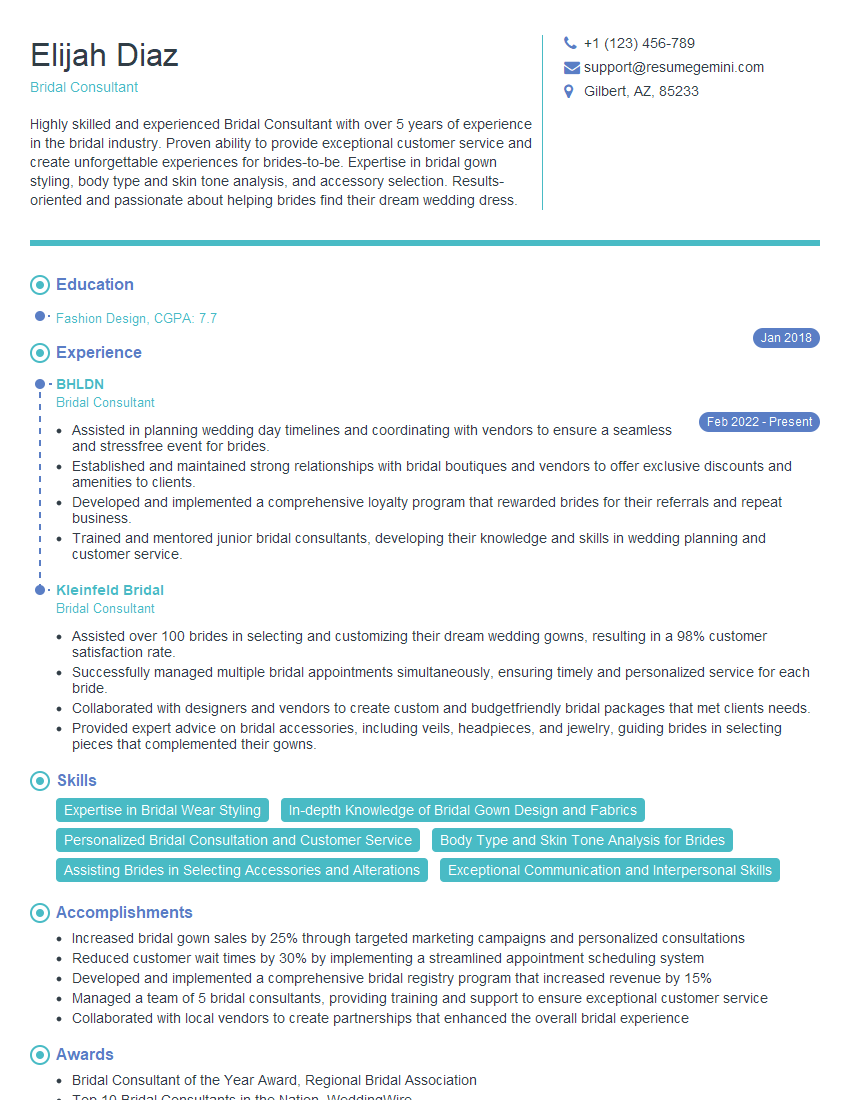
Mastering Expertise in Bridal Couture and Eveningwear is crucial for career advancement in the fashion industry, opening doors to exciting opportunities in design, production, and management. An ATS-friendly resume is vital to maximizing your job prospects. Use ResumeGemini, a trusted resource, to build a professional resume that showcases your skills and experience effectively. Examples of resumes tailored to Expertise in Bridal Couture and Eveningwear are available to help you get started. Invest in crafting a strong resume; it’s your first impression on potential employers.
Explore more articles
Users Rating of Our Blogs
Share Your Experience
We value your feedback! Please rate our content and share your thoughts (optional).
What Readers Say About Our Blog
Very informative content, great job.
good