The right preparation can turn an interview into an opportunity to showcase your expertise. This guide to Custom Tailoring and Bespoke Garment Creation interview questions is your ultimate resource, providing key insights and tips to help you ace your responses and stand out as a top candidate.
Questions Asked in Custom Tailoring and Bespoke Garment Creation Interview
Q 1. Explain the difference between bespoke, made-to-measure, and ready-to-wear garments.
The terms bespoke, made-to-measure, and ready-to-wear represent a spectrum of garment customization. Ready-to-wear (RTW) clothing is mass-produced in standard sizes. Made-to-measure involves selecting a standard pattern from existing sizes and then adjusting it to your body measurements. Think of it like buying a suit off the rack, but then having the tailor adjust the sleeves or waist. Bespoke, however, is a completely different process. It starts from scratch. Every aspect, from the pattern creation to the final stitch, is uniquely tailored to the individual client’s measurements, style preferences, and desired fabric.
- Ready-to-Wear: Off-the-rack clothing; limited customization, often fits imperfectly.
- Made-to-Measure: Starts with a standard pattern; offers some customization based on your measurements.
- Bespoke: Completely custom-made from scratch; personalized design and perfect fit.
Q 2. Describe your experience with various fabrics (e.g., wool, silk, linen).
My experience encompasses a wide range of fabrics, each with unique properties and handling requirements. Wool, for instance, offers warmth, durability, and a luxurious drape. Different weights of wool – from lightweight cashmere to heavy-weight tweed – dictate their best applications. Silk is known for its unparalleled smoothness, sheen, and breathability; it requires meticulous handling to prevent snagging or damage. Linen, a natural fiber, is celebrated for its breathability and crisp texture, but its tendency to wrinkle necessitates careful consideration of the garment design. Understanding these properties is crucial in choosing the right fabric for a specific garment and for ensuring a successful outcome.
For example, I recently worked on a bespoke suit using a super 150s merino wool for a client seeking a lightweight and luxurious feel for a summer suit. For a more formal evening wear piece, I chose a heavy silk charmeuse that draped beautifully and shimmered elegantly under the lights.
Q 3. How do you take accurate body measurements for bespoke garments?
Taking accurate body measurements is fundamental to bespoke tailoring. I use a standardized system, measuring the client in their undergarments to ensure accuracy. A skilled tailor uses multiple measurements, including the client’s posture, to account for nuances of the body. A typical process might involve over 20 measurements, covering chest, waist, hips, shoulders, sleeves, neck, inseam and more, and also includes noting any postural peculiarities. I also consider the client’s posture and any asymmetries to account for their individual shape. This is where my years of experience really come into play: I can quickly identify any unusual proportions or posture that requires adjustments to the standard measurement procedure. Precision is key – a few millimeters can make a significant difference in the final fit.
Q 4. Explain the process of creating a pattern from measurements.
Creating a pattern from measurements is a meticulous process involving drafting or manipulating existing block patterns. I utilize a combination of traditional drafting techniques and modern computer-aided design (CAD) software. The traditional method involves using specialized drafting tools and a vast knowledge of pattern design to create the pattern pieces. The CAD software allows me to make adjustments and refine the pattern more efficiently, especially when dealing with complex shapes or details. After drafting the pattern pieces, I meticulously check its accuracy against the client’s measurements before cutting the fabric to ensure a precise fit. Then, it undergoes multiple fittings and adjustments until the ideal fit is achieved.
Q 5. Describe your experience with different types of sewing machines and their applications.
My experience encompasses various sewing machines, each suited to specific tasks. Industrial sewing machines are invaluable for heavier fabrics and long seams, providing strength and consistency. Overlock machines are essential for neat and durable seam finishes. For delicate fabrics like silk, I use a walking foot machine to prevent slippage and ensure even stitching. I also utilize specialized machines like buttonhole attachments, blind stitch machines for inconspicuous hems and embroidery machines for decorative accents. The selection of the right machine is crucial for efficient and quality production.
Q 6. What techniques do you use to ensure a precise and clean finish?
Achieving a precise and clean finish is paramount in bespoke tailoring. I employ a multitude of techniques, including precise cutting, use of high-quality interfacing for structure and support, and careful seam construction. The use of hand-stitching for finishing details enhances durability, and creates a more refined aesthetic. For example, hand-stitching buttonholes and attaching linings add elegance and strength that a machine cannot replicate. The quality of the stitching and the overall presentation are critical elements that demonstrate the garment’s bespoke nature.
Q 7. How do you handle alterations and fitting adjustments?
Alterations and fitting adjustments are an integral part of the bespoke process. Typically, multiple fittings are scheduled to ensure the garment fits perfectly. During these fittings, I make detailed notes of any required adjustments. This could include minor tweaks such as sleeve length adjustments to more substantial changes like altering the waistline or shoulder fit. The adjustments are meticulously made, and the garment is re-fit until the client is entirely satisfied. Addressing client concerns and ensuring their complete satisfaction is a cornerstone of successful bespoke tailoring.
Q 8. How do you identify and address common fitting problems?
Identifying and addressing fitting problems is crucial in bespoke tailoring. It’s a process that involves careful observation, precise measurement, and a deep understanding of the human body’s unique variations. I begin by conducting a thorough fitting session, taking multiple measurements and observing the garment’s drape on the client. Common problems include:
- Shoulder fit: A poorly fitting shoulder can create unwanted wrinkles or pulling. I address this by adjusting the shoulder slope, width, and set. For instance, if the shoulder seams are too high, I’ll lower them, and if they’re too tight, I’ll ease in the fabric.
- Chest and waist: Excess fabric in the chest or waist can create a baggy appearance. I use darts, shaping, or adjustments to the pattern to achieve a tailored fit. Conversely, if the garment is too tight, I’ll let out seams or adjust the pattern for more ease.
- Sleeve length and width: Sleeve length and circumference are easily adjusted. I might need to let out or take in the seam, or even rework the sleeve cap for a perfect fit.
- Length: Adjusting the length of the garment often requires letting out or taking in the hem. For trousers, I might shorten or lengthen the inseam.
Addressing these problems often requires a combination of techniques, including pattern adjustments, seam alterations, and careful hand-stitching. For example, a client might have a slightly uneven shoulder slope. I would adjust the pattern accordingly to accommodate this and ensure a smooth, natural fit. The process is iterative; multiple fittings are often necessary to achieve perfection.
Q 9. Describe your experience with different types of closures (buttons, zippers, hooks).
My experience with different closures is extensive, encompassing the nuances of each type and their suitability for various garments.
- Buttons: I’m proficient in selecting buttons based on fabric weight, style, and desired aesthetic. I consider factors like button shank height, material (horn, shell, resin), and placement to ensure durability and a polished finish. I can hand-sew buttons securely using different techniques, including shank buttons which allow for better drape.
- Zippers: I’ve worked with various zipper types, including metal, plastic coil, and invisible zippers. My expertise extends to choosing the appropriate zipper based on the garment and its intended functionality. I know how to precisely install zippers, ensuring smooth operation and a neat finish, paying close attention to the top and bottom stops for flawless action.
- Hooks and eyes: These are often used in conjunction with other closures. I have experience selecting the appropriate size and type of hook and eye, ensuring secure closure without compromising aesthetics. Hand sewing these is crucial for strength and an almost invisible finish.
The choice of closure significantly impacts the garment’s overall look and feel. For a formal evening gown, I might opt for elegant hooks and eyes combined with a discreet zipper, while for a more casual jacket, buttons might be more suitable. It’s about choosing the right tool for the job.
Q 10. How do you manage and organize your workload and deadlines?
Managing workload and deadlines in bespoke tailoring requires meticulous organization and effective time management. I utilize a project management system that includes a detailed calendar, client communication logs and a dedicated notebook for sketching and patternmaking. This helps visualize progress, track client communications, and prevent conflicts. I prioritize tasks based on deadlines and complexity, often breaking down large projects into smaller, manageable steps.
For example, if I have several projects underway, I’ll allocate specific days or time blocks for patternmaking, cutting, sewing, and fittings. This structured approach minimizes stress and ensures that I meet each deadline without compromising quality. Regular communication with clients is vital to keeping them informed of progress and any potential delays. Transparency builds trust and helps manage expectations.
Q 11. How familiar are you with different types of interfacing and their uses?
Interfacing plays a vital role in garment construction. It provides support and structure, enhancing the overall drape and finish. My experience spans various types:
- Woven interfacing: Offers excellent stability and crispness, ideal for collars, cuffs, and structured garments. I choose the weight based on the outer fabric – heavier fabrics require heavier interfacing.
- Fusible interfacing: Bonds to fabric using heat and pressure. It’s quick and convenient for many applications but requires careful application to avoid scorching or puckering.
- Knit interfacing: Provides flexibility and stretch, suitable for knit garments or areas requiring movement. It offers a softer, more forgiving structure than woven interfacing.
- Sew-in interfacing: Provides less structure than fusible interfacing, but avoids the issues of heat or pressure. It requires precise stitching to ensure that it is securely attached to the garment.
Selecting the right interfacing is crucial. For example, using a heavy woven interfacing on a delicate silk shirt would result in an overly stiff and unnatural feel. My expertise lies in choosing the interfacing that perfectly complements the outer fabric and intended design to achieve the desired drape and structure.
Q 12. Explain your experience with hand-stitching techniques.
Hand-stitching is a fundamental skill in bespoke tailoring, allowing for precision, durability, and a high level of finish. My experience encompasses numerous techniques, including:
- Running stitch: A basic stitch used for seams, basting, and gathering. It’s strong and versatile.
- Backstitch: Provides a very strong, secure seam, ideal for areas requiring extra durability.
- Slip stitch: Creates an almost invisible seam, perfect for hems and closures.
- Blind stitch: Similar to the slip stitch, but primarily used for hems, leaving no visible stitching on the garment’s face.
- Saddle stitch: A durable stitch often used for leather work, suitable for heavier fabrics.
Hand-stitching adds a level of detail that machine stitching can’t replicate. For example, hand-stitching a buttonhole not only ensures a precise fit and smooth operation but also adds a touch of elegance. I consider hand-stitching an integral part of the bespoke process and often use it to enhance the overall quality and durability of the finished garment.
Q 13. How do you maintain quality control throughout the garment creation process?
Maintaining quality control is paramount throughout the garment creation process. This involves a multi-faceted approach:
- Careful patternmaking and cutting: Precision in patternmaking and cutting prevents fitting issues. I double-check all measurements and use high-quality fabrics and tools.
- Meticulous sewing techniques: I employ precise stitching and consistent seam allowances, paying attention to detail at every stage.
- Regular fittings: Multiple fittings allow for adjustments and corrections, ensuring a perfect fit. I actively seek client feedback during each fitting to address any concerns.
- Quality materials: I use premium fabrics, threads, and interfacing which contribute to the garment’s overall quality and longevity.
- Final inspection: Before delivery, I conduct a thorough final inspection, checking for any imperfections or inconsistencies. This is the last chance to ensure that everything is perfect.
Quality control is not a single event but a continuous process. For instance, I always take time to press each seam thoroughly to enhance the garment’s overall appearance and maintain its shape. This attention to detail is what sets bespoke tailoring apart.
Q 14. Describe your experience working with clients to understand their style preferences.
Understanding a client’s style preferences is crucial in creating a truly bespoke garment. I approach this through a collaborative process, beginning with an initial consultation.
This consultation involves detailed discussions regarding the client’s lifestyle, personal style, and desired functionality of the garment. I review mood boards, images and past garment experiences to better understand their preferences. We discuss fabric options, design elements, and construction details. I might ask questions about their typical outfits, favorite colors, and clothing silhouettes. I might show examples of my past work to inspire ideas and help the client visualize the potential outcome.
One memorable experience involved a client who loved vintage military styling but wanted a modern twist. We collaborated to create a beautifully tailored, custom-made suit that incorporated classic elements such as structured shoulders and detailed stitching, while using modern fabrics and a contemporary fit. This resulted in a truly unique garment that perfectly reflected the client’s personality and preferences.
Q 15. How do you communicate effectively with clients about design and fitting details?
Effective communication with clients regarding design and fitting is paramount in bespoke tailoring. I begin by actively listening to their vision, understanding their lifestyle, and the occasions they intend to wear the garment. Visual aids, such as fabric swatches, style books, and even sketches, are crucial. I then translate their preferences into technical details, explaining the implications of fabric choices, construction methods, and design elements on the final fit and drape. For example, if a client wants a slim-fitting suit, we discuss the impact on movement and comfort, perhaps suggesting slight adjustments for ease of wear. During fittings, I use precise terminology to describe alterations—’take in the waist by half an inch,’ ‘ease the shoulder slightly’—and explain the reasoning behind any adjustments. Throughout the process, I maintain open communication, addressing any concerns or questions promptly and ensuring the client feels involved and confident every step of the way. Regular updates, both in person and digitally (via photos or videos), keep the client informed of progress.
Career Expert Tips:
- Ace those interviews! Prepare effectively by reviewing the Top 50 Most Common Interview Questions on ResumeGemini.
- Navigate your job search with confidence! Explore a wide range of Career Tips on ResumeGemini. Learn about common challenges and recommendations to overcome them.
- Craft the perfect resume! Master the Art of Resume Writing with ResumeGemini’s guide. Showcase your unique qualifications and achievements effectively.
- Don’t miss out on holiday savings! Build your dream resume with ResumeGemini’s ATS optimized templates.
Q 16. Describe your experience with various types of linings.
My experience encompasses a wide range of linings, each selected based on the garment’s style, seasonality, and the client’s preferences. For suits, I often use high-quality Bemberg cupro linings for their luxurious feel, drape, and moisture-wicking properties. These are especially suitable for warmer climates. For colder weather garments, I might opt for heavier weight silk or wool linings for added warmth and insulation. I’m also familiar with various synthetic linings, such as polyester, which are more durable and affordable, offering excellent value for specific projects. The choice also depends on the outer fabric; a delicate silk suit requires a lightweight, smooth lining to avoid compromising the drape, whereas a heavier tweed jacket might allow for a slightly more robust lining. I’ve also worked with vibrant patterned linings for more playful or visually interesting inner details, adding a personalized touch based on the client’s style.
Q 17. Explain your process for selecting appropriate fabrics for a specific garment.
Fabric selection is a critical step in bespoke tailoring. I start by considering the garment’s intended use and the client’s lifestyle. A formal evening suit demands a different fabric than a casual summer blazer. The climate and season also play a role; lightweight linen is perfect for summer, while heavier wool is ideal for winter. The client’s personal style is also paramount: do they prefer classic, modern, or avant-garde designs? I then present a curated selection of fabrics that match these criteria, explaining the characteristics of each: fiber content (wool, silk, cotton, linen, etc.), weight, drape, texture, and durability. For example, a client desiring a breathable summer suit might be presented with various linen options, explaining the differences in weave density and sheen. We’ll discuss the fabric’s care requirements and longevity, allowing them to make an informed decision that aligns with their needs and budget. Finally, I always factor in the drape and how the fabric will fall on the body to ensure a flattering silhouette.
Q 18. What software programs are you proficient in (e.g., CAD software for pattern making)?
While I primarily rely on my pattern-making skills and experience, I am proficient in several software programs that enhance my workflow and accuracy. I utilize industry-standard CAD software like Optitex for advanced pattern design, grading, and marker making. This software streamlines the process, allowing for precise adjustments and efficient production. Furthermore, I’m comfortable using Adobe Illustrator and Photoshop for digital design work, creating mood boards and visualizing final garment details with clients. For inventory and client communication, I use specialized management software to track orders, materials, and deadlines. Proficiency in these digital tools complements my traditional skills, ensuring both accuracy and efficiency.
Q 19. How do you manage inventory and order supplies?
Inventory management is essential for efficient operations. I maintain a detailed inventory database, digitally tracking fabric quantities, colors, and types. Regular audits ensure accuracy and help anticipate potential shortages. For high-demand fabrics, I pre-order larger quantities to avoid delays, always balancing this with the risk of stock obsolescence. I organize my supplies using a systematic approach, categorizing and storing fabrics according to type, weight, and color. Ordering is done strategically; I plan orders based on current projects and anticipated demand, optimizing inventory levels and minimizing storage costs. I prioritize working with reputable suppliers who offer consistent quality and reliable delivery, fostering strong relationships to ensure timely access to materials.
Q 20. Explain your approach to problem-solving when encountering unexpected challenges during garment construction.
Problem-solving is a key aspect of bespoke tailoring. Unexpected challenges can arise during garment construction—for example, a fabric defect or an unforeseen fitting issue. My approach is systematic and methodical. First, I identify the problem precisely. Then, I assess the available solutions, considering their impact on the garment’s aesthetic and structural integrity. If a fabric defect is found, I consult with the client, presenting options such as replacing the fabric, making creative adjustments to minimize the defect’s visibility, or even using a similar replacement. For fitting issues, I utilize my expertise in pattern adjustments and draping to resolve inconsistencies. Open communication with the client is crucial, ensuring they are informed of the challenge and the chosen solution. Documentation of the problem and the resolution aids future projects and refines my problem-solving processes.
Q 21. Describe your experience with different types of pressing and finishing techniques.
Pressing and finishing are integral to achieving a high-quality, professional finish. My experience includes a range of techniques, from traditional hand-pressing using tailor’s ham and pressing cloths to utilizing specialized equipment such as industrial steam presses and vacuum tables. The choice of technique depends on the fabric and garment type; delicate fabrics require gentle hand-pressing to avoid damage, while heavier materials might benefit from the power of a steam press. I utilize different pressing techniques for specific areas—for example, using a tailor’s ham to shape the shoulders of a jacket or a sleeve roll to create a clean, crisp sleeve. Finishing techniques include hand-stitching buttonholes, attaching buttons, and cleaning and pressing the finished garment. Attention to detail in these final steps is essential for achieving the impeccable finish expected in bespoke tailoring.
Q 22. How familiar are you with the different types of seams and their applications?
Seam selection is crucial in tailoring; the choice depends heavily on the garment’s style, fabric weight, and desired aesthetic. A well-chosen seam contributes significantly to both the garment’s durability and its overall appearance.
- French Seam: This is a strong, clean seam, ideal for lightweight fabrics where a neat finish is paramount. It encloses all raw edges, making it perfect for sheer fabrics or garments that require a high level of refinement. I often use this for blouses or fine dresses.
- Flat-Felled Seam: Known for its durability and clean finish, this seam is often used in workwear and menswear. It’s particularly suitable for heavier fabrics such as denim or canvas. The overlapping construction provides exceptional strength and prevents fraying.
- Hong Kong Seam: A beautiful, hand-finished seam, where bias binding neatly encloses the seam allowance. This adds a luxurious touch and is often seen in high-end garments. I frequently use this for linings and couture pieces.
- Overlocked Seam (Serged Seam): A quick and efficient machine-finished seam, offering good durability but a less refined finish. This is often used for less visible areas or for construction speed in production runs, but I rarely opt for it in bespoke work, as it lacks the elegance required.
Choosing the right seam isn’t just about functionality; it’s about understanding the interplay between technique and the desired outcome. For instance, a French seam on a heavy tweed suit would be impractical, while a flat-felled seam on a silk slip would be too bulky and detract from the fabric’s drape.
Q 23. What is your experience with various construction methods (e.g., fused, tailored)?
My experience encompasses both fused and tailored construction methods, each with its unique strengths and weaknesses.
- Fused Construction: This method utilizes interfacing – a fabric layer – to add structure and support to the garment. It’s faster and more cost-effective, making it common in ready-to-wear. However, it can result in a less flexible and less refined feel, especially in areas with complex curves. I use fused interfacing strategically in bespoke work, mostly for areas that need less shaping, like collars or cuffs where a crisp structure is necessary.
- Tailored Construction: This method relies on careful tailoring techniques, such as hand-stitching and precise fitting, to create a structured garment without relying heavily on interfacing. It’s more labor-intensive and requires a higher level of skill, resulting in a superior drape, shape retention, and a more luxurious feel. This is my preferred method for most bespoke garments, offering unmatched elegance and longevity.
The choice between these methods often depends on the fabric, the client’s preferences, and the overall design of the garment. For instance, a lightweight silk shirt might benefit from a more tailored approach, while a structured blazer may incorporate fused interfacing in certain key areas.
Q 24. Explain your knowledge of historical tailoring techniques.
My study of historical tailoring techniques informs my modern practice. Understanding the past allows me to appreciate the evolution of construction and adapt traditional methods to meet contemporary needs and aesthetics.
- Padded Shoulders: Historically, these were constructed using layers of horsehair canvas, painstakingly shaped to create a structured silhouette. While we don’t typically use horsehair now, understanding the principles behind this technique helps me achieve similar structured shapes with modern materials.
- Hand-Stitching: Mastering hand-stitching techniques, such as hand-basting, slip-stitching, and bespoke buttonholes, allows me to create exceptionally refined and durable garments. While machines offer efficiency, hand-stitching ensures a level of precision and quality that’s unmatched.
- Cutting Techniques: Traditional cutting methods, using specialized shears and patterns tailored to individual body types, are fundamental to achieving the perfect fit. The understanding of grain lines and fabric bias is critical for achieving both functionality and aesthetic appeal.
For example, I recently incorporated a traditional French darting technique into a modern evening gown to achieve a beautiful, fluid shape. The historical knowledge enabled me to offer a unique design element with impeccable construction.
Q 25. How do you adapt your techniques for different body types and styles?
Adapting to different body types and styles is central to bespoke tailoring. It’s not simply about making adjustments to a standard pattern; it’s about understanding the nuances of individual anatomy and translating that understanding into a garment that flatters and fits impeccably.
- Detailed Measurements: I take extensive measurements, going beyond standard sizing. This includes nuanced measurements such as posture and shoulder slope, to ensure a perfect fit.
- Pattern Adjustments: I adjust the pattern based on the client’s measurements and specific needs. This often involves adjustments to the shoulder line, waistline, bust, and other critical areas.
- Muslin Mock-up: I always create a muslin mock-up to test the fit before cutting into the final fabric. This allows for necessary alterations and ensures a perfect fit.
- Client Consultation: Crucially, I spend time discussing the client’s preferences and lifestyle with them. This helps me understand the style and functionality they require from the garment.
For instance, I recently tailored a suit for a client with a pronounced swayback. By taking precise measurements and making targeted pattern adjustments, I was able to create a suit that fit perfectly and concealed this feature rather than highlighting it, creating a much more flattering silhouette.
Q 26. What are your strengths and weaknesses as a tailor?
My strengths lie in my meticulous attention to detail, my mastery of traditional and modern tailoring techniques, and my ability to build strong client relationships. I excel at creating garments that are not only beautifully constructed but also perfectly tailored to the individual. I can expertly translate a client’s vision into a tangible reality.
One of my weaknesses is my perfectionism. While it ensures a high standard of quality, it can occasionally lead to longer production times. I’m actively working on improving my time management to balance perfectionism with efficient workflow.
Q 27. Describe your experience with sustainable and ethical tailoring practices.
Sustainable and ethical practices are integral to my tailoring philosophy. I prioritize sourcing high-quality, ethically produced fabrics from reputable suppliers. I’m committed to minimizing waste by carefully planning my cutting and using scraps for smaller projects or trims.
- Fabric Selection: I focus on natural, sustainable fabrics such as organic cotton, linen, and responsibly sourced wool.
- Waste Reduction: Through meticulous pattern design and efficient cutting techniques, I strive to minimize fabric waste.
- Local Sourcing: I whenever possible try to source fabrics and supplies locally to reduce my carbon footprint.
- Fair Labor Practices: I ensure fair wages and ethical working conditions for any assistants or employees I collaborate with.
For example, I recently completed a project using a deadstock fabric sourced from a local mill, minimizing environmental impact and giving a unique character to the client’s piece.
Q 28. How do you stay up-to-date with current trends in tailoring and garment construction?
Staying current in the ever-evolving world of tailoring involves a multifaceted approach.
- Trade Publications and Blogs: I regularly read industry magazines and blogs to stay abreast of new techniques, materials, and trends.
- Industry Events and Workshops: Attending trade shows and workshops provides hands-on experience and networking opportunities.
- Collaboration and Mentorship: I engage in discussions with other tailors and designers, exchanging ideas and techniques.
- Continuous Learning: I’m always seeking opportunities to further refine my skills and knowledge through online courses and self-study.
Recently, I attended a workshop on advanced draping techniques, which allowed me to incorporate innovative design elements into my work. Continuous learning is crucial for adaptation and innovation in this dynamic field.
Key Topics to Learn for Custom Tailoring and Bespoke Garment Creation Interview
- Understanding Fabrics: Explore different fabric types (wool, silk, linen, cotton etc.), their properties, drape, and suitability for various garments and seasons. Consider how fabric choice impacts the final garment’s look and feel.
- Pattern Making & Draping: Discuss the theoretical principles of pattern making, including drafting, fitting, and adjusting patterns. Understand the practical applications of draping techniques on a dress form to create unique and personalized patterns.
- Measuring & Fitting Techniques: Master accurate body measurement techniques and demonstrate understanding of how to interpret measurements to create a precise fitting pattern. Discuss common fitting adjustments and problem-solving approaches for various body types.
- Construction Techniques: Explain your knowledge of various garment construction methods, including hand-stitching, machine stitching, pressing, and finishing techniques. Be prepared to discuss the advantages and disadvantages of different techniques.
- Design & Aesthetics: Show your understanding of design principles, such as silhouette, proportion, balance, and color theory, as applied to bespoke garment creation. Explain how you translate client preferences into a cohesive design.
- Client Consultation & Communication: Discuss the importance of effective communication with clients to understand their needs, preferences, and style. Explain how to manage client expectations and address potential concerns.
- Advanced Techniques (optional): Depending on the seniority of the role, you may be asked about more advanced techniques like bespoke shirtmaking, tailoring jackets, or specialized finishing details.
Next Steps
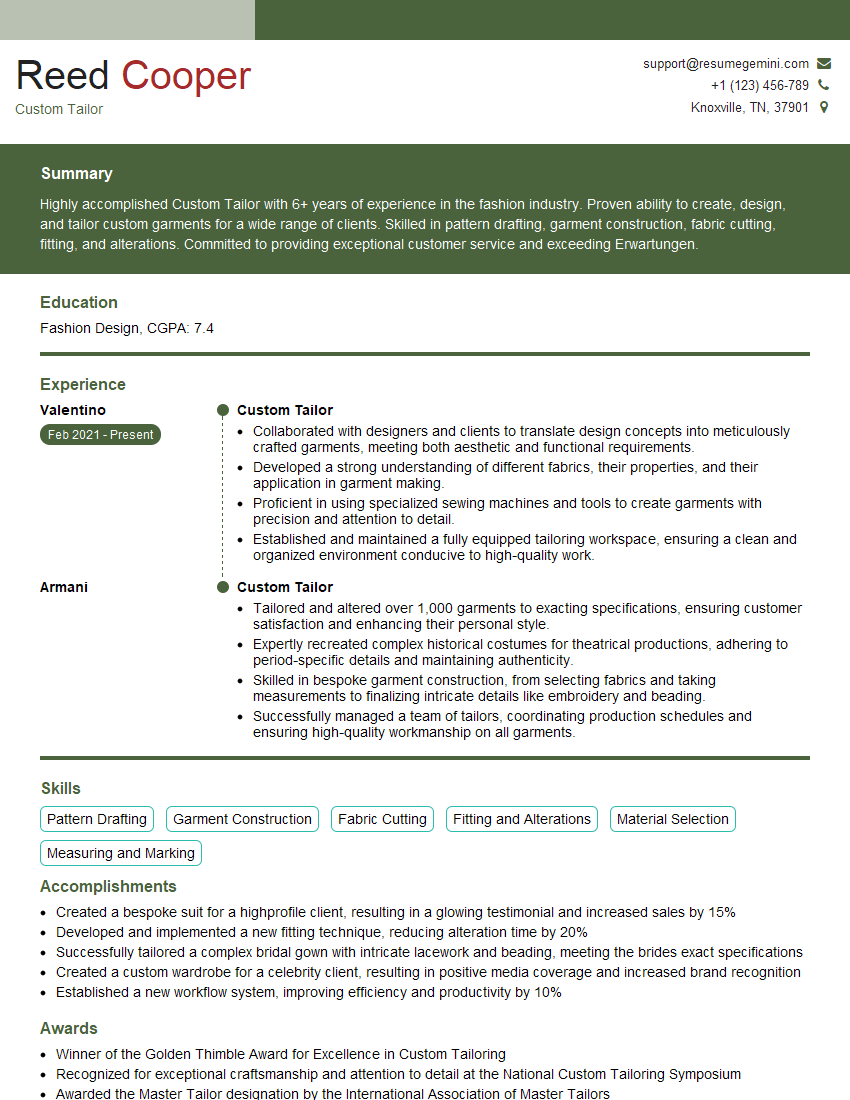
Mastering custom tailoring and bespoke garment creation opens doors to exciting career opportunities, offering high earning potential and creative fulfillment. A strong resume is crucial for showcasing your skills and experience to potential employers. Creating an ATS-friendly resume significantly increases your chances of getting noticed by recruiters. We highly recommend using ResumeGemini to build a professional and impactful resume that highlights your unique qualifications in this specialized field. ResumeGemini provides examples of resumes tailored to Custom Tailoring and Bespoke Garment Creation to help guide you.
Explore more articles
Users Rating of Our Blogs
Share Your Experience
We value your feedback! Please rate our content and share your thoughts (optional).
What Readers Say About Our Blog
Very informative content, great job.
good