Cracking a skill-specific interview, like one for GMDSS, requires understanding the nuances of the role. In this blog, we present the questions you’re most likely to encounter, along with insights into how to answer them effectively. Let’s ensure you’re ready to make a strong impression.
Questions Asked in GMDSS Interview
Q 1. Explain the different types of GMDSS distress alerts.
GMDSS (Global Maritime Distress and Safety System) utilizes several types of distress alerts, each designed for specific situations and communication capabilities. The key is choosing the appropriate alert for the circumstances to ensure the fastest and most effective response.
- Distress Alert (DSC): This is the primary distress alert, transmitted via the ship’s Inmarsat or VHF radio. It automatically includes the ship’s name, MMSI number, and position, instantly notifying the Coast Guard and other relevant authorities. Think of it as a 911 call for ships. A visual example might be a ship sinking rapidly in a storm – activating the DSC immediately gets help on the way.
- Urgency Alert (DSC): Used when there’s an urgent situation but not yet a distress. For example, a serious medical emergency requiring assistance. It alerts nearby ships and authorities that help is needed urgently. Imagine a crew member suffering a heart attack; an urgency alert would notify others to assist while seeking medical evacuation.
- Safety Alert (DSC): This alert is for situations needing assistance but not requiring urgent help, such as a loss of propulsion or a serious navigational hazard. Think of it as a slightly less critical SOS – like reporting a large floating object in a busy shipping lane.
The selection of the appropriate alert is critical. Misusing these signals can lead to delays in response or even unwanted distractions for rescue services.
Q 2. Describe the Inmarsat system and its role in GMDSS.
Inmarsat is a global mobile satellite communication system that plays a crucial role in GMDSS, particularly for ships operating in areas beyond the range of VHF radio. It provides reliable, long-range communication for distress alerts, safety messages, and routine communications. This is especially vital in remote ocean areas where other systems are not available.
Inmarsat’s role includes:
- Distress Alert Transmission: Ships equipped with Inmarsat terminals can transmit distress alerts via satellite to the appropriate coast guard authorities, regardless of their location.
- SafetyNET: This is a service provided through Inmarsat for safety-related communication among ships and shore-based facilities.
- E-mail and Data: Inmarsat provides various data and communication services.
Inmarsat’s satellite network ensures that even when a ship is far from land or other vessels, it can still communicate effectively for safety and distress purposes, bolstering the overall efficiency and reliability of GMDSS.
Q 3. What are the requirements for a GMDSS EPIRB?
An EPIRB (Emergency Position Indicating Radio Beacon) is a vital piece of safety equipment within GMDSS. It’s a self-activating beacon that automatically transmits a distress alert when activated by water activation or a manual activation switch. Here are the key requirements:
- COSPAS-SARSAT Compliance: EPIRBs must comply with the COSPAS-SARSAT (COSPAS and SARSAT are two cooperating search and rescue satellite-aided tracking systems) standards to ensure global coverage and compatibility with rescue organizations’ satellite tracking systems.
- MMSI Number Registration: Each EPIRB must be registered with a unique Maritime Mobile Service Identity (MMSI) number that provides immediate identification of the vessel in distress.
- Regular Testing and Maintenance: Regular testing is crucial to ensure the EPIRB is functioning correctly. Batteries and other components might need to be replaced periodically depending on the EPIRB model.
- Waterproofing and Durability: EPIRBs are designed to withstand harsh maritime conditions, remaining functional even after prolonged immersion in water.
- Position Reporting Accuracy: The EPIRB needs to transmit accurate location data to allow for rapid and effective search and rescue operations.
Failure to meet these requirements renders the EPIRB ineffective, potentially endangering lives at sea.
Q 4. How does the NAVTEX system work?
NAVTEX (Navigational Telex) is a broadcast service that transmits navigational warnings and meteorological information to ships at sea. This service is vital for safe navigation. It utilizes medium-frequency radio broadcasts, offering a safety net to ships that may not have satellite communications.
The system works as follows:
- Coast Stations Transmit: Coast guard stations transmit navigational warnings (such as icebergs, storms, and shipping hazards) and weather forecasts on designated frequencies.
- Ships Receive: Ships equipped with NAVTEX receivers automatically receive and print out these broadcasts, enabling the ship’s crew to stay informed of potential hazards and make necessary course adjustments.
- Geographic Coverage: NAVTEX covers designated coastal areas. The range is usually limited to around 200 nautical miles.
- Automatic Reception: Most NAVTEX receivers are programmed to receive broadcasts from specific coast stations based on the ship’s geographical position.
NAVTEX plays a critical role in enhancing the safety of navigation by ensuring mariners are aware of potential dangers before encountering them, even if they have limited communication capabilities.
Q 5. What are the responsibilities of a GMDSS operator during an emergency?
During a GMDSS emergency, the operator’s responsibilities are paramount and time-sensitive. Their actions can literally mean the difference between life and death.
- Initiate Distress Alert: Immediately initiate the appropriate distress alert (DSC) via the most effective means available. Accuracy in providing the ship’s name, MMSI number, and location is crucial.
- Relay Information: If a distress alert is received from another vessel, relay this information to the appropriate authorities. This action is important for potentially providing rapid assistance.
- Maintain Communications: Maintain open communication with rescue coordination centers (RCCs) and other involved parties, providing updates on the situation and responding to their inquiries.
- Coordinate Rescue Efforts: Assist in coordinating rescue operations by providing information about the vessel’s condition, the number of people on board, and any other relevant details.
- Follow Instructions: Strictly follow the instructions provided by the RCC or other rescue authorities.
- Document Everything: Meticulously document all communications, actions taken, and any other relevant information. This documentation will be essential for post-incident investigations.
The GMDSS operator has a huge responsibility in such situations, which requires both technical proficiency and calm decision-making under pressure.
Q 6. Explain the different types of radio equipment used in GMDSS.
GMDSS uses a variety of radio equipment depending on the vessel’s size, location, and operational needs. The key is appropriate equipment for diverse communication needs.
- VHF Radiotelephone: Used for short-range communications, particularly within coastal areas. It’s essential for contacting other vessels and shore-based authorities. A vital part of any ship.
- Inmarsat-C Terminal: Provides satellite communication for long-range distress alerts, safety communications, and data transfer.
- Inmarsat-FleetBroadband Terminal: Offers high-speed data communication via satellite.
- EPIRB (Emergency Position Indicating Radio Beacon): A self-activating beacon that automatically transmits a distress alert when activated.
- NAVTEX Receiver: Receives and displays navigational warnings and meteorological information via medium-frequency radio broadcasts.
- DSC (Digital Selective Calling) Equipment: This equipment is used to make automated distress, urgency, and safety calls to appropriate authorities.
The choice of equipment depends on various factors, but each plays a vital role in ensuring effective communication in all scenarios.
Q 7. What is the purpose of the GMDSS SafetyNET?
GMDSS SafetyNET is a crucial part of the overall GMDSS system. It’s a global network used for exchanging safety-related information among ships and between ships and shore-based facilities. Think of it as a real-time information-sharing system dedicated to safety at sea.
Its primary purpose is:
- Enhanced Safety Information Sharing: Facilitates the rapid dissemination of safety-related information, such as navigational warnings, severe weather alerts, and search and rescue (SAR) information.
- Improved Communication Efficiency: Improves the efficiency of communication between ships and shore-based facilities, especially during emergencies.
- Seafarer Safety Enhancement: By providing timely safety information, SafetyNET contributes to enhancing the safety of seafarers and preventing accidents.
- Integration with GMDSS: It complements other GMDSS services by providing an additional layer of safety and communication.
SafetyNET’s importance lies in its ability to proactively warn ships of potential dangers and facilitate quick responses in emergencies. It improves safety through better information flow.
Q 8. Describe the process for initiating a distress alert using an EPIRB.
Activating an EPIRB (Emergency Position-Indicating Radio Beacon) to initiate a distress alert is a straightforward process designed for ease of use even in critical situations. The EPIRB is typically a buoyant device, meaning it floats and transmits even if submerged. To activate it, you simply release the activation mechanism, often a pin or latch. This action triggers the internal GPS to pinpoint your location and the EPIRB will automatically transmit a distress alert via satellite to the appropriate coast guard or search and rescue authorities.
Once activated, the EPIRB transmits a unique identification number, along with its GPS coordinates, and a distress signal. This information is relayed through the COSPAS-SARSAT system, a global satellite system dedicated to search and rescue. This system alerts the relevant authorities, allowing for a swift response to your distress call. Remember, EPIRBs should only be activated in genuine life-threatening emergencies. False activations can tie up valuable resources and potentially delay assistance for those who truly need it. Always ensure the EPIRB is registered and tested regularly to guarantee optimal performance in an emergency.
Q 9. What are the limitations of VHF radio in GMDSS?
VHF radio, while a crucial part of GMDSS, has inherent limitations. Its most significant limitation is its relatively short range, typically limited to line-of-sight, approximately 50-80 nautical miles depending on antenna height and atmospheric conditions. This means VHF communication is ineffective beyond the horizon. Additionally, VHF is susceptible to interference from atmospheric conditions, including heavy rain, dense fog, and strong solar activity, potentially leading to unreliable communication. Another limitation is that VHF is susceptible to interference from other vessels and electronic equipment, creating a noisy channel and potentially obscuring important messages. Finally, VHF communications are not suitable for long-range communication crucial for vessels traveling beyond the reach of coastal stations.
Q 10. How do you maintain GMDSS equipment?
Maintaining GMDSS equipment is paramount to ensuring its readiness in emergency situations. Regular maintenance involves a multi-faceted approach, combining preventative measures and scheduled checks. This encompasses visual inspections for damage or wear and tear, checking connections for corrosion or looseness, and testing the functionality of all components. Batteries need periodic replacement to guarantee they have sufficient power in an emergency. Regular testing of the system, including a simulated distress alert, is crucial to verify that all components function correctly and that the signal transmits accurately. Documentation of all maintenance activities, including dates and outcomes, is essential for compliance and for tracing the history of the equipment’s performance. Consider employing qualified technicians specializing in GMDSS equipment for critical maintenance and repairs to ensure adherence to standards and regulatory compliance.
Q 11. What are the regulations governing GMDSS equipment testing and maintenance?
Regulations governing GMDSS equipment testing and maintenance are stringent and internationally standardized through the International Maritime Organization (IMO). These regulations mandate regular testing and maintenance schedules for all GMDSS equipment, varying depending on the specific equipment type. The frequency of testing often involves daily, weekly, monthly, or annual checks, with specific details laid out in the IMO’s SOLAS (Safety of Life at Sea) Convention and associated guidelines. Proper records of all testing and maintenance must be meticulously maintained, as these records will be subject to inspection by port state control authorities. Failure to meet these regulations can lead to significant penalties, including detention of the vessel. The testing protocols are designed to ensure the system’s reliability and functionality during critical situations, safeguarding the lives of those onboard.
Q 12. Explain the role of the coast station in GMDSS.
The coast station plays a vital role within the GMDSS system as a crucial link between vessels and the search and rescue authorities. Coast stations act as communication hubs, receiving distress alerts from vessels via various communication channels, including VHF, MF/HF, and satellite communications. They then relay these alerts to the appropriate search and rescue coordination centers (RCCs). Furthermore, coast stations provide essential safety services such as weather forecasts, navigational warnings, and other information crucial for safe navigation. Coast stations are responsible for maintaining constant watch on designated frequencies, monitoring distress calls, and coordinating the response to maritime emergencies within their area of responsibility. The availability and responsiveness of coast stations are fundamental to the effectiveness of the entire GMDSS system.
Q 13. What are the different types of distress signals used in GMDSS?
GMDSS employs a variety of distress signals, combining visual, audible, and radio signals to ensure a comprehensive alerting system. These signals include: the internationally recognized Mayday radiotelephone call, the distress signal SOS (…—…), visual distress signals like flares and hand-held flares, and EPIRB (Emergency Position-Indicating Radio Beacon) activation as previously described. The use of these signals is dictated by the situation and the available resources. For example, the visual distress signals aid in daytime detection, while the radio calls allow communication from greater distances, ensuring the widest possible awareness of an emergency. The integrated nature of these signals maximizes the chances of a swift response to a distress situation.
Q 14. How does the search and rescue process work within the GMDSS framework?
The search and rescue process within GMDSS is a coordinated, international effort aimed at ensuring the fastest possible response to maritime emergencies. When a distress alert is received, it is immediately relayed to the appropriate RCC (Rescue Coordination Center). The RCC assesses the information received and initiates a response. This might involve contacting nearby vessels, deploying aircraft or coast guard vessels, and coordinating the rescue efforts. Satellite-based systems such as COSPAS-SARSAT provide crucial location information to aid in the search. The RCC remains the central point of contact, coordinating and managing resources to efficiently and effectively conduct the rescue operation, emphasizing cooperation between various national authorities and agencies. The overall aim is to provide timely and efficient assistance, minimizing risks to life and property.
Q 15. Explain the importance of proper documentation in GMDSS operations.
Proper documentation is the backbone of effective GMDSS operations, acting as a verifiable record of all communications and actions taken during an emergency. Think of it as a ship’s detailed emergency logbook – crucial for investigations, insurance claims, and ensuring accountability. Without meticulous record-keeping, it becomes exceedingly difficult to reconstruct events, assess responsibility, and learn from experiences.
- Maintaining accurate logs: Every distress alert, safety call, and routine communication should be meticulously logged, including the time, frequency, message content, and recipient.
- Equipment maintenance records: Detailed records of all GMDSS equipment inspections, tests, and repairs are vital for demonstrating compliance and preventing equipment malfunctions during critical times.
- Personnel training certifications: Documentation of crew training on GMDSS procedures and equipment operation is essential for verifying competency and adherence to regulations.
- Emergency response plans: A well-documented emergency response plan outlining procedures for various maritime emergencies is a cornerstone of preparedness and effective response.
For example, imagine a situation where a distress call is received but later disputed. Comprehensive documentation, clearly showing the time, nature of the call, and actions taken, becomes crucial in determining the accuracy of the situation and the appropriate response.
Career Expert Tips:
- Ace those interviews! Prepare effectively by reviewing the Top 50 Most Common Interview Questions on ResumeGemini.
- Navigate your job search with confidence! Explore a wide range of Career Tips on ResumeGemini. Learn about common challenges and recommendations to overcome them.
- Craft the perfect resume! Master the Art of Resume Writing with ResumeGemini’s guide. Showcase your unique qualifications and achievements effectively.
- Don’t miss out on holiday savings! Build your dream resume with ResumeGemini’s ATS optimized templates.
Q 16. What are the procedures for receiving and handling distress calls?
Receiving and handling distress calls is a critical GMDSS procedure that demands immediate and accurate action. The process involves a series of well-defined steps, prioritizing speed and accuracy to ensure effective rescue.
- Immediate action: Upon receiving a distress alert, whether it’s a Mayday on VHF, an EPIRB activation, or a distress message via Inmarsat, the first step is to acknowledge the alert and ensure it’s genuine.
- Relay the alert: Immediately relay the distress alert to the appropriate authorities, such as the Coast Guard or Maritime Rescue Coordination Center (MRCC), providing all relevant information, including the location, nature of the distress, and vessel details.
- Assist the distressed vessel: While relaying the distress alert, the receiving vessel should offer any assistance possible, such as maintaining radio contact and providing updates on the vessel’s condition.
- Maintain logs: Meticulously document all actions, including the time, details of the message, and all communication with rescue authorities.
- Continue assistance until relieved: The rescuing vessel should continue to render assistance until relieved by the relevant rescue authorities.
Imagine a scenario where a fishing vessel is sinking in rough seas. Quick action is critical. The receiving vessel’s swift relaying of the distress alert, providing the distressed vessel’s location, significantly increases the chances of a timely and successful rescue.
Q 17. Describe the different types of satellite communication used in GMDSS.
GMDSS utilizes various satellite communication systems to ensure global coverage, especially in areas beyond the reach of terrestrial radio networks. These systems fall into two main categories: Inmarsat and other geostationary satellite systems.
- Inmarsat: Inmarsat is a leading provider of mobile satellite communications, offering various services within the GMDSS framework, including distress alerting via EPIRBS and Inmarsat-C terminals. Inmarsat’s network offers both geostationary and LEO (low earth orbit) satellites for robust and reliable coverage.
- Geostationary Satellites (GEO): These satellites orbit the Earth at the same speed as the Earth’s rotation, maintaining a fixed position above the equator. They provide wide coverage areas, but signal strength can degrade. Examples include various systems employed by different nations for distress alerting services.
Inmarsat-C, for example, provides a reliable and relatively inexpensive method for sending and receiving short messages, while EPIRBs utilize satellite technology to automatically alert authorities in the event of an emergency, providing crucial location data to aid the rescue.
Q 18. How does the GMDSS system handle different types of maritime emergencies?
GMDSS is designed to handle a wide range of maritime emergencies, utilizing different communication channels and procedures based on the situation’s urgency and nature. It’s like a well-organized emergency response team with specialized units.
- Distress alerts (Mayday): For immediate life-threatening situations, the Mayday signal is used via VHF radio, followed by the EPIRB activation for satellite-based alerting. This is the highest priority, immediately triggering rescue efforts.
- Urgency calls (Pan Pan): Used for situations requiring immediate assistance but not posing an immediate threat to life, such as engine failure in a remote area. These calls trigger a quicker response than safety calls.
- Safety calls (Sécurité): These communications alert other vessels and authorities of potentially hazardous situations, such as navigational warnings or floating debris. They alert others to potential dangers.
- Medical emergencies: GMDSS facilitates communication with medical experts via satellite services, allowing for remote diagnosis and guidance, potentially saving lives in remote locations.
- Search and rescue: GMDSS systems play a key role in coordinating search and rescue operations by providing timely and accurate information about the location and nature of the emergency.
The system ensures that each type of emergency receives appropriate attention and resources, adapting its response to the severity of the situation. This layered approach ensures that from simple safety alerts to life-threatening emergencies, GMDSS has the capacity and communication channels to deal effectively.
Q 19. What are the safety precautions related to operating GMDSS equipment?
Operating GMDSS equipment requires adherence to strict safety precautions to prevent equipment damage, injury, and ensure reliable communication during critical times. These precautions mirror the need for safe practices in any high-stakes environment.
- Proper training: All personnel operating GMDSS equipment should receive thorough training to understand the procedures and safety measures involved.
- Regular maintenance: Regular testing and maintenance of GMDSS equipment is essential to ensure its operational readiness and reliability. This prevents failures during emergencies.
- Emergency power supply: GMDSS equipment should be connected to an independent emergency power supply to ensure continuous operation even during power outages.
- Antenna safety: Care must be taken when working with GMDSS antennas, which can pose a risk of electrocution or injury.
- Environmental protection: GMDSS equipment should be protected from harsh weather conditions and potential damage from water or other elements.
- Radiation safety: While minimal, awareness of potential radiation exposure from high-powered transmitters should be practiced and guidelines followed.
For instance, ensuring the emergency power supply is functioning correctly can mean the difference between successfully sending a distress call and a critical communication failure during an emergency.
Q 20. Explain the concept of a GMDSS area.
A GMDSS area defines a geographical region where specific GMDSS requirements apply. These requirements mandate the type and number of communication equipment a vessel must carry, depending on the vessel’s size and the area’s remoteness. It’s like a zoning system for maritime safety communications.
GMDSS areas are divided into different zones based on the availability of terrestrial radio services. Areas with limited terrestrial coverage require vessels to carry more advanced equipment, such as satellite communication systems, for global coverage. Areas with good terrestrial radio coverage allow for a simplified setup. The IMO (International Maritime Organisation) defines these areas based on geographic location and communication infrastructure. Failure to comply with these mandates can lead to hefty fines and safety concerns.
Q 21. How does GMDSS ensure communication in remote areas?
GMDSS ensures communication in remote areas primarily through satellite communication systems, creating a safety net where traditional radio communication is unreliable or unavailable. It’s like having a global mobile phone network for ships.
EPIRBs (Emergency Position Indicating Radio Beacons) and Inmarsat-C systems automatically transmit distress alerts to the relevant authorities via satellite, regardless of the vessel’s location. Even if a ship is thousands of nautical miles from land, these systems are capable of relaying information for a timely rescue response. The use of geostationary and LEO satellites provides almost global coverage, significantly reducing the risk of being unreachable in a crisis.
Q 22. What are some common malfunctions of GMDSS equipment, and how are they addressed?
GMDSS equipment, while robust, is subject to malfunctions. Common issues include antenna problems (poor grounding, damage, misalignment), faulty power supplies, software glitches in the radio equipment, and failures in the EPIRB (Emergency Position-Indicating Radio Beacon) or SART (Search and Rescue Transponder) batteries or electronics. Addressing these requires a systematic approach.
- Antenna Issues: Inspect for physical damage, ensure proper grounding, and check for correct alignment. A simple visual inspection often reveals loose connections or broken elements. Signal strength testing can pinpoint antenna problems.
- Power Supply Failures: Check fuses, circuit breakers, and voltage levels. A multimeter is essential for this type of troubleshooting. Low voltage can lead to erratic behavior or complete system failure.
- Software Glitches: Many modern GMDSS systems have embedded software. A software reset or update (if available) might resolve the issue. This often involves contacting the manufacturer for support or accessing service manuals.
- EPIRB/SART Malfunctions: These devices require regular testing and battery replacements. A malfunctioning self-test is a common issue, often caused by low battery or internal component failure. The device will need repair or replacement.
Troubleshooting typically involves using test equipment, consulting technical manuals, and potentially contacting manufacturers or certified technicians for support. A preventative maintenance schedule greatly reduces the occurrence of these issues.
Q 23. What is the role of the IMO in GMDSS standards?
The International Maritime Organization (IMO) plays a crucial role in establishing and maintaining global standards for GMDSS. They are the body responsible for developing and amending the GMDSS regulations found in the Safety of Life at Sea (SOLAS) Convention. This includes specifying the types of equipment required, the performance standards they must meet, and the procedures for distress alerting and communication. The IMO’s role ensures global uniformity and interoperability of GMDSS systems, making communication possible regardless of a vessel’s flag state or location.
Essentially, the IMO sets the rules of the road for GMDSS – guaranteeing consistency and reliability in maritime distress and safety communications worldwide.
Q 24. Describe your experience in troubleshooting GMDSS equipment.
I have extensive experience in troubleshooting GMDSS equipment across various vessel types. For instance, I once resolved a situation where a vessel experienced complete radio silence due to a faulty power supply in the Inmarsat-C terminal. My systematic approach involved initially verifying power at the input, then tracing the wiring to the terminal itself. I discovered a corroded connection which, upon repair, restored full functionality. I also have experience using specialized test equipment, such as signal generators and spectrum analyzers, to diagnose problems with MF/HF radios. A frequent issue I’ve addressed is faulty antennas leading to poor signal strength, usually resolved through visual inspection, repairs, or re-tuning. I’m proficient in using manufacturer-provided diagnostic tools and manuals for a wide array of GMDSS components, ensuring quick resolution of technical issues that minimize operational downtime.
Q 25. How do you stay updated on changes and developments in GMDSS regulations?
Staying abreast of GMDSS regulations and developments is paramount. I actively monitor the IMO’s website for circulars, amendments to SOLAS, and any updates to GMDSS guidelines. I subscribe to relevant maritime publications and industry newsletters. Attending industry conferences and workshops provides valuable insight into the latest technologies and regulatory changes. Maintaining strong relationships with equipment manufacturers is another key aspect, allowing for timely updates on software patches, service bulletins and new product releases impacting GMDSS compliance.
Q 26. Explain the different types of GMDSS certificates and their requirements.
Several GMDSS certificates exist, each tied to specific equipment or responsibilities. The most common include:
- GMDSS Operator Certificate: This certifies an individual’s competence in operating GMDSS equipment and using the associated procedures. It usually covers a range of equipment like Inmarsat systems, MF/HF radios, and EPIRB/SART operation.
- GMDSS Maintenance Certificate: This signifies expertise in maintaining and repairing GMDSS equipment. Obtaining this often requires demonstrating knowledge of the systems’ workings and adherence to specific maintenance protocols.
- GMDSS Radio Installation Certificate: This certificate attests to the correct installation of GMDSS equipment according to IMO standards. This is typically held by those involved in the installation or survey of GMDSS systems on vessels.
Requirements vary based on the specific certificate, but generally involve a combination of theoretical knowledge, practical assessments, and experience. Certification bodies accredited by relevant national or international authorities administer these certifications, ensuring international recognition.
Q 27. What is your experience with different GMDSS systems (e.g., Inmarsat-C, MF/HF)?
My experience encompasses a variety of GMDSS systems. I’m well-versed in the operation and maintenance of Inmarsat-C, a cost-effective system for sending and receiving telex-type messages and distress alerts. I also possess significant hands-on experience with MF/HF radio systems, including their use in distress calls, routine communications, and weather forecasts. Understanding the limitations and strengths of each technology – like Inmarsat-C’s reliance on satellite coverage versus the MF/HF’s ability to use skywave propagation over longer distances – is crucial for effective communication strategy in any situation.
For example, I’ve worked on vessels where the Inmarsat-C system failed due to a power supply issue, while the MF/HF radio remained operational for distress communication. This highlighted the importance of redundancy and multiple systems for optimal maritime safety.
Q 28. Describe your experience working within a GMDSS team.
My experience within GMDSS teams has always been characterized by collaboration and a shared commitment to safety. Working alongside radio officers, engineers, and ship’s officers requires clear communication and efficient task delegation. A critical aspect is maintaining a thorough understanding of each member’s role, ensuring seamless cooperation during emergencies and routine operations. Regular drills and exercises help solidify team dynamics and ensure quick and efficient response protocols are in place. I value teamwork and communication as essential for maintaining the integrity and reliability of the GMDSS system aboard any vessel.
Key Topics to Learn for GMDSS Interview
- GMDSS System Overview: Understand the overall architecture, purpose, and functionalities of the Global Maritime Distress and Safety System. This includes its role in ensuring maritime safety and the various components that work together.
- Distress Alerting Systems: Master the practical applications of EPIRBs, Inmarsat-C, and other distress alerting technologies. Be prepared to discuss their operation, limitations, and the procedures involved in raising a distress alert.
- Radio Communication Procedures: Understand the correct use of radio communication protocols within GMDSS, including proper phraseology, distress calls, urgency calls, and safety calls. Practice using standardized maritime communication terms.
- Navigation and Safety-Related Information: Explore the role of GMDSS in disseminating navigational warnings, meteorological bulletins, and other safety-related information crucial for safe navigation. Understand how this information is received and interpreted.
- Maintenance and Troubleshooting: Familiarize yourself with the routine maintenance and troubleshooting procedures for GMDSS equipment. Be prepared to discuss common issues and their solutions.
- Legal and Regulatory Framework: Gain a solid understanding of the international regulations and conventions governing GMDSS operations and compliance. Be aware of the responsibilities of GMDSS operators.
- Digital Selective Calling (DSC): Deepen your knowledge of DSC, its functionalities, and its role in efficient and reliable communication within the GMDSS system. Understand its use in distress calls and routine communications.
- Long-Range Identification and Tracking (LRIT): Understand the purpose and operation of LRIT, its contribution to maritime safety, and its role in tracking vessels.
Next Steps
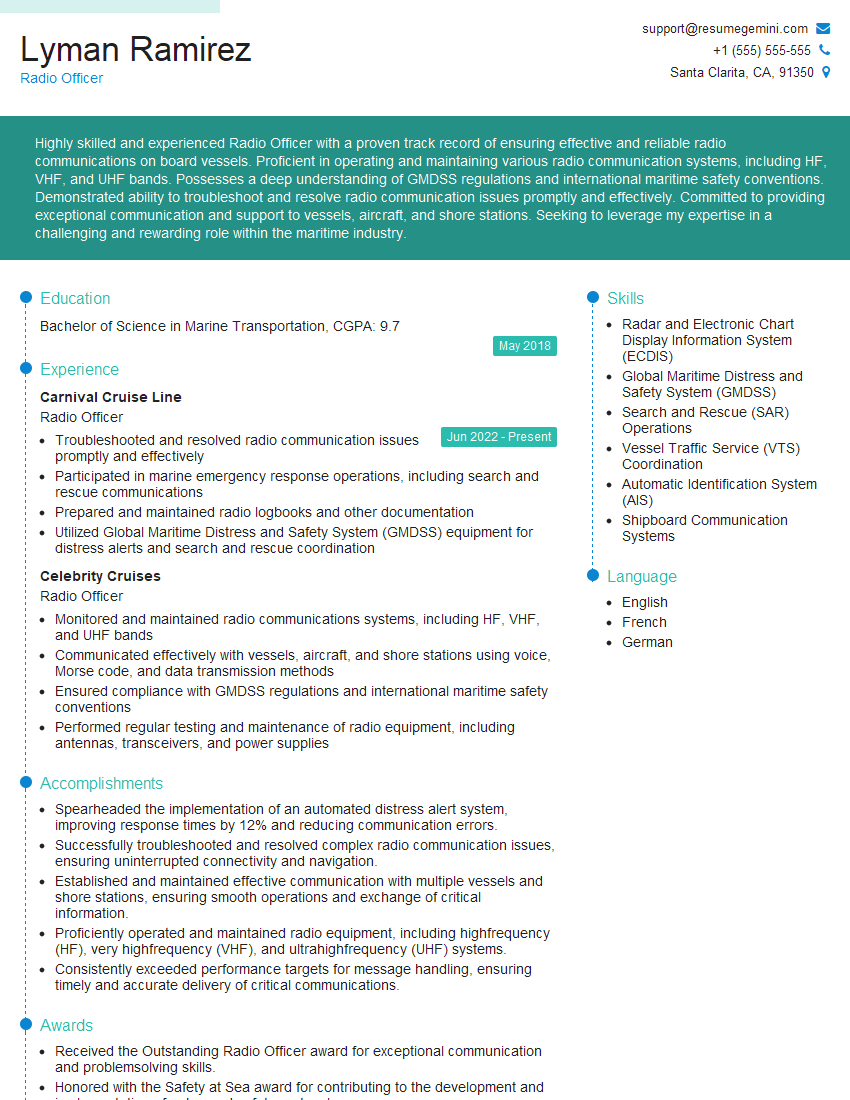
Mastering GMDSS significantly enhances your career prospects in the maritime industry, opening doors to specialized roles and higher earning potential. To maximize your chances of securing your dream job, it’s crucial to present yourself effectively. Creating an ATS-friendly resume is paramount for getting noticed by recruiters. ResumeGemini is a trusted resource to help you build a professional and impactful resume. We provide examples of resumes tailored to GMDSS roles to guide you in crafting your own compelling application. Take the next step towards a successful career in maritime communications – build your best resume with ResumeGemini today!
Explore more articles
Users Rating of Our Blogs
Share Your Experience
We value your feedback! Please rate our content and share your thoughts (optional).
What Readers Say About Our Blog
Very informative content, great job.
good