Feeling uncertain about what to expect in your upcoming interview? We’ve got you covered! This blog highlights the most important Machine Calibrations interview questions and provides actionable advice to help you stand out as the ideal candidate. Let’s pave the way for your success.
Questions Asked in Machine Calibrations Interview
Q 1. Explain the importance of machine calibration in maintaining accuracy and precision.
Machine calibration is crucial for maintaining accuracy and precision because it ensures that the machine’s measurements or outputs align with established standards. Think of it like tuning a musical instrument – without regular tuning, the instrument will be out of tune and produce inaccurate sounds. Similarly, an uncalibrated machine produces inaccurate results, leading to potential errors in manufacturing, scientific research, or any process relying on precise measurements.
Accuracy refers to how close a measurement is to the true value, while precision refers to how consistently a machine produces the same measurement. Calibration addresses both. Inconsistent measurements, even if close to the true value, can still be problematic. For instance, a slightly inaccurate scale used repeatedly for weighing pharmaceuticals could lead to significant dosage errors over time.
Regular calibration minimizes these errors, ensuring the machine consistently produces reliable and trustworthy data. This is essential for quality control, regulatory compliance (in industries like pharmaceuticals and aerospace), and preventing costly rework or product failures.
Q 2. Describe different calibration methods and their applications.
Several calibration methods exist, each tailored to specific machine types and applications. The choice depends on factors like the machine’s function, measurement uncertainty requirements, and available resources.
- Direct comparison: This involves comparing the machine’s output to a known standard. For example, calibrating a pressure gauge by comparing its readings to a certified pressure standard. This method is straightforward and widely applicable.
- Indirect comparison (substitution method): Here, a secondary calibrated standard is used as an intermediary to calibrate the machine indirectly. This can be useful for hard-to-access or complex machines.
- Calibration using traceable reference materials: In chemical analysis, for example, we can calibrate spectrophotometers using certified reference materials with known concentrations of specific substances. This ensures traceability to national or international standards.
- Functional calibration: This method involves testing the machine under various operational conditions and comparing its performance to pre-defined specifications. This is common for complex systems.
For example, a digital multimeter might be calibrated by direct comparison to a higher accuracy multimeter, while a complex robotic arm might need a functional calibration to ensure accurate movement across its range of motion.
Q 3. What are the common sources of measurement errors in machine calibration?
Measurement errors in machine calibration stem from various sources. It’s a multifaceted problem requiring careful consideration.
- Environmental factors: Temperature fluctuations, humidity, vibration, and electromagnetic interference can significantly affect measurement accuracy. A simple example is a thermometer giving inaccurate readings in direct sunlight.
- Instrument drift: Over time, instruments can drift from their original calibration due to wear and tear, aging components, or internal changes. Regular checks are needed.
- Operator errors: Improper handling, incorrect settings, or misinterpretations of readings by the operator can introduce errors.
- Calibration standard uncertainty: Even calibration standards possess inherent uncertainties, which propagate to the calibrated machine. This uncertainty needs to be accounted for in the overall measurement uncertainty budget.
- Non-linearity: Some instruments might not behave linearly across their operating range, introducing errors in specific regions of the measurement scale.
Careful attention to these factors is vital to minimize errors and maintain confidence in calibration results. A robust calibration procedure should address and mitigate these potential sources of error.
Q 4. How do you determine the appropriate calibration interval for a specific machine?
Determining the appropriate calibration interval requires a risk-based approach. It depends on several factors including:
- Criticality of the machine’s function: Machines crucial for safety or critical processes (e.g., medical equipment) require more frequent calibration.
- Machine stability: Machines exhibiting greater stability over time can have longer calibration intervals.
- Usage frequency and intensity: Machines used heavily and under demanding conditions may need more frequent calibration.
- Historical data: Analyzing past calibration results reveals trends in drift and helps in predicting the ideal interval.
- Manufacturer’s recommendations: The manufacturer often provides guidelines on the calibration frequency.
- Regulatory requirements: Industry regulations may dictate minimum calibration frequencies for specific equipment.
Often, a combination of these factors is considered. A formal risk assessment can be conducted to systematically evaluate the potential consequences of inaccurate measurements and determine an appropriate calibration interval that balances cost and risk.
Q 5. Explain the concept of traceability in calibration and its significance.
Traceability in calibration refers to the unbroken chain of comparisons that links a measurement result to a known standard. This chain starts from the machine being calibrated and goes all the way up to national or international standards (e.g., those maintained by national metrology institutes). It’s like connecting the dots to confirm the validity of each calibration step.
Imagine a ruler used to measure a piece of wood. The ruler’s accuracy is verified by comparing it to a more accurate measuring instrument, which is in turn compared to a national standard. This chain ensures that the measurement of the wood is ultimately traceable to a universally accepted standard. This traceability is crucial for:
- Ensuring accuracy and reliability: Traceability provides confidence that the measurement results are accurate and reliable, reducing uncertainties.
- Facilitating international comparability: It allows for comparison of measurements taken in different locations using different instruments.
- Meeting regulatory requirements: Many industries have regulations mandating traceability for calibration results. This is a very important factor in many sectors for quality and legal reasons.
Q 6. What are the key components of a calibration certificate?
A calibration certificate is a formal document that provides evidence of a machine’s calibration status. Key components include:
- Unique identification of the equipment: Serial number, model number, etc.
- Calibration date and time: Precise record of when the calibration was performed.
- Calibration methods and standards used: Details of the procedures followed and the reference standards employed.
- Calibration results: Measurements taken and any adjustments made to the machine.
- Measurement uncertainties: Quantification of the uncertainties associated with the calibration results.
- Calibration intervals: Recommended frequency of future calibrations.
- Signatures and accreditations: Authorizing signatures of the calibration personnel and any accreditations or certifications of the calibration laboratory.
- Traceability statement: A clear statement of traceability to national or international standards.
A complete calibration certificate provides comprehensive information regarding the calibration process and the machine’s performance, allowing users to assess its measurement reliability.
Q 7. Describe your experience with different types of calibration equipment.
Throughout my career, I’ve worked extensively with various calibration equipment, from simple to sophisticated instruments. My experience spans:
- Multimeters: Calibrating both analog and digital multimeters using precision standards, encompassing voltage, current, and resistance measurements.
- Temperature calibration equipment: Working with various types of thermometers, thermocouples, and RTDs (Resistance Temperature Detectors), using calibration baths and ovens.
- Pressure calibration equipment: Calibrating pressure gauges and transducers using deadweight testers and digital pressure calibrators.
- Force and torque calibration equipment: Using force gauges and torque wrenches, calibrated with deadweight testers.
- Mass and balance calibration equipment: Calibrating balances using certified weights.
- Specialized calibration equipment: My experience also extends to specialized calibration equipment used in specific industries, such as flow meters and spectrum analyzers.
My experience encompasses both manual and automated calibration systems and I’m proficient in utilizing various software packages for data acquisition and analysis, ensuring the traceability and accuracy of each calibration.
Q 8. How do you handle discrepancies during calibration?
Handling discrepancies during calibration involves a systematic approach focusing on identifying the root cause and implementing corrective actions. It’s crucial to avoid simply adjusting the instrument to meet the required standard without understanding why it’s off.
- Investigation: First, we meticulously review the calibration process. Were there any procedural errors? Was the environment controlled correctly (temperature, humidity, etc.)? Was the equipment used itself properly calibrated? We may examine the calibration data for trends or patterns.
- Traceability: We ensure the traceability of all standards and equipment used. This means verifying that the standards used for calibration are themselves traceable to national or international standards.
- Troubleshooting: If the discrepancy is significant, we may need to troubleshoot the instrument itself, looking for mechanical faults, electrical problems, or other issues. We might repeat measurements multiple times to confirm the issue.
- Documentation: All findings, corrective actions, and the final calibration result are meticulously documented. If a repair is needed, that’s also documented.
- Example: Imagine calibrating a pressure gauge. If the readings are consistently 5% higher than the standard, we wouldn’t simply adjust it. Instead, we’d investigate potential causes like a clogged pressure line, a faulty sensor, or an incorrect zero setting. Only after resolving the underlying issue would we recalibrate.
Q 9. Explain the process of calibrating a pressure transducer.
Calibrating a pressure transducer involves comparing its output to a known accurate pressure source. This is typically done using a calibrated pressure controller and a high-precision pressure gauge (the standard).
- Setup: The pressure transducer is connected to the pressure controller, which generates precise pressures within a specific range. The transducer’s output (usually voltage or current) is measured using a digital multimeter or data acquisition system. The pressure gauge also monitors the pressure.
- Calibration Points: A series of calibration points are selected across the transducer’s operating range—typically at zero pressure, several intermediate points, and full-scale pressure. At each point, the pressure is stabilized and both the pressure gauge and transducer readings are recorded.
- Data Analysis: The collected data points are analyzed, often using calibration software. This software can generate a calibration curve, which models the relationship between the transducer’s output and the actual pressure. It might identify a linear or non-linear relationship. Any deviations from the ideal response are quantified.
- Adjustment (if necessary): Some pressure transducers have internal adjustments to compensate for deviations. Others may only require a mathematical correction to be applied to future measurements. The software can assist in these adjustments.
- Documentation: The calibration results, including the calibration curve and any adjustments made, are documented and archived.
Think of it like checking a bathroom scale against a known weight. The scale is the pressure transducer, the known weight is the pressure standard, and the calibration verifies their consistency.
Q 10. How do you calibrate a temperature sensor?
Temperature sensor calibration involves comparing the sensor’s output to a known accurate temperature source. This typically uses a calibration bath or dry-block calibrator.
- Setup: The temperature sensor is immersed in the calibration bath or placed in the dry-block calibrator, which maintains a stable, precisely controlled temperature. The sensor’s output (voltage, resistance, etc.) is measured by a suitable instrument.
- Calibration Points: Several calibration points are selected across the sensor’s operating range. These points usually include ice point (0°C), some intermediate points, and a higher temperature point. At each point, the temperature is stabilized, and multiple readings are taken from both the standard and the sensor.
- Data Analysis: The data is analyzed to determine the sensor’s accuracy and linearity. Calibration software can help generate a curve that describes the sensor’s behavior. Like pressure transducers, it might be linear or nonlinear.
- Adjustment (rarely applicable): Most temperature sensors don’t have internal adjustments. However, if the sensor is significantly out of specification, a replacement may be required.
- Documentation: Detailed records of the calibration process, including calibration points, readings, and any deviation analysis, must be documented.
The process is similar to using a known temperature thermometer to confirm the accuracy of a kitchen thermometer.
Q 11. How do you calibrate a digital scale?
Calibrating a digital scale involves using calibrated weights to verify its accuracy. This is done by placing known weights on the scale and comparing the scale’s readings to the known weights’ values.
- Setup: The scale is placed on a stable, level surface. It should be warmed up to ensure stable readings.
- Calibration Weights: A set of calibrated weights, traceable to national standards, are used. The weights should cover the scale’s entire weighing range.
- Calibration Procedure: The weights are placed on the scale, one at a time, and the scale’s reading is recorded. This is often repeated multiple times for each weight to account for any inconsistencies. Many scales have built-in calibration functions.
- Data Analysis: The readings are compared to the known weights’ values. Any discrepancies are calculated as percentage error or deviation.
- Adjustment (if possible): Some digital scales have internal calibration adjustments. If the scale is out of specification, adjustment might be possible. Other scales might require recalibration or repair.
- Documentation: All calibration data, including weights used, readings, and deviations, are recorded and archived.
Think of this like using a set of known weights to check a postal scale’s accuracy. If it’s off by more than a certain tolerance, you wouldn’t trust it for accurate weighings.
Q 12. Describe your experience with statistical process control (SPC) in calibration.
Statistical Process Control (SPC) in calibration helps monitor the stability and capability of the calibration process itself. We use control charts to track calibration results over time, helping us to identify trends, detect out-of-control situations, and reduce variations.
- Control Charts: We use control charts like X-bar and R charts to monitor the average and range of calibration measurements. The charts visually represent the data, showing upper and lower control limits. Points outside these limits indicate potential problems.
- Data Collection: Data from calibration records is collected and plotted on the control chart. This might involve tracking the error of multiple instruments calibrated over time.
- Trend Analysis: Control charts aid in detecting trends or patterns in calibration errors, which might signify a drifting standard, degrading equipment, or a systematic error in the calibration procedure.
- Capability Analysis: SPC helps assess the capability of the calibration process. We can determine whether the process is consistently meeting specifications and identify areas for improvement.
- Example: If the control chart for pressure gauge calibrations consistently shows points near the upper control limit, this indicates that the calibration procedure might be biased and needs review. Perhaps the standard is aging or the calibration technique requires refinement.
Q 13. How do you maintain calibration records and documentation?
Maintaining calibration records and documentation is crucial for compliance and traceability. We use a combination of digital and paper-based systems to ensure comprehensive records.
- Calibration Certificates: Each calibration event generates a certificate listing the instrument calibrated, the date, the standards used, the results, and the technician’s signature. These certificates serve as proof of calibration.
- Database Management: Digital databases store all calibration records, enabling efficient retrieval and analysis of data. Information such as instrument identification numbers, calibration history, and any adjustment details is stored.
- Paper Records: Although digital systems are preferred, paper records might be retained as a backup. This also ensures compliance with regulations that mandate hard copy records.
- Data Security: Access to calibration records is controlled to maintain data integrity and prevent unauthorized changes. Security measures such as passwords and access restrictions are implemented.
- Retention Policy: A clear retention policy for calibration records is established, following relevant industry standards and regulations. This policy dictates how long the records need to be stored.
A well-maintained system ensures traceability of calibrations, allowing us to easily determine the history of a specific instrument and the validity of its measurements.
Q 14. Explain the difference between calibration and verification.
Calibration and verification are related but distinct processes:
- Calibration: This is a comparison of a measuring instrument against a known standard. The goal is to determine the instrument’s accuracy and, if needed, adjust it to meet predefined specifications. It produces a calibration certificate with documented evidence.
- Verification: This is a check to ensure that a measuring instrument still conforms to its specifications after calibration, after repair, or after a given period of time. It confirms whether the instrument’s performance remains within acceptable limits but doesn’t necessarily involve adjustments. The process can often be less extensive than a full calibration.
Analogy: Imagine you have a watch. Calibration would be like taking it to a watchmaker to check its accuracy against a precise atomic clock and adjusting it if needed. Verification would be checking the time on your watch against a known reliable clock to see if it is still within a reasonable timeframe, without necessarily adjusting it.
Q 15. What is the role of uncertainty in calibration?
Uncertainty in calibration is essentially the doubt surrounding a measurement’s true value. It’s not about mistakes, but rather the inherent limitations of any measurement system. Think of it like trying to measure the exact length of a table with a ruler: You can get close, but there’s always a small margin of error because of the ruler’s markings, your eye’s accuracy, and the table’s potential imperfections. This uncertainty is quantified and expressed, for example, as a plus or minus value around a measurement. In calibration, we strive to minimize uncertainty, but we always acknowledge and quantify its presence. This is crucial because it dictates the reliability and trustworthiness of our measurement results. A small uncertainty indicates high confidence in the measurement; a large uncertainty signals more potential error.
For instance, a calibrated pressure gauge might report a reading of 100 psi ± 0.5 psi. The ± 0.5 psi represents the uncertainty – the range within which the true pressure likely lies. Understanding and managing this uncertainty is paramount for ensuring the quality and safety of processes relying on accurate measurements.
Career Expert Tips:
- Ace those interviews! Prepare effectively by reviewing the Top 50 Most Common Interview Questions on ResumeGemini.
- Navigate your job search with confidence! Explore a wide range of Career Tips on ResumeGemini. Learn about common challenges and recommendations to overcome them.
- Craft the perfect resume! Master the Art of Resume Writing with ResumeGemini’s guide. Showcase your unique qualifications and achievements effectively.
- Don’t miss out on holiday savings! Build your dream resume with ResumeGemini’s ATS optimized templates.
Q 16. How do you identify and mitigate risks associated with faulty calibration?
Identifying risks associated with faulty calibration involves a multi-pronged approach. Firstly, regular calibration checks, according to a defined schedule, are essential. This detects deviations from established standards early on. Secondly, we must thoroughly document all calibration activities, including the equipment used, the results obtained, and any corrective actions taken. This meticulous record-keeping provides a valuable audit trail and facilitates proactive risk management. Regular review of these records aids in identifying trends and potential issues.
Mitigating these risks relies on several strategies: proactive maintenance of calibration equipment, using equipment appropriate for the measurement task, and ensuring that technicians possess the necessary training and competence. A robust quality management system (QMS), often aligned with standards like ISO 9001, plays a vital role in implementing and maintaining effective calibration procedures. Should a fault be detected, immediate corrective actions – such as recalibration or equipment repair – are crucial, along with a thorough investigation to understand the root cause and prevent recurrence. This might involve reviewing calibration procedures, staff training, or even replacing faulty equipment.
Q 17. Describe your experience with different calibration standards (e.g., ISO 17025).
My experience encompasses working extensively with ISO 17025, the internationally recognized standard for testing and calibration laboratories. It provides a framework for ensuring the competence and impartiality of calibration results. ISO 17025 guides the entire process from initial assessment and planning through to the issuance of calibration certificates. I’m familiar with its requirements related to traceability to national or international standards, uncertainty calculations, personnel competence, quality control, and record-keeping. My experience also includes working with other standards, depending on the specific application and industry requirements. For instance, I’ve dealt with industry-specific standards for certain measurement types, requiring tailored methodologies and specialized equipment. The core principle remains consistent across all these standards: ensuring the highest accuracy and reliability in calibration.
Q 18. How do you handle out-of-tolerance measurements during calibration?
Out-of-tolerance measurements during calibration are taken very seriously. They indicate that the equipment under test is not performing within its specified limits and may lead to inaccurate results in the applications where it’s used. The first step is to repeat the measurement to eliminate possible random errors. If the instrument remains out-of-tolerance, a thorough investigation follows to identify the root cause. This might involve inspecting the instrument for physical damage, checking its operating conditions, and verifying the calibration equipment’s accuracy. Depending on the cause, the instrument might require repair, adjustment, or even replacement. A detailed report documenting the out-of-tolerance readings, the investigation’s findings, and the corrective actions taken is essential. This report is part of the overall calibration record and helps to avoid future similar issues. Finally, the client is informed about the situation and the corrective actions taken to ensure their equipment is performing reliably.
Q 19. What are some common problems you’ve encountered during machine calibrations?
Throughout my career, I’ve encountered various issues. One common problem is the unavailability of suitable standards or reference materials for certain measurements. This necessitates developing alternative approaches or seeking external assistance. Another issue is the instability of certain measuring instruments, where environmental factors like temperature or humidity significantly affect their readings. This requires careful control of the calibration environment and the inclusion of environmental compensation factors in the calibration procedure. Another challenge involves dealing with poorly maintained equipment sent for calibration—sometimes, the condition of the equipment itself prevents accurate calibration.
Finally, human error remains a factor; mistakes in reading instruments, recording data, or following procedures can lead to inaccurate calibration results. Therefore, rigorous training and quality control measures are crucial to mitigate these risks. Addressing these challenges requires a combination of technical skill, careful planning, adherence to established procedures, and a keen eye for detail.
Q 20. How do you ensure the integrity and accuracy of your calibration process?
Ensuring integrity and accuracy is a cornerstone of my work. This begins with meticulous traceability – ensuring that all standards used in the calibration process are traceable to national or international standards. Regular calibration of the calibration equipment itself is critical – ‘calibration of the calibrator,’ as we say. This ensures that our equipment is accurate and reliable. We also employ stringent quality control measures throughout the calibration process. This includes multiple measurements at different points, rigorous data analysis, and the use of statistical methods to assess uncertainty. Furthermore, our lab’s environment is controlled to minimize external influences on measurements. We maintain detailed documentation of all calibration activities, including instrument histories, calibration procedures, results, and any deviations found, which aids in audits and process improvement. Finally, regular internal audits and participation in proficiency testing programs further bolster the integrity and accuracy of our services.
Q 21. Describe your experience with different types of calibration software.
My experience includes using various calibration software packages. These range from simple spreadsheet programs for managing calibration data to sophisticated software systems that automate the entire calibration process, from scheduling and instrument management to data analysis and report generation. I’ve worked with software that interfaces directly with calibration instruments, automatically transferring data and performing calculations. The choice of software depends on the complexity of the calibration process and the level of automation required. The software should support traceability, uncertainty calculations, and the generation of compliant calibration certificates. My preference generally leans towards software that offers flexibility and integrates seamlessly with our existing systems, maximizing efficiency and minimizing potential errors. Choosing the right software is critical to ensuring the accuracy and efficiency of the calibration process and compliance with relevant standards.
Q 22. How do you troubleshoot calibration equipment malfunctions?
Troubleshooting calibration equipment malfunctions requires a systematic approach. It begins with identifying the symptom – is the equipment producing inaccurate readings, displaying error messages, or completely unresponsive? Once the symptom is identified, I follow a structured process:
- Visual Inspection: Check for obvious issues like loose connections, damaged cables, or physical obstructions. This often reveals simple fixes.
- Check Calibration Records: Review past calibration data to see if the malfunction is a gradual drift or a sudden failure, providing clues about the root cause. Is the equipment nearing its scheduled recalibration date?
- Consult the Equipment Manual: The manual provides troubleshooting guides, error codes, and diagnostic procedures specific to the instrument. This is often the most effective resource.
- Power Cycle: A simple power cycle can resolve temporary software glitches. This is the first step I take, especially if there are no obvious physical problems.
- Verify Calibration Standards: Ensure that the standards used for calibration are valid and traceable to national or international standards. If the standard itself is faulty, it will lead to inaccurate calibration results.
- Environmental Factors: Consider environmental factors like temperature, humidity, and electromagnetic interference which can affect the accuracy of some equipment.
- Seek Expert Assistance: If the problem persists after these steps, it is crucial to seek assistance from the equipment manufacturer or a qualified service technician.
For example, I once encountered a malfunctioning pressure gauge that was giving erratic readings. After a visual inspection revealed no obvious problems, I consulted the manual and discovered a faulty pressure transducer. Replacing the transducer resolved the issue.
Q 23. What are some best practices for maintaining calibration equipment?
Maintaining calibration equipment is crucial for ensuring the accuracy and reliability of measurements. Best practices include:
- Regular Cleaning: Clean the equipment according to the manufacturer’s instructions. Dust, debris, and other contaminants can affect accuracy.
- Proper Storage: Store the equipment in a stable environment with controlled temperature and humidity to prevent damage and ensure optimal performance. This is especially important for sensitive equipment.
- Scheduled Calibration: Adhere to a strict calibration schedule. Frequency depends on the equipment type and usage, but regular calibration prevents deviations from accuracy and helps identify potential problems early.
- Preventative Maintenance: Conduct preventative maintenance as recommended by the manufacturer. This might involve replacing parts, lubricating moving components, or performing other checks to ensure optimal operating condition.
- Operator Training: Provide comprehensive training to operators on the proper use and handling of the equipment. Misuse can lead to damage or inaccurate results.
- Accurate Record Keeping: Maintain detailed calibration records. These are essential for demonstrating compliance with standards and traceability.
- Calibration Software: Using calibration management software improves efficiency and maintains an organized record of calibration data.
Think of it like maintaining a car – regular servicing, checking fluids, and following maintenance schedules prolong its life and ensures it runs efficiently and reliably.
Q 24. Explain the concept of a calibration laboratory.
A calibration laboratory is a controlled environment specifically designed and equipped to perform accurate and traceable calibrations of measuring instruments. It is crucial for maintaining the quality and reliability of measurements across various industries.
Key features of a calibration laboratory include:
- Controlled Environment: The lab maintains strict control over temperature, humidity, and other environmental factors that can affect the accuracy of measurements. This ensures consistent and reliable results.
- Traceable Standards: The lab uses calibration standards that are traceable to national or international standards, ensuring the accuracy and reliability of the calibrations it performs. This establishes a chain of custody for accuracy.
- Specialized Equipment: It is equipped with a variety of specialized equipment, depending on the types of instruments calibrated. This equipment is regularly calibrated to maintain accuracy.
- Qualified Personnel: The lab employs qualified and trained personnel who are proficient in performing calibrations and using the necessary equipment. These personnel have often undergone specific training and certifications.
- Quality Management System: A well-run calibration lab operates under a robust quality management system (often ISO/IEC 17025 accredited), which ensures consistency, accuracy and compliance with relevant standards.
Essentially, a calibration laboratory acts as the guarantor of measurement accuracy, ensuring that instruments are producing reliable and trustworthy results.
Q 25. What safety procedures do you follow during machine calibrations?
Safety is paramount during machine calibrations. I adhere to the following procedures:
- Risk Assessment: Before starting any calibration, I perform a thorough risk assessment to identify potential hazards associated with the equipment and the calibration process. This identifies potential hazards associated with specific equipment.
- Personal Protective Equipment (PPE): I use appropriate PPE, such as safety glasses, gloves, and protective clothing, as needed. This is dictated by the specific equipment and calibration process.
- Lockout/Tagout Procedures: For calibrations involving powered equipment, I follow strict lockout/tagout procedures to prevent accidental energization. This is a critical safety measure to prevent accidental injury.
- Proper Handling of Materials: I handle calibration standards and other materials carefully to prevent damage or contamination. Many standards are fragile and expensive.
- Emergency Procedures: I’m familiar with the emergency procedures for the facility and know how to respond to any incidents. This ensures a swift and appropriate response to any unexpected events.
- Environmental Awareness: I am mindful of any environmental hazards associated with the equipment or calibration materials and take appropriate precautions.
Following these safety procedures is not just about compliance; it’s about protecting myself and others from potential injury or harm.
Q 26. How do you stay up-to-date with the latest calibration techniques and standards?
Staying current with calibration techniques and standards is crucial for maintaining competence and ensuring accuracy. I utilize several methods:
- Professional Organizations: I’m a member of professional organizations like the American Society of Mechanical Engineers (ASME) or similar organizations relevant to my field. They provide access to publications, conferences, and networking opportunities to stay updated.
- Industry Publications and Journals: I regularly read industry publications and journals to keep abreast of advancements in calibration techniques, new standards, and best practices.
- Conferences and Workshops: Attending conferences and workshops provides opportunities for hands-on training, networking, and learning from experts in the field.
- Manufacturer’s Documentation: I regularly review equipment manufacturer’s documentation for updates, including software upgrades and new calibration procedures.
- Online Resources: I leverage reputable online resources to access calibration standards, guidelines, and training materials.
- Mentorship and Collaboration: I actively seek mentorship from experienced colleagues and collaborate with other calibration professionals to share knowledge and best practices.
Continuous learning is essential in this field, as standards and technologies constantly evolve. It is like following ongoing professional development in any technical field.
Q 27. Describe a time you had to troubleshoot a complex calibration issue.
I once faced a complex calibration issue with a high-precision optical measurement system. The system was producing erratic results, failing its internal self-diagnostics, and displaying inconsistent readings. After systematically eliminating common causes (environmental factors, loose connections, etc.), I suspected a problem within the internal optical components.
My troubleshooting involved:
- Detailed Data Analysis: I meticulously analyzed the calibration data, looking for patterns or trends in the errors. This identified a specific range of measurements where the errors were most prominent.
- Component-Level Testing: I isolated individual components of the optical system for testing, using calibrated reference standards to assess their performance. This pinpointed the faulty component.
- Manufacturer Consultation: I contacted the manufacturer’s technical support, providing them with detailed data and test results. Their expertise helped me understand the specific failure mode.
- Component Replacement: After verifying the faulty component, I replaced it with a certified replacement part and repeated the calibration process. This ultimately resolved the issue.
This experience highlighted the importance of thorough data analysis, systematic troubleshooting, and the value of seeking expert assistance when faced with complex problems.
Q 28. How do you handle pressure from deadlines when performing calibrations?
Deadlines are a reality in calibration work. To manage pressure effectively, I utilize the following strategies:
- Prioritization: I prioritize tasks based on urgency and criticality, ensuring that the most important calibrations are completed first. This allows for flexibility in tackling less pressing tasks.
- Effective Time Management: I use time management techniques, like creating detailed schedules and breaking down complex tasks into smaller, manageable steps. This improves efficiency and reduces stress.
- Clear Communication: I maintain open and clear communication with stakeholders, providing regular updates and proactively identifying any potential delays. This prevents misunderstandings and helps manage expectations.
- Resource Allocation: If feasible, I ensure proper allocation of resources (personnel, equipment, etc.) to meet deadlines. This prevents delays and ensures sufficient support.
- Contingency Planning: I develop contingency plans to address unforeseen issues or delays that might occur during the calibration process. This preparedness allows for flexibility.
- Stress Management: I utilize stress management techniques like regular breaks, exercise, and mindfulness to maintain focus and productivity under pressure. This is critical to maintaining focus and accuracy.
Ultimately, balancing speed and accuracy requires planning, communication, and self-care. It’s about delivering quality results within the given time constraints, and prioritizing both safety and efficiency.
Key Topics to Learn for Machine Calibrations Interview
- Calibration Principles: Understanding accuracy, precision, traceability, and uncertainty in measurement systems. This includes exploring different calibration methods and standards.
- Calibration Equipment & Tools: Familiarity with various instruments used in machine calibration (e.g., micrometers, calipers, laser interferometers) and their proper operation and maintenance. Practical application involves knowing how to select the right tool for a specific measurement task.
- Calibration Procedures & Documentation: Mastering the creation and execution of calibration procedures, including data recording, analysis, and report generation. This is crucial for demonstrating compliance with industry standards and regulations.
- Statistical Process Control (SPC): Understanding the application of SPC techniques to monitor calibration processes, identify trends, and ensure ongoing accuracy. Practical experience with control charts and process capability analysis is valuable.
- Troubleshooting & Problem-Solving: Developing skills in identifying and resolving calibration issues, including understanding the root causes of measurement errors and implementing corrective actions. This often involves analyzing data and applying systematic troubleshooting methods.
- Calibration Standards & Traceability: Knowledge of national and international calibration standards and the importance of maintaining traceability to national standards. Understanding the impact of traceability on the validity of calibration results is key.
- Types of Machines & Calibration Needs: Familiarizing yourself with the calibration requirements for different types of machinery (e.g., CNC machines, measuring instruments, automated systems). Understanding the unique challenges presented by various machine types is highly beneficial.
Next Steps
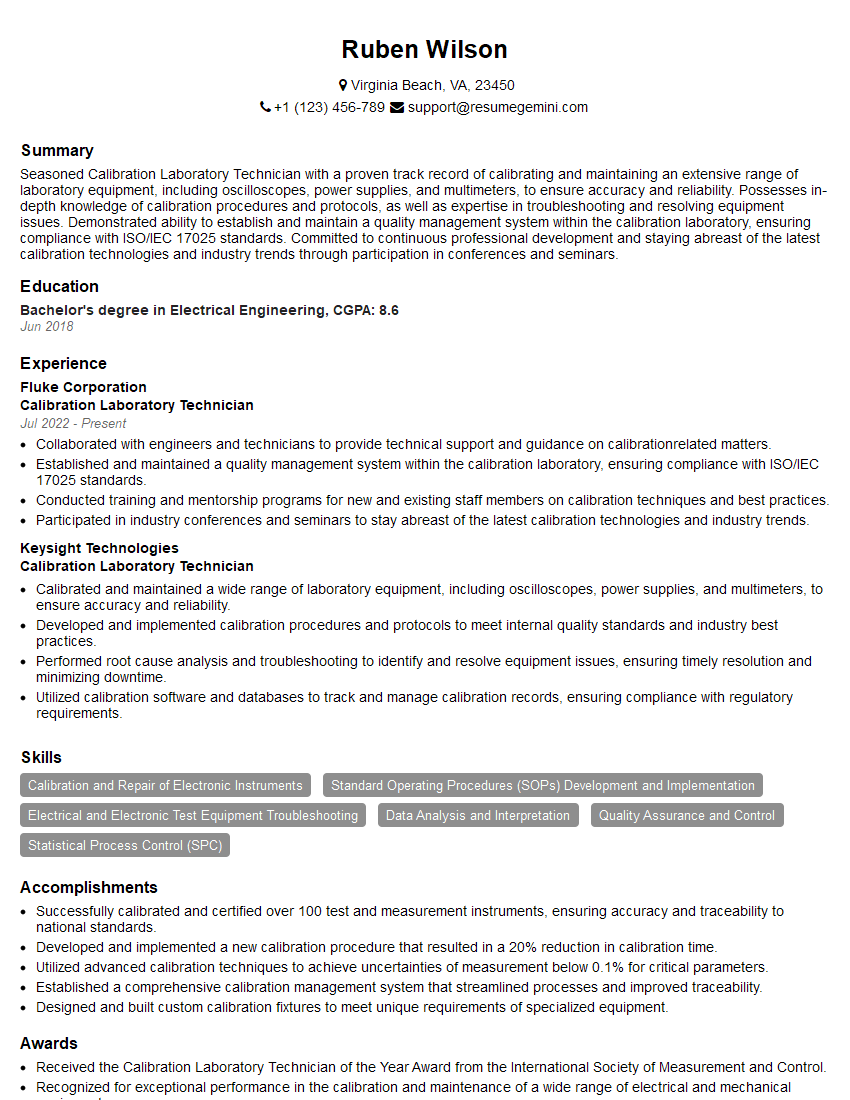
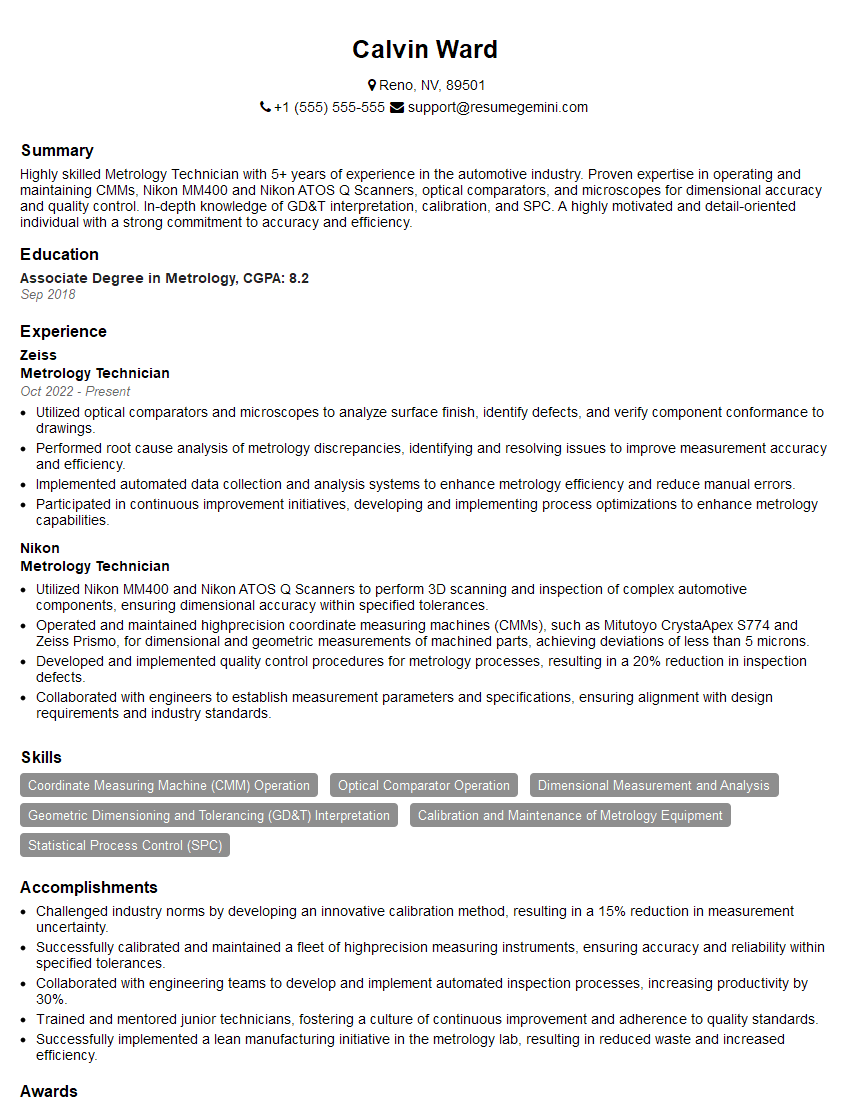
Mastering machine calibrations opens doors to exciting career opportunities in manufacturing, automation, and quality control. A strong understanding of these principles significantly increases your marketability and earning potential. To stand out, craft a compelling resume that highlights your skills and experience effectively. Building an ATS-friendly resume is crucial for getting your application noticed by recruiters and hiring managers. ResumeGemini is a trusted resource that can help you create a professional and impactful resume, optimized for applicant tracking systems. Examples of resumes tailored to Machine Calibrations are provided to help guide your resume creation process.
Explore more articles
Users Rating of Our Blogs
Share Your Experience
We value your feedback! Please rate our content and share your thoughts (optional).
What Readers Say About Our Blog
Very informative content, great job.
good