Cracking a skill-specific interview, like one for Global Geotechnical Projects, requires understanding the nuances of the role. In this blog, we present the questions you’re most likely to encounter, along with insights into how to answer them effectively. Let’s ensure you’re ready to make a strong impression.
Questions Asked in Global Geotechnical Projects Interview
Q 1. Explain the concept of soil liquefaction and its mitigation strategies.
Soil liquefaction is a phenomenon where saturated, loose sandy or silty soils temporarily lose their strength and stiffness due to increased pore water pressure from seismic shaking or other rapid loading. Imagine shaking a container of wet sand – the water rises to the surface, and the sand loses its ability to support weight. This can cause significant damage to structures built on these soils, leading to settlement, tilting, or even collapse.
Mitigation strategies focus on reducing pore water pressure or increasing soil strength. These include:
- Ground Improvement Techniques: Methods such as vibro-compaction, dynamic compaction, stone columns, and soil stabilization (e.g., cement injection) can increase soil density and strength, reducing liquefaction susceptibility.
- Drainage Systems: Installing drainage layers or systems can help dissipate excess pore water pressure, preventing liquefaction.
- Foundation Design: Deep foundations, such as piles or caissons, transfer loads below the liquefiable layer. Shallow foundations may be designed to accommodate settlement.
- Liquefaction Mitigation Layers: Placement of granular materials (e.g., sand) on top of liquefiable soils before construction can reduce the impact of ground shaking and prevent significant settlements.
- Seismic Design: Buildings designed to withstand seismic forces are less vulnerable to liquefaction-induced damage. This involves incorporating ductile design principles and appropriate seismic isolation techniques.
For example, during the 1964 Niigata earthquake, many buildings built on liquefiable soil suffered significant damage, highlighting the importance of proper geotechnical investigations and mitigation measures.
Q 2. Describe different types of soil and their engineering properties.
Soils are classified based on their particle size distribution, plasticity, and other engineering properties. Think of it like a recipe – different proportions of ingredients (sand, silt, clay) result in vastly different ‘soil cakes’.
- Gravel: Coarse-grained soil with particles larger than 2 mm. Well-graded gravels exhibit high permeability and good drainage.
- Sand: Fine-grained soil with particles ranging from 0.075 mm to 2 mm. Can range from loose to dense, affecting its strength and compressibility. Well-drained, generally good for foundations.
- Silt: Fine-grained soil with particles between 0.002 mm and 0.075 mm. Has intermediate properties between sand and clay. Can be problematic if saturated.
- Clay: Fine-grained soil with particles smaller than 0.002 mm. High plasticity and low permeability. Strength and compressibility highly dependent on water content.
Engineering properties describe how the soil behaves under load. Key properties include:
- Shear Strength: Resistance to deformation and failure.
- Compressibility: How much the soil settles under load.
- Permeability: How easily water flows through the soil.
- Consolidation: Gradual expulsion of water from a saturated clay soil under load.
Understanding these properties is crucial for proper foundation design and slope stability analysis. For example, a high compressibility clay requires a more elaborate foundation system than a well-drained sand.
Q 3. How do you perform a slope stability analysis?
Slope stability analysis determines the likelihood of a slope failing. This involves assessing the factors that contribute to slope stability, such as soil type, strength, water content, and external loads. We use various methods, often employing limit equilibrium methods.
A common approach is the Bishop simplified method. This method is based on the concept of slices, dividing the slope into vertical slices. It calculates the factor of safety (FOS), which represents the ratio of resisting forces to driving forces. An FOS greater than 1 indicates a stable slope, while a value less than 1 signifies potential failure.
The process typically involves these steps:
- Site investigation: This includes geological mapping, soil sampling and testing, and groundwater monitoring to determine soil properties.
- Geometric modeling: Creating a digital model of the slope geometry, using software to input slope angles, dimensions and layers.
- Strength parameters: Determining soil shear strength parameters (cohesion and angle of internal friction) from laboratory testing.
- Analysis: Using software or manual calculation to determine the factor of safety (FOS) based on chosen methods.
- Interpretation: Assessing the FOS and determining whether remediation is required.
- Remediation: Implementing measures such as terracing, retaining walls, or ground improvement techniques to increase stability.
For instance, a highway cut in a hilly region needs a detailed slope stability analysis to ensure the safety of the road during and after construction. Any potential instability necessitates appropriate mitigation measures, such as constructing retaining walls or re-grading the slope.
Q 4. What are the key considerations for designing foundations in seismic zones?
Designing foundations in seismic zones requires considering the dynamic forces exerted during an earthquake. The key is to ensure the foundation can withstand these forces and prevent damage to the superstructure.
- Soil liquefaction assessment: Determining the potential for soil liquefaction and incorporating appropriate mitigation measures as discussed previously.
- Seismic site response analysis: Evaluating how the ground motion will be amplified or modified by the soil layers at the site, ensuring the foundation design accounts for these amplified ground motions.
- Ductile design: Designing foundations and superstructures to deform inelastically without collapsing during seismic events, absorbing energy from shaking.
- Seismic isolation: Installing base isolation systems to decouple the structure from the ground motion, thereby reducing the seismic forces transmitted to the foundation.
- Ground improvement: Using techniques like deep soil mixing or vibro-compaction to enhance the soil’s strength and stiffness and improve its resistance to liquefaction.
For example, the design of a high-rise building in a highly seismic area would involve a comprehensive seismic analysis, possibly requiring deep foundations, seismic isolation, and ductile design elements to ensure stability and safety during an earthquake.
Q 5. Explain your experience with ground improvement techniques.
I have extensive experience with various ground improvement techniques, each tailored to specific soil conditions and project requirements. My experience encompasses both design and oversight of implementation.
- Vibro-compaction: This method uses vibratory equipment to densify loose granular soils, increasing their bearing capacity and reducing settlement. I’ve overseen projects using this technique to prepare sites for large industrial facilities.
- Stone Columns: These involve installing vertical columns of compacted granular material (e.g., gravel or crushed stone) into softer soils to improve their load-bearing capacity. I’ve used this technique effectively in projects involving soft clay deposits.
- Deep Soil Mixing: This involves mixing cementitious or other stabilizing agents with the in-situ soil to create columns or continuous walls. I’ve worked on projects where this technique has been essential to stabilize weak or expansive soils.
- Soil Stabilization (using cement or lime): This is a crucial method for improving the strength and stiffness of weak or expansive soils. I’ve managed projects where this method improved the subgrade quality for highway construction in challenging soil conditions.
Each technique requires careful consideration of soil properties, project constraints, and cost-effectiveness. For example, the selection between vibro-compaction and stone columns for a particular project will depend on the soil’s composition, the depth of improvement needed, and the site’s accessibility.
Q 6. Describe your experience with finite element analysis (FEA) in geotechnical engineering.
Finite Element Analysis (FEA) is a powerful tool for simulating complex geotechnical problems. I’ve extensively used FEA software (e.g., ABAQUS, PLAXIS) to model and analyze various scenarios, including:
- Slope Stability: FEA allows for a more realistic modeling of slope behavior compared to traditional limit equilibrium methods, accounting for complex geometries and material nonlinearities.
- Foundation Design: FEA can accurately predict settlement and stress distributions around foundations under various loading conditions, optimizing the design for stability and minimizing settlement.
- Ground Improvement Analysis: FEA can simulate the effectiveness of ground improvement techniques, providing insights into the stress distribution and load transfer mechanisms.
- Earthquake Response: FEA is essential for analyzing the seismic response of structures and their interaction with the surrounding soil during an earthquake.
For instance, I used FEA to model the behavior of a retaining wall subjected to seismic loading, optimizing the design to prevent overturning and excessive deformation. The software provided detailed stress and displacement contours, confirming the design’s adequacy and providing valuable insights for further refinement.
The use of FEA is not without its limitations. Accurate modeling requires detailed soil data, proper meshing strategies, and a thorough understanding of the underlying assumptions and limitations of the software. It’s crucial to validate FEA results with empirical data and engineering judgment.
Q 7. How do you manage geotechnical risks on global projects?
Managing geotechnical risks on global projects requires a proactive and systematic approach. My strategy involves:
- Thorough Site Investigation: Conducting comprehensive site investigations to accurately characterize soil conditions, including geophysical surveys, boreholes, and laboratory testing. This reduces uncertainties and allows for better informed design decisions.
- Risk Assessment and Mitigation: Identifying potential geotechnical risks (e.g., liquefaction, slope instability, expansive soils) and developing mitigation strategies based on their likelihood and potential consequences. This often involves scenario planning and sensitivity analyses.
- Collaboration and Communication: Establishing clear communication channels between the geotechnical engineer, the design team, the contractor, and the client to ensure everyone understands the risks and mitigation measures. Regular meetings and transparent reporting are crucial.
- Quality Control and Assurance: Implementing robust quality control procedures during construction to ensure the mitigation measures are implemented correctly. This involves regular site visits and inspections.
- Contingency Planning: Developing contingency plans to address unforeseen geotechnical issues during construction. This may involve alternative design solutions or construction methods.
- Global Considerations: Understanding and accounting for local regulations, building codes, and potential regional hazards.
For example, on a project in a seismically active region, we incorporated a detailed risk assessment of potential liquefaction and addressed this risk through a combination of ground improvement techniques, deep foundations, and seismic design standards tailored to the specific geographic location and local regulations.
Q 8. How do you handle uncertainties in geotechnical data?
Uncertainty is inherent in geotechnical data due to the subsurface’s heterogeneous nature. We address this through a probabilistic approach, not relying solely on single-point estimates. This involves:
- Multiple Investigations: Employing various investigation methods like boreholes, cone penetration tests (CPTs), and geophysical surveys to gather a comprehensive dataset, reducing reliance on any single data point.
- Statistical Analysis: Using statistical methods like geostatistics to analyze data variability and create probability distributions for key geotechnical parameters (e.g., shear strength, soil density). This allows us to understand the range of likely values, not just the average.
- Sensitivity Analysis: Performing sensitivity analyses on our design parameters. This assesses how changes in soil properties impact the overall stability or performance of the structure. We can then prioritize further investigation where uncertainty has the greatest impact.
- Factor of Safety and Design Codes: Incorporating appropriate factors of safety as per relevant design codes (e.g., Eurocode 7, AASHTO). These factors account for uncertainties and ensure a margin of safety.
- Risk Assessment: Conducting risk assessments to identify potential hazards and their likelihood. This helps prioritize mitigation strategies and informs decision-making.
For instance, on a recent highway project in mountainous terrain, we used a combination of CPTs and seismic refraction surveys to map highly variable soil conditions. Statistical analysis then allowed us to define probability distributions for soil strength, informing the design of retaining structures and foundation systems.
Q 9. Explain your understanding of different types of retaining structures.
Retaining structures are designed to hold back soil or other materials, preventing slope failure or retaining excavated areas. They vary considerably based on soil conditions, height, and aesthetic considerations. Common types include:
- Gravity Walls: Massive structures relying on their own weight for stability. Simple and robust, suitable for low to moderate heights and good soil conditions.
- Cantilever Retaining Walls: Commonly made of reinforced concrete, they use a cantilevered design where the wall’s base acts as an anchor.
- Anchored Walls: These walls are supported by ground anchors, which are tensioned steel rods embedded in stable soil beyond the wall’s footprint. They allow for taller walls in challenging conditions.
- Sheet Pile Walls: Interlocking steel or concrete sheets driven into the ground to create a continuous wall. Effective for deep excavations and water-bearing soils.
- Soil Nailing Walls: Soil is reinforced with steel bars (nails) driven into it at an angle, providing stability and support for the structure.
- Gabion Walls: These are constructed from wire baskets filled with rocks. A cost-effective and environmentally friendly option for low to moderate height retaining applications.
The choice of retaining structure depends on a thorough geotechnical investigation to determine the soil properties, groundwater conditions, and potential seismic activity. For example, in a project involving a deep excavation in a densely populated urban area, an anchored sheet pile wall might be preferable to minimize ground vibrations and encroachment on adjacent structures.
Q 10. Describe your experience with deep excavations and shoring systems.
Deep excavations, often exceeding 10 meters, necessitate sophisticated shoring systems to prevent collapse. My experience includes working on numerous projects using diverse shoring techniques. These include:
- Sheet Pile Walls with Tiebacks: As described previously, these are very effective for deep excavations and are often combined with tiebacks (ground anchors) for improved stability.
- Diaphragm Walls: These are constructed by trenching and then filling the trench with reinforced concrete. They provide excellent water tightness and structural support.
- Secant Pile Walls: These walls are formed by overlapping piles that interlock with each other to create a waterproof and strong wall.
- Soldier Pile and Lagging Walls: Steel soldier piles are driven into the ground, and horizontal lagging boards are placed between them to retain the soil. This system is adaptable to irregular excavation shapes.
- Slurry Walls: A trench is excavated using a bentonite slurry to prevent collapse, the slurry is then replaced with concrete forming an impermeable wall
The selection of the shoring system is based on factors such as soil conditions, groundwater level, proximity to adjacent structures, and project schedule. For example, a project involving an underground metro station required a diaphragm wall system due to the need for a watertight barrier in proximity to existing utility lines. Careful monitoring of ground movements and pore-water pressures is critical throughout the excavation phase to ensure safety.
Q 11. How do you ensure the quality control of geotechnical investigations?
Quality control in geotechnical investigations is crucial for accurate data and reliable design. We ensure quality through:
- Detailed Site Reconnaissance: A thorough initial site visit to understand the project context and identify potential challenges.
- Well-Defined Scope of Work: Clearly defined investigation objectives and methods to guide the fieldwork and laboratory testing.
- Qualified Personnel: Employing experienced geotechnical engineers and technicians with appropriate certifications and training. Regular calibration of field equipment is essential.
- Rigorous Laboratory Testing: Conducting standardized laboratory tests on collected soil and rock samples according to established protocols (e.g., ASTM, BS). Each test result is critically examined before being incorporated in the overall geotechnical model.
- Data Management and Reporting: Implementing a robust system for recording, storing, and analyzing data. Clear and concise reporting is crucial for efficient communication.
- Independent Peer Review: Seeking an external review to ensure that the investigation and interpretation adhere to best practices and relevant standards.
For example, in a large-scale infrastructure project, we implemented a rigorous quality control program that included blind sampling of soil to verify the accuracy of field-based estimations.
Q 12. What are your experiences with different types of instrumentation used in geotechnical projects?
Instrumentation plays a vital role in monitoring ground behavior and verifying design assumptions. My experience encompasses various types, including:
- Inclinometers: Measure lateral soil movements in deep excavations or slopes.
- Piezometers: Measure pore-water pressure, which is crucial for assessing the stability of soil and foundations.
- Extensometers: Measure horizontal and vertical displacements of structures or soil masses.
- Settlement Gauges: Measure vertical settlement of foundations or other structures.
- Strain Gauges: Measure strain in structural elements like retaining walls.
- Total Station Surveying: Used for monitoring displacements with high precision.
The choice of instrumentation depends on the specific project needs and anticipated ground behavior. In a project involving a high-rise building on soft clay, we used inclinometers and settlement gauges to monitor ground movements during construction, allowing for timely adjustments to the construction methodology to ensure safety.
Q 13. Explain your experience with numerical modeling software (e.g., PLAXIS, ABAQUS).
I have extensive experience using numerical modeling software like PLAXIS and ABAQUS for geotechnical analysis. These tools are essential for simulating complex ground behavior and evaluating different design options. My work includes:
- Finite Element Analysis (FEA): Using FEA to model soil-structure interaction, slope stability, and deep excavation behavior.
- Verification and Validation: Rigorous validation of numerical models against in-situ and laboratory data. Calibration and refinement are crucial to achieve reliable simulations.
- Parametric Studies: Conducting parametric studies to assess the sensitivity of design parameters and optimize designs.
For example, in a recent project involving a complex underground structure, we used PLAXIS to model the excavation sequence and evaluate different shoring systems. This allowed us to optimize the design and minimize ground movement, reducing construction risks and costs. Example code (PLAXIS): [Specific PLAXIS code snippet would be too extensive for this format but would involve defining material properties, geometry, and boundary conditions].
Q 14. Describe your experience with geotechnical report writing and presentation.
Effective communication is critical in geotechnical engineering. My experience includes preparing comprehensive geotechnical reports and presentations tailored to various audiences, from technical specialists to non-technical stakeholders.
- Clear and Concise Writing: Using plain language to explain complex technical concepts to diverse audiences. Avoiding jargon where possible and defining any necessary specialized terms.
- Visual Aids: Incorporating figures, tables, and charts to effectively present data and findings.
- Logical Structure: Organizing reports and presentations in a clear and logical manner, following a standard format.
- Tailoring the message: Adapting the level of detail and technical language depending on the audience. A report for design engineers will differ significantly from one for project managers.
For instance, in presenting the findings of a large-scale dam project, I used visualizations of the stress and strain distribution in the foundation to demonstrate the stability and safety of the design to both engineering and managerial audiences.
Q 15. How do you manage the budget and schedule of a geotechnical project?
Managing the budget and schedule of a geotechnical project requires a proactive and meticulous approach. It begins with a thorough understanding of the project scope, including all anticipated investigations, laboratory testing, analysis, and reporting. We utilize techniques like Work Breakdown Structures (WBS) to break down the project into smaller, manageable tasks, each with its own cost and time estimates. This granular level of detail allows for accurate budgeting and scheduling.
For budgeting, we use various methods including parametric estimating based on historical data from similar projects, and bottom-up estimating where we meticulously sum up the costs of individual tasks. Contingency is also crucial; we typically allocate a percentage of the budget to account for unforeseen circumstances, such as unexpected subsurface conditions. Software like Primavera P6 or MS Project helps in scheduling, tracking progress, and identifying potential delays early on. Regular monitoring and reporting to stakeholders is essential to identify and address cost or schedule overruns promptly. For example, on a recent large-scale infrastructure project, we employed a phased budgeting approach, releasing funds only when specific milestones were achieved, ensuring responsible spending and minimizing risk.
Career Expert Tips:
- Ace those interviews! Prepare effectively by reviewing the Top 50 Most Common Interview Questions on ResumeGemini.
- Navigate your job search with confidence! Explore a wide range of Career Tips on ResumeGemini. Learn about common challenges and recommendations to overcome them.
- Craft the perfect resume! Master the Art of Resume Writing with ResumeGemini’s guide. Showcase your unique qualifications and achievements effectively.
- Don’t miss out on holiday savings! Build your dream resume with ResumeGemini’s ATS optimized templates.
Q 16. Describe your approach to problem-solving in complex geotechnical scenarios.
My approach to problem-solving in complex geotechnical scenarios is systematic and data-driven. It involves a structured process:
- Problem Definition: Clearly defining the problem, including its scope and potential impacts.
- Data Gathering: Gathering all relevant data, including site investigation data, historical records, and relevant literature. This often involves reviewing borehole logs, geotechnical reports, and conducting additional site inspections.
- Analysis: Performing appropriate geotechnical analyses (e.g., slope stability, foundation design, liquefaction analysis) using relevant software (e.g., PLAXIS, ABAQUS, Slope/W).
- Solution Development: Developing multiple potential solutions, considering their feasibility, cost-effectiveness, and risks.
- Evaluation and Selection: Evaluating each solution against predefined criteria and selecting the optimal solution.
- Implementation and Monitoring: Implementing the chosen solution and monitoring its performance to ensure effectiveness.
For example, on a project involving a landslide-prone slope, we employed a combination of Finite Element Analysis and geotechnical instrumentation to design a reinforced earth wall, which not only stabilized the slope but also provided valuable real-time monitoring data to validate our design.
Q 17. Explain your experience working with international codes and standards.
My experience with international codes and standards is extensive. I’m proficient in Eurocodes (particularly EN 1997), American Society of Civil Engineers (ASCE) standards, and Australian Standards. Understanding the nuances and differences between these codes is crucial for global projects. For instance, the approach to seismic design differs significantly between Eurocode 8 and ASCE 7, requiring careful consideration of local seismic hazards and building codes. I have personally worked on projects in multiple continents, adapting my designs to local codes and regulatory requirements. In some instances, we may have to utilize a combination of codes to satisfy diverse regulatory requirements on a single project. For example, a project located near a border might need compliance with the codes of both neighboring countries. Thorough familiarity with these codes helps ensure the safety, stability, and compliance of our geotechnical designs.
Q 18. How do you coordinate with other disciplines on a geotechnical project (e.g., structural, environmental)?
Coordination with other disciplines is critical for successful geotechnical projects. Effective communication and collaboration are paramount. We use various methods to facilitate this, including:
- Regular Meetings: Holding regular meetings with representatives from all disciplines to discuss project progress, challenges, and potential conflicts.
- Integrated Design Models: Utilizing Building Information Modeling (BIM) to create a shared digital model that integrates geotechnical, structural, and other disciplines’ data.
- Data Sharing Platforms: Using cloud-based platforms to share information and documentation efficiently and transparently.
- Clear Communication Protocols: Establishing clear communication channels and protocols to avoid misunderstandings and delays.
For example, on a recent high-rise building project, close collaboration with the structural engineers was vital to ensure that the foundation design could adequately support the superstructure’s loads. We used BIM to integrate our geotechnical model with their structural model, allowing for early identification and resolution of potential conflicts.
Q 19. Describe your experience with risk assessment and management in geotechnical projects.
Risk assessment and management are integral to geotechnical projects. We employ a systematic approach using qualitative and quantitative methods. This begins with identifying potential hazards during the initial site investigation. For example, unexpected geological formations, aggressive soil conditions, or high water tables present inherent risks that must be accounted for. We then assess the likelihood and consequences of these hazards, prioritizing risks based on their potential impact on project cost, schedule, and safety.
Risk mitigation strategies are then developed and implemented. These strategies might involve additional site investigations, specialized design solutions, contingency planning, and insurance. We continuously monitor and review risks throughout the project lifecycle, adjusting our mitigation strategies as needed. For instance, on a project involving deep excavations in an urban area, we performed a detailed risk assessment, identifying potential risks such as ground settlement and excavation collapse. Our mitigation strategy involved implementing stringent ground support systems and continuous monitoring of ground movement using inclinometers and settlement gauges.
Q 20. How do you handle challenging stakeholders and conflicting priorities?
Handling challenging stakeholders and conflicting priorities requires strong communication, diplomacy, and a collaborative approach. I always aim to understand each stakeholder’s perspective and concerns. This often involves engaging in open and honest conversations, actively listening to their viewpoints, and finding common ground. When conflicts arise, I facilitate constructive dialogue, presenting options and working towards mutually acceptable solutions. Transparency is key; keeping stakeholders informed about project progress, challenges, and potential changes is crucial to maintaining trust and confidence.
Prioritization is often needed. We use techniques like prioritization matrices to weigh the importance of competing priorities, balancing technical requirements with project constraints. For example, on a project with conflicting budgetary and time constraints, I facilitated discussions among stakeholders to identify areas where compromises could be made to achieve a satisfactory outcome. Documenting all agreements and decisions helps avoid future disputes.
Q 21. Explain your experience with using GIS and geospatial data in geotechnical projects.
GIS and geospatial data play a crucial role in modern geotechnical projects. I have extensive experience using GIS software (e.g., ArcGIS, QGIS) to manage, analyze, and visualize geotechnical data. This includes integrating data from various sources, such as site investigations, topographic surveys, satellite imagery, and geological maps. GIS allows for efficient spatial analysis, helping identify patterns, trends, and potential risks. For example, we can use GIS to create detailed geological models, assess slope stability, and delineate areas of potential liquefaction. This capability is especially valuable in large-scale projects where managing vast amounts of spatial data is essential. We often use GIS to present findings to stakeholders in clear and easily understandable maps and visualizations, facilitating informed decision-making.
Q 22. What are the key considerations for designing foundations in expansive soils?
Designing foundations in expansive soils requires meticulous planning because these soils, primarily clays, exhibit significant volume changes due to variations in moisture content. This swelling and shrinking can severely damage structures.
- Understanding Soil Behavior: The first step involves thorough site investigation to determine the type of expansive soil, its swelling potential (e.g., using the swell pressure test), and the depth of the expansive layer. This often involves detailed geotechnical investigations such as borehole drilling, laboratory testing, and in-situ testing like the pressuremeter test.
- Foundation Type Selection: The choice of foundation depends heavily on the level of expansion. Shallow foundations might suffice for low-expansion soils, but deep foundations, like piles, are usually preferred for highly expansive soils. Other options include mat foundations or raft foundations, offering greater stability over larger areas.
- Mitigation Techniques: Various techniques minimize the impact of expansive soils. These include:
- Moisture control: Techniques like moisture barriers (impermeable membranes) or gravel drainage layers can help regulate soil moisture.
- Soil stabilization: Modifying the soil’s properties, such as adding lime or cement, can reduce its swelling potential. This can be both in-situ or through the use of pre-fabricated stabilized soil columns.
- Foundation design: Designing flexible foundations that can accommodate some soil movement is crucial. This might include using flexible elements in the foundation or designing for differential settlement.
- Compaction grouting: This technique injects a grout into the expansive soil to improve its strength and reduce its volume change potential.
- Monitoring: Post-construction monitoring of foundation movement is vital, especially in areas with fluctuating moisture content. This might involve installing inclinometers or settlement gauges to detect any issues early on.
For example, I worked on a project where a residential development was planned on expansive clay. By employing deep foundations and implementing a robust moisture control system, we successfully mitigated the risk of foundation damage, ensuring the longevity of the structures.
Q 23. Describe your experience with the analysis and design of earth retaining structures.
My experience in analyzing and designing earth retaining structures spans over a decade, encompassing various projects, from small retaining walls to large-scale excavation support systems. A key aspect of this work involves understanding the soil properties, the forces acting on the structure, and selecting the most appropriate design method and materials.
I’ve used various analysis techniques, including:
- Rankine and Coulomb theories: For simpler retaining wall designs, these classical methods provide a good approximation of earth pressures.
- Finite element analysis (FEA): For complex geometries or soil conditions, FEA provides a more accurate and detailed analysis of stress and deformation.
- Limit equilibrium methods: These methods are particularly useful for analyzing the stability of slopes and embankments.
Material selection depends on several factors, including site conditions, cost, and aesthetics. Common materials include reinforced concrete, gabions, sheet piles, and geosynthetics. I’ve also worked with innovative techniques using soil nailing and anchored earth walls to improve stability.
In one project involving a deep excavation next to an existing building, we implemented a comprehensive support system using soldier piles and lagging, along with ground anchors to manage lateral earth pressure and prevent ground movement. The project required detailed monitoring and adjustments throughout the construction phase.
Q 24. Explain your understanding of different types of pile foundations.
Pile foundations are deep foundations used when shallow foundations are unsuitable due to weak or compressible soil conditions. Several types exist, each with its own characteristics and applications.
- Driven Piles: These are hammered or vibrated into the ground. Common types include timber piles, steel H-piles, and precast concrete piles. Driven piles are efficient for dense soils.
- Bored Piles: These are created by excavating a hole and then filling it with concrete. Bored piles are suitable for softer soils and allow for larger diameter piles, often incorporating reinforcement for strength.
- Auger Cast Piles: These are formed by drilling a hole and placing the reinforcement cage, then immediately filling with concrete. They are efficient and can be used in varied soil conditions.
- Mini Piles/Micropiles: Smaller-diameter piles, usually installed using specialized equipment, suitable for strengthening existing foundations or for situations where space is limited.
- Sheet Piles: Interlocking steel sections driven into the ground to form a continuous wall, often used for temporary or permanent earth retention.
The selection of a pile type depends on many factors, including soil conditions, load capacity requirements, environmental constraints, and construction methods. For instance, in a project involving a waterfront structure, we opted for steel H-piles due to their high load-bearing capacity in saturated soils.
Q 25. How do you address environmental considerations in geotechnical projects?
Environmental considerations are paramount in geotechnical projects. My approach involves integrating environmental stewardship throughout the project lifecycle, from initial planning to post-construction monitoring.
- Site Investigation: Careful consideration is given to protecting sensitive habitats and minimizing disturbance during site investigations. This might include adhering to strict protocols for handling soil samples and managing waste.
- Material Selection: We prioritize sustainable materials whenever possible, minimizing the use of materials with high embodied carbon or potentially harmful chemicals. For example, using recycled materials in concrete or choosing geosynthetics with low environmental impact.
- Construction Practices: Implementing best practices to minimize noise and air pollution during construction is essential. We also take measures to control erosion and sediment runoff, protecting nearby water bodies.
- Waste Management: Careful planning ensures that excavated materials are disposed of responsibly, complying with all relevant environmental regulations. Recycling or repurposing of materials is preferred.
- Remediation: In cases of contaminated soil, we develop remediation plans that align with environmental regulations, using appropriate techniques to ensure site cleanup.
For example, in a recent project, we worked closely with environmental consultants to develop a comprehensive environmental management plan, ensuring minimal environmental impact and securing necessary permits. This proactive approach resulted in a smooth and environmentally responsible project execution.
Q 26. Explain your familiarity with different types of ground penetrating radar (GPR) applications.
Ground Penetrating Radar (GPR) is a non-destructive geophysical technique that uses electromagnetic pulses to image subsurface features. My experience covers a range of GPR applications.
- Utility Mapping: Locating buried utilities, such as pipes, cables, and conduits, to prevent damage during excavation is a common application.
- Void Detection: GPR effectively identifies voids, cavities, or other subsurface anomalies that could compromise structural stability.
- Geological Mapping: GPR helps map subsurface geological layers, providing valuable information about soil stratigraphy and identifying potential issues like bedrock depth or the presence of different soil types.
- Foundation Assessment: Evaluating the condition of existing foundations or detecting areas of potential weakness is crucial for rehabilitation projects.
- Archaeological Investigations: GPR assists in identifying subsurface archaeological features, contributing to responsible site development.
Data interpretation requires expertise in geophysics and an understanding of the geological context. Software processing and advanced techniques are often needed to produce meaningful results. I am proficient in using various GPR systems and interpreting the resulting data to inform design decisions.
Q 27. Describe your experience in the use of borehole logging techniques and their interpretation.
Borehole logging techniques are essential for characterizing subsurface conditions. I have extensive experience in various logging methods and their interpretation.
- Standard Penetration Test (SPT): This in-situ test provides information about soil density and strength.
- Cone Penetration Test (CPT): This test measures soil resistance to penetration, offering insights into soil stratigraphy and strength.
- Shelby Tube Sampling: Undisturbed soil samples are obtained for laboratory testing, characterizing soil properties like grain size distribution, Atterberg limits, and shear strength.
- Geophysical Logging: Techniques such as gamma-gamma logging, resistivity logging, and seismic velocity logging provide data on soil density, moisture content, and other properties.
Interpreting borehole logs requires a strong understanding of geotechnical engineering principles and experience in correlating different test results. I can create geological profiles based on the data obtained, facilitating informed geotechnical design. This detailed analysis allows for an accurate representation of subsurface conditions, enabling informed decisions on foundation design, slope stability analysis, and other crucial aspects of the project.
Q 28. What is your experience with managing and resolving geotechnical disputes?
Managing and resolving geotechnical disputes requires a strong understanding of geotechnical principles, construction practices, and contract law. My experience includes participating in numerous dispute resolutions, acting as an expert witness, and providing mediation support.
I have successfully resolved disputes by:
- Thorough Data Review: Critically evaluating all available data, including geotechnical reports, construction documents, and test results, to identify the root cause of the dispute.
- Independent Analysis: Conducting an unbiased, independent analysis to determine the validity of competing claims and provide an objective assessment of the situation.
- Expert Testimony: Providing clear and concise expert testimony in legal proceedings, presenting findings in a manner easily understood by non-technical audiences.
- Negotiation and Mediation: Facilitating communication and negotiation between the involved parties to achieve a mutually acceptable resolution.
A successful dispute resolution requires a collaborative approach, focused on transparency, clear communication, and a commitment to finding a fair and equitable solution. The ultimate goal is to achieve a satisfactory outcome for all parties while maintaining professional integrity.
Key Topics to Learn for Global Geotechnical Projects Interview
- Site Investigation and Characterization: Understanding subsurface conditions through drilling, sampling, and in-situ testing. Practical application: Interpreting geotechnical reports and identifying potential risks.
- Slope Stability Analysis: Applying limit equilibrium methods and numerical modeling to assess slope stability in various geotechnical scenarios. Practical application: Designing retaining walls and embankments for global projects.
- Foundation Engineering: Designing foundations (shallow and deep) suitable for diverse global soil conditions and considering seismic activity. Practical application: Selecting appropriate foundation types for high-rise buildings or large-scale infrastructure.
- Ground Improvement Techniques: Familiarity with techniques like soil stabilization, grouting, and deep mixing for challenging ground conditions. Practical application: Evaluating the cost-effectiveness and suitability of different ground improvement methods for specific projects.
- Earth Retaining Structures: Design and analysis of retaining walls, sheet pile walls, and other earth support systems. Practical application: Addressing challenges related to excavation support in different geological settings.
- Geoenvironmental Engineering: Understanding and mitigating environmental concerns related to geotechnical projects. Practical application: Designing remediation strategies for contaminated sites.
- Project Management in Geotechnical Engineering: Understanding project planning, risk assessment, and budget management within a global context. Practical application: Experience with international codes and standards.
- International Codes and Standards: Familiarity with relevant international geotechnical design codes and standards. Practical application: Applying appropriate standards to projects in diverse geographical locations.
Next Steps
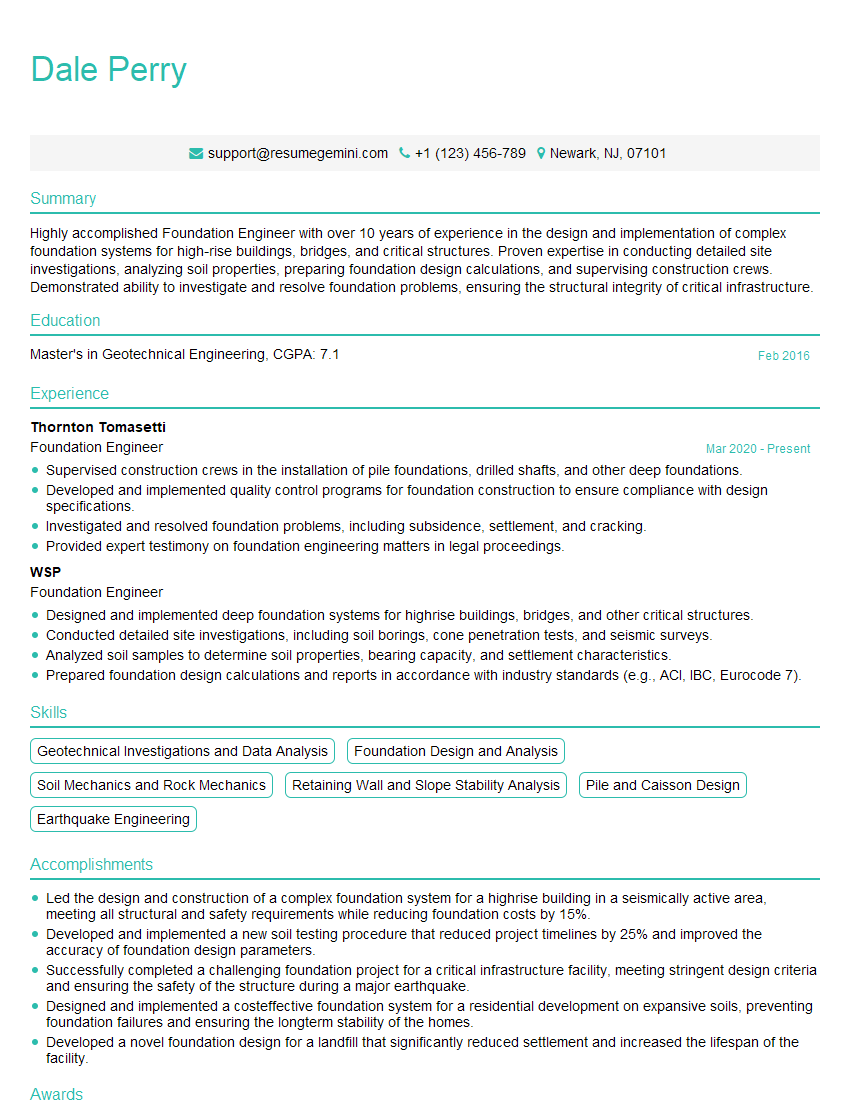
Mastering the complexities of Global Geotechnical Projects significantly enhances your career prospects, opening doors to exciting international opportunities and challenging projects. An ATS-friendly resume is crucial for navigating the application process effectively. To create a compelling and impactful resume that highlights your skills and experience, we strongly recommend using ResumeGemini. ResumeGemini provides a user-friendly platform to build a professional resume, and we offer examples of resumes tailored to Global Geotechnical Projects to guide you. Investing time in crafting a strong resume is a vital step in your career journey.
Explore more articles
Users Rating of Our Blogs
Share Your Experience
We value your feedback! Please rate our content and share your thoughts (optional).
What Readers Say About Our Blog
Very informative content, great job.
good