Cracking a skill-specific interview, like one for Geotechnical Research and Innovation, requires understanding the nuances of the role. In this blog, we present the questions you’re most likely to encounter, along with insights into how to answer them effectively. Let’s ensure you’re ready to make a strong impression.
Questions Asked in Geotechnical Research and Innovation Interview
Q 1. Explain the principles of effective stress and pore water pressure.
Effective stress and pore water pressure are fundamental concepts in geotechnical engineering. Imagine a soil element submerged in water. The total stress acting on it is the weight of the soil column above plus the weight of the water. Effective stress, denoted by σ’, represents the stress carried by the soil skeleton, essentially the stress that ‘actually’ makes the soil particles resist deformation. Pore water pressure, denoted by u, is the pressure of the water within the soil pores. The relationship between them is given by Terzaghi’s principle: Total stress (σ) = Effective stress (σ’) + Pore water pressure (u)
In simpler terms, think of a sponge soaked in water. The total weight is the sponge and the water. The effective stress is the weight the sponge itself can bear once the water is squeezed out (or accounted for). The pore water pressure is the pressure the trapped water exerts.
Understanding effective stress is crucial because it governs soil strength and deformation. High pore water pressure reduces effective stress, weakening the soil and making it more susceptible to failure. This is why, for example, quick clay landslides occur – a sudden release of pore water pressure dramatically decreases the effective stress.
Q 2. Describe different types of soil and their engineering properties.
Soils are broadly classified based on particle size and their properties. We have:
- Gravel: Coarse-grained soil with particles larger than 4.75 mm. Well-graded gravels have a good range of particle sizes, leading to higher strength and permeability. Poorly graded gravels have a narrow size range and might be less strong.
- Sand: Medium-grained soil with particles ranging from 0.075 mm to 4.75 mm. Sands can be classified as fine, medium, or coarse based on their particle size distribution. They are relatively permeable and exhibit good drainage.
- Silt: Fine-grained soil with particles between 0.002 mm and 0.075 mm. Silt has low permeability and is often susceptible to erosion. It can be quite cohesive when wet.
- Clay: Fine-grained soil with particles smaller than 0.002 mm. Clay particles are platy and possess significant cohesion due to electrochemical forces between particles. Clay’s strength and permeability can vary significantly depending on its mineral composition and water content. It has very low permeability.
Engineering properties like permeability, shear strength, compressibility, and consolidation characteristics differ significantly between these soil types. For example, clay soils are highly compressible and exhibit significant consolidation under load, unlike sands.
Q 3. How do you determine the shear strength of soil?
The shear strength of soil is its ability to resist deformation under shear stress. It’s determined through laboratory and field tests. Common methods include:
- Direct Shear Test: A soil sample is placed in a shear box and subjected to a normal stress, then shear stress until failure occurs. Shear strength parameters, cohesion (c) and angle of internal friction (φ), are obtained from the test results.
- Triaxial Test: A soil sample is encased in a rubber membrane and subjected to all-around confining pressure before being sheared. This test provides a more comprehensive evaluation of soil strength parameters under different stress states. It is more realistic than the direct shear test
- Van der Veen’s method: A simple and inexpensive method of determining the shear strength for very soft cohesive soils by using a small cutting device.
- In-situ tests: Methods like the Vane Shear Test (used for soft clays), the field penetration test (used for granular soils), and the cone penetration test (widely used in exploration and site investigations) offer an estimation of soil shear strength at the site.
The shear strength parameters (c and φ) are used in slope stability analysis, foundation design, and retaining wall design to ensure safety and stability.
Q 4. Explain the concept of consolidation and its significance in geotechnical engineering.
Consolidation is the process by which a saturated soil reduces its volume under sustained loading. Imagine squeezing a sponge filled with water; the water gradually escapes, and the sponge shrinks. Similarly, when a load is applied to saturated clay, the pore water is expelled, and the soil compresses. This process takes time, and the rate depends on the soil’s permeability and compressibility.
The significance of consolidation in geotechnical engineering lies in its impact on settlement. Structures built on compressible soils will experience significant settlement if consolidation isn’t accounted for during design. For example, a high-rise building founded on soft clay will settle over time due to consolidation. The degree of consolidation determines the magnitude and rate of settlement and the time required before full load capacity is reached.
Consolidation is analyzed using the theory of consolidation developed by Terzaghi, which uses mathematical models to predict settlement and pore water pressure dissipation over time. This allows engineers to design foundations that can withstand the anticipated settlement and ensure the stability of structures.
Q 5. Describe different methods for soil stabilization.
Soil stabilization improves the engineering properties of soil, enhancing its strength, durability, and resistance to erosion and weathering. Methods include:
- Mechanical Stabilization: This involves compacting the soil using rollers or vibratory equipment to increase its density and strength. It is effective for granular soils.
- Chemical Stabilization: Adding chemical admixtures like lime, cement, or fly ash alters the soil’s structure, increasing its strength and reducing permeability. Lime is often used to stabilize clayey soils, while cement is more effective in improving the strength of granular soils.
- Thermal Stabilization: High temperatures can be used to alter soil structure. It’s less common but useful in specific applications.
- Bio Stabilization: This technique uses microorganisms to bind soil particles, enhancing strength. It’s a relatively new and environmentally friendly method.
- Grouting: Injecting grout (cement, resin, or other materials) into the soil fills voids and cracks, increasing strength and reducing permeability. This method is used for soil improvement and ground stabilization.
The choice of stabilization method depends on the soil type, project requirements, and environmental considerations. For instance, cement stabilization might be suitable for high-strength requirements, while lime stabilization could be preferred for environmentally sensitive areas.
Q 6. What are the factors influencing slope stability?
Slope stability is the resistance of a soil slope to failure. Several factors influence it:
- Soil type and strength: Cohesive soils (clays) have higher shear strength than granular soils (sands), influencing slope stability. A weaker soil is more likely to fail.
- Slope angle: Steeper slopes are inherently less stable than gentler slopes. The steeper the slope, the higher the driving forces that can cause failure.
- Water content: High water content significantly reduces soil strength, increasing the risk of slope failure. Pore water pressure increases, reducing effective stress.
- Groundwater conditions: The presence of high water tables increases pore water pressure and reduces soil strength, thereby decreasing stability.
- Vegetation: Vegetation can improve slope stability by increasing root cohesion and reducing erosion. The roots bind soil particles together.
- Seismic activity: Earthquakes can trigger slope failures by generating excess pore water pressure and increasing shear stresses.
Slope stability analysis uses methods like the limit equilibrium method to determine the factor of safety (FoS), which indicates the ratio of resisting forces to driving forces. An FoS less than 1 indicates potential instability.
Q 7. How do you analyze and design retaining structures?
Retaining structures are designed to hold back soil and prevent it from sliding or collapsing. The analysis and design involve determining the forces acting on the structure and ensuring its stability. Common types include:
- Gravity walls: These massive structures resist soil pressure through their own weight.
- Cantilever walls: These walls utilize the cantilever action of a reinforced concrete stem anchored into the ground.
- Anchored walls: These walls are stabilized by ground anchors that transfer lateral forces to the ground.
- Sheet pile walls: Interlocking steel sheets driven into the ground form a continuous barrier to prevent soil movement.
Analysis involves calculating lateral earth pressures acting on the wall using theories like Rankine’s or Coulomb’s theory, considering factors such as soil properties, wall geometry, and surcharge loads. Design includes selecting appropriate materials, dimensions, and reinforcement to ensure the wall’s stability and safety. Software packages are commonly used to perform detailed analysis and design, considering various soil conditions and loading scenarios.
For example, in designing a cantilever retaining wall, calculations will consider the soil pressure distribution and bending moments in the wall stem, leading to the determination of the required wall thickness and reinforcement. Proper drainage is also crucial to reduce pore water pressure and maintain stability.
Q 8. Explain the principles of shallow and deep foundations.
Foundation design hinges on the principle of transferring structural loads safely to the ground. Shallow foundations, like spread footings and strip footings, transfer loads to the soil within a relatively shallow depth (typically less than their width). Think of them as a wide base distributing weight evenly. Deep foundations, on the other hand, such as piles and caissons, transfer loads to stronger soil layers much deeper below the surface. They’re like long legs reaching down to a solid foundation.
Shallow Foundations: These are suitable for structures with relatively light loads and soil conditions that can support the bearing capacity. Factors considered include soil type, bearing capacity, and potential settlement. A spread footing under a column is a classic example, distributing the column load over a larger area. Strip footings are continuous foundations supporting walls.
Deep Foundations: These are necessary when dealing with weak or compressible surface soils, or when carrying heavy loads. Piles are driven into the ground, transferring loads through end-bearing (resting on a stronger layer) or friction resistance (along the pile shaft). Caissons, large cylindrical or box-shaped structures, are often constructed in place using excavated methods. They’re employed when exceptionally heavy loads need support, such as in bridge piers or high-rise buildings.
The choice between shallow and deep foundations depends critically on geotechnical investigations and engineering judgment. A cost-benefit analysis, considering construction time and material costs, is also vital.
Q 9. Describe different types of ground improvement techniques.
Ground improvement techniques aim to enhance the engineering properties of soil, making it more suitable for construction. These techniques can be broadly categorized as in-situ (performed in place) and ex-situ (requiring soil removal and replacement).
- Compaction: This method increases the soil density by reducing void spaces, increasing its strength and bearing capacity. Think of it as packing sand tightly. Vibratory rollers are commonly used for this purpose. Example: Compacting the subgrade soil for a roadway.
- Stone Columns: These are created by installing granular columns (like crushed stone) into softer soils. They improve load transfer and reduce settlement. Imagine it like reinforcing a soft sponge with stronger rods.
- Soil Stabilization: This involves improving soil properties by adding binding agents like cement, lime, or fly ash. It’s like mixing cement in with weak concrete to make it stronger. Example: Stabilizing clay soils with lime to increase their shear strength.
- Vibro-Replacement: This involves using vibrations to displace and compact loose soils while simultaneously filling the space with a more suitable material (like granular fill). This is a bit like a deep tissue massage for the soil, replacing the loose tissues with something stronger.
- Grouting: Injecting grout (a mixture of cement, water and other additives) into the soil to fill voids and increase strength. It’s analogous to patching up cracks in a wall.
The selection of an appropriate technique depends on several factors, including soil type, depth, cost, and environmental considerations.
Q 10. How do you assess the settlement of foundations?
Settlement assessment is crucial in foundation design. It involves predicting and monitoring the vertical movement of a structure due to the compression of the underlying soil under load. We employ both analytical and observational methods.
Analytical Methods: These rely on soil parameters obtained from laboratory and in-situ tests. Empirical methods like the Schmertmann method or more advanced methods such as finite element analysis are used to estimate settlement. These methods require careful consideration of factors such as soil stratigraphy, load distribution, and time-dependent consolidation.
Observational Methods: These involve monitoring actual settlement during and after construction using instruments like settlement plates, inclinometers, and extensometers. These provide real-time data to validate predictions and detect unexpected settlements. Example: Regular monitoring of the settlement of a bridge pier during construction using settlement plates.
Accurate assessment of settlement is vital to ensure the structural integrity and functionality of the building or structure. Excessive settlement can lead to cracking, tilting, and other structural damage.
Q 11. Explain the importance of site investigation in geotechnical projects.
Site investigation is paramount in geotechnical projects, providing the fundamental data for design and construction. It’s like a thorough medical examination for a building project, revealing the ground’s ‘health’ before planning any construction.
The investigation involves a range of activities, including:
- Desk study: Gathering existing information like geological maps, aerial photographs, and historical records to get a preliminary understanding of the site.
- Field exploration: This includes conducting borehole drilling to collect soil samples, in-situ testing to assess soil properties in their natural state, and geophysical surveys to map subsurface conditions.
- Laboratory testing: Performing various tests on collected soil samples to determine their physical and mechanical properties (e.g., grain size distribution, shear strength, consolidation characteristics).
A well-executed site investigation minimizes risks, reduces construction costs through informed decision-making, and ensures the safety and longevity of the structure. Ignoring this crucial step can lead to disastrous consequences, such as foundation failure and structural damage.
Q 12. What are the common methods used for in-situ testing?
In-situ testing provides valuable information about the soil’s behavior in its natural state. Several common methods include:
- Standard Penetration Test (SPT): A widely used test where a split-spoon sampler is driven into the ground, and the number of blows required to drive it a certain distance is recorded. This indicates soil density and relative strength.
- Cone Penetration Test (CPT): A cone-shaped probe is pushed into the ground, measuring its resistance to penetration. This provides data on soil density, strength, and stratigraphy.
- Vane Shear Test: A vane is rotated in the soil to measure its undrained shear strength. This is particularly useful for assessing the strength of soft clays.
- Pressuremeter Test (PMT): A cylindrical probe is inflated in the ground to measure the soil’s pressure-volume relationship, providing information about its stiffness and strength.
The choice of in-situ test depends on the project’s requirements, soil conditions, and cost considerations. The data obtained is crucial in determining appropriate foundation design and ground improvement strategies.
Q 13. How do you interpret laboratory soil test results?
Interpreting laboratory soil test results requires a thorough understanding of soil mechanics principles. The results provide essential parameters for design, including:
- Grain size distribution: Indicates the proportion of different particle sizes, which affects soil permeability and drainage characteristics.
- Atterberg limits: These define the consistency limits of fine-grained soils (liquid limit, plastic limit, and shrinkage limit), influencing their behavior under various moisture conditions.
- Consolidation characteristics: Show how much the soil compresses under load over time, which is crucial for settlement prediction.
- Shear strength parameters: Determine the soil’s resistance to failure under shear stress, which is vital for designing foundations and retaining structures.
The interpretation goes beyond simply reading the numbers. It involves understanding the relationships between different parameters and how they affect the overall soil behavior. Experience and engineering judgment are crucial in drawing reliable conclusions from the data. For instance, a high plasticity index indicates a high potential for settlement, while a low permeability suggests poor drainage capabilities.
Q 14. Describe your experience with finite element analysis in geotechnical engineering.
Finite element analysis (FEA) is a powerful numerical method extensively used in geotechnical engineering to solve complex problems. I’ve used FEA extensively throughout my career to model and analyze various geotechnical scenarios, including foundation settlement, slope stability, earth pressure on retaining structures, and ground improvement effectiveness.
In my experience, FEA allows for a more detailed and realistic representation of soil behavior compared to simpler analytical methods. It can handle complex geometries, non-linear material properties, and various loading conditions. I’ve used commercial software packages like ABAQUS and PLAXIS for this purpose. For example, I used FEA to model the settlement of a large-scale foundation under a high-rise building, considering the complex soil stratigraphy and the time-dependent consolidation behavior. This analysis helped optimize the foundation design and mitigate potential settlement issues.
However, FEA’s accuracy depends on the quality of the input data (soil properties, boundary conditions, loads). It’s critical to conduct appropriate site investigations and use realistic soil models for reliable results. In addition to the software itself, an understanding of the underlying principles of soil mechanics and numerical analysis is crucial for proper modeling and accurate interpretation of the results. I always ensure thorough quality control and validation of the FEA results through comparison with simpler analytical methods and, where possible, in-situ measurements.
Q 15. Explain the use of empirical methods versus numerical modeling in geotechnical design.
Geotechnical design relies on both empirical methods and numerical modeling, each with its strengths and weaknesses. Empirical methods utilize established correlations and simplified formulas based on past observations and experimental data. They are often simpler to apply and require less computational power, making them suitable for preliminary designs or simpler projects. Think of them as using a well-tested recipe – you know the ingredients and the expected outcome.
Numerical modeling, on the other hand, uses sophisticated computer programs to simulate soil behavior under various loading conditions. These models can handle complex geometries, material properties, and loading scenarios, providing a more detailed and accurate representation of reality. It’s like having a detailed blueprint of the building, showing every component and their interaction.
The choice between these methods often depends on the project’s complexity, available data, and required accuracy. Simple shallow foundations might rely heavily on empirical methods, while complex retaining walls or deep excavations could necessitate the use of finite element analysis (FEA) or other numerical techniques. In many instances, a hybrid approach combining both methods is most effective – empirical methods for initial estimations and numerical modeling for refinement and validation.
Career Expert Tips:
- Ace those interviews! Prepare effectively by reviewing the Top 50 Most Common Interview Questions on ResumeGemini.
- Navigate your job search with confidence! Explore a wide range of Career Tips on ResumeGemini. Learn about common challenges and recommendations to overcome them.
- Craft the perfect resume! Master the Art of Resume Writing with ResumeGemini’s guide. Showcase your unique qualifications and achievements effectively.
- Don’t miss out on holiday savings! Build your dream resume with ResumeGemini’s ATS optimized templates.
Q 16. How do you handle uncertainty and risk in geotechnical design?
Uncertainty and risk are inherent in geotechnical engineering because we are dealing with a highly variable natural material – soil. We address this through a combination of techniques. Firstly, thorough site investigation is crucial. This involves geotechnical drilling, sampling, laboratory testing, and geophysical surveys to characterize the soil properties as accurately as possible. Think of this as detective work, gathering as much evidence as possible before making conclusions.
Secondly, we employ probabilistic methods. Instead of using single values for soil parameters, we use probability distributions that reflect the inherent uncertainty. This allows us to perform risk assessments and determine the likelihood of different failure scenarios. We might use Monte Carlo simulations to analyze the potential range of outcomes.
Thirdly, we incorporate factors of safety into our designs. These factors are multipliers applied to design loads or allowable stresses to account for uncertainties and ensure that the structure will perform reliably even under unexpected conditions. This is like building in a margin for error, adding extra support to ensure stability.
Finally, we often use risk-mitigation strategies, such as using alternative foundation types or incorporating monitoring systems to detect potential problems early on. We might decide to use a more expensive, but less risky, solution than the cheapest option to prevent future issues.
Q 17. Describe your experience with geotechnical instrumentation and monitoring.
I have extensive experience with geotechnical instrumentation and monitoring, having used a wide array of instruments on numerous projects. This ranges from simple inclinometers and piezometers to more sophisticated systems such as fiber optic sensors and distributed temperature sensing (DTS) technologies. These instruments provide real-time data on ground movements, pore water pressures, and other crucial parameters.
For example, during the construction of a deep basement excavation, we used inclinometers to monitor the movement of the retaining walls. This allowed us to adjust the support systems as needed, preventing potential failures. On another project involving a landslide-prone slope, we installed piezometers to measure pore water pressure, providing early warning of potential instability. The data gathered helps refine our models, validate design assumptions, and ensure the safety of the project. Proper data analysis and reporting are critical for successfully monitoring projects.
Q 18. How do you ensure the safety and quality of geotechnical projects?
Ensuring safety and quality in geotechnical projects requires a multi-faceted approach. First, meticulous planning and design are essential, using appropriate methodologies and incorporating all relevant safety factors. This starts with a thorough site investigation and detailed geotechnical modeling, as discussed earlier.
Secondly, rigorous quality control during construction is crucial. This involves regular inspections of excavation work, foundation construction, and installation of ground improvement techniques. For example, we would carefully monitor the compaction of soil fills using nuclear density gauges. Regular inspections are conducted to ensure that construction complies with specifications and doesn’t compromise the safety and longevity of the project.
Thirdly, effective communication and collaboration among the design team, contractors, and regulatory agencies is paramount. This helps identify and resolve potential problems early on, preventing costly delays and safety risks.
Finally, post-construction monitoring, where applicable, provides valuable feedback and allows for adjustments or corrective measures to be implemented if necessary. It is a crucial aspect to check the long-term performance and address unexpected issues that may surface over time.
Q 19. What are your experiences with different types of ground anchors?
My experience encompasses various ground anchor types, including:
- Soil anchors (or ground anchors): These are common for stabilizing slopes and retaining walls. I’ve worked with both grouted anchors and un-grouted anchors (e.g., driven anchors). The selection depends on soil conditions and the required holding capacity.
- Rock bolts: Used extensively in rock slopes and underground excavations to enhance stability. The length, diameter, and grouting method are carefully chosen based on rock mass characteristics.
- Micropiles: These small-diameter piles are often used for underpinning existing structures or providing localized support for foundations. They are particularly useful in congested urban environments.
- Tiebacks: Used in deep excavations to support the retaining walls and prevent collapse. Tiebacks can be installed horizontally or at an angle, and their design requires careful consideration of the soil’s strength and the anticipated loads.
Each type has its own advantages and limitations, and the selection depends on factors such as the ground conditions, required load capacity, access constraints, and cost considerations. Careful design and installation practices are essential for each type to ensure long-term performance.
Q 20. Describe your understanding of seismic soil behavior.
Seismic soil behavior is complex and depends significantly on soil type and density. During an earthquake, the ground undergoes cyclic loading, leading to several phenomena:
- Liquefaction: Loose, saturated sandy soils can lose their strength and stiffness under cyclic loading, behaving like a liquid. This can lead to significant ground settlement and lateral spreading, causing damage to structures.
- Cyclic mobility: Even soils that don’t liquefy can experience a reduction in shear strength under cyclic loading, leading to ground deformation.
- Seismic amplification: Soft soils can amplify the ground shaking, leading to increased forces on structures compared to what would be experienced on bedrock.
- Ground resonance: In certain geological settings, the ground can resonate at specific frequencies, exacerbating ground shaking.
Understanding these phenomena is crucial for designing earthquake-resistant structures. Site-specific investigations are essential to determine the potential for seismic hazards and to design appropriate mitigation measures.
Q 21. How would you design a foundation for a structure in liquefiable soil?
Designing a foundation for a structure in liquefiable soil requires a multi-pronged approach focused on mitigating the effects of liquefaction. Simply placing a foundation directly on liquefiable soil is unacceptable.
Several strategies can be employed:
- Ground improvement techniques: This is often the most effective approach. Techniques such as vibro-compaction, deep dynamic compaction (DDC), stone columns, or soil stabilization can densify the soil and increase its resistance to liquefaction. The choice depends on the soil type, site conditions, and project constraints.
- Drilled shafts or piles: Transferring the load to deeper, more stable strata is crucial. These can be designed to resist both vertical and lateral loads. This acts as a strong anchor, irrespective of what’s happening in the liquefiable layer.
- Floating foundations: For lighter structures, a floating foundation that allows for some settlement may be appropriate. This acknowledges the potential for settlement and builds a system that moves with the ground.
- Liquefaction analysis: This is an essential step in the design process, determining the potential for liquefaction and the resulting ground deformation.
The specific design will depend on a thorough site investigation, including soil testing, seismic hazard analysis, and evaluation of the structure’s weight and sensitivity to settlement. It’s a complex process requiring the experience and judgment of a geotechnical engineer specializing in seismic design.
Q 22. Explain your experience with geotechnical report writing.
Geotechnical report writing is crucial for communicating complex subsurface information clearly and concisely to engineers, contractors, and clients. A well-written report not only presents the findings but also interprets their significance for design and construction. My experience encompasses various project types, from small-scale residential developments to large-scale infrastructure projects. I’m proficient in preparing reports that adhere to industry standards (like ASTM and AASHTO guidelines), including detailed site investigations, laboratory testing results, analyses (e.g., slope stability, bearing capacity), design recommendations, and conclusions.
For example, on a recent highway expansion project, I authored a report detailing the complex geology (including expansive clay layers and a high water table), recommending appropriate foundation design, and specifying the need for specialized ground improvement techniques like deep soil mixing. The report’s clarity was critical in securing the necessary approvals and preventing costly construction delays.
Beyond the technical aspects, I prioritize clear and accessible language, avoiding unnecessary jargon. I use visual aids like cross-sections, bore logs, and tables to enhance understanding and ensure that the report is readily comprehensible to a diverse audience.
Q 23. Describe your experience using geotechnical software (e.g., PLAXIS, ABAQUS).
I have extensive experience using geotechnical software, primarily PLAXIS and ABAQUS. PLAXIS is my go-to for finite element analysis of complex geotechnical problems, especially those involving soil-structure interaction. I’ve used it extensively for analyzing retaining wall stability, slope stability, and the behavior of earth dams. For instance, in one project involving a high retaining wall adjacent to a busy highway, PLAXIS helped us model the complex stress distribution in the soil and optimize the wall design for safety and long-term performance. The software’s ability to account for nonlinear soil behavior and pore water pressure changes was crucial in this analysis.
ABAQUS, while more general-purpose than PLAXIS, provides powerful capabilities for advanced geotechnical simulations, such as analyzing the response of foundations subjected to seismic loading or investigating the effects of ground improvement techniques. I’ve used it to model the behavior of pile foundations under various loading scenarios, including cyclic loading conditions. The results directly informed the design parameters, ensuring a safe and cost-effective solution.
My experience extends beyond simply running the software. I understand the underlying theoretical principles and can critically evaluate the results. I’m adept at selecting appropriate numerical models, interpreting the output, and validating the findings with field observations and empirical data.
Q 24. Explain your experience with different types of retaining wall design.
My experience encompasses a wide range of retaining wall designs, including gravity walls, cantilever walls, anchored walls, and soil-nailed walls. The selection of the most appropriate wall type depends on several factors, such as the soil conditions, the height of the wall, the available space, and the aesthetic requirements.
Gravity walls are the simplest, relying on their own weight for stability. They are suitable for low to moderate heights and strong soil conditions. Cantilever walls use the soil behind the wall as a counterweight, making them more suitable for taller walls. Anchored walls incorporate anchors that transfer lateral loads to the ground, allowing for cost-effective designs in challenging soil conditions. Soil-nailed walls are particularly effective in unstable slopes, reinforcing the soil with steel nails to increase its strength and stability.
For example, in a project involving a steep slope near a residential area, we opted for a soil-nailed wall to stabilize the slope and prevent potential landslides. A thorough geotechnical investigation, including extensive laboratory testing and in-situ measurements, was essential in determining the appropriate nail spacing, length, and diameter. The project demonstrated the effectiveness of combining innovative design with robust geotechnical analysis.
Q 25. What are your experiences with tunneling design and construction?
My involvement in tunneling design and construction spans various aspects, from initial feasibility studies to detailed design and construction supervision. I’m familiar with different tunneling methods, including cut-and-cover, shield tunneling, and drill-and-blast. The choice of method is dictated by factors such as ground conditions, depth of the tunnel, environmental constraints, and project budget.
A key aspect of tunneling design is predicting and mitigating ground instability. This often involves using numerical models to simulate ground behavior under different construction scenarios and identifying potential challenges like ground water ingress, settlement, and squeezing ground. For instance, in a recent project involving a deep tunnel in a highly fractured rock mass, I used advanced numerical modeling techniques to predict the likely ground response during the excavation process. This enabled us to design a robust support system, minimizing the risk of ground collapse and ensuring the safety of the construction crews.
Construction monitoring and instrumentation are also integral parts of my role, allowing for real-time evaluation of ground behavior and timely adjustments to the construction methodology as needed.
Q 26. How do you approach solving geotechnical problems in challenging conditions?
Solving geotechnical problems in challenging conditions requires a systematic and multi-faceted approach. It starts with a comprehensive understanding of the site-specific challenges, including soil properties, hydrological conditions, and potential environmental impacts. This understanding is built through a thorough site investigation, involving techniques such as in-situ testing (CPT, SPT, DMT), laboratory testing, and geophysical surveys.
Once the challenges are well-defined, I employ a combination of analytical methods, numerical modeling, and engineering judgment to develop solutions. This might involve exploring ground improvement techniques (e.g., soil stabilization, deep mixing, vibro-compaction), modifying the design to accommodate the challenging conditions, or implementing advanced construction methods. For instance, in a project involving a soft clay layer beneath a high-rise building, we used a combination of deep pile foundations and ground improvement techniques to ensure adequate settlement control and bearing capacity.
Risk assessment and mitigation are crucial. I use probabilistic methods to quantify the uncertainty associated with the soil properties and the design parameters and implement appropriate safety factors and contingency plans.
Q 27. Describe your understanding of sustainability and environmental considerations in geotechnical projects.
Sustainability and environmental considerations are increasingly important in geotechnical projects. My approach involves minimizing the environmental footprint throughout the project lifecycle, from site investigation to construction and decommissioning. This includes reducing energy consumption, minimizing waste generation, and protecting sensitive ecosystems.
In site investigation, I prioritize non-destructive techniques wherever possible, reducing the need for extensive excavation and minimizing disruption to the environment. In design, I aim for solutions that utilize locally sourced materials and minimize the need for imported fill. During construction, I work closely with contractors to implement environmentally friendly practices, such as recycling materials and managing stormwater runoff. For example, in a recent project, we explored the use of recycled materials for backfill, reducing the reliance on virgin materials and lowering the project’s carbon footprint.
Moreover, I consider the long-term environmental impacts of the project. This involves assessing the potential for ground water contamination, erosion, and habitat loss and incorporating mitigation measures in the design and construction phases.
Q 28. Discuss your experience with managing geotechnical projects within budget and timeline constraints.
Managing geotechnical projects within budget and timeline constraints requires careful planning, effective communication, and proactive risk management. I begin by establishing a clear project scope, defining deliverables, and establishing a realistic budget and schedule. This involves detailed cost estimation, considering all potential contingencies. Regular monitoring of progress and costs is essential, with timely adjustments made as needed.
Effective communication is crucial in maintaining a cohesive project team. I foster collaborative relationships with contractors, clients, and other stakeholders, ensuring transparency and open communication throughout the project lifecycle. Regular progress meetings, detailed reports, and proactive issue resolution are key components of my management style. For example, in a recent project with a tight deadline, proactive communication with the contractor, coupled with a well-defined risk management plan, helped us avoid costly delays and stay on budget.
Value engineering plays a significant role in optimizing project costs without compromising safety or quality. This often involves exploring alternative design solutions and construction methods, comparing their costs and benefits, and selecting the most cost-effective option that still meets project requirements.
Key Topics to Learn for Geotechnical Research and Innovation Interview
- Soil Mechanics Fundamentals: Understanding soil behavior, including stress-strain relationships, shear strength, consolidation, and permeability. Consider practical applications like slope stability analysis and foundation design.
- Rock Mechanics Principles: Exploring the mechanical properties of rocks, rock mass classification, and the design of rock slopes and tunnels. Think about applications in underground construction and mining.
- Advanced Geotechnical Testing and Analysis: Familiarize yourself with various laboratory and in-situ testing methods, such as triaxial testing, vane shear testing, and CPT. Understand data interpretation and analysis techniques.
- Numerical Modeling in Geotechnical Engineering: Gain proficiency in using finite element analysis (FEA) software to simulate geotechnical problems and predict ground behavior. Consider case studies demonstrating model application and validation.
- Ground Improvement Techniques: Explore methods for enhancing soil properties, including compaction, soil stabilization, and ground reinforcement. Understand their applications and limitations.
- Sustainability and Environmental Considerations: Learn about the environmental impact of geotechnical projects and sustainable practices in geotechnical engineering. Consider topics such as carbon footprint reduction and waste management.
- Data Analysis and Interpretation: Develop skills in statistical analysis and data visualization to effectively interpret geotechnical data and draw meaningful conclusions. This is crucial for research and problem-solving.
- Research Methodology and Presentation: Practice clearly communicating your research findings through effective reports and presentations. This is essential for collaborative research environments.
Next Steps
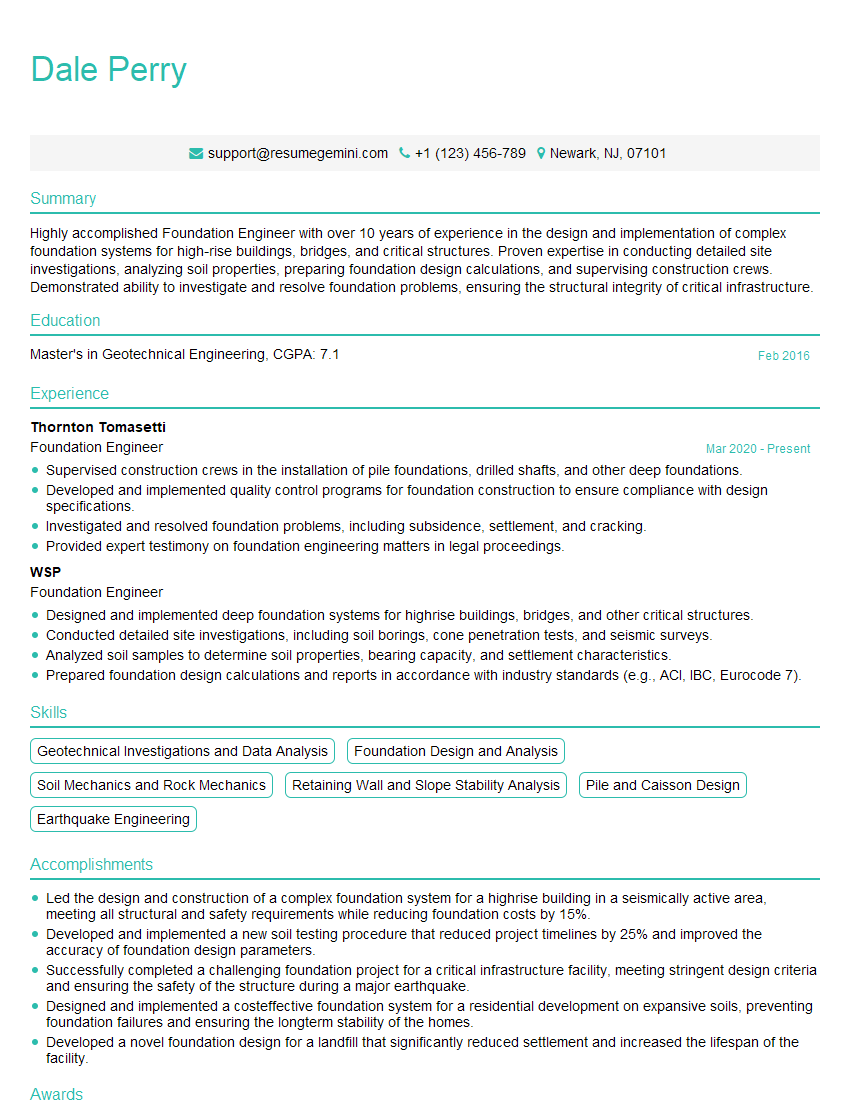
Mastering Geotechnical Research and Innovation opens doors to exciting and impactful careers, offering opportunities to contribute to crucial infrastructure projects and groundbreaking research. A strong resume is your key to unlocking these opportunities. Crafting an ATS-friendly resume is essential to ensure your application gets noticed by recruiters. To significantly enhance your resume and increase your chances of securing your dream role, we recommend using ResumeGemini. ResumeGemini provides a user-friendly platform and offers examples of resumes specifically tailored to Geotechnical Research and Innovation, helping you present your qualifications effectively. Take the next step towards a successful career in this field today!
Explore more articles
Users Rating of Our Blogs
Share Your Experience
We value your feedback! Please rate our content and share your thoughts (optional).
What Readers Say About Our Blog
Very informative content, great job.
good