Preparation is the key to success in any interview. In this post, we’ll explore crucial Advanced Mathematics Skills interview questions and equip you with strategies to craft impactful answers. Whether you’re a beginner or a pro, these tips will elevate your preparation.
Questions Asked in Advanced Mathematics Skills Interview
Q 1. Explain the concept of eigenvalues and eigenvectors.
Eigenvalues and eigenvectors are fundamental concepts in linear algebra. Imagine a linear transformation, like stretching or rotating a vector. Eigenvectors are special vectors that, when this transformation is applied, only change in scale; they don’t change direction. The factor by which they scale is the eigenvalue. Formally, if A is a square matrix, v is an eigenvector, and λ is an eigenvalue, then the equation Av = λv holds.
Example: Consider the matrix A = [[2, 0], [0, 3]]. If we apply this transformation to the vector v = [1, 0], we get Av = [2, 0] = 2v. Thus, v = [1, 0] is an eigenvector with eigenvalue λ = 2. Similarly, v = [0, 1] is an eigenvector with eigenvalue λ = 3.
Practical Application: Eigenvalues and eigenvectors are used extensively in various fields, including physics (vibration analysis, quantum mechanics), computer graphics (image compression, rotation), and machine learning (principal component analysis).
Q 2. Describe the difference between a discrete and continuous random variable.
The difference between discrete and continuous random variables lies in the nature of the values they can take. A discrete random variable can only take on a finite number of values or a countably infinite number of values. Think of it like counting – you can have 1 apple, 2 apples, but not 1.5 apples. A continuous random variable, on the other hand, can take on any value within a given range. Imagine measuring the height of a person; it could be 1.75 meters, 1.751 meters, or any value in between.
Example: The number of heads when flipping a coin three times is a discrete random variable (it can be 0, 1, 2, or 3). The height of a student is a continuous random variable.
Practical Application: Discrete variables are used to model counts (e.g., number of defects in a production run), while continuous variables are used to model measurements (e.g., temperature, weight).
Q 3. What is the Central Limit Theorem and its significance?
The Central Limit Theorem (CLT) is a cornerstone of statistics. It states that the distribution of the sample means of a large number of independent, identically distributed random variables, regardless of their original distribution, will approximate a normal distribution. The approximation improves as the sample size increases.
Significance: The CLT is crucial because it allows us to make inferences about a population mean even if we don’t know the underlying population distribution. Many statistical tests rely on the assumption of normality, and the CLT assures us that this assumption is often reasonable, especially with larger samples.
Example: Imagine measuring the weights of a large population of apples. Even if the individual apple weights don’t follow a normal distribution, the average weight of many samples will be approximately normally distributed.
Practical Application: The CLT underpins many statistical hypothesis tests, confidence intervals, and estimations in fields like quality control, market research, and clinical trials.
Q 4. Explain the concept of hypothesis testing and its steps.
Hypothesis testing is a statistical procedure used to determine whether there is enough evidence to reject a null hypothesis. The null hypothesis is a statement of no effect or no difference. We test this against an alternative hypothesis, which represents the effect we are trying to detect.
Steps:
- State the hypotheses: Formulate the null (H0) and alternative (H1) hypotheses.
- Set the significance level (α): This is the probability of rejecting the null hypothesis when it is actually true (Type I error).
- Choose a test statistic: Select a statistical test appropriate for the type of data and hypotheses.
- Collect data and calculate the test statistic: Gather the necessary data and compute the value of the test statistic.
- Determine the p-value: This is the probability of obtaining the observed results (or more extreme) if the null hypothesis is true.
- Make a decision: If the p-value is less than or equal to α, reject the null hypothesis; otherwise, fail to reject the null hypothesis.
Example: Testing whether a new drug lowers blood pressure. H0: The drug has no effect. H1: The drug lowers blood pressure.
Practical Application: Hypothesis testing is fundamental in medical research, A/B testing in marketing, and quality control in manufacturing.
Q 5. How do you calculate the confidence interval for a population mean?
The confidence interval for a population mean provides a range of values within which we are confident the true population mean lies. Its calculation depends on whether the population standard deviation (σ) is known or unknown.
If σ is known: The confidence interval is calculated as:
CI = x̄ ± Zα/2 * (σ/√n)
where: x̄ is the sample mean, Zα/2 is the critical Z-value for the desired confidence level (e.g., 1.96 for a 95% confidence interval), σ is the population standard deviation, and n is the sample size.
If σ is unknown: We use the sample standard deviation (s) and the t-distribution:
CI = x̄ ± tα/2, n-1 * (s/√n)
where tα/2, n-1 is the critical t-value from the t-distribution with n-1 degrees of freedom.
Example: Suppose we have a sample mean weight of 150g (x̄), a sample standard deviation of 10g (s), a sample size of 100 (n), and we want a 95% confidence interval. Since σ is unknown, we use the t-distribution. We would look up the t-value for α/2 = 0.025 and 99 degrees of freedom.
Practical Application: Confidence intervals are widely used to report the precision of estimates in various fields, from market research to clinical trials.
Q 6. What are different types of probability distributions?
There are many types of probability distributions, each with its own characteristics and applications. Some common ones include:
- Normal Distribution: A bell-shaped, symmetric distribution. It’s crucial in many statistical analyses.
- Binomial Distribution: Models the probability of a certain number of successes in a fixed number of independent Bernoulli trials (e.g., coin flips).
- Poisson Distribution: Models the probability of a given number of events occurring in a fixed interval of time or space (e.g., number of customers arriving at a store per hour).
- Uniform Distribution: Each outcome in a range has an equal probability.
- Exponential Distribution: Models the time until an event occurs in a Poisson process (e.g., time between customer arrivals).
- Chi-Squared Distribution: Often used in hypothesis testing involving categorical data.
- t-Distribution: Similar to the normal distribution, but used when the population standard deviation is unknown.
- F-Distribution: Used in ANOVA (analysis of variance) to compare the variances of two or more groups.
Practical Application: Choosing the right distribution is crucial for accurate statistical modeling. The choice depends on the nature of the data and the research question.
Q 7. Explain the concept of linear regression and its assumptions.
Linear regression is a statistical method used to model the relationship between a dependent variable and one or more independent variables. It aims to find the best-fitting straight line (or hyperplane in multiple linear regression) that describes this relationship.
Assumptions: Several assumptions underlie linear regression for valid inferences:
- Linearity: The relationship between the dependent and independent variables is linear.
- Independence: The observations are independent of each other.
- Homoscedasticity: The variance of the errors is constant across all levels of the independent variable(s).
- Normality: The errors are normally distributed.
- No multicollinearity (in multiple linear regression): The independent variables are not highly correlated with each other.
Example: Predicting house prices based on size. The size would be the independent variable, and the price the dependent variable. The linear regression model would attempt to find a line that best fits the data points.
Practical Application: Linear regression is used extensively in forecasting, prediction, and causal inference across numerous fields, including economics, finance, and engineering.
Q 8. How do you handle missing data in a dataset?
Handling missing data is crucial for accurate analysis. Ignoring it can lead to biased results. The best approach depends on the nature and extent of the missing data, and the size of your dataset.
- Deletion: The simplest method is to remove rows or columns with missing values. This is suitable for small datasets with few missing values, but it can lead to significant information loss if applied liberally.
- Imputation: This involves filling in missing values with estimated values. Several techniques exist:
- Mean/Median/Mode Imputation: Replacing missing values with the mean (average), median (middle value), or mode (most frequent value) of the respective column. Simple but can distort the distribution if many values are missing.
- Regression Imputation: Predicting missing values using a regression model based on other variables. More sophisticated, but assumes a linear relationship.
- K-Nearest Neighbors (KNN) Imputation: Estimating missing values based on the values of similar data points (neighbors). Works well for non-linear relationships but can be computationally expensive.
- Multiple Imputation: Creating multiple plausible imputed datasets and combining the results. Reduces bias compared to single imputation methods.
- Advanced Techniques: For complex scenarios, consider maximum likelihood estimation or expectation-maximization algorithms, especially when dealing with missing data patterns.
Example: Imagine analyzing customer purchase data with some missing ages. Mean imputation might be suitable if only a few ages are missing, but KNN imputation might be better if age is correlated with other features like purchase history.
Q 9. What are the different methods for data normalization?
Data normalization aims to scale features to a similar range, preventing features with larger values from dominating models. Common methods include:
- Min-Max Scaling: Scales features to a range between 0 and 1.
x_scaled = (x - min(x)) / (max(x) - min(x))This is sensitive to outliers. - Z-score Standardization: Transforms data to have a mean of 0 and a standard deviation of 1.
z = (x - mean(x)) / std(x)Less sensitive to outliers than Min-Max. - Robust Scaling: Similar to Z-score but uses median and interquartile range instead of mean and standard deviation. Highly resistant to outliers.
- Unit Vector Normalization (L2 Normalization): Scales each data point to have a Euclidean norm of 1. Useful for text analysis and document processing.
The choice of method depends on the dataset’s distribution and the algorithm used. For example, algorithms sensitive to feature scaling, like K-Nearest Neighbors, often benefit from Min-Max or Z-score normalization.
Q 10. What is the difference between correlation and causation?
Correlation describes the statistical relationship between two variables, while causation implies a cause-and-effect relationship. Correlation indicates how strongly two variables change together, while causation indicates that a change in one variable directly causes a change in the other.
Example: Ice cream sales and crime rates might be positively correlated – both increase during summer. However, this doesn’t mean that increased ice cream sales cause increased crime. A confounding variable (summer heat) influences both.
Establishing causation requires more rigorous methods like controlled experiments, randomized trials, or strong temporal precedence (cause must precede effect) alongside correlation.
Q 11. Explain the concept of Bayesian inference.
Bayesian inference is a statistical method that updates our beliefs about an event based on new evidence. It uses Bayes’ theorem, which states: P(A|B) = [P(B|A) * P(A)] / P(B) where:
P(A|B)is the posterior probability – the probability of event A happening given that event B has occurred.P(B|A)is the likelihood – the probability of event B occurring given that event A has occurred.P(A)is the prior probability – the initial belief about the probability of event A.P(B)is the evidence – the probability of event B occurring.
Imagine you’re testing a new drug. Your prior belief (prior) might be that it has a 50% chance of working. After observing successful results in a trial (likelihood), Bayesian inference updates your belief (posterior) to a higher probability of the drug being effective.
Bayesian inference is powerful for incorporating prior knowledge and updating beliefs incrementally as more data become available. It’s used extensively in machine learning, especially in areas like spam filtering and medical diagnosis.
Q 12. Describe different optimization algorithms.
Optimization algorithms aim to find the best solution to a problem by iteratively improving an initial guess. The choice of algorithm depends on the problem’s characteristics (convexity, smoothness, dimensionality).
- Gradient Descent: A workhorse for finding minima of differentiable functions. We’ll explore it in more detail in the next answer.
- Stochastic Gradient Descent (SGD): A variant of gradient descent that uses a single data point or a small batch of data points to estimate the gradient, making it faster for large datasets but potentially less stable.
- Newton’s Method: Uses second-order derivatives (Hessian matrix) for faster convergence near the minimum, but computationally expensive.
- Quasi-Newton Methods (e.g., BFGS): Approximate the Hessian matrix, offering a good balance between speed and accuracy.
- Simulated Annealing: A probabilistic method that escapes local minima by accepting worse solutions with a certain probability, gradually reducing this probability as the search progresses. Useful for non-convex problems.
- Genetic Algorithms: Inspired by natural selection, using techniques like mutation and crossover to evolve a population of solutions towards optimality.
Q 13. What is gradient descent and how does it work?
Gradient descent is an iterative optimization algorithm that finds a local minimum of a function by repeatedly moving in the direction of the steepest descent. Imagine walking down a mountain: you look around, find the steepest downward slope, and take a step in that direction. You repeat this until you reach the bottom of the valley (a local minimum).
Mathematically, it involves updating parameters (weights) iteratively based on the gradient of the function. The update rule is: θ = θ - α * ∇f(θ) where:
θrepresents the parameters.αis the learning rate (step size).∇f(θ)is the gradient of the functionfat pointθ(the direction of steepest descent).
Different variants exist (batch, stochastic, mini-batch) depending on how much data is used to compute the gradient. A smaller learning rate leads to slower but more stable convergence, while a larger learning rate can lead to faster but less stable convergence (potentially overshooting the minimum).
Q 14. Explain the concept of Markov chains.
A Markov chain is a mathematical model describing a sequence of possible events where the probability of each event depends only on the state attained in the previous event. It’s ‘memoryless’ – the future depends only on the present, not the past. Think of it like a frog hopping between lily pads: the probability of jumping to a specific pad depends only on its current location, not on how it got there.
Formally, it’s represented by a state space (the set of possible events), a transition probability matrix (giving the probabilities of transitioning between states), and an initial state distribution. Markov chains are used in diverse fields:
- Weather forecasting: Modeling daily weather patterns based on previous day’s weather.
- Finance: Modeling stock prices or economic conditions.
- Natural language processing: Generating text by predicting the next word based on the previous words (n-gram models).
- Queueing theory: Modeling customer waiting times in a queue.
Markov chains can be used to predict future states and analyze long-term behavior. They are a foundational concept in stochastic processes and have many practical applications.
Q 15. What is the difference between supervised and unsupervised learning?
Supervised and unsupervised learning are two fundamental approaches in machine learning that differ primarily in how they utilize data. Think of it like teaching a child: supervised learning is like showing a child many labeled examples (e.g., pictures of cats labeled “cat” and pictures of dogs labeled “dog”) and having them learn to identify new images. Unsupervised learning, on the other hand, is like giving a child a box of unsorted toys and letting them figure out how to group them based on their similarities.
Supervised learning uses labeled datasets, meaning each data point is tagged with the correct answer. Algorithms learn to map inputs to outputs based on this labeled data. Common examples include:
- Classification: Predicting categories (e.g., spam/not spam, cat/dog).
- Regression: Predicting continuous values (e.g., house price, stock price).
Unsupervised learning uses unlabeled datasets. The algorithm explores the data to identify patterns, structures, and relationships without any prior knowledge of the correct answers. Examples include:
- Clustering: Grouping similar data points together (e.g., customer segmentation, image segmentation).
- Dimensionality reduction: Reducing the number of variables while preserving important information (discussed further in the next question).
In essence, supervised learning aims to predict, while unsupervised learning aims to discover.
Career Expert Tips:
- Ace those interviews! Prepare effectively by reviewing the Top 50 Most Common Interview Questions on ResumeGemini.
- Navigate your job search with confidence! Explore a wide range of Career Tips on ResumeGemini. Learn about common challenges and recommendations to overcome them.
- Craft the perfect resume! Master the Art of Resume Writing with ResumeGemini’s guide. Showcase your unique qualifications and achievements effectively.
- Don’t miss out on holiday savings! Build your dream resume with ResumeGemini’s ATS optimized templates.
Q 16. Explain the concept of dimensionality reduction.
Dimensionality reduction is a crucial technique in machine learning that aims to simplify data by reducing the number of variables (features) while preserving important information. Imagine you’re trying to understand the behavior of a complex system with hundreds of variables. Dimensionality reduction helps you distill this complexity into a smaller set of essential factors, making it easier to analyze, visualize, and build models. This process prevents the curse of dimensionality, where the model becomes overly complex and difficult to train.
There are several methods for dimensionality reduction. Two prominent ones are:
- Principal Component Analysis (PCA): This linear transformation finds the principal components—new uncorrelated variables that capture the maximum variance in the data. Think of it as finding the most important axes that explain the spread of your data. It’s often used for feature extraction and data visualization.
- t-distributed Stochastic Neighbor Embedding (t-SNE): This non-linear technique is particularly useful for visualizing high-dimensional data in lower dimensions (e.g., 2D or 3D). It focuses on preserving the local neighborhood structure of the data, making it excellent for visualizing clusters and patterns.
For instance, if you’re analyzing customer data with dozens of features, PCA could help reduce it to a few principal components, which might represent underlying customer segments. t-SNE could then visualize these segments in a 2D plot for easy interpretation.
Q 17. How do you evaluate the performance of a machine learning model?
Evaluating the performance of a machine learning model is crucial to ensure its accuracy and reliability. The choice of evaluation metrics depends on the type of problem (classification, regression, etc.).
For classification problems:
- Accuracy: The percentage of correctly classified instances. Simple, but can be misleading with imbalanced datasets.
- Precision: Out of all instances predicted as positive, what proportion was actually positive? Important when the cost of false positives is high.
- Recall (Sensitivity): Out of all actual positive instances, what proportion was correctly predicted? Important when the cost of false negatives is high.
- F1-score: The harmonic mean of precision and recall. A good balance between the two.
- AUC-ROC (Area Under the Receiver Operating Characteristic Curve): Measures the model’s ability to distinguish between classes across various thresholds.
For regression problems:
- Mean Squared Error (MSE): The average squared difference between predicted and actual values. Sensitive to outliers.
- Root Mean Squared Error (RMSE): The square root of MSE. Easier to interpret as it’s in the same units as the target variable.
- Mean Absolute Error (MAE): The average absolute difference between predicted and actual values. Less sensitive to outliers than MSE.
- R-squared: Represents the proportion of variance in the target variable explained by the model.
Cross-validation techniques like k-fold cross-validation are essential to obtain robust and reliable performance estimates by training and testing the model on different subsets of the data.
Q 18. What are different types of biases in machine learning?
Biases in machine learning can significantly impact a model’s fairness, accuracy, and reliability. They arise from various sources, leading to unfair or inaccurate predictions.
Some common types of biases include:
- Sampling bias: The training data does not accurately represent the real-world population, leading to models that perform poorly on unseen data.
- Measurement bias: Inaccuracies or inconsistencies in data collection methods affect the model’s learning process.
- Algorithmic bias: The algorithm itself may inherently favor certain groups or outcomes. For example, a model trained on historical data reflecting gender inequality might perpetuate this inequality in its predictions.
- Confirmation bias: The model is designed or evaluated in a way that confirms pre-existing beliefs, rather than objectively evaluating performance.
- Label bias: Inaccuracies or inconsistencies in the labels used to train the model.
Mitigating biases requires careful data collection, preprocessing, algorithm selection, and rigorous evaluation. Techniques like data augmentation, adversarial training, and fairness-aware algorithms can help reduce biases.
Q 19. Explain the concept of Fourier Transform.
The Fourier Transform is a powerful mathematical tool that decomposes a function (often a signal or image) into its constituent frequencies. Imagine a musical chord: the Fourier Transform reveals the individual notes that make up that chord. Instead of looking at the sound wave directly, it shows you the amplitudes of each frequency present.
Mathematically, the Fourier Transform converts a function from the time domain (or spatial domain for images) to the frequency domain. For a function f(t), its Fourier Transform F(ω) represents the amplitude of each frequency component ω.
Applications:
- Signal processing: Analyzing audio signals, extracting features from speech, image compression.
- Image processing: Edge detection, image filtering, image reconstruction.
- Data analysis: Identifying periodic patterns in time series data.
- Partial differential equations: Solving certain types of PDEs using Fourier methods.
For example, in audio processing, the Fourier Transform can be used to isolate specific frequencies from a recording, allowing you to remove unwanted noise or enhance certain aspects of the sound.
Q 20. Describe the difference between a differential equation and an integral equation.
Differential equations and integral equations are both powerful tools for modeling various phenomena, but they differ fundamentally in how they relate a function to its derivatives or integrals.
Differential equations relate a function to its derivatives. They describe how a quantity changes over time or space. The solutions are functions that satisfy the equation. For example, Newton’s second law of motion, F = ma, can be expressed as a second-order differential equation describing the acceleration of an object under a force.
Integral equations relate a function to its integrals. They often arise when modeling cumulative effects or systems with memory. The solutions are functions that satisfy the integral equation. For instance, integral equations are used to model phenomena like heat diffusion or the vibrations of strings.
Here’s a key distinction: Differential equations directly involve derivatives, while integral equations involve integrals. Often, problems can be formulated using either type of equation, with one form sometimes being more convenient than the other for solving the problem.
Q 21. What are partial differential equations and their applications?
Partial differential equations (PDEs) are equations involving partial derivatives of a function with respect to multiple independent variables. They model processes involving changes over both space and time, or across multiple spatial dimensions. Imagine modeling the temperature distribution across a metal plate; the temperature changes both in the x and y directions, and perhaps over time. A PDE would be essential for modeling this.
Examples of PDEs and their applications:
- Heat equation: Models the diffusion of heat in a material. Applications include weather forecasting, material science.
- Wave equation: Describes the propagation of waves, such as sound waves or electromagnetic waves. Applications include acoustics, seismology.
- Laplace’s equation: Models steady-state phenomena such as electrostatic potentials or fluid flow. Applications include electromagnetism, fluid dynamics.
- Navier-Stokes equations: Describe the motion of viscous fluids. Applications are extensive in fluid mechanics, aerodynamics, and meteorology.
Solving PDEs often requires sophisticated techniques, including analytical methods (such as separation of variables) and numerical methods (such as finite element analysis and finite difference methods). The choice of method depends heavily on the specific equation and boundary conditions.
Q 22. Explain the concept of stochastic processes.
A stochastic process is essentially a collection of random variables indexed by time or some other parameter. Imagine it like this: instead of a single, predictable outcome, you have a whole family of possible outcomes, each with its own probability, evolving over time. The key is that future outcomes are uncertain, even given complete knowledge of past outcomes. This uncertainty is inherent in the process.
For example, the daily price of a stock is a stochastic process. You can’t definitively say what the price will be tomorrow, even if you know today’s price and all previous prices. The process is driven by random factors like market sentiment, news events, and investor behavior.
Another example is the number of customers entering a store each hour. This is also a stochastic process because you can’t predict exactly how many customers will arrive in the next hour, although you might have some statistical idea based on past data. Stochastic processes are crucial for modeling systems where randomness plays a significant role.
Mathematically, a stochastic process is often represented as {Xt, t ∈ T}, where Xt is the random variable at time t and T is the index set (usually time). The study of stochastic processes involves analyzing the properties of these random variables, their probability distributions, and their dependence on each other over time. This can involve techniques from probability theory, statistics, and measure theory.
Q 23. How do you solve a system of linear equations?
Solving a system of linear equations involves finding the values of the unknown variables that satisfy all the equations simultaneously. Consider a system of n linear equations with n unknowns:
a11x1 + a12x2 + ... + a1nxn = b1a21x1 + a22x2 + ... + a2nxn = b2...an1x1 + an2x2 + ... + annxn = bn
We can represent this system using matrices: Ax = b, where A is the coefficient matrix, x is the vector of unknowns, and b is the vector of constants.
There are several methods to solve this system:
- Gaussian elimination (row reduction): This involves systematically manipulating the equations (rows of the augmented matrix [A|b]) to obtain an upper triangular matrix, then using back-substitution to solve for the unknowns. It’s a fundamental and widely used method.
- LU decomposition: This method factors the matrix
Ainto a lower triangular matrixLand an upper triangular matrixUsuch thatA = LU. This allows solving the system in two steps:Ly = bandUx = y, which are easier to solve than the original system. - Cramer’s rule: This method expresses the solution in terms of determinants. While elegant, it becomes computationally expensive for larger systems.
- Numerical methods (e.g., iterative methods like Jacobi or Gauss-Seidel): These methods are particularly useful for very large systems that are computationally expensive to solve using direct methods.
The choice of method depends on factors such as the size and structure of the system, and the desired accuracy.
Q 24. Explain the concept of matrix decomposition.
Matrix decomposition involves expressing a matrix as a product of two or more matrices with specific properties. This is a powerful technique with many applications in linear algebra and numerical analysis. Think of it like factoring a number into its prime factors; it simplifies operations and reveals important structural information.
Several common matrix decompositions include:
- LU decomposition: As mentioned before, decomposes a matrix into a lower (L) and upper (U) triangular matrix. Useful for solving linear systems and computing determinants.
- Cholesky decomposition: This applies only to symmetric, positive-definite matrices, and decomposes the matrix into the product of a lower triangular matrix and its transpose (
A = LLT). Efficient and numerically stable. - QR decomposition: Decomposes a matrix into an orthogonal matrix (Q) and an upper triangular matrix (R). Used in least squares problems and eigenvalue calculations.
- Singular Value Decomposition (SVD): Decomposes a matrix into three matrices:
A = UΣVT, where U and V are orthogonal matrices and Σ is a diagonal matrix containing the singular values. Provides valuable information about the rank, condition number, and null space of a matrix. Widely used in data analysis, image processing, and recommendation systems. - Eigenvalue decomposition: Decomposes a square matrix into its eigenvectors and eigenvalues:
A = VDV-1, where V is a matrix of eigenvectors and D is a diagonal matrix of eigenvalues. This is fundamental for understanding the matrix’s behavior and its transformations.
The choice of decomposition depends on the specific problem and the properties of the matrix.
Q 25. Describe the application of calculus in optimization problems.
Calculus provides the fundamental tools for solving optimization problems. Optimization involves finding the best solution (maximum or minimum) of a function, subject to certain constraints. The core concepts are derivatives and gradients.
For unconstrained optimization, we use derivatives to find critical points where the derivative is zero or undefined. The second derivative (or Hessian matrix for multivariable functions) helps to determine whether these points are maxima, minima, or saddle points. Consider finding the maximum of a function f(x). We find f'(x) = 0 and check the sign of f''(x) at these critical points.
For constrained optimization (e.g., finding the maximum of f(x,y) subject to g(x,y) = 0), we use techniques like the method of Lagrange multipliers, which introduces a Lagrange multiplier to incorporate the constraint into the optimization process. The gradient of the Lagrangian function is set to zero to find the optimal solution.
For example, a company might want to maximize its profit (a function of production quantities) subject to constraints on resources (raw materials, labor, etc.). Calculus, specifically optimization techniques, provide the mathematical framework to solve such problems.
Q 26. Explain the concept of time series analysis.
Time series analysis is the study of data points collected over time. It involves analyzing trends, seasonality, and other patterns in the data to understand the underlying process and potentially make forecasts. Imagine analyzing stock prices, weather patterns, or website traffic. These all change over time, showing distinct characteristics that time series analysis helps us understand and predict.
The goal is often to model the data, understand the dependencies between successive observations, and make predictions about future values. Techniques used in time series analysis include decomposition methods (to separate trends, seasonal, and irregular components), autocorrelation analysis (to measure the correlation between values at different time lags), and various time series models (to capture the dynamic patterns in the data).
Q 27. What are different types of time series models?
There are several types of time series models, each suitable for different types of data and patterns. Here are some key examples:
- AR (Autoregressive) models: These models assume that the current value is a linear combination of past values plus a random error term. The order of the model (p) indicates the number of past values considered.
- MA (Moving Average) models: These models assume that the current value is a linear combination of past error terms. The order of the model (q) indicates the number of past error terms considered.
- ARMA (Autoregressive Moving Average) models: Combine both AR and MA components, capturing both autocorrelations and moving average effects. The order is denoted as ARMA(p,q).
- ARIMA (Autoregressive Integrated Moving Average) models: These models extend ARMA models to handle non-stationary data (data with a trend or seasonality). The ‘I’ (integrated) part represents differencing, a transformation to make the data stationary.
- SARIMA (Seasonal ARIMA) models: These models are extensions of ARIMA models specifically designed to capture seasonal patterns. They incorporate additional parameters to model the seasonal component.
- Exponential Smoothing models: Assign exponentially decreasing weights to older observations, placing more emphasis on recent data. Simple exponential smoothing, Holt-Winters models (for trend and seasonality), are examples.
The choice of model depends on the characteristics of the time series data, such as the presence of trend, seasonality, and autocorrelation.
Q 28. How do you perform forecasting using time series data?
Forecasting using time series data involves fitting an appropriate time series model to the historical data and then using the model to predict future values. The steps generally include:
- Data Preprocessing: This involves cleaning the data, handling missing values, and potentially transforming the data (e.g., taking logarithms or differencing) to achieve stationarity.
- Model Selection: Choosing an appropriate time series model (ARIMA, SARIMA, Exponential Smoothing, etc.) based on the characteristics of the data. This often involves analyzing autocorrelation and partial autocorrelation functions (ACF and PACF).
- Model Fitting: Estimating the parameters of the chosen model using statistical methods (e.g., maximum likelihood estimation).
- Model Diagnostics: Assessing the goodness-of-fit of the model using diagnostic tools such as residual analysis. This helps ensure that the model accurately captures the underlying patterns in the data.
- Forecasting: Using the fitted model to generate predictions for future time periods. The forecast accuracy depends on the quality of the model and the inherent predictability of the time series.
- Evaluation: Assessing the forecast accuracy using metrics such as Mean Absolute Error (MAE), Root Mean Squared Error (RMSE), or Mean Absolute Percentage Error (MAPE). This helps to compare different models and select the best one for the task at hand.
Software packages like R and Python (with libraries like statsmodels and Prophet) offer tools to perform these steps efficiently.
Key Topics to Learn for Advanced Mathematics Skills Interview
- Linear Algebra: Understanding vector spaces, linear transformations, eigenvalues, and eigenvectors. Practical applications include machine learning algorithms and data analysis.
- Calculus (Multivariable and beyond): Mastering partial derivatives, multiple integrals, and vector calculus. Applications span optimization problems, physics simulations, and financial modeling.
- Differential Equations: Solving ordinary and partial differential equations, understanding their applications in modeling dynamic systems, and applying numerical methods for solutions.
- Probability and Statistics: Deep understanding of probability distributions, statistical inference, hypothesis testing, and regression analysis. Crucial for data science, machine learning, and risk assessment.
- Numerical Methods: Proficiency in numerical techniques for solving mathematical problems, including root-finding, numerical integration, and solving systems of equations. Essential for computational mathematics and simulations.
- Abstract Algebra: Familiarity with group theory, ring theory, and field theory. Relevant for cryptography and advanced theoretical computer science.
- Real and Complex Analysis: A solid grasp of limits, continuity, differentiability, and integration in both real and complex domains. Forms the foundation for many advanced mathematical concepts.
- Problem-Solving Strategies: Developing a structured approach to tackling complex mathematical problems, including breaking down problems, identifying key concepts, and formulating solutions.
Next Steps
Mastering advanced mathematics skills opens doors to exciting and high-impact careers in fields like data science, finance, engineering, and research. To maximize your job prospects, creating a strong, ATS-friendly resume is crucial. ResumeGemini can help you build a professional and impactful resume tailored to highlight your advanced mathematical capabilities. We provide examples of resumes specifically designed for candidates with advanced mathematics skills to help you showcase your expertise effectively. Invest time in crafting a compelling resume—it’s your first impression on potential employers.
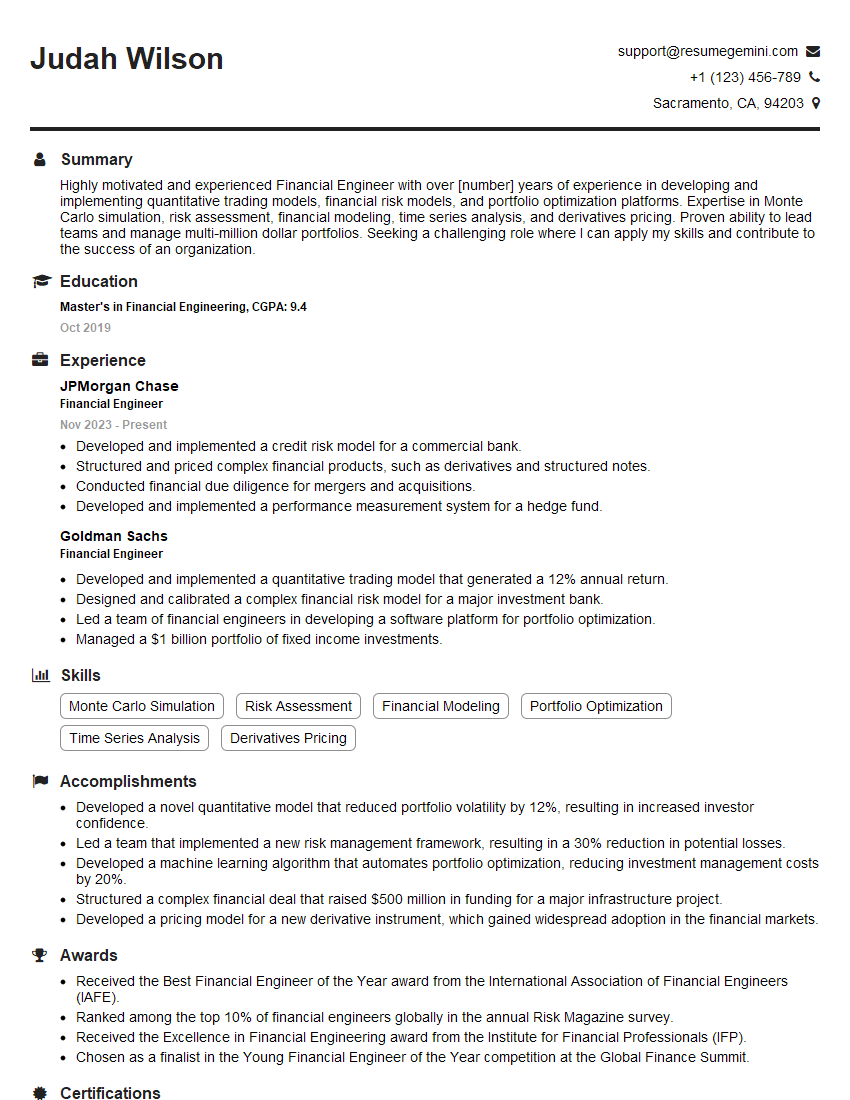
Financial Engineer Resume Sample

Risk Manager Resume Sample

Financial Analyst Resume Sample
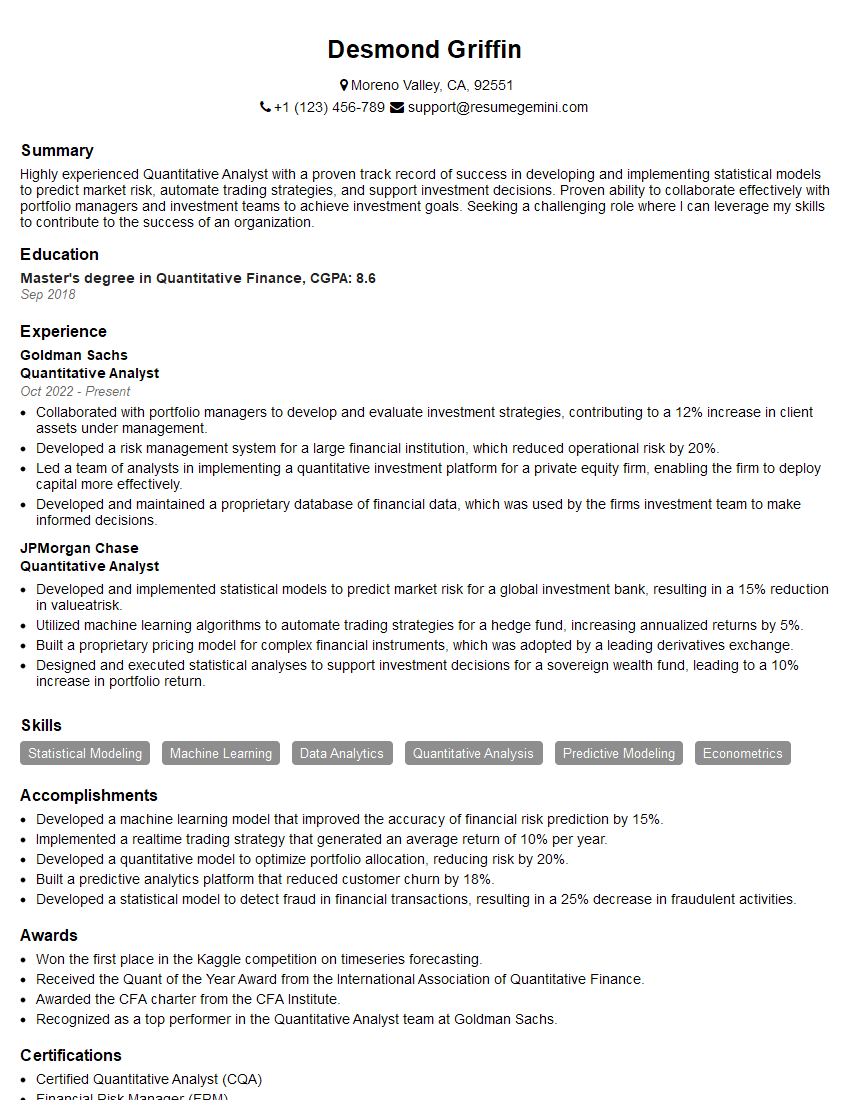
Quantitative Analyst Resume Sample
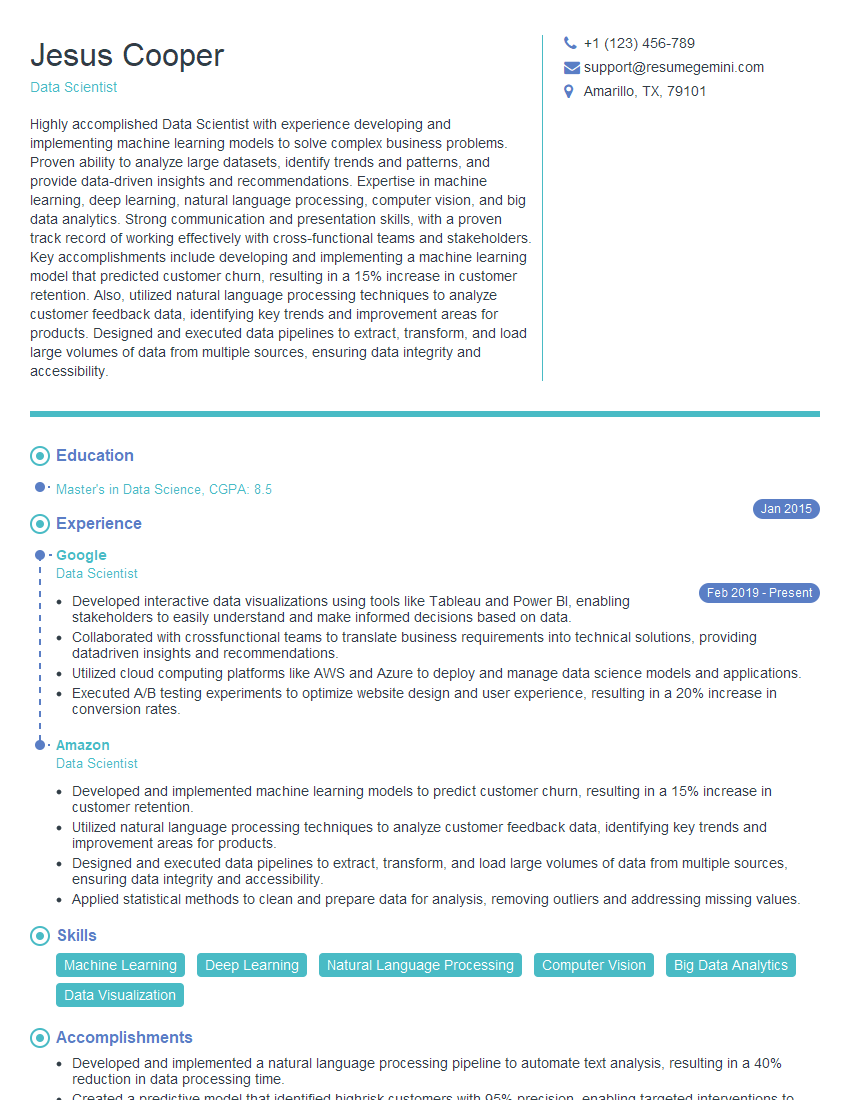
Data Scientist Resume Sample

Research Scientist Resume Sample

Actuary Resume Sample
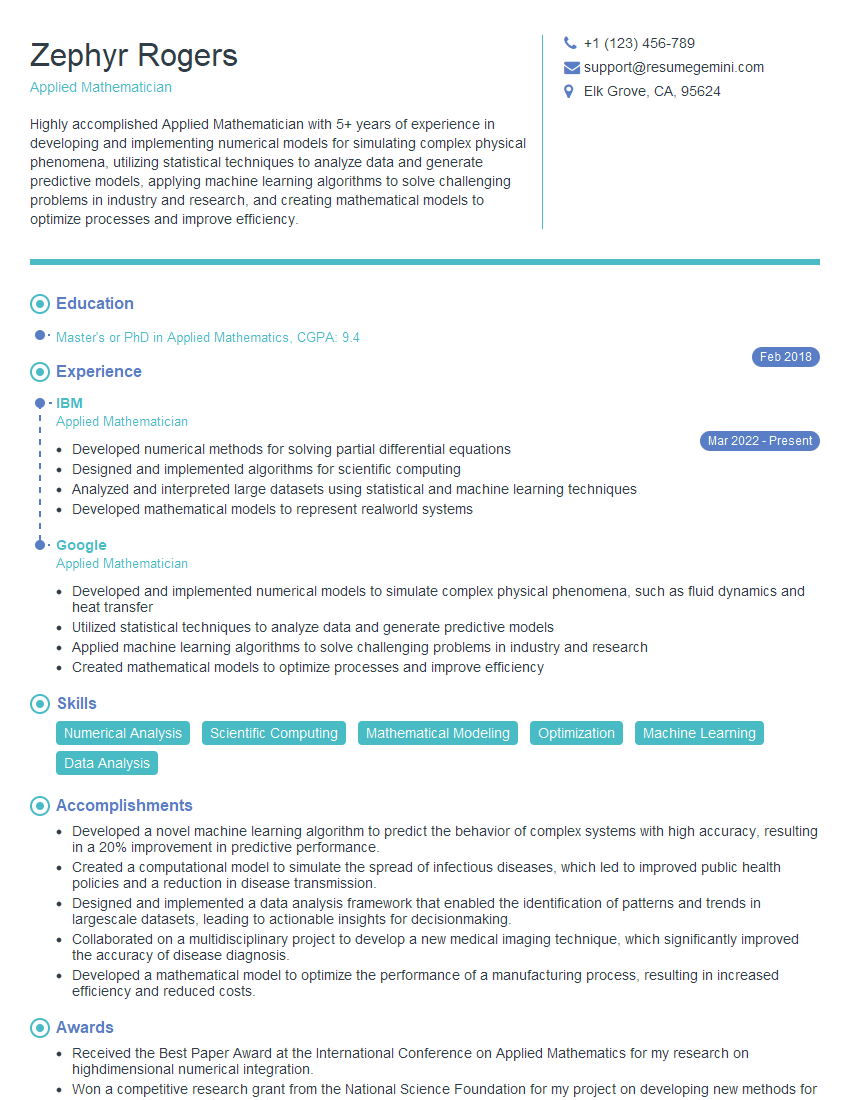
Applied Mathematician Resume Sample

Computational Mathematician Resume Sample

Cryptographer Resume Sample
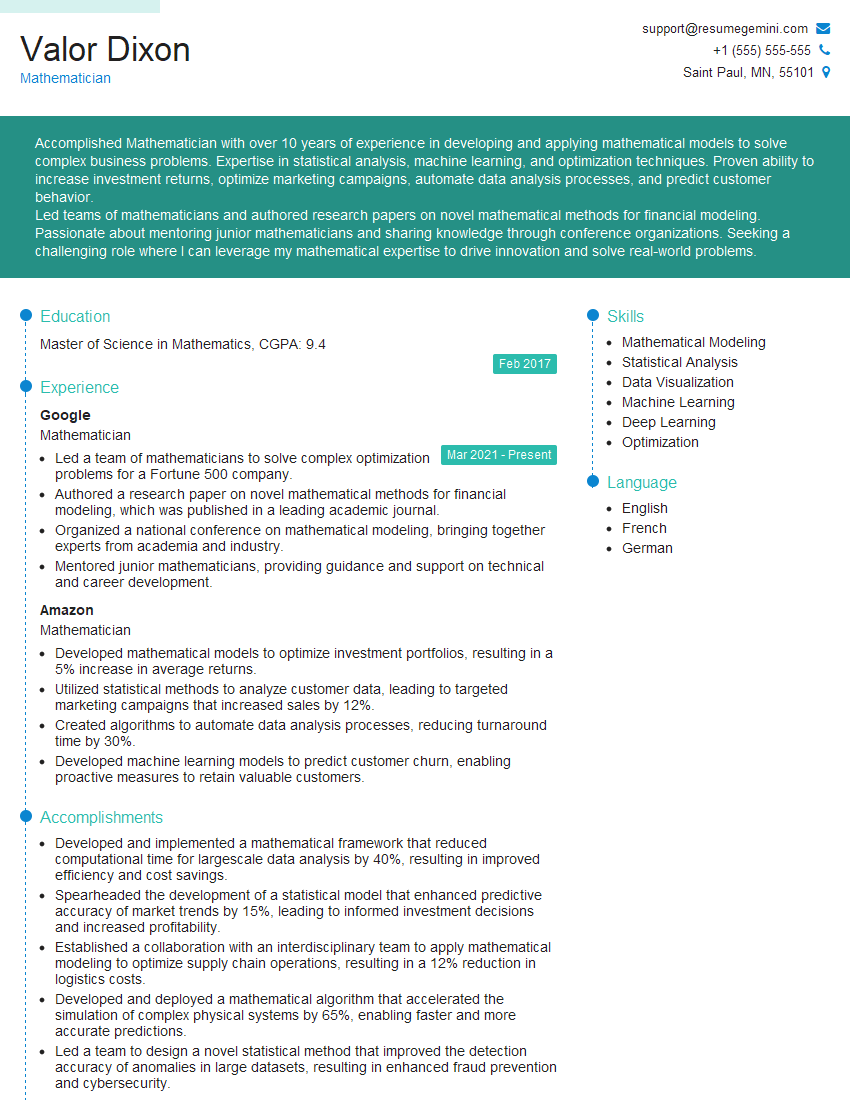
Mathematician Resume Sample

Operations Research Analyst Resume Sample
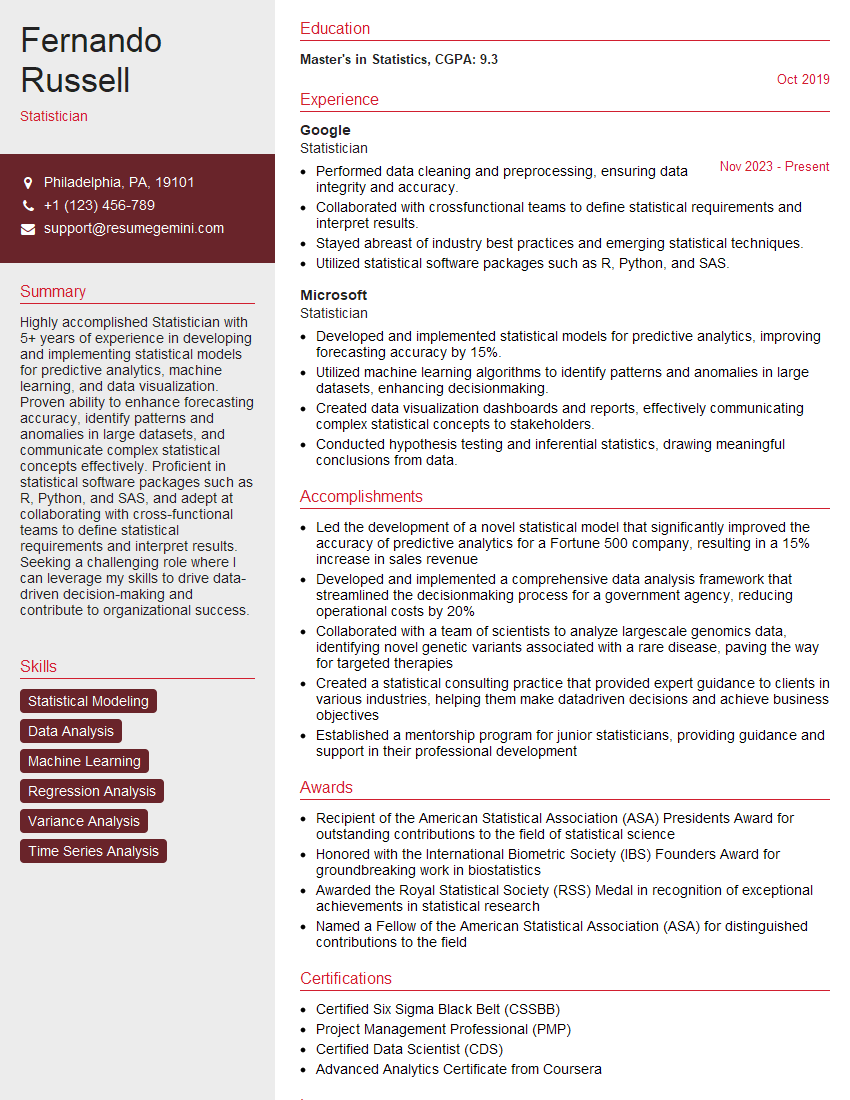
Statistician Resume Sample

Biostatistician Resume Sample

Control Systems Engineer Resume Sample

Econometrician Resume Sample

Professor of Mathematics Resume Sample
- Financial Engineer
- Risk Manager
- Financial Analyst
- Quantitative Analyst
- Data Scientist
- Research Scientist
- Actuary
- Applied Mathematician
- Computational Mathematician
- Cryptographer
- Mathematician
- Operations Research Analyst
- Statistician
- Biostatistician
- Control Systems Engineer
- Econometrician
- Professor of Mathematics
Explore more articles
Users Rating of Our Blogs
Share Your Experience
We value your feedback! Please rate our content and share your thoughts (optional).
What Readers Say About Our Blog
Very informative content, great job.
good