The thought of an interview can be nerve-wracking, but the right preparation can make all the difference. Explore this comprehensive guide to Vibratory and Impact Pile Driving interview questions and gain the confidence you need to showcase your abilities and secure the role.
Questions Asked in Vibratory and Impact Pile Driving Interview
Q 1. Explain the difference between vibratory and impact pile driving.
Vibratory and impact pile driving are two distinct methods for installing piles into the ground, differing fundamentally in how they transfer energy to the pile.
Impact driving uses a heavy hammer, repeatedly striking the pile head, delivering energy in short, powerful blows. Think of it like hammering a nail – each hit provides a significant impulse. This method is suitable for various soil conditions but can cause significant noise and vibration.
Vibratory driving employs a vibrating hammer that oscillates at high frequency, causing the pile to move vertically into the soil. Imagine it like jiggling a tight jar lid – the continuous vibrations loosen the soil, allowing the pile to sink more easily. This method is generally quieter and produces less vibration, making it suitable for sensitive environments, but it’s less effective in very dense or rocky soils.
In short: Impact driving is forceful and direct, while vibratory driving is gentler and relies on vibration to reduce soil resistance.
Q 2. Describe the factors influencing the selection of pile driving method.
Selecting the appropriate pile driving method depends on several interacting factors:
- Soil conditions: Dense soils or bedrock often necessitate impact driving, while looser soils can often be effectively handled with vibratory driving. The presence of groundwater also influences the choice, as vibratory driving can be challenging in saturated, unstable soils.
- Pile type: Different pile materials and geometries respond differently to the two methods. For instance, precast concrete piles are well-suited to both, while timber piles are often driven using impact methods.
- Environmental considerations: Vibratory driving is generally preferred in noise-sensitive areas, near existing structures, or when minimizing ground vibration is crucial. Impact driving can lead to significant ground vibration and noise pollution.
- Project constraints: Time and cost factors are significant. Vibratory driving can sometimes be faster, but the initial investment in specialized equipment might be higher. Accessibility to the site also matters; some areas might be too confined for large impact hammers.
- Pile capacity requirements: The needed pile capacity dictates the energy level needed for driving. Impact hammers can achieve higher driving energies, making them necessary for piles bearing high loads.
Often, a combination of both methods is employed, using vibratory driving for initial penetration and impact driving for final seating in difficult soils.
Q 3. What are the safety precautions for operating vibratory and impact hammers?
Safety is paramount in pile driving operations. For both vibratory and impact hammers, crucial precautions include:
- Proper training and certification: Operators must be thoroughly trained on the specific equipment and safety protocols.
- Personal Protective Equipment (PPE): This includes hard hats, safety glasses, hearing protection (essential for impact driving), steel-toed boots, and high-visibility clothing.
- Clear work area: The site needs to be adequately fenced off and free from obstructions. Access routes should be clear to allow for quick evacuation in emergencies.
- Regular equipment inspections: Thorough pre-operation checks are essential to identify and address potential malfunctions.
- Vibration monitoring: Monitoring ground vibrations is particularly important for nearby structures and sensitive environments.
- Emergency procedures: Clear emergency protocols and communication procedures are essential, including readily available first-aid.
- Noise control measures: Employing noise barriers or using quieter equipment can reduce the noise impact during operation.
Failure to adhere to these measures can lead to severe injuries or fatalities. The responsibility rests on both the operator and the project management to ensure a safe working environment.
Q 4. How do you ensure the verticality of driven piles?
Maintaining pile verticality is critical for ensuring the structural integrity of the foundation. Several techniques are used:
- Accurate pile positioning: Precise positioning of the pile before driving minimizes initial deviations.
- Guidance systems: Laser-guided systems or plumb bobs can provide real-time monitoring of pile inclination.
- Pile driving guides: Using guides during driving can restrict lateral movement and help maintain verticality.
- Regular monitoring and adjustment: Continuously monitoring the pile’s inclination and making adjustments as needed during driving.
- Experienced operators: Skilled operators possess the knowledge to anticipate and correct deviations using the equipment controls.
For significantly deviated piles, remedial measures might be necessary, which can include removing and re-driving the pile or using specialized techniques to correct the alignment.
Q 5. What are the common problems encountered during pile driving and their solutions?
Common problems encountered during pile driving and their solutions:
- Pile refusal: The pile stops driving before reaching the desired depth. This often signifies hitting an unexpectedly hard stratum. Solution: Use a more powerful hammer or consider alternative pile driving techniques (e.g., pre-boring) or a different pile design.
- Pile buckling: Lateral forces cause the pile to bend. Solution: Improve driving procedures, using guidance systems, or choosing piles with higher bending strength.
- Soil heave: Soil around the pile rises during driving. Solution: Employ techniques to reduce soil disturbance, such as pre-boring, or use quieter methods like vibratory driving.
- Damage to the pile: Excessive force during driving may damage the pile. Solution: Optimize hammer energy and driving parameters, and monitor pile integrity.
- Excessive noise and vibration: Especially prevalent with impact driving. Solution: Use noise mitigation measures, choose vibratory driving, or schedule works to minimize disturbance.
Careful planning, site investigation, and experienced execution are vital in mitigating these problems.
Q 6. Explain the concept of pile driving capacity and its assessment methods.
Pile driving capacity refers to the maximum load a pile can safely carry. Assessment methods aim to determine this capacity and are often crucial for design and safety.
Methods for assessing pile capacity include:
- Static load testing: Applying a gradually increasing load to the pile until failure or a predetermined limit is reached. This provides a direct measure of capacity but is time-consuming and expensive.
- Dynamic load testing: Using the pile driving data (e.g., hammer energy, set) and empirical formulas to estimate capacity. This is faster and cheaper than static testing but less accurate.
- Analytical methods: Employing soil properties and pile characteristics in engineering calculations to predict capacity. This requires detailed site investigation and geotechnical analyses.
The choice of method often depends on project constraints and the required accuracy. Often, a combination of methods is used for better confidence.
Q 7. How do you determine the appropriate hammer energy for a given pile and soil condition?
Determining the appropriate hammer energy involves considering several factors:
- Pile type and dimensions: Larger piles generally require more energy.
- Soil conditions: Denser soils necessitate higher energy levels.
- Desired pile penetration: The target depth influences the energy selection.
- Safety factors: Safety factors are incorporated to account for uncertainties.
The selection process typically involves using specialized software or design charts which incorporate soil parameters, pile properties, and the required driving parameters. Experienced engineers often use empirical relationships and past experiences to guide their selection, ensuring the energy level is sufficient for effective driving yet prevents pile damage. Incorrect energy selection can lead to either inefficient driving or pile damage.
Q 8. Describe the different types of piles used in construction.
Pile types are selected based on soil conditions, load capacity requirements, and project specifics. There’s a wide variety, but some key categories include:
- Timber Piles: Relatively inexpensive and easy to handle, suitable for less demanding applications and in environments where they’re naturally durable (e.g., treated pine in freshwater). However, they’re susceptible to decay and insect infestation, limiting their lifespan and applicability.
- Steel Piles: High strength-to-weight ratio, making them ideal for heavy loads and deep foundations. They can be driven easily and are readily available. Types include H-piles (widely used for bridges and buildings), pipe piles (used where corrosion resistance is crucial), and sheet piles (interlocking sections for cofferdams and retaining walls).
- Concrete Piles: Precast concrete piles offer high strength, durability, and resistance to corrosion. They’re versatile, can be made to specific dimensions, and can accommodate various load capacities. Cast-in-place concrete piles are poured directly into the ground, adapting better to uneven soil conditions but requiring more on-site preparation.
- Composite Piles: These combine the advantages of different materials (e.g., steel encased in concrete). They offer improved corrosion resistance and increased load capacity compared to single-material piles.
The choice depends heavily on site investigation and design parameters. For example, in a coastal project where corrosion is a significant concern, steel piles might require specialized coatings or be substituted with concrete piles. In a project with limited headroom, precast concrete piles might be preferable to cast-in-place piles.
Q 9. Explain the importance of pre-driving analysis.
Pre-driving analysis is crucial for optimizing the pile driving process and mitigating potential issues. It involves analyzing soil conditions, pile geometry, and driving parameters to predict pile capacity, settlement, and potential damage to surrounding structures. Think of it as a detailed plan to avoid surprises on-site.
This analysis helps in selecting the appropriate pile driving equipment, setting optimal driving parameters (hammer energy, blow count), and assessing the risk of ground vibrations and noise pollution. Without it, you risk overdriving (damaging the pile), underdriving (insufficient capacity), or causing unacceptable ground vibrations affecting nearby structures. For example, pre-driving analysis might reveal a need for a different type of pile or specialized driving techniques to avoid exceeding allowable vibration levels near an existing building.
Sophisticated software packages utilize soil data from geotechnical investigations to simulate the pile driving process and predict its performance. This modeling allows for ‘what-if’ scenarios, enabling informed decisions regarding pile type, length, and driving method before actual construction commences.
Q 10. What are the environmental considerations during pile driving?
Environmental considerations are increasingly important in pile driving projects. The major concerns revolve around noise and vibration, as well as potential impact on groundwater and nearby ecosystems.
- Noise Pollution: Pile driving generates significant noise that can disrupt local communities and wildlife. Mitigation strategies include using noise barriers, limiting driving hours, and employing quieter driving techniques.
- Ground Vibration: Vibrations can damage nearby structures and disrupt sensitive equipment. Mitigation strategies include using vibration monitoring systems, employing techniques to minimize vibrations (e.g., using vibratory hammers instead of impact hammers where feasible), and potentially adjusting driving parameters to stay within acceptable limits.
- Groundwater Impact: Driving piles can affect groundwater levels and potentially introduce contaminants into the soil and water. Proper ground water monitoring is necessary. Measures such as using proper wellpoints to dewater can mitigate this.
- Habitat Disturbance: Pile driving can disturb sensitive ecosystems, particularly in aquatic environments. Careful planning, including environmental impact assessments and potentially employing alternative construction methods in ecologically sensitive areas, is vital.
Environmental regulations and permits are often needed for pile driving projects, emphasizing the importance of incorporating these considerations into the project planning and execution phases. A well-planned project with appropriate mitigation strategies can significantly reduce environmental impact.
Q 11. How do you monitor pile driving progress and ensure quality control?
Monitoring pile driving progress and ensuring quality control are paramount for project success. This involves a multi-pronged approach:
- Blow Count Monitoring: Tracking the number of hammer blows required to drive the pile a specific distance provides insights into soil resistance and pile capacity. Unexpected increases in blow count might indicate encountering unexpected obstructions or pile damage.
- Settlement Monitoring: Measuring the pile’s settlement during and after driving ensures it’s achieving the required depth and capacity. Excessive settlement could indicate unstable soil conditions or design flaws.
- Vibration Monitoring: Monitoring ground vibrations using accelerometers ensures that vibrations remain within permissible limits to protect nearby structures and comply with environmental regulations.
- Pile Integrity Testing: Non-destructive testing (NDT) methods, such as dynamic testing (PDA) and low-strain integrity tests, are employed to verify pile integrity after driving. This ensures the pile has been installed correctly and meets design specifications.
- Regular Inspections: Regular on-site inspections by experienced personnel are crucial for identifying potential issues, ensuring compliance with safety standards, and maintaining accurate records of the driving process.
Data collected during these monitoring activities is vital for evaluating the pile driving operation’s effectiveness and identifying areas needing corrective action. This data is also used in subsequent analysis and to confirm the project meets the design criteria.
Q 12. Describe your experience with different types of pile driving equipment.
My experience encompasses a range of pile driving equipment, from traditional impact hammers to advanced vibratory systems.
- Diesel Impact Hammers: These are workhorses in many projects, utilizing the force of gravity or a diesel engine to drive piles. I’ve worked with various sizes, from smaller ones suitable for smaller diameter piles to massive units for large-diameter piles in challenging soil conditions. Understanding their maintenance and operational nuances, including fuel efficiency and safety protocols, is crucial.
- Hydraulic Impact Hammers: These offer more precise control over driving energy compared to diesel hammers, and are often more efficient, leading to faster pile installation. Experience with hydraulic systems—including the maintenance and troubleshooting of pumps, valves, and actuators—is essential.
- Vibratory Hammers: These are very effective in certain soil types, offering quieter and less vibration-intensive driving. They use a rotating eccentric weight to generate vibrations that loosen the soil, allowing the pile to settle into place more easily. My experience includes working with both hydraulically and electrically powered vibratory hammers, with adjustments needed to optimize the frequency and amplitude based on soil conditions.
- Pile Driving Rigs: I’m familiar with operating and maintaining various pile driving rigs, from smaller, more mobile units to larger, more powerful rigs used for larger scale projects. This includes knowledge of the different types of leads, pile clamps, and safety features.
The choice of equipment is project-specific, determined by factors such as pile type, soil conditions, and environmental constraints. Each type of equipment has its strengths and limitations, and experienced operators need to select the right machine for the job.
Q 13. How do you troubleshoot malfunctions in vibratory and impact hammers?
Troubleshooting malfunctions in vibratory and impact hammers requires a systematic approach, combining theoretical knowledge and practical experience. It often involves a combination of visual inspection, listening for unusual sounds, and checking operational parameters.
Impact Hammers: Common problems include issues with the diesel engine (fuel delivery, ignition, lubrication), hydraulic system leaks, and hammer malfunction (e.g., ram failure, anvil wear). Troubleshooting involves systematic checks of each component, using pressure gauges, diagnostic tools, and visual inspection for wear and tear.
Vibratory Hammers: Common problems include issues with the vibration generating mechanism (eccentric weights, bearings), hydraulic or electrical systems, and pile clamps. Diagnostics might involve checking hydraulic pressure, electrical currents, and the vibration frequency and amplitude using sensors. Proper lubrication and maintenance are crucial for preventing breakdowns.
A key aspect is safety; any repair or maintenance should only be performed after isolating power and depressurizing hydraulic systems. A step-by-step approach, supported by the equipment’s manual and manufacturer’s recommendations, is crucial for proper diagnostics and resolution. For example, a sudden drop in hydraulic pressure in a vibratory hammer might indicate a leak in a hydraulic line or a faulty valve. Systematic leak checks and pressure testing would be employed to identify the source of the malfunction.
Q 14. What is the significance of pile integrity testing?
Pile integrity testing is crucial for verifying that the driven piles meet design requirements and are capable of carrying the intended loads. It provides assurance that the piles have been installed correctly and are structurally sound. This is especially vital for safety and preventing costly failures.
Several methods exist, each with its strengths and weaknesses:
- Dynamic Pile Testing (PDA): This is a widely used method that uses a hammer to deliver a controlled blow to the pile top and measures the resulting vibrations. This data provides insights into pile stiffness, resistance, and capacity.
- Low-Strain Integrity Testing: This method uses a smaller impact to assess the wave propagation through the pile. Changes in the wave pattern can indicate internal defects or damage to the pile. This method offers a less disruptive way to check for damage compared to PDA.
- Cross-Hole Sonic Logging: This method involves inserting probes into the pile and measuring the time it takes for sound waves to travel between the probes. It’s particularly useful for detecting internal voids or cracks.
The choice of method depends on factors such as pile type, soil conditions, and project requirements. These tests are invaluable for verifying the as-built condition of piles and ensuring the structural integrity of the foundation system, providing confidence in the project’s long-term performance and preventing potential failures.
Q 15. What are the different types of pile driving analyses used?
Pile driving analysis is crucial for ensuring the structural integrity and safety of the project. We use several methods to predict pile behavior and assess the effectiveness of the driving process. These methods can be broadly categorized as:
- Empirical Methods: These rely on simplified formulas and correlations based on historical data and observations. They’re quick but less precise, often used for preliminary assessments. An example is using the Engineering News-Record (ENR) formula to estimate pile capacity.
- Wave Equation Analysis: This sophisticated method uses mathematical models to simulate the dynamic interaction between the hammer, pile, and soil during driving. It provides a detailed prediction of pile behavior, including set, velocity, and stress.
- Finite Element Analysis (FEA): FEA uses numerical techniques to model the entire pile driving system, including the hammer, pile, soil, and any surrounding structures. This provides the most comprehensive analysis, capturing complex interactions but requiring significant computational resources and expertise.
- CAPWAP (Case Pile Wave Analysis Program): This is a commercially available software program widely used in the industry that implements wave equation analysis. It’s capable of simulating various driving conditions and pile geometries.
The choice of method depends on factors like project requirements, soil complexity, and available resources. For simple projects and preliminary estimations, empirical methods might suffice. However, for complex projects with challenging soil conditions or high-risk structures, wave equation analysis or FEA is necessary to ensure safety and design accuracy.
Career Expert Tips:
- Ace those interviews! Prepare effectively by reviewing the Top 50 Most Common Interview Questions on ResumeGemini.
- Navigate your job search with confidence! Explore a wide range of Career Tips on ResumeGemini. Learn about common challenges and recommendations to overcome them.
- Craft the perfect resume! Master the Art of Resume Writing with ResumeGemini’s guide. Showcase your unique qualifications and achievements effectively.
- Don’t miss out on holiday savings! Build your dream resume with ResumeGemini’s ATS optimized templates.
Q 16. Explain the concept of wave equation analysis in pile driving.
Wave equation analysis is a powerful tool for simulating the dynamic behavior of pile driving. Imagine hitting a long, flexible rod (the pile) into the ground. The impact of the hammer creates a stress wave that travels down the pile, causing it to move into the soil. The wave equation models this wave propagation and its interaction with the soil, considering factors like wave reflection, damping, and soil resistance. The program solves a set of partial differential equations that describe the motion of the pile and soil. These equations take into account various parameters such as:
- Pile material properties (Young’s modulus, Poisson’s ratio, density)
- Soil properties (shear modulus, damping ratio, density)
- Hammer characteristics (impact energy, mass)
- Pile geometry (length, diameter, cross-section)
The solution of the wave equation provides a time history of pile velocity, acceleration, stress, and set. This information allows engineers to predict the ultimate pile capacity, assess the potential for pile damage, and optimize the driving parameters (e.g., hammer energy, cushion properties).
In practice, this is often done using specialized software like CAPWAP. The software takes as input the various parameters mentioned above and then performs the wave equation analysis to predict pile behavior. The results are then used to ensure that the pile is driven to its design specifications and to minimize the risk of damage to the pile or the surrounding environment.
Q 17. Describe your experience with different soil conditions and their impact on pile driving.
My experience spans a wide range of soil conditions, each impacting pile driving differently. For example, driving piles in dense sand or gravel requires significantly more energy compared to loose saturated clay. In dense soils, we often see higher resistance, leading to increased driving times and potential pile damage if not carefully managed. Conversely, loose saturated clays can present challenges due to their tendency to flow and create a less stable foundation. The presence of hard layers (e.g., bedrock) necessitates careful planning and potentially specialized equipment like vibratory hammers with high-frequency oscillation to penetrate such tough materials.
I’ve encountered scenarios where we had to adjust our driving parameters – like hammer energy or the use of different driving techniques – based on in-situ soil testing results. For instance, unexpected soft spots within a generally firm soil profile require careful attention to avoid creating voids or excessive settlement. Detailed soil investigation before pile driving is crucial for success and minimizing risks.
We use various soil testing methods including Standard Penetration Tests (SPTs), Cone Penetration Tests (CPTs), and borehole investigations to gather the necessary data to characterize the subsurface conditions. This information is then used to develop a realistic model for the wave equation or FEA analysis, ensuring accurate prediction of pile behavior.
Q 18. How do you handle unexpected ground conditions during pile driving?
Unexpected ground conditions are a common challenge in pile driving. The first step is to halt operations immediately and assess the situation. This involves collecting new soil data near the unexpected area through additional boring or in-situ tests. This is essential for determining the extent and nature of the unexpected conditions.
Depending on the nature of the unexpected condition, different strategies may be employed. If we encounter significantly softer soil than anticipated, we may need to adjust the driving parameters, perhaps reducing hammer energy or using a different hammer type. Alternatively, we might need to consider alternative pile design, for example, a longer pile or a larger diameter pile. If we encounter an unexpected hard layer (e.g., rock), we might need to consider techniques like pre-boring or using specialized equipment designed for rocky conditions.
Thorough documentation of the unexpected condition, the measures taken to address it, and the impact on the project is critical. It’s vital to obtain approvals from relevant stakeholders before proceeding with any corrective measures. This step helps ensure we meet all safety and design requirements, maintaining the project’s integrity while adapting to the unforeseen circumstances.
Q 19. What are the limitations of vibratory and impact pile driving?
Vibratory and impact pile driving, while widely used, have limitations:
- Noise and Vibration: Impact driving generates significant noise and ground vibrations, potentially causing nuisance to nearby residents and structures. Vibratory driving is quieter but can still cause vibrations, especially in sensitive areas. Mitigation strategies such as vibration monitoring and noise barriers are often necessary.
- Soil Conditions: Both methods are less effective in extremely hard or rocky soils. Impact driving can damage piles in these conditions, while vibratory driving might be ineffective altogether.
- Pile Damage: Improper driving parameters can lead to pile damage, such as buckling or bending, particularly for longer piles or those subjected to high lateral loads.
- Environmental Impact: Impact driving can cause soil compaction and damage to nearby utilities. Vibratory driving has less of an environmental impact but can still disturb the soil and potentially damage nearby structures.
- Suitability for Specific Piles: Certain types of piles, such as pre-cast concrete piles with delicate internal components, might be vulnerable to damage during impact driving.
Careful site investigation, proper planning, and the use of appropriate driving parameters are crucial to mitigate these limitations and ensure a successful pile driving operation.
Q 20. Describe your experience with different types of pile caps and their installation.
Pile caps are critical structural elements that distribute loads from the superstructure to the piles. I have experience with various types including:
- Cast-in-place concrete pile caps: These are constructed on site by pouring concrete into a formwork built around the pile heads. This offers flexibility in design and can accommodate irregular pile layouts.
- Precast concrete pile caps: These are prefabricated off-site and lifted into place, reducing on-site construction time and potentially improving quality control. However, precast caps might be limited by size and shape.
- Steel pile caps: These are usually used in situations requiring high strength and stiffness, or where corrosion resistance is critical. They are often welded to the pile heads.
The installation process depends on the type of pile cap. Cast-in-place caps involve setting up formwork, placing reinforcement bars, and pouring and curing the concrete. Precast caps require accurate lifting and positioning to ensure proper alignment with the piles. Steel pile caps involve careful welding and quality control to ensure structural integrity. In all cases, proper alignment and leveling of the pile caps are crucial to ensure even load distribution and prevent uneven settlement.
My experience includes working with different grouting techniques to ensure proper bonding between the pile cap and the piles. Accurate placement and appropriate grout mix are essential to transfer loads efficiently.
Q 21. What are the regulatory requirements for pile driving in your region?
Regulatory requirements for pile driving vary depending on the region. However, some common aspects include:
- Permits and Approvals: Obtaining necessary permits from local authorities, including environmental permits and construction permits, is essential. These permits often require detailed project plans, including soil investigations, pile design, and proposed driving methods.
- Noise and Vibration Limits: Regulations often specify acceptable noise and vibration levels to protect nearby residents and structures. Monitoring and mitigation strategies are typically required to remain within these limits.
- Environmental Protection: Measures to protect the environment are commonly mandated, such as preventing soil erosion, controlling water pollution, and minimizing disturbance to flora and fauna.
- Safety Regulations: Strict safety regulations govern all aspects of pile driving, including worker safety, equipment maintenance, and emergency response protocols. Compliance with Occupational Safety and Health Administration (OSHA) standards or equivalent regional standards is vital.
- Inspection and Reporting: Regular inspection of the work and submission of reports documenting the progress, any issues encountered, and compliance with regulations are typically mandated.
It’s essential to work closely with regulatory agencies and local authorities to understand and adhere to all applicable regulations. Non-compliance can result in significant penalties and project delays.
Q 22. How do you manage a pile driving crew effectively?
Managing a pile driving crew effectively hinges on clear communication, meticulous planning, and fostering a strong safety culture. It’s like conducting an orchestra – each member has a crucial role, and their harmonious performance determines the project’s success.
Pre-job briefings: I always start with thorough briefings, outlining the day’s tasks, safety protocols, and potential hazards. This ensures everyone is on the same page and understands their responsibilities.
Delegation and skill matching: I delegate tasks based on individual skills and experience. A skilled operator should handle the hammer, while a competent rigger manages the lifting operations. This optimizes efficiency and reduces the risk of errors.
Motivation and teamwork: I believe in building a positive team environment. Regular feedback, recognizing achievements, and addressing concerns promptly fosters collaboration and morale. A motivated team is a productive team.
Monitoring and problem-solving: Continuous monitoring of the operation is vital. I address any issues or delays promptly, ensuring the project stays on schedule and within budget. For example, if a pile is encountering unexpected resistance, I’ll consult the geotechnical report and adjust the driving parameters accordingly.
Q 23. Describe your experience with using pile driving software and data analysis.
I have extensive experience using various pile driving software packages, including CasePile, PLAXIS, and specialized software for hammer performance analysis. This software allows for accurate modeling of pile behavior, predicting driving resistance, and optimizing hammer settings. Data analysis helps prevent overdriving or underdriving and ensures pile integrity.
For instance, in a recent project, we used CasePile to simulate the driving process, inputting soil parameters from geotechnical investigations. This allowed us to select the optimal hammer and optimize energy transfer, reducing driving time and fuel consumption by 15%. The data collected during the driving process, including blow counts and penetration rates, were then analyzed to verify the model’s accuracy and ensure the piles met the design criteria. Discrepancies prompted further investigation and adjustments as needed.
Q 24. How do you ensure the safety of workers and the public during pile driving operations?
Safety is paramount. My approach is based on a proactive, multi-layered strategy involving comprehensive risk assessments, stringent safety protocols, and ongoing training. It’s about anticipating potential hazards and implementing controls before they become incidents.
Risk Assessment: Before any operation, I conduct a thorough risk assessment, identifying potential hazards like falling objects, noise exposure, and ground instability. Control measures are then implemented, such as using safety harnesses, implementing noise barriers, and ensuring stable ground conditions.
Safety Training: Regular safety training is essential. I ensure all workers receive comprehensive training on safe working practices, including the use of personal protective equipment (PPE), emergency procedures, and hazard awareness. We use practical demonstrations and simulations to reinforce the training.
Site Supervision: Constant site supervision is crucial. I actively monitor worker compliance with safety regulations, intervene if unsafe practices are observed, and ensure all safety equipment is functional and properly used. This includes regular toolbox talks to address specific safety concerns.
Public Safety: Public safety is addressed through appropriate barricading, signage, and communication with nearby residents or businesses. We often implement noise monitoring and control measures to minimize disruption to the community.
Q 25. Explain the process of selecting appropriate pile driving equipment for a project.
Selecting the right pile driving equipment is crucial for project efficiency and success. The selection process involves carefully considering several factors, almost like choosing the right tool for a specific job.
Pile type and dimensions: Different piles (e.g., timber, steel, concrete) require different hammers and driving methods. The pile’s length and diameter influence the hammer’s energy capacity and driving technique.
Soil conditions: Soil type and bearing capacity greatly influence hammer selection. Dense soils require more powerful hammers than loose soils. Geotechnical investigations provide crucial data for this selection.
Project requirements: Factors like project schedule, budget, access restrictions, and environmental considerations also influence the choice of equipment. For example, a restricted site might necessitate smaller, more maneuverable equipment.
Hammer type: Various hammers are available, including diesel hammers, hydraulic hammers, and vibratory hammers. Each has its strengths and limitations. Diesel hammers are suitable for high resistance soils, while vibratory hammers are better for softer soils and quieter operations.
Equipment availability and logistics: The availability of specific equipment in the region and its transportation logistics should also be considered. A cost-benefit analysis often forms part of the selection.
Q 26. What is your experience with noise mitigation strategies during pile driving?
Noise mitigation is a critical aspect of pile driving, particularly in densely populated areas. My experience includes implementing various strategies to minimize noise pollution and maintain good relations with the community.
Noise Barriers: Constructing temporary noise barriers around the pile driving site effectively reduces noise levels. The design of these barriers is crucial and should be based on acoustic modeling.
Vibratory Hammers: Using vibratory hammers instead of impact hammers significantly reduces noise levels. They are especially useful in areas with strict noise restrictions.
Optimized Driving Techniques: Using the most efficient driving techniques to minimize the number of blows and duration of operation significantly impacts noise output.
Mufflers and Attenuators: Installing mufflers and attenuators on the hammers reduces the direct noise generated from the driving process.
Community Engagement: Proactive community engagement before, during, and after operations is crucial. This might include notifying residents about planned activities, providing noise level predictions, and addressing their concerns.
Q 27. How do you interpret and analyze pile driving data?
Interpreting and analyzing pile driving data is essential for ensuring pile integrity and project success. It’s like deciphering a story told by the piles themselves, which provides important feedback on the performance of the driving process and the soil conditions.
I use several methods, including:
Blow Count Analysis: Analyzing blow counts (number of hammer blows per unit of penetration) helps determine the pile’s resistance to driving. A sudden increase in blow count indicates potential soil obstructions or pile damage.
Settlement Monitoring: Regular monitoring of pile settlement during and after driving helps ensure adequate pile embedment and stability.
Wave Equation Analysis: Advanced analysis methods, such as the wave equation analysis, allow for a detailed assessment of the driving process, providing insights into pile capacity and soil response.
CAPWAP (Case Pile Wave Analysis Program) output: This software is widely used to interpret data and determine the dynamic resistance to driving which can be compared against various models and soil data.
Correlation with Geotechnical Data: Comparing the driving data with geotechnical investigations helps validate the soil model and ensure pile installation is in accordance with the design specifications.
Any anomalies or discrepancies require investigation and may lead to adjustments in the driving parameters or further geotechnical analysis.
Q 28. What are your salary expectations for this role?
My salary expectations are commensurate with my experience and expertise in vibratory and impact pile driving. Given my extensive experience, proven track record of successful project delivery, and in-depth knowledge of safety regulations and advanced data analysis techniques, I am seeking a competitive compensation package in the range of [Insert Salary Range] annually. I am also open to discussing benefits and other compensation components that align with the value I bring to the company.
Key Topics to Learn for Vibratory and Impact Pile Driving Interview
- Pile Driving Principles: Understanding the fundamental mechanics of both vibratory and impact driving methods, including energy transfer and soil interaction.
- Equipment Selection and Operation: Familiarizing yourself with various types of hammers (e.g., diesel, hydraulic), vibratory drivers, and ancillary equipment. Knowing the factors influencing equipment selection for specific soil conditions and project requirements.
- Soil Mechanics and Pile Behavior: Grasping the importance of soil properties (e.g., bearing capacity, density) in determining driving parameters and predicting pile performance. Understanding pile types (e.g., timber, steel, concrete) and their suitability for different applications.
- Driving Parameters and Monitoring: Knowing how to select appropriate driving parameters (e.g., hammer energy, blow count) and the techniques for monitoring pile driving progress (e.g., wave equation analysis, dynamic monitoring). Understanding the significance of set and refusal criteria.
- Safety Procedures and Regulations: Demonstrating knowledge of relevant safety regulations and best practices related to pile driving operations, including risk assessment and mitigation.
- Practical Applications: Being able to discuss real-world applications of vibratory and impact pile driving in various construction projects (e.g., bridges, buildings, offshore structures). Understanding the advantages and limitations of each method in different contexts.
- Problem Solving and Troubleshooting: Being prepared to discuss potential problems encountered during pile driving operations (e.g., soil obstructions, equipment malfunctions) and the strategies for addressing them effectively.
- Environmental Considerations: Understanding the environmental impact of pile driving and the methods for minimizing noise and vibration.
Next Steps
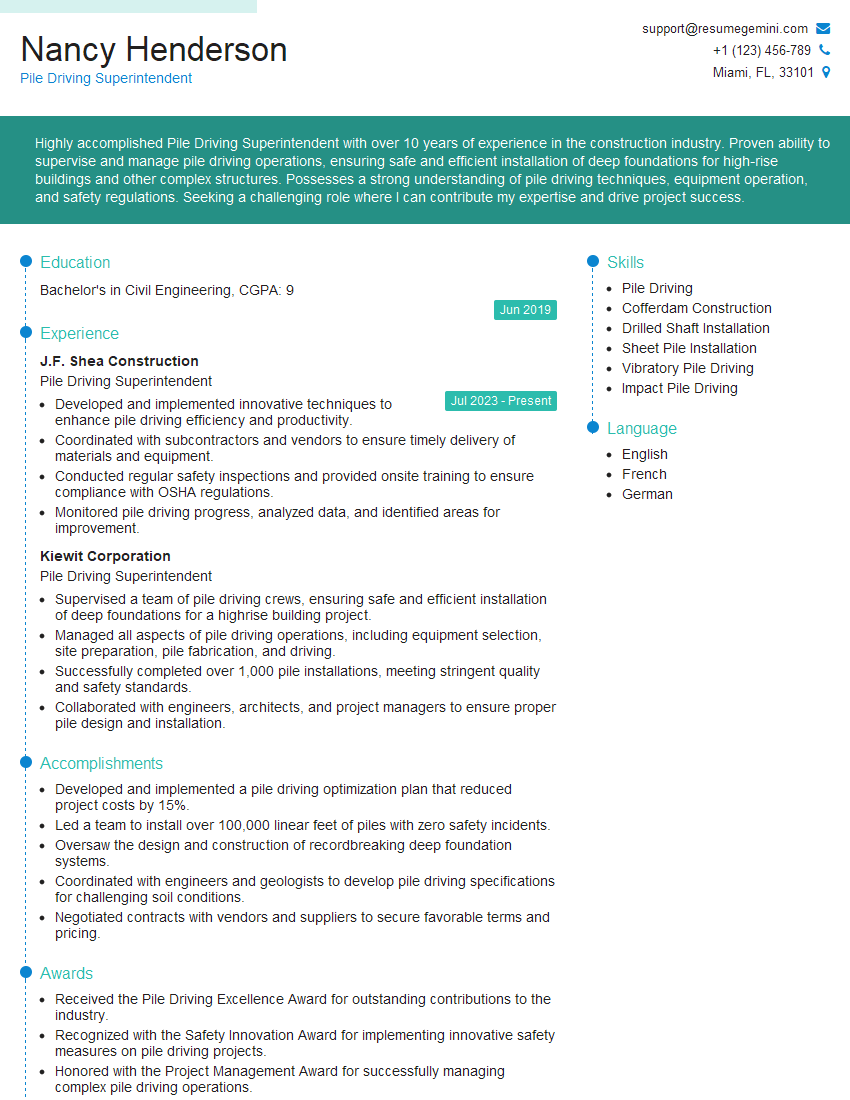
Mastering Vibratory and Impact Pile Driving is crucial for career advancement in the construction industry, opening doors to specialized roles and higher earning potential. To significantly boost your job prospects, create a resume that Applicant Tracking Systems (ATS) can easily read. ResumeGemini is a trusted resource to help you build a professional and effective resume that highlights your skills and experience in this specialized field. Examples of resumes tailored to Vibratory and Impact Pile Driving are available to guide you through the process. Invest in your future and build the resume that lands you your dream job!
Explore more articles
Users Rating of Our Blogs
Share Your Experience
We value your feedback! Please rate our content and share your thoughts (optional).
What Readers Say About Our Blog
Very informative content, great job.
good