The right preparation can turn an interview into an opportunity to showcase your expertise. This guide to Ability to train and develop other musicians interview questions is your ultimate resource, providing key insights and tips to help you ace your responses and stand out as a top candidate.
Questions Asked in Ability to train and develop other musicians Interview
Q 1. Describe your teaching philosophy for developing musical proficiency.
My teaching philosophy centers on fostering a holistic musical development that goes beyond technical proficiency. I believe in nurturing a student’s intrinsic motivation, building a strong foundation in music theory and aural skills, and cultivating their unique artistic voice. This approach involves a blend of structured learning, creative exploration, and personalized guidance.
- Solid Foundation: We begin by establishing a strong understanding of music theory, ear training, and rhythmic concepts. This forms the bedrock for all subsequent learning.
- Individualized Approach: Each student is different. I tailor my teaching to their specific learning pace, musical goals, and preferred learning style, whether they are visual, auditory, or kinesthetic learners.
- Performance-Based Learning: Regular performance opportunities, whether in recitals, workshops, or informal settings, are crucial for building confidence and developing stage presence.
- Creative Exploration: I encourage students to explore different genres, improvisation, and composition to expand their musical horizons and discover their unique artistic voice.
Q 2. What methods do you employ to assess a student’s musical strengths and weaknesses?
Assessing a student’s strengths and weaknesses is an ongoing process that involves multiple methods. It’s not just about technical skills but also encompasses musicality, creativity, and work ethic.
- Listening Tests: I use aural tests to evaluate their understanding of melody, harmony, rhythm, and form.
- Performance Evaluations: Observing students perform pieces reveals their technical abilities, musical interpretation, and stage presence.
- Sight-Reading Exercises: This assesses their ability to interpret new music quickly and accurately.
- Theory Assessments: Written tests and practical exercises evaluate their knowledge of music theory.
- Informal Observation: I pay attention to their engagement during lessons, their practice habits, and their overall musical curiosity.
By combining these methods, I get a comprehensive picture of the student’s musical profile, allowing me to tailor my teaching to address their individual needs and strengths.
Q 3. How do you adapt your teaching style to accommodate different learning styles?
Recognizing that students learn in different ways is paramount. I employ a variety of teaching methods to cater to visual, auditory, and kinesthetic learners.
- Visual Learners: I utilize diagrams, charts, sheet music, and visual aids to illustrate musical concepts.
- Auditory Learners: I emphasize listening exercises, musical dictation, and interactive aural training.
- Kinesthetic Learners: I encourage hands-on activities, like playing games that reinforce rhythmic concepts or using movement to express musical ideas.
For example, when explaining a complex chord progression, I might use a diagram for visual learners, play the progression multiple times for auditory learners, and have them physically move their hands to represent the chord changes for kinesthetic learners. This multi-sensory approach ensures that all students can grasp the concepts effectively.
Q 4. Explain your approach to providing constructive criticism to students.
Constructive criticism is crucial for growth, but it needs to be delivered thoughtfully and empathetically. My approach focuses on being specific, positive, and solution-oriented.
- Focus on Specifics: Instead of general statements like “that wasn’t very good,” I pinpoint the specific areas needing improvement, e.g., “The rhythm in bars 5-8 could be more precise.”
- Sandwich Method: I often use the “sandwich method” – starting with positive feedback, then addressing the areas for improvement, and ending with another positive note to maintain their motivation.
- Solution-Focused: I don’t just point out mistakes; I provide suggestions and strategies for improvement. For example, “Let’s try practicing this passage slowly and focusing on the articulation.”
- Open Dialogue: I encourage students to ask questions and express their concerns, creating a safe space for learning and feedback.
Q 5. How do you motivate students to practice consistently and improve their skills?
Motivation is key to consistent practice. I foster a positive learning environment and help students set realistic, achievable goals.
- Goal Setting: We collaboratively set short-term and long-term goals, breaking down larger objectives into smaller, manageable steps.
- Positive Reinforcement: I regularly acknowledge and praise their progress, focusing on their achievements and effort.
- Gamification: Incorporating games and challenges into practice sessions can make it more fun and engaging.
- Performance Opportunities: Regular performance opportunities provide a sense of accomplishment and motivate them to practice diligently.
- Personalized Practice Plans: I create customized practice plans that are tailored to their individual needs and goals, making practice more efficient and less daunting.
For example, I might create a sticker chart for younger students or a progress tracking sheet for older students to visually represent their progress.
Q 6. Describe your experience in designing and implementing music curricula.
My experience in curriculum design includes developing comprehensive programs that cater to diverse learning needs and skill levels. I’ve created curricula for both individual instruction and group classes, covering various musical styles and instruments.
- Needs Assessment: I begin by assessing the students’ current skill levels, learning styles, and musical interests.
- Learning Objectives: I define clear learning objectives for each unit, focusing on both technical skills and musical understanding.
- Variety of Activities: The curriculum incorporates a diverse range of activities, including theory lessons, performance practice, ear training, improvisation, and composition.
- Assessment Methods: I incorporate various assessment methods, including written tests, performance evaluations, and project-based assignments.
- Regular Review and Revision: I regularly review and revise the curriculum to ensure its effectiveness and adapt it to the evolving needs of the students.
For example, I recently developed a curriculum focusing on jazz improvisation for intermediate students, incorporating elements of music theory, blues scales, and ear training exercises.
Q 7. How do you incorporate technology into your music teaching methods?
Technology offers powerful tools for enhancing music education. I integrate technology in a thoughtful and purposeful way, always prioritizing meaningful musical engagement.
- Music Notation Software: Software like Sibelius or Finale helps students create and edit their own musical scores, fostering composition skills.
- Digital Audio Workstations (DAWs): DAWs like GarageBand or Ableton Live allow students to explore recording, mixing, and arranging music, encouraging creativity and technological literacy.
- Online Resources: I utilize online resources such as interactive theory websites, ear training apps, and video tutorials to supplement my teaching.
- Video Conferencing: For remote instruction, video conferencing allows for real-time interaction and feedback, maintaining the quality of in-person instruction.
For instance, I might use GarageBand to have students record their practice sessions, allowing them to hear their playing objectively and identify areas for improvement. I also use online platforms for sharing lesson materials, assignments, and providing instant feedback.
Q 8. What strategies do you use to foster collaboration and teamwork among students?
Fostering collaboration is crucial in music education. It’s not just about playing together; it’s about building a supportive community where students learn from and inspire each other. I achieve this through several strategies.
Ensemble work: I frequently assign ensemble projects, requiring students to work together on a piece of music. This teaches them to listen actively, compromise, and build upon each other’s strengths. For example, I might have small groups arrange a familiar song in a new style, or have them collaboratively compose a short piece.
Peer teaching and mentoring: More advanced students can mentor beginners, boosting their confidence and providing a different learning perspective. This benefits both parties – the mentor solidifies their understanding by teaching, and the mentee receives personalized support.
Classroom discussions and feedback sessions: Creating a safe space for open dialogue about musical ideas and challenges promotes teamwork. I encourage students to offer constructive feedback to one another, focusing on specific aspects of performance, such as intonation or rhythm.
Shared goals and projects: Working towards a common goal, such as a concert or recording project, fosters a sense of shared responsibility and accomplishment. The process of planning and executing such a project necessitates cooperation and mutual support.
Q 9. How do you address student performance anxiety?
Performance anxiety is a common challenge for musicians of all levels. My approach is multifaceted and emphasizes building confidence and developing coping mechanisms.
Gradual exposure: I start with smaller, low-pressure performances, such as informal classroom recitals or smaller ensemble performances. This allows students to build their confidence gradually.
Positive self-talk and visualization: I teach students techniques like positive self-talk and visualization to manage their anxiety. This involves practicing positive affirmations and imagining a successful performance.
Mindfulness and relaxation techniques: I introduce mindfulness and deep breathing exercises to help students calm their nerves before performances. These techniques can help reduce physiological symptoms of anxiety.
Performance practice and preparation: Thorough preparation is key. The more comfortable students are with their music, the less anxious they will be. I encourage meticulous practice and provide regular feedback to build their confidence.
Understanding the source of anxiety: Sometimes, performance anxiety stems from underlying issues, like fear of failure or judgment. I create a safe and supportive classroom environment where students feel comfortable discussing these concerns and finding solutions collaboratively.
Q 10. How do you handle challenging or disruptive students in a music class?
Handling challenging students requires a balanced approach combining understanding, clear expectations, and consistent discipline. My strategy involves several steps:
Identifying the root cause: Disruptive behavior often stems from underlying issues, such as frustration, lack of engagement, or learning differences. I try to understand the reason behind the behavior before addressing it directly.
Individualized attention and support: I work with challenging students individually to understand their needs and tailor my teaching approach to their specific challenges. This might include adjusting assignments or providing extra support.
Clear expectations and consequences: I establish clear expectations for behavior and classroom conduct from the start of the course. Consistent and fair enforcement of consequences is crucial to maintaining order.
Positive reinforcement: Focusing on positive behavior and rewarding appropriate conduct is equally important. This can involve verbal praise, extra privileges, or other forms of recognition.
Collaboration with parents/guardians: In cases of persistent disruptive behavior, I work closely with parents or guardians to develop a consistent approach at home and at school. This may involve parent-teacher meetings and consistent communication.
Q 11. Describe your experience in working with students of varying skill levels.
My experience encompasses working with students of diverse skill levels, from complete beginners to advanced musicians. I use differentiated instruction to cater to individual needs.
Tiered assignments: I create assignments that can be adapted to various skill levels. For example, a composition assignment might have different complexity levels, allowing beginners to focus on basic melodic ideas while advanced students explore more complex harmonic structures.
Small group instruction: I often utilize small group instruction to address specific skill gaps or provide individualized attention. This ensures that all students receive appropriate support.
Adaptive teaching methods: My approach is flexible. I adjust my teaching methods based on the students’ needs and learning styles. Some students benefit from visual aids, others from kinesthetic learning, and others from aural learning. I adapt my strategy accordingly.
Celebrating diverse talents: I create a positive environment that values all skill levels and talents, regardless of a student’s experience. Each student’s unique contributions are celebrated.
Q 12. How do you create a positive and supportive learning environment in your music classes?
Creating a positive and supportive learning environment is paramount. My approach prioritizes respect, inclusivity, and encouragement.
Building rapport: I take time to get to know each student individually, creating a safe and trusting environment where they feel comfortable taking risks and expressing themselves musically.
Positive feedback and encouragement: I focus on positive reinforcement, emphasizing the student’s strengths and progress. This builds their confidence and motivates them to continue learning.
Collaborative learning: I incorporate collaborative learning activities, which encourages peer support and teamwork.
Celebrating achievements: I regularly celebrate students’ achievements, both big and small. This can involve informal feedback, formal assessments, and public performances.
Open communication: I maintain open communication with my students, creating a space where they feel comfortable sharing concerns or suggestions.
Q 13. What resources do you utilize to stay current in music education trends and best practices?
Staying current in music education requires continuous learning. I utilize several resources to stay abreast of the latest trends and best practices.
Professional development workshops and conferences: I attend conferences and workshops related to music education to learn from leading experts in the field.
Music education journals and publications: I regularly read journals and publications that feature research and articles on effective teaching strategies in music.
Online resources and communities: I use online resources and participate in online communities to connect with other music educators and share best practices.
Mentorship and collaboration: I actively seek mentorship from experienced music educators and collaborate with colleagues to share ideas and best practices.
Q 14. How do you evaluate the effectiveness of your teaching methods?
Evaluating teaching effectiveness is an ongoing process. I use a combination of methods to assess the impact of my instruction.
Student performance and progress: I regularly assess student performance through formal assessments, informal observations, and self-evaluations. I track individual progress to identify areas where adjustments are needed.
Student feedback: I collect student feedback through surveys, interviews, and informal conversations. This helps me understand their perspectives on the learning environment and the effectiveness of the teaching methods.
Self-reflection and analysis: I regularly reflect on my own teaching practices and analyze my lessons to identify areas for improvement. I keep a teaching journal to document my observations and reflections.
Data analysis: I analyze data from assessments and feedback to identify trends and patterns. This helps me make informed decisions about curriculum design and teaching strategies.
Q 15. Describe a time you had to adapt your teaching plan due to unforeseen circumstances.
Adaptability is crucial in music education. One instance involved a student who, mid-semester, experienced a significant hand injury preventing them from playing their primary instrument, the violin. My initial teaching plan heavily featured violin technique and repertoire. I immediately adjusted.
First, I focused on music theory, ear training, and composition – areas unaffected by their injury. This allowed them to continue engaging with music intellectually. Second, we explored alternative instruments like the piano, focusing on transferable skills like finger dexterity and rhythmic accuracy. Third, we incorporated music history and analysis, fostering a deeper appreciation for the art form. By the end of the semester, they had a solid theoretical foundation and were playing basic piano pieces. This experience underscored the importance of having a flexible curriculum and considering alternative learning pathways.
Career Expert Tips:
- Ace those interviews! Prepare effectively by reviewing the Top 50 Most Common Interview Questions on ResumeGemini.
- Navigate your job search with confidence! Explore a wide range of Career Tips on ResumeGemini. Learn about common challenges and recommendations to overcome them.
- Craft the perfect resume! Master the Art of Resume Writing with ResumeGemini’s guide. Showcase your unique qualifications and achievements effectively.
- Don’t miss out on holiday savings! Build your dream resume with ResumeGemini’s ATS optimized templates.
Q 16. What strategies do you use to promote the musical growth of your students?
Promoting musical growth requires a multifaceted approach. I employ a combination of strategies tailored to the individual student’s needs and goals.
- Personalized Learning Plans: I create detailed plans outlining skill development targets, practice schedules, and repertoire choices. These are regularly revised based on student progress and feedback.
- Targeted Exercises and Drills: I design specific exercises to address technical weaknesses, for example, scales, arpeggios, or etudes tailored to improve specific aspects of technique.
- Exposure to Diverse Genres and Styles: To broaden their musical horizons, I expose students to various genres, encouraging exploration outside their comfort zone. This might involve listening to different composers, exploring world music, or even incorporating improvisation into their practice.
- Masterclasses and Workshops: I facilitate opportunities for students to learn from and interact with other musicians through masterclasses and workshops, fostering collaboration and inspiration.
- Regular Performance Opportunities: Performance provides essential feedback and helps students overcome performance anxiety. More on this in a later answer.
Q 17. How do you encourage self-expression and creativity in your students?
Encouraging self-expression and creativity is paramount. I create an environment where students feel safe to experiment and take risks.
- Improvisation Exercises: Improvisation allows students to explore their own musical ideas and develop their unique voice.
- Composition Activities: I assign composition exercises, starting with simple melodic ideas and progressing to more complex forms. This encourages them to articulate their creative vision in a structured way.
- Open Mic Nights and Jams: Creating opportunities for informal performances in a supportive environment helps students to develop confidence and express their musical personality.
- Arranging Existing Pieces: Students can take familiar pieces and rearrange them, exploring different instrumentation or harmonic structures.
- Student-led projects: Letting students suggest repertoire or musical styles they are interested in learning allows them ownership and fuels their creative drive.
For example, one student initially hesitant to express themselves through improvisation blossomed when given the freedom to compose a piece inspired by their favorite poem.
Q 18. How do you assess the progress of your students and provide them with feedback?
Assessment is an ongoing process, not just a final evaluation.
- Regular Performance Assessments: I observe their technical proficiency and musicality during practice and performances. I document strengths and weaknesses, noting areas for improvement.
- Written Examinations (Theory and History): These assess theoretical understanding and historical context.
- Recorded Performances: Recording performances allows for detailed analysis and identification of areas for improvement. It also allows students to see their own progress visually.
- Self-Assessment: I encourage students to reflect on their own progress and identify their challenges and achievements. This promotes self-awareness and ownership of their learning.
- Feedback Sessions: Providing constructive feedback is crucial. I focus on both the positive aspects of their playing and areas needing improvement, offering specific suggestions for improvement.
Feedback is always constructive and specific, focusing on actionable steps rather than broad generalizations. For example, instead of saying “your rhythm is bad,” I might say “Your rhythm falters slightly in the second bar of measure 12. Let’s focus on practicing that section with a metronome at a slower tempo.”
Q 19. What are some of the challenges you have faced in teaching music, and how did you overcome them?
Challenges are inevitable in teaching.
- Motivation and Discipline: Some students struggle with maintaining practice discipline. Addressing this involves open communication, setting realistic goals, and celebrating small victories.
- Differing Learning Styles: Students learn differently. Adapting my approach requires utilizing various teaching methods—visual, auditory, kinesthetic—to meet the diverse needs of my students.
- Performance Anxiety: Many students experience anxiety before performances. I address this by creating a supportive environment, employing relaxation techniques, and providing opportunities for low-pressure performances.
Overcoming these involves patience, understanding, and a willingness to adapt. I’ve found that fostering a strong teacher-student relationship built on trust and mutual respect is key to addressing these challenges effectively. For example, I implemented a weekly check-in system where students can discuss challenges they face, creating a safe space for communication.
Q 20. How do you ensure that your students understand the theoretical foundations of music?
Theoretical understanding is essential for a complete musical education. I integrate theory into my teaching in various ways:
- Practical Application: I don’t teach theory in isolation. I link theoretical concepts directly to the musical pieces they are learning, showing how harmony, rhythm, and melody work together.
- Interactive Exercises: I use interactive exercises such as analyzing scores, composing short pieces, and ear training activities to solidify their understanding.
- Visual Aids and Technology: I utilize diagrams, software, and online resources to illustrate abstract concepts visually and dynamically.
- Gradual Progression: I introduce concepts progressively, starting with foundational elements and gradually building towards more complex ideas.
- Real-world examples: I often use examples from popular music to illustrate theoretical concepts, helping to relate them to the music they already enjoy.
For example, while teaching a Bach prelude, we’d analyze the harmonic progressions, identify the key signature, and discuss the composer’s use of counterpoint. This approach ensures theory isn’t abstract but an integral part of their musical understanding.
Q 21. How do you integrate performance opportunities into your teaching?
Performance is essential for solidifying skills and boosting confidence.
- Recitals and Concerts: I organize regular student recitals and concerts providing opportunities for students to showcase their progress in a formal setting.
- Smaller, informal performances: I incorporate less formal performance opportunities such as class performances, open mic nights, or student-led workshops, easing students into public performances.
- Collaborations and Ensembles: I encourage ensemble participation, providing chances to collaborate with other musicians, developing teamwork and performance skills.
- Community Engagement: I seek opportunities for my students to perform in local community events, broadening their audience and experience.
- Recording sessions: Recording performances is an excellent way to provide feedback and help students to develop their performance skills in a less stressful environment.
These experiences build confidence, refine their musical abilities, and provide valuable feedback. The sense of accomplishment from a successful performance significantly boosts their motivation and enhances their overall musical journey.
Q 22. How do you help students develop their musical independence and self-sufficiency?
Developing musical independence and self-sufficiency is crucial for a musician’s long-term success. It’s not just about technical proficiency; it’s about fostering a mindset of proactive learning and problem-solving. I achieve this through a multi-pronged approach.
Goal Setting and Self-Assessment: I guide students to identify their strengths and weaknesses, set realistic goals, and track their progress. This might involve creating a practice journal, where they reflect on each session and identify areas for improvement. For example, a student struggling with rhythm might set a goal to practice rhythmic exercises for 15 minutes daily and note their improvement over a week.
Resourcefulness and Problem-Solving: I encourage students to become active learners by seeking out resources independently. This could involve suggesting relevant YouTube tutorials, articles, or sheet music. If they encounter a technical challenge, I guide them towards finding solutions themselves, perhaps by experimenting with different approaches or consulting reputable online sources, rather than immediately seeking my assistance. For instance, if a student is having trouble with a particularly challenging passage, I might suggest trying different fingerings or practicing it slowly in sections, encouraging them to find their optimal solution.
Performance Opportunities: Providing regular performance opportunities—whether it’s a solo recital, a chamber music performance, or even just playing for friends and family—is crucial for building confidence and developing the ability to perform under pressure. These experiences foster self-reliance and the ability to handle unforeseen challenges on stage.
Q 23. Describe your experience in working with students with diverse cultural backgrounds.
My experience working with students from diverse cultural backgrounds has been incredibly enriching. I believe that music transcends cultural boundaries, but it’s essential to be sensitive and respectful of different musical traditions and learning styles.
Cultural Sensitivity: I begin by creating a welcoming and inclusive environment where students feel comfortable sharing their experiences and perspectives. I actively listen to their stories and incorporate elements of their cultural backgrounds into our lessons whenever appropriate. For example, I’ve incorporated traditional rhythms and melodies from various cultures into improvisation exercises.
Adapting Teaching Methods: I adapt my teaching methods to cater to different learning styles. Some students might benefit from more structured lessons, while others thrive in a more collaborative, exploratory setting. Understanding the cultural context helps me tailor my teaching to better suit each student’s needs. For instance, a student from a culture that emphasizes collaborative learning might benefit more from group projects and ensemble work.
Celebrating Diversity: I celebrate the diversity of musical styles and traditions by exposing students to a wide range of musical genres from around the world. This broadens their musical horizons and fosters appreciation for different cultures.
Q 24. How do you maintain a balance between technical skills and artistic expression in your teaching?
The balance between technical skills and artistic expression is paramount in my teaching. They are not mutually exclusive; rather, they are two sides of the same coin. Strong technical skills provide the foundation for artistic expression, allowing musicians to convey their emotions and ideas effectively.
Integrated Approach: I integrate technical exercises into musical pieces, making them meaningful and engaging. Instead of rote scales, we might work on scales within the context of a piece, focusing on musical phrasing and expression.
Emphasis on Interpretation: I encourage students to develop their own interpretations of the music, exploring nuances of dynamics, phrasing, and articulation. We discuss the composer’s intent, historical context, and personal emotions, fostering a deeper understanding and connection to the music.
Experimentation and Improvisation: I incorporate improvisation and experimentation into lessons, encouraging students to explore their creativity and find their unique voice. This helps them translate technical proficiency into expressive performances.
Q 25. What are your expectations regarding student participation and effort in your classes?
My expectations for student participation and effort are high, but always realistic and supportive. I believe that learning is a collaborative process and requires active engagement from both the teacher and the student.
Active Participation: I expect students to participate actively in class discussions, ask questions, and share their ideas. I encourage a supportive and open learning environment where students feel comfortable expressing themselves.
Consistent Effort: Consistent practice is essential for musical progress. I work with each student to develop a realistic practice schedule that fits their lifestyle, focusing on quality over quantity. Regular check-ins and feedback help ensure they stay on track.
Respectful Collaboration: I expect students to respect their peers and contribute positively to the learning environment. Teamwork and collaboration are essential, particularly in ensemble settings. I teach them about effective communication and listening skills crucial for successful group work.
Q 26. How do you use formative and summative assessments to monitor student learning?
Formative and summative assessments are integral parts of my teaching methodology. They provide valuable feedback for both the student and myself, allowing us to adjust the learning process and ensure optimal progress.
Formative Assessments: These are ongoing assessments that happen throughout the learning process. They involve regular observation of students’ practice habits, informal quizzes, and feedback during lessons. For example, I might listen to a student play a section of a piece and provide immediate feedback on their technique or musical interpretation. This allows for adjustments in teaching strategies and prevents larger problems from developing.
Summative Assessments: These are formal assessments that take place at the end of a unit or a semester. They might include recitals, formal performances, written exams, or projects. These assessments provide a comprehensive overview of the student’s learning and help identify areas for further development.
Through a combination of formative and summative assessments, I can track student progress, tailor my teaching to their needs, and provide constructive feedback that promotes growth and development.
Q 27. Describe your experience in collaborating with other music educators or professionals.
Collaboration with other music educators and professionals is crucial for my own professional development and for providing my students with the best possible learning experience.
Sharing Best Practices: I regularly attend workshops and conferences, sharing best practices and innovative teaching strategies with colleagues. This allows me to stay current with the latest trends in music education and adopt effective methodologies into my teaching.
Guest Artists and Workshops: I invite guest artists and professionals to conduct workshops for my students, exposing them to different musical perspectives and expanding their learning beyond the classroom.
Mentorship: I have developed strong relationships with experienced music educators who offer guidance and support. This collaboration provides a network for sharing experiences and insights, benefiting both my teaching and my students’ learning journeys.
Q 28. How do you ensure that your students have access to appropriate musical resources?
Ensuring students have access to appropriate musical resources is vital for their success. I leverage various strategies to create a rich and supportive learning environment.
Digital Resources: I utilize online platforms and educational software providing access to sheet music, backing tracks, interactive exercises, and audio libraries. These resources provide flexibility and cater to diverse learning preferences.
Library and Institutional Resources: I guide students towards utilizing the resources available at the local library, school library, or music conservatory, emphasizing the importance of independent research and resourcefulness.
Instrument Access: I work with the school or institution to ensure students have access to appropriate instruments. This might involve recommending rental options, arranging for instrument loans, or connecting students with local instrument shops.
Community Partnerships: I collaborate with local music shops, community centers, and other organizations to provide students with additional opportunities for learning and resource access. For instance, I might arrange for workshops or masterclasses at a local music shop.
Key Topics to Learn for Ability to train and develop other musicians Interview
- Understanding Learning Styles: Identify and adapt your teaching methods to cater to diverse learning styles (visual, auditory, kinesthetic). Consider how to assess individual learning needs and tailor your approach accordingly.
- Curriculum Development & Lesson Planning: Design structured and engaging lesson plans that progressively build skills. Discuss your experience in creating curriculums, selecting appropriate materials, and adapting them to different skill levels.
- Effective Communication & Feedback: Explain your strategies for providing constructive criticism and positive reinforcement. Highlight your ability to build rapport with students and create a supportive learning environment.
- Performance Assessment & Evaluation: Describe your methods for assessing student progress, providing meaningful feedback, and identifying areas for improvement. This includes both formal and informal assessment techniques.
- Motivation & Engagement Strategies: Discuss your techniques for keeping students motivated, engaged, and challenged. Share examples of how you fostered a love of music and encouraged practice and self-improvement.
- Troubleshooting & Problem-Solving: Describe how you handle technical difficulties, student frustration, or plateaus in learning. Show your ability to adapt your teaching methods to overcome challenges.
- Mentorship & Guidance: Discuss your experience in mentoring students beyond technical skills, focusing on their personal and professional development as musicians.
- Adaptability and Continuous Learning: Show your willingness to adapt your teaching style to new technologies, pedagogical approaches, and the ever-evolving musical landscape.
Next Steps
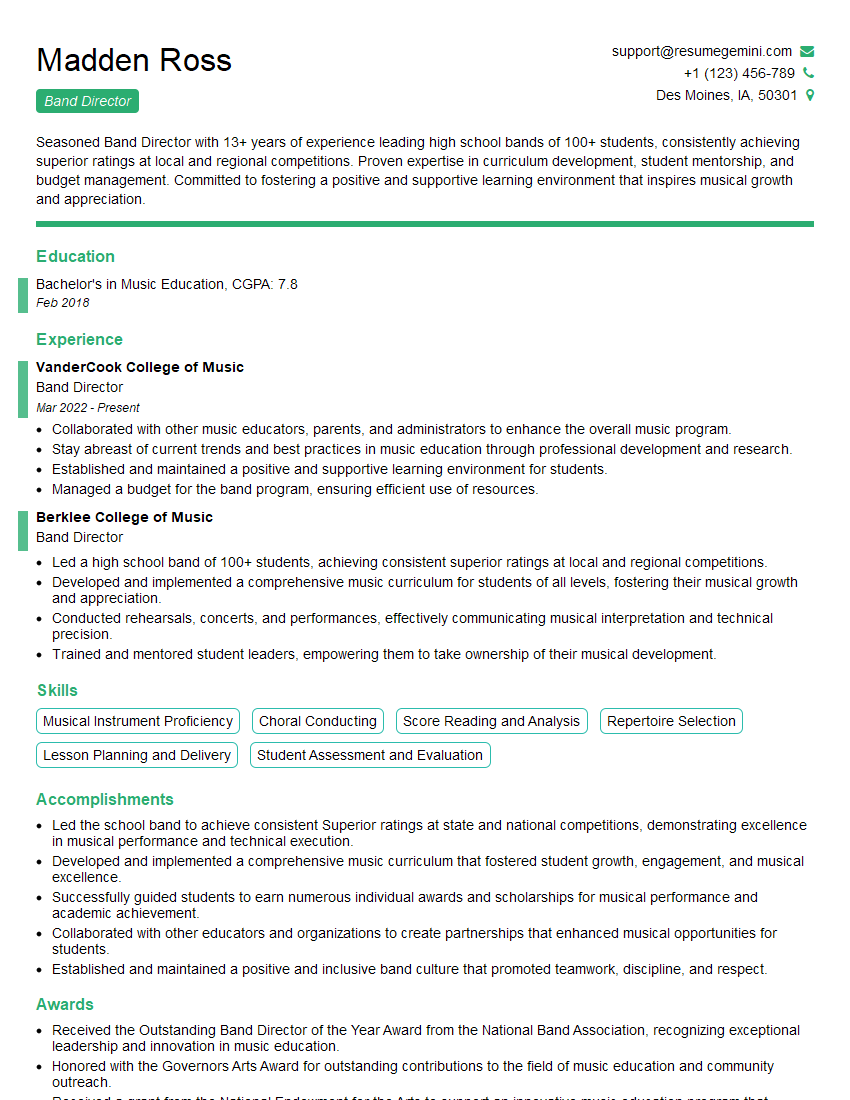
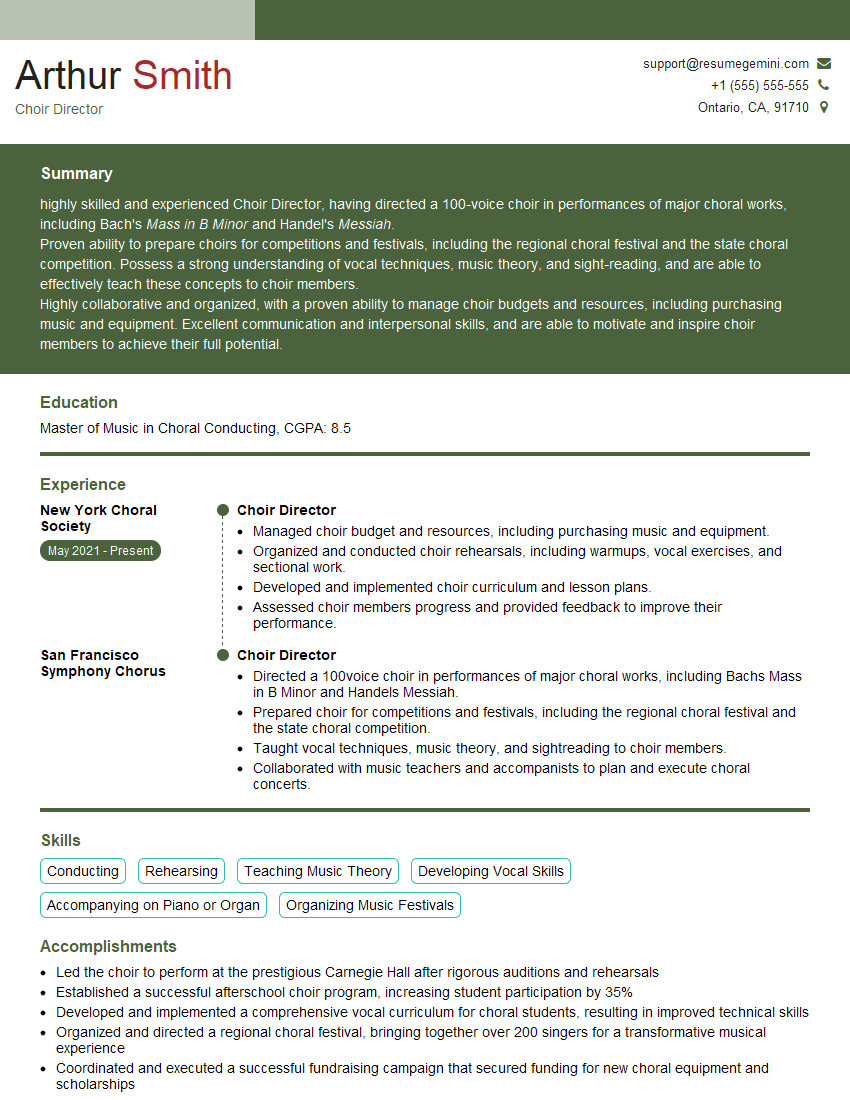
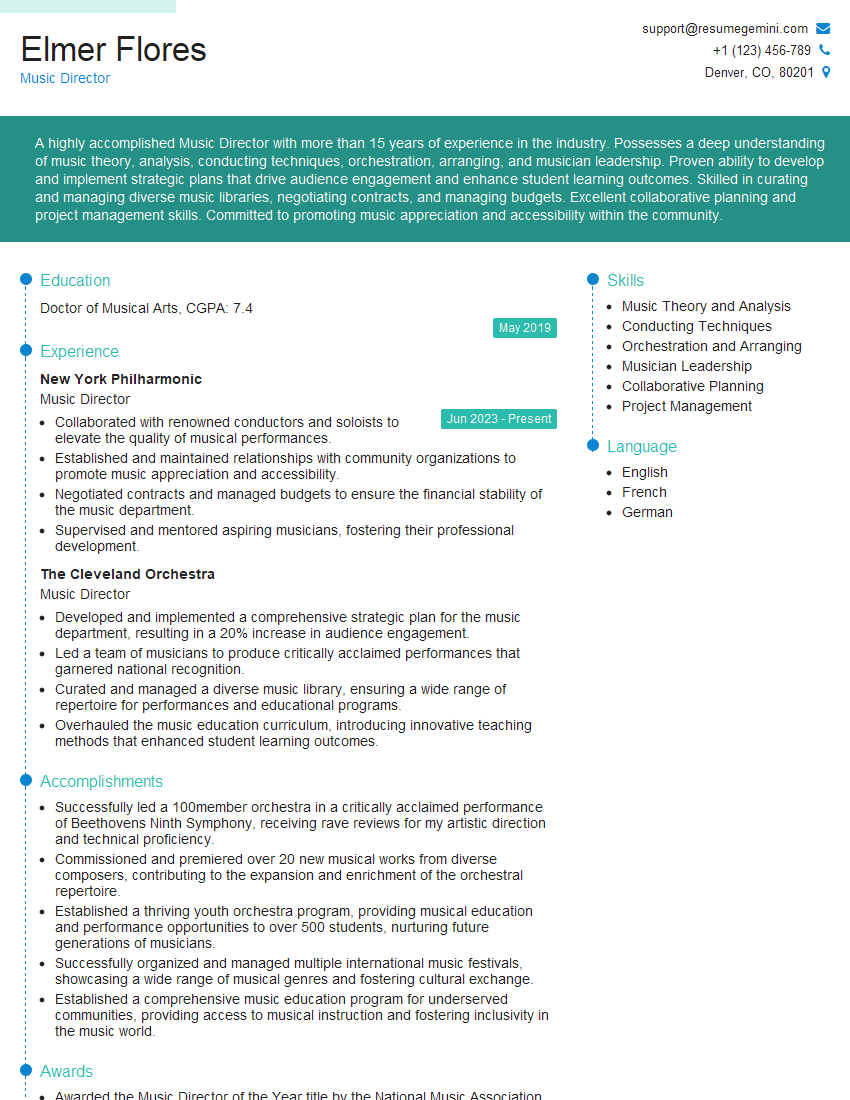
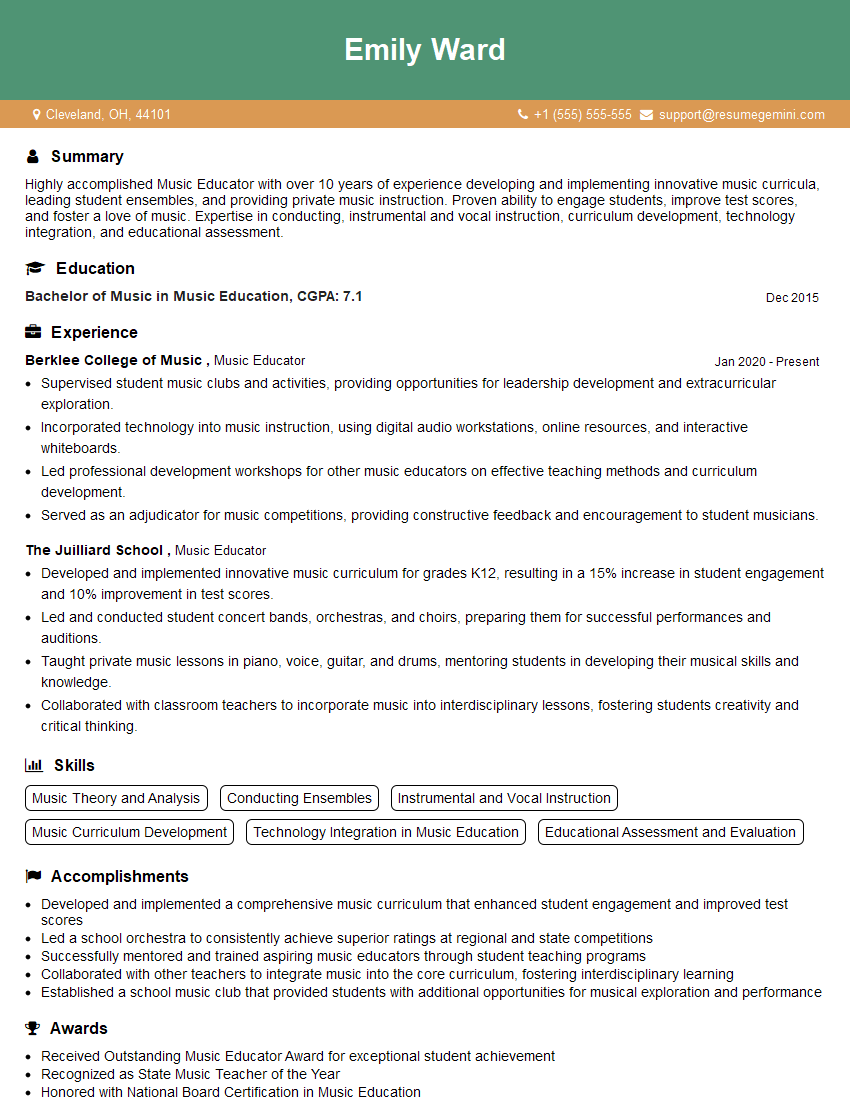
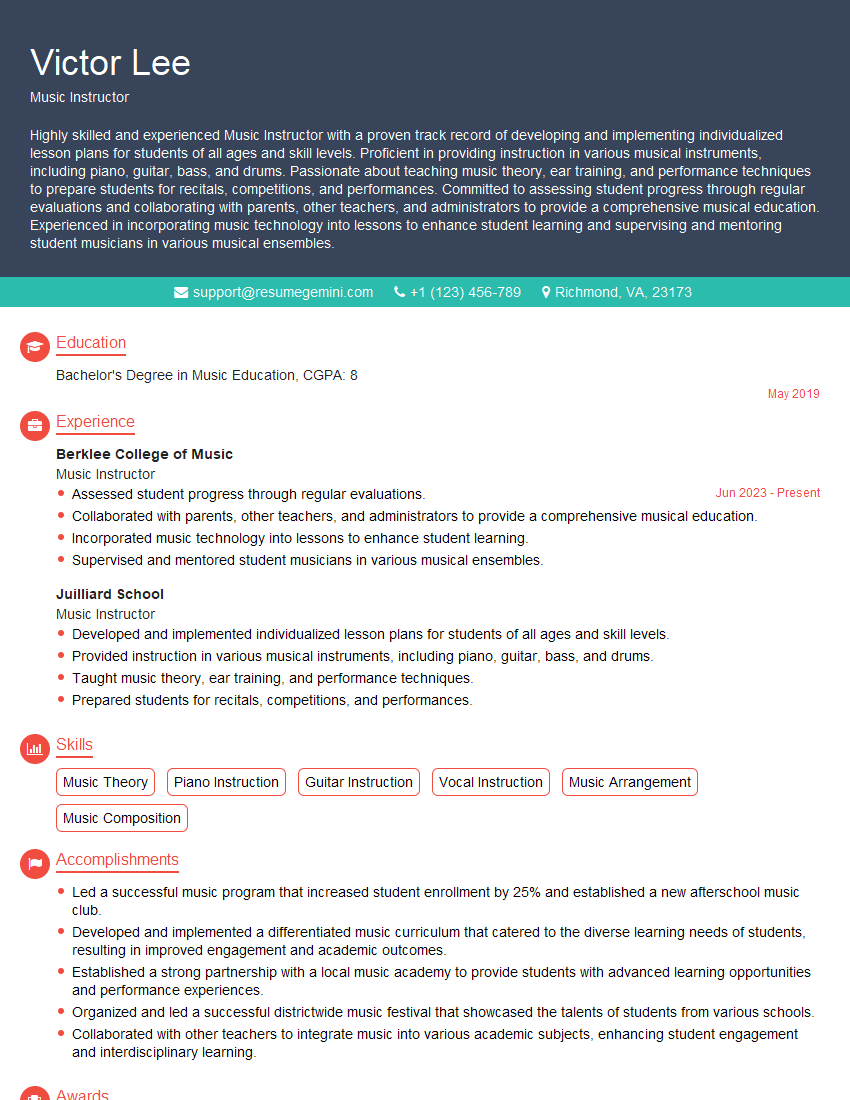
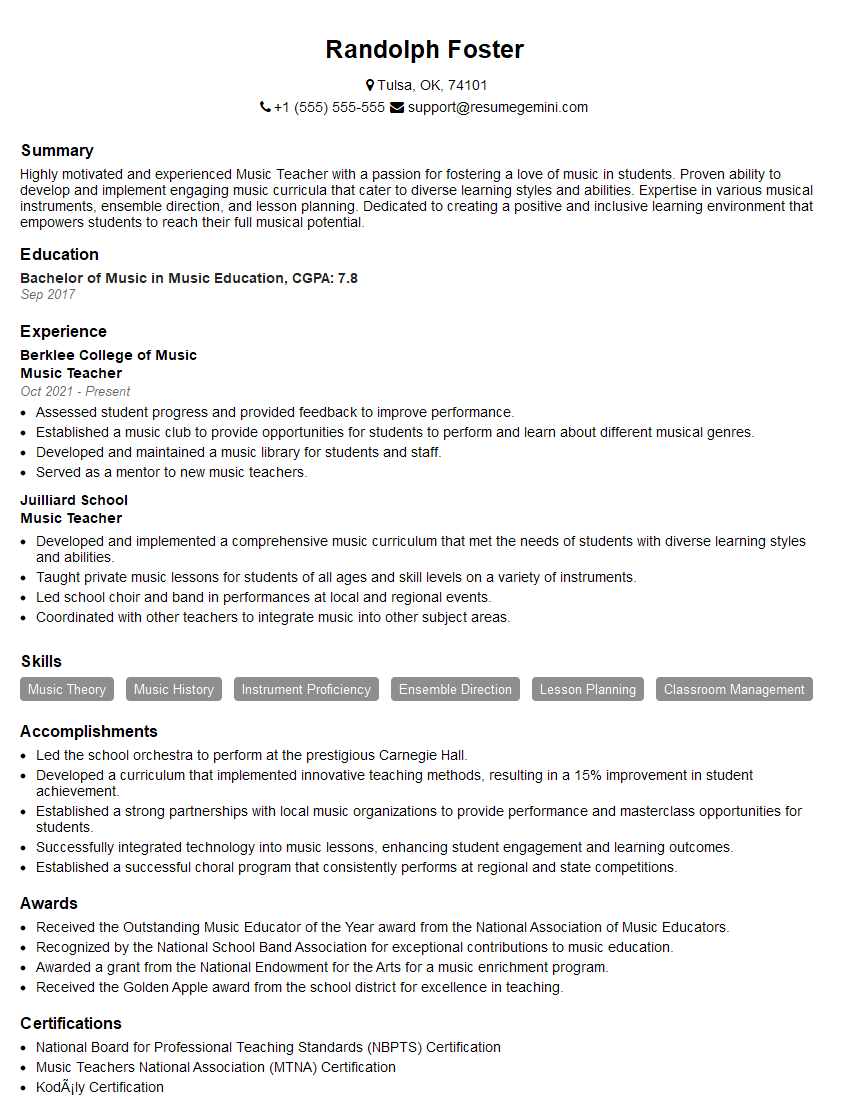
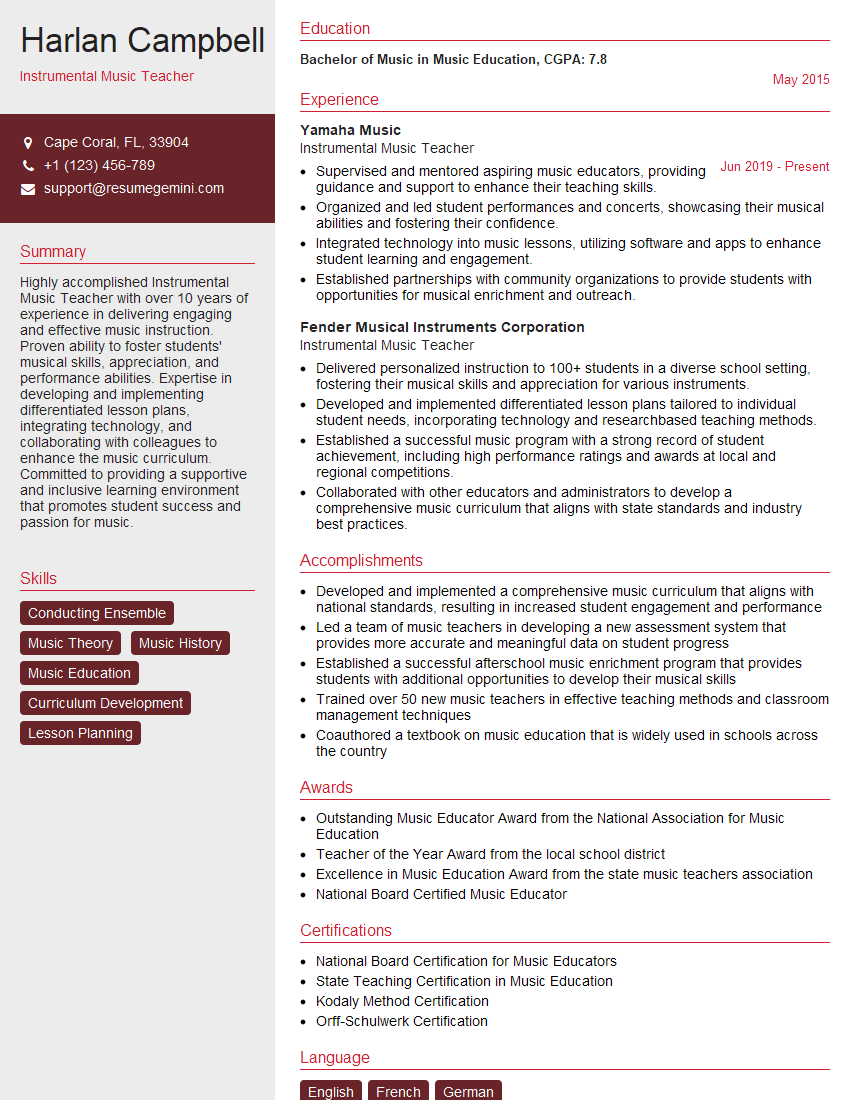
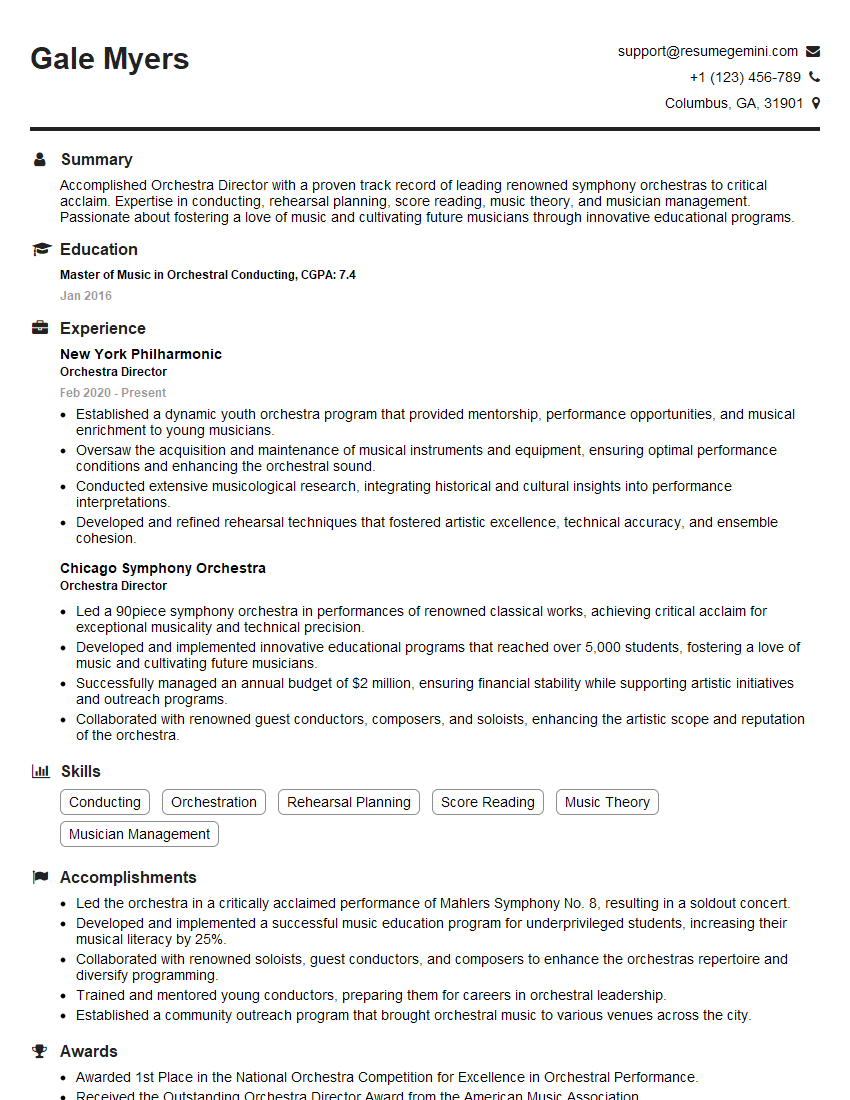
Mastering the ability to train and develop other musicians significantly enhances your career prospects, opening doors to leadership roles and greater influence within the music industry. A well-crafted, ATS-friendly resume is crucial for showcasing your skills and experience effectively to potential employers. To maximize your job search success, we strongly recommend using ResumeGemini to build a professional and impactful resume. ResumeGemini provides you with the tools and resources to create a compelling document, and we offer examples of resumes tailored specifically to highlight experience in training and developing other musicians.
Explore more articles
Users Rating of Our Blogs
Share Your Experience
We value your feedback! Please rate our content and share your thoughts (optional).
What Readers Say About Our Blog
Very informative content, great job.
good