Cracking a skill-specific interview, like one for Ability to transcribe and arrange music from various sources, requires understanding the nuances of the role. In this blog, we present the questions you’re most likely to encounter, along with insights into how to answer them effectively. Let’s ensure you’re ready to make a strong impression.
Questions Asked in Ability to transcribe and arrange music from various sources Interview
Q 1. Describe your experience with music notation software (e.g., Sibelius, Finale, Dorico).
I’m highly proficient in several music notation software packages, including Sibelius, Finale, and Dorico. My experience spans over 15 years, encompassing everything from basic score entry to advanced techniques like engraving, audio import/export, and advanced scoring features. Sibelius, for instance, excels in its intuitive interface and powerful playback engine, which I frequently use for quick revisions and proofing. Finale’s robust features, particularly its extensive library of templates and sounds, are invaluable for large-scale projects. Dorico’s modern approach to workflow, especially its efficient handling of complex scores and its excellent engraving capabilities, makes it my preferred choice for projects demanding precision and high-quality output. I can seamlessly adapt to any of these platforms depending on the project’s specific needs and client preferences.
For example, in a recent project involving a large orchestral score, Dorico’s advanced features allowed me to efficiently manage numerous instrument parts and implement complex articulations and dynamics effortlessly. In contrast, for a smaller chamber piece, the simplicity and speed of Sibelius was ideal for rapid composition and revision.
Q 2. Explain your process for transcribing a complex musical piece from audio.
Transcribing a complex piece from audio is a meticulous process that combines musical understanding with technical skill. It typically involves these steps:
- Careful Listening and Analysis: I begin by listening repeatedly to the audio, identifying the key, meter, and overall structure. This often requires slowing down the playback speed and using tools to isolate specific instrumental parts.
- Melody Extraction: I then start by notating the main melodic lines. This involves identifying pitches accurately, which may require repeated listening and comparison to reference recordings of the instrument(s) used in the recording.
- Harmony and Rhythm Recognition: Once the melody is established, I analyze the harmonic structure, identifying chords, chord progressions, and rhythmic patterns. This step frequently involves using software tools that can analyze audio frequencies to assist with accurate pitch identification.
- Transcription and Notation: The actual notation process follows, using my chosen software (usually Dorico). I input the melody, harmony, and rhythm, paying close attention to details such as articulation marks, dynamics, and phrasing.
- Verification and Refinement: After a first draft, I meticulously compare my transcription to the audio, correcting any errors and refining the notation to match the nuances of the performance. I often repeat this verification step several times to ensure accuracy.
Think of it like assembling a complex jigsaw puzzle. Each musical element—melody, harmony, rhythm—is a piece of the puzzle, and only when they’re all meticulously assembled will the complete picture emerge.
Q 3. How do you handle discrepancies or ambiguities in an audio recording during transcription?
Discrepancies and ambiguities are common in audio transcription. I handle these situations using a combination of techniques:
- Contextual Clues: I look for musical clues in the surrounding context. For instance, if a note sounds ambiguous, I might find a resolution or clarification later in the piece.
- Instrumental Knowledge: My deep understanding of different instruments helps me discern potential technical limitations or expressive choices that might create ambiguity.
- Multiple Listenings: Repeating the listening process several times, often at different playback speeds, allows for more precise identification of notes and rhythms.
- External References: If possible, I research the piece or composer to find additional scores or recordings that might offer insight into the intended interpretation.
- Conservative Approach: When absolute certainty is impossible, I err on the side of caution, opting for the most likely solution. I’ll make a note in the score indicating the ambiguous areas, indicating my rationale for my transcription decision.
For example, if a note is very short and obscured by other instrumentation, I might indicate this uncertainty in my transcription with a question mark or a note indicating a possible alternative.
Q 4. What are the key differences between arranging for a string quartet versus a full orchestra?
Arranging for a string quartet versus a full orchestra involves significant differences in approach:
- Textural Density: String quartets have a much thinner texture. Each part is equally prominent, requiring careful balancing of voices to create a cohesive sound. Orchestras allow for greater textural density and layering of sounds.
- Range and Timbre: The limited range of a string quartet requires careful consideration of register. The diverse range and timbres of an orchestra offer a vastly broader palette of sounds.
- Harmonic Complexity: String quartets can handle harmonic complexity but are more constrained than an orchestra, which can easily accommodate more elaborate harmonic structures and textures.
- Orchestration Techniques: Orchestration for a full orchestra demands a deep understanding of instrumental techniques, balance, and interplay between sections (strings, woodwinds, brass, percussion).
Think of it as painting a picture. A string quartet is like painting with a limited set of fine brushes, requiring precision and subtlety. A full orchestra is like having a vast array of brushes, paints, and canvases, allowing for much bolder and more complex creations.
Q 5. How do you approach adapting a piece for different instrumentations?
Adapting a piece for different instrumentations requires a deep understanding of both the original piece and the capabilities of the new instrumentation. My approach involves:
- Analyzing the Original: I begin by thoroughly analyzing the original piece, identifying its key melodic, harmonic, and rhythmic elements.
- Understanding the New Instrumentation: I study the range, timbre, and technical capabilities of the instruments in the new arrangement. This includes considering the specific instruments and the sizes/types of ensembles.
- Re-voicing and Rewriting: I carefully re-voice the music, adapting melodies, harmonies, and rhythms to suit the new instruments. This may involve simplifying or elaborating certain passages.
- Balancing and Texture: I ensure a balanced and effective texture, considering the individual strengths and limitations of each instrument.
- Maintaining the Style: It is important to retain the essence and style of the original composition, adapting only as needed to accommodate the new instrumentation.
For example, adapting a piano solo for a string quartet might require re-harmonization to suit the string’s timbral qualities, while adapting a piece for a larger ensemble might necessitate adding countermelodies or harmonic embellishments to enhance the overall texture.
Q 6. Describe your experience with various musical styles and genres.
My experience encompasses a broad spectrum of musical styles and genres, including classical, jazz, pop, folk, and world music. Within classical music, I am comfortable with various periods—Baroque, Classical, Romantic, and 20th/21st century—and subgenres such as chamber music, orchestral works, and vocal music. In jazz, I have worked with various styles, from swing and bebop to fusion and modern jazz. My experience also extends to transcribing and arranging popular music, including both vocal and instrumental pieces. This diverse background allows me to approach each transcription and arrangement project with flexibility and a deep appreciation for the unique characteristics of each genre.
For example, I recently completed a project transcribing a complex jazz improvisation, requiring a deep understanding of jazz harmony and rhythmic notation conventions. This differed significantly from a previous project where I transcribed a Baroque sonata, which demanded a precise understanding of historical performance practices.
Q 7. How familiar are you with different musical forms and structures?
I possess a comprehensive understanding of various musical forms and structures, including sonata form, rondo form, theme and variations, fugue, and many others. I am able to recognize these forms in both notated scores and audio recordings, which is crucial for effective transcription and arrangement. Understanding form helps me to predict musical events, identify structural elements, and ensure that the transcription and any subsequent arrangement maintains the integrity and stylistic coherence of the original piece.
For instance, recognizing the development section in a sonata form piece allows me to anticipate the return of the primary thematic material, aiding in accurate transcription and providing context for structural ambiguities.
Q 8. How do you ensure accuracy and efficiency in your transcription work?
Accuracy and efficiency in music transcription are paramount. My approach is multi-faceted, starting with meticulous listening. I employ high-quality audio equipment and software to minimize noise and ensure a clean recording. Then, I use a combination of methods: I begin with a broad overview to identify the key elements – tempo, time signature, instrumentation – before diving into detailed note-by-note transcription. I often employ slow-motion playback and loop functionality to capture tricky passages accurately. For efficiency, I use notation software like Sibelius or Dorico, utilizing their features like automatic rhythm and key detection. This is then followed by repeated listening to refine the transcription, ensuring the subtle nuances are captured. Regular breaks are crucial to maintain focus and prevent errors. Finally, I always perform a thorough proofread and cross-check against the audio source. Think of it like building a house – you wouldn’t skip the foundation or structural integrity checks, and music transcription demands the same level of care.
Q 9. How do you handle copyright considerations when arranging music?
Copyright is a crucial consideration. Before undertaking any arrangement, I meticulously research the copyright status of the original composition. Public domain works present no issue, but for copyrighted material, I always obtain the necessary permissions from the copyright holder or their representative. This process often involves contacting publishers, licensing agencies, or the composer themselves. Transparency is key – I clearly state in my arrangement the original composer and any applicable copyright information. Failure to obtain proper permissions can lead to legal issues and damage professional reputation. Respecting intellectual property rights is not just legally mandated; it’s a fundamental ethical responsibility in the music profession.
Q 10. Explain your understanding of harmonic analysis and its role in arrangement.
Harmonic analysis is the foundation of effective arrangement. It’s the process of dissecting a piece’s chord progressions, identifying key changes, and understanding the underlying harmonic structure. This understanding allows me to create arrangements that retain the emotional core of the original while adding new layers of complexity or simplicity, as appropriate. For instance, analyzing a simple I-IV-V-I progression reveals its diatonic nature, allowing me to explore substitutions, inversions, or added chords without disrupting the piece’s overall feel. A deeper analysis might reveal secondary dominants or modal interchange, opening up even more creative possibilities. Imagine it as understanding the skeleton of the piece before adding muscle and skin – the arrangement.
Q 11. Describe your approach to voicing and orchestration.
Voicing and orchestration are crucial for shaping the sonic landscape of an arrangement. My approach involves carefully considering the timbre and range of each instrument, ensuring a balanced and expressive texture. For example, I might choose to double a melody line with strings for a lusher sound, or use a bassoon to provide a melancholic countermelody in the lower register. I create mock-ups using MIDI (Musical Instrument Digital Interface) to experiment with different instrumental combinations, ensuring that each voice contributes effectively to the overall musical narrative. This process often involves iterative revisions and listening tests to refine the sound.
Consider arranging a simple piano piece for a string quartet. The piano’s range is vast; I’d need to distribute that across the violin, viola, and cello, carefully considering which instrument suits particular melodic or harmonic passages best, creating a cohesive and expressive arrangement.
Q 12. How do you balance creativity with the integrity of the original composition when arranging?
Balancing creativity with the integrity of the original is a delicate act. My approach emphasizes respecting the essence of the composition while adding my own unique interpretation. This could involve adding new countermelodies, expanding harmonies, or rearranging sections to create a new dynamic. However, I would avoid altering the fundamental melody or harmonic structure unless specifically requested or justifiable within a clear artistic context. For example, I might add a rhythmic variation in a particular section to create more energy, but I’d never replace a memorable melody. It’s a careful dance between honoring the composer’s vision and expressing my own creativity. Think of it as a respectful restoration of an antique piece – preserving its history while enhancing its beauty.
Q 13. What strategies do you employ to ensure readability and clarity in your musical scores?
Readability and clarity are essential for successful musical communication. I use clear and consistent notation practices, following standard music publishing conventions. This involves properly spaced staves, clear articulation markings, appropriate dynamics and tempo indications, and consistent use of symbols. I avoid unnecessary complexity or overly dense scores. Logical sectioning and clear labeling make navigating and performing the piece significantly easier. Imagine a poorly written recipe – it’s frustrating and may lead to mistakes. Similarly, a poorly written score can hinder the performance.
Q 14. How do you prioritize your tasks when working on multiple transcription or arrangement projects?
Managing multiple projects requires careful prioritization. I use project management techniques, often employing a Kanban board to visualize tasks and deadlines. I prioritize projects based on urgency, deadlines, and client expectations. Breaking down large projects into smaller, manageable tasks makes them less overwhelming. This allows for effective time management and reduces stress. Maintaining a clear communication channel with clients is crucial – keeping them informed of progress and any potential delays is essential for smooth project completion.
Q 15. Describe your experience working with deadlines and tight schedules.
Meeting deadlines is crucial in music transcription and arrangement. I’ve consistently delivered projects on time, even under pressure. My approach involves meticulous planning, breaking down large tasks into smaller, manageable chunks, and prioritizing based on urgency and dependency. For example, when transcribing a complex orchestral piece with a tight deadline, I might start by focusing on the main melodic lines and harmonies before tackling the intricate rhythmic and textural details. This phased approach allows me to maintain momentum and avoid feeling overwhelmed. I also proactively communicate with clients about potential delays or challenges, ensuring transparency and collaborative problem-solving. I use project management tools to track progress and stay organized. Successfully completing a 100-minute orchestral score transcription within a two-week deadline for a film scoring client is a testament to this efficiency.
Career Expert Tips:
- Ace those interviews! Prepare effectively by reviewing the Top 50 Most Common Interview Questions on ResumeGemini.
- Navigate your job search with confidence! Explore a wide range of Career Tips on ResumeGemini. Learn about common challenges and recommendations to overcome them.
- Craft the perfect resume! Master the Art of Resume Writing with ResumeGemini’s guide. Showcase your unique qualifications and achievements effectively.
- Don’t miss out on holiday savings! Build your dream resume with ResumeGemini’s ATS optimized templates.
Q 16. How do you handle feedback and revisions on your transcriptions and arrangements?
Feedback is invaluable for improving the quality of my work. I actively solicit feedback throughout the process, not just at the end. I see revisions as opportunities to refine my transcriptions and arrangements, ensuring they meet the client’s vision. I carefully analyze each comment and implement changes effectively. For instance, if a client requests a more dynamic arrangement, I might adjust the articulation markings and add more crescendo and diminuendo indications. I always maintain a professional and collaborative approach to discussions, making sure I understand the client’s reasoning behind any suggestions. If there’s a difference of opinion about a particular musical decision, I would engage in a respectful dialogue to reach a solution that achieves both musical integrity and client satisfaction.
Q 17. Describe your proficiency in music theory and its application to transcription and arrangement.
Music theory is the foundation of my work. My comprehensive understanding of harmony, counterpoint, rhythm, and form is crucial for accurate transcriptions and creative arrangements. I can identify chord progressions, analyze melodic structures, and understand the underlying compositional techniques of a piece. This allows me to not only accurately capture the original music but also to make informed decisions during the arrangement process. For example, when transcribing a jazz solo, I use my understanding of chord voicings and improvisation techniques to ensure an accurate representation of the musician’s style. When arranging a piece for a different ensemble, my knowledge of voice leading and orchestration helps me to create a balanced and effective arrangement that respects the original character of the piece while also tailoring it to the new instrumentation.
Q 18. What are some common challenges you encounter during transcription and how do you overcome them?
Transcription challenges can include poor audio quality, complex polyphony (multiple melodic lines happening simultaneously), unusual or ambiguous notation, and stylistic inconsistencies. I overcome these by employing various strategies. For poor audio quality, I might use noise reduction software and enhance specific frequencies. For complex polyphony, I utilize specialized transcription software and focus on separating the individual melodic lines, often breaking it down into smaller sections. If notation is ambiguous, I consult other sources such as recordings or scores of similar works. Inconsistent style is addressed by carefully analyzing multiple sections of the music, establishing a consistent interpretation to the best of my abilities. I might even consult with a music theory expert if needed, especially in the case of more complex works.
Q 19. What software and hardware do you use regularly for music transcription and arrangement?
My workflow relies heavily on several software and hardware tools. My primary software includes Sibelius for notation, Antares Auto-Tune for pitch correction (when necessary for vocal transcriptions), and various audio editing programs like Audacity and Adobe Audition for pre-processing and enhancing audio recordings. I also use specialized transcription software such as Transcribe! and Melody Assistant. My hardware includes a high-quality audio interface, studio headphones offering accurate frequency response, and a comfortable computer setup optimized for efficient music notation and audio editing. The choice of software and hardware is tailored to the specific needs of each project, ensuring the highest level of accuracy and efficiency.
Q 20. How do you maintain the musical integrity of a piece while adapting it for a different context?
Maintaining musical integrity while adapting a piece involves careful consideration of its stylistic characteristics and emotional impact. This is akin to translating a story into another language while preserving the essence of the narrative. I begin by deeply analyzing the source material, understanding its harmony, melody, rhythm, and emotional arc. When arranging for a different context (e.g., changing instrumentation from piano solo to string quartet), I strive to preserve the original melody and harmonic structure. I may adjust the rhythmic figures and voicing to better suit the new instrumentation. For instance, I might simplify complex piano passages for a string quartet by distributing the melodic lines amongst the different string instruments. I always seek to enhance the original, not to replace it. The goal is to create a new interpretation that complements and respects the source.
Q 21. Explain your understanding of musical dynamics and their impact on arrangement.
Musical dynamics are crucial for shaping the emotional narrative of a piece. They involve the variation of loudness and intensity, creating contrasts and building tension. My understanding of dynamics plays a key role in both transcription and arrangement. During transcription, I meticulously note all dynamic markings from the original source, whether a recording or score. In arrangement, I strategically employ dynamics to heighten the emotional impact of the music. For example, a sudden crescendo can build tension before a dramatic climax, while a diminuendo can create a sense of calm or reflection. I carefully consider the phrasing, articulation, and tempo in conjunction with dynamics to create a holistic and expressive arrangement. Understanding the composer’s intent and utilizing dynamics thoughtfully are critical to bringing a piece to life.
Q 22. Describe your experience using MIDI for transcription or arrangement.
MIDI (Musical Instrument Digital Interface) is invaluable for transcription and arrangement. It allows for the non-destructive manipulation of musical data. My experience with MIDI encompasses a wide range of tasks, from importing MIDI files exported from DAWs (Digital Audio Workstations) like Logic Pro X or Ableton Live, to meticulously editing note data, velocity, and articulation. I often use MIDI editors to clean up messy transcriptions from automated software, correcting timing inaccuracies and smoothing out velocity inconsistencies. For arrangement, MIDI allows for quick experimentation; I can easily transpose sections, rearrange parts, and add or delete instruments without re-recording.
For example, I recently transcribed a complex orchestral piece from a low-quality audio recording. Using a combination of audio transcription software and manual editing in a DAW, I first created a rough MIDI transcription. Then, I used the MIDI data to build a more accurate and refined version, correcting errors, cleaning up the timing, and adding expressive details based on my musical knowledge and experience.
I also frequently use MIDI to create mock-ups for potential arrangements, experimenting with different instrumentations and harmonies before committing to final arrangements in audio. This iterative process, enabled by the flexibility of MIDI, saves both time and resources.
Q 23. How do you ensure your transcriptions and arrangements are suitable for performance?
Ensuring suitability for performance requires a multifaceted approach. It’s not just about accurate notes; it’s about creating a playable and expressive score. I consider several factors:
- Practicality of Instrumentation: I choose instruments appropriate for the context and skill level of the performers. A demanding passage might be simplified or re-harmonized if necessary.
- Balance and Dynamics: I carefully craft the dynamic range and balance between instruments, considering the acoustic space and the overall sonic goal.
- Technical Feasibility: I examine the parts for difficult passages and suggest alternatives or voicings to make them more playable and achievable.
- Musicality and Expression: I focus on creating a compelling performance by incorporating phrasing, articulation, and other expressive details. I try to capture the emotion and style of the original piece.
Before finalizing an arrangement, I always conduct thorough playtesting. I either play the parts myself, if possible, or provide them to trusted musicians for feedback, ensuring the arrangement works smoothly and effectively in a live setting.
Q 24. How do you identify and correct errors in your transcriptions or arrangements?
Identifying and correcting errors is an iterative process involving both analytical and intuitive skills. I employ a layered approach:
- Careful Listening: Repeated listening to the source material is crucial to detect discrepancies between the transcription/arrangement and the original.
- Visual Inspection: I meticulously scrutinize the score for inconsistencies in rhythm, harmony, and melody. Software tools can aid in identifying potential issues, such as rhythmic irregularities or harmonic clashes.
- Cross-Referencing: If working from multiple sources, I compare them to identify the most accurate representation.
- Playtesting: Performance is a vital check; hearing the transcription/arrangement played allows for the immediate detection of any technical flaws or unmusical aspects.
Corrections vary. Sometimes it’s a simple note correction; other times, it involves revisiting sections to improve flow, phrasing, or harmony. I maintain detailed notes about the corrections made, documenting the process for future reference.
Q 25. What are your preferred methods for verifying the accuracy of your work?
Verifying accuracy is paramount. My preferred methods include:
- Multiple Source Comparison: When available, I compare my transcriptions with other versions to ensure accuracy. This could involve comparing my transcription against multiple recordings or scores from different publishers.
- Peer Review: I often seek feedback from other musicians, particularly those specializing in the same genre or style of music.
- Performance Feedback: Once a transcription or arrangement is completed, I prioritize testing it in a performance setting to pinpoint any remaining issues.
- Software Verification: Using software such as Sibelius or Finale for score writing allows for built-in checks for rhythmic or harmonic errors.
Using multiple methods for verification ensures a higher level of confidence in the final product.
Q 26. Describe a challenging transcription or arrangement project you completed and what you learned from it.
One challenging project involved transcribing a solo piano improvisation by a renowned jazz pianist. The piece was highly improvisational, with complex harmonic changes and rapid rhythmic variations, captured on a low-fidelity recording. The audio quality made discerning individual notes and chords difficult.
My approach involved using both automated transcription software as a starting point and painstaking manual editing. I used spectral analysis tools to isolate individual notes in dense harmonic textures. I spent countless hours refining the transcription, cross-referencing with my musical knowledge of the pianist’s style. This process helped me hone my skills in dealing with ambiguous audio, refining my listening skills, and understanding the importance of context in deciphering complex musical passages.
The most significant lesson was the importance of combining technology with musical intuition. Technology can provide a framework, but musical understanding is necessary to make the final piece both accurate and artistically coherent.
Q 27. How do you stay current with the latest trends and developments in music transcription and arrangement?
Staying current is crucial. I achieve this through:
- Professional Development: Attending workshops and conferences focused on music technology and transcription techniques.
- Online Resources: Actively engaging with online communities and forums for musicians and music technologists. I follow industry blogs and publications.
- Software Updates: Keeping abreast of new software releases and updates from DAWs and music notation software to leverage advancements in AI-assisted transcription or new features.
- Collaboration: Working with other musicians and arrangers on projects allows for the exchange of ideas and techniques.
By actively seeking out new information and engaging with the community, I ensure my skills and knowledge remain at the forefront of this ever-evolving field.
Q 28. What are your salary expectations for this role?
My salary expectations for this role are commensurate with my experience and expertise, and are in the range of [Insert Salary Range Here] annually. This is based on industry standards and my demonstrated ability to deliver high-quality work efficiently and effectively.
Key Topics to Learn for Ability to transcribe and arrange music from various sources Interview
- Transcription Techniques: Mastering accurate notation of melodies, rhythms, harmonies, and dynamics from various audio sources (live recordings, MIDI files, etc.). Understanding different notation styles.
- Aural Skills: Developing strong aural skills to identify intervals, chords, rhythms, and melodic contours without relying solely on visual cues. Practicing ear training exercises.
- Arrangement Principles: Understanding the principles of musical arrangement, including voice leading, counterpoint, orchestration, and form. Knowing how to adapt arrangements for different ensembles or instrumentation.
- Software Proficiency: Demonstrating competency with music notation software (Sibelius, Finale, Dorico, etc.) and Digital Audio Workstations (DAWs) for transcription and arrangement.
- Music Theory Fundamentals: A strong grasp of music theory concepts, including scales, modes, chords, chord progressions, key signatures, and rhythm. This forms the foundation for accurate transcription and effective arrangement.
- Style and Genre Understanding: Demonstrating familiarity with various musical styles and genres and the ability to transcribe and arrange music within those stylistic frameworks.
- Practical Application: Being able to articulate how you’ve applied your skills in real-world projects, such as transcribing music for educational purposes, creating arrangements for performances, or contributing to musical productions.
- Problem-Solving: Discussing your approach to challenges in transcription, such as ambiguous recordings or complex rhythmic patterns. Showcasing your ability to adapt and find solutions.
Next Steps
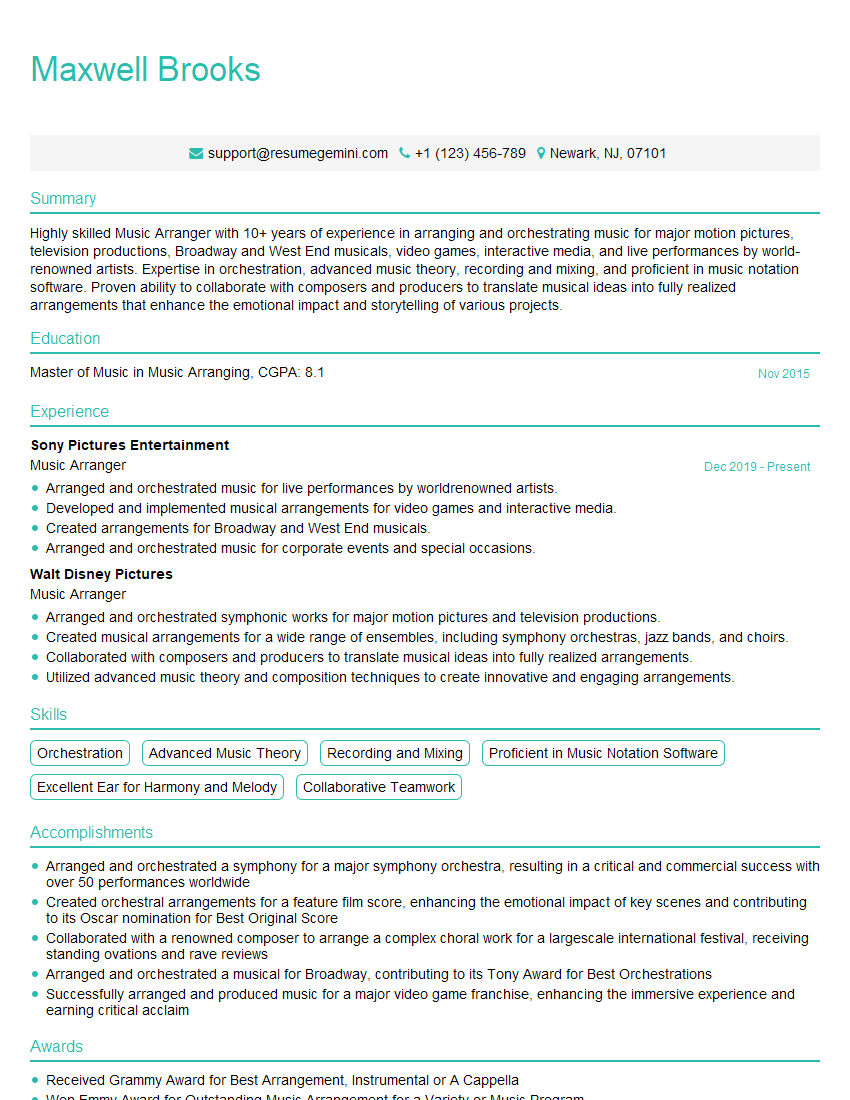
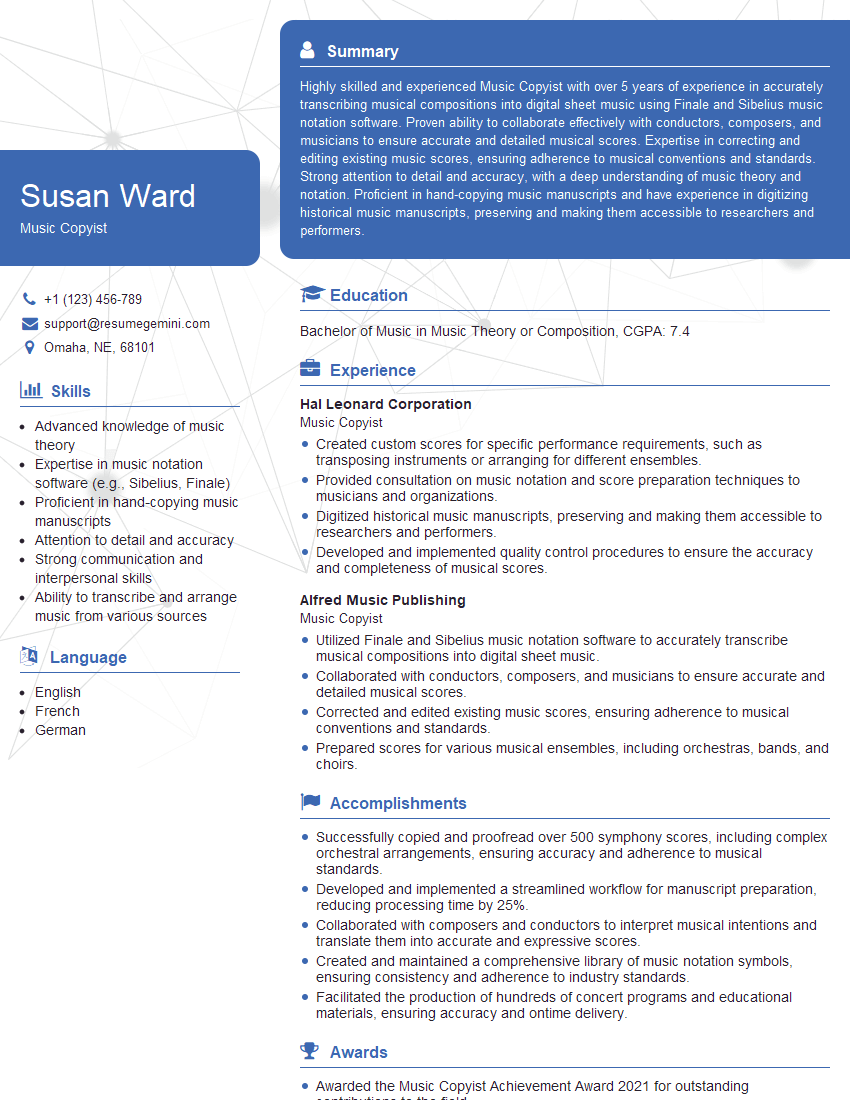
Mastering the ability to transcribe and arrange music from various sources is crucial for career advancement in diverse musical fields, opening doors to exciting opportunities in composition, arranging, music education, and audio production. An ATS-friendly resume is key to maximizing your job prospects. To create a professional and impactful resume that highlights your skills and experience, leverage the power of ResumeGemini. ResumeGemini offers a streamlined process and provides examples of resumes tailored to showcasing expertise in transcribing and arranging music, giving you a significant advantage in your job search.
Explore more articles
Users Rating of Our Blogs
Share Your Experience
We value your feedback! Please rate our content and share your thoughts (optional).
What Readers Say About Our Blog
Very informative content, great job.
good