Are you ready to stand out in your next interview? Understanding and preparing for Accurate Color Management interview questions is a game-changer. In this blog, we’ve compiled key questions and expert advice to help you showcase your skills with confidence and precision. Let’s get started on your journey to acing the interview.
Questions Asked in Accurate Color Management Interview
Q 1. Explain the concept of color spaces (e.g., sRGB, Adobe RGB, CMYK).
Color spaces are standardized models that define the range of colors a device or system can represent. Think of it like a palette of paints – each color space has a different set of colors available. Different color spaces are optimized for different purposes.
- sRGB (Standard Red Green Blue): This is the most common color space for the internet and standard displays. It’s a relatively small color gamut, meaning it can’t represent as many colors as some other spaces. Most web browsers and digital cameras use sRGB by default.
- Adobe RGB (1998): This color space offers a wider gamut than sRGB, particularly in the greens and blues. It’s often preferred for professional photography and print work because it can capture a broader range of colors, potentially leading to richer, more vibrant images.
- CMYK (Cyan, Magenta, Yellow, Key/Black): This is a subtractive color space used primarily for printing. Instead of adding light, CMYK inks subtract light from the white paper. The ‘K’ represents black, often added to improve contrast and richness.
Choosing the right color space is crucial. Using sRGB for web design ensures consistency across devices, while Adobe RGB might be better for print projects that need a wide color range. Mixing color spaces can lead to significant color shifts and inaccuracies.
Q 2. What is the difference between additive and subtractive color mixing?
The difference between additive and subtractive color mixing lies in how light or pigment is handled to produce colors.
- Additive Color Mixing: This is used with light, like in computer screens or projectors. It starts with black (absence of light) and adds red, green, and blue light to create other colors. Mixing all three at full intensity produces white. Think of it like shining colored spotlights on a white wall: the overlapping areas create new colors.
- Subtractive Color Mixing: This is used with pigments, like in paints or inks. It starts with white (reflecting all light) and subtracts color with cyan, magenta, yellow, and black (CMYK). Mixing all four will produce black (or close to it, in practice, often requiring a separate black ink). Think of mixing paint: adding colors together results in darker, more muted tones.
Understanding the distinction is crucial for color management. Images created in additive spaces (like RGB) often need to be converted to subtractive spaces (like CMYK) for printing, requiring color profile management to avoid unexpected results.
Q 3. Describe the role of ICC profiles in color management.
ICC (International Color Consortium) profiles act as translators between different devices and color spaces. They contain mathematical data that describes the color characteristics of a specific device, like a printer or monitor. This data accounts for variations in how different devices reproduce color.
Imagine you have a recipe (the image data) and two different ovens (devices). Each oven cooks differently, affecting the final outcome. ICC profiles are like customized instructions for each oven – they tell you how to adjust the recipe (image) to get the desired result in that specific oven (device).
Without ICC profiles, an image that looks vibrant on your screen might appear dull or completely different when printed. The profiles ensure that the colors are interpreted and displayed correctly, regardless of the device involved. A crucial part of professional workflow.
Q 4. How do you create or modify an ICC profile?
Creating or modifying ICC profiles is a complex process typically done using specialized software. There are two main methods:
- Measurement-based profiling: This is the most accurate method. A colorimeter or spectrophotometer measures the actual color output of a device under controlled conditions. The software then uses this data to create a profile. This is commonly used to characterize printers and monitors to an incredibly fine degree, often by professional calibration services.
- Emulation-based profiling: This method uses existing profiles as a base to create a new profile. While less precise than measurement-based profiling, it’s quicker and simpler, and can sometimes be sufficient for certain devices.
Software like X-Rite i1Profiler or Datacolor SpyderX PRO offer tools for both methods. The process requires a good understanding of color management principles and the use of specialized hardware for accurate measurement.
Q 5. Explain the importance of color gamut mapping.
Color gamut mapping handles the situation when an image contains colors outside the reproducible range of a target device (its color gamut). For example, an image with colors in Adobe RGB needs to be displayed on an sRGB monitor, or printed using a CMYK printer. Since the target device cannot reproduce all the colors in the source image, the colors need to be mapped (translated) into the smaller color space.
Different gamut mapping methods exist, each with its own trade-offs:
- Clipping: The simplest method; colors outside the target gamut are simply cut off or ‘clipped,’ resulting in a loss of color information.
- Perceptual: Attempts to preserve the overall appearance and relationships between colors, even if some colors need adjustments.
- Saturation: Prioritizes the vibrancy and intensity of colors, potentially altering the overall hue.
- Relative Colorimetric: Maintains relative color differences between colors, trying to ensure colors are consistently related.
Choosing the appropriate mapping method depends on the specific application and the desired result. For instance, perceptual mapping is often preferred for photography to maintain visual fidelity, while clipping might be acceptable for simple graphics where exact color accuracy is not paramount.
Q 6. What are common color management workflow challenges?
Several challenges arise in color management workflows:
- Inconsistent device profiles: Using inaccurate or outdated profiles can lead to significant color discrepancies.
- Mismatched color spaces: Working with multiple color spaces without proper conversion can result in color shifts.
- Lack of standardization: Different software and hardware may handle color management in varying ways.
- Difficult to visualize changes: The subtle nature of color differences can make it challenging to detect and address inconsistencies.
- Hardware limitations: Not all devices offer the same color gamut or precision.
These challenges often necessitate a rigorous workflow, including thorough profile management, careful color space selection, regular device calibration, and the use of color management tools within software applications.
Q 7. How do you troubleshoot color inconsistencies between different devices?
Troubleshooting color inconsistencies involves a systematic approach:
- Verify color profiles: Ensure that accurate and up-to-date ICC profiles are installed and correctly assigned to each device.
- Check color space settings: Confirm that all software and devices are consistently using the same color space throughout the workflow.
- Calibrate devices: Regular calibration of monitors and printers using a colorimeter or spectrophotometer is crucial for consistency.
- Examine image data: Verify that the source image is in the appropriate color space for the target device.
- Test prints and soft proofs: Perform test prints and soft proofs to preview the final output before mass production.
- Isolate the problem: If inconsistencies persist, isolate the issue by testing each device or software component individually.
A strong understanding of color theory and practical experience with color management tools are vital to effectively troubleshoot and solve these issues. Sometimes, professional color calibration services are necessary to address complex problems.
Q 8. What are the differences between perceptual, relative colorimetric, and absolute colorimetric rendering intents?
Rendering intents define how a color profile converts colors from one color space to another. They handle situations where a color in the source space doesn’t exist in the destination space. Think of it like translating languages – some words have direct equivalents, others need interpretation.
Perceptual Rendering Intent: This aims for the most visually similar result. It prioritizes preserving the overall look and feel, even if individual colors are slightly off. Imagine translating a poem; you wouldn’t just translate word-for-word, but convey the sentiment and meaning. It’s great for images with a wide range of colors where maintaining the overall balance is crucial, like photographs.
Relative Colorimetric Rendering Intent: This maintains the relative color differences within the image. The white point is adjusted to match the destination device, and colors are then transformed proportionally. Think of it as scaling a map; relative distances stay correct, even if the map is resized. It’s useful for images where color accuracy relative to other colors within the image is paramount, such as logos or illustrations.
Absolute Colorimetric Rendering Intent: This attempts to match the absolute color values. It’s the most accurate method if both source and destination profiles are well-calibrated and share a common color space. It is like directly mapping coordinates from one map to another. This works best for precise color reproduction where absolute accuracy is essential, such as color-critical proofing or prepress.
Choosing the right rendering intent depends heavily on the application. A photo might benefit from perceptual, while a logo needs relative or absolute for precision.
Q 9. Explain the concept of color temperature and its significance.
Color temperature describes the color appearance of a light source. It’s measured in Kelvin (K). Lower Kelvin values represent warmer colors (reds and oranges), while higher values represent cooler colors (blues and whites).
A common example is incandescent light bulbs, which have a warm color temperature (around 2700K), while daylight has a much cooler color temperature (around 6500K). This is significant because the color temperature of your light source significantly influences how colors appear. Inaccurate color temperature can lead to incorrect color representation in your work, especially in photography and video editing. A photo taken under warm tungsten lighting will need its color temperature adjusted to match a standard daylight reference to look natural.
Q 10. What is Delta E, and how is it used in color accuracy assessment?
Delta E (ΔE) is a numerical measure of the perceived difference between two colors. It’s a single number that represents the overall difference, considering lightness, hue, and chroma (saturation). A lower Delta E value indicates a closer match. There are different formulas for calculating Delta E (e.g., ΔE76, ΔE94, ΔE00, ΔE2000), each with its own strengths and weaknesses. ΔE2000 is currently considered the most perceptually uniform.
In color accuracy assessment, Delta E values are used to compare the colors displayed or printed to the intended colors. For example, a Delta E of 1 might be imperceptible to the human eye, while a Delta E of 5 might be quite noticeable. Acceptable Delta E values vary depending on the application; print applications typically aim for lower Delta E values than applications viewed on screen.
Q 11. Describe different methods for calibrating a monitor.
Calibrating a monitor ensures consistent color reproduction. Here are some methods:
Using a colorimeter or spectrophotometer: These devices measure the monitor’s output and compare it to a standard. Software then adjusts the monitor’s settings to improve accuracy. This is the most precise method.
Using calibration software with an embedded sensor: Some monitors have integrated sensors. Calibration software uses the sensor to measure the output and automatically adjust the settings.
Using built-in calibration tools: Many operating systems (like macOS and Windows) include basic monitor calibration tools. While not as precise as colorimeter-based methods, they offer a quick and simple way to improve your monitor’s accuracy.
Regardless of the method, a well-calibrated monitor is crucial for accurate color work. Remember to recalibrate your monitor regularly, as its characteristics can drift over time due to age and usage.
Q 12. How do you manage color consistency across various printing methods (e.g., offset, digital)?
Maintaining color consistency across different printing methods (offset, digital, etc.) requires a robust color management workflow. Key elements include:
Using a standardized color profile for each printing device: These profiles characterize the device’s color capabilities and allow for accurate color transformation.
Proofing: Soft proofing (on-screen) and hard proofing (physical print) should be implemented to verify color accuracy before mass production.
Color calibration and characterization: Regularly calibrate and characterize each printing device to ensure consistent results. This often requires specialized equipment and expertise from printing professionals.
Utilizing a color management system (CMS): A CMS, like Adobe Color Management Modules, helps manage profiles and color transformations, ensuring consistency across different devices and processes.
Communication with the printer: Close collaboration with the printing facility is crucial. They may need specific file formats or color profiles to ensure accurate reproduction.
A common strategy is to utilize a spot color system for critical colors, providing consistency even across different printing technologies.
Q 13. Explain the importance of soft proofing in the design process.
Soft proofing is the process of simulating the appearance of a printed image on your screen. It allows you to preview how your design will look in print before actually sending it to the press. This prevents costly reprints due to unexpected color shifts or errors.
In a professional workflow, soft proofing using calibrated monitors, appropriate color profiles and the correct rendering intent is crucial for ensuring a final product matches the design expectations. It is a cost-effective way to catch discrepancies and makes design revisions easier. Imagine a marketing campaign; soft proofing would ensure the final print materials align with the brand’s color identity, avoiding any inconsistencies.
Q 14. What software and hardware are crucial for accurate color management?
Accurate color management relies on both software and hardware:
Hardware:
Calibrated monitor: Essential for accurate on-screen color representation.
Colorimeter or spectrophotometer: For precise monitor calibration.
Printer with good color capabilities: A printer capable of accurate color reproduction, ideally with ICC profiles.
Software:
Color management system (CMS): Software like Adobe Color Management Modules or similar that manages color profiles and transformations.
Image editing software with color management support: Software like Adobe Photoshop, Illustrator, or similar with features for profile management, color space conversions, and soft proofing.
Investing in high-quality hardware and software is key to achieving and maintaining accurate color management throughout the design and production process. This is especially true for applications like packaging design or publishing where precise color reproduction is paramount.
Q 15. How do you handle color discrepancies between a digital design and the final printed product?
Color discrepancies between digital designs and printed products stem from the fundamental difference in how color is represented and reproduced on screens versus on paper. Screens use additive color (RGB), where light is combined to create colors, while print uses subtractive color (CMYK), where inks subtract light from white paper. To minimize these discrepancies, a robust color management strategy is essential.
My approach involves a multi-step process: 1. Profile Creation: Accurate color profiles (ICC profiles) must be created for every device involved – the monitor, the printer, and the scanner (if applicable). These profiles mathematically describe how each device handles color. 2. Color Space Selection: Choosing the appropriate color space for the project is crucial. For print, CMYK is necessary, but designing in a wider gamut color space like Adobe RGB allows more flexibility while reducing the risk of losing information during conversion. 3. Soft Proofing: Before printing, soft proofing simulates the final printed appearance on screen using the printer’s ICC profile. This allows for corrections prior to physical printing, saving time and materials. 4. Print Calibration and Verification: Regular calibration of the printer and colorimetric verification of the printed output using a spectrophotometer ensure consistent and accurate results. By meticulously managing every stage of the process, I can ensure that the final print closely matches the digital design. I often use a color target during this stage to get a baseline for comparison and fine tune the settings.
For example, I once worked on a project where the client’s Pantone colors were crucial to brand identity. By meticulously building color profiles, using soft proofing, and finally, conducting a colorimetric verification, the final prints matched the Pantone values with minimal deviation, preventing costly reprints and maintaining the client’s brand consistency.
Career Expert Tips:
- Ace those interviews! Prepare effectively by reviewing the Top 50 Most Common Interview Questions on ResumeGemini.
- Navigate your job search with confidence! Explore a wide range of Career Tips on ResumeGemini. Learn about common challenges and recommendations to overcome them.
- Craft the perfect resume! Master the Art of Resume Writing with ResumeGemini’s guide. Showcase your unique qualifications and achievements effectively.
- Don’t miss out on holiday savings! Build your dream resume with ResumeGemini’s ATS optimized templates.
Q 16. Discuss the benefits of using a color management system (CMS).
A Color Management System (CMS) is like a translator for color data, ensuring consistent color appearance across different devices and workflows. Its benefits are multifaceted:
- Color Consistency: The primary benefit is maintaining consistent color appearance regardless of the device used for viewing or printing. Imagine designing a vibrant logo on your screen; a CMS ensures it will look nearly identical on a client’s screen and in the final print.
- Wider Color Gamut Utilization: CMSs allow you to work in larger color spaces (like Adobe RGB), maximizing the range of colors available in your designs, while safely converting to the target color space (like CMYK) for printing.
- Reduced Waste and Reprints: By accurately predicting the printed output, CMSs minimize the chance of color discrepancies, reducing the need for costly reprints and material waste.
- Improved Collaboration: In collaborative projects, a CMS ensures everyone sees the same colors, regardless of their monitor or software. This eliminates frustrating inconsistencies and saves time on approvals.
- Enhanced Workflow Efficiency: Automation tools within CMSs can streamline color conversion and proofing tasks, saving time and improving overall efficiency.
Q 17. What are the limitations of color management?
While CMSs are incredibly powerful, they have limitations:
- Device Limitations: A CMS can only work within the capabilities of the devices involved. A printer that cannot reproduce a particular color will show that limitation even with a CMS. It can only translate; it cannot create impossible colors.
- Metamerism: Two colors that appear identical under one light source (like your screen) may appear different under another (like natural sunlight). A CMS can’t fully account for this perceptual phenomenon.
- Profile Accuracy: The accuracy of the CMS relies heavily on the accuracy of the color profiles. Inaccurate profiles lead to inaccurate color representations.
- Complexity and Cost: Implementing and managing a comprehensive CMS can be complex, and requires expertise and may involve investment in specialized hardware (e.g., spectrophotometers).
- Subjectivity: Despite the best efforts, color perception is subjective. What one person finds acceptable may differ slightly for another.
Q 18. How do you manage color in a collaborative design environment?
Managing color in a collaborative design environment requires careful planning and communication, heavily reliant on a robust CMS. I employ these strategies:
- Shared Color Palettes: Use shared color palettes (e.g., via Adobe Creative Cloud Libraries) that define colors using a consistent color space (like sRGB or Adobe RGB) for all team members.
- Standardized Color Profiles: Ensure everyone uses the same ICC profiles for their monitors and uses soft-proofing to simulate the final output.
- Regular Calibration: Enforce regular monitor and printer calibrations to maintain accuracy across all devices.
- Clear Communication: Establish clear communication protocols regarding color choices and expectations to minimize misunderstandings and prevent costly rework. This may involve regular feedback and testing during the design process.
- Version Control: Use version control systems to track color changes and revert if necessary, providing a record of decisions.
For instance, when collaborating with a team on a large printing project, our team implemented a shared Adobe Color library and standardized on the same color profiles. Regular check-in meetings ensured consistent color understanding and prevented major discrepancies later in the process.
Q 19. Explain the difference between spectral and device-dependent color data.
The key difference lies in how color information is represented. Spectral color data describes the color as a physical phenomenon, measuring the amount of light reflected or transmitted at different wavelengths across the entire visible spectrum. It’s a highly accurate but very data-intensive representation.
Device-dependent color data, on the other hand, represents color as numerical values specific to a particular device (like a monitor or printer). For example, RGB values (e.g., 255, 0, 0 for red) only have meaning within the context of that device’s color gamut. It’s less accurate but practical for use in design software and actual device reproduction. Think of spectral data as the precise recipe for a color, and device-dependent data as instructions on how to mix it based on the ingredients available to the specific machine.
Spectral data is typically used in advanced colorimetry and for creating ICC profiles, while device-dependent data is what we use daily when working in design software like Photoshop or Illustrator.
Q 20. What are common color-related issues in web design?
Web design presents unique color challenges:
- Browser Variations: Different browsers and operating systems may render colors slightly differently, leading to inconsistencies across platforms.
- Device Variations: Color accuracy is affected by screen technology, calibration, and viewing conditions (e.g., ambient light). A vibrant color on a high-end calibrated monitor might appear duller on a smartphone screen.
- Color Gamut Limitations: Web color spaces (like sRGB) have a narrower gamut than print, meaning some colors might not be reproducible.
- Accessibility: Color choices must meet accessibility standards (WCAG) to ensure visibility for users with visual impairments; sufficient color contrast is essential.
Addressing these challenges involves using web-safe color palettes, performing browser testing, choosing appropriate color formats (like sRGB), and utilizing tools to check color contrast ratios. Regular testing on various devices is also necessary.
Q 21. How does color management affect the efficiency of a print production workflow?
Effective color management significantly improves print production efficiency by:
- Reducing Rework: Accurate color prediction drastically reduces the need for color corrections and reprints, saving time and money.
- Streamlining Workflow: Automation tools within CMSs automate color conversions and proofing tasks, speeding up the overall process.
- Improving Communication: Consistent color representation improves communication among designers, prepress operators, and printers, leading to fewer misunderstandings and delays.
- Minimizing Material Waste: Accurate color reproduction reduces waste associated with trial prints and corrections.
- Enhancing Client Satisfaction: Meeting color expectations on the first print enhances client satisfaction and builds trust.
In a high-volume print shop, the savings from reducing reprints alone can be substantial. Implementing a robust CMS translates to a more efficient, cost-effective, and ultimately, more profitable operation.
Q 22. Explain the process of color calibration for a printer.
Color calibration for a printer ensures accurate color reproduction by aligning the printer’s output with a known color standard. This involves measuring the printer’s color output using a spectrophotometer and then creating a profile that corrects any discrepancies.
- Step 1: Profiling Target Selection: Choose a suitable color profile target. This is a printed target with precisely defined color patches. Different targets are available depending on the print media and desired color space (e.g., CMYK, Adobe RGB).
- Step 2: Measurement: Use a spectrophotometer to measure the color of each patch on the printed target. This instrument precisely measures the spectral reflectance or transmittance, providing the actual color data.
- Step 3: Profile Creation: Specialized software (like those included with spectrophotometers or color management systems) analyzes the measured data and compares it to the expected values. Based on the differences, it creates a color profile (ICC profile). This profile is a mathematical description of how the printer behaves in terms of color.
- Step 4: Profile Installation: Install this profile in your operating system and applications (like Photoshop or InDesign). Now, your software will utilize this profile to adjust the colors sent to the printer, ensuring closer alignment with the intended colors.
For instance, if a particular cyan patch is slightly too green, the profile will instruct the printer to compensate, producing a truer cyan in future prints. Regular calibration is crucial, as printer characteristics can change over time due to factors like ink degradation or print head wear.
Q 23. Discuss the role of metadata in color management.
Metadata plays a crucial role in color management by providing information about an image’s color characteristics and intended color space. This allows for consistent color representation across various devices and workflows.
- ICC Profiles Embedded: Images often have embedded ICC profiles (International Color Consortium). These profiles are digital descriptions of a device’s color characteristics. For example, an image’s profile might state that it was created in Adobe RGB, enabling the receiving device to translate the colors accurately.
- Color Space Information: Metadata can specify the color space (like sRGB, Adobe RGB, or ProPhoto RGB). Understanding the color space is essential because different spaces have different gamuts (range of reproducible colors). Transferring an image from a wide gamut space to a smaller gamut space requires careful color management to avoid color clipping (losing color information).
- Rendering Intent: The metadata can define the rendering intent, which describes how colors should be mapped when there’s a gamut mismatch between the source and destination devices. Options include Perceptual, Saturation, Relative Colorimetric, and Absolute Colorimetric, each offering a different approach to handling out-of-gamut colors.
Think of metadata as the instructions for how to handle an image’s colors, ensuring consistency and accuracy regardless of where or how it’s viewed or printed.
Q 24. What is colorimetric analysis, and how is it used in quality control?
Colorimetric analysis is a process that quantitatively measures and analyzes the color of an object or material. In quality control, it’s used to ensure consistent and accurate color reproduction across different batches of products, production runs, and different devices.
- Objective Measurement: Unlike subjective visual assessment, colorimetric analysis provides objective, numerical data, removing human bias.
- Color Difference Calculations: Colorimetric analysis employs color difference formulas (like Delta E) to compare the measured color of a sample to a reference or target color. This quantifies the difference, allowing for precise control and ensuring consistency within an acceptable tolerance.
- Quality Control Applications: It’s extensively used in industries such as printing, textiles, paints, plastics, and food where accurate and consistent color is paramount. Colorimetric analysis helps identify discrepancies in color production early in the process, preventing costly waste and rework.
For example, a textile manufacturer might use colorimetric analysis to ensure that each batch of dyed fabric matches the pre-approved color sample. Small deviations identified through color difference measurements are then addressed before the entire batch is produced.
Q 25. Describe your experience with different color measurement devices (spectrophotometers, etc.).
I have extensive experience using various color measurement devices, primarily spectrophotometers, both benchtop and handheld. Benchtop spectrophotometers offer higher precision and accuracy for critical color measurements, while handheld devices are more portable and suitable for on-site quality checks.
- X-Rite i1Pro: A versatile spectrophotometer ideal for both print and screen calibration.
- Datacolor SpyderX Pro: Excellent for monitor calibration and profiling. Provides accurate color and brightness assessment.
- Konica Minolta Spectrophotometers: I’ve worked with several of their models, known for their accuracy and reliability in industrial settings. These are often used for precise quality control in manufacturing.
My experience encompasses using these devices for various tasks, including printer profiling, monitor calibration, and evaluating the color accuracy of printed materials and digital displays. I’m proficient in selecting appropriate devices based on the specific application and required level of precision.
Q 26. How do you ensure the accuracy of color reproduction across different media?
Ensuring color accuracy across different media involves a multi-faceted approach centered around using a consistent color space, proper profile management, and thorough color proofing.
- Consistent Color Space: Employing a widely-supported color space like sRGB for web content or Adobe RGB for print ensures broad compatibility. Using a wider gamut color space like ProPhoto RGB in the initial design stages allows flexibility, but careful color management is essential when converting to other spaces.
- Profile Management: ICC profiles are critical. Each device (monitor, printer, scanner) should have its own profile created with appropriate measurement tools. These profiles act as translators, compensating for individual device variations. Software must correctly interpret and apply these profiles to maintain consistency.
- Color Proofing: Before final production, create soft and/or hard proofs. Soft proofing (on screen) allows for visual assessment using simulated printer or display characteristics. Hard proofing involves generating a test print on the target media to verify accuracy.
For example, a design intended for both web display and print requires careful consideration. The design process should start with a wide-gamut color space, which is then carefully translated using profiles to the appropriate sRGB profile for web viewing and a CMYK profile for printing. Soft and hard proofing ensures the final outputs will be visually consistent and close to the intended design.
Q 27. What are some emerging trends in color management technology?
Several exciting trends are shaping the future of color management:
- AI-Powered Color Management: Artificial intelligence is improving color prediction and adjustment, reducing manual intervention required in profiling and color correction processes. AI can analyze larger datasets and adapt to complex color situations more efficiently than traditional methods.
- Advanced Spectral Imaging: Moving beyond traditional spectrophotometry, advanced spectral imaging techniques provide richer color data, enabling more precise color reproduction and better management of complex color effects like fluorescence.
- Expanded Color Gamuts: New printing technologies and display technologies continue to expand the range of colors that can be reproduced. Color management systems must evolve to handle these wider gamuts efficiently.
- Cloud-Based Color Management: Cloud-based color management solutions offer improved collaboration, accessibility, and centralized color data management. This improves workflow efficiency across geographically distributed teams.
These advancements will lead to more accurate, efficient, and accessible color management workflows across various applications.
Q 28. Describe a situation where you had to solve a complex color management problem. (Focus on the technical solution, not behavioral aspects)
I encountered a complex color management issue involving a client’s high-end packaging project. The client provided Pantone color specifications, but the final printed results on the selected metallic substrate consistently deviated. The metallic inks interacted differently with the substrate than anticipated, causing significant color shifts.
My solution involved a three-step process:
- Precise Measurement and Analysis: I used a high-end spectrophotometer to measure the printed samples on the metallic substrate and compared these measurements to the specified Pantone values. This precisely quantified the color deviations.
- Substrate Characterization: I measured the spectral reflectance of the metallic substrate to understand its effect on the color appearance. This data was critical for creating a custom ICC profile.
- Custom ICC Profile Creation: Using specialized color management software and the data gathered from the measurement and substrate analysis, a custom ICC profile was created. This profile accounted for the substrate’s unique properties and the metallic ink behavior. The resulting profile accurately compensated for the color shifts, ensuring the packaging accurately matched the Pantone specifications in subsequent print runs.
This customized profile significantly improved color accuracy, eliminating the costly reprinting required with the original inaccurate color reproduction.
Key Topics to Learn for Accurate Color Management Interview
- Color Spaces and Transformations: Understand the differences between various color spaces (e.g., RGB, CMYK, LAB) and how colors are converted between them. Practice performing these transformations and consider the implications of color space choices on different output mediums.
- Color Profiles (ICC Profiles): Learn how ICC profiles define a color space and manage color transformations. Be prepared to discuss profile embedding, assignment, and the importance of profile accuracy for consistent color reproduction.
- Colorimetric vs. Perceptual Rendering Intents: Grasp the differences between these rendering intents and when each is appropriate. Understand how different intents affect the final color appearance.
- Color Management Software and Workflows: Familiarize yourself with industry-standard color management software and workflows. Be prepared to discuss practical applications and troubleshooting common color-related issues.
- Device Characterization: Understand the process of creating and utilizing device profiles (for printers, monitors, scanners). Consider how accurate characterization impacts print quality and consistency.
- Colorimetric Measurements and Quality Control: Familiarize yourself with methods used to measure color accuracy (spectrophotometers, colorimeters). Be prepared to discuss quality control strategies related to accurate color reproduction.
- Gamut Mapping and Compression: Understand the concept of gamut mapping and different algorithms used to handle out-of-gamut colors. Explore techniques for color gamut compression and its implications.
- Troubleshooting Color Issues: Develop a systematic approach to identify and resolve color discrepancies in different print and digital workflows. Consider common problems and their solutions.
Next Steps
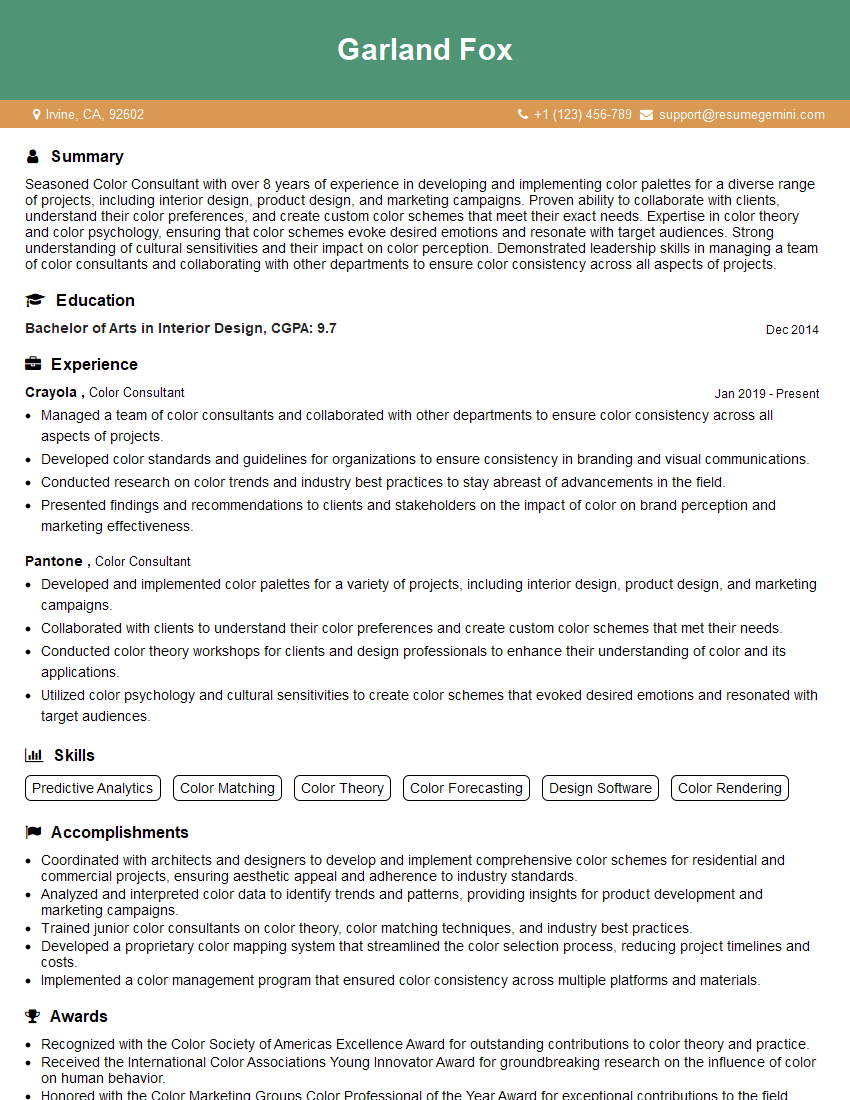
Mastering accurate color management is crucial for career advancement in design, printing, imaging, and related fields. A strong understanding of these principles demonstrates technical proficiency and attention to detail, highly valued by employers. To significantly boost your job prospects, crafting an ATS-friendly resume is essential. ResumeGemini is a trusted resource that can help you build a professional resume that highlights your skills and experience effectively. Examples of resumes tailored to Accurate Color Management are available to help guide you. Take the next step and create a compelling resume that showcases your expertise!

Explore more articles
Users Rating of Our Blogs
Share Your Experience
We value your feedback! Please rate our content and share your thoughts (optional).
What Readers Say About Our Blog
Very informative content, great job.
good