The thought of an interview can be nerve-wracking, but the right preparation can make all the difference. Explore this comprehensive guide to Acetylene Gas Production interview questions and gain the confidence you need to showcase your abilities and secure the role.
Questions Asked in Acetylene Gas Production Interview
Q 1. Describe the process of acetylene gas production from calcium carbide.
Acetylene gas production from calcium carbide is a relatively straightforward chemical process. It’s based on the reaction between calcium carbide (CaC2) and water (H2O). When water comes into contact with calcium carbide, a vigorous exothermic reaction occurs, producing acetylene gas (C2H2) and calcium hydroxide (Ca(OH)2), also known as slaked lime. Think of it like this: you’re adding water to a very reactive substance, and that releases a flammable gas.
The process typically involves feeding calcium carbide into a reactor, where it’s carefully reacted with water. The rate of water addition is carefully controlled to manage the reaction’s heat and gas production rate. The resulting acetylene gas then undergoes purification processes to remove impurities before storage and distribution.
The chemical equation representing this reaction is:
CaC2 + 2H2O → C2H2 + Ca(OH)2In industrial settings, this reaction is carried out in large-scale reactors optimized for efficient gas production and heat management. The scale of operation varies widely depending on the demand.
Q 2. Explain the safety precautions necessary when handling acetylene gas.
Acetylene is a highly flammable and reactive gas, demanding stringent safety precautions. The most critical safety measures include:
- Proper Ventilation: Acetylene should only be used in well-ventilated areas to prevent the buildup of potentially explosive mixtures with air.
- No Open Flames or Sparks: Absolutely no open flames, sparks, or sources of ignition should be present near acetylene gas storage, handling, or use. Even a small spark can ignite an explosive mixture.
- Pressure Control: Acetylene cylinders should always be used and stored according to the manufacturer’s instructions. Over-pressurization can lead to cylinder rupture.
- Protective Equipment: Appropriate personal protective equipment (PPE), including gloves, eye protection, and respiratory protection, should be worn when handling acetylene.
- Leak Detection: Regular inspection of equipment and piping for leaks is crucial. Soap solution is often used to detect leaks by creating bubbles at the point of escape.
- Emergency Procedures: Emergency plans and procedures should be in place in case of a leak or fire, including appropriate fire extinguishers (Class D or multi-purpose) readily available.
Ignoring these precautions can lead to serious accidents, including explosions and fires.
Q 3. What are the common impurities found in acetylene gas and how are they removed?
Acetylene produced from calcium carbide typically contains various impurities, including phosphine (PH3), hydrogen sulfide (H2S), ammonia (NH3), and other hydrocarbons. These impurities can affect the quality and applications of the acetylene, and many need to be removed before its use in welding or other sensitive applications.
Removal methods vary depending on the impurity and the desired purity level. Common purification techniques include:
- Washing: This involves passing the gas through a series of scrubbers containing solvents that selectively absorb specific impurities. For example, water can absorb some ammonia.
- Chemical Treatment: Certain chemicals can react with specific impurities, neutralizing or converting them into less harmful substances.
- Filtration: Filters can remove particulate matter and other solid impurities.
- Fractional Distillation: In some advanced processes, fractional distillation separates the acetylene from other hydrocarbons by exploiting their different boiling points.
The choice of purification methods depends on factors such as the type and concentration of impurities, the required purity level, and the cost-effectiveness of the purification process. For instance, high-purity acetylene for laser applications requires much more rigorous purification compared to what might be needed for industrial cutting applications.
Q 4. Describe the different methods for storing and transporting acetylene gas.
Acetylene’s instability at high pressures necessitates specialized storage and transportation methods. It’s never stored as a pure, compressed gas in high pressure cylinders because it can decompose explosively under pressure. Instead, it’s typically stored:
- Dissolved in Acetone: This is the most common method. Acetylene is dissolved in acetone, a solvent that absorbs and stabilizes it, and then stored in porous-mass cylinders filled with an inert material such as diatomaceous earth. This allows for a safer and more manageable storage and transportation system.
- In low pressure gas cylinders: For applications that do not require high gas flow rate, low-pressure cylinders can be used. This reduces the risk associated with high pressure.
Transportation follows similar guidelines, prioritizing safety with proper cylinder securing, and strict adherence to transportation regulations. Special trailers and containers are designed for transporting acetylene cylinders, ensuring they are securely fastened and protected from damage during transit. The cylinders are always marked with proper labels to warn handlers of the flammable and explosive nature of acetylene.
Q 5. What are the potential hazards associated with acetylene gas production?
Acetylene production and handling pose several potential hazards:
- Explosion Risk: Acetylene’s flammability and explosive nature pose the most significant hazard. Mixtures of acetylene and air can explode when ignited, even at low concentrations.
- Fire Risk: The exothermic nature of the reaction between calcium carbide and water, and the flammability of acetylene, present a significant fire risk, especially if the process is not properly controlled.
- Toxicity: Impurities in acetylene, such as phosphine and hydrogen sulfide, are toxic and can cause health problems if inhaled.
- Burns: Contact with calcium carbide or hot surfaces during the production process can result in severe burns.
- Environmental Concerns: The production process generates calcium hydroxide (slaked lime), which requires careful disposal to prevent environmental damage.
Proper safety measures, including appropriate engineering controls, personal protective equipment, and emergency response plans, are essential to mitigate these hazards.
Q 6. How do you ensure the quality and purity of the produced acetylene gas?
Ensuring the quality and purity of produced acetylene requires a multi-faceted approach:
- Raw Material Quality Control: The quality of the calcium carbide used significantly impacts the purity of the acetylene produced. Careful selection and testing of the calcium carbide are crucial.
- Process Control: Close monitoring of the reaction parameters, such as temperature and water addition rate, is necessary to maintain consistent acetylene production and to minimize the formation of impurities.
- Effective Purification: The implemented purification methods must be carefully selected and maintained to effectively remove impurities, achieving the desired purity level.
- Quality Testing: Regular quality testing of the produced acetylene gas is vital. This typically involves analyzing the gas composition to determine the concentration of acetylene and any impurities present.
- Calibration and Maintenance: Equipment used in the production and purification processes must be regularly calibrated and maintained to ensure consistent performance and accurate results.
Adherence to established quality standards and protocols, such as ISO 9001, ensures consistent high-quality acetylene production.
Q 7. Explain the role of pressure and temperature in acetylene gas production.
Pressure and temperature play critical roles in acetylene gas production. The reaction between calcium carbide and water is exothermic, meaning it releases heat. This heat generation needs to be carefully managed to prevent the reaction from becoming too vigorous and potentially leading to unsafe conditions, such as uncontrolled pressure increases.
Temperature: Higher temperatures generally increase the reaction rate, leading to faster acetylene production. However, excessively high temperatures can lead to undesirable side reactions, the formation of more impurities, or even the decomposition of acetylene. Therefore, maintaining an optimal temperature range is crucial for both safety and efficient gas production.
Pressure: While the reaction itself doesn’t directly involve high pressure, the resulting acetylene gas needs to be managed appropriately. As mentioned, high pressure can cause acetylene to decompose explosively. Therefore, pressure control is essential for safe handling and storage. In the production process, the pressure is controlled to keep the reaction within safe operating limits and then reduced for storage and distribution.
In summary, both temperature and pressure need to be carefully monitored and controlled to achieve optimal production rates, maintain the quality of the acetylene, and ensure a safe operating environment.
Q 8. What are the key performance indicators (KPIs) used to monitor acetylene gas production efficiency?
Monitoring acetylene gas production efficiency relies on several key performance indicators (KPIs). These KPIs help ensure optimal production, minimize waste, and maximize safety. Think of them as the vital signs of your acetylene production process.
Production Rate (kg/hr or m³/hr): This measures the volume of acetylene produced per unit of time, reflecting the overall productivity of the system. A consistent, high production rate indicates efficient operation. Low rates might signal issues with the calcium carbide feed, water flow, or generator performance.
Purity of Acetylene (%): High-purity acetylene is crucial for many applications. Regular monitoring using gas chromatography ensures the gas meets required specifications. Impurities can affect the quality of welding or cutting and necessitate purification system adjustments.
Calcium Carbide Consumption Rate (kg/kg): This KPI indicates the efficiency of carbide utilization. A high consumption rate suggests losses due to incomplete reaction or inefficient generator design. Optimizing the reaction conditions can improve this metric.
Energy Consumption (kWh/kg): This measures the energy required to produce a unit weight of acetylene, considering both the generator operation and any purification processes. Reducing energy consumption contributes to lower operational costs and a smaller environmental footprint.
Downtime (minutes/hour or %): This KPI reflects the time the production line is inactive due to maintenance, repairs, or operational disruptions. Minimizing downtime is essential for maximizing overall production. Regular preventive maintenance is key.
Safety Incidents: This is arguably the most critical KPI. Tracking the number and severity of safety incidents (leaks, fires, etc.) is vital for continuously improving safety protocols and reducing risks.
Q 9. Describe the different types of acetylene generators used in industrial settings.
Industrial acetylene generators broadly fall into two categories: those that use calcium carbide and water, and those that generate it via other processes. The former is the most common.
Water-fed generators: These are the most prevalent type in industrial settings. They react calcium carbide (CaC₂) with water to produce acetylene gas (C₂H₂). There are various designs, including:
Manually-fed generators: Calcium carbide is manually added to the generator, offering simple operation but limited in large-scale use.
Automatically-fed generators: These generators use automated systems for carbide feeding, allowing for continuous operation and increased efficiency.
Electric Arc Generators: These generators produce acetylene through the thermal decomposition of hydrocarbons such as methane, using high-temperature electric arcs. These are less common than water-fed types but provide an alternative for areas where carbide sources are limited.
Other Methods: While less common industrially, acetylene can also be produced through other methods like partial combustion of hydrocarbons (like natural gas) or as a byproduct of other industrial processes. However, these usually require much more complex setups and additional treatment to purify the final product.
Q 10. How do you troubleshoot common problems encountered during acetylene gas production?
Troubleshooting acetylene gas production involves a systematic approach, starting with safety precautions. Always ensure the area is well-ventilated and that appropriate safety equipment is used before beginning any troubleshooting.
Low Production Rate: Check the carbide feed rate, water flow, and generator pressure. Clogged lines or depleted carbide are common causes. Inspect the generator for any mechanical issues.
Low Acetylene Purity: This might indicate insufficient purification, impure carbide, or problems with the scrubber. Gas chromatography analysis will help pinpoint the impurities.
Excessive Pressure: This suggests a blockage in the gas delivery system. Check valves, pipes, and regulators for obstructions. Over-pressurization can be dangerous, so address this immediately.
Generator Overheating: This could be due to insufficient water flow or a buildup of heat in the generator. Check the cooling system and water supply.
Leaks: Use a leak detection solution to find the source of the leak. Address any damaged pipes or fittings promptly and safely.
A systematic approach, using flowcharts and checklists, can streamline troubleshooting and greatly enhance efficiency and safety.
Q 11. What is the role of catalysts in acetylene gas production?
While not directly involved in the primary reaction of calcium carbide and water to produce acetylene, catalysts play a significant role in some processes aimed at increasing efficiency or producing acetylene from alternative sources.
For example, in the partial combustion of hydrocarbons to produce acetylene, catalysts can enhance the selectivity of the reaction, favouring acetylene formation and minimizing the creation of unwanted byproducts. These catalysts are typically transition metals or metal oxides, carefully chosen to optimize the reaction conditions for maximum acetylene yield.
In purification, catalysts might be used in processes to remove impurities, converting them into less harmful substances. The specific catalyst choice depends heavily on the impurities present and the desired outcome.
Q 12. Explain the process of purifying acetylene gas.
Purifying acetylene is essential to remove impurities such as phosphine (PH₃), arsine (AsH₃), hydrogen sulfide (H₂S), and ammonia (NH₃), which are toxic and can interfere with its applications.
The purification process typically involves several steps:
Washing: The crude acetylene gas is passed through various washing solutions to remove acidic and basic impurities. These solutions might include caustic soda (NaOH) to absorb acidic gases and dilute sulfuric acid to remove basic impurities.
Scrubbing: This involves passing the gas through a scrubber containing a suitable material to absorb the remaining impurities. Common scrubbing materials include activated carbon, which can adsorb many impurities, or specialized chemical solutions.
Drying: The gas is then dried to remove any remaining moisture, often using calcium chloride (CaCl₂) or other desiccants.
Compression and Filtration: Finally, the gas is compressed and passed through filters to remove any remaining particulate matter.
The specific purification steps and the materials used vary depending on the initial purity of the acetylene gas and the desired level of purity for the final product.
Q 13. What are the environmental regulations related to acetylene gas production?
Environmental regulations governing acetylene gas production vary by location, but generally focus on minimizing emissions and waste. Key areas of concern include:
Air Emissions: Regulations often limit the release of volatile organic compounds (VOCs), including acetylene, and other harmful gases into the atmosphere. This often necessitates the use of emission control systems such as scrubbers and flares.
Water Discharge: Wastewater from the purification process must meet stringent standards before discharge. Treatment processes may be required to remove impurities and reduce the environmental impact.
Waste Management: Proper disposal of spent calcium hydroxide (Ca(OH)₂) from the generation process is crucial, as it is a byproduct. Landfilling or other environmentally sound methods must be employed.
Noise Pollution: Generators can be noisy, and regulations might specify noise level limits. Noise control measures, such as enclosure or sound dampening, may be needed.
Compliance with these regulations is crucial to ensure responsible operation and protect the environment.
Q 14. Describe the emergency procedures in case of a leak or accident during acetylene gas production.
Emergency procedures for acetylene leaks or accidents must prioritize safety. A well-defined emergency response plan is vital and should be regularly practiced.
Immediate Actions: In case of a leak, immediately evacuate the area and establish a safe perimeter. Stop the acetylene flow if possible without creating further hazards.
Notification: Alert emergency services (fire department, hazardous materials team) immediately and follow their instructions.
Containment: If feasible and safe, attempt to contain the leak using appropriate measures, such as shutting off valves or using spill containment materials.
Ventilation: Ensure adequate ventilation to disperse the acetylene gas and prevent its build-up in enclosed spaces.
Post-Incident Procedures: Following the emergency response, conduct a thorough investigation to determine the cause of the incident and implement corrective actions to prevent recurrence. Proper documentation and reporting are also essential.
Regular training of personnel on emergency procedures and the proper use of safety equipment is essential for minimizing the risk of accidents and ensuring a safe working environment.
Q 15. How do you maintain and repair acetylene gas production equipment?
Maintaining and repairing acetylene gas production equipment requires a rigorous approach, prioritizing safety and regulatory compliance. Regular inspections are crucial, checking for leaks using specialized detection equipment like soap solution tests or electronic leak detectors. We look for corrosion on carbide storage tanks and generators, paying close attention to the pressure relief valves. Any signs of wear or damage necessitate immediate repair or replacement. For example, a worn gasket on a valve can lead to leaks, posing a fire hazard. Repair procedures often involve replacing damaged components and ensuring proper sealing to prevent leaks and maintain pressure. Routine maintenance also includes cleaning the generator and associated piping to prevent blockages and ensure efficient operation. This process often involves specialized tools and training. Detailed records are meticulously maintained to track maintenance activities and identify potential issues before they become major problems.
- Regular visual inspections for leaks, corrosion, and wear.
- Leak detection using soap solutions or electronic detectors.
- Periodic cleaning and maintenance of generators and piping.
- Replacement of worn or damaged parts (valves, gaskets, etc.).
- Thorough documentation of all maintenance activities.
Career Expert Tips:
- Ace those interviews! Prepare effectively by reviewing the Top 50 Most Common Interview Questions on ResumeGemini.
- Navigate your job search with confidence! Explore a wide range of Career Tips on ResumeGemini. Learn about common challenges and recommendations to overcome them.
- Craft the perfect resume! Master the Art of Resume Writing with ResumeGemini’s guide. Showcase your unique qualifications and achievements effectively.
- Don’t miss out on holiday savings! Build your dream resume with ResumeGemini’s ATS optimized templates.
Q 16. What are the different applications of acetylene gas in various industries?
Acetylene gas finds widespread use across various industries due to its high-temperature flame. In welding and cutting, it’s a cornerstone technology, providing the intense heat needed to melt and join metals. Think about constructing skyscrapers or pipelines – acetylene is essential. The chemical industry uses acetylene as a building block for various organic compounds, like vinyl chloride (used in PVC production) and acrylic acid (used in paints and coatings). In the lighting industry, acetylene was once widely used in lamps for its bright, luminous flame, though this has been largely superseded by safer alternatives. Finally, it has applications in analytical chemistry and in specialized processes needing a very high-temperature source.
- Welding and Cutting: Metal fabrication, construction, shipbuilding
- Chemical Synthesis: Production of plastics, solvents, and other chemicals
- Lighting (historical): Acetylene lamps
- Analytical Chemistry: Atomic absorption spectroscopy
Q 17. Explain the difference between dissolved acetylene and gas-phase acetylene.
The key difference lies in how the acetylene is stored and handled. Dissolved acetylene is stored in cylinders filled with a porous mass, usually acetone, which absorbs the gas. This drastically reduces the risk of explosion because the acetone acts as a safety buffer. Gas-phase acetylene, on the other hand, is generally not stored as a pure gas due to its highly unstable nature and the risk of detonation. It’s typically generated on-site and used immediately. In essence, dissolved acetylene provides a safer, more transportable form of the gas, while gas-phase acetylene is usually a byproduct of a process or directly produced for immediate use.
Think of it like this: dissolved acetylene is like a sponge holding water—the sponge is the acetone and the water is the acetylene. This makes it much safer to handle than having a large volume of free water (gas-phase acetylene).
Q 18. How do you handle waste materials generated during acetylene gas production?
Waste management in acetylene production is critical for environmental protection and safety. Calcium hydroxide (slaked lime), a byproduct of the reaction between calcium carbide and water, is the primary waste material. This residue is often neutralized and disposed of in designated landfills, adhering to all relevant environmental regulations. Any leaked or unused acetylene gas is carefully recovered to prevent atmospheric release. In many modern plants, this lime byproduct is sometimes repurposed, for instance, in construction or agriculture, minimizing waste and promoting sustainability. Moreover, the rigorous maintenance of equipment minimizes the risk of spills or leaks, reducing the amount of waste generated.
- Neutralization and disposal of calcium hydroxide residue.
- Recovery and reuse of unused acetylene gas.
- Compliance with all environmental regulations.
- Exploration of potential reuse applications for byproducts.
Q 19. What are the safety considerations related to the use of calcium carbide?
Calcium carbide reacts violently with water, generating acetylene gas and heat. This reaction can be explosive if not managed correctly. Safety precautions include: storing calcium carbide in dry, well-ventilated areas away from sources of ignition or moisture; using appropriate personal protective equipment (PPE) such as gloves, goggles, and respiratory protection when handling it; never mixing large quantities of calcium carbide with water at once; and ensuring the reaction vessel is robust and well-ventilated to prevent pressure build-up. Furthermore, training employees on proper handling techniques and emergency procedures is of utmost importance to mitigate risks. Incorrect handling can lead to burns, explosions, and fire hazards.
Q 20. Describe the process of quality control testing for acetylene gas.
Quality control testing of acetylene gas involves several steps to ensure purity and safety. Purity is typically checked using gas chromatography, which analyzes the composition of the gas, identifying any impurities. Acetylene’s purity is crucial for its intended applications; impurities can impact the welding process and lead to unwanted byproducts. Moisture content is also a critical parameter as it can affect the stability of the gas and its flammability. Pressure and flow rate are monitored to ensure consistent performance of the gas delivery system. Finally, regular checks of the cylinders themselves, including their valves and seals, are vital for safety. Testing follows established protocols and standards, often verified by independent third-party audits.
Q 21. What are the regulatory compliance requirements for acetylene gas production?
Regulatory compliance for acetylene gas production is stringent due to its flammable and potentially hazardous nature. Producers must adhere to national and international safety standards, including those related to the storage, handling, and transportation of dangerous goods. This includes obtaining the necessary permits and licenses, complying with environmental regulations regarding waste disposal, and ensuring worker safety through appropriate training and protective measures. Regular inspections by regulatory bodies are common, and non-compliance can result in penalties and legal action. The specific regulations vary depending on the location of the production facility and the quantity of gas produced. Staying updated on these changing regulations is vital for maintaining legal and safe operations.
Q 22. Explain the role of instrumentation and control systems in acetylene gas production.
Instrumentation and control systems are the backbone of safe and efficient acetylene gas production. They monitor critical process parameters, ensuring the process stays within safe operating limits and produces high-quality gas. Think of them as the nervous system of the plant, constantly monitoring and adjusting to maintain stability.
- Temperature sensors and controllers: These are crucial for maintaining the reaction temperature during calcium carbide hydrolysis, preventing runaway reactions and ensuring optimal acetylene yield. A deviation from the set point triggers automated adjustments or alarms.
- Pressure sensors and regulators: Acetylene, being highly flammable, necessitates precise pressure control throughout the production and delivery stages. Sensors constantly monitor pressure, while regulators maintain it within safe limits. This prevents dangerous overpressurization.
- Flow meters and controllers: Accurate measurement and control of the flow rates of water, calcium carbide, and acetylene are critical. This ensures consistent production and efficient use of raw materials.
- Gas analyzers: These instruments analyze the gas composition, ensuring purity and detecting any impurities like phosphine or ammonia that need to be removed before delivery.
- Safety Interlocks: These systems automatically shut down the process in case of emergencies, such as high pressure, high temperature, or gas leaks, preventing accidents.
In my experience, advanced control systems such as Programmable Logic Controllers (PLCs) are employed for automated process control and data logging, optimizing production and enhancing safety.
Q 23. How do you ensure the safe operation of acetylene gas compressors and pumps?
Safe operation of acetylene compressors and pumps is paramount due to acetylene’s explosive nature. Several key safety measures are implemented:
- Regular inspections and maintenance: This includes checking for leaks, wear and tear, and ensuring proper lubrication. We follow strict preventative maintenance schedules to identify and address potential problems before they escalate.
- Pressure relief valves: These devices are essential safety features, releasing pressure if it exceeds a predetermined limit, preventing equipment failure and potential explosions. Regular testing is vital to ensure their functionality.
- Emergency shutdown systems: These systems automatically stop the compressors and pumps in case of a malfunction or emergency situation. These systems are routinely tested to ensure their reliability.
- Explosion-proof design: Compressors and pumps are often housed in explosion-proof enclosures, designed to withstand explosions and prevent the propagation of flames.
- Appropriate materials: Materials compatible with acetylene, resistant to corrosion, and able to withstand high pressures, are selected for construction of equipment.
- Training and procedures: Operators are rigorously trained on safe operating procedures, emergency response protocols, and routine maintenance. This includes hands-on practice in emergency shutdowns and leak detection.
For instance, during my time at [Previous Company Name], we implemented a predictive maintenance program based on vibration analysis, enabling us to identify potential issues in compressors before they caused failures, significantly improving safety and reducing downtime.
Q 24. Describe your experience with different types of acetylene gas delivery systems.
I’ve worked with several acetylene gas delivery systems, each tailored to specific needs and scales of operation:
- Dissolved Acetylene Cylinders: These are the most common delivery systems, utilizing acetone as a solvent to safely store acetylene under pressure. I have experience managing the filling, testing, and distribution of these cylinders, ensuring compliance with all safety regulations.
- Generator-on-site: In larger industrial settings, on-site generators are used to produce acetylene as needed, eliminating the need for cylinder handling and transportation. I’ve been involved in the commissioning, operation, and maintenance of such systems, focusing on optimal performance and safety.
- Pipeline distribution: For very large-scale operations, acetylene can be transported through pipelines, though this requires significant investment and specialized safety protocols. My experience includes working with pipeline design and safety protocols, particularly ensuring leak detection and prevention.
Each system has its advantages and disadvantages. Dissolved acetylene cylinders offer portability but require careful handling and management. On-site generators provide higher throughput but demand more rigorous maintenance. Pipeline systems offer the highest throughput but necessitate large upfront investment and stringent safety measures.
Q 25. What are the economic factors influencing acetylene gas production?
Several economic factors significantly impact acetylene production:
- Raw material costs: The price of calcium carbide, the primary raw material, fluctuates with energy prices (used in its production) and market demand. A rise in carbide costs directly affects acetylene’s production cost.
- Energy costs: Energy is a significant input, particularly in the process of calcium carbide production and the compression and purification of acetylene. Fluctuations in energy prices directly impact profitability.
- Market demand: Acetylene’s demand in welding, cutting, and chemical synthesis fluctuates based on economic activity in related industries like construction and manufacturing. High demand generally leads to higher prices, while low demand can lead to lower prices and potential production cutbacks.
- Transportation costs: The cost of transporting acetylene, whether in cylinders or pipelines, can be significant, particularly for geographically dispersed markets.
- Environmental regulations: Stringent environmental regulations regarding waste disposal and emission control increase production costs and require investment in pollution control technologies.
Effectively managing these economic factors requires careful planning, efficient operations, and a close watch on market trends to ensure profitability.
Q 26. Explain the impact of process optimization on acetylene gas production efficiency.
Process optimization is crucial for improving acetylene production efficiency and reducing costs. This involves several strategies:
- Improving reaction efficiency: Optimizing the calcium carbide hydrolysis process by adjusting parameters like temperature, water flow rate, and carbide particle size, can maximize acetylene yield.
- Minimizing energy consumption: Implementing energy-efficient equipment, optimizing process parameters to reduce energy demands, and employing waste heat recovery systems can significantly reduce operating costs.
- Reducing raw material waste: Careful control of the reaction process and efficient separation techniques minimize the loss of raw materials and byproducts.
- Improving purification efficiency: Optimizing the purification steps to remove impurities like phosphine and ammonia improves product quality and reduces waste.
- Advanced process control: Implementing advanced control systems and employing techniques like model predictive control can help maintain optimal operating conditions and maximize yield.
For example, at [Previous Company Name], we implemented a sophisticated control system that optimized the water flow rate based on real-time temperature measurements, resulting in a 5% increase in acetylene yield and a 3% reduction in energy consumption.
Q 27. How do you maintain accurate records and documentation related to acetylene gas production?
Maintaining accurate records and documentation is crucial for compliance, safety, and continuous improvement in acetylene gas production. This includes:
- Production logs: Detailed records of daily production, including raw materials used, acetylene produced, and any process deviations.
- Quality control data: Records of acetylene purity, impurity levels, and results of quality control tests.
- Maintenance logs: Detailed records of all maintenance activities, including inspections, repairs, and equipment replacements.
- Safety records: Documentation of all safety incidents, near misses, and safety training activities.
- Inventory management: Accurate tracking of raw material and acetylene gas inventories.
- Calibration records: Records of regular calibrations of all instruments and equipment.
We typically use a combination of computerized maintenance management systems (CMMS) and electronic data logging systems to manage and track these records. This ensures data integrity, facilitates data analysis for process improvement, and supports regulatory compliance.
Q 28. Describe your experience with predictive maintenance in an acetylene gas production facility.
Predictive maintenance is a crucial aspect of ensuring the safe and efficient operation of an acetylene gas production facility. It involves using data analysis and advanced techniques to predict potential equipment failures before they occur. This minimizes downtime, enhances safety, and reduces maintenance costs.
- Vibration analysis: Monitoring the vibration patterns of critical equipment like compressors and pumps helps identify potential bearing failures, misalignments, or other mechanical issues before they lead to catastrophic failure.
- Oil analysis: Regular analysis of lubricant oil samples helps detect the presence of contaminants or degradation, indicating potential wear and tear.
- Thermal imaging: Infrared cameras identify potential overheating problems in electrical components and equipment, preventing fires and equipment damage.
- Data analytics: Using historical maintenance data, production data, and sensor readings, we can develop predictive models that forecast potential failures and schedule maintenance proactively.
For example, at [Previous Company Name], we implemented a vibration monitoring system on our acetylene compressors. This system enabled us to detect a bearing failure weeks before it would have caused a major shutdown, allowing for planned maintenance and preventing significant production losses and safety risks.
Key Topics to Learn for Acetylene Gas Production Interview
- Raw Materials and Feedstocks: Understanding the various sources of calcium carbide and other raw materials used in acetylene generation, including their properties and quality requirements.
- Production Processes: Detailed knowledge of different acetylene production methods, such as the carbide process, including reaction mechanisms, process parameters (temperature, pressure, etc.), and equipment involved.
- Purification and Treatment: Familiarization with the techniques employed to remove impurities from crude acetylene gas, ensuring the final product meets safety and quality standards. This includes understanding the impact of different impurities.
- Safety and Hazard Management: Thorough understanding of the safety protocols and regulations surrounding acetylene handling, storage, and transportation, including emergency procedures and risk mitigation strategies. This also includes familiarity with relevant safety equipment.
- Process Optimization and Control: Knowledge of techniques for optimizing acetylene production processes to maximize efficiency, minimize waste, and ensure consistent product quality, including process monitoring and control systems.
- Applications and Uses: Familiarity with the diverse applications of acetylene gas in various industries, including welding, cutting, chemical synthesis, and its role in downstream processes. Understanding the properties that make it suitable for these applications.
- Troubleshooting and Problem Solving: Ability to identify, diagnose, and solve common problems encountered during acetylene production, including understanding the root causes of process deviations and implementing corrective actions.
- Environmental Considerations: Awareness of the environmental impacts associated with acetylene production and the measures taken to minimize pollution and ensure sustainable practices.
Next Steps
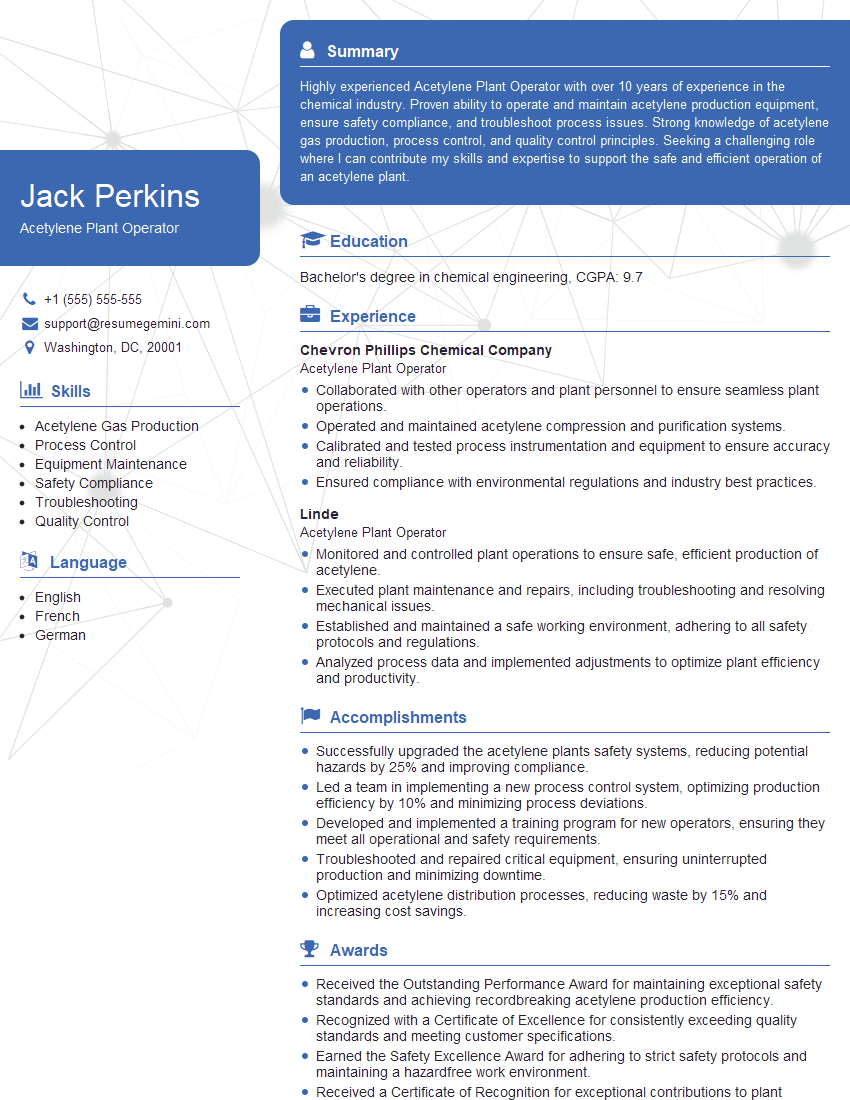
Mastering Acetylene Gas Production opens doors to exciting career opportunities in chemical manufacturing, industrial gas production, and related fields. A strong understanding of this process demonstrates valuable technical skills and problem-solving abilities highly sought after by employers. To maximize your job prospects, it’s crucial to present your expertise effectively. Creating an ATS-friendly resume is key to getting your application noticed. We encourage you to leverage ResumeGemini, a trusted resource for building professional and impactful resumes. ResumeGemini provides examples of resumes tailored to Acetylene Gas Production to help you showcase your qualifications effectively.
Explore more articles
Users Rating of Our Blogs
Share Your Experience
We value your feedback! Please rate our content and share your thoughts (optional).
What Readers Say About Our Blog
Very informative content, great job.
good