Interviews are opportunities to demonstrate your expertise, and this guide is here to help you shine. Explore the essential Advanced Energy Economics interview questions that employers frequently ask, paired with strategies for crafting responses that set you apart from the competition.
Questions Asked in Advanced Energy Economics Interview
Q 1. Explain the concept of externalities in the energy sector and how they are addressed.
Externalities in the energy sector refer to the costs or benefits of energy production and consumption that are not reflected in the market price. These ‘spillover effects’ impact third parties who are not directly involved in the transaction. For instance, air pollution from a coal-fired power plant imposes health costs on nearby communities, while the benefits of renewable energy, like reduced carbon emissions, are enjoyed globally. These aren’t usually factored into the price of electricity.
Addressing externalities often involves internalizing them – making those who create them responsible for their full costs. This can be done through various methods:
- Pigouvian taxes: A tax levied on the polluter, equal to the marginal external cost (e.g., a carbon tax on fossil fuel emissions). This increases the price of polluting activities, reducing their consumption.
- Subsidies: Government financial support for activities with positive externalities, like renewable energy deployment. This lowers the cost to consumers, encouraging adoption.
- Cap-and-trade systems: A market-based approach where a limit (cap) is set on total emissions. Polluters can buy and sell permits to emit, creating a market price for pollution. The cap ensures overall emission reductions, while the trading system promotes cost-effective emission reductions.
- Regulation: Direct government controls, such as emission standards or technology mandates (e.g., requiring cleaner vehicle emissions). This is a more prescriptive approach but can be effective for managing specific pollutants.
For example, the European Union Emissions Trading System (EU ETS) is a cap-and-trade system designed to reduce greenhouse gas emissions from large industrial installations.
Q 2. Discuss different energy market designs and their implications for efficiency and competition.
Energy market designs vary significantly, impacting efficiency and competition. They broadly fall into these categories:
- Vertically Integrated Markets: A single company controls all aspects of the energy value chain – from generation to transmission and distribution. This model can offer economies of scale but often lacks competition and incentives for innovation.
- Unbundled Markets: Different companies specialize in different parts of the value chain. Generation, transmission, and distribution are separate entities, promoting competition and efficiency. This model is more complex to manage but can foster innovation and lower prices.
- Wholesale Markets: Power is traded on a wholesale market, usually through auctions or bilateral contracts. This creates price transparency and allows efficient allocation of resources. Different market designs within wholesale markets exist, for instance, day-ahead and real-time markets, with varying levels of price volatility.
- Retail Markets: Consumers choose their electricity supplier, fostering competition among retailers. This can lead to better customer service and potentially lower prices, although retail competition is heavily regulated in most jurisdictions.
The choice of market design has significant implications. Unbundled markets, for example, promote competition but can lead to higher administrative costs. Vertically integrated markets may be simpler to manage but can lead to higher prices and less innovation. A well-designed market balances competition, efficiency, and reliability.
Q 3. Describe various methods for valuing environmental externalities associated with energy production.
Valuing environmental externalities is crucial for informing policy decisions. Various methods exist, each with strengths and limitations:
- Hedonic pricing: This analyzes how environmental attributes (e.g., air quality) affect the prices of goods (e.g., housing). By comparing property values in areas with differing levels of pollution, we can infer the implicit price consumers place on cleaner air.
- Travel cost method: Estimates the value of recreational areas (e.g., national parks) by analyzing the costs visitors incur to access them. This can be applied to valuing environmental amenities affected by energy production.
- Contingent valuation: This uses surveys to directly ask people their willingness to pay for environmental improvements or avoid environmental damages. It’s straightforward but prone to biases.
- Damage function approach: This uses scientific models to estimate the physical damages caused by pollution (e.g., health impacts of air pollution) and then translates these into monetary values using estimates of the cost of healthcare, lost productivity, etc. It requires robust scientific data.
Each method has its own challenges. Hedonic pricing requires sufficient data on property values and environmental characteristics. Contingent valuation is vulnerable to hypothetical bias. The damage function approach relies on accurate scientific models and estimation of monetary damages.
Q 4. Analyze the role of government regulation in shaping energy markets.
Government regulation plays a vital role in shaping energy markets, aiming to balance various objectives: promoting competition, ensuring reliability, protecting the environment, and ensuring affordability. Regulations influence the industry through:
- Market structuring: Defining market rules, determining access to transmission infrastructure, and overseeing market operations.
- Environmental regulations: Setting emission standards, promoting renewable energy deployment, and managing waste disposal.
- Price regulation: Setting price caps or floors to ensure affordability or prevent market manipulation. These can include rate of return regulations for utilities.
- Safety and reliability standards: Establishing standards for the safe operation of power plants and transmission systems, including cybersecurity regulations.
- Investment incentives: Offering tax credits, subsidies, or grants to promote investment in specific energy technologies or infrastructure.
Regulatory approaches can range from prescriptive (e.g., setting specific technology standards) to market-based (e.g., carbon pricing). The optimal approach depends on various factors, such as market characteristics, environmental goals, and economic context. For example, the Renewable Portfolio Standard (RPS) in many US states mandates a minimum percentage of electricity from renewable sources, driving investment and innovation in the renewable energy sector.
Q 5. Explain the economic principles behind carbon pricing mechanisms (e.g., carbon tax, cap-and-trade).
Carbon pricing mechanisms aim to internalize the externalities associated with greenhouse gas emissions by putting a price on carbon. Two main approaches exist:
- Carbon tax: A direct tax levied on the carbon content of fossil fuels. This raises the price of high-carbon energy sources, making low-carbon alternatives more competitive. The revenue generated can be used to fund climate mitigation or adaptation measures, or returned to taxpayers.
- Cap-and-trade: A market-based approach where a cap is set on the total amount of emissions allowed. Companies are given or auctioned allowances to emit, and they can buy and sell allowances in the market. This creates a market price for carbon, which theoretically reflects the scarcity of emission permits. If a company needs to emit more it will need to purchase allowances. If they emit less, they can sell their excess allowances.
Both mechanisms incentivize emissions reductions. The carbon tax directly affects the price of fossil fuels. Cap-and-trade creates a market price and lets the market determine the most cost-effective way to reduce emissions. The choice between the two often depends on political and economic considerations; carbon taxes are easier to administer but may be less predictable in the level of emission reductions achieved.
Q 6. Discuss the economic challenges and opportunities of renewable energy integration into the grid.
Integrating renewable energy sources, like solar and wind, into the grid presents both challenges and opportunities.
Challenges:
- Intermittency: Renewable energy sources are intermittent, meaning their output fluctuates depending on weather conditions. This poses challenges for grid stability and requires sophisticated forecasting and grid management techniques.
- Transmission infrastructure: Renewable energy resources are often located far from population centers, necessitating upgrades to transmission infrastructure to accommodate the flow of electricity.
- Storage: The lack of readily available large-scale energy storage technologies makes it challenging to balance supply and demand when renewable generation is low. Development of cost-effective energy storage is critical.
- Grid management: Integrating large amounts of variable renewable energy requires advanced grid management systems to maintain frequency and voltage stability.
Opportunities:
- Cost reductions: The costs of renewable energy technologies are falling rapidly, making them increasingly competitive with fossil fuels.
- Energy independence: Renewable energy can reduce reliance on imported fossil fuels, enhancing energy security.
- Economic development: The renewable energy sector can create new jobs and stimulate economic growth.
- Environmental benefits: Renewable energy sources produce significantly fewer greenhouse gas emissions than fossil fuels, contributing to climate change mitigation.
Successful integration requires a combination of technological advancements (e.g., smart grids, energy storage), policy support (e.g., subsidies, renewable portfolio standards), and market design reforms (e.g., capacity markets).
Q 7. Evaluate the economic impacts of energy efficiency policies.
Energy efficiency policies aim to reduce energy consumption for a given level of service. This has significant economic impacts:
- Reduced energy bills for consumers: Improved energy efficiency lowers household and business energy costs.
- Lower energy imports: Reduced energy consumption decreases reliance on imported fossil fuels, improving energy security and balance of payments.
- Reduced greenhouse gas emissions: Lower energy consumption translates directly into lower greenhouse gas emissions, contributing to climate change mitigation.
- Job creation: Investing in energy efficiency creates jobs in various sectors, including insulation, building retrofits, and appliance manufacturing.
- Increased economic productivity: Improved energy efficiency in businesses can increase productivity and competitiveness.
- Avoided costs: Energy efficiency measures can avoid the future need for costly power plant construction, transmission infrastructure investment, and other capacity expansions.
However, energy efficiency improvements may initially require upfront investments. Policy measures, like rebates, tax credits, and building codes, can help overcome this barrier and encourage adoption. For example, building codes requiring minimum energy efficiency standards for new construction can drive innovation and long-term cost savings.
Economically, the overall impact is typically positive. The benefits of reduced energy costs, emissions, and improved productivity often outweigh the initial investment costs. A cost-benefit analysis is frequently employed to evaluate the economic viability of specific energy efficiency programs.
Q 8. How do you forecast energy demand and supply?
Forecasting energy demand and supply is crucial for effective energy planning and policymaking. It involves analyzing historical data, current trends, and future projections to estimate the amount of energy required and the capacity to meet that demand. This process is complex and relies on a multi-faceted approach.
- Demand-side forecasting: This involves analyzing factors like population growth, economic activity (GDP growth), technological advancements (energy efficiency improvements), climate conditions (heating and cooling degree days), and government policies (incentives for energy conservation).
- Supply-side forecasting: This focuses on the available energy resources, their production capacity, and the associated costs. Factors considered include resource availability (oil reserves, renewable energy potential), technological advancements (improvements in extraction and generation efficiency), government regulations (environmental restrictions), and geopolitical factors (international trade and political stability).
Methods employed include econometric modeling (using statistical techniques to establish relationships between energy consumption and influencing factors), time series analysis (predicting future values based on past patterns), and agent-based modeling (simulating the behavior of individual energy consumers and producers to understand overall market dynamics).
Example: A forecast might predict a 2% annual growth in electricity demand driven by increasing industrial activity and population growth, but a simultaneous 1% decrease due to the widespread adoption of energy-efficient appliances. This net 1% increase informs planning for additional generation capacity.
Q 9. Explain different energy storage technologies and their economic viability.
Energy storage technologies are critical for addressing the intermittency of renewable energy sources and improving grid stability. Different technologies offer varying levels of economic viability, depending on factors like upfront costs, lifespan, efficiency, and operational characteristics.
- Pumped hydro storage: This mature technology involves pumping water uphill to a reservoir during off-peak hours and releasing it to generate electricity during peak demand. It’s cost-effective for large-scale applications but geographically limited.
- Batteries (Lithium-ion, etc.): Lithium-ion batteries are widely used for grid-scale and residential applications, offering high power density and fast response times. However, their costs remain significant, particularly for large-scale deployment. Technological advancements continue to improve cost-effectiveness.
- Compressed air energy storage (CAES): This technology stores energy by compressing air and releasing it to drive turbines. It offers long-duration storage potential, but the efficiency can be relatively low.
- Thermal energy storage: This involves storing energy as heat or cold, often using molten salts or ice. Suitable for applications requiring long-duration storage, but generally not suitable for rapid power dispatch.
Economic viability is assessed by comparing the levelized cost of storage (LCOS) – the average cost of electricity over the lifespan of the storage system – with other electricity generation and storage alternatives. Factors such as grid services revenue, potential carbon credit income, and policy support (tax incentives, subsidies) can significantly impact the economic feasibility of a storage project.
Q 10. Discuss the role of energy economics in climate change mitigation.
Energy economics plays a pivotal role in climate change mitigation by providing the analytical framework for evaluating the costs and benefits of different climate policies. It informs the design and implementation of effective strategies to reduce greenhouse gas emissions.
- Carbon pricing: Energy economics helps determine the optimal level of carbon pricing (e.g., carbon tax or cap-and-trade system) to incentivize emissions reductions. This involves analyzing the elasticity of energy demand and supply with respect to price changes.
- Renewable energy deployment: Cost-benefit analysis, using methods like discounted cash flow (DCF) analysis, is crucial for evaluating the economic viability of renewable energy projects, considering factors like capital costs, operating costs, and potential government subsidies.
- Energy efficiency improvements: Energy economics helps assess the economic benefits of energy efficiency measures, such as building retrofits and appliance standards, taking into account the costs of implementation versus the savings in energy consumption.
- Climate change impacts: Energy economics helps assess the economic damages associated with climate change impacts, such as sea-level rise, extreme weather events, and agricultural losses, which inform the design of mitigation and adaptation policies.
Example: A cost-benefit analysis of a carbon tax might consider the reduced emissions, the resulting health benefits (less air pollution), and the costs imposed on energy-intensive industries, weighing the overall societal welfare gains against the potential economic burdens.
Q 11. Analyze the economic benefits and drawbacks of nuclear power.
Nuclear power offers a carbon-free source of electricity, but its economic viability is debated due to significant upfront costs, potential risks, and the challenges of waste disposal.
- Benefits: Nuclear power plants provide a reliable, baseload source of electricity, meaning they can operate continuously and are not subject to the intermittency of renewable sources. The relatively low operating costs, after the initial investment, can lead to lower electricity prices compared to some other sources. The small land footprint required for a nuclear plant is another advantage.
- Drawbacks: The substantial capital costs required for building nuclear power plants, including safety features and security measures, are a major barrier to entry. The risks associated with nuclear accidents and the long-term challenges of nuclear waste management add significantly to the total cost and pose potential liabilities. Public perception and regulatory hurdles can also increase the overall costs and development time.
Economic analysis needs to account for the full lifecycle costs, including decommissioning and waste disposal. Sensitivity analysis, considering variations in cost parameters (e.g., fuel prices, waste disposal costs), is essential to assess the robustness of economic projections.
Q 12. How do you assess the economic risks associated with energy investments?
Assessing economic risks associated with energy investments requires a comprehensive approach that considers both market risks and project-specific risks.
- Market risks: These include fuel price volatility, electricity price fluctuations, changes in government policies (e.g., subsidies, regulations), technological advancements that can render existing technologies obsolete, and shifts in consumer preferences.
- Project-specific risks: These involve construction delays, cost overruns, operational problems, permitting issues, and regulatory uncertainty.
Methods for assessing risk include sensitivity analysis (determining how changes in key parameters affect project outcomes), scenario planning (developing multiple plausible future scenarios and assessing project performance under each scenario), and Monte Carlo simulation (using random sampling to simulate the probability distribution of project outcomes).
Example: A wind farm project faces market risk from fluctuating electricity prices and technological risk from advancements in battery storage technologies. Project-specific risks could involve delays due to permitting challenges or cost overruns during construction.
Q 13. Explain the concept of energy poverty and its economic consequences.
Energy poverty refers to the lack of access to modern energy services, such as electricity and clean cooking fuels, which severely impacts the quality of life and economic development of individuals and communities.
- Economic consequences: Energy poverty hinders economic productivity, limits educational opportunities (due to lack of lighting for studying), restricts access to healthcare (lack of refrigeration for vaccines), and reduces overall well-being. It also affects household income and expenditure, often forcing people to rely on expensive and polluting fuels, such as biomass, leading to health issues and environmental damage.
- Impact on development: Energy poverty prevents businesses from operating efficiently and limits access to information and communication technologies, hindering economic growth and social progress. It increases inequality and perpetuates a cycle of poverty.
Addressing energy poverty requires targeted investments in energy infrastructure, access to affordable energy sources, and energy efficiency programs, along with social safety nets to support vulnerable households. Economic analysis is crucial in evaluating the cost-effectiveness of various interventions and prioritizing investments for maximum social and economic impact.
Q 14. Describe various methods for evaluating energy projects (e.g., NPV, IRR).
Several methods are used to evaluate the economic viability of energy projects. These methods help quantify the financial returns and risks associated with the project.
- Net Present Value (NPV): NPV discounts all future cash flows (revenues and costs) to their present value, using a specified discount rate that reflects the opportunity cost of capital. A positive NPV indicates that the project is expected to generate more value than its cost.
- Internal Rate of Return (IRR): IRR is the discount rate that makes the NPV of a project equal to zero. It represents the project’s expected rate of return. A higher IRR is generally preferred.
- Payback Period: This method calculates the time it takes for a project to recoup its initial investment. It is a simple metric that can be easily understood but does not fully capture the time value of money.
- Levelized Cost of Energy (LCOE): This is particularly useful for comparing the cost-effectiveness of different electricity generation technologies. It calculates the average cost of electricity generation over the lifetime of the project, taking into account all costs (capital, operating, maintenance).
Example: A solar farm project might have an NPV of $10 million at a discount rate of 10%, an IRR of 15%, a payback period of 5 years, and an LCOE of $0.05/kWh. These metrics would help assess the project’s profitability and competitiveness compared to other options.
The choice of method depends on the specific context and the decision-making objectives. Often, a combination of these methods is used to obtain a comprehensive evaluation of a project.
Q 15. Discuss the role of behavioral economics in shaping energy consumption patterns.
Behavioral economics significantly influences energy consumption. It acknowledges that individuals don’t always act rationally, as traditional economic models assume. Instead, biases, heuristics (mental shortcuts), and social norms play crucial roles. For example, the status quo bias means people tend to stick with their current energy consumption habits, even if more efficient options exist. Similarly, framing effects demonstrate how the way information is presented impacts choices; highlighting energy savings can be more effective than focusing on costs.
Example: A campaign emphasizing the community benefits of energy conservation (social norm) might be more impactful than simply promoting individual cost savings. Another example is the use of smart meters, which provide feedback on energy use, thereby nudging consumers toward more efficient behavior through information provision. Understanding these behavioral aspects is critical for designing effective energy efficiency policies and programs.
- Energy efficiency programs can leverage behavioral insights to design interventions that overcome resistance to change.
- Pricing strategies can be tailored to account for biases, such as using time-of-use pricing to incentivize shifting energy consumption to off-peak hours.
- Information campaigns can be designed to frame energy conservation in a positive and motivating light.
Career Expert Tips:
- Ace those interviews! Prepare effectively by reviewing the Top 50 Most Common Interview Questions on ResumeGemini.
- Navigate your job search with confidence! Explore a wide range of Career Tips on ResumeGemini. Learn about common challenges and recommendations to overcome them.
- Craft the perfect resume! Master the Art of Resume Writing with ResumeGemini’s guide. Showcase your unique qualifications and achievements effectively.
- Don’t miss out on holiday savings! Build your dream resume with ResumeGemini’s ATS optimized templates.
Q 16. Explain the challenges of modeling energy systems.
Modeling energy systems is incredibly complex due to the interconnectedness of various factors.
- Intermittency of renewables: Solar and wind power generation is unpredictable, making it challenging to forecast supply and balance the grid.
- Technological uncertainties: The pace of technological innovation is rapid, making it hard to accurately predict future energy technologies and their costs.
- Economic variables: Energy prices, fuel costs, and policy changes all influence energy demand and investment decisions.
- Geographic diversity: Energy resources and consumption patterns vary significantly across regions.
- Policy complexities: Energy markets are often subject to extensive regulations and policies that can be difficult to incorporate into models.
To overcome these challenges, modelers employ various techniques, including agent-based modeling, system dynamics, and integrated assessment models. These models often require extensive data sets and sophisticated computational capabilities. Validation and uncertainty analysis are also crucial steps to ensure model reliability.
Q 17. Discuss the economic impacts of fossil fuel subsidies.
Fossil fuel subsidies distort energy markets and have significant negative economic impacts. These subsidies, often in the form of tax breaks, direct payments, or price controls, artificially lower the price of fossil fuels, making them more attractive than cleaner alternatives.
- Market inefficiencies: Subsidies lead to overconsumption of fossil fuels and underinvestment in renewable energy technologies.
- Environmental damage: The lower price encourages higher greenhouse gas emissions and environmental pollution, leading to increased health costs and environmental remediation expenses.
- Fiscal burden: Governments bear the financial cost of subsidies, which could be used for more productive purposes like infrastructure development or education.
- Resource misallocation: Subsidies divert investment from more efficient and sustainable energy sources.
Example: Many countries have historically subsidized gasoline, making it cheaper for consumers but contributing to air pollution and climate change. Removing such subsidies can lead to increased fuel prices but also incentivizes energy efficiency and the adoption of cleaner fuels. A phased approach with complementary policies, such as carbon taxes or revenue recycling, can help mitigate the impact of price increases on vulnerable populations.
Q 18. How do you analyze the impact of technological innovation on energy markets?
Analyzing the impact of technological innovation on energy markets involves several steps. First, we need to identify the specific innovation, its potential cost reductions, and improvements in efficiency or performance. Then, we can assess its market penetration potential by considering factors such as consumer adoption rates, regulatory hurdles, and infrastructure requirements.
Methods: Cost-benefit analysis, diffusion models (e.g., Bass model), and agent-based modeling can be employed to predict the adoption and market share of new technologies. These analyses consider the interplay between technology costs, consumer preferences, and policy incentives.
Example: The dramatic cost reduction in solar photovoltaic (PV) technology has significantly increased its competitiveness in the electricity market. Analyzing this involves assessing the falling cost of PV modules, increasing efficiency, and the growing consumer acceptance of renewable energy. The impact can be measured by evaluating the increase in PV capacity installations, the displacement of fossil fuel-based generation, and the subsequent changes in electricity prices and emissions.
Q 19. Explain the economic principles behind energy deregulation.
Energy deregulation aims to increase competition and efficiency in energy markets. The core economic principles are based on the idea that competition leads to lower prices, increased innovation, and better consumer choice. In regulated markets, often utilities enjoy monopolies, potentially leading to higher prices and less investment in efficiency improvements.
Principles:
- Competitive markets: Deregulation encourages the entry of new players into the market, promoting competition and driving down prices.
- Consumer choice: Deregulation enables consumers to choose their energy suppliers, encouraging suppliers to offer better services and more competitive pricing.
- Improved efficiency: Competition incentivizes companies to operate more efficiently to reduce costs and improve their market position.
- Investment incentives: Deregulation can stimulate investment in new technologies and infrastructure by reducing barriers to entry.
However, deregulation isn’t without challenges. Concerns regarding market power, grid reliability, and consumer protection need careful consideration and often require robust regulatory oversight to prevent market failures.
Q 20. Discuss the role of international cooperation in addressing energy challenges.
International cooperation is crucial for addressing global energy challenges, particularly climate change. No single nation can effectively tackle these issues alone.
- Climate agreements: International agreements, such as the Paris Agreement, set targets for emissions reductions and encourage cooperation on technology transfer and financial assistance.
- Research and development: Joint research efforts can accelerate the development and deployment of clean energy technologies.
- Technology transfer: Developed nations can support developing countries in accessing and adopting clean energy technologies.
- Financial assistance: Developed countries can provide financial assistance to developing countries to support their transition to cleaner energy systems.
- Carbon markets: International carbon markets can help create incentives for emissions reductions by allowing countries to trade emission allowances.
Challenges: Achieving effective international cooperation involves overcoming differing national interests, political complexities, and varying levels of economic development.
Q 21. Analyze the economic implications of different energy transition pathways.
Different energy transition pathways have varying economic implications. A rapid transition to renewables, for example, might involve high upfront investment costs but could lead to long-term cost savings due to lower fuel costs and reduced environmental damage. A slower, more incremental approach might have lower initial costs but could prolong reliance on fossil fuels and result in higher long-term climate change costs.
Factors to consider:
- Investment costs: The cost of building new renewable energy infrastructure and upgrading the grid.
- Operational costs: The cost of operating and maintaining different energy systems.
- Economic growth: The impact of the transition on economic growth and employment.
- Environmental costs: The cost of climate change impacts and environmental damage.
- Social impacts: The impact on communities reliant on fossil fuel industries.
Analyzing Pathways: Cost-benefit analysis, integrated assessment models, and scenario planning are important tools for evaluating the economic implications of different transition pathways. These analyses should also incorporate uncertainty and risk assessment to provide a robust understanding of the potential outcomes.
Q 22. Explain the concept of stranded assets in the energy sector.
Stranded assets in the energy sector refer to assets that have suffered from premature write-downs or write-offs because their economic value has fallen to zero or is expected to fall to zero. This typically occurs when the underlying economic assumptions that justified the investment no longer hold true. Think of it like investing in a horse-drawn carriage company just before the invention of the automobile – the carriages become worthless almost overnight.
In the energy transition, this frequently involves fossil fuel reserves, power plants, and pipelines. If governments implement ambitious climate policies leading to a rapid shift away from fossil fuels, these assets may become unprofitable or even unviable before the end of their expected lifespan. For example, a newly built coal-fired power plant might be rendered uneconomical by stringent carbon taxes or a rapid rise in renewable energy adoption, resulting in its premature retirement and becoming a stranded asset.
The implications are significant, impacting investors, companies, and national economies. The financial losses can be substantial, potentially leading to banking crises and undermining investor confidence. Managing the risk of stranded assets requires careful consideration of future energy policy scenarios, incorporating climate change risks into investment decisions, and exploring options for asset repurposing or decommissioning.
Q 23. Discuss the economic viability of different smart grid technologies.
The economic viability of smart grid technologies depends on a complex interplay of factors including upfront investment costs, operational efficiency improvements, and the value of the services they provide. Different technologies have varying economic profiles.
- Smart meters: These are generally considered economically viable, offering benefits such as improved demand-side management, reduced electricity theft, and better outage detection, which often outweigh the installation costs. Return on investment varies based on factors like the size of the utility and the rate of adoption.
- Advanced metering infrastructure (AMI): The economic benefits of AMI are heavily dependent on the additional functionalities integrated into the system beyond basic smart metering. The higher the sophistication and capabilities, the greater the potential for cost savings and revenue generation, but also the higher the upfront investment costs.
- Distribution automation: This technology, involving automated switching and fault detection, offers significant benefits in terms of reduced outage durations and improved grid reliability. However, the high upfront investment costs need to be carefully weighed against the potential cost savings from reduced maintenance and improved system efficiency. The economics become more favorable in regions with high levels of grid outages.
- Energy storage: The economic viability of energy storage strongly depends on factors like the cost of batteries, the length of discharge, and the value of ancillary services (frequency regulation, etc.). As battery costs continue to decline, the economic case for energy storage is rapidly improving, especially for grid-scale applications.
Cost-benefit analysis, alongside life-cycle assessments, is crucial in determining the economic viability of specific smart grid technologies within a given context. This involves careful modeling of future electricity prices, load patterns, and technological advancements.
Q 24. How do you assess the economic benefits of grid modernization?
Assessing the economic benefits of grid modernization requires a holistic approach, going beyond simply calculating the cost of upgrading infrastructure. We need to consider both direct and indirect economic impacts.
- Direct benefits: These include reduced operational and maintenance costs due to improved efficiency and reliability, decreased energy losses, and potential revenue generation from ancillary services (e.g., providing frequency regulation).
- Indirect benefits: These encompass broader economic effects, such as increased investor confidence, job creation in the technology sector, improved energy security, and the facilitation of renewable energy integration, leading to a less volatile energy system.
Methodologies for assessment often involve cost-benefit analysis (CBA), comparing the total costs of grid modernization with the total benefits. More sophisticated approaches include life-cycle cost analysis (LCCA), which considers the costs and benefits over the entire lifespan of the modernized grid, and dynamic simulation models, accounting for the interplay between various grid components and their interactions with the energy market.
For instance, a modernized grid with improved integration of renewable energy can reduce reliance on expensive fossil fuel-based generation and improve overall energy security, resulting in lower electricity prices and enhanced economic competitiveness for a region.
Q 25. Explain the role of energy economics in sustainable development.
Energy economics plays a crucial role in achieving sustainable development. It provides the analytical framework to evaluate the economic costs and benefits of different energy pathways, guiding policy decisions towards environmentally and socially responsible options.
Specifically, energy economics helps in:
- Identifying and valuing externalities: This includes incorporating the environmental and social costs of pollution and climate change into energy pricing, promoting a more accurate reflection of the true cost of energy production and consumption.
- Designing effective policies: Energy economics informs the design of optimal carbon taxes, renewable energy subsidies, energy efficiency standards, and other instruments aimed at promoting sustainable energy development.
- Analyzing the trade-offs between competing objectives: This involves weighing the economic costs of transitioning to cleaner energy sources against the environmental and health benefits, thereby finding a balance that maximizes societal welfare.
- Assessing the impact of energy investments: It helps evaluate the economic and environmental impact of various investments in renewable energy technologies, energy storage, grid infrastructure, and research and development.
Sustainable development requires a shift toward a low-carbon economy, and energy economics provides the analytical tools to make this transition efficient and equitable.
Q 26. Discuss the potential economic impacts of climate change on the energy sector.
Climate change poses significant economic risks to the energy sector. These risks are multifaceted and can have severe consequences.
- Physical risks: These include direct damage to energy infrastructure from extreme weather events like hurricanes, floods, and wildfires. This can lead to costly repairs, extended outages, and disruptions to energy supply chains. For example, coastal power plants are increasingly vulnerable to sea-level rise and storm surges.
- Transition risks: These arise from the shift towards a low-carbon economy. As policy makers tighten regulations to curb greenhouse gas emissions, the value of fossil fuel-based assets could decline, potentially leading to significant stranded assets. This transition necessitates considerable investments in renewable energy and grid infrastructure.
- Liability risks: Energy companies may face increasing legal and financial liabilities associated with their contribution to climate change, particularly from lawsuits related to climate-related damages.
- Reputational risks: Companies perceived as lagging in their efforts to address climate change may face reputational damage, impacting their ability to attract investment and retain customers.
Mitigating these risks requires proactive strategies, including investing in climate-resilient infrastructure, diversifying energy portfolios, implementing robust risk management frameworks, and engaging in transparent climate-related disclosure.
Q 27. Analyze the economic impacts of energy price volatility.
Energy price volatility has significant economic impacts, affecting both consumers and producers. High price volatility leads to uncertainty and instability in the energy market. This affects investment decisions, as companies are hesitant to commit to large-scale projects when future energy prices are uncertain.
The impacts include:
- Increased costs for consumers: Price spikes can lead to higher energy bills, particularly for households and businesses that are highly energy-intensive.
- Reduced investment in energy efficiency: Uncertainty about future energy prices can discourage investment in energy-efficient technologies and practices.
- Market distortions: Extreme price swings can create distortions in the market, favouring certain types of energy generation (e.g., less efficient but more readily available sources during price spikes) over others.
- Economic instability: Large changes in energy prices can have cascading effects across the wider economy, affecting manufacturing, transportation, and other sectors.
Managing energy price volatility often involves policies designed to promote diversification of energy sources, improve energy storage capacity, and enhance market transparency. Instruments like futures markets can also play a role in mitigating price swings, allowing businesses to hedge against risks associated with price uncertainty.
Q 28. How do you evaluate the effectiveness of energy policies?
Evaluating the effectiveness of energy policies requires a multifaceted approach, combining quantitative and qualitative assessments.
Key steps include:
- Defining clear objectives: The first step is to clearly define the policy goals, such as reducing greenhouse gas emissions, improving energy security, or increasing the share of renewables. These objectives should be specific, measurable, achievable, relevant, and time-bound (SMART).
- Developing appropriate metrics: Choosing appropriate indicators to measure the success of the policy is crucial. Examples include changes in energy consumption, greenhouse gas emissions, renewable energy capacity, and energy prices.
- Employing rigorous analytical methods: Econometric modeling, cost-benefit analysis, and scenario planning can be used to assess the impact of the policy on different stakeholders and sectors.
- Collecting and analyzing data: Reliable data on energy consumption, production, prices, and emissions are essential for evaluating policy effectiveness.
- Conducting impact assessments: This involves examining both intended and unintended consequences of the policy. For example, a carbon tax intended to reduce emissions might also lead to higher energy prices for consumers.
- Regular monitoring and evaluation: Policies should be continuously monitored and evaluated to ensure they are achieving their stated objectives and adapted as needed. This requires a feedback loop where insights from evaluation inform future policy design.
A successful evaluation provides evidence-based insights to refine existing policies and inform the design of new ones, leading to a more efficient and effective energy system.
Key Topics to Learn for Advanced Energy Economics Interview
- Market Design and Regulation: Understanding electricity market structures, regulatory frameworks, and their impact on investment and innovation in renewable energy sources.
- Renewable Energy Integration: Analyzing the technical and economic challenges of integrating variable renewable energy (VRE) sources like solar and wind into the grid, including forecasting, storage, and grid management strategies.
- Energy Policy and Modeling: Evaluating the economic effectiveness of various energy policies (e.g., carbon pricing, renewable portfolio standards) using energy system models and scenario planning.
- Energy Finance and Investment: Assessing the financial viability of energy projects, understanding investment appraisal techniques (e.g., NPV, IRR), and analyzing the role of public and private finance in the energy transition.
- Behavioral Economics and Energy Demand: Exploring how behavioral insights can be used to design effective energy efficiency policies and programs, influencing consumer choices and reducing energy consumption.
- Climate Change Economics: Analyzing the economic impacts of climate change, including the costs of mitigation and adaptation, and evaluating the economic benefits of transitioning to a low-carbon economy.
- Econometric Modeling and Forecasting: Applying econometric techniques to analyze energy markets, forecast energy demand and prices, and evaluate the impact of policy interventions.
Next Steps
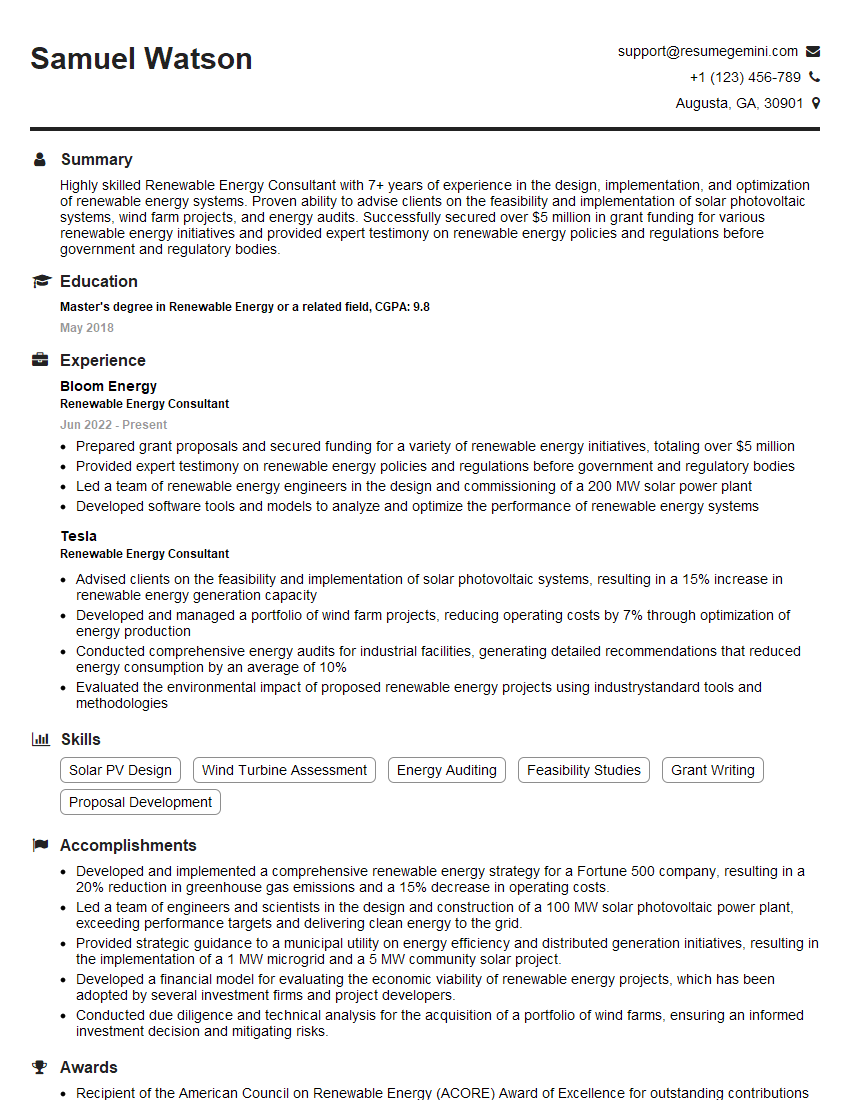
Mastering Advanced Energy Economics opens doors to exciting and impactful careers shaping the future of energy. A strong understanding of these concepts is crucial for securing leading roles in consulting, research, government, and the private sector. To maximize your job prospects, create an ATS-friendly resume that highlights your skills and experience effectively. ResumeGemini is a trusted resource to help you build a professional and impactful resume. We provide examples of resumes tailored to Advanced Energy Economics to guide you. Use our tools to showcase your expertise and land your dream job!

Explore more articles
Users Rating of Our Blogs
Share Your Experience
We value your feedback! Please rate our content and share your thoughts (optional).
What Readers Say About Our Blog
Very informative content, great job.
good